What Does “Fandom” Mean in K-Pop?
If you are new to K-pop, you will quickly notice that fans are rarely described simply as “fans.”
Many K-pop artists have an official fandom name.
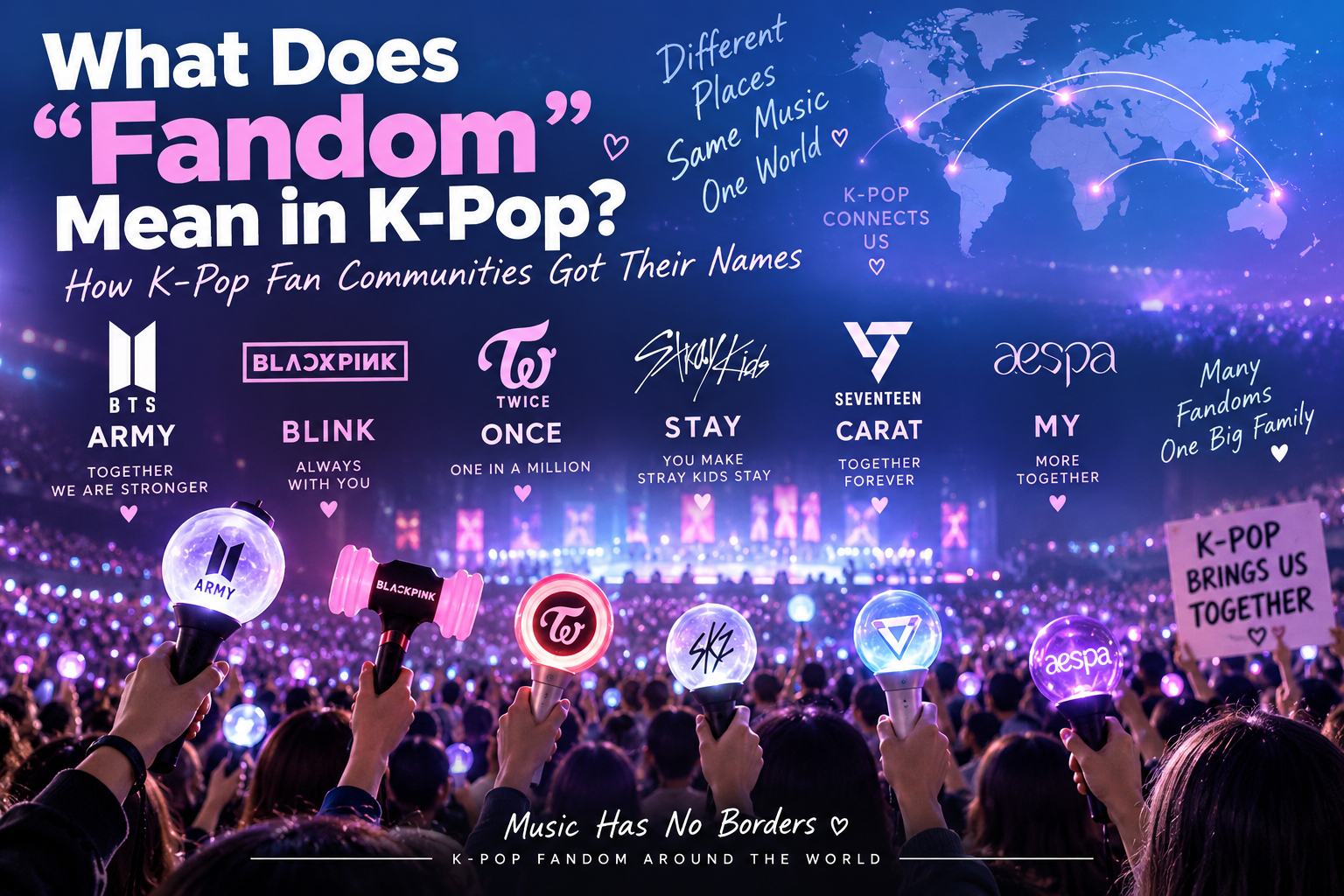
BTS fans are known as ARMY, BLACKPINK fans are called BLINK, and many other groups have names created especially for the communities that support them.
But why are fandom names so important in K-pop?
To understand that, we first need to understand what the word fandom means.
What Is a K-Pop Fandom?
A fandom is a community of people who share an interest in a particular artist, group, or form of entertainment.
Fandoms exist throughout music, movies, sports, books, and popular culture.
K-pop, however, has developed an especially organized and visible form of fandom culture.
Fans do much more than listen to songs.
They attend concerts, collect albums and photocards, watch music videos, follow artists on social media, participate in fan communities, celebrate anniversaries, and support new releases.
For many people, becoming part of a fandom is an important part of the K-pop experience.
Why Do K-Pop Fandoms Have Names?
Official fandom names create a shared identity.
Instead of simply saying “BTS fans,” people can say ARMY.
Instead of “BLACKPINK fans,” they can say BLINK.
A fandom name creates a direct connection between the artist and the community supporting them.
These names are often announced by entertainment companies or artists and may have special meanings connected with the group’s name, concept, or message.
Once established, the fandom name can become almost as recognizable as the artist’s name itself.
What Does BTS ARMY Mean?
BTS has one of the most internationally recognized fandoms in modern music.
Their fans are known as ARMY.
The fandom name was officially announced in 2013, shortly after BTS debuted.
Over time, ARMY became much more than a label.
As BTS gained international popularity, fans around the world used the name to identify themselves as part of a shared global community.
Today, the relationship between BTS and ARMY is frequently discussed as an important part of the group’s history.
What Does BLACKPINK’s BLINK Mean?
BLACKPINK’s official fandom is called BLINK.
The name combines parts of the words BLACK and PINK.
It creates a short, memorable identity directly connected to the group’s name.
As BLACKPINK expanded internationally, BLINK became a familiar term across social media, concerts, fan communities, and entertainment coverage.
Like ARMY, the name allows fans in different countries to identify as members of the same global community.
Other Famous K-Pop Fandom Names
K-pop is filled with creative fandom names.
TWICE fans are known as ONCE.
Stray Kids fans are called STAY.
SEVENTEEN fans are known as CARAT.
aespa fans are called MY.
Each fandom name has its own story and relationship with the artist.
For new K-pop fans, learning these names can initially feel like learning another vocabulary.
But after spending time in K-pop communities, they quickly become familiar.
What Do K-Pop Fandoms Actually Do?
K-pop fandoms participate in many different activities.
The most obvious is supporting music.
Fans may listen to new releases, purchase albums, watch music videos, attend concerts, and follow performances.
But fandom activity extends far beyond music consumption.
Fans create translations, artwork, dance covers, video edits, discussion communities, guides for new fans, and social media content.
Some fan communities also organize charitable projects or events in an artist’s name.
This level of participation helps explain why K-pop fandoms are so visible online.
Why Are Lightsticks Important to K-Pop Fandoms?
One of the most distinctive symbols of K-pop fandom culture is the official lightstick.
Many groups have their own specially designed lightstick.
At concerts, thousands of fans holding matching lightsticks can transform an arena into a sea of color.
Modern lightsticks can sometimes synchronize with concert production, creating coordinated patterns across the audience.
The result makes fans visually part of the performance.
A lightstick therefore becomes more than concert merchandise.
For many fans, it represents belonging to a particular fandom.
Why Do Fandoms Have Official Colors?
Earlier generations of K-pop fandoms were often strongly associated with particular colors.
Fans could identify groups through balloons, banners, and other objects displaying those colors.
As K-pop evolved, official lightsticks and more elaborate visual branding became increasingly important.
The basic idea, however, remained similar.
A shared symbol or color helps thousands of individual fans feel like part of one community.
K-Pop Fandoms and Social Media
Social media transformed K-pop fandom culture.
In earlier generations, international fans had fewer ways to follow Korean artists closely.
Today, fans can receive updates almost instantly.
A music video released in Seoul can be watched within seconds by audiences in New York, London, Bangkok, Manila, São Paulo, Sydney, and countless other cities.
Fans can also translate interviews, discuss performances, share clips, and organize community projects across national borders.
This digital network is one of the major reasons modern K-pop fandoms can operate globally.
What Is a Multi-Stan?
Not every fan belongs to only one fandom.
A person who follows and supports several K-pop groups may describe themselves as a multi-stan.
For example, someone might enjoy BTS, BLACKPINK, TWICE, Stray Kids, and aespa at the same time.
They may have a bias in each group and participate in several fandom communities.
K-pop fandom identities are therefore not always exclusive.
Many listeners explore multiple generations, groups, and musical styles.
Do You Have to Join a Fandom to Enjoy K-Pop?
No.
There is no requirement to use a fandom name, buy albums, collect merchandise, stream music videos, or participate in online communities.
You can simply enjoy the music.
Fandom culture provides additional ways for people to connect with artists and other listeners, but everyone can participate at their own level.
Being a K-pop fan should ultimately begin with enjoying the music and performances.
Can K-Pop Fandoms Have Negative Sides?
Like any large online community, fandoms can sometimes experience conflict.
Arguments may develop between different fan communities or even among fans of the same artist.
Competition over charts, awards, popularity, and social media can occasionally become intense.
However, these conflicts should not define all K-pop fandom culture.
Millions of fans simply enjoy sharing music, attending concerts, meeting other fans, and celebrating artists they appreciate.
Understanding both the positive and competitive sides gives a more realistic picture of modern fandom.
Why K-Pop Fandoms Became Global Communities
The most remarkable feature of modern K-pop fandom may be its international scale.
A fan in Korea, India, the United States, the Philippines, Brazil, France, or Australia can belong to the same fandom.
They may speak different languages and live thousands of kilometers apart, yet recognize the same fandom name, songs, symbols, and artists.
Digital platforms made this type of community possible on an unprecedented scale.
K-pop fandoms therefore demonstrate how popular culture can create connections that cross national and linguistic boundaries.
More Than Just a Fan Name
A K-pop fandom name may appear to be a simple nickname.
But names such as ARMY, BLINK, ONCE, STAY, CARAT, and MY represent communities that can span the world.
They give fans a shared identity and artists a recognizable way to address the people supporting them.
That is why understanding fandom culture is useful for anyone beginning to explore K-pop.
Sooner or later, every new fan encounters the same question:
Which fandoms are you part of?
Leave a Reply