Tag: BLACKPINK

  • JENNIE and The Weeknd’s “One Of The Girls” Live in Korea: What Happened and Why It Matters

    JENNIE and The Weeknd’s “One Of The Girls” Live in Korea: What Happened and Why It Matters

    JENNIE joined The Weeknd onstage in Korea on October 8, 2026, to perform “One Of The Girls.” For viewers discovering the performance through a short clip, the main question is simple: was this a new release, a BLACKPINK performance, or a reunion around an older collaboration?

    It was a live performance of an existing song. The original recording credits The Weeknd, JENNIE and Lily-Rose Depp, and dates back to 2023.

    The useful way to understand this moment is to separate three things: the song, the concert appearance and what performing together adds to a recorded collaboration.

    What happened at The Weeknd’s Korea concert?

    JENNIE appeared as a special guest during the October 8 show of Hyundai Card Super Concert 28: The Weeknd, at the main stadium of Goyang Sports Complex in Gyeonggi Province.

    She joined him for “One Of The Girls.” Although international coverage often describes the event as a Seoul concert, the venue was in Goyang, outside Seoul itself.

    This distinction helps readers identify the event correctly without confusing the concert’s location with the wider metropolitan area.

    QuestionAnswer
    When was the appearance?October 8, 2026
    Where did it happen?Goyang Sports Complex main stadium, Gyeonggi Province
    Whose concert was it?The Weeknd’s Hyundai Card Super Concert 28 show
    What did they perform?“One Of The Girls”
    Was it a new song announcement?The performance featured an existing 2023 collaboration

    The appearance is the news event. Understanding the original recording explains why the song was the natural connection between the two artists.

    Who sings the original “One Of The Girls”?

    The original track is credited to The Weeknd, JENNIE and Lily-Rose Depp. It was released in connection with HBO’s The Idol in 2023.

    That makes it different from both a BLACKPINK group release and a JENNIE-only solo single. JENNIE is one of the credited artists on a shared recording.

    For a new listener, those credits matter. A performance clip may focus on the two people standing onstage, but it does not change who appears on the studio version. Lily-Rose Depp remains part of the original song’s artist credits.

    Start with the official recording if you want to understand the song before comparing it with concert footage. The studio version provides the full arrangement and the original sequence of vocal parts.

    Why does a live reunion feel different from a recorded collaboration?

    A studio collaboration and a shared stage answer different questions.

    The recording shows how voices fit within an arranged track. A concert appearance lets an audience see the performers sharing a space, responding to the same crowd and moving through the song in real time.

    Our reading of the Korea appearance is that this visible connection is its main appeal. Listeners who already knew the recording could now associate it with a specific shared performance.

    That does not require claiming the song changed the industry overnight. A more precise point is that the performance gave an established collaboration a new event around which fans could gather.

    For JENNIE, it also offers a way to discuss her work outside BLACKPINK without treating every appearance as the start of a new solo era. An artist’s career includes group releases, solo projects, collaborations and guest performances. Those categories can overlap, but they are not interchangeable.

    What should you listen for when comparing the song and the live clip?

    Instead of deciding which version is “better,” listen for what each format lets you notice.

    Vocal entrances and handovers

    Pay attention to where a voice enters and how the next part begins. In the studio recording, these transitions sit inside a controlled arrangement. In concert footage, the camera and audience noise may draw attention to the handover itself.

    The atmosphere around the voices

    The official audio is the clearest starting point for hearing the production. A crowd-recorded video captures something else: the room, the audience and the excitement around the appearance.

    Phone footage can make sound seem louder, thinner or more distorted than it was in person. It is useful for experiencing the event, but it is a limited basis for judging a singer’s entire performance.

    The difference between the full song and a highlight

    A short clip may show an entrance, a vocal passage or the end of the performance. Those moments can be memorable while still leaving out much of the song.

    If you are new to the collaboration, hear the original track first, then use the clip to understand the live moment. That order gives the highlight more context.

    Three common misunderstandings

    “One Of The Girls” is JENNIE’s new 2026 single

    The song dates back to 2023. The October 2026 event was a concert appearance featuring that existing collaboration.

    A BLACKPINK member appearing means it was a BLACKPINK comeback stage

    This was JENNIE’s guest appearance at The Weeknd’s concert. It should not be described as a BLACKPINK group comeback announcement.

    A joint performance confirms another song is coming

    The appearance shows the artists performing their existing track together. It is not, by itself, confirmation of a future release. A new collaboration would need its own announcement.

    Where should new fans go next?

    If this performance introduced you to JENNIE, begin with her wider career rather than assuming one collaboration represents all of her music.

    Our guide to JENNIE of BLACKPINK follows her development from group performer to solo artist. The BLACKPINK members guide provides the group context and explains where each member’s individual career fits.

    You can then return to “One Of The Girls” with a clearer understanding of the distinction between JENNIE’s group identity, solo work and collaborations.

    The Korea appearance is worth discussing because it brings those contexts together in one visible moment: a BLACKPINK member on another artist’s stage, performing a song they already share. Knowing the original credits and the event details makes the clip more meaningful than a headline alone.

  • JISOO CLICK Explained: BLACKPINK Star’s New Solo Song, Meaning & 2026 Comeback

    JISOO CLICK Explained: BLACKPINK Star’s New Solo Song, Meaning & 2026 Comeback

    JISOO Returns With “CLICK”

    BLACKPINK’s JISOO has opened a new chapter in her solo career with “CLICK,” her 2026 solo single released on September 4.

    The song arrived after her 2025 solo EP AMORTAGE, giving fans another look at how JISOO is developing her musical identity outside BLACKPINK.

    “CLICK” quickly attracted attention from BLINKs and K-pop listeners, and on September 17, the song earned a music-show win on M Countdown, adding an early milestone to the comeback.

    But what is “CLICK” about, and how does it fit into JISOO’s evolving solo career?

    In this guide, we’ll explore JISOO’s “CLICK,” its meaning and concept, the 2026 comeback, and why the song represents an important next step in her solo journey.

    What Is JISOO’s “CLICK”?

    “CLICK” is JISOO’s 2026 solo single, released on September 4, 2026.

    The release follows AMORTAGE, her first solo EP released in 2025, and continues the development of her music outside BLACKPINK’s group activities.

    Rather than treating “CLICK” as an isolated release, the song can be viewed as another step in JISOO’s growing solo catalog — one that began with earlier releases such as “FLOWER” and later expanded through AMORTAGE.

    The title “CLICK” suggests the instant when something suddenly connects or feels right. Within the song’s romantic context, that idea becomes a way of describing attraction and the moment when two people emotionally connect.

    For longtime BLINKs, the comeback is also significant because it shows JISOO continuing to establish her own musical direction while remaining part of BLACKPINK.

    What Does “CLICK” Mean?

    At the center of “CLICK” is the idea of instant emotional connection — the moment when attraction suddenly becomes clear and two people seem to understand each other naturally.

    The word “click” works particularly well for this concept because it can describe something happening instantly while also referring to the feeling that two people simply fit together.

    Rather than presenting love as something complicated or distant, “CLICK” focuses on the excitement of recognizing a connection and wanting to follow where that feeling leads.

    The Concept Behind “CLICK”

    The song also fits naturally into JISOO’s developing solo identity.

    Her earlier solo releases have explored different sides of romance and relationships, while “CLICK” presents another perspective: the sudden spark that can begin a new emotional story.

    This makes the song more than simply another BLACKPINK member solo release. It adds another chapter to the musical identity JISOO has been building through FLOWER, AMORTAGE, and now CLICK.

    JISOO’s 2026 Comeback and First Music Show Win

    “CLICK” marked JISOO’s return with new solo music in September 2026, following the release of AMORTAGE in 2025.

    The comeback quickly reached an important milestone.

    On September 17, 2026, “CLICK” took first place on M Countdown, giving the song an early music-show win shortly after its release.

    The achievement added momentum to the comeback and demonstrated the continuing attention surrounding JISOO’s solo activities.

    For fans, however, the significance of the 2026 comeback goes beyond a single trophy. “CLICK” expands JISOO’s solo discography and provides another opportunity to see how her individual sound and artistic identity continue to develop alongside her work with BLACKPINK.

    From “FLOWER” to AMORTAGE to “CLICK”

    JISOO’s solo career has developed through several distinct stages.

    FLOWER

    JISOO made her official solo debut in 2023 with “FLOWER,” the title track from her single album ME. The release introduced her individual musical style outside BLACKPINK and became one of the defining songs of her early solo career.

    AMORTAGE

    In 2025, JISOO expanded her solo catalog with the EP AMORTAGE.

    The project allowed her to explore a broader range of songs and concepts, marking an important step beyond her initial solo debut.

    CLICK

    With “CLICK” in 2026, JISOO continues that progression.

    Rather than beginning again with each release, her solo discography increasingly reads as an evolving story: ME introduced JISOO as a solo artist, AMORTAGE expanded that identity, and CLICK represents the next stage of her musical journey.

    This progression is particularly important for understanding JISOO not only as a member of BLACKPINK, but also as an artist developing a distinct solo catalog of her own.

    Frequently Asked Questions About JISOO’s “CLICK”

    When was JISOO’s “CLICK” released?

    JISOO released “CLICK” on September 4, 2026, marking her latest solo release following AMORTAGE.

    What does JISOO’s “CLICK” mean?

    “CLICK” centers on the idea of an instant romantic connection — the moment when attraction feels natural and two people seem to emotionally click.

    Is “CLICK” part of AMORTAGE?

    No. “CLICK” is a separate 2026 solo single released after JISOO’s 2025 EP AMORTAGE.

    Did “CLICK” win on a music show?

    Yes. “CLICK” earned a first-place win on M Countdown on September 17, 2026, shortly after its release.

    What was JISOO’s first solo song?

    JISOO made her official solo debut in 2023 with “FLOWER,” the title track from her single album ME.

    Is JISOO still a member of BLACKPINK?

    Yes. JISOO continues to be a member of BLACKPINK while also developing her individual career through solo music and other activities.

    Final Thoughts: “CLICK” Opens JISOO’s Next Solo Chapter

    JISOO’s “CLICK” represents another step in a solo career that has continued to evolve since her debut with “FLOWER” in 2023.

    After expanding her musical identity through AMORTAGE in 2025, “CLICK” gives listeners another glimpse of the direction JISOO is exploring as an individual artist.

    Its theme of instant emotional connection provides a simple but memorable concept, while its early music-show success added momentum to her 2026 comeback.

    More broadly, the progression from ME to AMORTAGE to CLICK shows that JISOO’s solo career is becoming an increasingly important part of her story alongside BLACKPINK.

    As her solo catalog continues to grow, “CLICK” stands as the latest chapter in that journey — and another reason for BLINKs to watch where JISOO goes next.

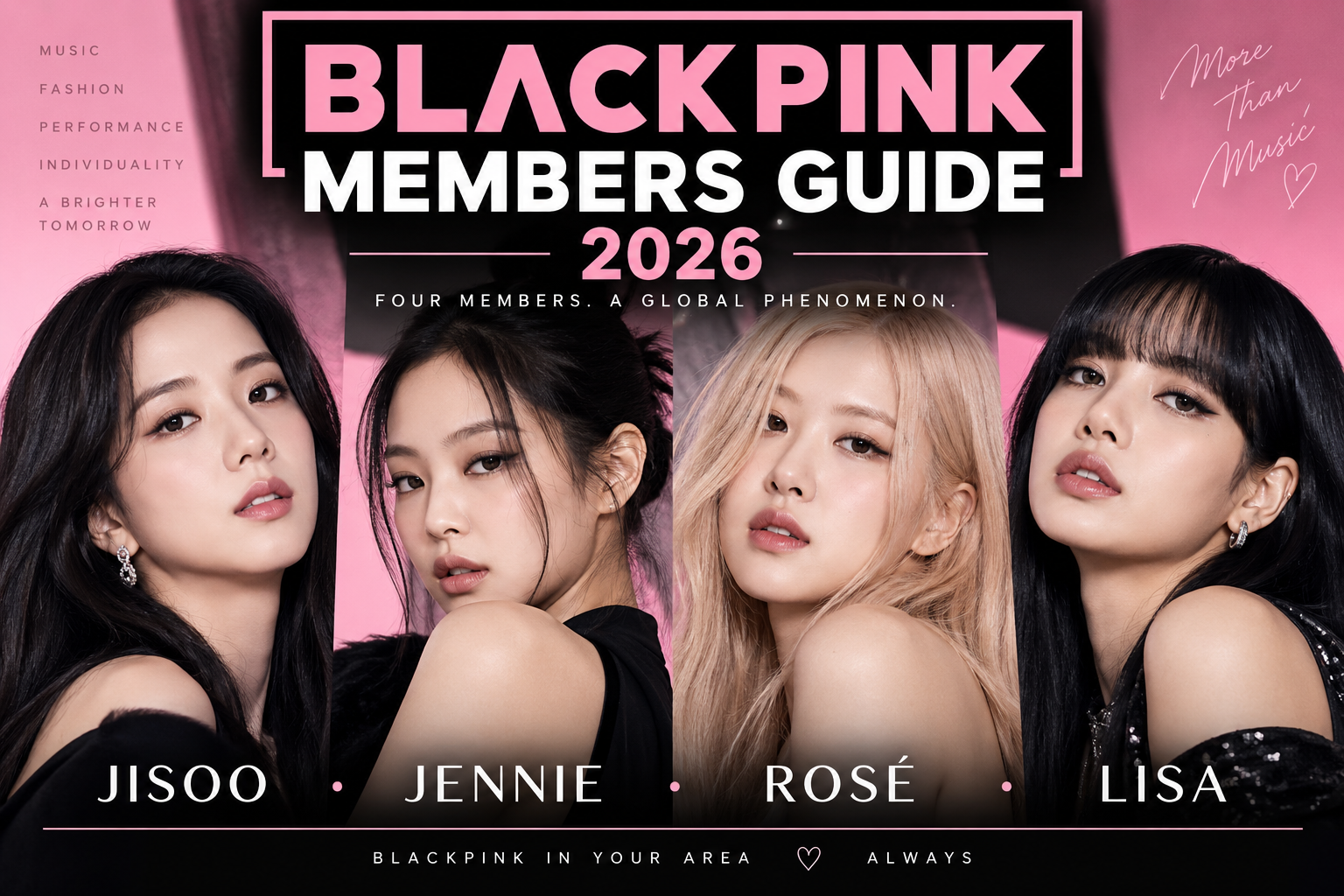
  • BLACKPINK Members 2026: Ages, Positions & Solo Careers

    BLACKPINK Members 2026: Ages, Positions & Solo Careers

    BLACKPINK is one of the most influential K-pop groups in the world. Since their debut in 2016, JISOO, JENNIE, ROSÉ, and LISA have grown from YG Entertainment rookies into global stars with successful careers in music, fashion, acting, and entertainment.

    What makes BLACKPINK especially interesting in 2026 is that each member has developed a distinct solo identity while remaining connected to the group. Their individual careers have introduced them to new audiences around the world, while BLACKPINK continues to hold an important place in global K-pop culture.

    In this guide, we’ll introduce all four BLACKPINK members, including their names, ages, roles, nationalities, solo careers, and key facts that new BLINKs should know.

    Whether you have followed BLACKPINK for years or have just discovered their music, this guide is a simple starting point for getting to know JISOO, JENNIE, ROSÉ, and LISA.

    BLACKPINK at a Glance

    BLACKPINK is a four-member South Korean girl group formed by YG Entertainment. The group officially debuted on August 8, 2016, with the single album Square One, featuring “Whistle” and “Boombayah.”

    The four members are JISOO, JENNIE, ROSÉ, and LISA. Unlike many K-pop groups, BLACKPINK does not have an officially designated leader, and each member brings a different combination of vocals, rap, dance, performance, and personality to the group.

    The members also have diverse international backgrounds. JISOO and JENNIE were born in South Korea, ROSÉ was born in New Zealand and raised in Australia, while LISA was born and raised in Thailand.

    Over the years, BLACKPINK expanded far beyond the traditional K-pop market, building a worldwide fanbase known as BLINK and establishing major individual careers alongside their group activities.

    JISOO: Vocalist, Actress, and Solo Artist

    Full name: Kim Jisoo
    Born: January 3, 1995
    Nationality: South Korean

    JISOO is the oldest member of BLACKPINK and is known for her distinctive vocal tone, elegant stage presence, and acting career. She trained under YG Entertainment before debuting with BLACKPINK in 2016.

    Alongside her group activities, JISOO expanded into acting and solo music. She made her solo debut in 2023 with the single album ME, led by the track “FLOWER,” which became one of her signature songs.

    Her career later entered a new phase when she established BLISSOO for her individual activities. She has continued developing both her music and acting careers while remaining a member of BLACKPINK.

    For new BLINKs, JISOO represents an important part of BLACKPINK’s identity: a performer whose career connects K-pop, acting, fashion, and entertainment.

    JENNIE: Rapper, Vocalist, and Global Solo Star

    Full name: Kim Jennie
    Born: January 16, 1996
    Nationality: South Korean

    JENNIE is one of BLACKPINK’s most recognizable members, known for combining rap, vocals, fashion, and a powerful stage presence. Before debuting with BLACKPINK, she spent several years training under YG Entertainment and also lived and studied in New Zealand.

    In 2018, JENNIE became the first BLACKPINK member to officially debut as a solo artist with “SOLO.” The song established her individual identity outside the group and became a major milestone in BLACKPINK’s solo history.

    Her independent career later expanded through ODDATELIER (OA), the company she founded for her individual activities. She has continued developing her own musical direction while participating in BLACKPINK’s group activities.

    JENNIE’s influence also extends well beyond music. Her work in fashion, entertainment, and global brand partnerships has helped make her one of the most internationally visible figures associated with modern K-pop.

    ROSÉ: Vocalist, Songwriter, and International Solo Artist

    Full name: Roseanne Park (Park Chaeyoung)
    Born: February 11, 1997
    Nationality: New Zealand–born Korean artist, raised in Australia

    ROSÉ is widely recognized for her distinctive singing voice and emotional performance style. Born in New Zealand and raised in Australia, she moved to South Korea after successfully auditioning for YG Entertainment in 2012.

    She made her solo debut in 2021 with the single album R, featuring “On the Ground” and “Gone.” Her solo career later entered a major new phase as she pursued individual activities outside YG Entertainment while continuing her BLACKPINK group activities with the company.

    ROSÉ reached an even broader global audience with “APT.,” her collaboration with Bruno Mars. The song became a major international hit and introduced her solo music to listeners far beyond the traditional K-pop audience.

    Her career demonstrates how a BLACKPINK member can maintain a strong connection to the group while developing a distinctive musical identity as an international solo artist.

    LISA: Rapper, Dancer, and Global Solo Performer

    Full name: Lalisa Manobal
    Born: March 27, 1997
    Nationality: Thai

    LISA is BLACKPINK’s Thai member and is especially known for her dance skills, rap performances, and charismatic stage presence. Born and raised in Thailand, she successfully auditioned for YG Entertainment and moved to South Korea to train before BLACKPINK’s debut.

    She launched her solo career in 2021 with the single album LALISA, featuring “LALISA” and “MONEY.” The latter became a major international success and helped expand her audience beyond K-pop.

    LISA later established LLOUD to manage her individual activities and continued expanding into international music, fashion, and entertainment. Her solo career has increasingly positioned her as a global performer with an identity distinct from, but still connected to, BLACKPINK.

    As the only Thai member of BLACKPINK, LISA has also played an important role in the group’s international appeal, particularly across Southeast Asia and the wider global K-pop audience.

    BLACKPINK Members: Ages, Nationalities, and Roles

    BLACKPINK’s four members bring different backgrounds and strengths to the group.

    MemberAge in 2026*NationalityRoles
    JISOO31South KoreanVocals, acting
    JENNIE30South KoreanRap, vocals
    ROSÉ29New Zealand-born, raised in AustraliaVocals, songwriting
    LISA29ThaiDance, rap

    *Ages are international ages reached during 2026. Actual age before each birthday is one year younger.

    One detail that often surprises new fans is that BLACKPINK does not have an official leader. Rather than organizing the group around a designated leader, the four members contribute different strengths to BLACKPINK’s identity.

    Frequently Asked Questions About BLACKPINK Members

    Who are the four members of BLACKPINK?
    BLACKPINK consists of JISOO, JENNIE, ROSÉ, and LISA.

    Who is the oldest BLACKPINK member?
    JISOO is the oldest member. She was born on January 3, 1995.

    Who is the youngest BLACKPINK member?
    LISA is the youngest member. She was born on March 27, 1997.

    Does BLACKPINK have a leader?
    No. BLACKPINK does not have an officially designated group leader.

    Which BLACKPINK member is from Thailand?
    LISA was born and raised in Thailand before moving to South Korea to train under YG Entertainment.

    Which BLACKPINK member grew up in Australia?
    ROSÉ was born in New Zealand and raised in Australia before moving to South Korea.

    Do the BLACKPINK members have solo careers?
    Yes. All four members have developed individual careers alongside BLACKPINK, including solo music as well as activities in fashion, acting, and entertainment.

    Final Thoughts

    BLACKPINK’s story is built around four artists with very different backgrounds and individual strengths. JISOO, JENNIE, ROSÉ, and LISA have each developed successful careers beyond the group while remaining central to BLACKPINK’s identity.

    For new BLINKs, learning about each member is one of the best ways to understand why BLACKPINK has become such an influential name in global pop culture. From music and performance to fashion and acting, each member has created a distinctive path of her own.

    As BLACKPINK continues its journey, the combination of four individual careers and their work together as a group remains one of the most fascinating parts of the BLACKPINK story.

  • What Is a K-Pop Lightstick? Why Every Fandom Has Its Own Design

    What Is a K-Pop Lightstick? Why Every Fandom Has Its Own Design

    What Is a K-Pop Lightstick?

    If you have ever watched a K-pop concert, you may have noticed thousands of fans holding glowing objects in the audience. These colorful lights often move together, turning an entire concert venue into a sea of light.

    These objects are called lightsticks, and they have become one of the most recognizable symbols of K-pop fandom culture.

    But what exactly is a K-pop lightstick, why does each fandom have its own design, and do you need one to enjoy a K-pop concert?

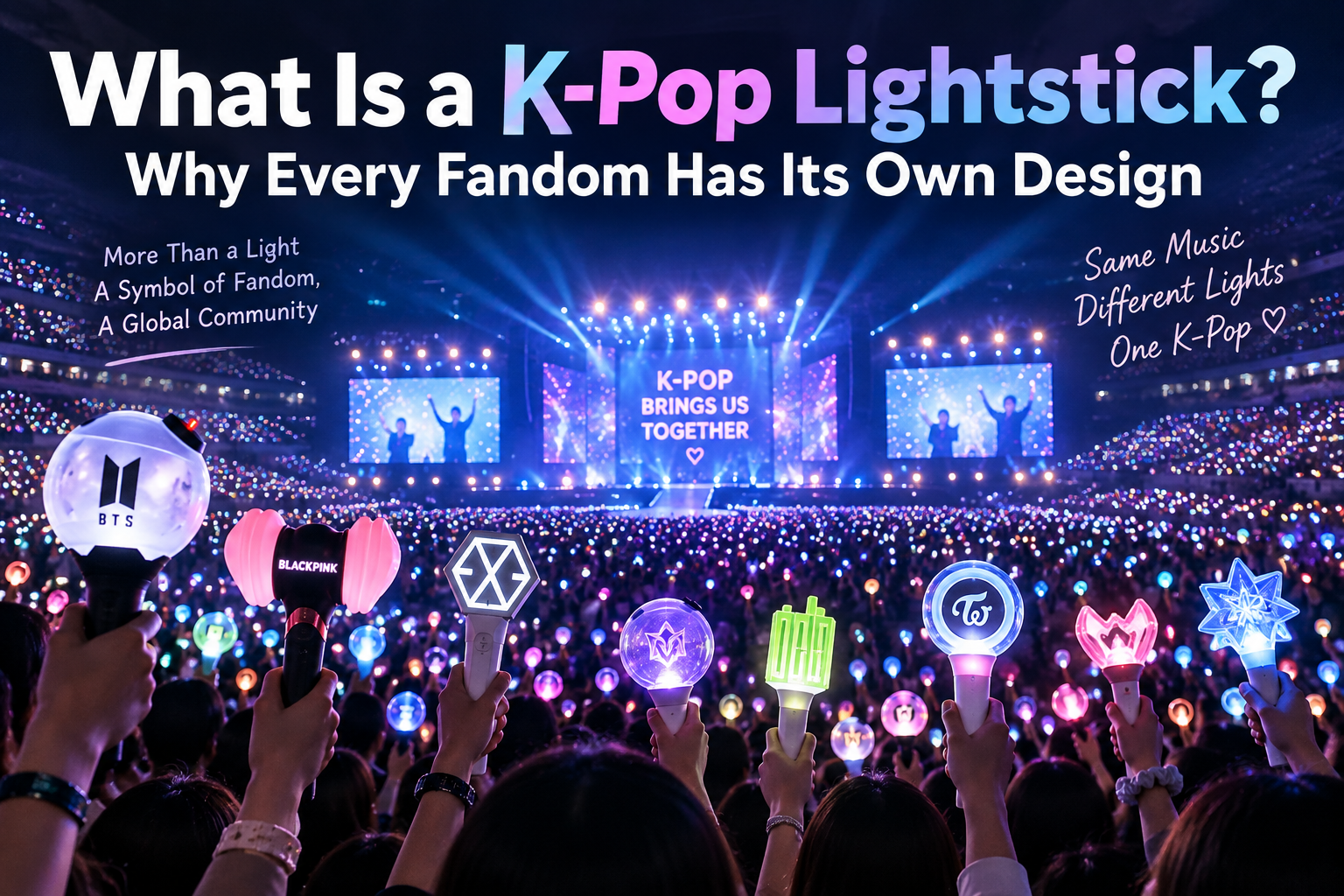
    A K-pop lightstick is a handheld electronic light designed to represent a particular K-pop artist or group. Fans commonly use lightsticks at concerts, fan meetings, and other events to show support for their favorite artists.

    Unlike ordinary glow sticks, official K-pop lightsticks usually have unique designs, colors, logos, and features connected to the identity of the artist and fandom.

    Why Do K-Pop Groups Have Their Own Lightsticks?

    K-pop fandoms often have their own names, symbols, colors, and traditions.

    A lightstick turns that identity into something fans can physically hold.

    Instead of every concert audience using the same generic glow stick, each artist can have a recognizable design associated with their music, image, and fandom.

    This means a lightstick can serve several purposes at once.

    It can be a concert accessory, a collectible item, a symbol of fandom identity, and a visual connection between artists and fans.

    Why Do K-Pop Lightsticks Have Different Designs?

    One of the most interesting things about K-pop lightsticks is how different they can look.

    Some are simple and elegant. Others are playful, futuristic, symbolic, or highly unusual.

    Designs may incorporate:

    • a group’s logo
    • fandom colors
    • symbols connected to the artist
    • album or concept imagery
    • shapes associated with the group’s identity

    Because of this, fans can often recognize which artist a lightstick belongs to even before seeing the group’s name.

    The design itself becomes part of the artist’s visual identity.

    What Are Some Famous K-Pop Lightsticks?

    Many major K-pop artists have lightsticks that fans immediately recognize.

    BTS fans, known as ARMY, use the official BTS lightstick commonly known as the ARMY Bomb.

    BLACKPINK’s official lightstick has a distinctive pink-and-black design with heart-shaped ends.

    Other groups have developed equally recognizable designs, each reflecting the personality and identity of the artist and fandom.

    As K-pop has expanded internationally, these lightsticks have also become familiar sights at concerts around the world.

    How Do K-Pop Lightsticks Work at Concerts?

    Modern K-pop lightsticks can do much more than simply turn on and off.

    Depending on the artist, venue, event, and lightstick model, some official lightsticks can connect to concert systems or supported apps.

    During a performance, large numbers of lightsticks may change colors or lighting patterns together.

    From the stage, this can transform the audience into a coordinated field of light.

    Different songs or moments in the concert may produce different lighting effects, adding another visual layer to the performance.

    What Is an “Ocean” in K-Pop Concert Culture?

    K-pop fans sometimes use the word “ocean” to describe the visual effect created when thousands of audience lights fill a concert venue.

    For example, a venue filled with lights associated with one artist or fandom can look like a glowing ocean from the stage.

    These concert oceans can become memorable images because they visually represent the size and unity of a fandom.

    For artists, seeing an arena filled with their fandom’s lights can also create a powerful connection with the audience.

    Why Are Lightsticks Important to K-Pop Fandoms?

    Lightsticks are closely connected with fandom identity.

    When thousands of people hold the same lightstick at a concert, each person is participating individually while also becoming part of a much larger visual community.

    This reflects an important part of K-pop fandom culture.

    Fans may live in different countries, speak different languages, and discover an artist at different times, but symbols such as fandom names and lightsticks give them something recognizable to share.

    That is why a lightstick can have emotional meaning beyond its practical use at a concert.

    Are K-Pop Lightsticks Official Merchandise?

    Many well-known K-pop lightsticks are released as official merchandise associated with an artist.

    Official versions may be sold through an artist’s official store, entertainment company, concert merchandise booth, or authorized retailer.

    However, unofficial products and imitations also exist.

    This matters especially when a lightstick includes features intended to work with a particular concert or application, because unofficial products may not support the same functions.

    Fans who want a lightstick for an upcoming concert should therefore check the artist’s official information for the event and the specific lightstick version being supported.

    Do You Need a Lightstick to Attend a K-Pop Concert?

    No.

    Owning a lightstick is not a requirement for being a K-pop fan, and in most situations you do not need one simply to enjoy a concert.

    Many fans attend concerts without lightsticks.

    Others choose to buy one because they enjoy participating in the concert atmosphere or want an official collectible connected to their favorite artist.

    Being part of a fandom is not determined by how much merchandise someone owns.

    Listening to and enjoying the music is enough.

    Can You Bring Another Group’s Lightstick to a K-Pop Concert?

    This is a question new K-pop fans sometimes ask.

    Fan expectations can vary depending on the artist, fandom, venue, and event.

    Because lightsticks are strongly associated with particular groups, some fans prefer to use the performing artist’s official lightstick or no lightstick at all.

    More importantly, concert rules can vary.

    Before attending a concert, it is best to check the organizer’s or artist’s official event information rather than assuming that every type of lightstick will be permitted or supported.

    What Is the Difference Between a Lightstick and a Regular Glow Stick?

    A regular glow stick is usually a simple light source.

    A K-pop lightstick is more closely connected to an artist’s brand and fandom.

    It may include a distinctive design, official logo, multiple lighting modes, replaceable batteries, wireless functions, or app connectivity, depending on the product.

    Most importantly, it carries symbolic meaning.

    Fans do not simply see it as a light. They often see it as a representation of their relationship with an artist and fellow fans.

    Why Do Fans Collect K-Pop Lightsticks?

    Not everyone buys a lightstick only for concerts.

    Some fans collect them in the same way others collect albums, photocards, posters, or other official merchandise.

    Because each group’s lightstick has a different design, a collection can also represent a fan’s history with K-pop.

    A lightstick may remind someone of their first concert, favorite comeback, favorite group, or a particular period in their life.

    For this reason, older or redesigned versions can sometimes have special sentimental value to fans.

    How Are Lightsticks Connected to K-Pop’s Global Growth?

    Lightsticks were once most strongly associated with Korean concert and fandom culture, but international K-pop tours have made them increasingly visible around the world.

    When a K-pop group performs in cities such as Los Angeles, London, Paris, Tokyo, Bangkok, or Singapore, audiences may use the same official fandom lightstick seen at concerts in Seoul.

    This creates a recognizable visual language across borders.

    Fans may speak different languages, but when an arena lights up with thousands of matching lightsticks, the meaning is immediately understandable.

    Do All K-Pop Artists Have Official Lightsticks?

    No.

    Some established groups and solo artists have official lightsticks, while newer or smaller artists may not.

    Lightstick designs can also change over time, and new versions may be released as technology or branding evolves.

    Therefore, fans should not assume that every K-pop artist has one or that every version works in exactly the same way.

    Lightsticks, Fandom, and the K-Pop Experience

    K-pop is not only experienced through recorded music.

    Fans also encounter it through music videos, choreography, concerts, social media, fancams, albums, merchandise, and fandom communities.

    The lightstick sits at the intersection of many of these experiences.

    It is merchandise, but it is also part of concert participation.

    It represents an individual artist, but thousands of fans can use it together.

    And although it is a physical object, its meaning comes largely from the community surrounding it.

    Final Thoughts

    A K-pop lightstick is much more than a glowing concert accessory.

    It is a symbol designed to represent an artist and their fandom, and it can transform thousands of individual fans into one coordinated visual audience.

    From distinctive designs and fandom colors to synchronized concert effects and collectible value, lightsticks have become an important part of modern K-pop culture.

    But owning one is never what makes someone a fan.

    Whether you are holding an official lightstick in a stadium or simply listening to your favorite K-pop song at home, the most important part is the connection you have with the music and artists you enjoy.


  • What Does “Fandom” Mean in K-Pop? How K-Pop Fan Communities Got Their Names

    What Does “Fandom” Mean in K-Pop? How K-Pop Fan Communities Got Their Names

    What Does “Fandom” Mean in K-Pop?

    If you are new to K-pop, you will quickly notice that fans are rarely described simply as “fans.”

    Many K-pop artists have an official fandom name.

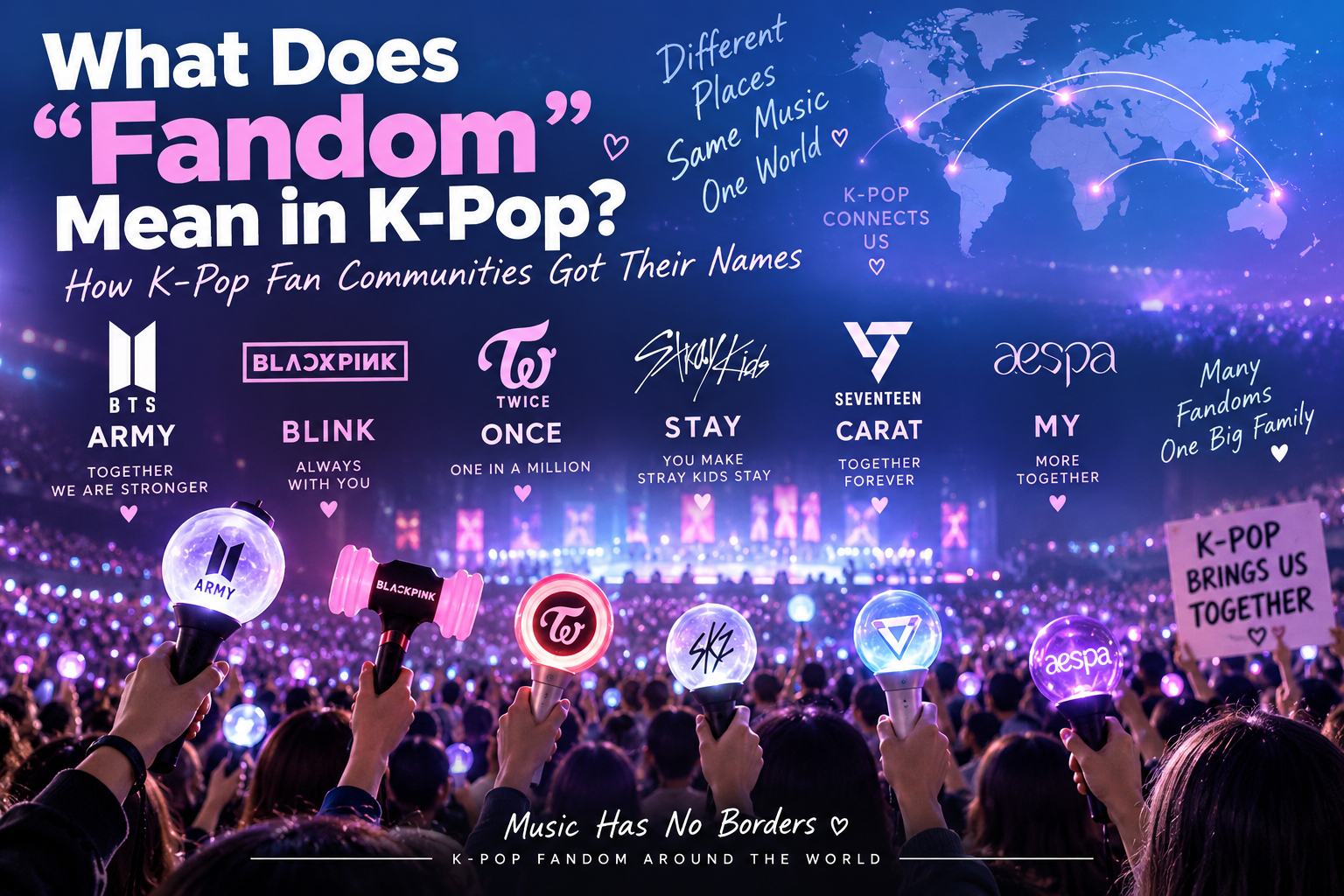
    BTS fans are known as ARMY, BLACKPINK fans are called BLINK, and many other groups have names created especially for the communities that support them.

    But why are fandom names so important in K-pop?

    To understand that, we first need to understand what the word fandom means.

    What Is a K-Pop Fandom?

    A fandom is a community of people who share an interest in a particular artist, group, or form of entertainment.

    Fandoms exist throughout music, movies, sports, books, and popular culture.

    K-pop, however, has developed an especially organized and visible form of fandom culture.

    Fans do much more than listen to songs.

    They attend concerts, collect albums and photocards, watch music videos, follow artists on social media, participate in fan communities, celebrate anniversaries, and support new releases.

    For many people, becoming part of a fandom is an important part of the K-pop experience.

    Why Do K-Pop Fandoms Have Names?

    Official fandom names create a shared identity.

    Instead of simply saying “BTS fans,” people can say ARMY.

    Instead of “BLACKPINK fans,” they can say BLINK.

    A fandom name creates a direct connection between the artist and the community supporting them.

    These names are often announced by entertainment companies or artists and may have special meanings connected with the group’s name, concept, or message.

    Once established, the fandom name can become almost as recognizable as the artist’s name itself.

    What Does BTS ARMY Mean?

    BTS has one of the most internationally recognized fandoms in modern music.

    Their fans are known as ARMY.

    The fandom name was officially announced in 2013, shortly after BTS debuted.

    Over time, ARMY became much more than a label.

    As BTS gained international popularity, fans around the world used the name to identify themselves as part of a shared global community.

    Today, the relationship between BTS and ARMY is frequently discussed as an important part of the group’s history.

    What Does BLACKPINK’s BLINK Mean?

    BLACKPINK’s official fandom is called BLINK.

    The name combines parts of the words BLACK and PINK.

    It creates a short, memorable identity directly connected to the group’s name.

    As BLACKPINK expanded internationally, BLINK became a familiar term across social media, concerts, fan communities, and entertainment coverage.

    Like ARMY, the name allows fans in different countries to identify as members of the same global community.

    Other Famous K-Pop Fandom Names

    K-pop is filled with creative fandom names.

    TWICE fans are known as ONCE.

    Stray Kids fans are called STAY.

    SEVENTEEN fans are known as CARAT.

    aespa fans are called MY.

    Each fandom name has its own story and relationship with the artist.

    For new K-pop fans, learning these names can initially feel like learning another vocabulary.

    But after spending time in K-pop communities, they quickly become familiar.

    What Do K-Pop Fandoms Actually Do?

    K-pop fandoms participate in many different activities.

    The most obvious is supporting music.

    Fans may listen to new releases, purchase albums, watch music videos, attend concerts, and follow performances.

    But fandom activity extends far beyond music consumption.

    Fans create translations, artwork, dance covers, video edits, discussion communities, guides for new fans, and social media content.

    Some fan communities also organize charitable projects or events in an artist’s name.

    This level of participation helps explain why K-pop fandoms are so visible online.

    Why Are Lightsticks Important to K-Pop Fandoms?

    One of the most distinctive symbols of K-pop fandom culture is the official lightstick.

    Many groups have their own specially designed lightstick.

    At concerts, thousands of fans holding matching lightsticks can transform an arena into a sea of color.

    Modern lightsticks can sometimes synchronize with concert production, creating coordinated patterns across the audience.

    The result makes fans visually part of the performance.

    A lightstick therefore becomes more than concert merchandise.

    For many fans, it represents belonging to a particular fandom.

    Why Do Fandoms Have Official Colors?

    Earlier generations of K-pop fandoms were often strongly associated with particular colors.

    Fans could identify groups through balloons, banners, and other objects displaying those colors.

    As K-pop evolved, official lightsticks and more elaborate visual branding became increasingly important.

    The basic idea, however, remained similar.

    A shared symbol or color helps thousands of individual fans feel like part of one community.

    K-Pop Fandoms and Social Media

    Social media transformed K-pop fandom culture.

    In earlier generations, international fans had fewer ways to follow Korean artists closely.

    Today, fans can receive updates almost instantly.

    A music video released in Seoul can be watched within seconds by audiences in New York, London, Bangkok, Manila, São Paulo, Sydney, and countless other cities.

    Fans can also translate interviews, discuss performances, share clips, and organize community projects across national borders.

    This digital network is one of the major reasons modern K-pop fandoms can operate globally.

    What Is a Multi-Stan?

    Not every fan belongs to only one fandom.

    A person who follows and supports several K-pop groups may describe themselves as a multi-stan.

    For example, someone might enjoy BTS, BLACKPINK, TWICE, Stray Kids, and aespa at the same time.

    They may have a bias in each group and participate in several fandom communities.

    K-pop fandom identities are therefore not always exclusive.

    Many listeners explore multiple generations, groups, and musical styles.

    Do You Have to Join a Fandom to Enjoy K-Pop?

    No.

    There is no requirement to use a fandom name, buy albums, collect merchandise, stream music videos, or participate in online communities.

    You can simply enjoy the music.

    Fandom culture provides additional ways for people to connect with artists and other listeners, but everyone can participate at their own level.

    Being a K-pop fan should ultimately begin with enjoying the music and performances.

    Can K-Pop Fandoms Have Negative Sides?

    Like any large online community, fandoms can sometimes experience conflict.

    Arguments may develop between different fan communities or even among fans of the same artist.

    Competition over charts, awards, popularity, and social media can occasionally become intense.

    However, these conflicts should not define all K-pop fandom culture.

    Millions of fans simply enjoy sharing music, attending concerts, meeting other fans, and celebrating artists they appreciate.

    Understanding both the positive and competitive sides gives a more realistic picture of modern fandom.

    Why K-Pop Fandoms Became Global Communities

    The most remarkable feature of modern K-pop fandom may be its international scale.

    A fan in Korea, India, the United States, the Philippines, Brazil, France, or Australia can belong to the same fandom.

    They may speak different languages and live thousands of kilometers apart, yet recognize the same fandom name, songs, symbols, and artists.

    Digital platforms made this type of community possible on an unprecedented scale.

    K-pop fandoms therefore demonstrate how popular culture can create connections that cross national and linguistic boundaries.

    More Than Just a Fan Name

    A K-pop fandom name may appear to be a simple nickname.

    But names such as ARMY, BLINK, ONCE, STAY, CARAT, and MY represent communities that can span the world.

    They give fans a shared identity and artists a recognizable way to address the people supporting them.

    That is why understanding fandom culture is useful for anyone beginning to explore K-pop.

    Sooner or later, every new fan encounters the same question:

    Which fandoms are you part of?

  • What Does Bias Mean in K-Pop? Bias Wrecker & Ult Bias Explained

    What Does Bias Mean in K-Pop? Bias Wrecker & Ult Bias Explained

    If you are new to K-pop, you may quickly encounter a word that seems unusual at first: bias.

    Fans might say, “Who is your bias?” or “She became my bias after that performance.”

    Outside K-pop, the word “bias” usually refers to a preference or prejudice. But in K-pop fan culture, it has developed a much more specific meaning.

    Simply put, your bias is your favorite member of a K-pop group.

    But as with many K-pop terms, there is more to the story.

    What Is a K-Pop Bias?

    A bias is the member of a K-pop group that a fan personally likes or connects with the most.

    For example, someone who follows BTS might enjoy all seven members but feel especially drawn to one member because of his music, personality, performances, or sense of humor.

    A BLACKPINK fan might admire the entire group while having Jisoo, Jennie, Rosé, or Lisa as their bias.

    Having a bias does not mean that a fan dislikes the other members.

    It simply describes a personal favorite within the group.

    In Korean fan communities, a similar term is choe-ae (최애), meaning someone or something you love most. Fans often use it for their favorite idol or group member. While bias and choe-ae are closely related, their usage can vary depending on the fandom and context.

    Why Do K-Pop Fans Choose a Bias?

    There is no single reason people choose a bias.

    Some fans first notice a member because of appearance or fashion.

    Others are attracted to a particular singing voice, rap style, dance ability, stage presence, personality, or sense of humor.

    Sometimes the connection develops slowly.

    A fan may initially notice one member in a music video and later become interested in another after watching interviews, variety shows, concerts, or behind-the-scenes content.

    That is one reason choosing a bias can become part of the fun of discovering a new K-pop group.

    What Is a Bias Wrecker?

    Once you understand “bias,” another popular K-pop expression becomes much easier to understand: bias wrecker.

    A bias wrecker is another member who repeatedly challenges your choice of favorite member.

    Imagine that one member has always been your bias.

    Then another member gives an unforgettable concert performance, appears in a funny interview, or releases an impressive solo song.

    Suddenly, you begin wondering whether your original favorite is still your favorite.

    Fans jokingly describe that second member as a bias wrecker.

    The expression reflects the playful way K-pop fans talk about their attachment to different members.

    Can You Have More Than One Bias?

    Yes.

    There are no official rules about how many biases a fan can have.

    Some fans choose one favorite member in each group. Others have two or more favorites.

    A person who follows many groups may have a different bias in BTS, BLACKPINK, TWICE, Stray Kids, SEVENTEEN, aespa, or other groups.

    Fan culture develops naturally, so the terminology is flexible rather than strictly regulated.

    The most important point is that “bias” describes personal preference, not a formal position within K-pop.

    What Does “Ultimate Bias” Mean?

    Fans who follow several K-pop groups sometimes use the term ultimate bias, often shortened to ult bias.

    An ultimate bias is a fan’s favorite idol across all the groups and artists they follow.

    For example, someone might have a bias in several different groups but still consider one particular artist their overall favorite.

    The term demonstrates how K-pop fandom often develops across multiple groups rather than remaining focused on only one artist.

    What Does “OT” Mean in K-Pop?

    Another expression that often appears alongside bias discussions is OT, followed by a number.

    Fans commonly use expressions such as OT7 or OT4 to express support for all members of a particular group lineup.

    For example, BTS fans may use OT7 when talking about supporting all seven members, while BLACKPINK fans may use OT4 for all four members.

    The expression can carry different nuances depending on the fandom and context, but it is commonly associated with recognizing or supporting the full group.

    Do You Need a Bias to Be a K-Pop Fan?

    No.

    You can enjoy a K-pop group without choosing a favorite member at all.

    Some fans prefer the group’s music as a whole.

    Others enjoy different members for different reasons and do not want to rank them.

    K-pop terminology helps fans communicate with one another, but it is not a set of rules that everyone must follow.

    You do not need a bias, a bias wrecker, or an ultimate bias to enjoy K-pop.

    How Does Someone Become Your Bias?

    For many fans, the process happens naturally.

    You may first notice a singer’s voice in a song.

    Then you watch a live performance and become impressed by the person’s stage presence.

    Later, an interview reveals a personality you find interesting or relatable.

    After watching more content, you realize that you consistently pay attention to the same member.

    At that point, many fans would simply say, “That’s my bias.”

    Why Is the Idea of a Bias So Important in K-Pop?

    K-pop groups are often designed around members with distinctive roles, personalities, talents, and public images.

    One member may be known for powerful vocals, another for rap, another for dance, and another for variety or performance skills.

    This gives fans many different ways to connect with a group.

    The bias concept reflects that structure.

    Fans can support the group collectively while developing a particularly strong interest in one member’s individual career and personality.

    Bias Culture and Solo Careers

    Bias culture also helps explain why solo projects by group members can attract large audiences.

    Fans who become especially interested in one member may follow that artist’s solo albums, acting roles, fashion activities, collaborations, or other projects.

    BTS and BLACKPINK provide clear examples.

    Their members have strong group identities while also developing individual careers that attract their own audiences.

    This relationship between group fandom and individual fandom has become an important feature of modern K-pop.

    Is “Bias” Only Used for K-Pop?

    The term is most strongly associated with K-pop fandom, but online fan communities sometimes use it more broadly.

    As K-pop culture has spread internationally, expressions such as bias, bias wrecker, comeback, maknae, and fandom names have also become familiar to global audiences.

    These words are part of the vocabulary that new fans gradually learn as they explore K-pop.

    Understanding them makes conversations within international fan communities much easier to follow.

    A Simple Example

    Imagine you have just discovered BLACKPINK.

    You enjoy songs from the entire group, but you find yourself watching Lisa’s dance performances more often than anything else.

    Lisa might become your bias.

    Then you watch Rosé perform a solo song and suddenly become fascinated by her voice.

    Rosé might become your bias wrecker.

    You can still enjoy and support all four BLACKPINK members.

    The terms simply provide a playful way to describe your personal preferences.

    K-Pop Fan Culture Is About Connection

    The popularity of the word “bias” reveals something important about K-pop.

    Fans are often interested not only in songs but also in the individual artists who perform them.

    Music videos, concerts, interviews, social media, variety content, and solo projects allow audiences to discover different sides of each member.

    That creates a stronger sense of connection between artists and fans.

    And for many people entering the K-pop world for the first time, answering one simple question becomes part of the experience:

    Who is your bias?

  • Why Is BLACKPINK So Popular? How Four K-Pop Stars Became a Global Phenomenon

    Why Is BLACKPINK So Popular? How Four K-Pop Stars Became a Global Phenomenon

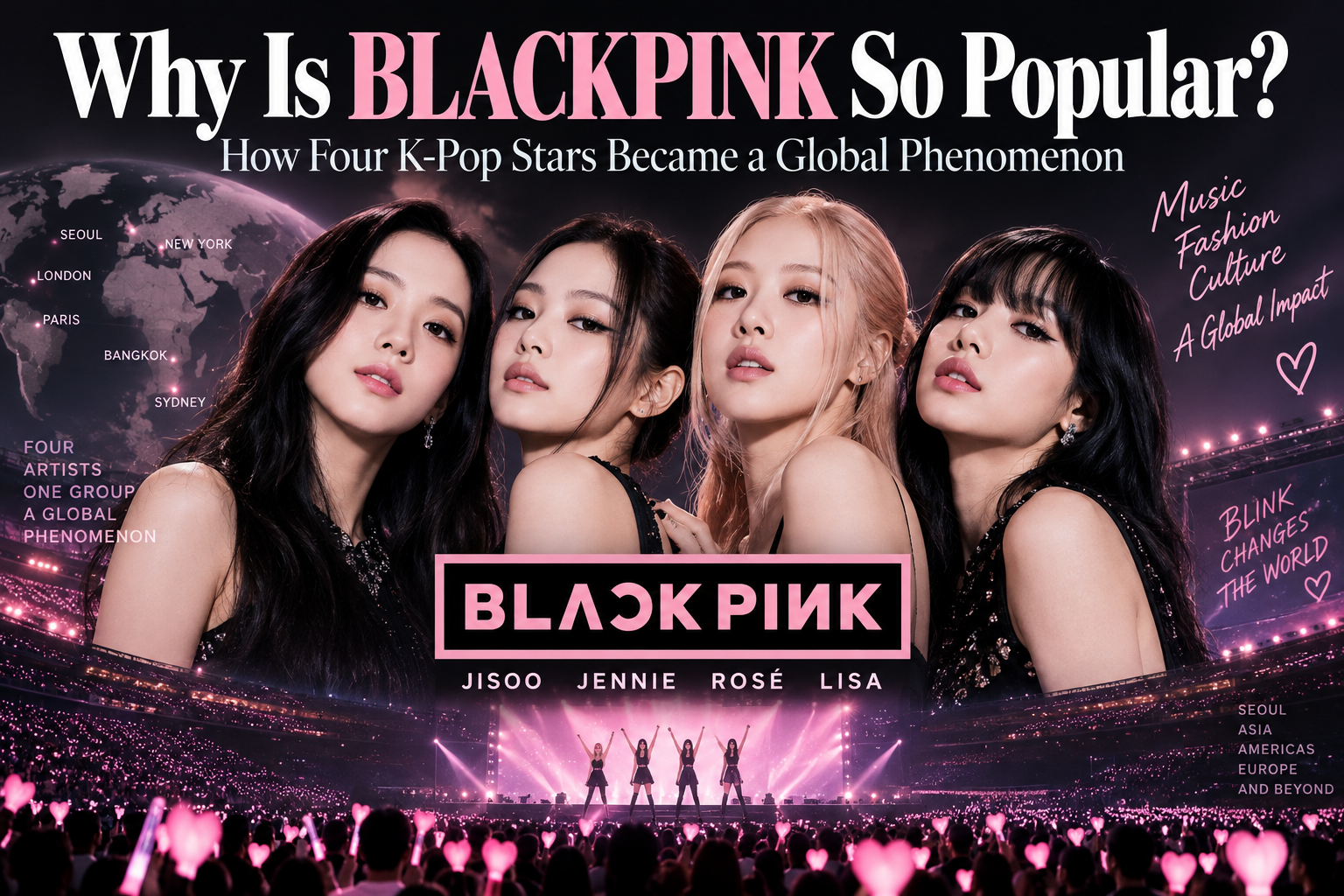
    Since debuting in 2016, Jisoo, Jennie, Rosé, and Lisa have grown from promising YG Entertainment artists into global stars whose influence extends far beyond South Korea.

    Their music videos attract enormous international audiences, their concerts bring together fans from many countries, and each member has developed an individual identity in music, fashion, entertainment, and popular culture.

    But BLACKPINK‘s success raises an interesting question.

    Why did this particular group become such a powerful global phenomenon?

    The answer involves much more than a few hit songs.

    Four Members with Distinct Identities

    One of BLACKPINK’s greatest strengths is that the four members are easy to distinguish from one another.

    Jisoo brings a calm and elegant presence while developing careers in both music and acting.

    Jennie combines rap, vocals, fashion, and a strong individual image.

    Rosé is instantly recognizable for her distinctive vocal tone and increasingly personal approach to solo music.

    Lisa stands out through dance, rap, stage presence, and her international background.

    These differences allow fans to connect with individual members while still supporting BLACKPINK as a group.

    Rather than four performers competing for the same identity, BLACKPINK works because each member contributes something different.

    Music Designed for Immediate Impact

    BLACKPINK’s biggest songs are built to make an impression quickly.

    Tracks such as “DDU-DU DDU-DU,” “Kill This Love,” “How You Like That,” and “Pink Venom” combine powerful beats, memorable hooks, rap sections, dramatic vocal moments, and choreography designed for the stage.

    Many of their songs also move between contrasting moods.

    A track may begin with a confident rap, shift into a melodic vocal section, and then explode into a large chorus or dance break.

    That structure gives BLACKPINK’s music a strong visual and performance dimension.

    The songs are not simply meant to be heard.

    They are designed to be experienced.

    The Power of BLACKPINK’s Music Videos

    Visual storytelling has played a major role in BLACKPINK’s rise.

    Their music videos often feature elaborate sets, striking fashion, bold colors, dramatic camera work, and memorable choreography.

    For international audiences who may not understand every Korean lyric, these visual elements provide another way to connect with the music.

    A BLACKPINK release can therefore function simultaneously as a song, fashion event, dance performance, and visual spectacle.

    This made platforms such as YouTube especially important to the group’s international expansion.

    BLACKPINK and the Growth of YouTube K-Pop

    BLACKPINK emerged during a period when global audiences were increasingly discovering music through digital platforms rather than traditional television or radio.

    This was particularly important for K-pop.

    Fans did not need to live in South Korea to watch a new music video, learn choreography, follow performances, or share content with friends.

    BLACKPINK’s highly visual style was perfectly suited to this environment.

    Every major release could immediately reach viewers across Asia, North America, Europe, Latin America, and other regions.

    The internet helped remove one of the biggest barriers that earlier generations of Korean artists had faced: geography.

    Fashion Became Part of the BLACKPINK Brand

    BLACKPINK’s influence is not limited to music.

    Jisoo, Jennie, Rosé, and Lisa have each developed strong connections with international fashion and luxury culture.

    Their appearances at major fashion events introduced them to audiences who might not have originally followed K-pop.

    This created an unusual crossover.

    A person could first discover a BLACKPINK member through a fashion campaign and later become interested in the group’s music.

    At the same time, existing fans followed the members into the fashion world.

    BLACKPINK therefore became not only a music group but also a major cultural brand.

    Why International Fans Connect with BLACKPINK

    BLACKPINK has always had an unusually international identity.

    Lisa is Thai.

    Rosé grew up in Australia after being born in New Zealand.

    Jennie spent part of her youth in New Zealand.

    The members’ different backgrounds and language abilities helped the group communicate naturally with audiences outside South Korea.

    But international appeal is not simply about speaking different languages.

    BLACKPINK’s music, fashion, choreography, and personalities created multiple entry points for fans.

    Some listeners discovered them through songs.

    Others arrived through dance videos, fashion, social media, collaborations, or individual members.

    The Importance of BLINK

    No global pop phenomenon exists without a highly engaged fan community.

    BLACKPINK’s fandom, known as BLINK, has played a major role in spreading the group’s music and content.

    Fans share performances, discuss releases, create translations, participate in online communities, and introduce BLACKPINK to new listeners.

    Digital fandom can turn every comeback into an international event.

    When a new song or video arrives, millions of fans across different time zones can respond almost simultaneously.

    This level of participation has become one of the defining characteristics of modern K-pop.

    Global Collaborations Expanded Their Audience

    BLACKPINK has also worked with major international artists.

    Collaborations with musicians such as Dua Lipa, Lady Gaga, Selena Gomez, and Cardi B helped connect the group with audiences already familiar with Western pop.

    These collaborations were important not because BLACKPINK needed Western artists to become successful, but because they demonstrated how naturally the group could operate within the wider global music industry.

    BLACKPINK increasingly appeared less like a Korean group visiting the international pop market and more like a permanent part of it.

    Coachella and the Global Stage

    Festival appearances became another important symbol of BLACKPINK’s international rise.

    Performing at Coachella placed the group in front of a large global festival audience and demonstrated that K-pop could occupy major stages outside the traditional idol concert system.

    Their later return to the festival at an even higher level of prominence reflected how much their global position had grown.

    These performances were significant not only for BLACKPINK but also for the broader visibility of K-pop.

    Solo Careers Made the Group Even Bigger

    Another unusual strength of BLACKPINK is the individual popularity of its members.

    Jennie, Rosé, Lisa, and Jisoo have all developed solo careers while remaining strongly associated with the group.

    Their individual projects reveal different artistic directions.

    One member may focus more heavily on music, another may expand into acting, while others explore fashion, performance, songwriting, or business.

    Instead of weakening the BLACKPINK identity, these individual careers can bring new audiences back to the group.

    Fans who discover one member’s solo work may eventually explore BLACKPINK’s wider history.

    Scarcity Also Created Anticipation

    BLACKPINK has often released music less frequently than many K-pop groups.

    This has sometimes frustrated fans, but it also created enormous anticipation around major comebacks.

    Because releases were relatively limited, each new era could feel like a major event.

    New music meant new styling, choreography, music videos, performances, interviews, and international attention.

    The result was a cycle in which anticipation itself became part of the BLACKPINK experience.

    BLACKPINK Helped Redefine the Global K-Pop Girl Group

    Before BLACKPINK, Korean girl groups had already built significant international audiences.

    But BLACKPINK helped push the possibilities even further.

    They demonstrated that a K-pop girl group could become a major force in global touring, fashion, streaming, festivals, advertising, and celebrity culture simultaneously.

    Their success also contributed to greater international interest in other Korean girl groups.

    In that sense, BLACKPINK’s impact extends beyond their own achievements.

    They helped expand expectations for what a K-pop girl group could become.

    So, Why Is BLACKPINK So Popular?

    There is no single reason.

    BLACKPINK’s global success comes from the combination of four distinctive members, memorable music, powerful performances, visually ambitious videos, fashion influence, digital platforms, international backgrounds, and a highly active global fandom.

    Timing also mattered.

    They emerged when K-pop was becoming increasingly accessible around the world and when social media could turn a Korean music release into an immediate international conversation.

    But opportunity alone does not create a global phenomenon.

    BLACKPINK had the songs, personalities, performances, and visual identity capable of taking advantage of that moment.

    From K-Pop Group to Global Phenomenon

    BLACKPINK began as four artists debuting under YG Entertainment in Seoul.

    Over time, Jisoo, Jennie, Rosé, and Lisa became recognizable figures across music, fashion, entertainment, and global popular culture.

    Their story demonstrates how dramatically K-pop has changed.

    A group can now begin in South Korea, include members with international backgrounds, communicate with fans through global digital platforms, perform on some of the world’s biggest stages, and build individual careers that reach far beyond the traditional boundaries of an idol group.

    That is why BLACKPINK’s story is about more than popularity.

    It is also a story about how K-pop itself became global.

  • LISA of BLACKPINK: From Thailand to Global K-Pop Superstar

    LISA of BLACKPINK: From Thailand to Global K-Pop Superstar

    Who Is LISA?

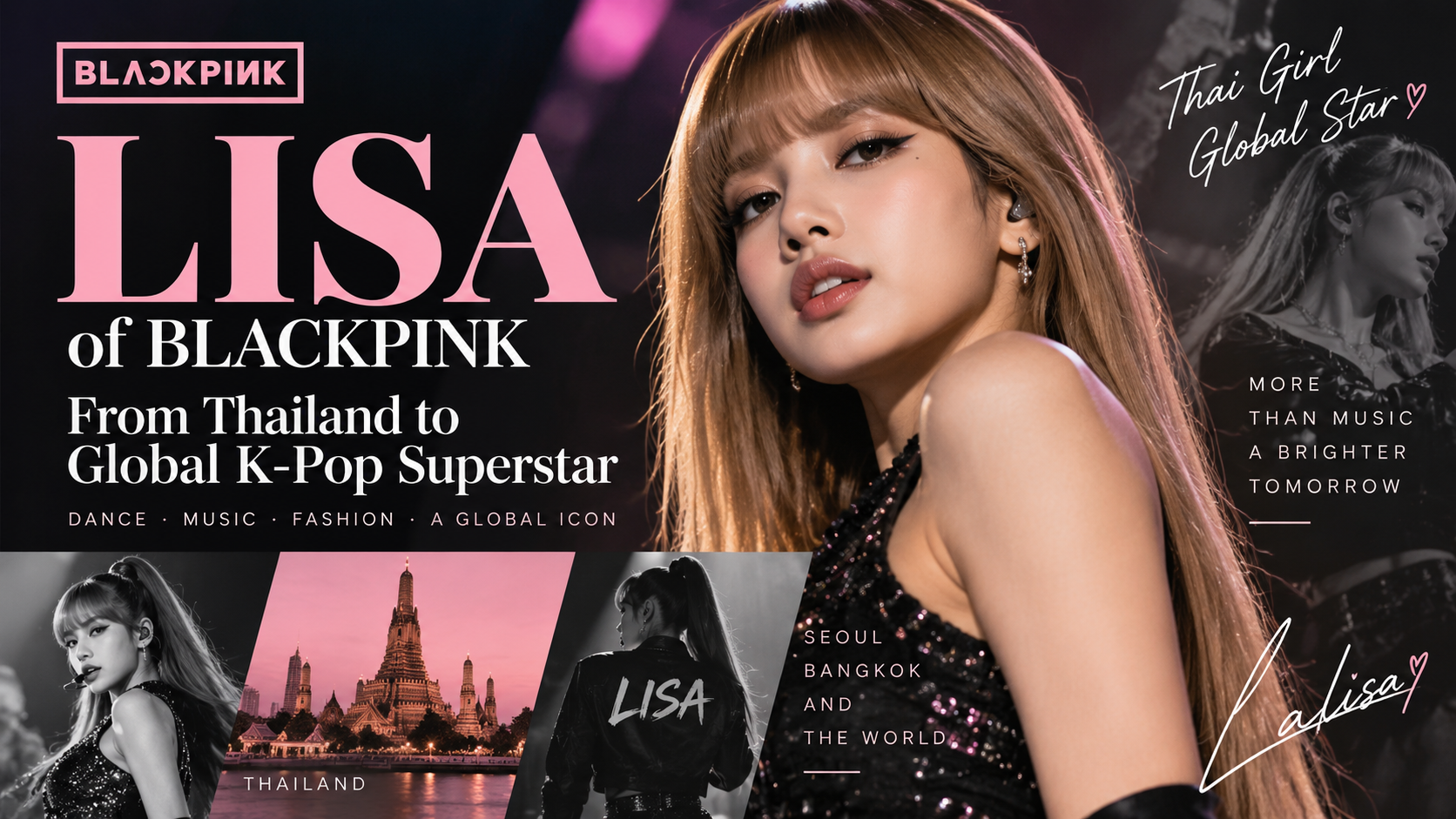
    LISA is a Thai rapper, singer, dancer, and performer best known as a member of BLACKPINK and one of the most internationally recognized artists to emerge from K-pop.

    Born Lalisa Manobal in Thailand, she developed an interest in dance and performance from a young age. Her journey eventually took her from Thailand to South Korea, where she entered the highly competitive K-pop training system.

    Years later, LISA would become known around the world for her powerful stage presence, distinctive rap style, and remarkable dance skills.

    How Did LISA Join YG Entertainment?

    Before becoming a K-pop star, LISA participated in dance activities and competitions in Thailand.

    Her life changed when she auditioned for YG Entertainment in Thailand in 2010.

    After succeeding in the audition process, she moved to South Korea as a teenager and began training under YG Entertainment.

    The transition was not easy. She had to adapt to a new country, language, culture, and demanding training environment while preparing for the possibility of becoming an idol.

    After several years of training, LISA debuted alongside Jisoo, Jennie, and Rosé as BLACKPINK in August 2016.

    What Is LISA’s Role in BLACKPINK?

    Within BLACKPINK, LISA quickly became especially recognized for her dancing and rap performances.

    Her sharp movements, stage confidence, and ability to switch between powerful and playful performance styles helped create some of BLACKPINK’s most memorable stages.

    Her rap sections also became an important part of the group’s musical identity.

    As BLACKPINK’s popularity expanded internationally, LISA’s performances attracted audiences far beyond South Korea.

    Why Is LISA Famous for Dancing?

    Dance has always been central to LISA’s identity as a performer.

    Even before her K-pop debut, she had years of dance experience. After joining YG Entertainment, those skills developed further through intensive idol training.

    Her performances combine precision, speed, control, and charisma.

    For many fans, LISA represents one of the clearest examples of how dance can become just as important as vocals or rap in defining a K-pop artist’s identity.

    LISA’s Solo Debut

    In 2021, LISA officially began her solo career with the single album LALISA.

    The title track “LALISA” presented a confident introduction to her individual identity outside BLACKPINK.

    The project also included “MONEY,” a track that became especially popular internationally and helped expand her solo audience.

    Her debut showed that the performance style audiences knew from BLACKPINK could successfully translate into a solo career.

    “MONEY” and Global Popularity

    “MONEY” became one of the defining songs of LISA’s early solo career.

    Its strong beat, memorable choreography, and performance-focused style made it particularly suited to short-form video platforms and dance content.

    The song reached listeners far beyond the traditional K-pop audience and demonstrated LISA’s ability to attract attention as an individual performer.

    It also reinforced the increasingly global nature of K-pop, where an artist from Thailand could debut in South Korea and build an audience across continents.

    A New Chapter with LLOUD

    As BLACKPINK’s members expanded their individual careers, LISA began building a new platform for her solo activities.

    She established LLOUD, a company designed to support her individual artistic and professional projects.

    This represented an important transition.

    LISA was no longer developing only as a performer within an established entertainment system. She was also taking greater control over the direction of her individual career.

    “Rockstar” and LISA’s Evolving Image

    The release of “Rockstar” marked another major stage in LISA’s solo evolution.

    The song presented a bold visual and musical identity while highlighting her connection to Thailand.

    Its music video included scenes filmed in Bangkok, bringing part of her home country directly into a global pop production.

    For an artist whose career had taken her from Thailand to South Korea and then around the world, this connection carried particular significance.

    From K-Pop Idol to Global Pop Artist

    LISA’s solo career increasingly demonstrates how the boundaries between K-pop and global pop are becoming less rigid.

    Her music combines the performance intensity associated with K-pop with collaborations, sounds, and promotional strategies aimed at international audiences.

    Rather than leaving her K-pop identity behind, she has expanded it.

    Her career shows how artists can emerge from the Korean entertainment industry while developing identities that operate across several countries and music markets.

    LISA Beyond Music

    LISA’s influence extends beyond songs and performances.

    She has become a major presence in global fashion and luxury culture, attending international events and working with prominent brands.

    Her enormous social media audience has also helped make her one of the most visible Thai entertainers in the world.

    This combination of music, fashion, performance, and digital influence has transformed LISA into a global celebrity whose reach extends well beyond K-pop fandom.

    LISA as a Thai Global Star

    One of the most important parts of LISA’s story is her Thai background.

    Her success has helped demonstrate that K-pop can provide a platform for artists from countries outside South Korea to build truly international careers.

    For fans in Thailand and across Southeast Asia, her rise has carried additional cultural significance.

    She represents both the international expansion of K-pop and the growing visibility of Southeast Asian artists in global entertainment.

    What Makes LISA Different?

    LISA’s career combines several qualities that make her particularly distinctive.

    She is a Thai artist who built her career in South Korea, became famous through BLACKPINK, and then developed an increasingly independent presence in international pop culture.

    Dance remains one of her strongest artistic signatures, but her career now extends into rap, solo music, fashion, business, and entertainment.

    Her ability to move between these different worlds has become one of the defining characteristics of her global appeal.

    From Thailand to Global K-Pop Superstar

    LISA’s journey began with a young dancer in Thailand who was willing to move far from home for an uncertain opportunity.

    Years of training eventually led to BLACKPINK, and BLACKPINK opened the door to a global audience.

    But her story did not stop there.

    Through LALISA, “MONEY,” LLOUD, “Rockstar,” and her expanding international career, LISA has continued to build an identity of her own.

    Her journey reflects one of the most fascinating developments in modern K-pop: an industry that began in South Korea can now launch artists from around the world onto the global stage.

  • ROSÉ of BLACKPINK: From Australian Dreamer to Global Solo Star

    ROSÉ of BLACKPINK: From Australian Dreamer to Global Solo Star

    Who Is ROSÉ?

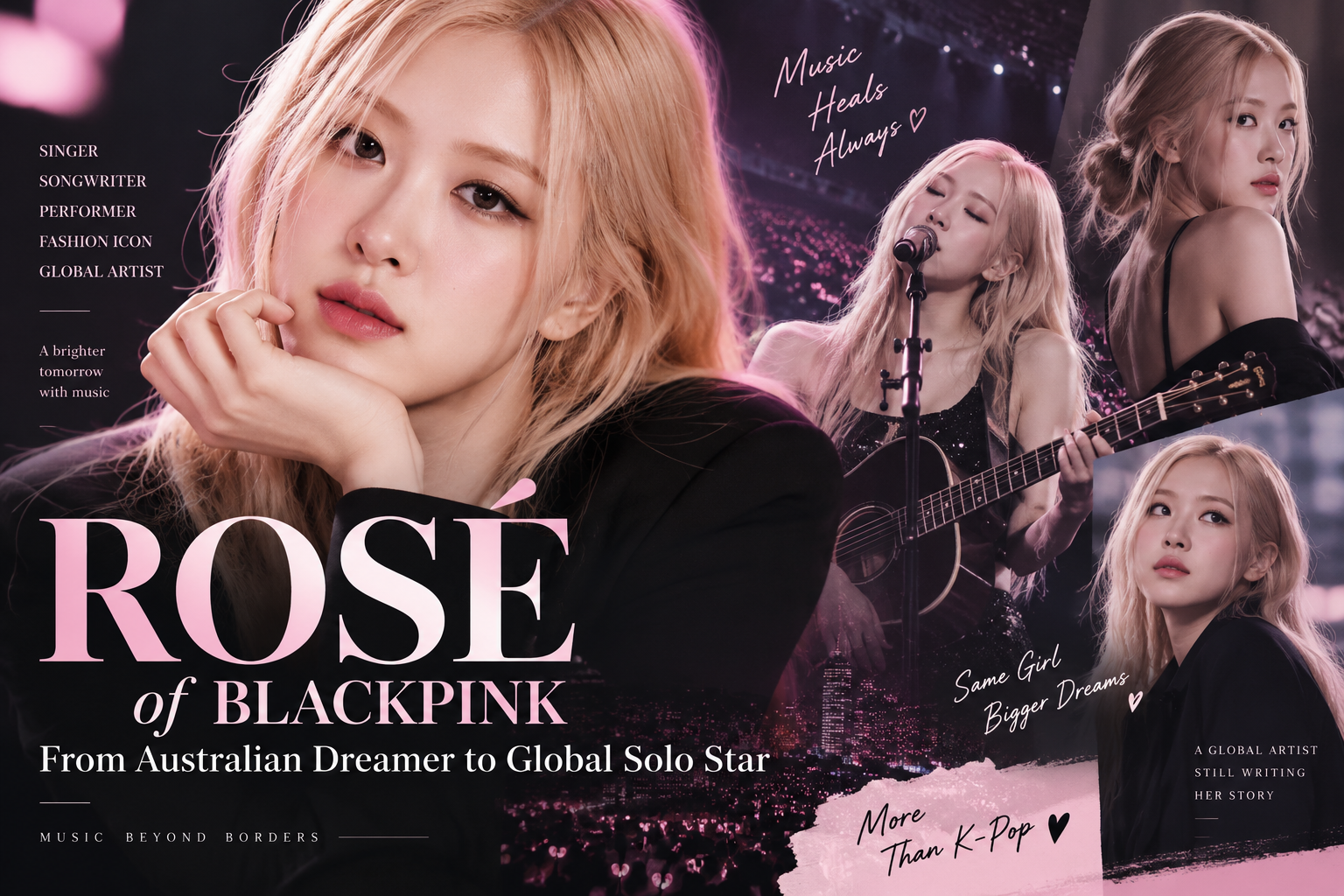
    ROSÉ is a Korean-New Zealand singer and songwriter best known as a member of BLACKPINK and for her distinctive voice as a solo artist.

    Born Roseanne Park in Auckland, New Zealand, and raised in Australia, she grew up surrounded by music before moving to South Korea to pursue a career in K-pop.

    Her journey from a teenager in Australia to one of the most recognizable voices in global pop is a story of talent, persistence, and artistic growth.

    How Did ROSÉ Join BLACKPINK?

    Before becoming a BLACKPINK member, ROSÉ lived with her family in Australia.

    Music was already an important part of her life. She sang, played instruments, and developed a strong interest in performing.

    In 2012, she auditioned for YG Entertainment in Australia. After succeeding in the audition, she moved to South Korea and became a trainee.

    The decision meant leaving behind the familiar environment of her family and school life to enter the demanding K-pop training system.

    After several years of training, ROSÉ debuted with Jisoo, Jennie, and Lisa as BLACKPINK in August 2016.

    What Is ROSÉ’s Role in BLACKPINK?

    ROSÉ quickly became recognizable for her distinctive vocal tone.

    BLACKPINK’s music often moves between rap, powerful electronic production, and melodic vocal sections. ROSÉ’s voice provides a sound that listeners can identify almost immediately.

    Her performances also reveal her musical background. In addition to singing and dancing, she has frequently shown her ability to play guitar and piano.

    That combination helped establish an image of ROSÉ not only as a K-pop performer but also as an artist deeply interested in music itself.

    Why Is ROSÉ’s Voice So Recognizable?

    One of the most common discussions about ROSÉ is the uniqueness of her voice.

    Her vocal tone can sound delicate and emotional in quieter songs while still cutting through the powerful production associated with BLACKPINK’s biggest tracks.

    A recognizable voice is particularly valuable in pop music. Listeners can often identify ROSÉ within seconds, even when she is performing outside BLACKPINK.

    That vocal identity would later become one of the foundations of her solo career.

    ROSÉ’s First Solo Era

    ROSÉ officially began her solo career in 2021 with the single album R.

    Its lead single, “On The Ground,” explored ideas about success, ambition, and realizing what truly matters after chasing larger dreams.

    Another track, “Gone,” presented a more emotional and stripped-back side of her music.

    Together, the songs allowed ROSÉ to step outside BLACKPINK’s group sound and show listeners a more personal musical identity.

    Her solo debut demonstrated that she could carry a project independently while maintaining the qualities that had made her voice recognizable within BLACKPINK.

    From BLACKPINK to a New Solo Chapter

    As BLACKPINK’s members began expanding their individual careers, ROSÉ entered another important stage of her artistic development.

    Her later solo work allowed her to explore songwriting and musical styles in ways that were increasingly distinct from BLACKPINK.

    Rather than simply recreating the group’s sound as a solo performer, ROSÉ began shaping music around her own voice, emotions, and experiences.

    This transition helped audiences see her not only as a member of a major K-pop group but as an individual pop artist.

    “APT.” and a New Global Audience

    A major moment in ROSÉ’s solo career arrived with “APT.,” her collaboration with Bruno Mars.

    The song combined an instantly memorable hook with playful energy and a concept inspired by a Korean drinking game.

    Its appeal crossed language and cultural boundaries, introducing another side of ROSÉ to audiences around the world.

    “APT.” also demonstrated something important about the changing position of K-pop artists. Collaborations between Korean artists and major international musicians are no longer unusual side projects. They can become central moments in global pop culture.

    For ROSÉ, the song marked another step from K-pop star to internationally recognized solo artist.

    The Meaning of rosie

    ROSÉ’s first full-length solo studio album, rosie, represented a more personal stage in her career.

    The title itself comes from a familiar nickname, immediately suggesting a project closer to the person behind the global celebrity.

    Through her solo music, ROSÉ has increasingly explored relationships, vulnerability, loneliness, ambition, and the emotional experiences that exist behind public success.

    This more personal approach distinguishes her individual career from the large-scale performance identity associated with BLACKPINK.

    ROSÉ as a Songwriter and Musician

    ROSÉ’s evolution is also connected to her growing role in shaping her own music.

    For many K-pop artists, the transition from idol performer to individual artist involves greater participation in songwriting, creative direction, and musical decision-making.

    ROSÉ’s background with guitar, piano, and singing made this progression feel natural.

    Her solo work gives listeners a clearer sense of the musical influences and emotions that matter to her personally.

    ROSÉ and Global Fashion

    Like the other BLACKPINK members, ROSÉ has also developed a major presence in international fashion.

    Her appearances at global fashion events and partnerships with luxury brands have expanded her influence beyond music.

    This crossover reflects one of BLACKPINK’s most significant cultural effects: the members operate simultaneously in music, fashion, beauty, and global celebrity culture.

    ROSÉ’s distinctive style has become another recognizable part of her public identity.

    Is ROSÉ Still a Member of BLACKPINK?

    ROSÉ’s growing solo career does not mean that her history with BLACKPINK has disappeared.

    BLACKPINK remains the group that brought Jisoo, Jennie, Rosé, and Lisa together and introduced their different talents to a worldwide audience.

    At the same time, the members have reached a stage where each can develop an independent artistic career.

    ROSÉ’s journey shows how a K-pop artist can maintain a group identity while building a musical world of her own.

    What Makes ROSÉ Different?

    ROSÉ’s story stands out because of the distance—both literal and artistic—that she has traveled.

    She grew up in Australia, moved to South Korea as a teenager, survived years of training, debuted in one of K-pop’s biggest groups, and eventually developed into a global solo artist.

    Yet through each stage, music has remained at the center of her identity.

    Her distinctive voice may have first introduced her to millions of BLACKPINK listeners, but her solo career has allowed audiences to discover more of the musician behind that voice.

    From Australian Dreamer to Global Solo Star

    ROSÉ’s journey began far from the center of the Korean entertainment industry.

    A successful audition changed the direction of her life, taking her from Australia to Seoul and eventually onto stages around the world with BLACKPINK.

    Years later, songs such as “On The Ground” and “APT.,” along with her album rosie, have opened another chapter.

    Her career now exists at the intersection of K-pop and global pop, group history and individual artistry.

    And as ROSÉ continues to develop her own musical identity, her story is becoming much larger than the journey that first brought her to BLACKPINK.

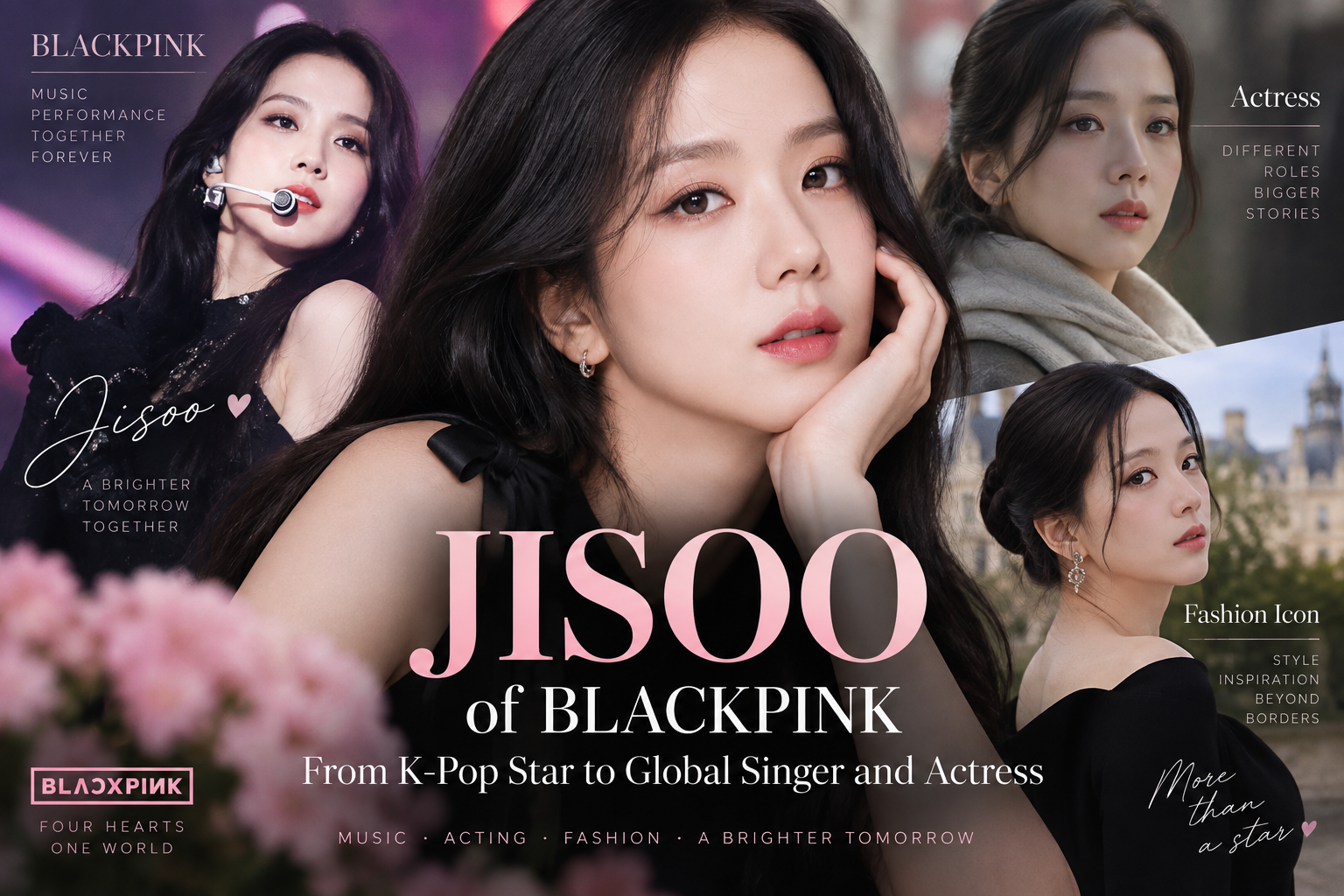
  • JISOO of BLACKPINK: From K-Pop Star to Global Singer and Actress

    JISOO of BLACKPINK: From K-Pop Star to Global Singer and Actress

    Who Is JISOO?

    JISOO is a South Korean singer and actress best known as a member of BLACKPINK, one of the world’s most influential K-pop groups.

    Born Kim Jisoo in South Korea, she entered the entertainment industry as a trainee at YG Entertainment and eventually debuted with BLACKPINK in 2016.

    While BLACKPINK introduced her to audiences around the world, JISOO gradually built an identity that extended beyond the group. Her career has developed across music, acting, fashion, and solo projects, making her one of the most recognizable Korean entertainers of her generation.

    How Did JISOO Become a Member of BLACKPINK?

    Before becoming a global K-pop star, JISOO spent years preparing for her debut.

    She joined YG Entertainment as a trainee in 2011. Like many future K-pop idols, she went through an intensive training period that involved developing her singing, dancing, performance skills, and stage presence.

    On August 8, 2016, JISOO officially debuted as one of the four members of BLACKPINK alongside Jennie, Rosé, and Lisa.

    The group quickly attracted attention with songs such as “Whistle” and “Boombayah,” beginning a career that would eventually take the four members to some of the world’s biggest stages.

    What Is JISOO’s Role in BLACKPINK?

    Each BLACKPINK member developed a distinctive identity, and JISOO became known for her unique vocal tone, composed personality, and strong visual presence.

    Her voice adds a recognizable texture to BLACKPINK’s music, particularly when contrasted with the different vocal and rap styles of Jennie, Rosé, and Lisa.

    But JISOO’s importance to the group cannot be explained only through musical roles.

    Her personality and chemistry with the other members became an important part of BLACKPINK’s appeal. As international audiences discovered more of the group through interviews, performances, and online content, JISOO developed a global fan base of her own.

    JISOO’s Journey as an Actress

    Acting has been another important part of JISOO’s career.

    Even before BLACKPINK became a global phenomenon, she showed an interest in acting and appeared in small roles and entertainment projects.

    Her major breakthrough as a leading actress came with the Korean television drama Snowdrop, in which she played the character Eun Yeong-ro.

    Taking on a leading dramatic role allowed audiences to see a different side of JISOO. Instead of performing onstage as part of BLACKPINK, she had to communicate emotion through character development, dialogue, and storytelling.

    Her acting career demonstrated that her ambitions extended beyond music.

    How Did JISOO Begin Her Solo Career?

    JISOO made her official solo music debut in 2023 with the single album ME.

    The project included the title track “FLOWER,” which quickly became one of the defining songs of her solo career.

    “FLOWER” presented a style that felt different from BLACKPINK’s group releases. Its elegant visual concept, distinctive choreography, and restrained confidence helped establish a musical identity that was recognizably JISOO’s own.

    The success of her solo debut showed that audiences were interested not only in BLACKPINK but also in the individual artistic identities of its four members.

    Why Did “FLOWER” Become So Popular?

    “FLOWER” became widely recognizable through its melody, choreography, and visual presentation.

    The song also spread rapidly through short-form video platforms, where its signature dance movements were recreated by fans around the world.

    Its popularity demonstrated how modern K-pop songs can travel beyond traditional music platforms. A memorable performance, visual concept, or dance can become part of global online culture.

    For JISOO, “FLOWER” also marked an important transition: she was no longer appearing only as one-fourth of BLACKPINK. She was establishing herself as a solo performer.

    JISOO Beyond YG Entertainment

    As BLACKPINK entered a new stage in its career, the members began developing more independent paths for their individual activities.

    JISOO established BLISSOO for her solo activities, creating a new foundation for the next stage of her career.

    This development reflected a broader change among established K-pop artists. After years within traditional idol-management systems, successful artists increasingly have opportunities to take greater control over their individual careers.

    For JISOO, that has meant continuing to explore music, acting, fashion, and other projects while maintaining her connection to BLACKPINK.

    JISOO and the Global Fashion World

    JISOO’s influence also extends into fashion.

    Her appearances at international fashion events and work with major luxury brands have made her a familiar figure far beyond K-pop audiences.

    This relationship between K-pop and luxury fashion has become an important part of the industry’s global expansion. Artists can now influence music, beauty, fashion, and popular culture simultaneously.

    JISOO’s elegant public image has made fashion a particularly visible part of her international career.

    Is JISOO Still a Member of BLACKPINK?

    JISOO’s expanding solo career does not erase her identity as a BLACKPINK member.

    BLACKPINK remains the group through which JISOO, Jennie, Rosé, and Lisa first became internationally recognized together. At the same time, each member has increasingly developed her own professional direction.

    This makes BLACKPINK an interesting example of how the careers of established K-pop groups can evolve.

    Group identity and individual careers do not necessarily have to compete. They can exist alongside one another.

    What Makes JISOO Different?

    JISOO’s career is defined partly by contrast.

    Onstage with BLACKPINK, she is part of a high-energy global pop group. As a solo artist, she can explore a more individual musical and visual identity. As an actress, she works through characters and stories rather than concert performances.

    These different roles reveal why her career cannot be understood through a single label.

    She is a K-pop idol, but she is also a solo singer, actress, fashion figure, and entertainer building a career beyond the traditional boundaries of an idol group.

    From BLACKPINK Member to Global Artist

    JISOO’s journey began long before BLACKPINK became a worldwide name.

    Years of training led to her 2016 debut, and BLACKPINK’s extraordinary rise introduced her to millions of listeners around the world. Since then, acting, “FLOWER,” ME, fashion, and her independent activities have expanded the meaning of her career.

    Her story also reflects the changing possibilities available to today’s K-pop artists.

    An idol can begin as a member of a group and eventually develop multiple creative identities without abandoning the group that helped start the journey.

    For JISOO, that evolution is still continuing.