BABYMONSTER is preparing for a different kind of comeback. The YG Entertainment girl group will release its new digital single, “DESERVE,” on October 23, 2026, at 1 p.m. KST.
The release follows June’s “SUGAR HONEY ICE TEA,” but the early announcements suggest a change in musical direction. Rather than promising another fast-paced performance track, YG has described “DESERVE” as a slower song with unusually powerful emotional energy.
That contrast makes the comeback interesting. BABYMONSTER has already built a reputation around strong vocals, dynamic performances, and confident stage presence. Could a slower, more emotionally focused release reveal another side of the group?
Here is what has been confirmed, what the teasers suggest, and why “DESERVE” could become an important chapter in BABYMONSTER’s development.
BABYMONSTER “DESERVE”: Release Date and Confirmed Details
Detail
Information
Artist
BABYMONSTER
Song
DESERVE
Release date
October 23, 2026
Release time
1 p.m. KST
Format
Digital single
Agency
YG Entertainment
Previous new single
SUGAR HONEY ICE TEA
Next album
Targeted for early 2027
YG Entertainment confirmed the release through its official announcements in October.
The distinction between a confirmed release and a future plan matters. While “DESERVE” has a scheduled release date, the group’s next album is currently an early-2027 target rather than a project with a fully announced date and tracklist.
Why Is BABYMONSTER Releasing a Slower Song?
One of the most revealing details about “DESERVE” came from YG executive producer Yang Hyun-suk.
In his October 14 message, he described the upcoming track as slower-paced while emphasizing its unusually strong emotional intensity. He also highlighted the combination of delicate vocals and powerful singing.
At first, that description might sound contradictory.
How can a slow song feel more powerful than an energetic dance track?
The answer is that musical intensity does not depend entirely on tempo.
A song can create dramatic impact through vocal delivery, arrangement, contrast, and emotional progression. A quiet opening can make a later climax feel even bigger. A restrained instrumental can also give a singer’s voice more space to carry the emotional weight.
These are possibilities suggested by the announcement, not confirmed characteristics of the unreleased recording.
What makes the direction noteworthy is how it could place BABYMONSTER’s singing at the center of the listening experience.
What Makes “DESERVE” Different From BABYMONSTER’s Recent Releases?
BABYMONSTER has maintained an active release schedule throughout 2026.
Its third mini-album, CHOOM, and subsequent releases such as “SUGAR HONEY ICE TEA” have given the group opportunities to explore different musical styles and performance concepts.
“DESERVE” appears positioned to introduce another contrast.
Instead of asking whether the new song will be bigger or louder than previous releases, the more interesting question may be whether BABYMONSTER can create a similarly strong impact through emotional restraint.
That would not mean abandoning the group’s established identity.
An artist’s musical identity can become stronger when familiar qualities appear in unfamiliar settings. For BABYMONSTER, powerful singing and performance confidence could remain central even if the rhythm, atmosphere, and storytelling change.
The actual musical comparison will only be possible after the song is released.
The Dark “DESERVE” Concept: What Do the Teasers Reveal?
The promotional imagery has also attracted attention.
The initial announcement poster used a restrained black-and-white design with blurred lettering and a rough, textured appearance.
Later music video stills introduced darker, more cinematic visuals.
The October 19 preview showed contrasting images, including Rora in a backstage setting and Chiquita standing alone in a dim corridor.
These scenes suggest that atmosphere and individual emotion may play an important role in the music video.
However, the still images do not establish a complete storyline.
It would be premature to claim that “DESERVE” is about heartbreak, betrayal, personal growth, or any other specific theme before the lyrics and full video are available.
For now, the strongest observation is visual: the promotional material places greater emphasis on mood, isolation, and dramatic contrast than a straightforward performance teaser would.
What Does the Title “DESERVE” Mean?
The English word deserve refers to being worthy of something, whether that is recognition, love, reward, or a particular consequence.
As a song title, it leaves room for several possible interpretations.
It could express confidence, disappointment, longing, or self-worth depending on the lyrics and their context.
But the title alone cannot tell us which interpretation BABYMONSTER intends.
The official lyrics will be essential to understanding the song’s actual message.
Why the Comeback Matters During the CHOOM World Tour
“DESERVE” is arriving while BABYMONSTER is carrying out its second world tour, 2026–27 BABYMONSTER WORLD TOUR [CHOOM].
According to YG Entertainment, the tour spans 31 performances in 18 cities across five continents.
This timing creates an interesting connection between the group’s recorded music and its live performances.
A world tour introduces artists to audiences with different levels of familiarity. Some attendees may have followed BABYMONSTER since its earliest releases, while others may discover the group through a concert or a viral performance.
A new single released during that period can give both audiences another reason to explore the group’s catalog.
It may also provide a new emotional contrast within the group’s future live performances, although any addition to the tour setlist would require separate confirmation.
The important point is that “DESERVE” is not arriving during a quiet period. It is part of an active international chapter.
Is “DESERVE” a Preview of BABYMONSTER’s 2027 Album?
YG has stated that BABYMONSTER is aiming to release another album in early 2027.
That makes “DESERVE” especially interesting as a possible bridge between the group’s current activities and its next major project.
However, several details remain unconfirmed.
YG has not established whether “DESERVE” will appear on the next album, whether the album will follow the single’s musical direction, or what its final release schedule will be.
Those distinctions are important because a digital single can serve several purposes.
It may introduce a new sound, maintain momentum between larger projects, or simply stand as an independent release.
Until YG provides further details, “DESERVE” should be understood as a confirmed digital single rather than automatically described as the lead single from an announced 2027 album.
Three Things to Watch When “DESERVE” Is Released
The full release will provide answers that the teasers cannot.
1. How the vocals create emotional intensity
YG’s description places particular emphasis on vocal expression. The finished song will show whether that intensity comes from quiet phrasing, dramatic transitions, powerful climaxes, or another approach.
2. Whether the music video tells a connected story
The promotional stills have introduced distinct cinematic scenes. The full video will reveal whether they form a continuous narrative or function primarily as visual expressions of the song’s mood.
3. How the song fits into BABYMONSTER’s broader direction
One slower release does not necessarily signal a permanent genre change. Its significance will become clearer when placed alongside the group’s later music and performances.
Frequently Asked Questions
When is BABYMONSTER’s “DESERVE” coming out?
“DESERVE” is scheduled for October 23, 2026, at 1 p.m. Korean Standard Time.
Is “DESERVE” a full album?
No. YG Entertainment has announced “DESERVE” as a digital single.
Is “DESERVE” a ballad?
YG has described it as a slower-paced song with powerful emotional energy. That description alone is not enough to confirm its exact genre before release.
Does “DESERVE” have a music video?
YG has released promotional stills for a “DESERVE” music video. The complete video and its narrative should be evaluated after the official release.
When is BABYMONSTER’s next album?
YG is targeting early 2027, but a specific album release date has not been confirmed in the announcements reviewed here.
Final Thoughts: A Different Kind of Power
BABYMONSTER’s “DESERVE” is interesting not simply because it marks another comeback, but because of the contrast at the center of its announcement.
The group is known for energetic performances and strong vocal ability. Now, YG is emphasizing a slower song built around emotional intensity.
If the finished release delivers on that promise, it could demonstrate how BABYMONSTER’s established strengths work in a different musical setting.
For now, the most important distinction is between what has been announced and what remains to be heard.
October 23 will be the moment when listeners can finally judge “DESERVE” on its own terms.
When people first discover BTS, RM is often introduced simply as the leader of the group.
But what does that actually mean?
RM’s role in BTS has never been limited to standing at the front during interviews or speaking on behalf of the members. From the group’s early hip-hop years to its rise as a global act, he has played an important role in songwriting, communication, musical identity and the way BTS has presented its ideas to the world.
At the same time, RM’s own career has changed dramatically.
He began as an underground-influenced rapper, became the leader of one of the world’s biggest music groups, and gradually developed a solo catalog that explores identity, art, uncertainty and personal growth.
To understand RM’s career, it helps to look at how these different roles developed together.
RM’s Career at a Glance: From Underground Rapper to BTS Leader and Solo Artist
Pre-debut: RM developed his skills as an underground-influenced rapper and lyricist before BTS debuted.
2013: BTS debuted with RM as the group’s leader and a key rapper and songwriter.
2015: His first solo mixtape, RM, introduced a more individual voice outside BTS.
2018:mono. showed a quieter, more introspective side of his music.
2022:Indigo, his first official solo album, expanded his work across genres, art and collaboration.
2024:Right Place, Wrong Person pushed his solo music further into alternative and experimental territory.
2025–2026: After completing his military service, RM entered a new stage with BTS while his public role increasingly extended beyond music into art and Korean culture.
Why Is RM the Leader of BTS?
RM, born Kim Namjoon, became part of the project that would eventually become BTS during the group’s early formation.
Before BTS debuted in 2013, he had already developed experience as a rapper and lyricist.
As BTS took shape, RM became its leader.
In K-pop, the leader is not necessarily the oldest member or the most popular member. The role often involves helping the group communicate, representing the team in certain situations and supporting coordination among the members.
For BTS, RM’s leadership became especially visible as the group’s international profile grew.
But his importance to the group began long before BTS became globally famous.
RM’s Early Role Was Closely Connected to Hip-Hop
Early BTS had a much stronger public emphasis on hip-hop than many newer fans may realize.
Songs from the group’s early years dealt with school pressure, ambition, expectations placed on young people and the desire to define one’s own future.
RM’s background as a rapper fit naturally into this direction.
He participated extensively in writing lyrics and helped establish the language through which BTS expressed many of its early themes.
This is important because BTS did not begin with the same musical identity that later produced songs such as “Dynamite” or “Butter.”
The group changed considerably over time.
RM changed with it.
His Role Expanded as BTS’s Music Expanded
As BTS moved beyond its early school-era concepts, its music began exploring broader subjects.
Youth, loneliness, temptation, self-acceptance, fear, success and identity became recurring themes.
RM remained involved as a rapper and songwriter, but his musical role became harder to describe with a single label.
He could deliver aggressive rap verses, contribute reflective lyrics and participate in songs built around completely different genres.
That flexibility became increasingly important as BTS moved from a primarily hip-hop-influenced sound into pop, R&B, EDM, rock and other musical styles.
RM’s career therefore provides a useful way to trace the musical evolution of BTS itself.
RM Is More Than BTS’s English Speaker
One reason international audiences quickly noticed RM was his ability to communicate in English.
As BTS expanded internationally, he frequently took a prominent role during English-language interviews, award shows and overseas appearances.
This led some casual viewers to associate his leadership primarily with translation.
But that description is too narrow.
Language ability made RM especially visible internationally, but BTS’s leadership structure cannot be reduced to one member translating for the others.
His role also involved representing the group’s ideas, explaining its music and helping connect conversations between BTS and audiences unfamiliar with Korean pop culture.
That became particularly important when BTS began appearing in settings far beyond traditional K-pop promotion.
BTS’s United Nations Appearances Showed a Different Side of RM’s Leadership
One of the clearest examples came through BTS’s appearances connected with the United Nations.
In 2018, RM delivered a speech at the United Nations as part of BTS’s work with UNICEF.
The speech centered on the idea of “Speak Yourself,” encouraging young people to find their own voices rather than allowing mistakes, expectations or insecurity to define them.
BTS later returned to UN-related events, further expanding the group’s role as cultural representatives.
These moments did not make RM the leader of BTS—they showed publicly a leadership role that had already existed for years.
They also demonstrated how dramatically the scale of that role had changed.
A rapper who debuted in a relatively small K-pop company was now speaking in one of the world’s most recognizable international institutions.
RM’s Leadership Style Is Not About Controlling the Other Members
It is easy to misunderstand what “leader” means when talking about a K-pop group.
It does not mean RM makes every decision for BTS.
The members have individual personalities, musical interests and careers, and BTS has repeatedly emphasized the importance of the group as seven members.
RM’s public leadership is therefore better understood as representation, communication and coordination rather than authority over the other members.
This distinction matters.
BTS’s longevity has depended not on one person controlling the group but on seven members developing together while maintaining individual identities.
RM’s role exists within that collective structure.
Songwriting Has Always Been Central to RM’s Career
Leadership receives much of the public attention, but songwriting is equally important to understanding RM.
He has accumulated extensive songwriting credits across BTS’s catalog.
His work as a lyricist reflects one of the characteristics that became closely associated with BTS: songs that often attempt to communicate an idea rather than simply fit a concept.
Those ideas have changed as the members have grown older.
Early frustrations about school and social expectations gradually gave way to questions about adulthood, fame, identity and what success actually means.
RM’s own lyrics evolved alongside those changes.
RM’s work as a solo artist also reflects his growth beyond BTS. His projects, including mono., Indigo, and Right Place, Wrong Person, explore different musical styles and personal themes.
For a closer look at his solo career and artistic influence, read our RM of BTS profile.
RM’s influence on modern K-pop can be seen in three areas: artist participation in songwriting, the global communication of Korean music, and the growing freedom for idols to develop distinct artistic identities beyond their groups.
RM’s career developed during a period when international expectations surrounding K-pop changed dramatically.
BTS demonstrated that a Korean group could reach massive audiences without abandoning Korean-language music or the cultural context from which it emerged.
RM played a visible part in that expansion.
His songwriting, interviews and public speeches helped international audiences understand that K-pop artists could participate directly in conversations about their own work rather than simply perform material created around them.
That does not mean BTS or RM alone created every change in modern K-pop.
K-pop’s global expansion resulted from decades of work by many artists, companies, fandoms and industry figures.
But BTS became one of the most influential examples of that expansion, and RM’s role within BTS made him an important figure in that history.
For a broader look at RM as a leader, artist and thinker, read ourRM of BTS profile.
RM’s Career Is Really Several Careers at Once
One reason RM can be difficult to summarize is that several different career paths overlap.
He is:
the leader of BTS
a rapper
a songwriter
a solo artist
a public speaker
a collaborator
an artist increasingly connected with visual art and cultural projects
These roles have not developed separately.
His experiences as BTS’s leader influenced his understanding of fame and identity.
His songwriting influenced how he communicated BTS’s ideas.
His solo work gave him space to explore subjects that did not always fit naturally within a seven-member group.
Together, those experiences explain why RM’s career looks so different now from when BTS debuted in 2013.
FAQ
Why is RM the leader of BTS?
RM became BTS’s leader during the group’s formation. His experience as a rapper, ability to communicate and role in the group’s musical development made him an important coordinating and representative figure from BTS’s early years.
Is RM the oldest member of BTS?
No. Jin is the oldest member of BTS. A K-pop group’s leader does not necessarily have to be its oldest member.
What does RM do in BTS?
RM is BTS’s leader and one of its rappers. He has also contributed extensively as a songwriter and has frequently represented the group during speeches, interviews and international appearances.
Did RM write BTS songs?
Yes. RM has songwriting credits across many BTS releases and has been involved in the group’s lyrics throughout its career.
What are RM’s solo albums and projects?
His major solo projects include the 2015 mixtape RM, the 2018 playlist mono., the 2022 album Indigo and the 2024 album Right Place, Wrong Person.
Why is RM important to BTS’s international career?
His English ability helped during international interviews, but his role goes beyond translation. RM frequently helped communicate the group’s ideas, music and messages to global audiences.
Conclusion
RM’s role in BTS cannot be explained simply by saying that he is “the leader.”
His career developed through several interconnected roles: rapper, songwriter, spokesperson, solo artist and creative thinker.
In BTS’s early years, his hip-hop background and songwriting were central to the group’s identity. As BTS became a global act, his communication skills made his leadership increasingly visible to international audiences.
At the same time, his solo career continued moving in new directions—from the intensity of RM to the introspection of mono., the reflective character of Indigo and the experimentation of Right Place, Wrong Person.
That evolution helps explain both RM’s individual career and part of BTS’s larger history.
The most interesting thing about RM’s role may therefore be that it has never remained fixed.
Every autumn, K-pop fandoms enter award season with a familiar sense of urgency.
Voting guides spread across social media. Fan accounts organize reminders. Screenshots of rankings appear hourly, and supporters encourage one another to keep voting before the deadline.
But there is a question behind all that activity:
If your favorite artist wins the fan vote, does that mean they will win the award?
In some categories, voting is the decisive factor. In others, votes contribute only a fraction of the final score. And for certain awards, fan votes do not count at all.
The 2026 MAMA Awards and Melon Music Awards (MMA) provide a particularly useful comparison because they use noticeably different evaluation systems.
This guide is not another nominee list or a promise that a particular group will win.
Instead, it explains how to read the rules, interpret voting percentages, understand the limits of rankings, and decide what your vote can actually influence.
Last reviewed: October 19, 2026. Award schedules and voting instructions can change. Always consult the organizers’ official pages before participating.
The Short Answer: Yes, Your Vote Matters—but Not in Every Category
The influence of fan voting depends on the award.
At the 2026 MAMA Awards, Fans’ Choice categories rely on designated fan-voting channels. Meanwhile, major categories such as Artist of the Year use judges, music consumption and album sales rather than the Fans’ Choice vote.
At MMA 2026, fan voting contributes 20% to several major awards, including Artist of the Year and TOP10. However, some categories are judged entirely by a panel, while KakaoBank Everyone’s Star allocates 80% to voting.
The most important rule is simple:
Never assume that the voting percentage for one award applies to the entire ceremony.
The 2026 comparison at a glance
Question
2026 MAMA Awards
2026 Melon Music Awards
Are there fan-voted categories?
Yes, including Fans’ Choice
Yes, including TOP10 and popularity awards
Does voting determine every award?
No
No
Do music consumption figures matter?
Yes, for specified categories
Yes, for many categories
Do judges matter?
Yes, for specified categories
Yes, including 100%-judged awards
Can a fan-vote leader still lose another award?
Yes
Yes
Should fans follow category-specific rules?
Absolutely
Absolutely
The real difference is not simply which awards show has more voting.
It is how each program defines the relationship between popularity, measurable music performance, and professional evaluation.
1. MAMA 2026: Where Fan Voting Has the Strongest Influence
The 2026 MAMA Awards are scheduled for November 20–21 in Osaka, Japan.
The nominees were announced on October 12.
According to the published 2026 award criteria, the Fans’ Choice categories use two voting components:
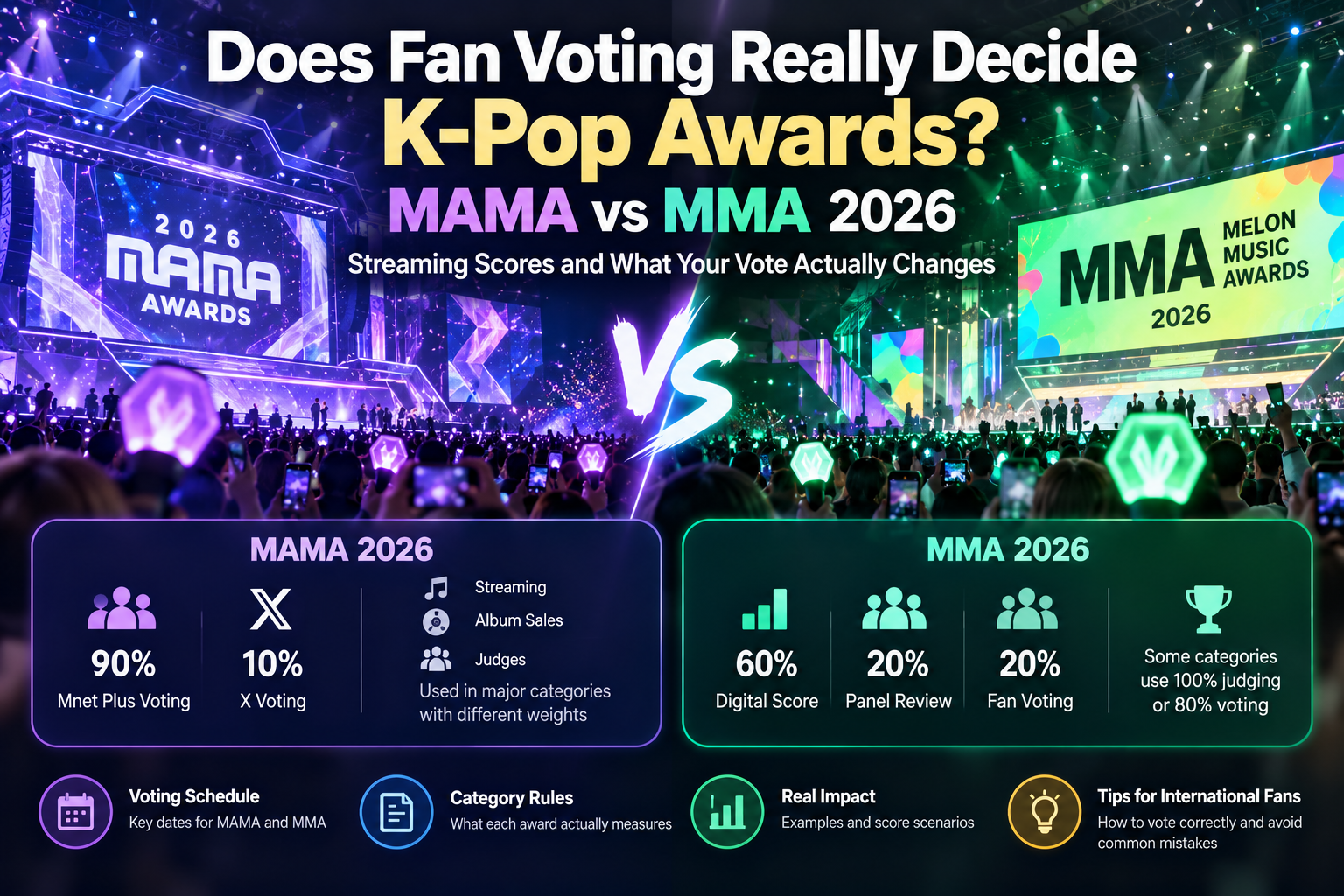
Mnet Plus voting: 90%
X voting: 10%
The same distribution applies to the regular first and second Fans’ Choice voting rounds.
Fans’ Choice of the Year also includes an additional live Mnet Plus voting component worth 10% under the published rules.
Important: That additional live component should not be interpreted as simply making an ordinary 110-point score. Its treatment must follow the organizer’s category-specific calculation rules.
The practical lesson is that fans must read the instructions for the particular round and award rather than combining all visible numbers themselves.
What does 90% Mnet Plus and 10% X actually mean?
Imagine two candidates with very different strengths across the voting channels.
One artist might perform strongly on Mnet Plus while another receives greater support through X.
The final calculation reflects the announced weighting and whatever vote normalization and eligibility rules the organizer applies.
This does not mean one Mnet Plus vote is automatically worth nine individual votes on X.
Those are different platforms, potentially with different voting totals and validation mechanisms.
A percentage weight represents a category’s contribution to the final evaluation—not necessarily an exchange rate between individual votes.
The key warning for fans
A screenshot of an artist leading on one platform does not prove they lead the combined Fans’ Choice score.
Nor does a first-round lead guarantee victory in a later round.
Each stage has its own rules, deadline, eligible candidates and purpose.
2. MAMA’s Major Awards Are Not Simply Fan Popularity Contests
Now consider MAMA’s larger award categories.
The 2026 published criteria distinguish Fans’ Choice from the awards based on judges and music performance.
MAMA 2026 category
Published evaluation criteria
Artist of the Year and artist categories
Jury 40%, domestic streaming/downloads 15%, global streaming/downloads 15%, album sales 30%
Song of the Year and genre categories
Jury 50%, domestic streaming/downloads 25%, global streaming/downloads 25%
Album of the Year
Jury 40%, album sales 60%, subject to the published eligibility threshold
Best Music Video and Best Choreography
Jury 100%
Best Song Top 10
Streaming/downloads 100%, split between domestic and global measures
Fans’ Choice Male/Female
Mnet Plus 90%, X 10%
The Album of the Year criteria also include an eligibility condition involving albums with at least one million sales, according to the published 2026 rules.
That condition should not be confused with a guarantee that the highest-selling eligible album will win.
The jury component still matters.
What this means in practice
A group can have an exceptionally organized international voting fandom without winning Artist of the Year.
Another artist might have outstanding music consumption scores or strong jury evaluation but not dominate Fans’ Choice.
Both outcomes can be consistent with the published rules.
A Fans’ Choice win and an Artist of the Year win measure different things.
Treating them as interchangeable creates unnecessary confusion.
3. MMA 2026: The 60–20–20 Model Explained
The Melon Music Awards take a different approach.
For MMA 2026, the official Melon rules list the following weighting for TOP10:
Digital score: 60%
Panel review: 20%
Fan voting: 20%
The same 60–20–20 framework applies to several other categories, including Artist of the Year, Song of the Year, and New Artist of the Year.
However, not every MMA award uses that model.
The organizer’s official English guide also lists multiple special awards evaluated entirely by a judging panel.
And the KakaoBank Everyone’s Star category uses a much more vote-oriented allocation:
Panel review: 20%
Fan voting: 80%
This is why asking whether “MMA is based on fan voting” is the wrong question.
The right question is: Which MMA category are you talking about?
What does a 20% fan-vote allocation mean?
Imagine an award where the total evaluation is divided into 100 weighted points.
The vote component can contribute up to 20 points.
An artist who performs better in voting may gain an advantage, but the digital and panel components together account for the remaining 80 points.
That means voting can change a close result without automatically overcoming a large deficit elsewhere.
It also means a category’s public voting leaderboard is not necessarily its overall awards leaderboard.
4. Three Examples That Show What Voting Can—and Cannot—Change
The following examples are deliberately simplified.
They are mathematical illustrations using hypothetical normalized category scores—not real 2026 artist rankings, secret jury scores, or predictions.
Example A: Winning the public vote but losing overall at MMA
Suppose two artists are competing for an award with MMA’s 60–20–20 model.
Component
Artist A
Artist B
Digital performance, maximum 60
35
52
Panel review, maximum 20
14
16
Fan voting, maximum 20
20
12
Hypothetical total
69
80
Artist A wins the voting component.
Artist B wins the overall hypothetical score because of stronger combined performance in the other categories.
Lesson: First place in fan voting is not equivalent to first place overall.
Example B: A close race where the vote changes the result
Now imagine two artists with much closer digital and panel scores.
Component
Artist C
Artist D
Digital performance, maximum 60
49
52
Panel review, maximum 20
16
17
Fan voting, maximum 20
19
12
Hypothetical total
84
81
Artist D leads before fan votes are considered.
Artist C wins in this simplified example because of the voting advantage.
Lesson: Even a 20% component can be decisive when the other scores are close.
Example C: MAMA’s Fans’ Choice is a different type of contest
Imagine one artist performs very strongly in MAMA’s Fans’ Choice voting but has modest album sales.
That could be sufficient for a strong Fans’ Choice result, depending on the complete voting totals and rules.
It does not mean the same artist automatically leads Album of the Year, where jury review and eligible album sales carry the published weighting.
Lesson: Never transfer one category’s voting result into another category’s award prediction.
These examples illustrate possible scoring behavior. They do not reveal the actual 2026 scoring systems’ full internal normalization formulas or any unpublished results.
5. Why Streaming Numbers, Album Sales and Votes Are Different
Fans often discuss streaming, album sales and voting as if all three are interchangeable expressions of popularity.
But award organizers may use them to measure different forms of success.
Digital performance
A digital score is based on music consumption metrics selected by the organizer.
For MAMA 2026, the published criteria distinguish domestic and global streaming/download measurements for specified categories.
For MMA, the 2026 guide relies heavily on digital performance for many major awards.
But neither framework means that a public Spotify screenshot necessarily equals an award’s official digital score.
The eligible services, dates, territories and calculation rules matter.
Physical album sales
Physical sales can influence certain MAMA categories, including Artist of the Year and Album of the Year.
But physical sales are not a universal component of all 2026 categories.
A high album-sales total does not by itself settle Song of the Year or Fans’ Choice.
Fan voting
Voting measures eligible participation under a specific event’s rules.
A large fandom can be highly effective at organizing voting campaigns.
Yet vote totals do not automatically substitute for album sales, digital performance or judging.
This is especially important for international fans trying to understand why a globally popular artist did not win a particular Korean awards category.
6. The Overlooked Detail: Eligibility Windows Can Change the Race
Award outcomes also depend on which releases qualify for consideration.
The 2026 MAMA Awards use an eligible music-release period from October 1, 2025, through September 30, 2026, according to the published nomination criteria.
MMA 2026’s standard eligibility period for digital tracks is November 20, 2025, through October 14, 2026.
But MMA makes exceptions for certain categories.
For example, the official rules specify a different evaluation period for Global TOP10, from May 11 to October 14, 2026.
They also outline a separate period for TrackZero Choice, while Hot Trend has no release-date restriction.
Why this matters
Two hit songs released only a few weeks apart might be treated differently by the two ceremonies.
A song released outside one show’s qualification period may still be eligible elsewhere.
And an award category may assess chart activity during a specific period rather than only considering a release date.
Before comparing artists, check whether the same music and time period are actually being measured.
This is one reason fans should be cautious about comparing MAMA and MMA rankings directly.
7. The 2026 Voting Calendar: What International Fans Need to Know
As of the October 19 review, the published schedules include:
Event
Stage
Scheduled period
MAMA 2026
Fans’ Choice first-round voting
Through October 22, 11:59 p.m. KST
MAMA 2026
Fans’ Choice second-round voting
October 28, 6 p.m. to November 18, 11:59 p.m. KST, as reported in the October 12 published criteria
MMA 2026
TOP10 voting
October 15–29
MMA 2026
Category voting
October 30–November 13
MMA 2026
Award ceremony
November 14–15
MAMA 2026
Award ceremony
November 20–21
These are announced schedules, not a promise that event organizers cannot revise them.
Some third-party articles display conflicting information about the MAMA second-round closing date. Fans should use the current Mnet Plus announcement for the relevant voting round as the final operational reference.
If voting requires an account, identity verification, country-specific eligibility, or a particular app, those conditions must come from the official platform.
Avoid relying on unofficial promises about unlimited voting, bonus votes or guaranteed ranking improvements.
8. Five Mistakes Fans Make When Reading Award Rankings
Mistake 1: Treating a voting leaderboard as the final award result
A visible voting ranking may represent only one portion of an award’s total calculation.
Check the other components.
Mistake 2: Using one category’s criteria for every trophy
An MMA TOP10 vote does not have the same influence as a vote in KakaoBank Everyone’s Star.
Likewise, MAMA’s Fans’ Choice criteria are not the criteria for Artist of the Year.
Mistake 3: Assuming more social-media posts equal more valid votes
Social-media activity may encourage participation, but only votes that satisfy the event’s official rules count toward the specified voting component.
Posting volume is not automatically an award metric.
Mistake 4: Comparing different tracking periods
A music chart’s public weekly ranking may not represent the award’s complete evaluation period.
Always look for the eligibility window and measurement rules.
Mistake 5: Treating every loss as evidence of unfairness
Award shows can be criticized, and transparency matters.
But a mismatch between a public fan-voting ranking and the final award result is not, by itself, proof of manipulation.
First establish whether the category also includes digital performance, sales or panel scores.
If the organizer provides insufficient detail to verify a result independently, describe that as a transparency limitation rather than claiming a specific cause without evidence.
9. How to Interpret Results Without Seeing Every Internal Score
When the ceremony announces a winner, try this four-question method.
Question 1: Which category was awarded?
Find the specific award, not just the overall event.
Question 2: What was the published weighting?
Identify whether votes, digital performance, sales or judging contributed.
Question 3: Which results are publicly visible?
A voting ranking may be visible, while other components remain unpublished or less granular.
Question 4: What can actually be concluded?
If the full component scores are not public, you may know who won without knowing exactly how many points separated the candidates.
This distinction matters for responsible reporting.
A fan community can discuss whether the process was sufficiently transparent without inventing hidden numerical scores.
10. What Does Fan Voting Mean Beyond Winning?
Voting has a cultural role as well as a numerical one.
A K-pop fandom is a community that follows, supports and organizes around an artist.
Voting campaigns can strengthen a sense of connection among fans, especially when supporters live across different countries and time zones.
They can also introduce new listeners to an artist through award-season discussions.
But healthy fandom does not require participating in every voting campaign.
Fans can support music through listening, attending performances, discussing releases and engaging with other fans.
These articles explain the fandom itself; this guide focuses specifically on how award rules translate that participation into evaluation.
11. A Practical Checklist for International Fans
Before you cast a vote, verify the following:
You are using the official voting platform.
The voting round is currently active.
Your artist is eligible for that category.
You understand whether the vote is a category’s full score or only one component.
You know the closing time in Korea Standard Time (UTC+9).
You have checked any account, region, age or other eligibility requirements.
You are following the platform’s permitted voting limits.
You do not assume preliminary rankings guarantee a final award.
It is also worth checking whether the category uses an additional live-voting stage, a separate application or a special final-round procedure.
Official event rules should always take priority over screenshots circulated without a date or source.
Frequently Asked Questions
Does the artist with the most votes automatically win MAMA?
Not every MAMA award is decided by fan voting. The Fans’ Choice categories use designated fan-vote weighting, while other major awards use judges, music consumption or album sales.
Are MAMA and MMA the same awards show?
No. MAMA and the Melon Music Awards are separate ceremonies with different organizers, schedules and evaluation systems.
How much do fan votes count at MMA 2026?
For TOP10 and several main awards, the official rules allocate 20% to fan voting. Other categories may be judged entirely by a panel or use different voting percentages, including 80% for KakaoBank Everyone’s Star.
Why can an artist lead the vote but lose an award?
Because a public vote may represent only part of the final evaluation. The other components can produce a different overall result.
Does Spotify streaming count toward every K-pop award?
No. The answer depends on the organizer’s designated data sources and category rules. A streaming screenshot cannot be assumed to equal an official award score.
What does 90% Mnet Plus and 10% X mean?
It describes the published weighting of those two voting components for MAMA’s relevant Fans’ Choice categories. It does not necessarily mean that a single vote on one platform has a fixed nine-to-one exchange rate with an individual vote on the other.
Can fans outside South Korea participate?
Participation depends on the particular category and voting platform. Some events support international voting, while specific awards use regional apps or eligibility restrictions. Check the current official instructions.
Is winning Fans’ Choice the same as winning Artist of the Year?
No. They are separate awards that can have fundamentally different criteria.
Final Verdict: Your Vote Has Real Influence When the Rules Give It Influence
Fan voting is an important part of modern K-pop award culture.
But it does not operate as a universal popularity referendum across every category.
For the 2026 MAMA Awards, Fans’ Choice gives fans direct influence through dedicated voting channels, while major awards use other criteria.
For MMA 2026, voting contributes meaningfully to several major categories, yet often shares the final score with digital performance and panel review.
The difference matters for how fans interpret leaderboards, communicate about results and decide where to focus their participation.
A voting victory is not always an awards victory—and an awards victory is not always a fan-voting victory.
The fairest way to interpret a result is to read the criteria for the specific category, distinguish published facts from assumptions, and acknowledge what the organizer has not disclosed.
That makes award season more understandable for new fans and more meaningful for experienced ones.
Sources and Editorial Methodology
This article is an explanatory comparison of published 2026 criteria. K-Pop Through Time has not conducted its own vote count, obtained confidential judging scores, or predicted winners.
The mathematical examples are hypothetical and use simplified normalized weighted scores. They should not be interpreted as actual 2026 artist scores or predictions. Award organizers may update schedules and rules after publication.
From a 2024 debut to one of 2026’s most talked-about K-pop success stories, RESCENE’s rise shows how a song can find its biggest audience long after its original release.
Some K-pop groups make an immediate impact with their debut. Others build their audience gradually, waiting for a song, a performance, or an unexpected online moment to introduce them to a much wider public.
RESCENE belongs to the second story.
The five-member girl group debuted in March 2024, but its profile rose dramatically in 2026 when the earlier release “LOVE ATTACK” gained renewed attention and climbed South Korean music charts.
Now RESCENE is preparing to release its fourth mini album, PULSE, on November 3, 2026.
For international K-pop listeners discovering the group for the first time, several questions naturally follow: Who are the members? Why did “LOVE ATTACK” become popular so long after its release? And what makes the upcoming PULSE era especially important?
Here is a guide to the group’s identity, breakthrough, music, and confirmed comeback schedule.
Last updated: October 18, 2026. The album has not yet been released, and additional details are scheduled to be announced.
RESCENE at a Glance
Detail
Information
Group name
RESCENE (리센느)
Debut
March 2024
Members
Woni, Liv, Minami, May, Zena
Agency
THE MUZE Entertainment
Number of members
Five
Breakthrough song
“LOVE ATTACK”
Upcoming release
Fourth mini album, PULSE
Confirmed comeback
November 3, 2026
Official fandom name
REMINE
RESCENE’s artistic identity is closely associated with fragrance, memory, and emotional atmosphere.
Rather than treating each release as an entirely separate concept, the group has built a recognizable creative language around the idea that music can evoke memories in much the same way as a familiar scent.
That concept is one of the reasons RESCENE is worth understanding beyond its latest chart results.
Who Are the Five RESCENE Members?
RESCENE consists of Woni, Liv, Minami, May, and Zena.
Woni (원이)
Woni has become an especially visible personality in the group’s recent rise.
Her online content helped expose RESCENE to viewers who might not previously have followed the group’s releases. That visibility matters because viral interest in an idol’s personality can introduce audiences to the entire group’s music.
For new fans, Woni’s appearances also offer an approachable starting point for understanding RESCENE’s group chemistry.
Liv (리브)
Liv is one of the five members who contribute to RESCENE’s group performances, visual identity, and musical presentation.
As the group’s audience grows internationally, its appeal depends not only on a single viral personality but also on how its members function together as a team.
Minami (미나미)
Minami is a Japanese member of RESCENE.
Her presence is part of the group’s international makeup, while her appearances in online content have also contributed to RESCENE’s wider visibility.
In October 2026 interviews, Minami discussed the distinctive musical identity the group hopes to preserve as it reaches a larger audience.
May (메이)
May is another member of RESCENE’s five-person lineup.
Speaking about the forthcoming PULSE album, she suggested that listeners would recognize the group’s established musical direction rather than encounter a complete departure from its identity.
That makes the next comeback particularly interesting: RESCENE is trying to grow without losing what attracted listeners in the first place.
Zena (제나)
Zena completes the five-member lineup.
Like her fellow members, she is part of a group entering a new phase after its unexpected commercial breakthrough.
For new listeners, the most useful introduction is to watch official group performances, interviews, and individual member content rather than judge each member through isolated viral clips.
Why Did “LOVE ATTACK” Suddenly Become Popular in 2026?
One of the most interesting parts of RESCENE’s story is the timing.
“LOVE ATTACK” was not a brand-new 2026 release. It was an earlier song that attracted a much larger audience after renewed online attention.
This is known in Korean music as yeokjuhaeng (역주행), commonly translated as “reverse charting.”
The expression describes a song that rises in popularity after its original release period, sometimes months or years later.
RESCENE’s resurgence combined several developments.
1. Online attention introduced new audiences to the group
Viral member-centered content and memorable online moments helped bring RESCENE to people outside its established fandom.
Instead of discovering the group through a traditional music-show performance or comeback advertisement, some viewers encountered its personalities first.
That gave the group an opportunity to convert casual attention into sustained interest in its songs.
2. Listeners revisited “LOVE ATTACK”
As awareness increased, listeners returned to the group’s earlier music.
“LOVE ATTACK” became the central example of this renewed interest.
According to Korean reports published in October 2026, the song reached No. 1 on Melon’s Top 100 in July, a notable achievement for a track released well before its biggest chart breakthrough.
The important distinction is that a viral moment may attract attention, but continued listening is what allows a song to develop lasting chart momentum.
3. RESCENE had an existing musical identity
The group already had a recognizable sound and artistic concept before the broader public began paying attention.
That provided new listeners with more to explore than one viral song.
For artists seeking longevity, this is critical: a breakout hit can open the door, but a coherent catalog gives listeners a reason to stay.
4. The success extended beyond one track
RESCENE also attracted attention with its remake of KARA’s “Pretty Girl” in July 2026.
The connection to an earlier generation of K-pop gave the group another way to reach listeners familiar with Korean pop history, while presenting the song to a newer audience.
That combination of renewed interest in original material and a successful remake helped strengthen RESCENE’s visibility ahead of its next album.
What Makes RESCENE Different From Other K-Pop Girl Groups?
Every K-pop group needs memorable music, strong performances, and a clear visual identity.
RESCENE’s distinctive approach is the recurring connection between sound, scent, and memory.
The group’s concept treats music as something that can evoke an atmosphere or remind listeners of a particular moment.
This artistic idea has appeared across its releases, with different fragrance-inspired themes helping give individual eras their own character.
What makes the concept interesting is not simply its imagery.
It offers a way to interpret RESCENE’s music as part of a connected artistic project rather than a collection of unrelated releases.
The group’s 2026 breakthrough has also created a different challenge.
An act that once had to fight for attention must now show that its artistic identity can remain compelling under much greater public scrutiny.
That is one of the central questions surrounding PULSE.
RESCENE’s “PULSE” Comeback: What Has Been Confirmed?
RESCENE’s fourth mini album, PULSE, is scheduled for release on November 3, 2026.
THE MUZE Entertainment confirmed the comeback, and the group subsequently released a promotional scheduler outlining the rollout.
The album title refers to a heartbeat.
The scheduler uses a three-dimensional heart-shaped object and heartbeat sounds, connecting the visual presentation directly to the release’s central idea.
The group has also indicated that it intends to maintain its established musical identity while introducing a new chapter.
However, the full tracklist, title track details, and final musical direction have not all been revealed as of October 18.
It would therefore be premature to describe the unreleased album’s sound as a confirmed fact.
Confirmed “PULSE” promotion schedule
Date (2026)
Scheduled content
October 13
Album pre-orders begin
October 19–20
Concept photos A and B
October 22
Concept trailer
October 23
Album details and tracklist
October 26
Highlight medley
October 27
Title-track preview and an additional heart-marked schedule item
October 30
Title-track music-video teaser
November 3
PULSE album release
Dates are based on the promotional schedule announced in October. Planned events and release details may change.
For international fans, the next major information point will be the tracklist announcement on October 23.
That should offer a clearer indication of the album’s musical direction before the highlight medley and title-track preview become available.
Why “PULSE” Could Be RESCENE’s Most Important Comeback So Far
The group’s previous releases helped establish its identity.
Its 2026 resurgence brought that identity to a much wider audience.
PULSE arrives at the intersection of those two developments.
Three questions will be especially important.
Can RESCENE retain its new audience?
Viral attention can be temporary.
A successful follow-up release can show whether new listeners are becoming long-term fans.
Streaming performance, audience response, and sustained interest beyond the initial release week will provide a fuller picture than one promotional-day milestone.
Will the group preserve its signature sound?
One of RESCENE’s strengths is that its members have articulated a consistent creative direction.
A larger audience may increase pressure to follow prevailing trends, but maintaining a recognizable musical identity could be equally important to the group’s future.
Can RESCENE turn domestic recognition into international growth?
The group has openly discussed its ambition to expand internationally.
That does not mean a specific global tour or international promotion schedule has been confirmed.
For now, the more meaningful question is whether interest in its music and members continues to grow across markets after the November release.
Why RESCENE’s Story Matters in K-Pop History
RESCENE is not the first K-pop act to benefit from a song’s delayed rise.
The broader history of Korean pop contains examples of music becoming newly popular after its original promotion period.
What makes RESCENE’s case distinctive is the combination of an established musical identity, online personality-driven discovery, and renewed attention to an older release.
It demonstrates how the relationship between artists and audiences can develop outside a carefully planned promotional timeline.
A song’s initial chart performance does not necessarily determine its long-term cultural impact.
Sometimes the audience arrives later.
And when that happens, a group must be ready with both an accessible catalog and a clear sense of what comes next.
For RESCENE, PULSE represents the first major opportunity to test that momentum through a new physical-album era.
Where Should New Fans Start Listening?
If you have only recently heard about RESCENE, this listening order provides a useful introduction.
Start with “LOVE ATTACK.”
This is the song most closely associated with the group’s breakthrough in 2026.
Listen to the original recording before exploring recent live performances to understand why the song attracted renewed attention.
Then explore “Pretty Girl.”
The KARA remake provides an interesting connection between generations of K-pop.
It also illustrates how RESCENE can work with familiar material while introducing its own performance identity.
Next, listen to the group’s earlier albums.
This is where the fragrance-and-memory concept becomes more apparent.
Exploring the releases chronologically can help reveal how the group’s music and presentation evolved before the viral breakthrough.
Finally, follow the “PULSE” rollout.
The upcoming concept photos, tracklist, and previews should provide a clearer picture of the new release.
Rather than judging the album from a brief teaser alone, wait until the music is available to evaluate the full artistic direction.
Frequently Asked Questions
When did RESCENE debut?
RESCENE debuted in March 2024 under THE MUZE Entertainment.
How many members are in RESCENE?
RESCENE has five members: Woni, Liv, Minami, May, and Zena.
Why is RESCENE popular in 2026?
The group’s popularity rose substantially after viral online attention contributed to renewed listening interest in earlier songs, particularly “LOVE ATTACK.”
Is “LOVE ATTACK” a 2026 song?
No. Its major 2026 resurgence came after the song’s original release.
When is RESCENE’s next comeback?
RESCENE is scheduled to release its fourth mini album, PULSE, on November 3, 2026.
Has the “PULSE” title track been announced?
As of October 18, the complete details of the title track have not yet been confirmed in the sources reviewed. Further information is scheduled for the promotional rollout.
What does “comeback” mean in K-pop?
In K-pop, a comeback generally refers to a new musical release and promotional era, even when the artist has not been away for very long.
Final Thoughts: From a Viral Breakthrough to a Defining New Era
RESCENE’s success is about more than one song climbing the charts.
It is the story of a group whose music found a larger audience after its initial release period, and whose identity helped turn curiosity into wider recognition.
With Woni, Liv, Minami, May, and Zena preparing their fourth mini album, the November 3 release of PULSE will offer the next important chapter.
The group’s challenge is no longer simply getting noticed.
It is showing what RESCENE can become now that more people are listening.
For new fans and longtime supporters alike, that makes this comeback worth following.
This article uses publicly reported information and editorial analysis, not an exclusive interview or hands-on evaluation. Upcoming album details are subject to official confirmation.
You finally find tickets for the K-pop concert you’ve been dreaming about.
Then another option appears on the booking page: VIP with soundcheck access.
The price is higher. The description promises an exclusive pre-show experience. And suddenly, the decision feels much more complicated.
Will you actually get closer to your favorite artist? Is soundcheck a mini-concert? What happens if you arrive late? And could you pay for VIP only to miss the part you wanted most?
The answers are not as straightforward as many ticket listings make them seem.
In 2026, official concert announcements show that soundcheck benefits can work very differently depending on the artist, venue and organizer.
This guide explains what you’re really paying for, how the rules affect your experience, and when a VIP upgrade makes financial and practical sense.
1. What Is K-Pop Soundcheck, Exactly?
A soundcheck is traditionally part of a concert’s technical preparation.
Before the main performance, artists and production teams may check microphones, instruments, stage audio or other elements of the live show.
A VIP soundcheck event, however, is a fan-facing experience built around that pre-concert period.
Depending on the tour, eligible fans may enter the venue early and watch a short performance or special appearance before the main concert begins.
But here’s something worth understanding.
A soundcheck event isn’t necessarily a technical rehearsal, a private concert or an opportunity to personally meet the artists.
It is a specific event benefit, and the organizer decides what that benefit includes.
You should never assume that a VIP soundcheck automatically comes with a meet-and-greet, a signed item, a group photo or direct interaction.
Those benefits must be explicitly listed in the official package.
Three different ways fans can access soundcheck
Access type
How it works
What to check
VIP concert ticket
Soundcheck is included with an eligible seat or package
Ticket tier, included benefits, seating rules
VIP upgrade
An existing qualifying ticket becomes eligible for additional benefits
Membership, lottery and upgrade conditions
Promotional soundcheck event
Access comes through a separate promotion or lottery
Winner verification, eligibility and assigned entry procedures
These are not interchangeable.
For example, a Weverse album-purchase soundcheck event may use a separate winner list and assigned seats, while a concert’s VIP ticket tier may have its own admission system.
Before comparing prices, identify which kind of access you’re actually being offered.
2. Is VIP Soundcheck Worth the Extra Money?
This is the question that matters most.
And there’s no universal answer.
The value of soundcheck depends on what you receive beyond a regular ticket — and what you must give up to receive it.
Consider a real example.
For EXO’s April 2026 EXhOrizon concerts in Seoul, the announced VIP ticket price was KRW 198,000, compared with KRW 165,000 for a general ticket.
That’s a difference of KRW 33,000 for the specified ticket categories.
However, the premium was not simply a fixed price for a separate soundcheck. The ticket categories and their associated benefits were sold as packages.
This distinction matters because the difference between two ticket prices does not automatically tell you what soundcheck alone is worth.
A VIP package may also differ in seating, admission arrangements or other benefits.
And you may not have the option to purchase a regular seat and add soundcheck separately.
The real cost isn’t just the ticket difference
Imagine two fans considering the same VIP ticket.
Fan A lives near the venue, can arrive early and would treasure an additional performance experience.
Fan B is flying into the city that afternoon, has a tight schedule and mainly wants to hear the complete concert setlist.
Even at the same price, VIP may be an excellent choice for Fan A and a frustrating purchase for Fan B.
Why?
Because the effective cost includes more than money.
You should consider:
The additional ticket or upgrade cost
Travel and accommodation changes required for early check-in
The possibility of missing the benefit because of an arrival delay
Extra time spent waiting at the venue
Restrictions on leaving and returning
Whether the actual experience matches your expectations
A premium ticket offers an opportunity, not unlimited flexibility.
3. The Most Overlooked Rule: Soundcheck Check-In Is Not Concert Entry
One of the most expensive mistakes a fan can make is assuming that arriving before the main concert is early enough.
It may not be.
Soundcheck often operates on a separate timeline.
A concert could begin in the evening while the soundcheck registration deadline falls much earlier.
Your official instructions may list several different times:
Time listed
What it means
VIP identity-verification window
When staff confirm your eligibility
VIP check-in deadline
The final time registration is accepted
VIP gate admission
When eligible attendees are allowed through a specified entrance
Soundcheck start
When the pre-show event begins
Main concert admission
Regular concert entry procedures
Main concert start
The advertised performance time
The mistake is planning your journey around only the final row.
A real example: LE SSERAFIM’s 2026 Japan tour
An official PUREFLOW soundcheck notice instructed VIP attendees to complete identity verification, receive a wristband and arrive at the designated gate within the announced admission procedure.
It also warned that fans who were late might not be able to attend soundcheck, even though they could still enter later for the main concert.
Missing soundcheck does not always mean losing your concert ticket. But keeping your concert admission doesn’t mean you can recover the missed VIP benefit.
Always read the event-specific late-arrival policy before making travel plans.
4. Can You Leave After Soundcheck and Come Back?
Here’s where things get particularly interesting.
There is no single K-pop industry rule for re-entry.
Two official concert notices illustrate why.
Example A: EXO — Exit and return required
For EXO’s November 2026 EXhOrizon [dot] concerts, the official notice states that soundcheck attendees will be asked to leave after the event and prepare to re-enter for the main concert.
It also states that missing soundcheck for personal reasons does not qualify for a partial refund.
These are specific event policies, not universal rules for EXO, BTS or any future concerts.
But they demonstrate something important.
The same word — soundcheck — can describe experiences with completely different logistics.
Before booking, find the official re-entry clause for your exact performance date.
Never rely on a video, social media comment or guide from another tour stop.
5. What Do You Actually Need to Bring?
For many VIP experiences, buying a ticket is only the beginning.
The organizer may require identity verification before allowing you to collect benefits or enter the venue.
Depending on the event, you may need:
An accepted original identification document
The ticket or official digital ticket
Booking confirmation or reservation details
Evidence of eligible fan-club membership
A matching purchaser or attendee name
A wristband or another access item issued at the venue
The precise requirements differ by event.
International fans should pay particular attention to identification and account-name rules.
A name entered differently on a ticketing account may create problems if the organizer requires an exact match with an accepted ID.
But don’t assume every show follows identical document rules.
Follow the accepted-ID list published by the actual organizer or ticket seller.
An especially useful example is the official BTS ARIRANG soundcheck event guidance, which describes assigned verification windows, ticket collection and wristband procedures.
Think of a soundcheck wristband as an access credential, not a souvenir you can casually remove.
Some events require the issued wristband to remain on your wrist until the soundcheck finishes or even until the main show ends.
Lost or damaged credentials may not be replaceable.
Keep your wristband, ticket and ID secure until the organizer’s requirements have been satisfied.
6. Does VIP Guarantee a Better View or a Personal Interaction?
Not necessarily.
There are two separate questions here.
First: Where will you stand or sit?
Some VIP packages include access to a particular seating section. Others use assigned or randomized positions.
A soundcheck prize from an album promotion may have completely different seating rules from a premium concert ticket.
Second: What will the artists actually do?
A soundcheck can be memorable because the atmosphere is different from the main show.
But the artist’s appearance, number of songs, interaction and duration are not standardized across K-pop concerts.
The best mindset is to evaluate the benefit that has actually been promised, not the most exciting fan video you’ve seen online.
If your primary goal is a specific view of the main stage, prioritize confirmed seating information rather than assuming soundcheck access automatically means a superior concert view.
7. A Practical VIP Decision Matrix
Still undecided?
Use this table before paying more.
Your situation
VIP soundcheck verdict
Why
You’ve followed the artist for years and value exclusive experiences
Strong candidate
The additional experience may be personally meaningful
You can arrive well before the VIP deadline
More practical
Lower risk of missing check-in
You’re arriving by flight on concert day
Higher risk
Travel delays could cost you the benefit
You’re on a strict travel budget
Compare carefully
Extra cost may reduce what you can spend on the trip
You mainly want a good view of the full concert
Check seating first
Soundcheck access doesn’t guarantee your preferred view
You expect a meet-and-greet
Verify explicitly
Soundcheck isn’t automatically a fan interaction event
You’re buying through an unofficial resale listing
Proceed cautiously
Transfer and identity rules may block access
The takeaway is straightforward.
VIP is most valuable when the included experience is something you genuinely want and your schedule lets you use it.
It is less attractive when the biggest selling point is a benefit you might miss.
8. Four Common Soundcheck Mistakes — and How to Avoid Them
Mistake 1: Assuming every VIP package includes soundcheck
The word VIP is a ticket category, not a universal list of benefits.
Better approach: Read the exact package inclusions before purchasing.
Mistake 2: Arriving before the concert but after VIP check-in
You might still be allowed into the concert while losing soundcheck access.
Better approach: Plan around the earliest required VIP checkpoint, not the advertised showtime.
Mistake 3: Assuming you can leave the venue between events
As the EXO and Jin examples demonstrate, procedures vary.
Better approach: Check the exact exit and re-entry wording before entering.
Mistake 4: Treating a premium ticket as an interaction guarantee
Soundcheck does not necessarily include selfies, autographs, conversations or a fixed number of songs.
Better approach: Pay for the listed benefits, not for expectations the organizer hasn’t promised.
9. Your Soundcheck Day: A Timeline That Actually Works
A careful plan can make the difference between enjoying the experience and spending the afternoon panicking.
Here’s a framework rather than a universal concert schedule.
The day before
Read the latest official event notice. Confirm the venue, entry gate, check-in window, accepted identification and prohibited items.
Save the relevant information somewhere accessible even if your phone connection becomes unreliable.
Before leaving your accommodation
Check that you have your ticket, required documents and any applicable membership information.
Confirm that your bag meets venue rules.
At the venue
Find the designated VIP verification location rather than joining the first concert queue you see.
Follow the staff’s instructions for registration, wristbands and entry.
After soundcheck
Follow the event-specific re-entry procedure. Do not assume you’re allowed to leave — or required to leave — without checking.
Before the main show
Keep any required credentials secure, locate your assigned area and allow enough time for the final entry process.
And if something doesn’t match the instructions, ask official venue staff rather than relying solely on other attendees’ experiences.
10. Your First K-Pop Concert? Prepare for the Experience, Not Just the Ticket
Soundcheck is only one part of concert culture.
The main show often includes coordinated fan chants, official lightsticks and shared audience moments that can be just as memorable as a premium pre-show benefit.
If you’re attending for the first time, these guides can help:
These preparations matter whether you choose a regular ticket or a VIP package.
11. Frequently Asked Questions
Is K-pop soundcheck a private concert?
Not necessarily. It is a scheduled pre-show benefit with an experience defined by the organizer. Its duration, format and attendance rules vary.
Can I buy soundcheck separately from my concert ticket?
Sometimes organizers offer an eligible upgrade process, but many packages do not allow a separate add-on purchase. Check the official sales structure for your event.
Can I enter soundcheck if my friend bought my ticket?
Only if the ticketing and identity rules permit that arrangement. Never assume transferability based on another concert.
Do I lose my main concert ticket if I miss soundcheck?
Not always. Some official notices allow later entry to the main concert, but the consequence depends on the exact event policy.
Are photographs and videos allowed during soundcheck?
Rules vary. Some events prohibit recording entirely, even if attendees have seen videos from other concerts. Follow the organizer’s filming policy.
Does VIP mean I can meet the artists?
No. Soundcheck, hi-touch, send-off, meet-and-greet and fansign are different benefits. Only expect an interaction if it is explicitly included.
Final Verdict: Is VIP Soundcheck Worth It in 2026?
Here’s the simplest way to decide.
Don’t ask only, “How much more does VIP cost?”
Ask three better questions.
What exactly am I getting?
Check the confirmed benefits, seating terms and whether the experience matches what you want.
Can I realistically attend every required checkpoint?
Check identification, admission deadlines and travel timing.
Would I still feel satisfied if the experience were short and offered no personal interaction?
If the answer is yes, VIP soundcheck may be a rewarding way to make a special concert feel even more memorable.
If the answer is no, a good regular ticket — with less logistical pressure and money left in your travel budget — may be the smarter choice.
Ultimately, the best K-pop concert experience isn’t defined by the word VIP.
It’s defined by knowing what you’ve purchased, arriving prepared and enjoying the show you came to see.
Last reviewed: October 17, 2026. Official soundcheck policies vary by artist, tour, performance date and ticket provider. The linked notices are examples, not blanket rules for future shows.
Buying a K-pop album should be exciting. But for international fans, choosing the wrong version can mean paying for a CD you cannot play, missing the photocard you wanted, or discovering that international shipping costs almost as much as the album.
A single comeback may offer photobook editions, member-specific digipacks, jewel cases, QR-based platform albums and retailer-exclusive pre-order benefits.
They are not necessarily different musical releases. Often, they are different ways of packaging and collecting the same music.
The best K-pop album version depends on what you actually want: a CD, a photobook, a specific member, collectible photocards, or an affordable way to support your favorite artist.
This 2026 guide explains how to choose without overspending.
Quick Answer: Which K-Pop Album Version Should You Buy?
Your main priority
Start with
Check before buying
Large concept photos and a physical CD
Photobook version
Page count, dimensions and CD inclusion
Your favorite member’s cover
Member digipack
Whether member selection is guaranteed
A compact, conventional CD
Jewel case
Included photos and photocards
App-based music and portable collectibles
Platform or QR album
App compatibility, redemption and CD absence
A retailer-exclusive photocard
Eligible POB edition
Benefit eligibility, deadline and stock
Lowest total international cost
Compare all formats
Shipping, tax and checkout fees
These are starting points, not universal rules. Album specifications vary by artist and release.
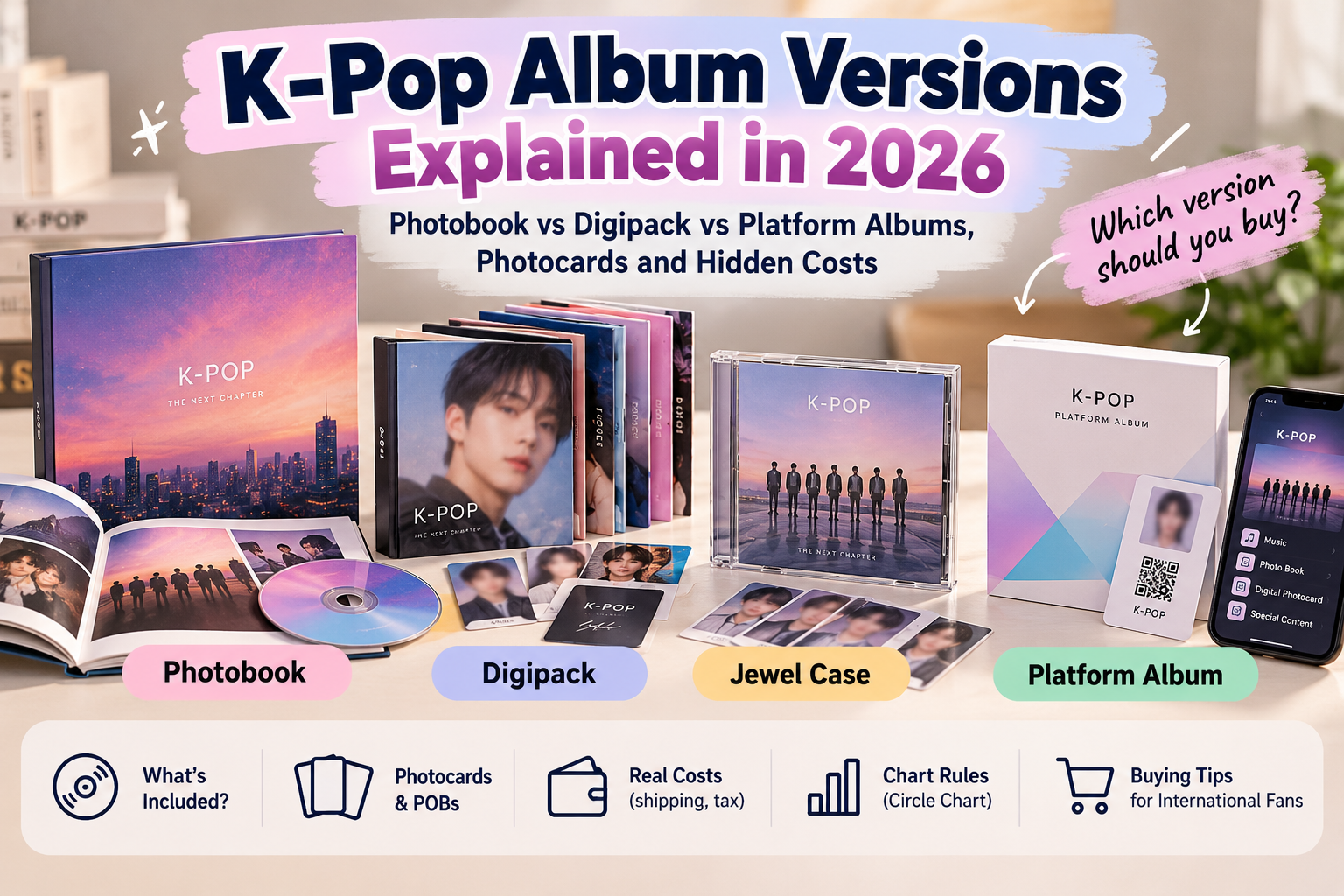
1. Photobook Albums: Best for Fans Who Want the Full Visual Concept
The photobook edition is often the most visually substantial format.
Depending on the release, it may include:
A printed photobook
A physical CD
One or more random photocards
Posters, stickers, postcards or lyric materials
Version-specific concept photography
A photobook album can be particularly satisfying if you enjoy displaying albums or revisiting the photography long after the comeback.
However, larger packaging can increase shipping costs, particularly when buying several albums internationally.
Best for: Fans who value printed photography, physical music ownership and display-worthy packaging.
Watch out for: Paying more for size and weight when you primarily want a single photocard.
2. Digipack Albums: Smaller Packaging, Often With Member Covers
A digipack generally uses compact cardboard packaging rather than a large album box.
Many K-pop releases offer member-specific covers, although the exact design depends on the artist.
A digipack may contain a CD, a smaller booklet and photocards. It does not automatically guarantee a photocard matching the member on the cover.
For example, official AHOF digipack specifications for RUN TO YOU list member and group versions, a CD, a 16-page photobook and randomly included photocards.
This illustrates an important distinction: choosing a member cover is not necessarily the same as choosing a member photocard.
Best for: Fans who want a compact physical CD or a particular member’s cover.
Watch out for: Listings marked random version, even when the product photographs show every member.
3. Jewel Case Albums: A Conventional CD in Compact Packaging
Jewel case versions generally resemble traditional CD releases.
They are useful for fans who want a physical disc without the size of a full photobook package.
Some releases add booklets, photocards or alternative covers, but inclusions differ.
A jewel case may be less expensive to ship because it is compact, although shipping prices depend on the retailer and destination.
Best for: Fans who primarily want a physical CD and prefer smaller packaging.
Watch out for: Assuming the jewel case includes the same printed photographs as the larger edition.
4. Platform Albums: What Are QR, Weverse, Nemo and POCA Versions?
Platform albums are one of the most confusing categories for first-time buyers.
Instead of relying on a conventional CD, these editions may use a QR code, NFC technology or another physical access item to connect to music and digital content through an app.
Weverse Albums, for example, describes a system that lets users register albums through QR codes and access music, digital photobooks and digital photocards.
Other platforms may work differently.
Before buying, check:
Is there a physical CD?
Which app is required?
Does the app work in your country?
How is the album registered?
Can the access item be reused after registration?
What happens if you change phones?
Can you listen offline after completing the required setup?
Best for: Fans who prefer compact collectibles and are comfortable accessing music through an app.
Watch out for: Assuming a QR-based album can be played in a CD player or that all platforms have identical access rules.
Do Platform Albums Count Toward K-Pop Album Charts?
Some do, but not every QR-based product should automatically be treated as chart-eligible.
Circle Chart officially recognizes approved platform album formats under defined requirements, including distribution, release status and access conditions.
Its album chart methodology is based on distribution volume adjusted for returns, rather than simply counting every purchase made by a fan.
If chart contribution matters to you, verify the exact album and seller’s stated chart eligibility.
Do not assume that buying a digital code, a platform album and a conventional CD will always have identical reporting arrangements.
5. Random Photocards: What Does “Random 1 of 8” Actually Mean?
Suppose an album lists:
Photocard: Random 1 out of 8.
That means the album contains one card selected from eight possible designs. It does not mean you receive all eight cards.
Buying two albums also does not guarantee two different cards.
You may receive duplicates.
A member-specific album cover does not necessarily guarantee a matching member photocard unless the product specifications explicitly say so.
A Better Photocard Buying Strategy
If you only want one particular card, compare the total cost of buying random albums with the cost of obtaining that card separately from a reputable seller or through a trusted trade.
For example, if an album has eight equally likely card designs and includes one card, the probability of obtaining one specific card from a single album would be 12.5%.
With three independent purchases under those assumptions, the probability of receiving that card at least once is approximately 33%.
Actual distributions and packaging practices can differ, so this is an illustration rather than a guarantee.
The key lesson: Buying more random albums can become expensive without guaranteeing your desired photocard.
6. What Is a POB? Pre-Order Benefits vs Album Inclusions
POB means pre-order benefit.
A POB is an additional item offered under particular promotional conditions, often by a specific retailer or for a particular purchase period.
It may be a photocard, postcard or another collectible.
But a POB is not necessarily included in every copy of the album.
Consider three separate items:
Item
What it means
Main risk
Standard album photocard
Included according to the album specifications
Usually random
Retailer POB
Extra benefit for qualifying purchases
Deadline, stock or seller restrictions
Lucky draw benefit
Promotional collectible offered under event rules
Eligibility and selection conditions
A product listing that says POB included should identify the actual promotion or provide enough detail for you to verify it.
Before paying, check whether the benefit is guaranteed, random, limited to a certain quantity or available only while supplies last.
For collectors, the retailer and promotion can matter as much as the album version.
7. The Hidden Cost of Buying K-Pop Albums Internationally
A lower album price does not necessarily mean a cheaper purchase.
International buyers should compare the final delivered cost, not just the price displayed on the product page.
Here is a hypothetical example. These are illustrative figures, not current retailer quotes.
Cost component
Photobook album
Compact album
Album price
$22
$15
International shipping
$19
$13
Estimated tax or handling
$5
$4
Total delivered cost
$46
$32
The compact version saves $14 in this example, even though the album itself costs only $7 less.
Your actual total depends on shipping weight, destination, carrier, taxes and seller policies.
Three Costly Mistakes to Avoid
Mistake 1: Buying multiple albums without comparing combined shipping.
Some sellers calculate shipping by package weight, while others use different rules. Combining items may save money, but it is not guaranteed.
Mistake 2: Paying extra for a POB you do not particularly want.
A promotional photocard can be valuable to collectors, but that does not mean it offers value to every buyer.
Mistake 3: Ordering a random version when you want a specific member.
Check whether the retailer allows version selection before paying.
8. Do All Album Versions Have the Same Songs?
Often, different packaging versions of one release share the same tracklist.
However, that should not be assumed for every special edition, repackage, regional release or platform product.
Always compare the official tracklist and edition details.
If you are trying to understand the distinction between a single, mini album and full album, see our guide:
Compare the final checkout price for at least two album formats.
Include international shipping, import charges where applicable, currency conversion and any additional fees.
A compact album may be the better value, but the cheapest choice depends on your destination and what you want to collect.
10. Seven Things to Check Before You Order
Use this checklist before completing your purchase:
The exact album version is identified.
The listing confirms whether a physical CD is included.
Member selection or random allocation is clearly stated.
Standard inclusions are distinguished from POBs.
The platform and app requirements are clear, if applicable.
Chart eligibility is verified if it matters to you.
The final delivered cost fits your budget.
Taking a few minutes to verify these details can prevent expensive disappointment.
Frequently Asked Questions
Is a digipack a real K-pop album?
Yes. A digipack is a legitimate physical packaging format when released as an official album edition. Its contents vary by release.
Does a platform album include a CD?
Many platform albums use QR, NFC or similar access systems instead of a conventional CD. Check the exact product specifications.
Does buying a member version guarantee that member’s photocard?
Not necessarily. The cover and photocard allocation may follow different rules.
Are pre-order benefits included in every album?
No. POB eligibility depends on the promotion, retailer, purchase timing and stock conditions.
Are platform albums counted on Circle Chart?
Approved platform album formats can qualify under Circle Chart’s official criteria. Eligibility should be verified for the specific release and format.
Should I buy every version to support my favorite group?
You do not need to purchase every version to enjoy or support an artist. Choose according to your budget and what you actually value.
Final Verdict: Buy for Your Purpose, Not the Number of Versions
There is no single best K-pop album format.
A photobook edition may offer the most satisfying physical collection. A digipack may be ideal for a member-focused fan. A jewel case can provide a compact CD, while a platform album may appeal to someone who prefers app-based access.
The smartest purchase is the one that matches your priorities without unnecessary spending.
Before ordering, verify the version, inclusions, benefits, chart claims and total delivery cost.
One carefully chosen album can be more satisfying than several versions bought without knowing what is inside.
LE SSERAFIM is heading to Kyocera Dome Osaka for two concerts on December 19 and 20, 2026, as part of the group’s PUREFLOW tour.
For international FEARNOTs, however, planning the trip involves more than choosing a concert date.
There are different ticketing routes, membership requirements, VIP upgrade conditions, and special fan events connected to the group’s Japanese single Made My Night.
Most importantly, a concert ticket and entry to a fan event are not the same thing.
This guide separates confirmed information from details that still need checking, explains the different ticket and fan-event options, and helps overseas fans avoid common booking mistakes.
LE SSERAFIM PUREFLOW Osaka 2026: Quick Facts
Detail
Official information
Artist
LE SSERAFIM
Tour
2026 LE SSERAFIM TOUR ‘PUREFLOW’
Venue
Kyocera Dome Osaka, Japan
Concert 1
Saturday, December 19, 2026
Concert 2
Sunday, December 20, 2026
Standard reserved seat
¥16,500
VIP upgrade total
¥27,500
Special fan events
High-touch and photocard handover events
Related Japanese single
Made My Night
Time zone
Japan Standard Time (JST)
Ticketing fees may be charged separately, and event conditions vary by application route.
1. LE SSERAFIM’s Osaka Dome Concert Dates and Times
The two Osaka performances have different opening and starting times.
Date
Doors open
Concert starts
Saturday, December 19
3:00 PM
5:00 PM
Sunday, December 20
2:00 PM
4:00 PM
All times are in Japan Standard Time.
The concerts will take place at Kyocera Dome Osaka, a major indoor venue in Osaka.
These dates and times are confirmed by both the group’s Japanese official website and the venue’s published event schedule.
The official notice also states that performance details may change.
Why international fans should pay attention to the start times
If you are traveling from another country or another Japanese city, do not plan around the concert start time alone.
You may need additional time for ticket collection, identity verification, security checks, merchandise shopping, and finding your entrance.
VIP soundcheck participants may have an earlier schedule than standard ticket holders.
Fans selected for post-concert events must also allow extra time after the main performance.
2. How Much Are LE SSERAFIM Osaka Concert Tickets?
The official announcement lists two main price levels.
Ticket type
Price
Main difference
Reserved seat
¥16,500
Standard concert admission
VIP upgrade
¥27,500 total
Arena-area seating guarantee and soundcheck access
The VIP total consists of a ¥16,500 reserved ticket plus an ¥11,000 upgrade.
Additional ticketing fees may apply.
Is VIP worth the extra ¥11,000?
The main officially announced benefits include an arena-area seat guarantee and access to the pre-concert soundcheck.
But VIP is not simply a premium ticket that anyone can purchase through any sales channel.
The official terms restrict VIP upgrades to eligible FEARNOT Membership applicants.
Fans should verify their own membership category and the specific application conditions before purchasing.
Important VIP planning detail
The official English Weverse notice explains that soundcheck attendees may be required to remain inside the venue until the concert ends, without re-entry after leaving.
This matters if you plan to buy merchandise, meet friends, or eat outside the venue.
5. High-Touch Event vs Photocard Handover: What Is Different?
LE SSERAFIM has announced two separate post-concert promotional event formats connected to eligible Made My Night purchases.
Detail
High-touch event
Photocard handover
Type of experience
High-touch with all members
One member hands over a photocard while the others see participants off
Participation
Lottery winners only
Lottery winners only
Concert ticket required?
No, according to the official announcement
No, according to the official announcement
Location
Kyocera Dome Osaka
Kyocera Dome Osaka
Timing
After the relevant concert
After the high-touch event, according to the announced plan
Member selection
All-member format
Recipient cannot choose the member handing over the card
The photocard event does not mean receiving five photocards
The October 13 announcement describes an event involving all five members, but each selected participant receives one event-exclusive photocard from one member.
The photocard design is randomly selected from five solo selfie versions.
The member handing over the photocard cannot be chosen.
This is a useful distinction because the phrase “all-member event” could otherwise be misunderstood.
Can you win both events?
According to the official notice, a fan who wins both lotteries may participate in both events, subject to the organizers’ procedures.
That does not mean a fan is guaranteed to win either event.
6. Made My Night Photocard Event: Application Dates
The newly announced photocard handover event has two application rounds.
Round
Application period (JST)
Scheduled result announcement
Round 1
October 13, 11:00 AM – October 20, 10:59 AM
October 27, around 6:00 PM
Round 2
October 20, 11:00 AM – October 28, 10:59 AM
November 9, around 6:00 PM
These dates apply to the October 13 photocard event announcement, not to every Made My Night promotion.
The earlier high-touch event had different application dates, which have already passed as of this article’s update.
Which purchases qualify?
The organizers identify eligible products through the relevant Weverse Shop and Universal Music Store application listings.
Examples in the announcement include designated Made My Night editions such as CHEMICAL NIGHT and COMPACT versions.
However, not every listing for the same album automatically qualifies.
Buyers must select products specifically marked for the photocard handover application and complete payment within the applicable period.
Purchasing an ordinary album listing may not count.
Before ordering, check the official notice for the precise product name, store, purchase limits, and eligibility conditions.
7. Can You Attend a Fan Event Without a Concert Ticket?
Yes, the official notices say that selected participants may attend these promotional events without holding a ticket for the Osaka concert.
But there are important qualifications.
You must qualify through the relevant purchase and lottery process, receive an invitation, and satisfy the event’s identity and admission requirements.
You cannot simply arrive at Kyocera Dome and request entry.
Also, attending a fan event without a concert ticket does not provide admission to the main concert.
Why this matters for overseas fans
Imagine that you are planning a trip to Osaka primarily to attend the concert.
If you also want to apply for a fan event, you should treat it as a separate opportunity with a separate result date.
Do not book nonrefundable travel solely on the assumption that buying several albums guarantees an event invitation.
8. Identity Verification and Electronic Tickets
For the photocard event, the official announcement specifies identity checks and designated photo identification.
It also describes an electronic admission system called passchord.
The organizers indicate that participants need a compatible smartphone or tablet to access the required electronic ticket.
The passchord information is expected to be sent around 5:00 PM on the day before the relevant event, subject to the official process.
Overseas fan checklist
Before applying or traveling, verify:
Whether your name is entered exactly as required by the application platform.
Which photo identification documents the organizer accepts.
Whether your smartphone can access the required ticketing service in Japan.
Whether the application requires an address, telephone number, or other information you can legitimately provide.
Whether the event date and post-concert timing fit your travel schedule.
Do not assume that every foreign passport or digital ID will be accepted for every ticketing route. Follow the specific organizer’s published document requirements.
9. The Post-Concert Timing Problem
This is one of the most overlooked parts of the Osaka event planning process.
The official notice indicates that the high-touch event is expected to begin approximately 45 minutes after the concert ends, with the photocard handover scheduled afterward.
These are planned arrangements, not guaranteed finishing times.
The actual concert duration has not been established by the information cited here.
A practical example
Suppose you attend the December 20 concert, which starts at 4:00 PM.
If you are also selected for a post-concert event, you cannot reliably calculate your departure time from the concert start time alone.
You need to account for:
The actual performance duration.
The time between the concert and fan-event check-in.
Possible event delays.
The order of the high-touch and photocard activities.
Travel from the venue to your hotel or station.
Do not book a tightly timed train or flight based on an assumed concert ending time.
For overseas visitors, staying in Osaka overnight may reduce the risk of a stressful return journey.
That is a travel-planning recommendation, not an official event requirement.
10. What Overseas Fans Should Confirm Before Traveling
A good concert trip begins with the ticket conditions, not the flight search.
Step 1: Choose your concert date
Compare December 19 and December 20 using the confirmed door and show times.
Step 2: Select the correct booking route
Check whether your eligibility fits a Japanese membership, GLOBAL/US membership, general sale, or global ticketing route.
Step 3: Confirm the ticket’s identity rules
Check name matching, ticket transfer restrictions, companion rules, and collection procedures.
Step 4: Separate concert and fan-event plans
A concert ticket does not guarantee a promotional event invitation.
A promotional event invitation does not include concert admission.
Step 5: Check accommodation and transport
Consider late-night travel, event delays, and the possibility of an extended stay.
Step 6: Monitor official announcements
Recheck official information shortly before departure, especially entry procedures and event meeting instructions.
For readers planning a wider Korea concert trip, our How to Buy K-Pop Concert Tickets in Korea as a Foreigner coverage provides additional background on presales and identity checks. Note that Japanese ticketing rules differ from Korean ticketing rules, so the Osaka organizer’s instructions take priority.
11. Why the Osaka Dome Shows Matter
The Osaka dates are more than another pair of tour stops.
The official announcement identifies them as LE SSERAFIM’s first Kyocera Dome Osaka concerts.
That makes the shows an important venue milestone in the group’s Japanese touring activities.
The Made My Night promotions also connect a physical music release with live fan participation.
This combination illustrates a familiar feature of the K-pop industry: a concert campaign can extend beyond the performance itself into album-linked promotions, fanclub programs, and exclusive in-person experiences.
For international fans, understanding these systems is increasingly important.
A concert announcement may look simple at first, but the actual participation options can involve several separate purchases, lotteries, and identity checks.
Frequently Asked Questions
When is LE SSERAFIM performing at Kyocera Dome Osaka?
December 19 and 20, 2026.
How much are PUREFLOW Osaka tickets?
The announced standard reserved-seat price is ¥16,500. The VIP upgrade totals ¥27,500, before any additional ticketing fees.
Can international FEARNOTs apply for tickets?
There are ticketing routes aimed at eligible GLOBAL/US membership holders and global buyers. Eligibility and availability depend on the specific platform and sales period.
Does buying Made My Night include a concert ticket?
No. Album-linked promotional event applications and concert tickets are separate.
Is the photocard handover event guaranteed with an album purchase?
No. The official promotion is lottery-based.
Can you attend the photocard event without a concert ticket?
Yes, if you win the relevant lottery and satisfy the participation requirements.
Will you receive a photocard from every member?
No. The announced event provides one random event-exclusive photocard, handed over by one member.
Can you choose which member hands over your photocard?
No. The official rules say the member cannot be selected.
Do you need photo identification?
Yes. The promotional event requires specified photo identification. Check the accepted document types in the official notice.
What time will the fan events finish?
A confirmed finishing time has not been provided in the sources used here. Fans should allow for delays and avoid tight travel connections.
Final Thoughts
LE SSERAFIM’s PUREFLOW concerts at Kyocera Dome Osaka on December 19 and 20, 2026, offer fans two major performances alongside separate Made My Night promotional opportunities.
The most important planning lesson is to keep the different systems separate.
Concert tickets, VIP upgrades, high-touch applications, and photocard event lotteries have different requirements.
For international FEARNOTs, checking those requirements before purchasing albums or booking travel can prevent expensive misunderstandings.
Use the official concert notices and promotional announcements as your final source of truth, particularly for ticket availability, identity checks, and event entry procedures.
Editorial note: Information is based on published official announcements checked on October 15, 2026. Ticket inventory, application eligibility, schedules, and event rules may change. This article is an independent fan information guide and is not affiliated with LE SSERAFIM, SOURCE MUSIC, HYBE, or the event organizers.
Your official K-pop lightstick turns on, but it will not connect to the app. Or perhaps Bluetooth works, yet your concert seat will not register. Does that mean your lightstick is broken?
Not necessarily.
In 2026, K-pop concert lightstick problems can have several different causes: an unsupported model, outdated firmware, weak batteries, incorrect seat information, or a misunderstanding of how a particular concert controls its audience lighting.
The most important thing to know is that not every K-pop concert uses the same pairing system.
Some performances require fans to register their seats through an official app. Others synchronize supported lightsticks automatically inside the venue. Certain older lightstick versions can illuminate normally but cannot participate in the synchronized concert effects.
This guide explains how to identify the problem, what to check before leaving home, and what to do if your lightstick stops working at the venue.
Last reviewed: October 2026. Lightstick compatibility and concert-mode instructions are event-specific. Always follow the latest notice from your artist, promoter, or official lightstick app.
Quick Answer: Why Is My K-Pop Lightstick Not Connecting?
Start by identifying what is actually failing.
Problem
Possible cause
First thing to check
Lightstick will not turn on
Battery or power issue
Battery type, orientation and contacts
Lightstick turns on but app cannot find it
Bluetooth mode, permissions or app issue
Official pairing instructions
Bluetooth connects but seat registration fails
Incorrect seat details or unavailable registration window
Event-specific concert notice
Lightstick works but does not change colors with the audience
Unsupported version or incomplete concert setup
Supported model list
Lightstick disconnects during an update
Power or connection interruption
Battery condition and official recovery instructions
Lightstick works at home but not inside the venue
Concert-mode requirements or event compatibility
On-site pairing support
Lightstick works at one concert but not another
Different concert systems or rules
Current event’s official guide
A lightstick that does not synchronize is not automatically defective.
Before buying a replacement, check whether the concert supports your exact model.
1. Understand the Three Different Types of Lightstick Connection
One reason fans become confused is that the word pairing can describe different processes.
Bluetooth connection to your phone
Many official lightsticks use Bluetooth to communicate with a dedicated smartphone application.
This connection may allow you to:
Check the device’s status
Update its firmware
Adjust supported settings
Access concert-specific functions
However, connecting your lightstick to your phone does not necessarily mean it has been registered for a concert.
Seat registration through Concert Mode
Some performances require fans to enter the concert date and their exact seat information in the official app.
The system can then associate a supported lightstick with a particular location in the audience.
This allows the lighting production to create coordinated patterns across sections of the venue.
For example, official 2026 notices for TOMORROW X TOGETHER and TWS instructed fans to use the Concert Mode feature of their respective lightstick applications.
Automatic synchronization inside the venue
Other events use a different approach.
For the 2026 Weverse Con Festival, the official notice stated that supported lightsticks did not require separate app-based seat pairing. Fans were instructed to switch on their lightsticks inside the venue to participate in the supported lighting effects.
This distinction matters enormously.
Do not search endlessly for a seat-registration button if your event does not require seat registration.
Conversely, do not assume that turning on your lightstick is enough when your concert specifically requires advance pairing.
2. Before Troubleshooting, Check Your Exact Lightstick Version
An official lightstick is not necessarily compatible with every concert by the same artist.
Groups may release several generations of lightsticks.
Although older versions may still function as handheld lights, their wireless concert-control capabilities can differ.
Example: TXT’s 2026 concert guidance
The official 2026 TXT MOA CON guide instructed fans to use the TXT Official Light Stick Ver.2 application and complete a firmware update and seat pairing.
It also stated that TXT Official Light Stick Ver.1 did not support the wireless-controlled performance.
Example: SEVENTEEN’s concert compatibility
Official SEVENTEEN concert notices have similarly distinguished between supported Ver.3 models and earlier generations that do not support the event’s wireless effects.
The practical lesson is simple:
The group name alone is not enough. You need the exact lightstick model and version.
How to check compatibility
Before purchasing or troubleshooting, find:
Your artist’s official concert notice
The exact lightstick model listed as supported
Any firmware requirements
Whether the concert uses seat registration
Whether the venue provides pairing or repair assistance
Do not rely solely on an older fan tutorial or an online seller’s compatibility claim.
3. Fix a Lightstick That Will Not Connect to Bluetooth
If the device powers on but the official app cannot detect it, work through the following checks.
Step 1: Confirm that you installed the correct app
Some artists have dedicated applications for specific lightstick models.
An older app may not support a newer device, and a similarly named third-party app may not be appropriate.
Use the app linked by the artist’s official announcement or official product instructions.
Step 2: Check your phone’s Bluetooth settings
Make sure Bluetooth is enabled.
Also check whether the official application has the permissions required by your phone’s operating system.
Depending on the device and operating system, these permissions can affect Bluetooth discovery.
Step 3: Enter the correct lightstick connection mode
Some models require a particular button sequence to enter Bluetooth mode.
For example, an official CLOSE YOUR EYES concert guide described a process involving a double-click of the power button before connecting through the group’s app.
That does not mean the same sequence works for every lightstick.
Follow the instructions for your exact model rather than experimenting with random button combinations.
Step 4: Move away from other active Bluetooth devices
If the app is having trouble discovering your lightstick, try the connection in a less crowded environment.
Temporarily reducing nearby device interference may help isolate the problem, although it is not a guaranteed fix.
Step 5: Restart the app and retry
Close and reopen the official app.
If necessary, restart your phone and follow the lightstick’s documented connection procedure again.
Avoid resetting or reinstalling firmware unless the manufacturer specifically instructs you to do so.
Step 6: Check for firmware updates
Some concerts require updated firmware for synchronized effects.
Complete any official update before arriving at a crowded venue.
Do not interrupt a firmware update intentionally or remove batteries while an update is in progress.
If the update fails, use the official recovery procedure or contact authorized support.
4. What If Bluetooth Works but Concert Mode Does Not?
This is a different problem.
Your phone may communicate with the lightstick correctly while the concert registration remains incomplete.
Check these possibilities.
The registration window has not opened
Some organizers allow seat registration only during a specified period before the concert.
For example, official SEVENTEEN notices have published different registration opening times for different performance dates.
If the feature is unavailable several days before your show, the registration period may simply not have started.
You selected the wrong performance date
Multi-day concerts may require separate registration for each show.
Choose the exact date shown on your ticket.
Your seat information is incorrect
Check the ticket carefully.
You may need to enter:
Section or block
Row
Seat number
Performance date
Use the official app’s required format.
Do not assume that seat information can be entered in the same way for every venue.
Your ticket or seat has changed
If your seat was reassigned or you received a replacement ticket, follow the organizer’s instructions for updating the registration.
Do not assume the old seat information will automatically change.
The concert does not use app-based seat registration
This possibility is easy to overlook.
For some events, supported lightsticks synchronize automatically inside the venue.
Always check the event notice before treating a missing Concert Mode option as an error.
5. Battery Problems: Why a Lightstick Can Turn On but Still Fail
A lightstick may illuminate briefly even when its batteries are no longer reliable enough for normal operation.
Official concert notices repeatedly warn that low batteries can cause weak illumination or interrupt synchronized effects.
Use the battery type specified for your model
Several official lightsticks use three AAA alkaline batteries.
However, this is not a universal specification.
Check your product manual before buying replacements.
Some devices use different power arrangements.
Replace old batteries before the show
If your model uses replaceable batteries, bring fresh batteries of the recommended type.
Avoid mixing old and new batteries.
Check that each battery is inserted in the correct direction.
Bring spares when permitted
Spare batteries can be useful during a long concert day.
Check the venue’s rules and carry batteries safely to prevent short circuits.
If the lightstick suddenly switches off
Try this sequence:
Confirm that the battery compartment is securely closed.
Check whether the batteries are depleted.
Replace them according to the official instructions.
Turn the device on again.
Recheck concert synchronization if required.
Some models retain concert registration after a battery replacement, but do not assume this applies to every lightstick.
The official SEVENTEEN guidance for certain performances has specifically addressed how pairing behaves when batteries are replaced.
6. Why Does My Lightstick Work at Home but Not at the Concert?
This can happen even when the hardware is functioning.
There are several possible explanations.
The lightstick is an unsupported version
Your device may still turn on but lack the wireless-control compatibility required for that performance.
The seat registration was not completed
If the event requires advance seat pairing, ordinary Bluetooth connectivity is not sufficient.
The event uses automatic venue synchronization
Your lightstick may behave differently once the concert’s wireless-control system is active.
The device needs a firmware update
Some concert organizers identify specific models that must be updated before the show.
The venue has a temporary technical issue
If your model is supported and your setup appears correct, seek assistance from official staff rather than assuming the device is broken.
Important: Wireless concert lighting is controlled by the event’s production system. You cannot guarantee compatibility merely by changing the lightstick’s ordinary color settings.
7. The 2026 Concert Examples That Explain Why One Tutorial Cannot Fit Every Group
Official notices provide useful real-world examples.
Concert or event
Published setup approach
Important distinction
2026 TXT MOA CON
Official app, firmware update and seat pairing
Ver.1 excluded from wireless effects
2026 TWS TOUR in Seoul
Official app Concert Mode and seat pairing
Advance pairing recommended
2026 Weverse Con Festival
Supported devices synchronized inside venue
Separate app seat pairing not required
2026 SEVENTEEN encore performances
Supported Ver.3 devices and event-specific pairing guidance
Earlier versions excluded from wireless control
2026 LE SSERAFIM Japan performances
Official app and seat registration
Registration timing varied by performance
These are examples from specific events, not permanent rules for every future concert by those artists.
A later tour may use different instructions.
Always treat the latest notice for your particular show as the final authority.
8. What to Do the Day Before Your Concert
A few minutes of preparation can prevent an unnecessarily stressful arrival.
Your pre-concert checklist
Confirm the exact supported lightstick version.
Read the latest official concert notice.
Install or update the correct official app.
Complete any required firmware update.
Check whether seat registration is required.
Enter the correct concert date and seat details when registration is available.
Test the device’s basic power function.
Prepare fresh batteries of the specified type.
Save your ticket and the relevant concert instructions.
Find out whether the venue offers a lightstick support booth.
Do not wait until you are standing in a crowded entrance queue to perform a major firmware update.
Official organizers have warned that congestion and unstable connectivity can make on-site setup difficult.
9. What to Do If Your Lightstick Stops Working at the Venue
First, identify whether the issue is basic power, app connection, seat registration, or synchronized lighting.
If it will not turn on
Check the batteries and compartment.
If the problem persists, ask whether an authorized support booth is available.
If it will not pair with your seat
Recheck the performance date and seat information.
Follow the official concert-mode procedure.
If the app still fails, visit the pairing support booth where available.
If it is not changing colors with the audience
Do not immediately reset the device.
Check whether your model is supported and whether the event requires seat registration or automatic synchronization.
If you need help
Some concerts operate official pairing, firmware-update, or repair booths.
For example, SEVENTEEN’s 2026 encore concert notices described dedicated on-site pairing assistance.
But booth availability, hours, and services vary by event.
Check your concert’s official information rather than assuming support will be available.
What if the problem cannot be fixed?
You can still enjoy the concert.
A malfunctioning or incompatible lightstick should not prevent you from participating in the music, singing, and atmosphere.
Follow venue rules about lighting devices, and do not use unsupported lights where they are prohibited.
10. Should You Buy a New Lightstick Just for Concert Synchronization?
Not automatically.
Before purchasing, consider three questions.
Is your current version supported?
If yes, troubleshooting may be more sensible than replacement.
Does the new model support your upcoming concert?
Verify this through the current event notice.
A newer-looking model is not enough evidence.
How often will you use it?
If you attend concerts regularly, the ability to participate in synchronized lighting may matter more to you.
If you are attending only one performance, consider the purchase cost in relation to your budget and priorities.
A lightstick is also a collectible expression of fandom, not merely a technical accessory.
There is no requirement to buy every new generation to be a meaningful fan.
11. Avoid These Common Lightstick Mistakes
Mistake 1: Assuming Bluetooth connection means seat registration is complete
These can be separate steps.
Mistake 2: Following instructions for a different lightstick generation
Button sequences, applications, and compatibility can change.
Mistake 3: Buying an unofficial device and expecting guaranteed concert synchronization
Only rely on officially documented compatibility.
Mistake 4: Using depleted batteries
Weak batteries can interrupt normal operation and wireless effects.
Mistake 5: Updating firmware for the first time in a crowded venue
Complete required updates in advance whenever possible.
Mistake 6: Registering the wrong seat or concert date
Check your ticket carefully.
Mistake 7: Assuming every event requires manual pairing
Some concerts use automatic synchronization.
Mistake 8: Buying a replacement without checking compatibility
A supported model with a simple setup problem may not need replacing.
12. How Concert Lightsticks Became Part of K-Pop Performance Culture
Modern lightsticks are more than merchandise.
They turn the audience into a visible part of the concert’s stage design.
When thousands of supported devices change colors together, the crowd becomes a coordinated visual environment.
This helps explain why pairing and wireless control matter to fans.
The technology connects individual participation with a collective performance.
But the emotional significance of a lightstick goes beyond technical synchronization.
For many fans, carrying an official lightstick symbolizes their relationship with an artist and a wider community.
That meaning remains even when a device cannot participate in every lighting effect.
Why is my K-pop lightstick not connecting to my phone?
Possible causes include an incorrect official app, disabled Bluetooth, missing permissions, an incorrect connection mode, or outdated firmware. Follow the instructions for your exact lightstick model.
Do all K-pop concerts require seat pairing?
No. Some require app-based seat registration, while others automatically synchronize supported lightsticks inside the venue.
Can an old official lightstick still work at a concert?
It may still illuminate normally, but wireless concert synchronization depends on the exact version and event. Check the supported-model list.
Why does my lightstick connect through Bluetooth but not Concert Mode?
The registration period may not be open, the seat information may be incorrect, or the event may use a different setup system.
Do I need Wi-Fi during the concert?
Requirements depend on the app and event. Complete updates and required registration in advance when instructed. Do not assume that every venue offers reliable connectivity.
Can I change batteries after pairing?
Some official systems retain registration after battery replacement. Check your model’s event-specific instructions rather than assuming this applies universally.
Can I use another group’s lightstick at a concert?
Venue rules and wireless compatibility vary. Some events restrict unsupported lighting devices. Check the concert policy before bringing one.
What if my lightstick is not changing colors with everyone else’s?
Check compatibility, concert-mode requirements, battery condition, and official venue instructions. Seek on-site support if available.
Should I buy a new lightstick before every tour?
No. First verify whether your existing version supports the upcoming concert and whether any required firmware updates are available.
What should I do if pairing fails at the venue?
Use the official pairing or service booth if the organizer provides one. Avoid unapproved firmware procedures or random resets.
Final Thoughts: Check the Concert, Not Just the Lightstick
A K-pop lightstick that will not connect is frustrating, especially when you have traveled a long way to see your favorite artist.
But the solution often begins with one simple question:
What does the official notice for this exact concert require?
Check your lightstick version, use the correct app, confirm the registration method, update firmware when instructed, and prepare suitable batteries.
Above all, remember that different concerts use different synchronization systems.
The best troubleshooting guide is not a universal button sequence. It is a clear process for identifying the correct requirements before you arrive.
And even if your lightstick refuses to cooperate, the music and the experience of sharing it with other fans remain the heart of the concert.
Editorial disclosure: This article is an independent informational guide based on published official instructions. It is not affiliated with any artist, entertainment company, or concert organizer. Specific concert requirements may change.
A world tour can be more than a sequence of concerts. For ATEEZ, the announced 2027 “ZERO TO ALL” world tour offers an opportunity to revisit the group’s artistic identity, international rise, and relationship with ATINY, its global fandom.
The title is particularly intriguing. ATEEZ has long built its music and performances around ambition, movement, identity, and collective experience. “ZERO TO ALL” feels like a continuation of that vocabulary, but it also invites a larger question: what does it mean for a group that has already reached international stages to begin another chapter?
Here is what fans should know about the announced tour schedule, the anticipated November 2026 comeback, ticket preparations, and the creative significance of ATEEZ’s next era.
ATEEZ “ZERO TO ALL” World Tour: What Has Been Announced?
The announced tour is scheduled to begin in Incheon, South Korea, on January 22–24, 2027, before moving through additional international markets.
The itinerary provides a broad picture of the group’s plans, although not every city, venue, and ticketing detail has been finalized publicly.
Region
Announced period
Status
Incheon, South Korea
January 22–24, 2027
Opening concerts announced
Japan
February 2027
Tour period announced
Europe
March–April 2027
Tour period announced
North America
July–August 2027
Tour period announced
South America
September 2027
Tour period announced
Important: These dates and periods reflect the announced tour framework, not a complete list of confirmed venues or individual performances. Fans should consult official ATEEZ and promoter announcements before arranging travel or purchasing tickets.
The geographical scope is significant. Rather than treating overseas appearances as occasional extensions of domestic promotion, ATEEZ continues to position international touring as a central part of its career.
Why “ZERO TO ALL” Is an Interesting Tour Title
ATEEZ debuted in 2018 with a creative identity shaped by exploration, ambition, and the pursuit of something beyond familiar boundaries.
Its earlier TREASURE era introduced an expansive sense of adventure, while subsequent releases developed increasingly complex narratives around identity, freedom, resistance, and self-determination.
Against that history, “ZERO TO ALL” suggests a compelling artistic progression: from the beginning of a journey toward an experience shared across continents.
This is an interpretation of the title, not a confirmed explanation from the group.
The word “all” is especially meaningful in the context of live performance. An ATEEZ concert is not simply a presentation of recorded songs. It is an encounter between the performers and an audience that actively shapes the atmosphere through chants, light sticks, and collective participation.
That relationship helps explain why concerts have become such a defining part of contemporary K-pop.
The November 2026 Comeback: A Bridge to the Next Tour?
ATEEZ’s forthcoming album, GOLDEN HOUR : Part.6, has been reported for release on November 13, 2026.
Its proximity to the January 2027 tour opening creates an interesting sequence: new music in November, followed by a major live-performance chapter approximately two months later.
That timing raises several possibilities.
New songs could influence the concert setlist. Recent choreography might become a centerpiece of the stage production. The group’s visual concepts could also provide clues about the atmosphere of the tour.
However, these are possibilities rather than confirmed production details. A complete setlist, stage design, and the precise relationship between the album and tour should not be assumed before official announcements.
What makes the timing notable is the way it connects recorded music with the concert experience. In K-pop, a comeback can introduce an artistic idea, while a subsequent tour allows that idea to develop through performance.
For readers interested in the industry’s creative process, our article on How K-Pop Songs Are Made explains how musical concepts move from songwriting to finished releases.
What Makes an ATEEZ Concert Different?
ATEEZ has cultivated a performance-centered identity in which choreography, theatrical expression, and musical intensity operate together.
Three qualities are especially important.
1. Performance as storytelling
ATEEZ’s stage presence is often built around dramatic contrasts: tension and release, precision and spontaneity, restraint and explosive movement.
These qualities allow a song to become something larger in a concert setting. Movement does not merely accompany the music; it can communicate the emotional stakes of the performance.
2. A distinctive musical range
ATEEZ’s catalog moves across forceful electronic production, hip-hop influences, melodic passages, and theatrical arrangements.
That variety offers possibilities for a concert’s emotional pacing. A powerful opening sequence can lead into more reflective material before the energy rises again.
The final artistic structure of “ZERO TO ALL,” however, will only become clear once official production details or performances are available.
3. Audience participation
ATINY’s role is central to the atmosphere of ATEEZ performances.
Fan chants, coordinated light sticks, and shared familiarity with songs can transform a large venue into a collective experience.
This dynamic is part of a wider transformation in K-pop, where fandom is not merely an audience category but an active cultural community.
For international fans, ticket information is often more complicated than a simple sale date.
As of this article’s October 13, 2026 editorial update, readers should not treat unverified online listings as proof that a particular show, venue, price, or presale has been officially confirmed.
Before attempting to buy tickets, check the following:
Official announcement channels. Start with ATEEZ’s official website, verified social media accounts, and notices from KQ Entertainment.
Local promoters. Ticketing companies and sales procedures may differ by country. A ticket platform used in Korea may not be the one used in Europe or North America.
Presale eligibility. If a membership presale is announced, check the registration deadline, account requirements, and whether eligibility must be verified in advance.
Identity requirements. Some concerts use purchaser-name verification or identification checks. Confirm the policy for the specific event rather than assuming all venues follow the same rules.
Refund and transfer policies. Understand whether a ticket can be canceled, transferred, or resold through an authorized channel.
Should Fans Book Flights Before Ticket Confirmation?
Generally, it is safer to wait until the specific concert date, venue, and ticketing conditions are officially confirmed.
Even when a tour period has been announced, individual dates may not yet be available. Booking nonrefundable travel too early can create unnecessary financial risk.
Fans who must plan in advance should consider flexible travel arrangements and read cancellation terms carefully.
Why the 2027 Tour Matters for ATEEZ’s Global Position
The significance of “ZERO TO ALL” extends beyond the number of cities on a tour poster.
International touring reflects the relationship between an artist’s recorded music, audience demand, live-production capabilities, and long-term cultural reach.
ATEEZ is part of a generation of K-pop artists whose careers have developed alongside streaming platforms, global fan communities, and international concert markets.
These developments have made it possible for groups to build relationships with audiences far beyond South Korea.
But global visibility also brings a new challenge: maintaining artistic identity while performing for increasingly diverse audiences.
ATEEZ’s distinctive performance style gives the group a recognizable foundation. The coming tour will offer another opportunity to see how that identity translates across different venues and cultures.
Fans should distinguish official announcements from speculation circulating on social media.
The following details may require additional announcements or verification for each destination:
Complete city and venue lists
Individual performance dates outside the specifically announced opening shows
General-sale and presale dates
Ticket prices and VIP package details
Seating configurations and venue-specific policies
The official concert setlist
Additional stops or schedule changes
This article will be most useful when these details are updated individually, with clear publication dates and official sources, rather than presented as predictions.
Frequently Asked Questions
When does ATEEZ’s 2027 world tour begin?
The announced opening concerts are scheduled for January 22–24, 2027, in Incheon, South Korea.
Is ATEEZ touring North America in 2027?
North America is included in the announced tour framework for July–August 2027. Fans should wait for official city, venue, and ticketing details.
Will ATEEZ perform in Europe?
Europe is included in the announced itinerary for March–April 2027. Specific performance information should be checked against official updates.
When is ATEEZ’s next comeback?
The forthcoming GOLDEN HOUR : Part.6 album has been reported for November 13, 2026. Fans should consult official release notices for the latest information.
Has the “ZERO TO ALL” setlist been released?
A complete official setlist should not be assumed before the concerts take place or the group releases further details.
Where should international fans buy ATEEZ tickets?
Use the authorized ticket seller identified in the official announcement for the specific concert. Avoid treating unofficial resale listings as confirmed primary tickets.
Final Thoughts: From a Beginning to a Shared Global Stage
The most compelling aspect of ATEEZ’s “ZERO TO ALL” tour may be its sense of continuity.
The group began with a creative language of exploration and possibility. Years later, that language still resonates, but its scale has changed.
An announced itinerary stretching from South Korea to multiple international regions represents more than geographical expansion. It reflects the enduring relationship between a performance-driven group and the audiences that have followed its development.
The November 2026 comeback may provide new material for that next chapter. The 2027 tour will reveal how the music, choreography, and audience experience ultimately come together.
For now, the strongest approach is to appreciate what has been announced, remain cautious about unconfirmed details, and watch how ATEEZ shapes the next phase of its artistic journey.
Editorial note: Tour information reflects announcements reported as of October 13, 2026. Dates, locations, ticketing arrangements, and release information may change. Interpretations of the tour’s artistic meaning are editorial analysis, not official statements from ATEEZ or KQ Entertainment.
You are watching your favorite K-Pop group perform. The music starts, the crowd erupts, and suddenly thousands of fans shout the same words at exactly the same moment.
Some fans call out the members’ names. Others respond to particular lyrics or shout a phrase during a pause in the song.
If you are new to K-Pop, you might wonder: How does everyone know what to say?
The answer is a K-Pop fan chant, often written as fanchant.
Fan chants are one of the most recognizable traditions in K-Pop performance culture. They turn a concert audience into an active part of the experience.
But you do not need to memorize every word to enjoy a K-Pop show.
This beginner-friendly guide explains what fan chants are, how they work, where to find official instructions, and how to participate respectfully at your first concert.
What Is a K-Pop Fan Chant?
A K-Pop fan chant is a coordinated set of words, names, or phrases that fans shout or sing at specific moments during a performance.
In Korean, a fan chant is commonly called eungwonbeop (응원법), meaning a cheering method or cheering guide.
Fan chants may include:
The group’s name
Individual members’ names
Selected lyrics
Short responses between vocal lines
A repeated phrase at a particular point in the song
Some fan chants are officially shared by an artist’s company or fan community. Others develop informally among fans.
An official fan chant typically tells fans what to say and when to say it.
Unlike ordinary singing along, fan chants often fit into carefully chosen spaces in a song, allowing the performers’ voices to remain the focus.
Quick example: How a fan chant works
Imagine a fictional four-member group called STARLIGHT.
During the introduction to a song, fans might chant:
“MINA! JIHO! SORA! YUNA! STARLIGHT!”
Later, they might shout a short phrase during an instrumental break.
This is only an illustrative example, not an official fan chant for a real group.
The important point is that the audience follows a recognizable pattern rather than shouting randomly throughout the performance.
Fan Chant vs. Singing Along: What Is the Difference?
A fan chant and a sing-along may happen during the same concert, but they are not identical.
Fan chant
Singing along
Uses particular words at planned moments
Follows the song’s lyrics
May include member names
Usually follows the vocalist’s lines
Often has an official guide
Usually does not require instructions
Frequently fills pauses or instrumental sections
May continue through entire verses or choruses
Creates a coordinated audience response
Creates a shared singing experience
For example, a fan chant might call out member names during an introduction, while a sing-along might happen when the audience sings an entire chorus.
Some performances combine both traditions.
The easiest way to remember the difference: A sing-along follows the song; a fan chant follows a cheering pattern.
Why Do K-Pop Fans Shout Members’ Names?
Member-name chants are among the most recognizable parts of K-Pop fan culture.
For many groups, fans learn a specific sequence of names and shout them during a designated part of a song.
These chants serve several purposes.
1. Recognizing the members
Calling members’ names is a direct way for fans to express support for the artists onstage.
2. Creating a shared rhythm
A coordinated chant gives the audience a common pattern to follow.
Even fans who speak different languages can participate together.
3. Making the audience part of the performance
A loud, well-timed response can become part of the atmosphere of a live show.
The performers provide the music and choreography; the audience adds its collective voice.
4. Expressing fandom identity
Knowing a group’s fan chants can be one way fans connect with a larger community.
However, memorizing a chant is not a requirement for being a genuine fan.
If you are unfamiliar with the wider fan community, read our guide:
Five Common Fan Chant Mistakes Beginners Can Avoid
Mistake 1: Treating every fan-made guide as official
Fan tutorials can be useful, but they are not always accurate.
Check the source before memorizing a chant.
Mistake 2: Shouting throughout the entire song
Fan chants usually have particular timing.
Constant shouting can interfere with the performance and other fans’ enjoyment.
Mistake 3: Assuming every song has the same pattern
A group may use different cheering methods for different songs.
Some songs may have no official chant at all.
Mistake 4: Worrying that you are not a real fan
There is no requirement to memorize fan chants to belong to a fandom.
Knowing the music, appreciating the performers, and respecting fellow fans matter more than passing an imaginary test.
Mistake 5: Forgetting concert etiquette
A concert is a shared experience.
Respect venue rules, accessibility needs, and the space of nearby audience members.
If an artist requests silence or a particular audience response, follow those instructions rather than forcing a chant into the moment.
How Fan Chants Help Explain K-Pop’s Global Appeal
Fan chants reveal something distinctive about K-Pop: the relationship between artists and audiences is often highly participatory.
The audience is not simply listening.
Fans may learn choreography, follow comeback activities, share performance clips, use official lightsticks, and participate in coordinated cheering.
Fan chants are one visible—and audible—expression of that broader culture.
They also help explain how fans from different countries can share a recognizable concert experience.
A fan who learns a chant in Seoul and another who practices it in Los Angeles may be following the same pattern, even if they speak different languages.
This does not mean every K-Pop audience behaves identically. Concert traditions vary by artist, country, venue, and fan community.
Still, the shared structure of fan chants helps turn an individual listening experience into a collective performance moment.
To explore the broader development of these communities, read:
A fan chant is a coordinated audience response performed at specific moments during a song. It may include member names, selected lyrics, or short phrases.
What is the Korean word for fan chant?
The Korean term is 응원법 (eungwonbeop), commonly translated as a cheering method or cheering guide.
Are K-Pop fan chants official?
Some are officially published by artists or entertainment companies. Others are created informally by fans. Check the source before assuming a chant is official.
Do all K-Pop songs have fan chants?
No. Some songs have published cheering guides, while others do not.
Do I have to learn fan chants before a K-Pop concert?
No. Fan chants are optional. You can enjoy a concert without memorizing them.
Why do fans shout K-Pop members’ names?
Name chants express support, create a coordinated rhythm, and help the audience participate in the performance.
Can international fans participate in Korean fan chants?
Yes. Many fans learn chants through recordings, pronunciation guides, and practice, regardless of whether they speak Korean fluently.
Is a fan chant the same as a sing-along?
No. A fan chant follows specific cheering cues, while a sing-along generally follows the song’s lyrics.
Where can I find BTS fan chants?
Start with BTS’s official Weverse community and official channels. Look for cheering guides associated with particular songs.
What happens if I forget the fan chant during a concert?
Nothing is wrong. Listen, enjoy the performance, and join the parts you remember. Participation is not a test.
Final Thoughts: You Do Not Need to Be an Expert to Join In
K-Pop fan chants can sound complicated when you first hear thousands of people shouting in perfect coordination.
But the basic idea is simple.
Fans learn a shared pattern and use it to support performers at particular moments in a song.
If you are new to K-Pop, begin with one song, find an official guide when available, and practice a short section.
At your first concert, participate as much or as little as you feel comfortable.
The goal is not to chant perfectly. It is to enjoy the music and share the experience with other fans.
Editorial note: Official fan chant availability and concert participation rules vary by artist and event. Always check the latest artist and venue announcements before attending a performance.