Tag: K-Pop Fans

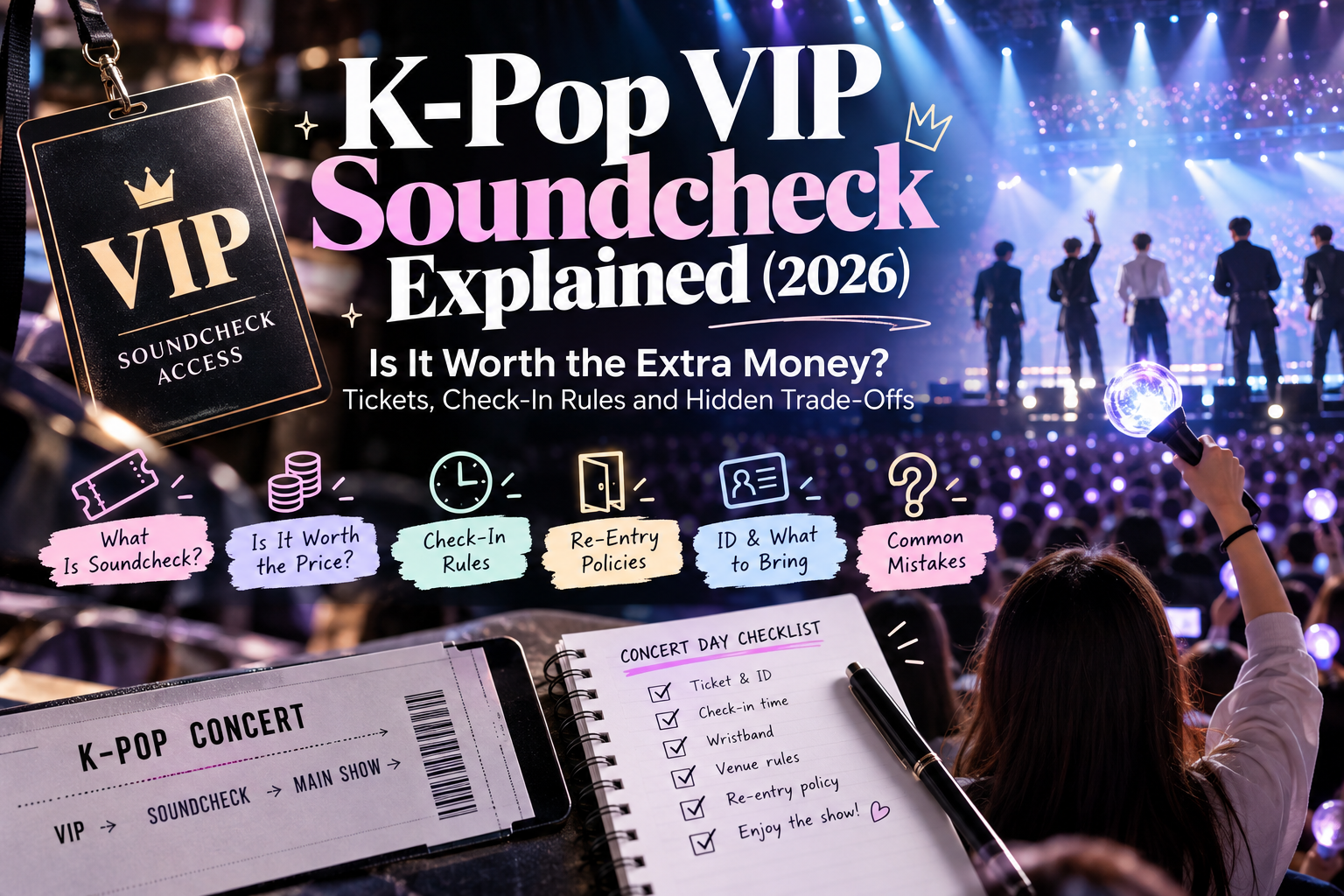
  • K-Pop VIP Soundcheck Explained (2026): Is It Worth the Extra Money? Tickets, Check-In Rules and Hidden Trade-Offs

    K-Pop VIP Soundcheck Explained (2026): Is It Worth the Extra Money? Tickets, Check-In Rules and Hidden Trade-Offs

    You finally find tickets for the K-pop concert you’ve been dreaming about.

    Then another option appears on the booking page: VIP with soundcheck access.

    The price is higher. The description promises an exclusive pre-show experience. And suddenly, the decision feels much more complicated.

    Will you actually get closer to your favorite artist? Is soundcheck a mini-concert? What happens if you arrive late? And could you pay for VIP only to miss the part you wanted most?

    The answers are not as straightforward as many ticket listings make them seem.

    In 2026, official concert announcements show that soundcheck benefits can work very differently depending on the artist, venue and organizer.

    This guide explains what you’re really paying for, how the rules affect your experience, and when a VIP upgrade makes financial and practical sense.

    1. What Is K-Pop Soundcheck, Exactly?

    A soundcheck is traditionally part of a concert’s technical preparation.

    Before the main performance, artists and production teams may check microphones, instruments, stage audio or other elements of the live show.

    A VIP soundcheck event, however, is a fan-facing experience built around that pre-concert period.

    Depending on the tour, eligible fans may enter the venue early and watch a short performance or special appearance before the main concert begins.

    But here’s something worth understanding.

    A soundcheck event isn’t necessarily a technical rehearsal, a private concert or an opportunity to personally meet the artists.

    It is a specific event benefit, and the organizer decides what that benefit includes.

    You should never assume that a VIP soundcheck automatically comes with a meet-and-greet, a signed item, a group photo or direct interaction.

    Those benefits must be explicitly listed in the official package.

    Three different ways fans can access soundcheck

    Access typeHow it worksWhat to check
    VIP concert ticketSoundcheck is included with an eligible seat or packageTicket tier, included benefits, seating rules
    VIP upgradeAn existing qualifying ticket becomes eligible for additional benefitsMembership, lottery and upgrade conditions
    Promotional soundcheck eventAccess comes through a separate promotion or lotteryWinner verification, eligibility and assigned entry procedures

    These are not interchangeable.

    For example, a Weverse album-purchase soundcheck event may use a separate winner list and assigned seats, while a concert’s VIP ticket tier may have its own admission system.

    Before comparing prices, identify which kind of access you’re actually being offered.

    2. Is VIP Soundcheck Worth the Extra Money?

    This is the question that matters most.

    And there’s no universal answer.

    The value of soundcheck depends on what you receive beyond a regular ticket — and what you must give up to receive it.

    Consider a real example.

    For EXO’s April 2026 EXhOrizon concerts in Seoul, the announced VIP ticket price was KRW 198,000, compared with KRW 165,000 for a general ticket.

    That’s a difference of KRW 33,000 for the specified ticket categories.

    However, the premium was not simply a fixed price for a separate soundcheck. The ticket categories and their associated benefits were sold as packages.

    Official source: https://weverse.io/exo/notice/33571

    This distinction matters because the difference between two ticket prices does not automatically tell you what soundcheck alone is worth.

    A VIP package may also differ in seating, admission arrangements or other benefits.

    And you may not have the option to purchase a regular seat and add soundcheck separately.

    The real cost isn’t just the ticket difference

    Imagine two fans considering the same VIP ticket.

    Fan A lives near the venue, can arrive early and would treasure an additional performance experience.

    Fan B is flying into the city that afternoon, has a tight schedule and mainly wants to hear the complete concert setlist.

    Even at the same price, VIP may be an excellent choice for Fan A and a frustrating purchase for Fan B.

    Why?

    Because the effective cost includes more than money.

    You should consider:

    • The additional ticket or upgrade cost
    • Travel and accommodation changes required for early check-in
    • The possibility of missing the benefit because of an arrival delay
    • Extra time spent waiting at the venue
    • Restrictions on leaving and returning
    • Whether the actual experience matches your expectations

    A premium ticket offers an opportunity, not unlimited flexibility.

    3. The Most Overlooked Rule: Soundcheck Check-In Is Not Concert Entry

    One of the most expensive mistakes a fan can make is assuming that arriving before the main concert is early enough.

    It may not be.

    Soundcheck often operates on a separate timeline.

    A concert could begin in the evening while the soundcheck registration deadline falls much earlier.

    Your official instructions may list several different times:

    Time listedWhat it means
    VIP identity-verification windowWhen staff confirm your eligibility
    VIP check-in deadlineThe final time registration is accepted
    VIP gate admissionWhen eligible attendees are allowed through a specified entrance
    Soundcheck startWhen the pre-show event begins
    Main concert admissionRegular concert entry procedures
    Main concert startThe advertised performance time

    The mistake is planning your journey around only the final row.

    A real example: LE SSERAFIM’s 2026 Japan tour

    An official PUREFLOW soundcheck notice instructed VIP attendees to complete identity verification, receive a wristband and arrive at the designated gate within the announced admission procedure.

    It also warned that fans who were late might not be able to attend soundcheck, even though they could still enter later for the main concert.

    Official source: https://weverse.io/lesserafim/notice/37575

    That’s a crucial distinction.

    Missing soundcheck does not always mean losing your concert ticket. But keeping your concert admission doesn’t mean you can recover the missed VIP benefit.

    Always read the event-specific late-arrival policy before making travel plans.

    4. Can You Leave After Soundcheck and Come Back?

    Here’s where things get particularly interesting.

    There is no single K-pop industry rule for re-entry.

    Two official concert notices illustrate why.

    Example A: EXO — Exit and return required

    For EXO’s November 2026 EXhOrizon [dot] concerts, the official notice states that soundcheck attendees will be asked to leave after the event and prepare to re-enter for the main concert.

    It also states that missing soundcheck for personal reasons does not qualify for a partial refund.

    Official source: https://weverse.io/exo/notice/38455

    Example B: Jin — Leaving was not permitted

    For Jin’s #RUNSEOKJIN_EP.TOUR in JAPAN, the official VIP instructions took a different approach.

    After entering soundcheck, attendees were required to remain within the venue through the main concert.

    Leaving the venue meant re-entry would not be permitted, although the rules allowed movement to designated facilities inside.

    Official source: https://weverse.io/bts/notice/28049

    These are specific event policies, not universal rules for EXO, BTS or any future concerts.

    But they demonstrate something important.

    The same word — soundcheck — can describe experiences with completely different logistics.

    Before booking, find the official re-entry clause for your exact performance date.

    Never rely on a video, social media comment or guide from another tour stop.

    5. What Do You Actually Need to Bring?

    For many VIP experiences, buying a ticket is only the beginning.

    The organizer may require identity verification before allowing you to collect benefits or enter the venue.

    Depending on the event, you may need:

    • An accepted original identification document
    • The ticket or official digital ticket
    • Booking confirmation or reservation details
    • Evidence of eligible fan-club membership
    • A matching purchaser or attendee name
    • A wristband or another access item issued at the venue

    The precise requirements differ by event.

    International fans should pay particular attention to identification and account-name rules.

    A name entered differently on a ticketing account may create problems if the organizer requires an exact match with an accepted ID.

    But don’t assume every show follows identical document rules.

    Follow the accepted-ID list published by the actual organizer or ticket seller.

    An especially useful example is the official BTS ARIRANG soundcheck event guidance, which describes assigned verification windows, ticket collection and wristband procedures.

    Official source: https://shop.weverse.io/en/shop/USD/artists/2/notices/13339

    What about the wristband?

    Think of a soundcheck wristband as an access credential, not a souvenir you can casually remove.

    Some events require the issued wristband to remain on your wrist until the soundcheck finishes or even until the main show ends.

    Lost or damaged credentials may not be replaceable.

    Keep your wristband, ticket and ID secure until the organizer’s requirements have been satisfied.

    6. Does VIP Guarantee a Better View or a Personal Interaction?

    Not necessarily.

    There are two separate questions here.

    First: Where will you stand or sit?

    Some VIP packages include access to a particular seating section. Others use assigned or randomized positions.

    A soundcheck prize from an album promotion may have completely different seating rules from a premium concert ticket.

    Second: What will the artists actually do?

    A soundcheck can be memorable because the atmosphere is different from the main show.

    But the artist’s appearance, number of songs, interaction and duration are not standardized across K-pop concerts.

    The best mindset is to evaluate the benefit that has actually been promised, not the most exciting fan video you’ve seen online.

    If your primary goal is a specific view of the main stage, prioritize confirmed seating information rather than assuming soundcheck access automatically means a superior concert view.

    7. A Practical VIP Decision Matrix

    Still undecided?

    Use this table before paying more.

    Your situationVIP soundcheck verdictWhy
    You’ve followed the artist for years and value exclusive experiencesStrong candidateThe additional experience may be personally meaningful
    You can arrive well before the VIP deadlineMore practicalLower risk of missing check-in
    You’re arriving by flight on concert dayHigher riskTravel delays could cost you the benefit
    You’re on a strict travel budgetCompare carefullyExtra cost may reduce what you can spend on the trip
    You mainly want a good view of the full concertCheck seating firstSoundcheck access doesn’t guarantee your preferred view
    You expect a meet-and-greetVerify explicitlySoundcheck isn’t automatically a fan interaction event
    You’re buying through an unofficial resale listingProceed cautiouslyTransfer and identity rules may block access

    The takeaway is straightforward.

    VIP is most valuable when the included experience is something you genuinely want and your schedule lets you use it.

    It is less attractive when the biggest selling point is a benefit you might miss.

    8. Four Common Soundcheck Mistakes — and How to Avoid Them

    Mistake 1: Assuming every VIP package includes soundcheck

    The word VIP is a ticket category, not a universal list of benefits.

    Better approach: Read the exact package inclusions before purchasing.

    Mistake 2: Arriving before the concert but after VIP check-in

    You might still be allowed into the concert while losing soundcheck access.

    Better approach: Plan around the earliest required VIP checkpoint, not the advertised showtime.

    Mistake 3: Assuming you can leave the venue between events

    As the EXO and Jin examples demonstrate, procedures vary.

    Better approach: Check the exact exit and re-entry wording before entering.

    Mistake 4: Treating a premium ticket as an interaction guarantee

    Soundcheck does not necessarily include selfies, autographs, conversations or a fixed number of songs.

    Better approach: Pay for the listed benefits, not for expectations the organizer hasn’t promised.

    9. Your Soundcheck Day: A Timeline That Actually Works

    A careful plan can make the difference between enjoying the experience and spending the afternoon panicking.

    Here’s a framework rather than a universal concert schedule.

    The day before

    Read the latest official event notice. Confirm the venue, entry gate, check-in window, accepted identification and prohibited items.

    Save the relevant information somewhere accessible even if your phone connection becomes unreliable.

    Before leaving your accommodation

    Check that you have your ticket, required documents and any applicable membership information.

    Confirm that your bag meets venue rules.

    At the venue

    Find the designated VIP verification location rather than joining the first concert queue you see.

    Follow the staff’s instructions for registration, wristbands and entry.

    After soundcheck

    Follow the event-specific re-entry procedure. Do not assume you’re allowed to leave — or required to leave — without checking.

    Before the main show

    Keep any required credentials secure, locate your assigned area and allow enough time for the final entry process.

    And if something doesn’t match the instructions, ask official venue staff rather than relying solely on other attendees’ experiences.

    10. Your First K-Pop Concert? Prepare for the Experience, Not Just the Ticket

    Soundcheck is only one part of concert culture.

    The main show often includes coordinated fan chants, official lightsticks and shared audience moments that can be just as memorable as a premium pre-show benefit.

    If you’re attending for the first time, these guides can help:

    What Is a K-Pop Fan Chant? Why Fans Shout Together During Performances — Learn how fans participate in songs and performances.

    K-Pop Lightstick Not Connecting in 2026? Concert Pairing, Seat Registration, Battery and Compatibility Fixes — Troubleshoot a common concert-day problem.

    These preparations matter whether you choose a regular ticket or a VIP package.

    11. Frequently Asked Questions

    Is K-pop soundcheck a private concert?

    Not necessarily. It is a scheduled pre-show benefit with an experience defined by the organizer. Its duration, format and attendance rules vary.

    Can I buy soundcheck separately from my concert ticket?

    Sometimes organizers offer an eligible upgrade process, but many packages do not allow a separate add-on purchase. Check the official sales structure for your event.

    Can I enter soundcheck if my friend bought my ticket?

    Only if the ticketing and identity rules permit that arrangement. Never assume transferability based on another concert.

    Do I lose my main concert ticket if I miss soundcheck?

    Not always. Some official notices allow later entry to the main concert, but the consequence depends on the exact event policy.

    Are photographs and videos allowed during soundcheck?

    Rules vary. Some events prohibit recording entirely, even if attendees have seen videos from other concerts. Follow the organizer’s filming policy.

    Does VIP mean I can meet the artists?

    No. Soundcheck, hi-touch, send-off, meet-and-greet and fansign are different benefits. Only expect an interaction if it is explicitly included.

    Final Verdict: Is VIP Soundcheck Worth It in 2026?

    Here’s the simplest way to decide.

    Don’t ask only, “How much more does VIP cost?”

    Ask three better questions.

    What exactly am I getting?

    Check the confirmed benefits, seating terms and whether the experience matches what you want.

    Can I realistically attend every required checkpoint?

    Check identification, admission deadlines and travel timing.

    Would I still feel satisfied if the experience were short and offered no personal interaction?

    If the answer is yes, VIP soundcheck may be a rewarding way to make a special concert feel even more memorable.

    If the answer is no, a good regular ticket — with less logistical pressure and money left in your travel budget — may be the smarter choice.

    Ultimately, the best K-pop concert experience isn’t defined by the word VIP.

    It’s defined by knowing what you’ve purchased, arriving prepared and enjoying the show you came to see.

    Last reviewed: October 17, 2026. Official soundcheck policies vary by artist, tour, performance date and ticket provider. The linked notices are examples, not blanket rules for future shows.


    Official References

    1. EXO PLANET #6 — EXhOrizon: Ticket and VIP Pricing
    2. EXO PLANET #6 — EXhOrizon [dot]: Soundcheck and Re-entry Instructions
    3. Jin — #RUNSEOKJIN_EP.TOUR in JAPAN: VIP Entry Rules
    4. LE SSERAFIM — PUREFLOW Japan: VIP Soundcheck Guidance
    5. BTS — ARIRANG Busan Soundcheck: Official Winner Instructions

  • What Does “Comeback” Mean in K-Pop? Why Every New Release Is Called a Comeback

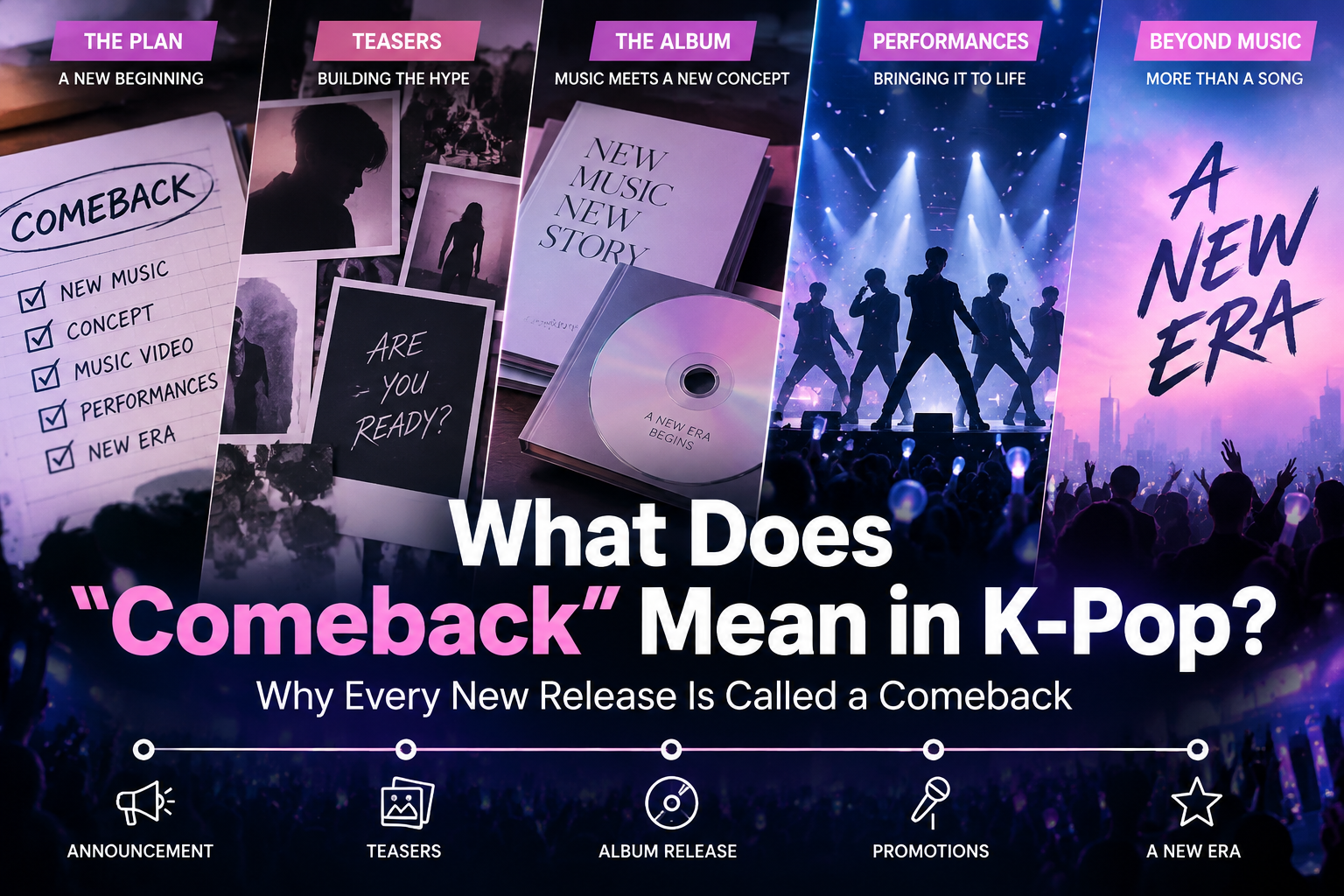
    What Does “Comeback” Mean in K-Pop? Why Every New Release Is Called a Comeback

    What Does “Comeback” Mean in K-Pop?

    If you are new to K-pop, the word “comeback” can be confusing.

    In everyday English, a comeback usually means returning after being away for a long time. A singer might make a comeback after several years without releasing music, or an actor might return to the spotlight after a long break.

    In K-pop, however, the word has a much broader meaning.

    A K-pop comeback is when an artist releases new music and begins a new promotional cycle, usually with a new song, album or mini album, concept, music video, and performances.

    The artist does not need to have disappeared for years—or even for very long.

    A group can release an album, finish promotions, return a few months later with another release, and fans will still call it a comeback.

    That is why K-pop fans regularly say things like:

    • “Their comeback is next month.”
    • “Did you see the comeback teaser?”
    • “This is my favorite comeback concept.”
    • “When is the group having its next comeback?”

    To understand why the word is used this way, it helps to understand how K-pop promotions are organized.

    Comeback in K-Pop: The Simple Definition

    In the simplest terms:

    Debut = the artist’s first official release or introduction.

    Comeback = a new promotional era after the debut.

    Once a K-pop artist has debuted, most major new release cycles can be described as comebacks.

    A comeback is therefore not simply about an artist “returning.” It marks the beginning of a new era of music, visuals, performances, and promotions.

    This is one reason the word is so important in K-pop culture. A new release is often presented as much more than uploading a new song. It can involve weeks of teasers, new styling, concept photos, choreography, music-show appearances, fan events, and other promotional content.

    For fans, a comeback can feel like the start of an entirely new chapter in an artist’s career.

    Why Is Every New K-Pop Release Called a Comeback?

    The meaning makes more sense when you look at the way the K-pop industry developed.

    K-pop promotions have traditionally been organized into distinct activity periods. An artist releases new music, promotes it intensively for a period of time, and then ends that promotional cycle before preparing for the next one.

    When the artist begins promoting new music again, they are considered to have “come back” to active promotions.

    The important point is that the artist does not need to have been inactive for years.

    The “return” is often a return to the promotion cycle, especially music shows, performances, interviews, fan events, and other activities connected to a new release.

    This is different from the way many Western music markets traditionally operate, where an artist may release several singles over a long album campaign without describing each release as a separate comeback.

    A K-Pop Comeback Is More Than Just a New Song

    A comeback often begins before fans hear the full song.

    Entertainment companies may build anticipation through a carefully planned sequence of promotional material, such as:

    • comeback announcements;
    • scheduling posters;
    • concept photos;
    • album details;
    • track lists;
    • individual member teasers;
    • video trailers;
    • highlight medleys or album previews;
    • music video teasers.

    By the time the title track and music video are released, fans may already have spent days or weeks discussing the new concept.

    Promotions can then continue through music shows, interviews, variety content, dance challenges, fan events, and live performances.

    This entire period is commonly referred to as the artist’s comeback era.

    That is why fans may remember different comebacks not only by their songs, but also by their hairstyles, fashion, choreography, album design, visual concept, and performances.

    A comeback can become a recognizable moment in a group’s history.

    Comeback vs Debut: What Is the Difference?

    The difference between a debut and a comeback is straightforward but important.

    A debut introduces an artist to the public for the first time. For a new K-pop group, it usually includes the group’s first official music release, music video, performances, and promotional activities.

    After that first era, later major promotional releases are generally described as comebacks.

    For example, a group may:

    Debut → finish promotions → prepare new music → announce a comeback → release the new album → begin another promotional era.

    This cycle can repeat several times during a group’s career.

    A comeback therefore represents continuity, while a debut represents a beginning.

    There are also other terms fans may encounter. A solo debut, for example, can happen when an established group member releases official solo music for the first time. The artist is already famous, but the release can still be called a debut because it begins that person’s official solo career.

    What Usually Happens During a K-Pop Comeback?

    Although every company and artist handles promotions differently, a typical comeback may follow several stages.

    1. The Comeback Is Announced

    The company or artist confirms that new music is coming.

    Sometimes the announcement arrives unexpectedly. In other cases, news about recording, filming, or comeback preparations may circulate before the official announcement.

    2. The Concept Is Revealed

    Concept photos, trailers, logos, styling, and other visual material begin establishing the identity of the new era.

    K-pop places unusual emphasis on this stage because visual storytelling can be closely connected to the music and the group’s broader identity.

    3. The Album and Songs Are Previewed

    Fans may receive a track list, album packaging information, highlight medley, or short previews.

    This is also when discussions about the title track and B-sides often become more active.

    4. The Music Is Released

    The album or single and its main music video are released.

    This is usually the central moment of the comeback, but it is not necessarily the end of the comeback cycle.

    5. Promotions Begin

    Artists may perform on Korean music shows, appear in interviews and entertainment content, hold fan events, release performance videos, and promote songs through short-form platforms.

    The length and style of promotions vary considerably between artists.

    This structured cycle is one of the main reasons a K-pop release can feel like an event rather than simply another song appearing online.

    Comeback vs Repackage, Pre-Release and Single

    Not every new piece of music works in exactly the same way, which can make K-pop terminology confusing for new fans.

    A repackage album usually takes an existing album and releases an expanded or revised version with additional songs and often a new title track. If the artist begins another round of promotions, fans may still describe the activity as a comeback.

    A pre-release single is a song released before the main album or title track. It can begin the excitement around an upcoming era, but the larger album release may still be treated as the main comeback.

    A digital single can also function as a comeback when it begins a new promotional cycle, even without a physical album.

    This is why the word “comeback” cannot always be defined by the format of the release alone. The promotional context matters.

    How Long Does an Artist Have to Be Away Before a Comeback?

    There is no required length of time.

    This is one of the biggest differences between the everyday English meaning of “comeback” and its K-pop meaning.

    An artist might return after:

    • several months;
    • one year;
    • several years;
    • military service;
    • a long hiatus;
    • or simply the gap between two normal promotional cycles.

    All of these can be described as comebacks.

    The emotional meaning, however, may be very different.

    When a group releases new music only a few months after its previous promotions, “comeback” usually functions as standard K-pop industry language.

    When an artist returns after several years, a long hiatus, or major changes, the word can also carry its familiar English meaning of a significant return.

    The same term therefore covers both routine promotional returns and genuinely long-awaited returns.

    This flexibility is part of what makes the term confusing at first—and completely normal once you become familiar with K-pop culture.

    Why Comebacks Matter So Much in K-Pop

    Comebacks are important because K-pop is built around more than recorded music.

    A comeback brings together music, choreography, visual design, fashion, performance, storytelling, fandom activity, and marketing. These elements can make each promotional era feel distinct from the one before it.

    For artists, a comeback is also an opportunity to show change.

    A group may move from a bright concept to a darker one, experiment with a different genre, introduce a new storyline, or present a more mature image. Looking back at an artist’s comebacks can therefore reveal how their music and identity developed over time.

    This is especially noticeable with long-running groups. Their early comeback eras may look and sound very different from releases that arrive five or ten years later.

    In that sense, comebacks help create the timeline of a K-pop career.

    How Comeback Culture Changed as K-Pop Became Global

    The basic idea of the comeback developed during an era when Korean television music shows and domestic promotions played a central role in K-pop.

    As K-pop became increasingly global, the comeback cycle expanded.

    Today, a major release can include global streaming campaigns, international interviews, social-media challenges, overseas performances, global album distribution, online fan events, and promotional content designed for audiences across multiple time zones.

    Fans no longer need to live in South Korea to experience a comeback almost in real time.

    They can watch teasers as they are released, follow countdowns, stream the music video, discuss concept photos, watch music-show performances online, and participate in fandom activities from around the world.

    The platforms have changed, but the central idea remains familiar:

    A new comeback marks the beginning of a new K-pop era.

    This is one reason the term has survived even as the industry around it has changed dramatically.

    Frequently Asked Questions About K-Pop Comebacks

    Does “comeback” mean the artist was inactive for a long time?

    No. In K-pop, an artist can have a comeback only a few months after the previous release. The term usually refers to starting a new release and promotional cycle rather than returning after a long absence.

    Is every new K-pop song a comeback?

    Not necessarily. An OST, collaboration, special track, or other release may not begin a full promotional era. Whether fans call something a comeback often depends on how the release is presented and promoted.

    Can a solo artist have a comeback?

    Yes. Once a solo artist has debuted, later major releases can be called comebacks in the same way as group releases.

    What is a comeback stage?

    A comeback stage is a performance associated with the beginning of an artist’s new promotional period, particularly on Korean music shows. It introduces the new song and performance to viewers.

    What is a comeback showcase?

    A comeback showcase is an event held around a new release where an artist may perform new songs, discuss the album, answer questions, and introduce the concept. The exact format varies.

    Is a comeback the same as a new album?

    Not always. A comeback can involve a full album, mini album, single album, digital single, or another type of release. The promotional cycle is more important than the physical format.

    Final Thoughts: What “Comeback” Really Means in K-Pop

    The word “comeback” is one of the clearest examples of how K-pop has developed its own vocabulary.

    To someone unfamiliar with K-pop, it may sound strange to say that an artist is “coming back” only a few months after the previous release.

    Within K-pop culture, however, the meaning is simple.

    A comeback marks the moment an established artist begins a new musical and promotional era.

    It can bring a new song, album, concept, choreography, visual identity, and series of performances. Sometimes the gap between eras is short. Sometimes fans wait for years.

    Either way, the comeback becomes another point on the artist’s timeline.

    And that is why understanding the word tells you something larger about K-pop itself: K-pop is organized not only around songs and albums, but around eras that fans experience, remember, and compare over time.

  • K-Pop Terms Explained: 30 Essential Words Every New Fan Should Know

    K-Pop Terms Explained: 30 Essential Words Every New Fan Should Know

    If you are new to K-pop, you may feel like fans are speaking an entirely different language.

    What is a bias? Why is a new album called a comeback even when the artist never disappeared? What is the difference between a title track and a B-side? And why do fans carry glowing lightsticks at concerts?

    K-pop has developed its own vocabulary through decades of idol culture, Korean entertainment, music shows, and global fandom communities.

    Understanding these terms makes it much easier to follow your favorite artists, watch K-pop content, and communicate with other fans.

    Here are 30 essential K-pop terms every new fan should know.

    1. K-Pop

    K-pop is short for Korean popular music.

    Today, the term is commonly associated with South Korea’s idol music industry, including groups and solo artists who combine music, choreography, visual concepts, fashion, performance, and fan culture.

    K-pop includes many musical styles, from pop and hip-hop to R&B, rock, electronic music, and ballads.

    2. Idol

    An idol is an entertainer who has usually trained under an entertainment company before debuting as a singer or member of a group.

    K-pop idols often receive training in singing, dancing, performance, languages, media appearances, and other skills.

    Some train for several years before making their official debut.

    3. Trainee

    Before becoming an idol, many aspiring performers are known as trainees.

    Entertainment companies recruit trainees through auditions, scouting, competitions, and other methods.

    Trainees may study vocals, dance, rap, languages, and performance skills while competing for the opportunity to debut.

    Not every trainee eventually becomes an idol.

    4. Debut

    A debut is an artist’s official introduction to the public.

    For a K-pop group, this usually involves the release of its first official music and promotional activities.

    Fans often remember debut dates because they mark the beginning of a group’s official career.

    5. Pre-Debut

    Pre-debut refers to the period before an artist officially debuts.

    Fans may discover pre-debut photos, performances, audition clips, trainee videos, or appearances in other artists’ content.

    For some groups, companies also release substantial content before the official debut.

    6. Comeback

    The word comeback has a special meaning in K-pop.

    It does not necessarily mean that an artist disappeared for years.

    Instead, a comeback generally refers to an artist returning with new music and a new promotional cycle.

    A group may therefore have several comebacks within a relatively short period.

    7. Title Track

    A title track is the main song promoted from a K-pop release.

    It is usually accompanied by a music video and performed extensively during promotional activities.

    For many fans, the title track becomes the song most strongly associated with that particular era.

    8. B-Side

    A B-side is a song on an album or EP that is not the main title track.

    Some B-sides become extremely popular among fans and may receive performances, choreography videos, or other promotional content.

    Exploring B-sides is often one of the best ways to discover the broader musical style of a K-pop artist.

    9. Bias

    Your bias is your favorite member of a K-pop group.

    For example, if you enjoy a seven-member group but feel particularly drawn to one member’s voice, personality, dancing, or style, that member may become your bias.

    Choosing a bias is one of the most familiar parts of K-pop fan culture.

    10. Bias Wrecker

    A bias wrecker is another member who constantly challenges your loyalty to your original bias.

    You may already have a favorite member, but another member keeps attracting your attention.

    Fans usually use the expression playfully.

    11. Ult Bias

    An ult bias, short for ultimate bias, is a fan’s favorite idol across all the K-pop artists they follow.

    Someone may have a bias in several groups but still consider one particular artist their ultimate favorite.

    12. Maknae

    Maknae (막내) is a Korean word meaning the youngest person in a group.

    In K-pop, it usually refers to the youngest member of an idol group.

    Fans often pay attention to the relationship between the maknae and the older members.

    13. Leader

    Many K-pop groups have an officially designated leader.

    The leader may help communicate between the members and the company, represent the group in certain situations, guide conversations during interviews, and support teamwork.

    However, the exact responsibilities vary from group to group.

    14. Main Vocalist

    The main vocalist is typically a member recognized for handling some of the group’s most demanding vocal parts.

    K-pop groups can also use positions such as lead vocalist or vocalist.

    However, not every modern group uses fixed official positions.

    15. Main Dancer

    The main dancer is typically one of the strongest dancers in a group and may take important positions during dance breaks or technically challenging choreography.

    As with vocal positions, not every group formally assigns this title.

    16. Main Rapper

    The main rapper generally handles significant or technically demanding rap sections within a group.

    Some K-pop rappers also participate in writing their own lyrics or producing music.

    Again, official positions differ among groups.

    17. Visual

    In traditional K-pop terminology, the visual is a member officially or commonly recognized for fitting the group’s visual image or prevailing Korean beauty standards.

    This does not mean other members are considered unattractive.

    The term is better understood as a role that developed within the idol industry’s traditional position system.

    18. Center

    The center is a member who frequently appears in prominent central positions during performances, promotional photos, or important parts of choreography.

    The center may change depending on the song or concept, although some groups have a member strongly associated with the role.

    19. Fandom

    A fandom is the community of fans who support an artist or group.

    Many K-pop artists have official fandom names.

    These names help create a shared identity between artists and their supporters.

    20. Lightstick

    A lightstick is an official illuminated fan item associated with a K-pop artist or group.

    At concerts, thousands of synchronized lightsticks can transform an arena into a sea of color.

    Modern lightsticks have become an important visual symbol of K-pop concert culture.

    21. Fanchant

    A fanchant is an organized chant performed by fans during particular parts of a song.

    It may include members’ names, repeated lyrics, or specially designed responses.

    When thousands of fans participate together, fanchants can become a powerful part of a live K-pop performance.

    22. Fancam

    A fancam is a video that focuses primarily on one performer during a live performance.

    Originally associated strongly with fan-recorded videos, the term is now also used for professionally produced individual-performance videos released by broadcasters and other official channels.

    Fancams can help particular performances or idols gain wider attention online.

    23. Fan Sign

    A fan sign is an event where selected fans can interact directly with an artist, traditionally while receiving signed albums or merchandise.

    Today, both in-person and video-call fan events are common.

    Entry rules vary depending on the organizer.

    24. Music Show

    K-pop artists frequently promote new releases on Korean television music shows.

    These programs feature performances by multiple artists and often include weekly ranking systems and awards.

    For new fans, music shows are a useful way to discover current K-pop releases and performance stages.

    25. Music Show Win

    A music show win happens when an artist receives first place on one of Korea’s music programs.

    Results can involve different combinations of digital performance, album sales, broadcast scores, voting, and other criteria depending on the program.

    A group’s first music show win can be an especially emotional milestone for both artists and fans.

    26. All-Kill

    An all-kill is a term associated with strong performance across major Korean music charts.

    You may also encounter more specific terms such as Certified All-Kill and Perfect All-Kill, which depend on defined chart conditions.

    Because chart systems and criteria can change, it is best to check the current rules when interpreting these achievements.

    27. Sub-Unit

    A sub-unit is a smaller team formed from members of an existing K-pop group.

    A sub-unit may explore a different musical style or highlight particular vocal, rap, or performance strengths.

    This allows artists to experiment while remaining part of the main group.

    28. Solo Debut

    A solo debut occurs when a member of a group officially releases music as a solo artist.

    A solo career does not automatically mean the member has left the group.

    Many idols maintain both group and solo activities.

    29. Concept

    A K-pop concept is the creative theme surrounding a release or promotional era.

    It can influence music videos, album artwork, styling, choreography, stage design, photography, and storytelling.

    Concepts may range from bright and playful to dark, futuristic, retro, elegant, or experimental.

    30. Era

    Fans often use the word era to describe the period associated with a particular album, song, concept, or promotional cycle.

    For example, fans may discuss their favorite styling, performances, hairstyles, or songs from a particular era.

    An era becomes part of the way fans remember an artist’s history and evolution.

    Why Does K-Pop Have So Many Special Terms?

    K-pop is more than a collection of songs.

    It developed through a distinctive entertainment system involving trainee programs, television music shows, organized fandoms, performance culture, merchandise, and close interaction between artists and fans.

    As K-pop expanded internationally, many Korean words and industry expressions became part of the vocabulary used by fans around the world.

    That is why learning K-pop terminology can also help new fans understand how the industry and its culture developed.

    K-Pop Vocabulary Is Always Evolving

    K-pop terminology is not completely fixed.

    Some traditional idol positions are used less formally by newer groups, while social media and global fandoms continually introduce new expressions.

    Words can also have slightly different meanings depending on the artist, company, generation, or fan community.

    The 30 terms above provide a strong foundation, but you will undoubtedly encounter many more as you explore K-pop.

    Final Thoughts

    Becoming a K-pop fan can initially feel overwhelming.

    There are group names, member names, fandom names, albums, performances, variety shows, and an entire vocabulary to learn.

    But you do not need to memorize everything at once.

    Start with a few essential terms such as bias, comeback, debut, title track, B-side, maknae, fandom, and lightstick. Soon, expressions that once seemed confusing will feel completely natural.

    And that is part of the fun of discovering K-pop: you are not only listening to music—you are learning about a global fan culture with its own history, traditions, and language.

  • What Is a K-Pop Fan Meeting? How It Differs From a Concert and Fan Sign

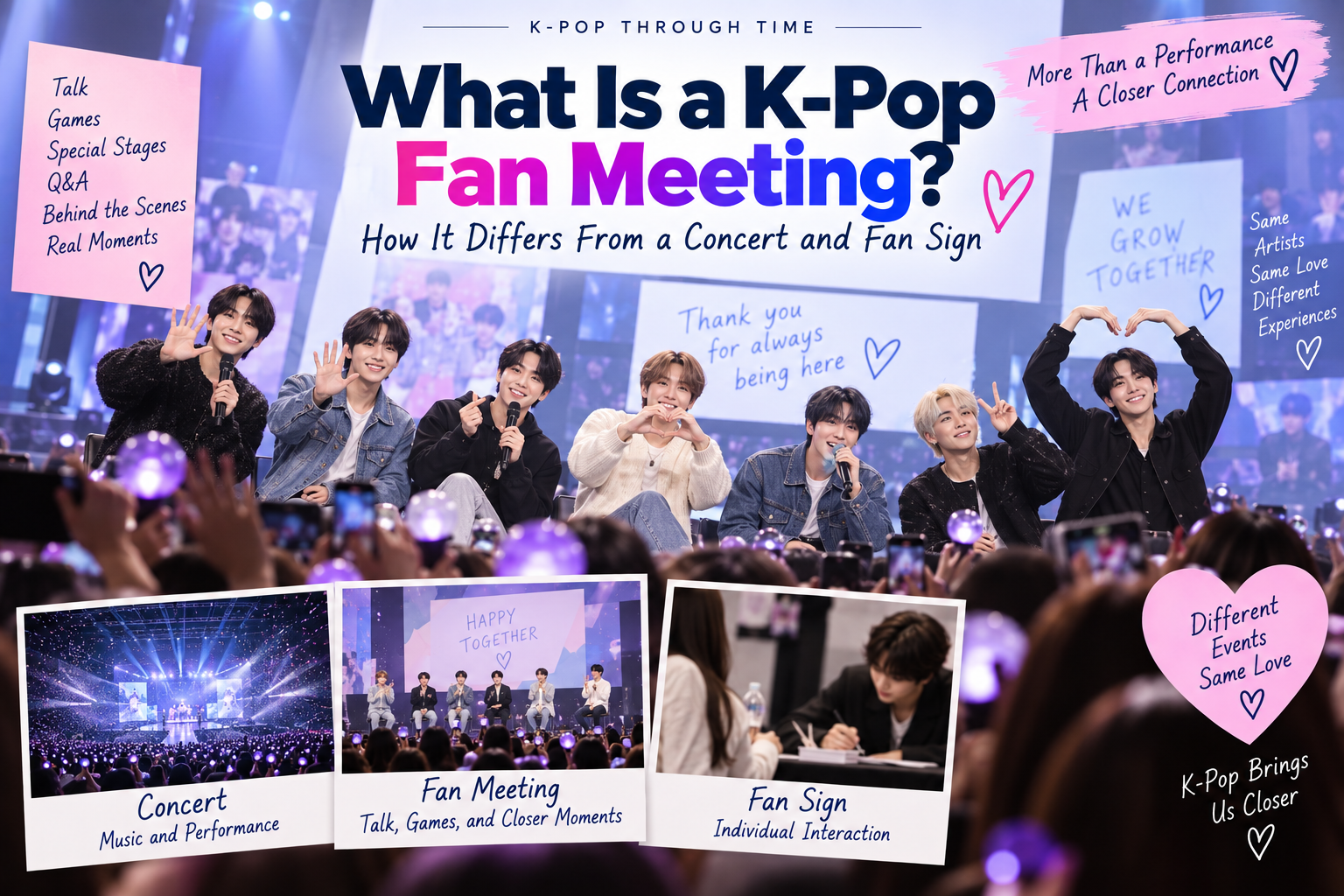
    What Is a K-Pop Fan Meeting? How It Differs From a Concert and Fan Sign

    If you are new to K-pop, the different types of fan events can be confusing.

    You may hear that an artist is holding a concert, a fan sign, or a fan meeting.

    All three events bring artists and fans together, but they are not the same experience.

    A concert focuses mainly on music and performance. A fan sign offers brief individual interactions with selected fans. A fan meeting falls somewhere in between, combining performances, conversations, games, and special moments designed specifically for fans.

    So what exactly happens at a K-pop fan meeting?

    What Is a K-Pop Fan Meeting?

    A K-pop fan meeting is a special event where artists spend time with fans through a mixture of entertainment and interaction.

    Unlike a regular concert, the schedule may include much more than songs.

    Artists might talk with the audience, answer questions, play games, perform special stages, watch old videos, share stories, or participate in activities prepared specifically for the fandom.

    The atmosphere is often more relaxed and personal than a large concert.

    Fan Meeting vs. Concert

    The biggest difference is the main purpose of the event.

    A concert is primarily built around musical performances.

    Fans usually attend expecting a setlist filled with songs, choreography, stage production, costumes, lighting, and other performance elements.

    A fan meeting, however, focuses more heavily on communication between artists and fans.

    Music is still important, but performances may take up only part of the event.

    There can be long talking segments, games, audience participation, and humorous moments that would not normally appear during a standard concert.

    Fan Meeting vs. Fan Sign

    A fan meeting is also different from a fan sign.

    At a fan sign, selected fans generally interact with idols individually for a short period while receiving autographs.

    At a fan meeting, a much larger audience watches the event together.

    Most attendees will not have an individual conversation with the artist.

    Instead, the interaction happens collectively through conversations, games, audience responses, and special activities.

    A simple way to think about it is:

    Concert = performance-focused

    Fan sign = brief individual interaction

    Fan meeting = group entertainment and fan interaction

    What Happens at a Fan Meeting?

    Every fan meeting is different, but several activities are common.

    Artists may begin by greeting the audience and talking about recent activities.

    There may be question-and-answer segments, games between members, challenges, behind-the-scenes stories, or discussions about memorable moments.

    Some events also include surprise missions or activities suggested by fans.

    Because the format is flexible, fan meetings can reveal more of an artist’s personality than a tightly planned music performance.

    Are There Performances at Fan Meetings?

    Yes.

    Fan meetings often include musical performances, but usually fewer songs than a full concert.

    Artists might perform popular songs, fan favorites, acoustic versions, solo stages, covers, or songs they rarely perform elsewhere.

    Sometimes a fan meeting includes a special performance created specifically for that event.

    This is one reason fans may consider fan meetings unique even if they have already attended the artist’s concert.

    Games and Challenges

    Games are a familiar part of many K-pop fan meetings.

    Members might compete against one another, answer trivia questions, complete missions, or participate in playful challenges.

    These segments often create funny and unpredictable moments.

    Fans get to see idols outside the highly polished environment of a music-show stage or music video.

    That relaxed atmosphere is part of the appeal.

    Talking With Fans

    Conversation is another major part of fan meetings.

    Artists may discuss their music, recent activities, memories, future goals, or experiences with the fandom.

    They may also read questions or messages submitted by fans.

    These conversations can make the event feel more intimate, even when hundreds or thousands of people are attending.

    Special Videos and Behind-the-Scenes Content

    Fan meetings sometimes include videos that are not normally available elsewhere.

    These may show rehearsals, backstage moments, funny missions, interviews, or messages prepared for fans.

    Artists may watch the videos together with the audience and react to them in real time.

    This gives fans another opportunity to see a more casual side of their favorite artists.

    Fan Meetings and Anniversaries

    Fan meetings are often connected to meaningful dates.

    An artist may organize one to celebrate a debut anniversary, the anniversary of a fandom, or another milestone.

    Anniversary fan meetings can include discussions about past years, old photographs, memorable performances, and messages of appreciation.

    For long-time fans, these events can feel like celebrating shared history with the artist.

    What Is a Fan Concert?

    Another term you may encounter is fan concert or sometimes fan-con.

    A fan concert generally combines characteristics of both a fan meeting and a concert.

    It may contain more musical performances than a traditional fan meeting while still including talking segments, games, and fan interaction.

    There is no universal formula, however.

    Different entertainment companies and artists may use these terms somewhat differently.

    Can International Fans Attend?

    Yes.

    Many K-pop artists hold fan meetings outside South Korea, especially as their international audiences grow.

    Cities across Asia and other parts of the world may be included in fan meeting tours.

    Some events may also offer online streaming options.

    Ticketing procedures vary, so international fans should always check official announcements for dates, venues, ticket sales, and participation rules.

    Do Fan Meetings Have Special Merchandise?

    Often, yes.

    Some fan meetings have merchandise designed specifically for the event.

    This can include photocards, posters, clothing, accessories, photo sets, or other collectibles.

    Because these products may be connected to one particular event, they can become memorable souvenirs for fans who attended.

    However, purchasing merchandise is optional and is not necessary to enjoy the event.

    Why Do Fans Love Fan Meetings?

    Concerts allow fans to experience the power of live music.

    Fan signs provide short personal interactions.

    Fan meetings offer something different: the feeling of spending a longer, more relaxed period with the artist.

    Fans can hear stories, watch members joke with one another, enjoy unusual performances, and participate in moments created specifically for the fandom.

    This can make the relationship between artist and fandom feel more personal.

    The Role of Fandom at a Fan Meeting

    Fan meetings are often designed around a particular fandom.

    The fandom name, inside jokes, memorable moments, fan chants, and shared history between artists and fans may all become part of the program.

    Someone unfamiliar with the artist can still enjoy the event, but long-time fans may recognize references that carry special meaning.

    In this sense, a fan meeting can feel like a celebration of the community surrounding an artist.

    Are Fan Meetings Smaller Than Concerts?

    Sometimes, but not always.

    Some fan meetings take place in relatively small venues, creating a more intimate atmosphere.

    Popular artists may hold fan meetings in large arenas or organize multiple dates because of high demand.

    The defining difference is therefore not necessarily the size of the venue.

    It is the style and purpose of the event.

    Do You Need to Attend a Fan Meeting to Be a Dedicated Fan?

    No.

    Like concerts, fan signs, albums, and merchandise, fan meetings are simply one way to experience K-pop.

    Tickets, travel, and other expenses can make attendance difficult or impossible for many fans.

    Someone who enjoys the music from home is no less of a fan than someone who attends multiple events.

    K-pop fandom can be experienced in many different ways.

    Fan Meeting, Concert, or Fan Sign: Which Is Best?

    There is no single answer.

    If you mainly want to hear many songs performed live, a concert may be the best choice.

    If you dream of having a brief individual interaction with an idol, a fan sign offers a very different experience.

    If you enjoy conversations, games, special stages, and a relaxed atmosphere, a fan meeting may be especially appealing.

    Each event reveals a different side of K-pop.

    Final Thoughts

    A K-pop fan meeting is more than a smaller version of a concert.

    It is an event designed around the relationship between artists and their fans.

    Music may be part of the experience, but so are conversations, games, special videos, unexpected performances, and moments of shared laughter.

    Concerts show us artists as performers.

    Fan signs can create brief one-to-one encounters.

    Fan meetings give artists and fans the chance to spend time together as a community.

    And that combination of music, personality, interaction, and shared memories is what makes the K-pop fan meeting a distinctive part of fandom culture.


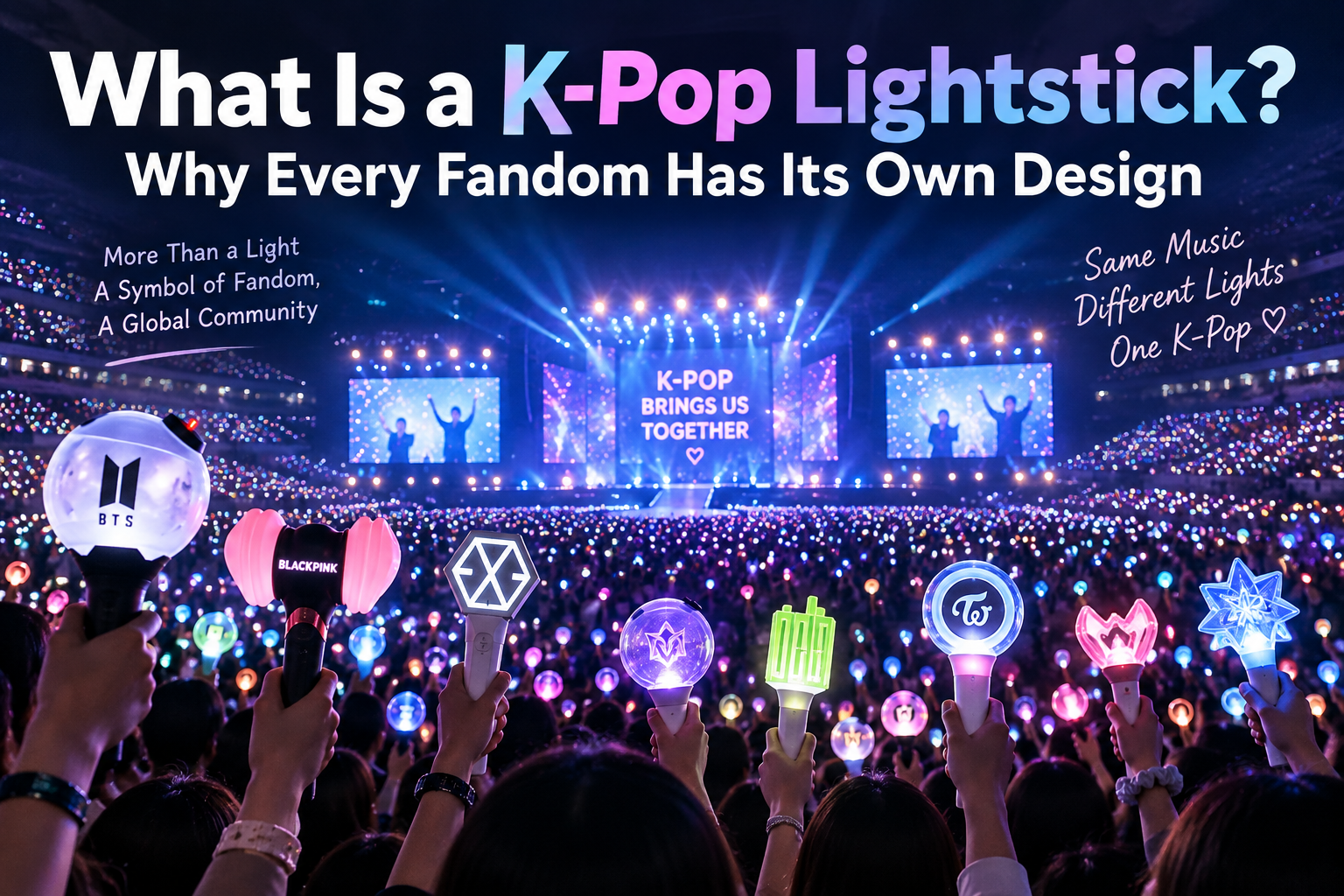
  • What Is a K-Pop Lightstick? Why Every Fandom Has Its Own Design

    What Is a K-Pop Lightstick? Why Every Fandom Has Its Own Design

    What Is a K-Pop Lightstick?

    If you have ever watched a K-pop concert, you may have noticed thousands of fans holding glowing objects in the audience. These colorful lights often move together, turning an entire concert venue into a sea of light.

    These objects are called lightsticks, and they have become one of the most recognizable symbols of K-pop fandom culture.

    But what exactly is a K-pop lightstick, why does each fandom have its own design, and do you need one to enjoy a K-pop concert?

    A K-pop lightstick is a handheld electronic light designed to represent a particular K-pop artist or group. Fans commonly use lightsticks at concerts, fan meetings, and other events to show support for their favorite artists.

    Unlike ordinary glow sticks, official K-pop lightsticks usually have unique designs, colors, logos, and features connected to the identity of the artist and fandom.

    Why Do K-Pop Groups Have Their Own Lightsticks?

    K-pop fandoms often have their own names, symbols, colors, and traditions.

    A lightstick turns that identity into something fans can physically hold.

    Instead of every concert audience using the same generic glow stick, each artist can have a recognizable design associated with their music, image, and fandom.

    This means a lightstick can serve several purposes at once.

    It can be a concert accessory, a collectible item, a symbol of fandom identity, and a visual connection between artists and fans.

    Why Do K-Pop Lightsticks Have Different Designs?

    One of the most interesting things about K-pop lightsticks is how different they can look.

    Some are simple and elegant. Others are playful, futuristic, symbolic, or highly unusual.

    Designs may incorporate:

    • a group’s logo
    • fandom colors
    • symbols connected to the artist
    • album or concept imagery
    • shapes associated with the group’s identity

    Because of this, fans can often recognize which artist a lightstick belongs to even before seeing the group’s name.

    The design itself becomes part of the artist’s visual identity.

    What Are Some Famous K-Pop Lightsticks?

    Many major K-pop artists have lightsticks that fans immediately recognize.

    BTS fans, known as ARMY, use the official BTS lightstick commonly known as the ARMY Bomb.

    BLACKPINK’s official lightstick has a distinctive pink-and-black design with heart-shaped ends.

    Other groups have developed equally recognizable designs, each reflecting the personality and identity of the artist and fandom.

    As K-pop has expanded internationally, these lightsticks have also become familiar sights at concerts around the world.

    How Do K-Pop Lightsticks Work at Concerts?

    Modern K-pop lightsticks can do much more than simply turn on and off.

    Depending on the artist, venue, event, and lightstick model, some official lightsticks can connect to concert systems or supported apps.

    During a performance, large numbers of lightsticks may change colors or lighting patterns together.

    From the stage, this can transform the audience into a coordinated field of light.

    Different songs or moments in the concert may produce different lighting effects, adding another visual layer to the performance.

    What Is an “Ocean” in K-Pop Concert Culture?

    K-pop fans sometimes use the word “ocean” to describe the visual effect created when thousands of audience lights fill a concert venue.

    For example, a venue filled with lights associated with one artist or fandom can look like a glowing ocean from the stage.

    These concert oceans can become memorable images because they visually represent the size and unity of a fandom.

    For artists, seeing an arena filled with their fandom’s lights can also create a powerful connection with the audience.

    Why Are Lightsticks Important to K-Pop Fandoms?

    Lightsticks are closely connected with fandom identity.

    When thousands of people hold the same lightstick at a concert, each person is participating individually while also becoming part of a much larger visual community.

    This reflects an important part of K-pop fandom culture.

    Fans may live in different countries, speak different languages, and discover an artist at different times, but symbols such as fandom names and lightsticks give them something recognizable to share.

    That is why a lightstick can have emotional meaning beyond its practical use at a concert.

    Are K-Pop Lightsticks Official Merchandise?

    Many well-known K-pop lightsticks are released as official merchandise associated with an artist.

    Official versions may be sold through an artist’s official store, entertainment company, concert merchandise booth, or authorized retailer.

    However, unofficial products and imitations also exist.

    This matters especially when a lightstick includes features intended to work with a particular concert or application, because unofficial products may not support the same functions.

    Fans who want a lightstick for an upcoming concert should therefore check the artist’s official information for the event and the specific lightstick version being supported.

    Do You Need a Lightstick to Attend a K-Pop Concert?

    No.

    Owning a lightstick is not a requirement for being a K-pop fan, and in most situations you do not need one simply to enjoy a concert.

    Many fans attend concerts without lightsticks.

    Others choose to buy one because they enjoy participating in the concert atmosphere or want an official collectible connected to their favorite artist.

    Being part of a fandom is not determined by how much merchandise someone owns.

    Listening to and enjoying the music is enough.

    Can You Bring Another Group’s Lightstick to a K-Pop Concert?

    This is a question new K-pop fans sometimes ask.

    Fan expectations can vary depending on the artist, fandom, venue, and event.

    Because lightsticks are strongly associated with particular groups, some fans prefer to use the performing artist’s official lightstick or no lightstick at all.

    More importantly, concert rules can vary.

    Before attending a concert, it is best to check the organizer’s or artist’s official event information rather than assuming that every type of lightstick will be permitted or supported.

    What Is the Difference Between a Lightstick and a Regular Glow Stick?

    A regular glow stick is usually a simple light source.

    A K-pop lightstick is more closely connected to an artist’s brand and fandom.

    It may include a distinctive design, official logo, multiple lighting modes, replaceable batteries, wireless functions, or app connectivity, depending on the product.

    Most importantly, it carries symbolic meaning.

    Fans do not simply see it as a light. They often see it as a representation of their relationship with an artist and fellow fans.

    Why Do Fans Collect K-Pop Lightsticks?

    Not everyone buys a lightstick only for concerts.

    Some fans collect them in the same way others collect albums, photocards, posters, or other official merchandise.

    Because each group’s lightstick has a different design, a collection can also represent a fan’s history with K-pop.

    A lightstick may remind someone of their first concert, favorite comeback, favorite group, or a particular period in their life.

    For this reason, older or redesigned versions can sometimes have special sentimental value to fans.

    How Are Lightsticks Connected to K-Pop’s Global Growth?

    Lightsticks were once most strongly associated with Korean concert and fandom culture, but international K-pop tours have made them increasingly visible around the world.

    When a K-pop group performs in cities such as Los Angeles, London, Paris, Tokyo, Bangkok, or Singapore, audiences may use the same official fandom lightstick seen at concerts in Seoul.

    This creates a recognizable visual language across borders.

    Fans may speak different languages, but when an arena lights up with thousands of matching lightsticks, the meaning is immediately understandable.

    Do All K-Pop Artists Have Official Lightsticks?

    No.

    Some established groups and solo artists have official lightsticks, while newer or smaller artists may not.

    Lightstick designs can also change over time, and new versions may be released as technology or branding evolves.

    Therefore, fans should not assume that every K-pop artist has one or that every version works in exactly the same way.

    Lightsticks, Fandom, and the K-Pop Experience

    K-pop is not only experienced through recorded music.

    Fans also encounter it through music videos, choreography, concerts, social media, fancams, albums, merchandise, and fandom communities.

    The lightstick sits at the intersection of many of these experiences.

    It is merchandise, but it is also part of concert participation.

    It represents an individual artist, but thousands of fans can use it together.

    And although it is a physical object, its meaning comes largely from the community surrounding it.

    Final Thoughts

    A K-pop lightstick is much more than a glowing concert accessory.

    It is a symbol designed to represent an artist and their fandom, and it can transform thousands of individual fans into one coordinated visual audience.

    From distinctive designs and fandom colors to synchronized concert effects and collectible value, lightsticks have become an important part of modern K-pop culture.

    But owning one is never what makes someone a fan.

    Whether you are holding an official lightstick in a stadium or simply listening to your favorite K-pop song at home, the most important part is the connection you have with the music and artists you enjoy.


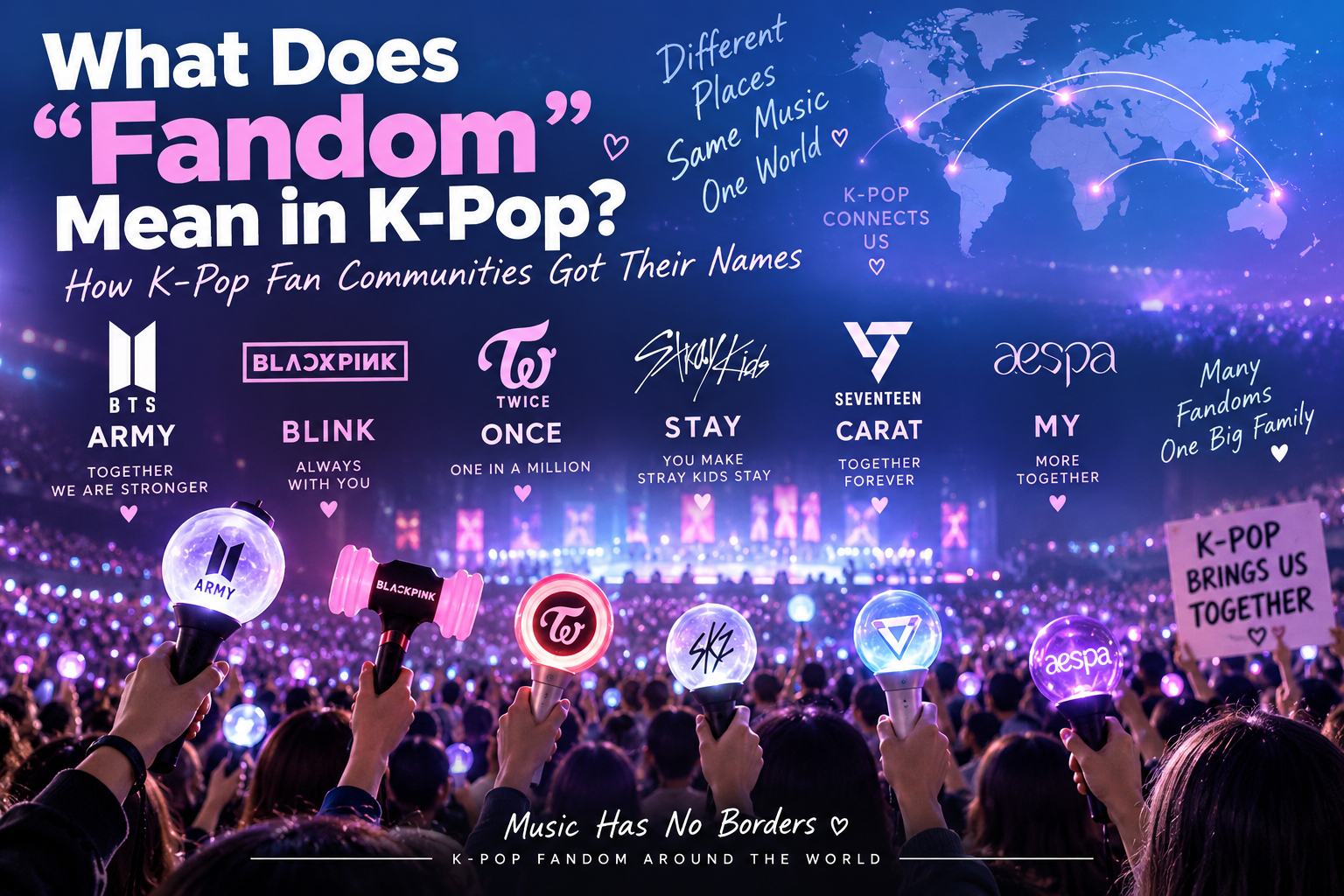
  • What Does “Fandom” Mean in K-Pop? How K-Pop Fan Communities Got Their Names

    What Does “Fandom” Mean in K-Pop? How K-Pop Fan Communities Got Their Names

    What Does “Fandom” Mean in K-Pop?

    If you are new to K-pop, you will quickly notice that fans are rarely described simply as “fans.”

    Many K-pop artists have an official fandom name.

    BTS fans are known as ARMY, BLACKPINK fans are called BLINK, and many other groups have names created especially for the communities that support them.

    But why are fandom names so important in K-pop?

    To understand that, we first need to understand what the word fandom means.

    What Is a K-Pop Fandom?

    A fandom is a community of people who share an interest in a particular artist, group, or form of entertainment.

    Fandoms exist throughout music, movies, sports, books, and popular culture.

    K-pop, however, has developed an especially organized and visible form of fandom culture.

    Fans do much more than listen to songs.

    They attend concerts, collect albums and photocards, watch music videos, follow artists on social media, participate in fan communities, celebrate anniversaries, and support new releases.

    For many people, becoming part of a fandom is an important part of the K-pop experience.

    Why Do K-Pop Fandoms Have Names?

    Official fandom names create a shared identity.

    Instead of simply saying “BTS fans,” people can say ARMY.

    Instead of “BLACKPINK fans,” they can say BLINK.

    A fandom name creates a direct connection between the artist and the community supporting them.

    These names are often announced by entertainment companies or artists and may have special meanings connected with the group’s name, concept, or message.

    Once established, the fandom name can become almost as recognizable as the artist’s name itself.

    What Does BTS ARMY Mean?

    BTS has one of the most internationally recognized fandoms in modern music.

    Their fans are known as ARMY.

    The fandom name was officially announced in 2013, shortly after BTS debuted.

    Over time, ARMY became much more than a label.

    As BTS gained international popularity, fans around the world used the name to identify themselves as part of a shared global community.

    Today, the relationship between BTS and ARMY is frequently discussed as an important part of the group’s history.

    What Does BLACKPINK’s BLINK Mean?

    BLACKPINK’s official fandom is called BLINK.

    The name combines parts of the words BLACK and PINK.

    It creates a short, memorable identity directly connected to the group’s name.

    As BLACKPINK expanded internationally, BLINK became a familiar term across social media, concerts, fan communities, and entertainment coverage.

    Like ARMY, the name allows fans in different countries to identify as members of the same global community.

    Other Famous K-Pop Fandom Names

    K-pop is filled with creative fandom names.

    TWICE fans are known as ONCE.

    Stray Kids fans are called STAY.

    SEVENTEEN fans are known as CARAT.

    aespa fans are called MY.

    Each fandom name has its own story and relationship with the artist.

    For new K-pop fans, learning these names can initially feel like learning another vocabulary.

    But after spending time in K-pop communities, they quickly become familiar.

    What Do K-Pop Fandoms Actually Do?

    K-pop fandoms participate in many different activities.

    The most obvious is supporting music.

    Fans may listen to new releases, purchase albums, watch music videos, attend concerts, and follow performances.

    But fandom activity extends far beyond music consumption.

    Fans create translations, artwork, dance covers, video edits, discussion communities, guides for new fans, and social media content.

    Some fan communities also organize charitable projects or events in an artist’s name.

    This level of participation helps explain why K-pop fandoms are so visible online.

    Why Are Lightsticks Important to K-Pop Fandoms?

    One of the most distinctive symbols of K-pop fandom culture is the official lightstick.

    Many groups have their own specially designed lightstick.

    At concerts, thousands of fans holding matching lightsticks can transform an arena into a sea of color.

    Modern lightsticks can sometimes synchronize with concert production, creating coordinated patterns across the audience.

    The result makes fans visually part of the performance.

    A lightstick therefore becomes more than concert merchandise.

    For many fans, it represents belonging to a particular fandom.

    Why Do Fandoms Have Official Colors?

    Earlier generations of K-pop fandoms were often strongly associated with particular colors.

    Fans could identify groups through balloons, banners, and other objects displaying those colors.

    As K-pop evolved, official lightsticks and more elaborate visual branding became increasingly important.

    The basic idea, however, remained similar.

    A shared symbol or color helps thousands of individual fans feel like part of one community.

    K-Pop Fandoms and Social Media

    Social media transformed K-pop fandom culture.

    In earlier generations, international fans had fewer ways to follow Korean artists closely.

    Today, fans can receive updates almost instantly.

    A music video released in Seoul can be watched within seconds by audiences in New York, London, Bangkok, Manila, São Paulo, Sydney, and countless other cities.

    Fans can also translate interviews, discuss performances, share clips, and organize community projects across national borders.

    This digital network is one of the major reasons modern K-pop fandoms can operate globally.

    What Is a Multi-Stan?

    Not every fan belongs to only one fandom.

    A person who follows and supports several K-pop groups may describe themselves as a multi-stan.

    For example, someone might enjoy BTS, BLACKPINK, TWICE, Stray Kids, and aespa at the same time.

    They may have a bias in each group and participate in several fandom communities.

    K-pop fandom identities are therefore not always exclusive.

    Many listeners explore multiple generations, groups, and musical styles.

    Do You Have to Join a Fandom to Enjoy K-Pop?

    No.

    There is no requirement to use a fandom name, buy albums, collect merchandise, stream music videos, or participate in online communities.

    You can simply enjoy the music.

    Fandom culture provides additional ways for people to connect with artists and other listeners, but everyone can participate at their own level.

    Being a K-pop fan should ultimately begin with enjoying the music and performances.

    Can K-Pop Fandoms Have Negative Sides?

    Like any large online community, fandoms can sometimes experience conflict.

    Arguments may develop between different fan communities or even among fans of the same artist.

    Competition over charts, awards, popularity, and social media can occasionally become intense.

    However, these conflicts should not define all K-pop fandom culture.

    Millions of fans simply enjoy sharing music, attending concerts, meeting other fans, and celebrating artists they appreciate.

    Understanding both the positive and competitive sides gives a more realistic picture of modern fandom.

    Why K-Pop Fandoms Became Global Communities

    The most remarkable feature of modern K-pop fandom may be its international scale.

    A fan in Korea, India, the United States, the Philippines, Brazil, France, or Australia can belong to the same fandom.

    They may speak different languages and live thousands of kilometers apart, yet recognize the same fandom name, songs, symbols, and artists.

    Digital platforms made this type of community possible on an unprecedented scale.

    K-pop fandoms therefore demonstrate how popular culture can create connections that cross national and linguistic boundaries.

    More Than Just a Fan Name

    A K-pop fandom name may appear to be a simple nickname.

    But names such as ARMY, BLINK, ONCE, STAY, CARAT, and MY represent communities that can span the world.

    They give fans a shared identity and artists a recognizable way to address the people supporting them.

    That is why understanding fandom culture is useful for anyone beginning to explore K-pop.

    Sooner or later, every new fan encounters the same question:

    Which fandoms are you part of?

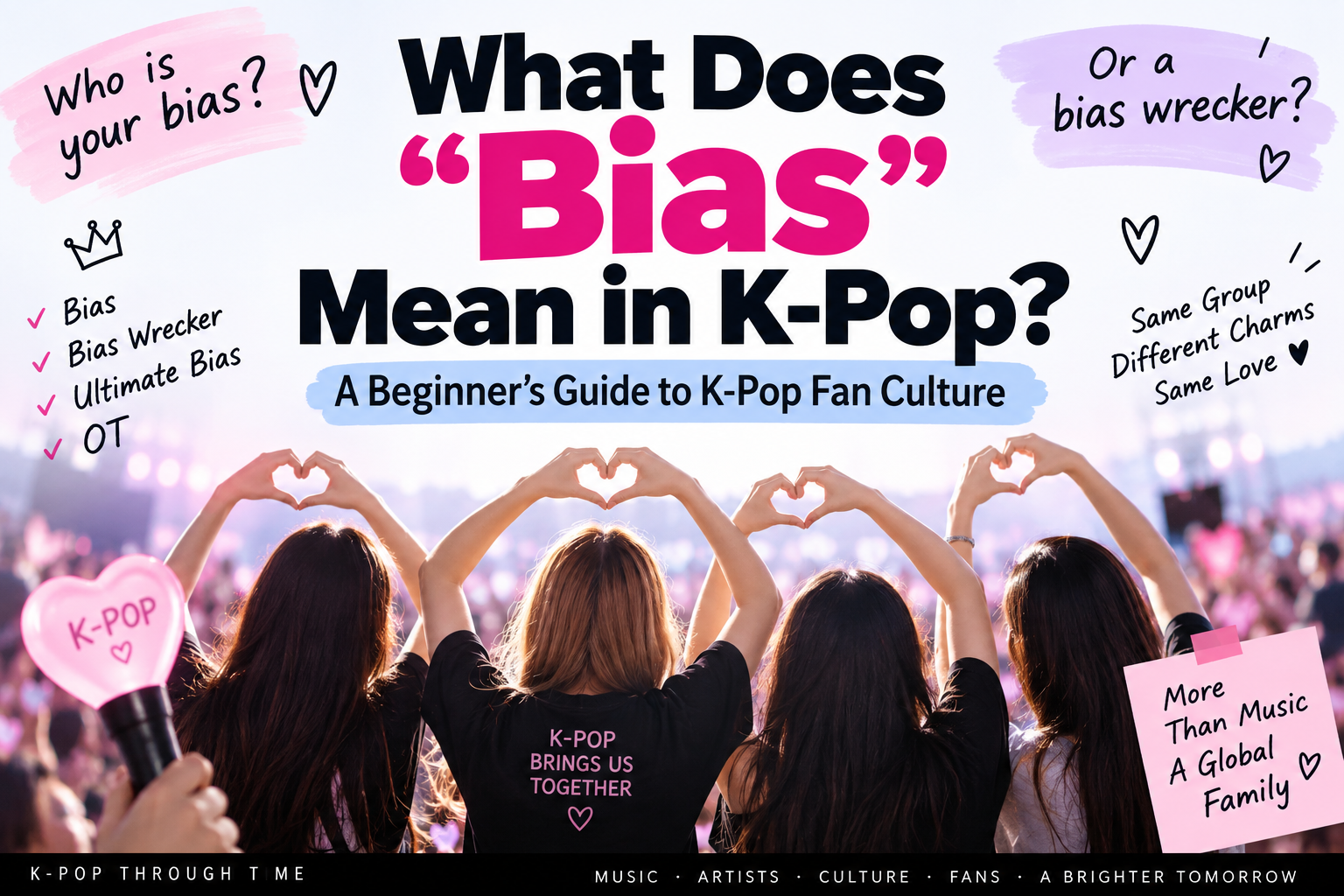
  • What Does Bias Mean in K-Pop? Bias Wrecker & Ult Bias Explained

    What Does Bias Mean in K-Pop? Bias Wrecker & Ult Bias Explained

    If you are new to K-pop, you may quickly encounter a word that seems unusual at first: bias.

    Fans might say, “Who is your bias?” or “She became my bias after that performance.”

    Outside K-pop, the word “bias” usually refers to a preference or prejudice. But in K-pop fan culture, it has developed a much more specific meaning.

    Simply put, your bias is your favorite member of a K-pop group.

    But as with many K-pop terms, there is more to the story.

    What Is a K-Pop Bias?

    A bias is the member of a K-pop group that a fan personally likes or connects with the most.

    For example, someone who follows BTS might enjoy all seven members but feel especially drawn to one member because of his music, personality, performances, or sense of humor.

    A BLACKPINK fan might admire the entire group while having Jisoo, Jennie, Rosé, or Lisa as their bias.

    Having a bias does not mean that a fan dislikes the other members.

    It simply describes a personal favorite within the group.

    In Korean fan communities, a similar term is choe-ae (최애), meaning someone or something you love most. Fans often use it for their favorite idol or group member. While bias and choe-ae are closely related, their usage can vary depending on the fandom and context.

    Why Do K-Pop Fans Choose a Bias?

    There is no single reason people choose a bias.

    Some fans first notice a member because of appearance or fashion.

    Others are attracted to a particular singing voice, rap style, dance ability, stage presence, personality, or sense of humor.

    Sometimes the connection develops slowly.

    A fan may initially notice one member in a music video and later become interested in another after watching interviews, variety shows, concerts, or behind-the-scenes content.

    That is one reason choosing a bias can become part of the fun of discovering a new K-pop group.

    What Is a Bias Wrecker?

    Once you understand “bias,” another popular K-pop expression becomes much easier to understand: bias wrecker.

    A bias wrecker is another member who repeatedly challenges your choice of favorite member.

    Imagine that one member has always been your bias.

    Then another member gives an unforgettable concert performance, appears in a funny interview, or releases an impressive solo song.

    Suddenly, you begin wondering whether your original favorite is still your favorite.

    Fans jokingly describe that second member as a bias wrecker.

    The expression reflects the playful way K-pop fans talk about their attachment to different members.

    Can You Have More Than One Bias?

    Yes.

    There are no official rules about how many biases a fan can have.

    Some fans choose one favorite member in each group. Others have two or more favorites.

    A person who follows many groups may have a different bias in BTS, BLACKPINK, TWICE, Stray Kids, SEVENTEEN, aespa, or other groups.

    Fan culture develops naturally, so the terminology is flexible rather than strictly regulated.

    The most important point is that “bias” describes personal preference, not a formal position within K-pop.

    What Does “Ultimate Bias” Mean?

    Fans who follow several K-pop groups sometimes use the term ultimate bias, often shortened to ult bias.

    An ultimate bias is a fan’s favorite idol across all the groups and artists they follow.

    For example, someone might have a bias in several different groups but still consider one particular artist their overall favorite.

    The term demonstrates how K-pop fandom often develops across multiple groups rather than remaining focused on only one artist.

    What Does “OT” Mean in K-Pop?

    Another expression that often appears alongside bias discussions is OT, followed by a number.

    Fans commonly use expressions such as OT7 or OT4 to express support for all members of a particular group lineup.

    For example, BTS fans may use OT7 when talking about supporting all seven members, while BLACKPINK fans may use OT4 for all four members.

    The expression can carry different nuances depending on the fandom and context, but it is commonly associated with recognizing or supporting the full group.

    Do You Need a Bias to Be a K-Pop Fan?

    No.

    You can enjoy a K-pop group without choosing a favorite member at all.

    Some fans prefer the group’s music as a whole.

    Others enjoy different members for different reasons and do not want to rank them.

    K-pop terminology helps fans communicate with one another, but it is not a set of rules that everyone must follow.

    You do not need a bias, a bias wrecker, or an ultimate bias to enjoy K-pop.

    How Does Someone Become Your Bias?

    For many fans, the process happens naturally.

    You may first notice a singer’s voice in a song.

    Then you watch a live performance and become impressed by the person’s stage presence.

    Later, an interview reveals a personality you find interesting or relatable.

    After watching more content, you realize that you consistently pay attention to the same member.

    At that point, many fans would simply say, “That’s my bias.”

    Why Is the Idea of a Bias So Important in K-Pop?

    K-pop groups are often designed around members with distinctive roles, personalities, talents, and public images.

    One member may be known for powerful vocals, another for rap, another for dance, and another for variety or performance skills.

    This gives fans many different ways to connect with a group.

    The bias concept reflects that structure.

    Fans can support the group collectively while developing a particularly strong interest in one member’s individual career and personality.

    Bias Culture and Solo Careers

    Bias culture also helps explain why solo projects by group members can attract large audiences.

    Fans who become especially interested in one member may follow that artist’s solo albums, acting roles, fashion activities, collaborations, or other projects.

    BTS and BLACKPINK provide clear examples.

    Their members have strong group identities while also developing individual careers that attract their own audiences.

    This relationship between group fandom and individual fandom has become an important feature of modern K-pop.

    Is “Bias” Only Used for K-Pop?

    The term is most strongly associated with K-pop fandom, but online fan communities sometimes use it more broadly.

    As K-pop culture has spread internationally, expressions such as bias, bias wrecker, comeback, maknae, and fandom names have also become familiar to global audiences.

    These words are part of the vocabulary that new fans gradually learn as they explore K-pop.

    Understanding them makes conversations within international fan communities much easier to follow.

    A Simple Example

    Imagine you have just discovered BLACKPINK.

    You enjoy songs from the entire group, but you find yourself watching Lisa’s dance performances more often than anything else.

    Lisa might become your bias.

    Then you watch Rosé perform a solo song and suddenly become fascinated by her voice.

    Rosé might become your bias wrecker.

    You can still enjoy and support all four BLACKPINK members.

    The terms simply provide a playful way to describe your personal preferences.

    K-Pop Fan Culture Is About Connection

    The popularity of the word “bias” reveals something important about K-pop.

    Fans are often interested not only in songs but also in the individual artists who perform them.

    Music videos, concerts, interviews, social media, variety content, and solo projects allow audiences to discover different sides of each member.

    That creates a stronger sense of connection between artists and fans.

    And for many people entering the K-pop world for the first time, answering one simple question becomes part of the experience:

    Who is your bias?

  • The Evolution of K-Pop Fandom: From Fan Clubs to Global Communities

    The Evolution of K-Pop Fandom: From Fan Clubs to Global Communities

    K-Pop Fandom Is More Than an Audience

    Every music industry has fans.

    But K-pop developed something more organized, visible, and participatory than a conventional audience.

    Fans do not simply listen to songs or attend concerts. They create communities, translate content, organize projects, collect albums, learn fan chants, vote in competitions, share performances, promote artists, and connect with other fans across national borders.

    In some cases, they also organize charitable campaigns or social projects in an artist’s name.

    This makes K-pop fandom an important part of the industry’s history.

    The global rise of K-pop cannot be explained only through entertainment companies and artists.

    It also requires understanding the people on the other side of the stage.

    The fans helped build the network through which K-pop traveled.

    Before Social Media: The Rise of Organized Fan Clubs

    Modern K-pop fandom did not begin with Twitter, TikTok, or YouTube.

    Its foundations were established much earlier.

    As South Korea’s idol industry expanded during the first generation of K-pop in the 1990s, large organized fan communities formed around popular groups.

    Groups such as H.O.T. and Sechs Kies attracted passionate supporters who developed strong collective identities.

    Fans gathered at performances.

    They joined organized communities.

    They used colors and symbols to identify themselves.

    They learned coordinated ways to support their favorite artists.

    The important development was not simply that many people liked the same group.

    They began to think of themselves as members of a fandom.

    The Official Fan Club Created a Shared Identity

    Entertainment companies recognized the power of these communities and increasingly formalized relationships through official fan clubs.

    An official fandom could have a name, membership structure, color, symbols, and specific ways of supporting the artist.

    This transformed fandom into something resembling a cultural identity.

    A fan could say not only:

    “I like this group.”

    They could say:

    “I belong to this fandom.”

    That difference matters.

    Personal preference became collective membership.

    Once fans saw themselves as part of a community, they could organize activities that an isolated listener could never accomplish alone.

    Fandom Names Became Cultural Symbols

    One of K-pop’s most recognizable traditions is the official fandom name.

    Over time, names such as Cassiopeia, S♡NE, ELF, VIP, SHINee World, ARMY, BLINK, CARAT, STAY, and many others became meaningful identities within K-pop culture.

    To outsiders, these may appear to be branding devices.

    To fans, they can represent years of memories, friendships, concerts, releases, and shared experiences.

    A fandom name also gives artists a convenient way to address their supporters as a community.

    Instead of speaking to an undefined mass of consumers, an artist can speak to a named group with its own history.

    This strengthens one of K-pop’s most powerful characteristics:

    the feeling of an ongoing relationship between artist and audience.

    Fandom Colors Made the Audience Visible

    Before sophisticated official light sticks became widespread, colors played an important role in identifying fandoms.

    Fans could use balloons, clothing, banners, or other objects associated with particular colors.

    At large music events, sections of an audience could become visually identifiable through those colors.

    This turned fandom into something that could literally be seen.

    The audience was no longer simply a dark crowd facing the stage.

    It became part of the spectacle.

    A large area filled with one fandom’s color could demonstrate the size and organization of that community.

    The idea eventually evolved into one of the most visually distinctive features of modern K-pop concerts.

    From Balloons to Light Sticks

    Official light sticks transformed fandom symbolism.

    Modern K-pop light sticks can be elaborate objects designed specifically for individual artists.

    Their shapes, colors, logos, and names can become instantly recognizable.

    But their importance goes beyond merchandise.

    At concerts, thousands of light sticks can create coordinated patterns across an arena or stadium.

    Technology may allow them to synchronize with songs and stage production.

    The audience becomes part of the show’s visual design.

    This is a powerful reversal of the traditional relationship between performer and spectator.

    Fans are watching the concert.

    But they are also helping create what the concert looks like.

    Fan Chants Turned Listening Into Participation

    Another distinctive feature of K-pop concert and music-show culture is the fan chant.

    Fans may learn specific words, member names, or responses to perform at particular moments in a song.

    The effect can be striking.

    The artist performs one part.

    The audience answers with another.

    A song that originally existed as a recording becomes a coordinated exchange between stage and crowd.

    Fan chants demonstrate why K-pop fandom is best understood as participatory culture.

    The ideal fan experience is often not simply:

    Watch.

    It is:

    Learn. Respond. Participate. Belong.

    The Fan Cafe Era

    Before today’s global social-media platforms became dominant, online fan cafes played an important role in Korean fandom culture.

    These communities provided spaces where fans could share information, discuss artists, organize activities, and sometimes receive official updates.

    They helped move fandom beyond physical concerts and television broadcasts.

    A fan did not need to be standing outside a broadcasting station to participate in the community.

    They could connect online.

    This was an important step toward the digital fandom that would later become essential to K-pop’s international expansion.

    But early online communities still had limitations.

    Language was one of the biggest.

    For international fans, finding information about Korean artists could be difficult.

    And that problem produced one of the most important unofficial roles in global K-pop fandom:

    the fan translator.

    Fan Translators Became Bridges Between Korea and the World

    Imagine discovering a Korean group before international subtitles became common.

    You enjoy the music.

    You want to understand an interview.

    You want to know what the members said during a livestream or television appearance.

    But you do not speak Korean.

    For many international fans, other fans solved the problem.

    People translated interviews, television clips, social-media posts, lyrics, and news.

    They created subtitles.

    They explained cultural references.

    They summarized information.

    They shared translations through forums, blogs, video platforms, and social networks.

    These activities were often unpaid.

    Yet their cultural impact was enormous.

    Fan translators helped reduce one of the biggest barriers between Korean artists and international audiences.

    Translation Was a Form of Distribution

    Traditional entertainment distribution focuses on moving products.

    Fan translation moved meaning.

    A music video could travel internationally on its own.

    But personality-driven content was harder to export without language support.

    Translation allowed overseas fans to understand jokes, conversations, interviews, and emotional moments.

    That deeper understanding could strengthen attachment to individual members and groups.

    In this sense, fan translators became part of K-pop’s unofficial international infrastructure.

    Entertainment companies eventually expanded professional subtitling and multilingual communication, but fandom had already demonstrated the demand.

    Fans did not wait for every barrier to be removed.

    They began removing barriers themselves.

    YouTube Changed Everything

    The rise of YouTube dramatically accelerated this process.

    K-pop performances no longer depended entirely on television broadcasts reaching foreign markets.

    Music videos could be uploaded once and watched around the world.

    Dance practices could attract enormous audiences.

    Fans could discover older performances years after they originally aired.

    Reaction videos, dance covers, lyric explanations, compilations, and fan-created content generated additional paths into K-pop.

    This gave fandom a new function.

    Fans were no longer only consuming official media.

    They were producing an enormous secondary layer of media around it.

    Every fan-made video had the potential to introduce another person to the artist.

    The Recommendation Chain

    K-pop often spreads through a simple but powerful process.

    One person discovers a song.

    They send it to a friend.

    The friend watches another video.

    An algorithm recommends a dance practice.

    They search for member profiles.

    They watch interviews.

    They encounter fan translations.

    They learn the fandom name.

    Eventually, they may purchase an album or concert ticket.

    This process rarely follows a company’s official marketing plan exactly.

    It is distributed across fans, platforms, algorithms, and communities.

    That is why K-pop’s global expansion cannot be understood only as traditional cultural export.

    It also functioned as networked cultural transmission.

    Millions of small acts of sharing collectively produced enormous visibility.

    Social Media Removed Geographic Distance

    As social platforms became central to everyday communication, the relationship between K-pop artists and international fans changed again.

    A fan living thousands of kilometers from Seoul could receive an artist’s update almost immediately.

    They could respond.

    They could share it.

    They could discuss it with fans in several countries at once.

    Geographic distance still mattered for concerts and physical events.

    But it mattered much less for everyday fandom.

    An international fan could participate in comeback excitement at the same time as a Korean fan.

    The K-pop audience was becoming synchronized across time zones.

    And once those globally connected fans learned how to coordinate their activity, fandom would gain a new kind of power:

    the ability to influence visibility, charts, voting, and commercial outcomes together.


    Streaming Turned Fandom Into Coordinated Action

    As streaming platforms became central to the music industry, K-pop fandom developed new ways of participating in an artist’s success.

    Listening was no longer always treated as an entirely private activity.

    Fans could organize around release dates, encourage others to discover new songs, share playlists, explain how particular platforms worked, and celebrate milestones together.

    This reflected a broader transformation in fandom.

    Supporting an artist increasingly meant understanding the digital systems through which music became visible.

    Charts, recommendations, playlists, video views, and social-media trends became part of everyday fan conversation.

    For some fans, the comeback experience now included not only enjoying the music but helping it reach a wider audience.

    Streaming Guides and the Culture of Organization

    Large fandoms often became highly organized during major releases.

    Fan communities created guides explaining where music could be heard or purchased. Accounts specialized in chart information. Others translated schedules, organized reminders, or collected information about promotional activities.

    This organization could be remarkably sophisticated.

    A fandom spread across dozens of countries might coordinate without having a conventional headquarters.

    Instead, networks of volunteer accounts and communities distributed information.

    This is one of the defining features of digital K-pop fandom:

    Organization can emerge without centralized control.

    Entertainment companies may provide the official content, but fans frequently build their own systems around it.

    When Support Becomes Pressure

    However, organized support can have a difficult side.

    When streaming goals or sales targets become highly visible, some fans may feel that enjoying the music is no longer enough.

    They may feel pressure to stream repeatedly, purchase multiple albums, vote continuously, or prove that they are sufficiently dedicated.

    This can turn fandom from a source of enjoyment into an obligation.

    There is an important difference between:

    “I want to support this artist.”

    and

    “I must do this or I am a bad fan.”

    Healthy fandom should leave room for different levels of participation.

    A person does not need to spend large amounts of money or devote every free hour to prove that music matters to them.

    Voting Became Another Arena of Competition

    Music programs, award ceremonies, online polls, and other competitions gave fans another way to influence visible outcomes.

    Voting could become highly organized.

    Fans shared instructions.

    They created multiple-language guides.

    They reminded one another about deadlines.

    International fans who could not attend Korean music broadcasts could still feel that they were participating in the competition surrounding a comeback.

    This strengthened global engagement.

    But it also intensified rivalry between fandoms.

    When rankings become symbolic measures of an artist’s importance, disagreement can quickly become emotional.

    The competitive structure of K-pop can therefore unite people inside a fandom while creating conflict between fandoms.

    Charts Became Part of Fan Vocabulary

    As K-pop expanded globally, fans became increasingly familiar with music charts in different countries.

    Chart performance could symbolize international recognition.

    Fans discussed album rankings, digital performance, streaming numbers, sales figures, and other measurements.

    This created a highly data-aware fan culture.

    But numbers require context.

    Different charts measure different things.

    Rules can change.

    Markets vary in size.

    Physical sales and streaming represent different forms of consumption.

    A high ranking on one chart does not automatically mean the same thing as a high ranking on another.

    The danger appears when numbers stop being tools for understanding success and become the only definition of success.

    Music has cultural value that cannot always be reduced to a ranking.

    Social Media Created Global Fan Headquarters

    Platforms such as X, Instagram, TikTok, YouTube, and other online communities allowed fandoms to operate continuously across borders.

    There was no single closing time.

    When fans in Seoul went to sleep, fans in Europe or the Americas could continue discussions.

    Information moved across time zones.

    Translations appeared.

    Performance clips circulated.

    Memes spread.

    Voting reminders continued.

    The global fandom effectively became a twenty-four-hour network.

    This was something earlier generations of fan clubs could not easily achieve.

    Physical distance no longer prevented coordinated participation.

    Fan Accounts Became Specialized Media Channels

    As fandoms grew, some fan accounts developed specialized roles.

    One account might focus on translations.

    Another might track schedules.

    Another might explain charts.

    Another might archive photographs or performances.

    Some focused on fashion, choreography, lyrics, music production, or individual members.

    These accounts could attract large audiences of their own.

    In effect, fandom created an unofficial media ecosystem surrounding the official entertainment industry.

    This ecosystem could be extraordinarily useful.

    It helped fans navigate enormous amounts of content.

    But it also created a new challenge:

    Who verifies the information?

    The Problem of Rumors and Misinformation

    Speed is one of social media’s greatest strengths and greatest weaknesses.

    A translation can reach thousands of people within minutes.

    So can an incorrect translation.

    A rumor can travel globally before reliable information appears.

    An edited video clip can remove important context.

    A mistranslated sentence can create unnecessary controversy.

    Fan communities therefore carry responsibilities as well as power.

    The larger an account becomes, the more influence it may have over how other fans understand events.

    Responsible fandom requires distinguishing confirmed information from speculation.

    It also requires recognizing that being first is not always more important than being accurate.

    Parasocial Relationships Became More Intense

    K-pop has always encouraged emotional connection between idols and fans.

    Digital media made that connection feel more immediate.

    Fans can watch livestreams from artists.

    They can receive frequent updates.

    They can see behind-the-scenes content.

    Some platforms allow forms of paid or membership-based communication that can feel highly personal.

    This can create genuine comfort and enjoyment.

    An artist’s music or messages may help someone through a difficult period.

    A fandom can provide friendships and a sense of belonging.

    But the relationship remains structurally unequal.

    A fan may know hundreds of details about an idol.

    The idol usually does not know the individual fan personally.

    This is known as a parasocial relationship—a one-sided sense of familiarity with a public figure.

    Parasocial relationships are not automatically unhealthy.

    The problem begins when emotional closeness is mistaken for personal ownership.

    Fans Do Not Own Idols

    One of the most difficult tensions in idol culture appears when some fans believe that financial or emotional support gives them authority over an artist’s private life.

    Dating can become controversial.

    Personal decisions may be intensely criticized.

    Some individuals may attempt to discover private schedules, travel information, addresses, or other personal details.

    This crosses a fundamental boundary.

    Supporting an artist does not create ownership of that person.

    Buying albums does not purchase control over an idol’s relationships.

    Following someone online does not create a right to their private life.

    A sustainable fan culture must recognize that idols are public performers with private human lives.

    Sasaeng Behavior Shows the Extreme

    K-pop discussions often use the term sasaeng to describe obsessive behavior that seriously violates an artist’s privacy or safety.

    Such behavior can include stalking or intrusive attempts to access private information and spaces.

    It should not be confused with ordinary enthusiastic fandom.

    Most fans do not behave this way.

    In fact, fan communities often criticize invasive behavior themselves.

    The distinction is important because intense enthusiasm and harmful intrusion are not the same thing.

    A person can be deeply devoted to an artist while still respecting boundaries.

    Respect is not the opposite of fandom.

    It is one of the conditions for healthy fandom.

    Fan Wars and the Cost of Competition

    Competition between fandoms has existed since early idol culture.

    Digital platforms amplified it.

    Disagreements over charts, awards, popularity, records, or perceived disrespect can escalate rapidly.

    Anonymous or semi-anonymous accounts can make aggressive behavior easier.

    Sometimes the original artists have little or nothing to do with the conflict.

    This reveals another paradox.

    Fandom can create friendship across countries and cultures.

    The same group identity can also produce tribal behavior.

    When supporting one artist becomes inseparable from attacking another, fandom loses much of what makes music valuable in the first place.

    K-Pop Fandom Can Also Mobilize for Good

    The organizational abilities developed by K-pop fandom are not used only for charts or voting.

    Fan communities have also organized charitable donations, fundraising campaigns, environmental projects, disaster support, and other forms of social action.

    Some projects are organized in connection with birthdays or anniversaries.

    Others respond to particular causes or emergencies.

    The important point is not that every fandom participates in the same activities.

    It is that the infrastructure created for entertainment can also be redirected toward other goals.

    Fans already know how to communicate quickly.

    They know how to coordinate internationally.

    They know how to collect small contributions from large numbers of people.

    Those same skills can support social initiatives.

    Fandom Creates Friendships Across Borders

    One of the least measurable but most important effects of K-pop fandom is social connection.

    People who might never otherwise meet can become friends because they follow the same artist.

    They may live in different countries.

    They may speak different first languages.

    They may come from different generations or cultural backgrounds.

    Music gives them an initial reason to communicate.

    Over time, the relationship can become larger than the artist who introduced them.

    This is one reason fandom cannot be understood purely as consumer behavior.

    People purchase products, but they also create relationships.

    The economic value of fandom is significant.

    Its social value can be just as meaningful.

    From Community to Economic Power

    As fandom became larger, more organized, and more international, entertainment companies could no longer treat fans simply as the final consumers of finished music.

    Fans had become active participants in the entire K-pop ecosystem.

    They influenced album demand.

    They filled concert venues.

    They purchased merchandise.

    They supported fan platforms.

    They amplified promotional content.

    They helped new listeners discover artists.

    They created cultural communities that could persist between releases.

    In other words, fandom became both a cultural network and an economic force.

    And that raises an important question:

    When millions of highly organized fans can influence visibility, sales, and global conversation, how much power do fans actually have—and where are the limits of that power?


    How Much Power Do K-Pop Fans Really Have?

    Modern K-pop fandom can be remarkably powerful.

    Fans can help songs gain visibility, fill arenas, create demand for albums and merchandise, translate content, organize international communities, and attract attention from media and brands.

    But fan power has limits.

    Fans can amplify an artist.

    They cannot completely control the music industry.

    They cannot guarantee that a song will become a lasting hit.

    They cannot determine every company decision.

    And they do not own the artists they support.

    Understanding this balance is important because K-pop works through an unusual relationship between three major forces:

    artists, entertainment companies, and fandoms.

    Each depends on the others, but none has complete control.

    Fans Can Influence Companies

    Organized fandoms can make their opinions difficult for entertainment companies to ignore.

    Fans may object to poor promotion, demand better treatment, criticize scheduling decisions, or raise concerns about an artist’s health and safety.

    They may organize statements, petitions, boycotts, or other collective actions.

    Because fandom contributes directly to album sales, concerts, merchandise, platforms, and online visibility, companies have economic reasons to pay attention.

    This does not mean every fan demand is reasonable or that companies should automatically follow every online campaign.

    But the relationship is no longer entirely one-directional.

    Companies communicate with fans.

    Fans respond.

    And sometimes that response affects business decisions.

    The Consumer Became a Participant

    Traditional entertainment businesses often followed a relatively simple model:

    A company created a product.

    The audience purchased it.

    K-pop complicated that relationship.

    Fans help circulate promotional material.

    They create translations.

    They organize streaming and voting information.

    They produce fan art, edits, dance covers, reaction videos, memes, and educational content.

    They create communities that keep artists culturally visible between releases.

    The consumer therefore becomes a participant in the distribution and interpretation of the product.

    This is one reason K-pop could expand globally so efficiently.

    Entertainment companies did not have to build every international connection themselves.

    Fans helped build many of them.

    But Fan Labor Raises Difficult Questions

    The phrase fan labor is sometimes used to describe unpaid activities through which fans create value around entertainment.

    This does not mean every fan project should be understood as exploitation.

    Many fans translate, edit, organize, or create content because they genuinely enjoy doing it.

    The activity itself may provide friendship, creativity, status within the community, or personal satisfaction.

    But the economic relationship is worth examining.

    When unpaid fan activity increases an artist’s visibility, it can also increase the commercial value of the company behind that artist.

    The boundary between participation and labor can therefore become complicated.

    K-pop provides a particularly clear example of how modern digital entertainment can turn audience enthusiasm into productive activity.

    Fandom Is Not One Unified Mind

    Large fandoms are often discussed as though they were single individuals.

    “ARMY thinks this.”

    “BLINK wants that.”

    “Fans are angry.”

    But a fandom may contain millions of people with different ages, nationalities, values, personalities, and opinions.

    No single social-media account speaks for everyone.

    A trending hashtag does not necessarily represent the entire community.

    The loudest voices are not always the majority.

    Recognizing this diversity helps prevent one of the most common mistakes in discussions of K-pop:

    treating the behavior of a small number of people as evidence about every fan of an artist.

    Different Countries Create Different Fan Cultures

    As K-pop expanded internationally, fandom practices were adapted to local environments.

    Fans in South Korea may have different opportunities for music-show attendance or domestic events.

    Japanese fandom operates within a distinctive music market and concert culture.

    Fans in North America, Europe, Southeast Asia, Latin America, the Middle East, and other regions encounter K-pop through different languages, platforms, media environments, and economic conditions.

    This means there is no single global K-pop fan experience.

    The culture travels, but it also changes as people participate in it.

    That process is one reason K-pop has become genuinely global rather than simply internationally distributed.

    Fans Became Cultural Interpreters

    International fandom does more than translate Korean words.

    Fans often explain Korean cultural references, honorifics, television formats, food, school culture, holidays, military service, and other aspects of Korean society to one another.

    This can create curiosity about South Korea beyond music.

    Some fans begin studying Korean.

    Others become interested in Korean dramas, food, fashion, beauty, history, or travel.

    K-pop can therefore operate as an entry point into a much larger cultural landscape.

    However, fan explanations are not always accurate.

    Korean society is complex, and entertainment content cannot represent an entire country.

    Responsible cultural exchange requires curiosity without assuming that fandom expertise automatically equals expertise about Korea.

    K-Pop Fandom and the Korean Wave

    This broader cultural curiosity connects fandom to the Korean Wave, or Hallyu.

    K-pop is only one part of Hallyu, alongside television, film, food, beauty, fashion, gaming, and other cultural industries.

    But fandom can create pathways between these areas.

    A person may discover Korea through an idol group and later watch a Korean film.

    Another may begin with a drama and later explore K-pop.

    Another may visit South Korea after years of engagement with Korean culture.

    The economic impact can therefore extend beyond entertainment companies.

    K-pop fandom can influence tourism, consumer products, language learning, and perceptions of South Korea itself.

    This gives fandom significance beyond the music industry.

    The Global Concert as a Meeting Place

    Perhaps nowhere is global fandom more visible than at an international K-pop concert.

    Online communities suddenly become physical.

    People who have communicated through screens meet in person.

    Fans trade photocards.

    They distribute banners.

    They wear clothing associated with the artist.

    They carry light sticks.

    They learn fan chants.

    For several hours, strangers behave like members of the same community.

    The concert is therefore more than a performance.

    It is a temporary physical home for a fandom that normally exists across countries and digital platforms.

    This helps explain why concerts can have such powerful emotional value.

    They transform an online identity into a shared real-world experience.

    Why Fandom Is So Valuable to the K-Pop Business

    In the previous chapter, we examined how K-pop entertainment companies make money.

    Fandom is the thread connecting many of those revenue sources.

    A dedicated fan may stream music.

    Purchase albums.

    Attend concerts.

    Buy merchandise.

    Join memberships.

    Use fan platforms.

    Follow brand collaborations.

    Consume additional content.

    But the most valuable characteristic of fandom may be continuity.

    A hit song can disappear from public attention quickly.

    A strong fandom can remain for years.

    It can support an artist through changing musical trends, individual projects, military-service periods, hiatuses, contract changes, and later stages of a career.

    For entertainment companies, that long-term relationship can be more valuable than temporary viral attention.

    Why Trust Matters

    Because fandom has economic value, trust becomes essential.

    Fans need to believe that the company respects the artist.

    They need to believe official products provide reasonable value.

    They need confidence that communication is authentic enough to sustain the relationship.

    Repeated disappointment can damage that trust.

    Artists also need trust.

    They need fans who respect boundaries and understand that performers have private lives.

    The strongest fandom relationship is therefore not one of unlimited access.

    It is one of mutual respect at an appropriate distance.

    Can K-Pop Fandom Become More Sustainable?

    The future of fandom will also involve environmental and economic questions.

    Multiple album versions, international shipping, collectible merchandise, concert travel, and frequent product releases all have environmental costs.

    At the same time, fandom participation can become financially demanding.

    Future fan culture may increasingly ask whether support can be meaningful without requiring constant consumption.

    Digital collectibles, more sustainable packaging, responsible merchandise production, and new forms of participation may become more important.

    The question is not whether fans should stop supporting artists.

    It is whether the industry can create ways of supporting them that remain enjoyable and sustainable over the long term.

    The Next Generation of Fandom

    Technology will continue changing the relationship between artists and audiences.

    Artificial intelligence, real-time translation, virtual spaces, immersive concerts, new community platforms, and other technologies could reduce geographic and language barriers even further.

    A fan may eventually experience a concert or fan event in ways that are difficult to imagine today.

    But technological change will not remove the basic human reason fandom exists.

    People want to connect.

    They want to share excitement.

    They want to belong to communities.

    They want music to mean something beyond the moment it plays through a speaker.

    The platforms will change.

    That emotional need probably will not.

    From Fan Clubs to a Global Network

    The history of K-pop fandom reflects the history of K-pop itself.

    Early idol fan clubs established strong collective identities.

    Fandom colors made communities visible.

    Fan chants turned audiences into participants.

    Online fan cafes created new spaces for organization.

    Fan translators helped international audiences cross language barriers.

    YouTube made performances globally accessible.

    Social media connected fandoms across time zones.

    Streaming and voting created new forms of coordinated participation.

    Dedicated platforms brought fandom and commerce closer together.

    What began as organized support around Korean idol groups evolved into a worldwide digital network.

    Fans Did Not Simply Watch K-Pop Go Global

    This is the central point.

    K-pop was not created by fans alone.

    Artists, producers, songwriters, choreographers, entertainment companies, media organizations, technology platforms, and many others all contributed to its expansion.

    But fans were not passive passengers on that journey.

    They translated.

    They recommended.

    They organized.

    They purchased.

    They traveled.

    They created communities.

    They introduced K-pop to friends who had never heard Korean pop music before.

    Millions of individual actions accumulated into global cultural momentum.

    Fans did not simply watch K-pop go global.

    They helped carry it there.

    What Comes Next?

    We have now followed K-pop from its historical development through four generations, into the trainee system, the entertainment business, and the global power of fandom.

    The next question takes us to another defining feature of the industry:

    Why does K-pop look so different from much of global pop music?

    The answer lies in the extraordinary importance of choreography, music videos, fashion, concepts, stage design, and visual storytelling.

    In the next chapter of K-Pop Through Time, we will explore how K-pop became a visual culture—and why performance and image became almost as important as the music itself.