K-pop songs are often recognized for their polished production, dramatic transitions, memorable hooks, and ability to combine musical influences from different parts of the world. Behind a three-minute song, however, there may be a surprisingly complex creative process involving songwriters, producers, A&R teams, lyricists, vocal directors, recording engineers, and performers working across different countries and time zones.
This production system is one of the less visible forces behind K-pop’s distinctive sound.
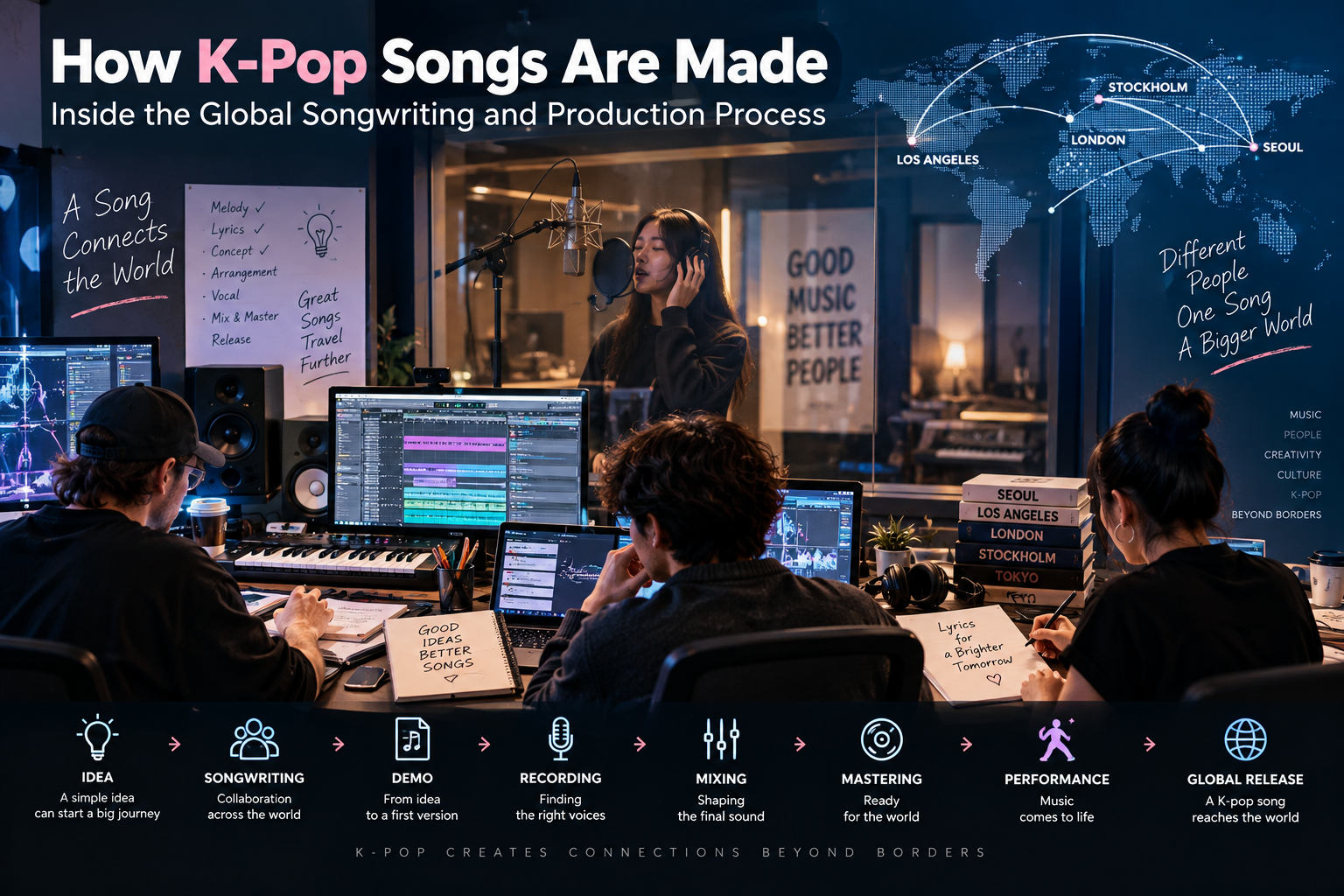
Unlike the popular image of a single songwriter sitting down and creating an entire track from beginning to end, many K-pop songs are built through collaboration. A song may begin as a demo written in Seoul, Stockholm, London, Los Angeles, or another music center. It may then be rearranged, rewritten, translated, recorded, mixed, and refined before eventually becoming the version heard by listeners.
Understanding this process helps explain an important part of modern K-pop: although the industry is based in South Korea, the music itself is often created through an international network of creative professionals.
From an Idea to a K-Pop Song
There is no single formula for creating a K-pop song.
Some tracks begin with a melody. Others start with a beat, chord progression, bass line, concept, or even a short musical phrase that producers believe could become a memorable hook.
In many cases, professional songwriters and producers work together in writing sessions. One person may concentrate on melodies, another on lyrics or vocal ideas, while another builds the instrumental track.
The first result is often a demo.
A demo is not necessarily intended to sound exactly like the final release. Instead, it demonstrates the song’s basic structure and creative potential. It may contain temporary English lyrics, guide vocals, unfinished production, or sections that will later be changed.
For an entertainment company, the important question is not simply whether the demo sounds good.
The company must also consider whether the song fits a particular artist.
Does the vocal range suit the members? Does the song match the group’s identity? Can it support choreography? Does it fit the concept of the planned album or comeback? Is there a memorable section that listeners may recognize immediately?
These questions show why selecting a K-pop song can be as important as writing one.
The Role of A&R
One of the key parts of this process is A&R, traditionally short for Artists and Repertoire.
In a modern K-pop company, A&R professionals can help connect artists with songs, songwriters, producers, and creative opportunities. Their responsibilities vary between companies, but they may listen to demos, communicate with music creators, evaluate potential tracks, and help shape the musical direction of a project.
This makes A&R a bridge between creativity and strategy.
A technically impressive song may not be appropriate for every group. A track written for one type of performer may need major changes before it works for another.
For example, a company preparing a comeback may already have a broad creative direction in mind. The project could require something energetic and performance-driven, something emotionally restrained, or something built around a particularly strong chorus.
The A&R process helps identify music that can support that direction.
This is also one reason K-pop albums can involve many different songwriting credits. Rather than depending on one permanent songwriting team, companies can draw from a wider network of composers, producers, lyricists, and specialists.
Why K-Pop Songwriting Became International
The international character of K-pop production did not appear overnight.
As the Korean music industry expanded, entertainment companies increasingly worked with creators from outside South Korea. Songwriters and producers from Europe, North America, and other regions became part of the creative ecosystem surrounding Korean pop music.
This does not mean that K-pop simply imports foreign songs.
The more interesting process is what happens after different musical ideas enter the Korean idol-production system.
A demo created overseas may be selected by a Korean entertainment company and then adapted for a specific group. Lyrics may be rewritten. Vocal parts may be redistributed. The arrangement may change. Rap sections can be added or revised. The key may be adjusted. Production details may be rebuilt, and the final recording can develop an identity very different from the original demo.
The result is a form of musical collaboration that crosses national boundaries.
This international network also helps explain why K-pop can contain influences from R&B, hip-hop, electronic dance music, pop, funk, rock, house, trap, and other genres while still being recognized by listeners as part of the K-pop industry.
K-pop is therefore not defined by one fixed musical genre.
It is better understood as a production culture capable of combining different sounds within an idol-centered system of music, performance, visual presentation, and promotion.
Songwriting Camps and Collaborative Creation
Another important part of contemporary pop production is the songwriting camp.
A songwriting camp brings multiple writers and producers together for concentrated creative sessions. Participants may form small teams and develop several songs or demos over a limited period.
For K-pop, this model can be particularly useful because entertainment companies need music for different artists, albums, concepts, and performance styles.
Collaborative writing also allows people with different strengths to contribute to the same song.
A producer may create the instrumental foundation. A topliner may develop the vocal melody. Another writer may specialize in hooks, while someone else focuses on harmonies or structural changes.
The final songwriting credits can therefore represent several stages of creative contribution rather than a single writing session.
Digital technology has made this collaboration even more international.
Creators no longer need to work in the same studio. Project files, demos, instrumental tracks, and vocal ideas can move between countries electronically. A song can pass through several creative teams before the final recording takes shape in South Korea.
This networked production process is one of the reasons modern K-pop can respond quickly to global musical trends while continuing to develop its own production conventions.
But receiving a strong demo is only the beginning.
Before a song becomes a K-pop release, it still has to be transformed around the voices, language, identity, and performance abilities of the artists who will ultimately bring it to life.
Adapting a Demo for a K-Pop Group
Once a demo has been selected, the process of turning it into a song for a specific K-pop artist begins.
This stage can involve much more than simply replacing temporary lyrics and recording new vocals.
A demo has to work with the identity of the group that will perform it. If a group has several members, producers must consider how the song can use their different vocal tones, ranges, and performance strengths.
A powerful vocalist may be given a demanding melodic section. A member with a distinctive tone may be placed at a moment where the arrangement becomes more exposed. Rap-oriented members may require newly written sections, while harmonies and background vocals can be redesigned around the group.
Even the structure of the original demo may change.
A verse can be shortened. A pre-chorus may be expanded. A dance break can be inserted. An instrumental section may be redesigned to create a stronger performance moment.
These decisions demonstrate an important characteristic of K-pop production: the final song is often designed not only to be heard, but also to be performed.
Writing Lyrics Across Languages
Language adds another layer to the production process.
An internationally written demo may arrive with English guide lyrics that primarily exist to communicate melody, rhythm, and phrasing. Those words do not necessarily become the final lyrics.
Korean lyricists may then write new lyrics that fit the song’s concept while preserving the musical flow of the melody.
This can be more difficult than direct translation.
Every language has its own rhythm, syllable structure, pronunciation, and natural patterns of emphasis. A phrase that fits perfectly into a melody in English may become awkward when translated literally into Korean.
Lyric writing therefore involves balancing meaning with sound.
The number of syllables matters. Vowel sounds can affect how comfortably a note is sung. Certain consonants may change the impact of a rhythmic phrase. The emotional meaning of the lyrics must also fit the artist and the larger concept of the release.
Modern K-pop frequently adds another challenge: multilingual lyrics.
Korean and English may appear in the same song, and other languages can sometimes be incorporated depending on the project and target audience.
English phrases are often used for hooks because short, memorable expressions can travel easily across linguistic boundaries. But effective multilingual songwriting requires more than inserting foreign words into Korean lyrics.
The different languages must still sound natural within the rhythm and emotional direction of the song.
This helps explain why lyricists are an important part of K-pop production even when the original composition comes from international songwriters.
Recording the Members
After the song, lyrics, and arrangement have developed sufficiently, vocal recording begins.
For listeners, this may seem like a straightforward stage: the members enter a studio and sing their assigned lines.
Professional recording is usually much more detailed.
A vocalist may record the same phrase repeatedly so that producers can compare differences in pronunciation, emotion, timing, tone, and intensity.
The goal is not always to capture the technically most powerful performance.
Sometimes a softer or less polished take communicates the emotion of a section more effectively. In other cases, precision is essential because several vocal layers must fit tightly together.
A vocal director or producer can guide these decisions.
They may ask a singer to change the way a word is pronounced, reduce or increase breathiness, emphasize a particular syllable, alter the rhythm slightly, or deliver a phrase with a different emotional character.
For groups with multiple members, vocal direction also helps create consistency.
Each member has an individual voice, but all of those voices must eventually belong inside the same song.
Line Distribution as a Production Decision
Fans often discuss line distribution—the amount of singing or rapping assigned to each member.
From a listener’s perspective, this can become a question of fairness. From a production perspective, however, line distribution can also involve musical and practical considerations.
Different parts of a song require different qualities.
One section may need a high register. Another may benefit from a lower tone. A rhythmic verse may suit a member with strong articulation, while an emotional bridge may be designed around a particular vocalist.
Performance considerations can matter as well.
A difficult vocal passage combined with demanding choreography may create challenges during live stages. Producers and performance teams therefore have to think about how the recording will translate to the stage.
This does not mean that every line distribution is automatically ideal or beyond criticism.
It means that the final allocation of parts can reflect multiple factors beyond simply dividing a song equally by time.
Building the Vocal Layers
The lead vocal that listeners notice first is only one part of a polished K-pop recording.
Many tracks contain extensive layers of background vocals, harmonies, doubles, ad-libs, and vocal effects.
A chorus, for example, may sound like a single powerful vocal moment while actually containing numerous recorded layers.
Lead vocals can be doubled to increase their weight. Harmonies can widen the sound. Additional voices may emphasize important words. Ad-libs can add energy to the final chorus, while carefully placed breaths, whispers, chants, or processed vocals may contribute to the atmosphere of the track.
These details are particularly important in dense pop production.
When drums, synthesizers, bass, effects, and multiple instrumental elements are competing for space, the vocal production must remain clear enough to guide the listener through the song.
This is where recording and arrangement begin to connect with another technical stage: mixing.
Mixing: Creating Space Inside the Song
Mixing is the process of balancing the many recorded elements of a track.
The mixer works with vocals, drums, bass, synthesizers, guitars, effects, and other sounds to create a coherent final presentation.
Volume is only one part of the process.
Mixing can involve adjusting frequencies, controlling dynamics, positioning sounds across the stereo field, adding effects, and creating a sense of depth.
A vocal may need to feel close and intimate during a verse but larger during the chorus. Bass must be powerful without overwhelming the kick drum. Background vocals need to support the lead without obscuring it.
In highly layered K-pop productions, these decisions can be especially demanding.
A song may move quickly between contrasting sections, each with a different sonic character. The mix has to preserve those contrasts while making the track feel like one complete piece of music.
This technical work is largely invisible to listeners when it succeeds.
But it can strongly influence whether a song feels clear, powerful, spacious, aggressive, warm, or emotionally immediate.
Mastering: Preparing the Final Recording
After mixing, the song normally moves to mastering.
Mastering is one of the final technical stages before distribution. It prepares the completed mix for release and helps ensure that the track translates effectively across different listening environments and formats.
A song may be heard through headphones, smartphones, laptop speakers, car systems, home audio equipment, streaming services, or large concert sound systems.
The mastering process helps the final recording maintain an appropriate balance and impact across those different situations.
It can also help create consistency between songs on the same album or project.
By this point, a track that may have started as a simple demo has passed through numerous creative and technical decisions.
But K-pop adds another major dimension to the process.
The finished recording must become part of a performance—and that means choreography, stage design, visual storytelling, and the physical abilities of the idols can influence how the music itself is understood.
When Music Meets Performance
A K-pop song is rarely developed in complete isolation from performance.
Once a track moves toward release, choreography and stage preparation can reveal things that were not obvious during the songwriting process.
A section that sounds effective through headphones may feel too long when choreographed. A transition may need more space for a formation change. A beat drop can become the center of a dance break, while a short pause may be emphasized because it creates a memorable visual moment on stage.
This relationship between sound and movement is one of the defining features of idol music.
Producers do not necessarily write every song with finished choreography already in mind. However, the K-pop production environment encourages music that can support physical performance.
Rhythmic clarity, contrasting sections, dramatic builds, instrumental breaks, and recognizable hooks can all provide opportunities for choreography.
This is one reason some K-pop songs contain unusually sharp structural changes.
What may initially sound unpredictable can make more sense when the song is experienced together with choreography, camera movement, stage lighting, and visual storytelling.
The recording and the performance are separate creative works, but they can be designed to strengthen each other.
The Song Can Keep Changing
Even after recording begins, a K-pop song may continue to evolve.
Producers can discover that a section does not work as expected with the members’ voices. Lyrics may need adjustment. A note can be moved into a more suitable range. An instrumental layer may be removed because it competes with the vocal.
Sometimes relatively small changes make a major difference.
The length of a pause, the placement of an ad-lib, the intensity of a drum sound, or the timing of a transition can affect how listeners experience the entire track.
This process illustrates why production is not simply the technical stage that follows songwriting.
Production itself is creative decision-making.
The final version of a song is the result of many choices about what to emphasize, what to remove, and what to transform.
Why K-Pop Songs Can Have Long Credit Lists
Listeners looking at the credits of a modern K-pop release may find a surprisingly large number of names.
This can include composers, lyricists, producers, arrangers, vocal directors, recording engineers, mixing engineers, mastering engineers, and other contributors.
A long credit list does not necessarily mean that creativity has become less personal.
Instead, it can reflect the specialized nature of contemporary music production.
Different people may contribute different skills at different stages.
One writer might help create the original melody. Another could contribute to the chorus. A Korean lyricist may adapt the song linguistically and conceptually. An arranger can reshape the instrumental production, while engineers are responsible for capturing and refining the final sound.
Credits therefore offer a useful window into how collaborative K-pop production can be.
They also remind listeners that the music associated with an idol group is usually the product of a much larger creative ecosystem.
The Idols Are Also Becoming Creators
Although K-pop is known for company-organized production systems, idols themselves can participate in songwriting and production.
The level of participation varies widely.
Some performers contribute occasional lyrics. Others become deeply involved in composition, arrangement, or production across multiple releases.
This participation can give artists another way to shape their musical identity.
Writing lyrics may allow a performer to communicate personal experiences or perspectives. Producing can give an artist greater influence over sound and structure. Over time, creative participation can also become an important part of how audiences understand an artist’s development.
However, it is useful to avoid treating songwriting credits as a simple measure of artistic value.
An idol who does not write a song can still contribute through vocal interpretation, rap delivery, choreography, stage performance, and other forms of creative expression.
K-pop is collaborative by nature.
The more useful question is not whether one person created everything, but how different creative roles combine to produce the final work.
Global Collaboration and the Question of K-Pop Identity
The international songwriting network raises an interesting question.
If a song is composed by writers from several countries, produced with global musical influences, and distributed internationally, what makes it K-pop?
There is no simple answer.
K-pop has never been a single musical genre with fixed sonic rules. Across different generations, it has absorbed and reinterpreted influences from numerous styles of popular music.
Its identity comes partly from the system surrounding the music.
Songs are developed for artists operating within the Korean entertainment industry. They are connected with idol training, group identities, Korean-language lyrics, choreography, visual concepts, album campaigns, music shows, fandom practices, and other elements of the broader K-pop ecosystem.
International collaboration therefore does not necessarily erase K-pop’s identity.
Instead, it demonstrates how cultural production can move across borders while being reorganized within a particular industry.
A melody created in one country can travel to another, acquire new lyrics, be rearranged around different performers, and eventually reach listeners around the world.
The path itself becomes part of the story.
The Advantages of a Global Production Network
A global production network gives K-pop companies access to songwriters and producers with diverse musical backgrounds. This broadens the range of ideas available for different artists and creates opportunities for international creators to contribute to Korean releases.
It also offers flexibility: companies can collaborate with specialists across borders without relying entirely on a single in-house production team.
The Challenges of Global Collaboration
The same system can create challenges.
A large number of contributors requires coordination. Creative intentions can change as a song moves between writers, companies, lyricists, performers, and production teams.
Cultural and linguistic differences can also matter.
A phrase that sounds natural in one language may carry an unintended meaning in another. Musical references that seem harmless in one context may be interpreted differently elsewhere.
Questions of authorship, compensation, rights, and proper credit are also important in any professional songwriting environment.
As music production becomes increasingly international, clear communication and responsible creative practices become more important.
Global collaboration works best when it is not simply a way of collecting sounds from different places, but a process in which contributors and cultural contexts are treated with care.
Technology Is Changing the Studio
Music-production technology has always influenced the sound of popular music, and K-pop is no exception.
Modern digital audio workstations allow producers to create complex recordings with extraordinary precision. Vocal editing, virtual instruments, sampling, synthesis, and remote collaboration have expanded what can be produced inside a studio.
These tools can make experimentation faster.
A producer can test different arrangements, change instrumentation, move sections, alter tempos, and exchange project files without requiring every contributor to be physically present.
Artificial intelligence is now introducing another set of possibilities and questions.
AI-assisted tools may help with certain production tasks, sound design, editing, or experimentation. At the same time, generative systems raise significant questions about copyright, consent, creative ownership, training data, and the use of human voices and artistic styles.
For K-pop, these questions may become increasingly important because the industry already operates at the intersection of technology, global collaboration, and carefully managed artist identities.
The future of production will therefore involve more than adopting new tools.
It will also require decisions about how those tools should be used.
Why the Production Process Matters
Understanding how K-pop songs are made changes the way the finished music can be heard.
A single track may contain ideas that traveled through several countries, lyrics rewritten to fit a new language, vocals recorded across many takes, layers that listeners barely notice consciously, and technical decisions refined until the final master is ready for release.
What sounds effortless may represent months of work.
The process also helps explain why K-pop can change rapidly without losing its broader identity.
Its production system is flexible.
It can absorb new genres, technologies, songwriting methods, and international influences while reorganizing them around specific artists and performances.
This flexibility has become one of the industry’s greatest creative strengths.
From Demo to Global Release
The journey of a K-pop song can begin almost anywhere.
It might start with a producer building a beat alone, a group of songwriters working in a camp, an international demo sent to an entertainment company, or an artist developing an idea with collaborators.
From there, the music passes through selection, adaptation, lyric writing, arrangement, vocal recording, editing, mixing, mastering, and performance preparation.
At every stage, people make decisions that reshape the song.
By the time listeners press play, the original idea may have traveled through an entire network of creative professionals.
That is one of the most fascinating aspects of modern K-pop.
Behind the polished music video, synchronized choreography, and instantly recognizable hook is a production system that connects creativity across languages, professions, technologies, and national borders.
K-pop’s global character is therefore present not only in the audiences who listen to it.
It can be found inside the music-making process itself.
Leave a Reply