
Stray Kids Made History at Rock in Rio 2026
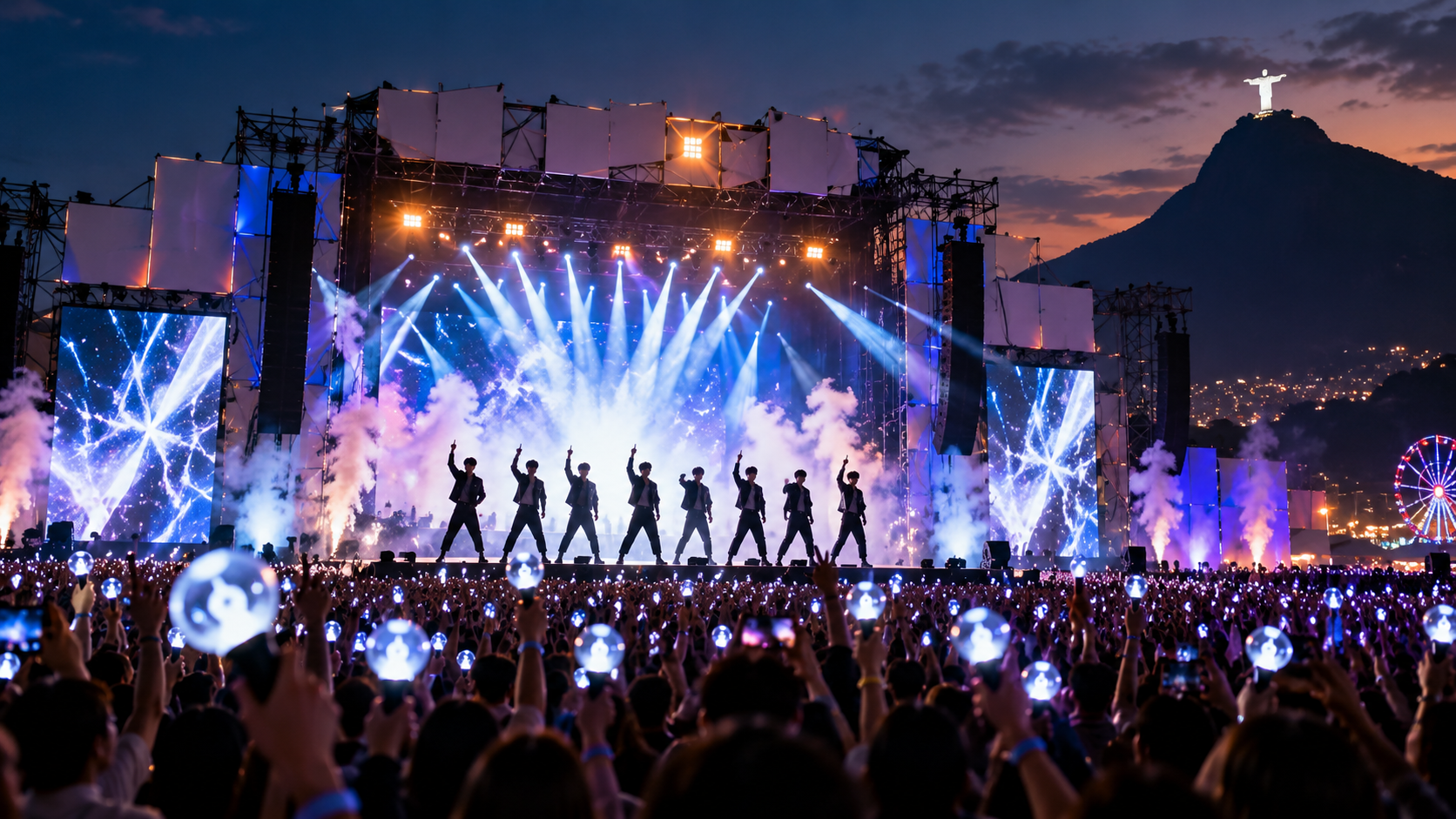
On September 11, 2026, Stray Kids reached another major milestone in their global career. The eight-member group headlined Rock in Rio in Brazil, becoming the first K-pop act to headline the legendary festival.
Their performance took place on Palco Mundo, Rock in Rio’s main stage, in front of an estimated 100,000 people. The achievement was especially significant because Rock in Rio has been one of the world’s best-known music festivals since its first edition in 1985.
For Stray Kids, however, the night represented more than another large international concert. It showed how far both the group and K-pop have moved into the mainstream global festival circuit.
Rock in Rio also made an unusual change for the occasion. For the first time in the festival’s history, fans were allowed to bring K-pop lightsticks into the venue. The result was a huge lightstick-filled crowd that visually brought K-pop concert culture into one of Latin America’s most famous music festivals.
Stray Kids performed songs from different stages of their career, including “TOPLINE,” “S-Class,” “MANIAC,” “God’s Menu,” “Chk Chk Boom,” “LALALALA,” and “THIS & THAT.” The group performed with a live band and delivered festival versions and remixes of several songs, giving the show a different character from a standard tour concert.
But why was Stray Kids becoming Rock in Rio’s first K-pop headliner such an important moment?
To understand that, it helps to look at both the history of the festival and Stray Kids’ rapid rise on the international festival circuit.
Why Rock in Rio Matters
Rock in Rio is not a new festival looking for its first international breakthrough. Its history goes back to 1985, when the first edition was held in Rio de Janeiro and attracted around 1.38 million people over 10 days.
Over the following decades, Rock in Rio expanded beyond Brazil to other countries and became one of the most recognizable large-scale music festivals in the world. Its stages have hosted major artists from rock, pop, metal, electronic music, and many other genres.
That history makes Stray Kids’ appearance especially meaningful.
On September 11, Stray Kids occupied the top position on the Palco Mundo lineup. The same 2026 main stage hosted artists including Foo Fighters, Elton John, Maroon 5, Twenty One Pilots, Halsey, Demi Lovato, and Avenged Sevenfold on other festival days.
The September 11 lineup also showed something bigger happening around K-pop. Stray Kids were joined on Palco Mundo by HWASA and NEXZ, alongside Brazilian DJ and producer Alok.
For a genre that once reached many international listeners mainly through online fandoms, albums, music videos, and dedicated K-pop concerts, appearing at the center of a festival like Rock in Rio represents a different kind of visibility.
Stray Kids were no longer performing only inside a K-pop-specific environment.
They were standing on the main stage of a major global music festival.
From K-Pop Concerts to Global Festival Stages
Stray Kids’ Rock in Rio appearance also fits a broader change in the group’s international career.
As their audience has grown, the group has increasingly appeared in spaces that place them alongside artists from many different genres and countries. Large festivals offer a different challenge from an arena or stadium filled primarily with dedicated fans.
A festival performance has to communicate quickly.
The songs, choreography, live energy, stage production, and individual personalities all have to work even for people who may not know every lyric or every member.
That makes Stray Kids particularly suited to this environment. Their music frequently combines hip-hop, electronic production, rock elements, powerful choreography, and performance-focused arrangements. Songs such as “God’s Menu,” “MANIAC,” “S-Class,” and “Chk Chk Boom” were already designed around strong musical and visual identities.
At Rock in Rio, those characteristics could be presented not simply as part of K-pop fandom culture, but as a live festival experience.
Why Latin America Matters for Stray Kids
Rock in Rio was not an isolated stop for Stray Kids. It came in the middle of a much larger push into Latin America.
Just two days before the Rock in Rio performance, Stray Kids launched STRAYCITY in Bogotá, Colombia. The new festival-style project, co-produced with Live Nation, was designed as a multi-city event rather than a conventional K-pop concert tour.
After Bogotá and Rio de Janeiro, the schedule continued through Buenos Aires and Mexico City. Local artists were also included alongside K-pop acts, giving STRAYCITY a broader festival identity.
That matters because Stray Kids had already demonstrated the scale of their Latin American audience before 2026. Their previous touring showed that the region was capable of supporting major stadium-level K-pop performances.
STRAYCITY takes the idea one step further.
Instead of simply bringing an existing Korean concert production to Latin America, the project places Stray Kids at the center of a festival format that can connect K-pop with artists and audiences from individual markets.
From Seoul to the World
There is also a clear connection between this expansion and the story Stray Kids have been telling through their music.
Their 2026 song “RUN IT” was built around the idea of moving from a small beginning in Seoul toward a much larger global stage. Members Bang Chan, Changbin, and Han of 3RACHA participated in creating the track, which combines pop and alternative hip-hop with brass, marching drums, and world-beat rhythms.
JYP Entertainment also connected “RUN IT” directly with the group’s expanding international performance schedule, including Governors Ball, Rock in Rio, and STRAYCITY.
That makes the Rock in Rio performance feel almost like a real-world continuation of the song’s message.
Stray Kids started as a K-pop group built around self-produced music and a distinctive sound. By 2026, they were not simply taking that music overseas. They were being positioned at the top of major festival lineups and building new live-event formats around their own name.
What This Moment Means for K-Pop
The significance of Rock in Rio goes beyond Stray Kids.
For years, one of the clearest signs of K-pop’s international growth was the expansion of dedicated K-pop concerts and world tours. Groups could travel farther, perform in larger venues, and attract increasingly large fandoms outside Asia.
Festival headlining represents another stage of that evolution.
At Rock in Rio, Stray Kids appeared on the same main stage used by major international artists from many different musical traditions. September 11 was also presented as the festival’s first K-pop-focused day, with HWASA and NEXZ performing on the main stage before Stray Kids.
Even the decision to allow K-pop lightsticks into the festival for the first time carried symbolic weight. A fan culture that developed largely inside K-pop concerts was now visible inside one of the world’s major music festivals.
Rock in Rio 2026 therefore represents more than another entry on Stray Kids’ tour schedule.
It marks a moment when a K-pop group did not simply participate in a global festival.
Stray Kids headlined it.
And as STRAYCITY continues across Latin America, that milestone may be remembered as another step in the transformation of K-pop from a global fandom phenomenon into a permanent part of the international live-music landscape.
Frequently Asked Questions
When did Stray Kids perform at Rock in Rio 2026?
Stray Kids performed at Rock in Rio in Rio de Janeiro, Brazil, on September 11, 2026. They closed the night on Palco Mundo, the festival’s main stage.
Were Stray Kids the first K-pop headliner at Rock in Rio?
Yes. Stray Kids became the first K-pop act to headline Rock in Rio. Their appearance was part of a historic K-pop-focused day that also featured HWASA and NEXZ on the main stage.
How many people attended Stray Kids’ Rock in Rio performance?
JYP Entertainment said the performance drew around 100,000 people. The huge crowd also stood out visually because Rock in Rio allowed K-pop lightsticks into the festival for the first time.
What songs did Stray Kids perform at Rock in Rio?
Their performance included major Stray Kids songs such as “God’s Menu,” “MANIAC,” “S-Class,” “LALALALA,” “Chk Chk Boom,” “TOPLINE,” and “THIS & THAT,” among others.
What is STRAYCITY?
STRAYCITY is Stray Kids’ festival-style live project developed with Live Nation. Its 2026 Latin American schedule includes cities such as Bogotá, Rio de Janeiro, Buenos Aires, and Mexico City, combining Stray Kids with other K-pop and local artists.
A New Chapter in Stray Kids’ Global Story
Stray Kids’ rise has often been measured through album sales, chart records, sold-out tours, and an increasingly international fandom.
Rock in Rio offered a different measure.
On September 11, 2026, eight Korean artists stood at the top of the lineup on one of the world’s most recognizable festival stages, while tens of thousands of fans filled the venue with the lightsticks and chants associated with K-pop concert culture.
That moment connected several parts of the Stray Kids story: their self-produced musical identity, their growth as live performers, their expanding Latin American audience, and their move into the wider global festival circuit.
For Stray Kids, Rock in Rio 2026 was another milestone.
For K-pop, it was another sign of how much the boundaries of the genre’s global stage have changed.
Leave a Reply