Author: kpopthroughtime

  • K-Pop Title Track vs B-Side vs Pre-Release

    K-Pop Title Track vs B-Side vs Pre-Release

    If you are new to K-pop, the phrase “title track” can be confusing.

    In many English-speaking music markets, a title track traditionally means a song that has the same name as the album. In K-pop, however, the term is often used differently. A title track is usually the main song chosen to represent and promote an album, single album, EP, or mini album—even when the song and album have completely different names.

    The title track is typically the song that receives the biggest promotional push. It may get the main music video, choreography, music-show performances, dance challenges, interviews, and other promotional content during a comeback.

    But that raises several questions. How is a title track different from a B-side? Is a pre-release song also a title track? And why do some K-pop albums have two title tracks?

    Understanding these terms makes it much easier to follow K-pop releases and comeback promotions. It also reveals something important about how the K-pop industry has developed: an album is not promoted only as a collection of songs, but often as a complete era built around music, performance, visuals, and storytelling.

    What Does “Title Track” Mean in K-Pop?

    In K-pop, a title track is generally the main song selected to represent a new release and receive the most promotion.

    It does not have to share the same name as the album.

    For example, a K-pop mini album may contain five or six songs, but one song is usually chosen as the central promotional track. That song may receive an official music video, choreography, music-show stages, performance videos, dance challenges, and extensive promotion on social media.

    This is why international K-pop fans often use “title track” almost interchangeably with “main promotional song.”

    For a beginner-friendly explanation of the term and its role in a comeback, read our guide: What Is a Title Track in K-Pop?

    Title Track Does Not Mean the Song Has the Same Name as the Album

    This is one of the biggest differences between the way the term is commonly understood in K-pop and its traditional English-language meaning.

    Outside K-pop, “title track” often refers specifically to a song whose title matches the album title.

    In K-pop fandom and promotional language, however, the album and its main song can have completely different names.

    What matters is the song’s role in the promotional cycle, not whether its name matches the album.

    That distinction is especially useful for new international fans because K-pop releases are often organized around clearly defined promotional eras. The title track usually becomes the musical centerpiece of that era.

    Title Track vs B-Side: What Is the Difference?

    The simplest difference is promotion.

    A title track is usually the main song selected to represent the release, while B-sides are the other songs included on the album or mini album.

    That does not mean B-sides are less important musically. In fact, some B-sides become fan favorites, go viral on social media, receive performance videos, or even become more popular with listeners than the title track.

    The difference is mainly about how the songs are positioned when the release begins.

    A title track typically receives:

    • The main music video
    • Major music-show performances
    • Choreography and performance content
    • More promotional appearances
    • A larger role in defining the comeback’s concept and visual identity

    B-sides may receive some of these things too, especially when a song becomes popular or the company decides to promote more than one track. But they usually begin as supporting tracks rather than the main promotional focus.

    Can a B-Side Become More Popular Than the Title Track?

    Yes.

    K-pop history includes many cases in which a B-side attracted significant attention after an album was released. Streaming platforms, short-form video, dance challenges, concert performances, and fan recommendations have made it much easier for songs that were not originally the main promotional track to reach large audiences.

    This is one reason the distinction between a title track and a B-side is about promotional status, not necessarily song quality or eventual popularity.

    A B-side can become a major hit while still technically being a B-side on the original release.

    Pre-Release vs Title Track: Are They the Same?

    Not necessarily.

    A pre-release is a song released before the main album or mini album arrives. Its purpose may be to build anticipation, introduce a new concept, or give fans an early taste of the upcoming release.

    The title track, by contrast, is usually the main promotional song associated with the full release.

    Sometimes a pre-release receives its own music video and extensive promotion, making it feel almost as important as the later title track. In other cases, it serves mainly as an introduction to the comeback.

    This means a song’s release timing and promotional role are two different things:

    • Pre-release: describes when the song is released relative to the album.
    • Title track: describes the song’s main promotional role.
    • B-side: generally describes an album track that is not designated as the main title track.

    These categories can occasionally overlap depending on how an entertainment company structures a release campaign.

    Why Do K-Pop Artists Release Songs Before the Title Track?

    Pre-releases have become an important part of modern K-pop promotion.

    Instead of concentrating all attention on one release date, companies can begin the comeback cycle earlier. A pre-release can generate streaming activity, social-media discussion, choreography clips, and international attention before the complete album arrives.

    For fans, this can make a comeback feel like a longer sequence of events rather than a single release day.

    It also shows how K-pop promotion has evolved. As streaming and global social platforms became increasingly important, release campaigns gained more flexibility. An artist can now introduce one song first, build anticipation, and then reveal the main title track as another major moment in the same era.

    Can a K-Pop Album Have Two Title Tracks?

    Yes. A K-pop release can have more than one title track.

    When two songs are officially presented as the main promotional tracks, fans may refer to them as double title tracks or dual title tracks.

    Instead of choosing only one song to represent the release, an artist or company may give two songs major promotional attention. Both can receive music videos, performances, choreography, or other prominent content.

    There are several reasons for using two title tracks.

    The songs may show different sides of an artist, target different musical audiences, or help demonstrate the range of an album. One track might emphasize powerful performance while another highlights vocals or a different concept.

    This also explains why simply looking for “the song with the album’s name” does not reliably identify a K-pop title track. The designation depends much more on how the release is officially structured and promoted.

    Why Is the Title Track So Important in K-Pop?

    The title track often does more than promote an album.

    It can define an entire comeback era.

    K-pop combines music with choreography, fashion, visual concepts, music videos, performances, and storytelling. Because the title track usually receives the greatest promotional attention, it often becomes the song that audiences associate most strongly with that particular era.

    For casual listeners, it may be their first introduction to the album—or even to the artist.

    For existing fans, the title track can become the center of weeks of teasers, performances, fan discussions, dance challenges, and other comeback activities.

    That is why choosing a title track can be an important strategic decision. It is not necessarily a declaration that the song is objectively the “best” track on the album. Instead, it is the song—or sometimes songs—chosen to lead the release publicly.

    How the Role of the K-Pop Title Track Has Changed Over Time

    The basic idea of promoting one main song is not new. Korean pop artists have long used a lead song to represent an album and perform on television music programs.

    What has changed is the scale of promotion surrounding that song.

    In earlier generations of K-pop, television performances, physical albums, radio, and domestic media played a particularly important role in introducing a new release. The main promoted song naturally became the track most familiar to the general public.

    As K-pop expanded internationally, the promotional environment changed.

    YouTube made music videos available instantly to global audiences. Streaming services allowed international fans to explore entire albums. Later, platforms built around short-form video helped choreography, memorable hooks, and even B-sides spread independently of traditional promotions.

    Today, a title track can sit at the center of a much larger campaign involving:

    • Concept photos and trailers
    • Music-video teasers
    • Performance and dance-practice videos
    • Music-show stages
    • Short-form dance challenges
    • Fan events and livestreams
    • Global interviews and promotional appearances

    At the same time, B-sides and pre-release songs now have more opportunities to gain attention of their own.

    This has made modern K-pop album promotion more complex than a simple “main song versus everything else” structure. The title track remains important, but fans can discover and popularize songs across the entire album.

    Title Track, Lead Single, and Promotional Single

    International fans may also encounter the terms lead single and promotional single.

    They can describe similar ideas, but they come from somewhat different music-industry terminology and should not always be treated as exact synonyms.

    In K-pop discussions, “title track” remains a very common way to identify the main song being promoted with a release. English-language media may instead describe the same song as a lead single, particularly when writing for audiences outside K-pop fandom.

    The safest way to understand a specific release is to look at how the artist, label, and official promotional materials describe the songs.

    How to Identify the Title Track on a K-Pop Album

    If you are new to K-pop, there are several easy clues that can help you identify the title track.

    Look for the song that receives the main music video, appears most prominently in comeback promotions, and is performed repeatedly on music shows. Official album announcements, track lists, and promotional schedules may also identify the title track directly.

    However, remember that not every release follows exactly the same formula. Some albums have two title tracks, while others use pre-release singles or promote selected B-sides alongside the main song.

    When in doubt, official information from the artist or label is the most reliable guide.

    Frequently Asked Questions

    Is a K-Pop Title Track Always the Best Song on the Album?

    No. Calling a song the title track describes its promotional role, not its quality.

    Fans may prefer a B-side, and sometimes a non-title track becomes especially popular after release.

    Does a Title Track Have to Have the Same Name as the Album?

    No. In K-pop, the main promotional song and the album can have completely different names.

    This is one of the main reasons the term can initially confuse international fans.

    Is Every K-Pop Single a Title Track?

    Not necessarily.

    The terminology depends on how a particular release is structured and officially promoted. A standalone single may function as the main promoted song, while albums and mini albums can contain a title track alongside multiple B-sides.

    Can There Be More Than One Title Track?

    Yes. Some K-pop releases officially promote two or more songs as title tracks.

    These may be described by fans as double or dual title tracks.

    Is a Pre-Release Song a B-Side?

    Not automatically.

    “Pre-release” describes when a song becomes available, while “B-side” and “title track” describe its position or promotional role within a release. Because these terms describe different aspects of a song, the categories do not always fit into a simple either-or system.

    Final Thoughts

    In K-pop, a title track is generally the main song chosen to lead the promotion of a new release. It does not need to share the album’s name, and it is not automatically considered better than the other songs.

    B-sides are the other tracks on the release, while pre-release songs arrive before the main album or mini album and may have their own promotional campaigns. Some releases even use multiple title tracks.

    Understanding these differences makes K-pop comeback schedules, track lists, music-show performances, and fan discussions much easier to follow.

    More importantly, the changing role of the title track tells part of the larger story of K-pop itself. What was once centered heavily on a main song promoted through domestic media has developed into a global release cycle in which title tracks, B-sides, pre-releases, music videos, performances, and social platforms can all shape how an era is experienced.
  • What Does “Comeback” Mean in K-Pop? Why Every New Release Is Called a Comeback

    What Does “Comeback” Mean in K-Pop? Why Every New Release Is Called a Comeback

    What Does “Comeback” Mean in K-Pop?

    If you are new to K-pop, the word “comeback” can be confusing.

    In everyday English, a comeback usually means returning after being away for a long time. A singer might make a comeback after several years without releasing music, or an actor might return to the spotlight after a long break.

    In K-pop, however, the word has a much broader meaning.

    A K-pop comeback is when an artist releases new music and begins a new promotional cycle, usually with a new song, album or mini album, concept, music video, and performances.

    The artist does not need to have disappeared for years—or even for very long.

    A group can release an album, finish promotions, return a few months later with another release, and fans will still call it a comeback.

    That is why K-pop fans regularly say things like:

    • “Their comeback is next month.”
    • “Did you see the comeback teaser?”
    • “This is my favorite comeback concept.”
    • “When is the group having its next comeback?”

    To understand why the word is used this way, it helps to understand how K-pop promotions are organized.

    Comeback in K-Pop: The Simple Definition

    In the simplest terms:

    Debut = the artist’s first official release or introduction.

    Comeback = a new promotional era after the debut.

    Once a K-pop artist has debuted, most major new release cycles can be described as comebacks.

    A comeback is therefore not simply about an artist “returning.” It marks the beginning of a new era of music, visuals, performances, and promotions.

    This is one reason the word is so important in K-pop culture. A new release is often presented as much more than uploading a new song. It can involve weeks of teasers, new styling, concept photos, choreography, music-show appearances, fan events, and other promotional content.

    For fans, a comeback can feel like the start of an entirely new chapter in an artist’s career.

    Why Is Every New K-Pop Release Called a Comeback?

    The meaning makes more sense when you look at the way the K-pop industry developed.

    K-pop promotions have traditionally been organized into distinct activity periods. An artist releases new music, promotes it intensively for a period of time, and then ends that promotional cycle before preparing for the next one.

    When the artist begins promoting new music again, they are considered to have “come back” to active promotions.

    The important point is that the artist does not need to have been inactive for years.

    The “return” is often a return to the promotion cycle, especially music shows, performances, interviews, fan events, and other activities connected to a new release.

    This is different from the way many Western music markets traditionally operate, where an artist may release several singles over a long album campaign without describing each release as a separate comeback.

    A K-Pop Comeback Is More Than Just a New Song

    A comeback often begins before fans hear the full song.

    Entertainment companies may build anticipation through a carefully planned sequence of promotional material, such as:

    • comeback announcements;
    • scheduling posters;
    • concept photos;
    • album details;
    • track lists;
    • individual member teasers;
    • video trailers;
    • highlight medleys or album previews;
    • music video teasers.

    By the time the title track and music video are released, fans may already have spent days or weeks discussing the new concept.

    Promotions can then continue through music shows, interviews, variety content, dance challenges, fan events, and live performances.

    This entire period is commonly referred to as the artist’s comeback era.

    That is why fans may remember different comebacks not only by their songs, but also by their hairstyles, fashion, choreography, album design, visual concept, and performances.

    A comeback can become a recognizable moment in a group’s history.

    Comeback vs Debut: What Is the Difference?

    The difference between a debut and a comeback is straightforward but important.

    A debut introduces an artist to the public for the first time. For a new K-pop group, it usually includes the group’s first official music release, music video, performances, and promotional activities.

    After that first era, later major promotional releases are generally described as comebacks.

    For example, a group may:

    Debut → finish promotions → prepare new music → announce a comeback → release the new album → begin another promotional era.

    This cycle can repeat several times during a group’s career.

    A comeback therefore represents continuity, while a debut represents a beginning.

    There are also other terms fans may encounter. A solo debut, for example, can happen when an established group member releases official solo music for the first time. The artist is already famous, but the release can still be called a debut because it begins that person’s official solo career.

    What Usually Happens During a K-Pop Comeback?

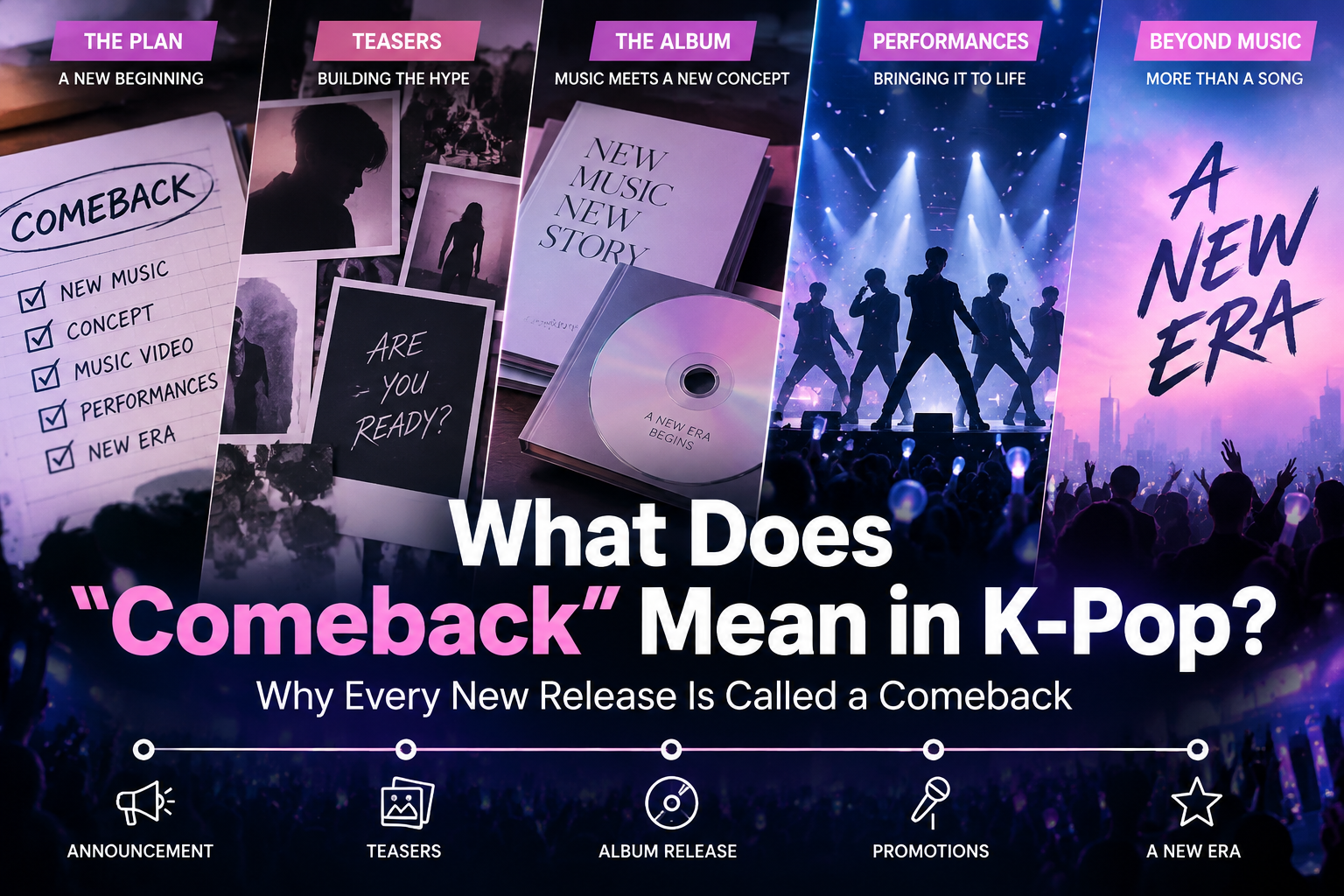
    Although every company and artist handles promotions differently, a typical comeback may follow several stages.

    1. The Comeback Is Announced

    The company or artist confirms that new music is coming.

    Sometimes the announcement arrives unexpectedly. In other cases, news about recording, filming, or comeback preparations may circulate before the official announcement.

    2. The Concept Is Revealed

    Concept photos, trailers, logos, styling, and other visual material begin establishing the identity of the new era.

    K-pop places unusual emphasis on this stage because visual storytelling can be closely connected to the music and the group’s broader identity.

    3. The Album and Songs Are Previewed

    Fans may receive a track list, album packaging information, highlight medley, or short previews.

    This is also when discussions about the title track and B-sides often become more active.

    4. The Music Is Released

    The album or single and its main music video are released.

    This is usually the central moment of the comeback, but it is not necessarily the end of the comeback cycle.

    5. Promotions Begin

    Artists may perform on Korean music shows, appear in interviews and entertainment content, hold fan events, release performance videos, and promote songs through short-form platforms.

    The length and style of promotions vary considerably between artists.

    This structured cycle is one of the main reasons a K-pop release can feel like an event rather than simply another song appearing online.

    Comeback vs Repackage, Pre-Release and Single

    Not every new piece of music works in exactly the same way, which can make K-pop terminology confusing for new fans.

    A repackage album usually takes an existing album and releases an expanded or revised version with additional songs and often a new title track. If the artist begins another round of promotions, fans may still describe the activity as a comeback.

    A pre-release single is a song released before the main album or title track. It can begin the excitement around an upcoming era, but the larger album release may still be treated as the main comeback.

    A digital single can also function as a comeback when it begins a new promotional cycle, even without a physical album.

    This is why the word “comeback” cannot always be defined by the format of the release alone. The promotional context matters.

    How Long Does an Artist Have to Be Away Before a Comeback?

    There is no required length of time.

    This is one of the biggest differences between the everyday English meaning of “comeback” and its K-pop meaning.

    An artist might return after:

    • several months;
    • one year;
    • several years;
    • military service;
    • a long hiatus;
    • or simply the gap between two normal promotional cycles.

    All of these can be described as comebacks.

    The emotional meaning, however, may be very different.

    When a group releases new music only a few months after its previous promotions, “comeback” usually functions as standard K-pop industry language.

    When an artist returns after several years, a long hiatus, or major changes, the word can also carry its familiar English meaning of a significant return.

    The same term therefore covers both routine promotional returns and genuinely long-awaited returns.

    This flexibility is part of what makes the term confusing at first—and completely normal once you become familiar with K-pop culture.

    Why Comebacks Matter So Much in K-Pop

    Comebacks are important because K-pop is built around more than recorded music.

    A comeback brings together music, choreography, visual design, fashion, performance, storytelling, fandom activity, and marketing. These elements can make each promotional era feel distinct from the one before it.

    For artists, a comeback is also an opportunity to show change.

    A group may move from a bright concept to a darker one, experiment with a different genre, introduce a new storyline, or present a more mature image. Looking back at an artist’s comebacks can therefore reveal how their music and identity developed over time.

    This is especially noticeable with long-running groups. Their early comeback eras may look and sound very different from releases that arrive five or ten years later.

    In that sense, comebacks help create the timeline of a K-pop career.

    How Comeback Culture Changed as K-Pop Became Global

    The basic idea of the comeback developed during an era when Korean television music shows and domestic promotions played a central role in K-pop.

    As K-pop became increasingly global, the comeback cycle expanded.

    Today, a major release can include global streaming campaigns, international interviews, social-media challenges, overseas performances, global album distribution, online fan events, and promotional content designed for audiences across multiple time zones.

    Fans no longer need to live in South Korea to experience a comeback almost in real time.

    They can watch teasers as they are released, follow countdowns, stream the music video, discuss concept photos, watch music-show performances online, and participate in fandom activities from around the world.

    The platforms have changed, but the central idea remains familiar:

    A new comeback marks the beginning of a new K-pop era.

    This is one reason the term has survived even as the industry around it has changed dramatically.

    Frequently Asked Questions About K-Pop Comebacks

    Does “comeback” mean the artist was inactive for a long time?

    No. In K-pop, an artist can have a comeback only a few months after the previous release. The term usually refers to starting a new release and promotional cycle rather than returning after a long absence.

    Is every new K-pop song a comeback?

    Not necessarily. An OST, collaboration, special track, or other release may not begin a full promotional era. Whether fans call something a comeback often depends on how the release is presented and promoted.

    Can a solo artist have a comeback?

    Yes. Once a solo artist has debuted, later major releases can be called comebacks in the same way as group releases.

    What is a comeback stage?

    A comeback stage is a performance associated with the beginning of an artist’s new promotional period, particularly on Korean music shows. It introduces the new song and performance to viewers.

    What is a comeback showcase?

    A comeback showcase is an event held around a new release where an artist may perform new songs, discuss the album, answer questions, and introduce the concept. The exact format varies.

    Is a comeback the same as a new album?

    Not always. A comeback can involve a full album, mini album, single album, digital single, or another type of release. The promotional cycle is more important than the physical format.

    Final Thoughts: What “Comeback” Really Means in K-Pop

    The word “comeback” is one of the clearest examples of how K-pop has developed its own vocabulary.

    To someone unfamiliar with K-pop, it may sound strange to say that an artist is “coming back” only a few months after the previous release.

    Within K-pop culture, however, the meaning is simple.

    A comeback marks the moment an established artist begins a new musical and promotional era.

    It can bring a new song, album, concept, choreography, visual identity, and series of performances. Sometimes the gap between eras is short. Sometimes fans wait for years.

    Either way, the comeback becomes another point on the artist’s timeline.

    And that is why understanding the word tells you something larger about K-pop itself: K-pop is organized not only around songs and albums, but around eras that fans experience, remember, and compare over time.

  • Stray Kids STRAYCITY 2026 Explained: Latin America Festival, Setlist, Dates & Why It’s Different

    Stray Kids STRAYCITY 2026 Explained: Latin America Festival, Setlist, Dates & Why It’s Different

    Stray Kids Turn STRAYCITY Into Their Own Global Festival

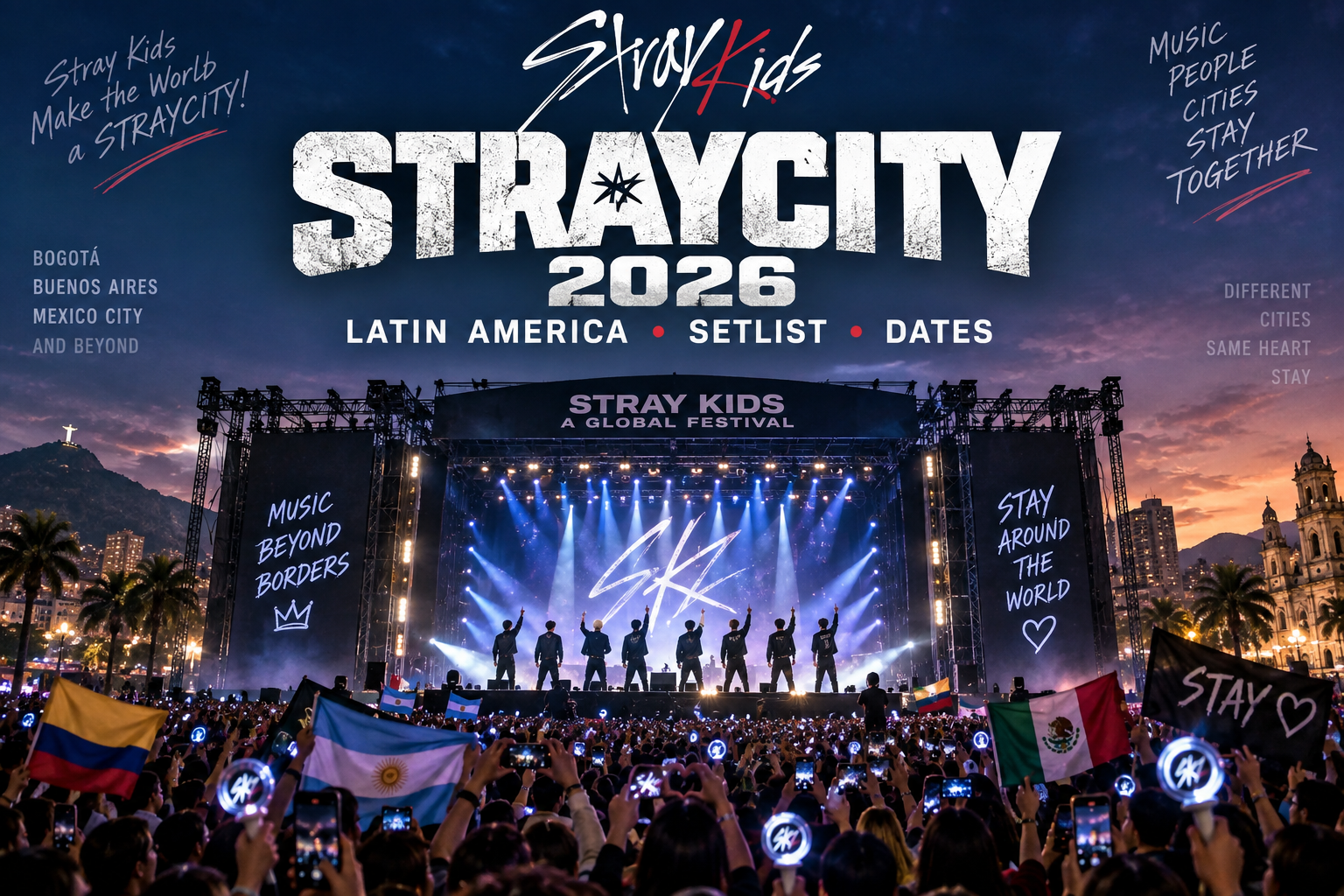
    Stray Kids have taken their live performances to a new level in 2026 with STRAYCITY, a large-scale festival project built around the group and their music.

    Rather than functioning like a traditional concert tour, STRAYCITY combines a major Stray Kids performance with the atmosphere and scale of a music festival, creating a different kind of experience for STAYs.

    The project launched in Latin America in September 2026, with shows in Bogotá and Buenos Aires, followed by scheduled dates in Mexico City.

    Fans have also been paying close attention to the STRAYCITY setlist, which mixes signature Stray Kids hits with newer songs from their 2026 era.

    So what exactly is STRAYCITY, how is it different from a regular Stray Kids concert, and which songs are being performed?

    In this guide, we’ll break down the STRAYCITY concept, Latin America dates, setlist highlights, and why the festival could become an important new chapter in Stray Kids’ global live career.

    What Is Stray Kids’ STRAYCITY?

    STRAYCITY is a large-scale live festival project centered on Stray Kids, created in partnership with JYP Entertainment and Live Nation.

    Unlike a standard concert tour, the concept is designed around a broader festival-style experience, with Stray Kids serving as the main attraction.

    The project began its Latin American run in Bogotá, Colombia, on September 9, 2026, before moving to Buenos Aires, Argentina. Mexico City is also part of the announced schedule later in September.

    The name “STRAYCITY” reflects the idea of transforming each host city into a temporary world built around Stray Kids, their music, performances, and STAY fandom.

    That distinction is important: STRAYCITY is not simply another stop on the RUN IT World Tour. It is presented as its own festival project, giving Stray Kids another format for connecting with large international audiences.

    How Is STRAYCITY Different From a Regular Stray Kids Concert?

    The biggest difference is the festival-style format.

    A traditional Stray Kids tour is built around a concert production that travels from city to city. STRAYCITY, however, is designed as a larger event concept centered on Stray Kids while creating the atmosphere of a dedicated music festival.

    That gives the project a different identity from the RUN IT World Tour, even though both are part of Stray Kids’ busy 2026 live schedule.

    STRAYCITY also allows the group to build a set around different stages of its career. Recent songs can appear alongside major fan favorites, giving longtime STAYs and newer listeners a broader live experience.

    In that sense, STRAYCITY is not simply about adding more tour dates. It experiments with a format in which Stray Kids themselves become the center of a festival-scale event.

    STRAYCITY 2026 Latin America Dates

    STRAYCITY launched its first run in Latin America, highlighting the growing importance of the region in Stray Kids’ global activities.

    The project began in Bogotá, Colombia, on September 9, 2026, before continuing to Buenos Aires, Argentina, where strong demand led to an additional performance.

    The next destination is Mexico City, Mexico, with STRAYCITY scheduled for September 25 and 26, 2026.

    These events give Latin American STAYs another opportunity to experience Stray Kids in a format that is different from a conventional world-tour stop.

    JYP Entertainment has also indicated that additional STRAYCITY locations could be announced, meaning the Latin America dates may represent the beginning of a broader festival project rather than its final form.

    STRAYCITY 2026 Setlist: Old Hits Meet the New Era

    One of the biggest attractions of STRAYCITY is its setlist.

    Rather than focusing only on Stray Kids’ newest material, the performances bring together songs from different stages of the group’s career.

    Major fan favorites such as “God’s Menu,” “MANIAC,” “S-Class,” “TOPLINE,” and “MIROH” have appeared alongside newer 2026 material including “This & That” and “After You.”

    This mix gives the festival a career-spanning feel. Longtime STAYs can experience songs that helped define Stray Kids’ rise, while newer releases connect the performance to the group’s current musical era.

    The live-band production and large outdoor setting also help distinguish STRAYCITY from simply replaying a standard tour set.

    Because setlists can change between cities and performances, fans attending future STRAYCITY dates should expect possible adjustments rather than assuming every show will feature exactly the same songs.

    Why STRAYCITY Matters for Stray Kids

    STRAYCITY represents something different in Stray Kids’ live career: an event built around the group rather than simply another stop on a conventional tour.

    By placing Stray Kids at the center of a festival-scale experience, the project shows how the group’s live presence has expanded alongside its international audience.

    Latin America is especially significant for the first STRAYCITY events. Bogotá, Buenos Aires, and Mexico City give the project a strong international starting point while allowing Stray Kids to connect with large communities of STAYs across the region.

    The format may also give Stray Kids more flexibility in the future. Different cities, changing setlists, festival production, and additional locations could allow STRAYCITY to evolve without simply duplicating the group’s regular world tours.

    For that reason, STRAYCITY can be viewed as more than a series of 2026 performances. It is an experiment with a new kind of Stray Kids live-event format — one that could potentially grow alongside the group’s global career.

    Frequently Asked Questions About STRAYCITY 2026

    What is Stray Kids’ STRAYCITY?

    STRAYCITY is a festival-style live project centered on Stray Kids, created with JYP Entertainment and Live Nation. It is presented separately from a standard Stray Kids world-tour concert.

    When did STRAYCITY begin?

    The first STRAYCITY event took place in Bogotá, Colombia, on September 9, 2026, followed by performances in Buenos Aires.

    When is STRAYCITY in Mexico City?

    The announced Mexico City STRAYCITY dates are September 25 and 26, 2026.

    What songs are on the STRAYCITY setlist?

    Performances have included Stray Kids favorites such as “God’s Menu,” “MANIAC,” “S-Class,” “TOPLINE,” and “MIROH,” together with newer songs including “This & That” and “After You.” Exact setlists can vary by show.

    Is STRAYCITY the same as the RUN IT World Tour?

    No. STRAYCITY is presented as a separate festival-style project rather than simply another RUN IT World Tour stop.

    Will STRAYCITY come to more cities?

    Additional locations have been indicated as possible, but fans should wait for official announcements before treating any unannounced city or date as confirmed.

    Final Thoughts: STRAYCITY Is More Than Another Stray Kids Concert

    STRAYCITY shows how Stray Kids are experimenting with what a large-scale K-pop live event can become.

    Instead of simply adding more dates to a traditional world tour, the project creates a festival-style experience centered on Stray Kids, their music, and the global STAY community.

    The first Latin America events have brought together career-defining tracks and newer 2026 songs, while the Bogotá, Buenos Aires, and Mexico City schedule gives STRAYCITY a distinctly international beginning.

    What happens after these first cities remains to be seen. But if the project continues to expand, STRAYCITY could develop into a recurring live-event format alongside Stray Kids’ conventional tours.

    For now, STRAYCITY 2026 represents another stage in Stray Kids’ evolution from a touring K-pop group into an act capable of building a festival-scale event around its own musical identity.

  • ENHYPEN “Checkmate” Explained: How the Music Video Ends THE SIN Story & What Comes Next

    ENHYPEN “Checkmate” Explained: How the Music Video Ends THE SIN Story & What Comes Next

    ENHYPEN Brings THE SIN Story to Its Finale With “Checkmate”

    ENHYPEN has taken another major step in its evolving storyline with “Checkmate,” a music video released in September 2026 as part of the conclusion to THE SIN era.

    Rather than functioning as just another visual release, “Checkmate” draws attention because of its connection to the larger narrative ENHYPEN has developed through THE SIN series.

    For ENGENEs who have followed the group’s concepts, symbolism, and interconnected music videos, the release raises several questions: What does “Checkmate” mean? How does it connect to THE SIN : BLISS? And does its ending offer clues about what ENHYPEN could explore next?

    In this guide, we’ll break down the “Checkmate” music video, its place in THE SIN storyline, and why it represents an important closing chapter in ENHYPEN’s 2026 era.

    What Is ENHYPEN’s “Checkmate”?

    “Checkmate” is a 2026 ENHYPEN music video connected to THE SIN : BLISS, the group’s eighth mini album.

    Released after THE SIN storyline had expanded through music, visuals, and narrative content, the video serves as an important closing piece of this chapter.

    The title itself immediately evokes the final move in a game of chess — the moment when there is no remaining escape.

    Within ENHYPEN’s fictional narrative, that idea can be read symbolically rather than literally. “Checkmate” suggests a point of confrontation and consequence, where earlier choices finally lead the characters toward an unavoidable outcome.

    That makes the video especially interesting for ENGENEs who follow ENHYPEN not only for the music, but also for the interconnected storytelling that has become a distinctive part of the group’s creative identity.

    How Does “Checkmate” Connect to THE SIN : BLISS?

    To understand “Checkmate,” it helps to look at the larger story surrounding THE SIN : BLISS.

    The album continued ENHYPEN’s long-running use of dark fantasy, temptation, desire, and supernatural storytelling. Rather than presenting each comeback as a completely separate concept, ENHYPEN often builds connections between songs, visual imagery, trailers, and music videos.

    “Checkmate” arrives near the end of this narrative cycle, which gives its imagery added significance.

    The chess-inspired title suggests that the characters have reached a decisive stage. Earlier conflicts and choices can be interpreted as pieces moving across a board, while “checkmate” represents the moment when those movements finally produce an outcome that cannot easily be reversed.

    This does not mean every image in the video has one official interpretation. ENHYPEN’s storytelling often leaves room for ENGENEs to connect clues and develop different theories.

    That ambiguity is part of what makes “Checkmate” particularly useful as a finale: it can close one storyline while still leaving questions that could carry into ENHYPEN’s next era.

    Why “Checkmate” Feels Like the Ending of THE SIN

    The importance of “Checkmate” comes from where it appears in ENHYPEN’s larger 2026 narrative.

    By the time the story reaches this video, the themes introduced throughout THE SIN have already moved through temptation, conflict, desire, and the consequences of difficult choices.

    The idea of “checkmate” therefore works as a powerful metaphor for an ending. In chess, checkmate does not simply mean that someone has made a strong move — it means the game has reached a decisive point.

    The video can be interpreted in a similar way.

    Instead of resolving every mystery with a simple explanation, “Checkmate” creates the feeling that one cycle of ENHYPEN’s story has reached its destination. At the same time, unanswered details leave space for fans to wonder whether certain elements could become clues to the group’s next narrative.

    For ENGENEs, that makes the ending particularly interesting: THE SIN may be closing, but ENHYPEN’s larger fictional universe does not necessarily end with it.

    Why “Checkmate” Matters for ENHYPEN in 2026

    “Checkmate” arrives during an important period in ENHYPEN’s career.

    By 2026, the group has expanded far beyond its early vampire-inspired identity, developing a larger creative universe in which music, performance, visual storytelling, and recurring themes often intersect.

    THE SIN era pushed that approach further, while “Checkmate” provides a point of closure for fans who have followed the story across multiple releases.

    The video is also significant because it demonstrates how ENHYPEN continues to use storytelling as more than background decoration. For many ENGENEs, searching for connections between lyrics, symbols, characters, and previous eras has become part of the experience of following the group.

    As a result, “Checkmate” works on two levels: it can be enjoyed as a standalone visual release, while also rewarding fans who recognize its place within ENHYPEN’s broader narrative.

    What Could Come After “Checkmate”?

    Because “Checkmate” functions as a closing point for THE SIN storyline, one of the biggest questions for ENGENEs is simple: what comes next?

    The ending does not necessarily provide a direct answer, and that may be intentional.

    ENHYPEN has repeatedly developed its concepts across different eras rather than explaining every connection immediately. Images or themes that appear to be conclusions can sometimes take on new meaning when later music and visual content are released.

    For that reason, “Checkmate” can be viewed as both an ending and a transition.

    It closes an important chapter of THE SIN narrative while leaving enough uncertainty for ENHYPEN to introduce a new concept, conflict, or direction in the future.

    Until the group officially reveals its next chapter, theories about specific clues should remain theories. But that unanswered space is exactly what gives ENGENEs another reason to keep watching the story unfold.

    Frequently Asked Questions About ENHYPEN’s “Checkmate”

    What is ENHYPEN’s “Checkmate”?

    “Checkmate” is a 2026 ENHYPEN music video connected to THE SIN : BLISS era and the conclusion of THE SIN storyline.

    What does “Checkmate” mean?

    The title refers to the decisive final position in chess. Within ENHYPEN’s storyline, it can also be interpreted symbolically as a moment when previous choices and conflicts reach an unavoidable conclusion.

    Is “Checkmate” connected to THE SIN : BLISS?

    Yes. “Checkmate” is connected to the larger narrative surrounding THE SIN : BLISS and helps bring this chapter of ENHYPEN’s storytelling toward its conclusion.

    Does “Checkmate” end ENHYPEN’s entire storyline?

    Not necessarily. It serves as a conclusion to THE SIN chapter, but that does not mean ENHYPEN’s broader fictional universe has ended.

    What comes after “Checkmate”?

    ENHYPEN has not provided a complete explanation of what every element in the ending means for future releases. Until new official material appears, specific theories about the group’s next storyline remain fan interpretations.

    Final Thoughts: “Checkmate” Closes One Chapter and Opens Another

    ENHYPEN’s “Checkmate” is more than another visual addition to the group’s 2026 releases. Its position at the end of THE SIN storyline gives the video particular importance for ENGENEs who have followed the narrative across the era.

    The idea of checkmate — a decisive ending with no simple way back — fits naturally with a story built around choices, conflict, desire, and consequences.

    At the same time, ENHYPEN leaves enough unanswered for the ending to feel like a transition rather than a permanent conclusion.

    That balance between closure and mystery is one of the reasons ENHYPEN’s storytelling continues to generate discussion among fans.

    For now, “Checkmate” marks the end of THE SIN chapter — and potentially the starting point for whatever story ENHYPEN chooses to tell next.

  • JISOO CLICK Explained: BLACKPINK Star’s New Solo Song, Meaning & 2026 Comeback

    JISOO CLICK Explained: BLACKPINK Star’s New Solo Song, Meaning & 2026 Comeback

    JISOO Returns With “CLICK”

    BLACKPINK’s JISOO has opened a new chapter in her solo career with “CLICK,” her 2026 solo single released on September 4.

    The song arrived after her 2025 solo EP AMORTAGE, giving fans another look at how JISOO is developing her musical identity outside BLACKPINK.

    “CLICK” quickly attracted attention from BLINKs and K-pop listeners, and on September 17, the song earned a music-show win on M Countdown, adding an early milestone to the comeback.

    But what is “CLICK” about, and how does it fit into JISOO’s evolving solo career?

    In this guide, we’ll explore JISOO’s “CLICK,” its meaning and concept, the 2026 comeback, and why the song represents an important next step in her solo journey.

    What Is JISOO’s “CLICK”?

    “CLICK” is JISOO’s 2026 solo single, released on September 4, 2026.

    The release follows AMORTAGE, her first solo EP released in 2025, and continues the development of her music outside BLACKPINK’s group activities.

    Rather than treating “CLICK” as an isolated release, the song can be viewed as another step in JISOO’s growing solo catalog — one that began with earlier releases such as “FLOWER” and later expanded through AMORTAGE.

    The title “CLICK” suggests the instant when something suddenly connects or feels right. Within the song’s romantic context, that idea becomes a way of describing attraction and the moment when two people emotionally connect.

    For longtime BLINKs, the comeback is also significant because it shows JISOO continuing to establish her own musical direction while remaining part of BLACKPINK.

    What Does “CLICK” Mean?

    At the center of “CLICK” is the idea of instant emotional connection — the moment when attraction suddenly becomes clear and two people seem to understand each other naturally.

    The word “click” works particularly well for this concept because it can describe something happening instantly while also referring to the feeling that two people simply fit together.

    Rather than presenting love as something complicated or distant, “CLICK” focuses on the excitement of recognizing a connection and wanting to follow where that feeling leads.

    The Concept Behind “CLICK”

    The song also fits naturally into JISOO’s developing solo identity.

    Her earlier solo releases have explored different sides of romance and relationships, while “CLICK” presents another perspective: the sudden spark that can begin a new emotional story.

    This makes the song more than simply another BLACKPINK member solo release. It adds another chapter to the musical identity JISOO has been building through FLOWER, AMORTAGE, and now CLICK.

    JISOO’s 2026 Comeback and First Music Show Win

    “CLICK” marked JISOO’s return with new solo music in September 2026, following the release of AMORTAGE in 2025.

    The comeback quickly reached an important milestone.

    On September 17, 2026, “CLICK” took first place on M Countdown, giving the song an early music-show win shortly after its release.

    The achievement added momentum to the comeback and demonstrated the continuing attention surrounding JISOO’s solo activities.

    For fans, however, the significance of the 2026 comeback goes beyond a single trophy. “CLICK” expands JISOO’s solo discography and provides another opportunity to see how her individual sound and artistic identity continue to develop alongside her work with BLACKPINK.

    From “FLOWER” to AMORTAGE to “CLICK”

    JISOO’s solo career has developed through several distinct stages.

    FLOWER

    JISOO made her official solo debut in 2023 with “FLOWER,” the title track from her single album ME. The release introduced her individual musical style outside BLACKPINK and became one of the defining songs of her early solo career.

    AMORTAGE

    In 2025, JISOO expanded her solo catalog with the EP AMORTAGE.

    The project allowed her to explore a broader range of songs and concepts, marking an important step beyond her initial solo debut.

    CLICK

    With “CLICK” in 2026, JISOO continues that progression.

    Rather than beginning again with each release, her solo discography increasingly reads as an evolving story: ME introduced JISOO as a solo artist, AMORTAGE expanded that identity, and CLICK represents the next stage of her musical journey.

    This progression is particularly important for understanding JISOO not only as a member of BLACKPINK, but also as an artist developing a distinct solo catalog of her own.

    Frequently Asked Questions About JISOO’s “CLICK”

    When was JISOO’s “CLICK” released?

    JISOO released “CLICK” on September 4, 2026, marking her latest solo release following AMORTAGE.

    What does JISOO’s “CLICK” mean?

    “CLICK” centers on the idea of an instant romantic connection — the moment when attraction feels natural and two people seem to emotionally click.

    Is “CLICK” part of AMORTAGE?

    No. “CLICK” is a separate 2026 solo single released after JISOO’s 2025 EP AMORTAGE.

    Did “CLICK” win on a music show?

    Yes. “CLICK” earned a first-place win on M Countdown on September 17, 2026, shortly after its release.

    What was JISOO’s first solo song?

    JISOO made her official solo debut in 2023 with “FLOWER,” the title track from her single album ME.

    Is JISOO still a member of BLACKPINK?

    Yes. JISOO continues to be a member of BLACKPINK while also developing her individual career through solo music and other activities.

    Final Thoughts: “CLICK” Opens JISOO’s Next Solo Chapter

    JISOO’s “CLICK” represents another step in a solo career that has continued to evolve since her debut with “FLOWER” in 2023.

    After expanding her musical identity through AMORTAGE in 2025, “CLICK” gives listeners another glimpse of the direction JISOO is exploring as an individual artist.

    Its theme of instant emotional connection provides a simple but memorable concept, while its early music-show success added momentum to her 2026 comeback.

    More broadly, the progression from ME to AMORTAGE to CLICK shows that JISOO’s solo career is becoming an increasingly important part of her story alongside BLACKPINK.

    As her solo catalog continues to grow, “CLICK” stands as the latest chapter in that journey — and another reason for BLINKs to watch where JISOO goes next.

  • Jimin’s Solo Career: From BTS Solo Songs to FACE and MUSE

    Jimin’s Solo Career: From BTS Solo Songs to FACE and MUSE

    How Jimin’s Solo Career Developed

    Jimin’s solo career began before he released an album under his own name. His individual songs on BTS albums introduced different sides of his voice and performance, while later standalone releases gave listeners another way to follow his work.

    His first official solo album, FACE, arrived on March 24, 2023. His second, MUSE, followed on July 19, 2024. These albums are important milestones, but they make more sense when placed alongside the songs that came before them.

    This guide follows that development through selected releases, explains where “Like Crazy” and “Who” fit, and distinguishes solo performances on BTS albums from Jimin’s own album releases.

    Jimin’s Solo Career at a Glance

    YearSelected releasePlace in his career
    2016“Lie” on WINGSA solo track within a BTS album
    2017“Intro: Serendipity” on LOVE YOURSELF 承 ‘Her’Another individual performance within BTS’s catalog
    2018“Serendipity” full-length version on LOVE YOURSELF 結 ‘Answer’An expanded version of the earlier song
    2020“Filter” on MAP OF THE SOUL : 7A further solo track within a BTS album
    2023FACE, including “Like Crazy”His first official solo album
    2024MUSE, including “Who”His second solo album

    This is a selected timeline rather than a complete list of every collaboration, soundtrack appearance or release.

    Before FACE: Solo Songs Within BTS

    “Lie,” “Serendipity” and “Filter” are useful starting points for understanding Jimin’s individual catalog. Each features him as a solo performer, but all appeared on BTS albums.

    That distinction matters. A member can perform a solo song on a group album years before releasing an official solo album.

    Listening to these tracks in release order also gives new fans a manageable introduction. Instead of starting with chart records, listeners can follow how different songs place his voice within different arrangements and performance settings.

    Standalone songs such as “Promise” and “Christmas Love” belong to this earlier catalog too. They should not be confused with tracks from FACE or MUSE simply because they are available alongside those albums on music platforms.

    FACE: His First Official Solo Album

    BIGHIT MUSIC identifies FACE as Jimin’s first official solo album. Its release on March 24, 2023 marked the beginning of his solo album career, rather than his first appearance on a solo song.

    The official album description connects FACE with confronting himself and preparing to move forward as an artist.

    “Set Me Free Pt.2” and “Like Crazy” provide two entry points into the project. They belong to the same album but offer different arrangements and performance presentations. Listening to the complete track sequence gives more context than treating either single as a summary of everything on the album.

    What Did “Like Crazy” Achieve?

    “Like Crazy” reached No. 1 on the Billboard Hot 100 chart dated April 8, 2023. Billboard confirmed that Jimin became the first South Korean soloist to lead that chart.

    The name of the chart is important: the Hot 100 ranks songs, while the Billboard 200 ranks albums. A song’s position on one chart should not be described as an album ranking on the other.

    This is a dated, verifiable milestone. It is more useful than a broad statement that Jimin “broke every record,” which does not identify a chart, measurement or time period.

    MUSE: His Second Solo Album

    MUSE was released on July 19, 2024. Its title track is “Who.”

    BIGHIT MUSIC describes the album as a journey of finding inspiration from Jimin’s surroundings. Other songs include “Smeraldo Garden Marching Band” featuring Loco and “Slow Dance” featuring Sofia Carson.

    For a new listener, “Who” is a practical starting point. The collaborations then offer additional entry points into the album, before listening through the complete sequence.

    For a closer discussion of the albums’ themes, selected songs and producers’ explanations, read our Jimin FACE vs MUSE comparison.

    Jimin FACE vs MUSE: Album Themes, Key Songs and What the Producers Explained – K-Pop Through Time↗

    How to Read Jimin’s Records Accurately

    Chart and streaming claims need context.

    When checking a record, look for:

    • The platform or chart being measured.
    • Whether the figure applies to a song, album or artist.
    • The chart week or date of the streaming count.
    • Whether multiple versions are combined.
    • The original source of the claim.

    A cumulative streaming total changes over time. Without a measurement date and a traceable source, a number can quickly become misleading.

    A chart peak and the number of weeks spent on that chart are also separate achievements. Neither should be substituted for the other.

    A Simple Listening Order for New Fans

    To follow the development of his catalog, start with “Lie,” “Serendipity” and “Filter,” then move to FACE and MUSE.

    To begin with his official solo albums, listen to FACE first and MUSE second. Afterward, return to the earlier songs to explore the wider catalog.

    Both approaches work. Release order provides historical context; starting with the albums offers a shorter introduction.

    Frequently Asked Questions

    Was “Lie” Jimin’s official solo debut album?

    No. “Lie” is a solo track on BTS’s WINGS. FACE is his first official solo album.

    Which album contains “Like Crazy”?

    “Like Crazy” appears on FACE, released in March 2023.

    Which album contains “Who”?

    “Who” is the title track of MUSE, released in July 2024.

    Are FACE and MUSE his complete solo catalog?

    No. His individual catalog also includes earlier solo performances on BTS albums, standalone songs and collaborations.

    Sources

  • ENHYPEN THE SIN : BLISS Explained: New Era, BLOOD SAGA World Tour & What ENGENEs Should Know

    ENHYPEN THE SIN : BLISS Explained: New Era, BLOOD SAGA World Tour & What ENGENEs Should Know

    ENHYPEN Enter the THE SIN : BLISS Era

    ENHYPEN have built one of K-pop’s most distinctive stories by connecting music, performance, and an evolving fictional universe. In 2026, that journey continues with THE SIN : BLISS, a new chapter that expands the group’s artistic narrative while their global activities continue to grow.

    At the same time, the BLOOD SAGA World Tour is bringing ENHYPEN’s performance-driven storytelling to fans on a larger international stage. Together, the album era and world tour make 2026 an important period for both longtime ENGENEs and new listeners discovering the group.

    But what exactly is THE SIN : BLISS, how does it fit into ENHYPEN’s larger story, and what should fans know about the BLOOD SAGA era?

    This guide explores ENHYPEN’s THE SIN : BLISS era, the BLOOD SAGA World Tour, and why this new chapter matters in 2026.

    What Is THE SIN : BLISS?

    THE SIN : BLISS is ENHYPEN’s eighth mini album, released in 2026 as the group entered another stage of its evolving musical and visual narrative.

    ENHYPEN’s albums have often been connected by recurring themes such as desire, temptation, identity, transformation, and the boundary between human and supernatural worlds. Because of this, a new ENHYPEN release is rarely experienced by fans as music alone.

    THE SIN : BLISS continues that tradition. Its title combines two contrasting ideas—sin and bliss—suggesting a story in which desire, pleasure, consequence, and emotional conflict can exist at the same time.

    For ENGENEs who have followed ENHYPEN’s earlier eras, the album becomes another piece of a much larger story. For newer listeners, however, it can also serve as an entry point into the cinematic storytelling that has become one of ENHYPEN’s defining characteristics.

    The Meaning Behind the THE SIN : BLISS Era

    One of ENHYPEN’s defining strengths is the way each comeback can function as another chapter in a continuing story. Their concepts frequently explore emotional conflicts through supernatural imagery, particularly themes connected with vampires, desire, fate, and transformation.

    The contrast between “SIN” and “BLISS” fits naturally within this approach. Something deeply desired can bring happiness while also creating temptation, uncertainty, or consequences. That tension gives the era room to explore both darker and more emotional sides of ENHYPEN’s storytelling.

    This layered approach also encourages fans to look beyond individual songs. Music videos, concept photos, lyrics, choreography, and other visual elements can all contribute to how ENGENEs interpret an era.

    That is part of what makes THE SIN : BLISS particularly interesting in 2026: it continues ENHYPEN’s tradition of turning a comeback into a larger narrative experience.

    BLOOD SAGA World Tour: Bringing ENHYPEN’s Story to the Stage

    The BLOOD SAGA World Tour extends ENHYPEN’s 2026 era beyond the album itself. Live performance has always been central to the group’s identity, with detailed choreography, dramatic staging, and visual storytelling playing major roles in their concerts.

    The tour gives ENGENEs an opportunity to experience different chapters of ENHYPEN’s music within one larger performance. Songs from earlier eras can take on new meaning when placed alongside material from THE SIN : BLISS, creating connections between the group’s past and present.

    The continuing international schedule also reflects ENHYPEN’s expanding global audience. As the tour reaches fans across different markets, the group’s interconnected music and storytelling are being experienced on an increasingly global scale.

    For ENGENEs, BLOOD SAGA is therefore more than a concert title—it represents another stage in ENHYPEN’s continuing story.

    Why the BLOOD SAGA Era Matters for ENGENEs

    For longtime ENGENEs, the BLOOD SAGA era offers another opportunity to see how ENHYPEN’s music, concepts, and performances continue to develop together.

    The group’s storytelling has evolved across multiple releases, but recurring themes—desire, fate, transformation, and supernatural imagery—have helped create continuity between different eras. THE SIN : BLISS adds another chapter to that larger creative world.

    At the same time, the era can be enjoyed without understanding every detail of ENHYPEN’s previous storyline. New fans can begin with the 2026 music and performances, then work backward through earlier albums and videos as they become more interested in the group.

    That balance is important to ENHYPEN’s continued growth: the story rewards longtime fans while still giving new ENGENEs a place to begin.

    ENHYPEN in 2026: From Rising Group to Global Touring Act

    ENHYPEN’s 2026 activities also show how much the group has grown since its 2020 debut. What began with a newly formed group introducing its identity has developed into a global career built around albums, international touring, performance, and a highly engaged fandom.

    That growth makes THE SIN : BLISS especially interesting. ENHYPEN now have an established musical history, which means every new era can both introduce something new and connect back to ideas explored earlier in their career.

    The BLOOD SAGA World Tour adds another dimension by bringing those songs and concepts directly to ENGENEs around the world.

    For fans following ENHYPEN’s history, 2026 can therefore be viewed as another important milestone: a period when their expanding global scale and their distinctive storytelling continue to develop side by side.

    Frequently Asked Questions

    What is ENHYPEN’s THE SIN : BLISS?

    THE SIN : BLISS is ENHYPEN’s eighth mini album, released in 2026. It continues the group’s distinctive approach to connecting music with visual concepts and ongoing storytelling.

    What is the BLOOD SAGA World Tour?

    The BLOOD SAGA World Tour is ENHYPEN’s 2026 concert tour, bringing the group’s music and performance-driven storytelling to ENGENEs across international markets.

    What does THE SIN : BLISS mean?

    The title brings together the contrasting ideas of sin and bliss. This contrast fits ENHYPEN’s recurring exploration of desire, temptation, emotional conflict, and transformation.

    Is THE SIN : BLISS a good starting point for new ENHYPEN fans?

    Yes. New listeners can begin with the 2026 era and then explore ENHYPEN’s earlier albums, music videos, and concepts to discover how the group’s story has developed.

    Where can I learn about the ENHYPEN members?

    New ENGENEs looking for the members’ names, ages, roles, and basic profiles can also read our ENHYPEN Members Guide 2026.

    Final Thoughts

    ENHYPEN’s THE SIN : BLISS era shows how the group continues to combine music, performance, and storytelling as its global career expands.

    With the BLOOD SAGA World Tour, that story moves from albums and visual concepts onto stages around the world, giving ENGENEs another way to experience the group’s evolving creative universe.

    For longtime fans, 2026 adds a new chapter to a story they have followed for years. For new listeners, it offers a timely starting point for discovering ENHYPEN and exploring the releases that came before.

    As ENHYPEN continue to grow, THE SIN : BLISS and BLOOD SAGA represent another important chapter in the group’s journey—and another story for ENGENEs to experience together.

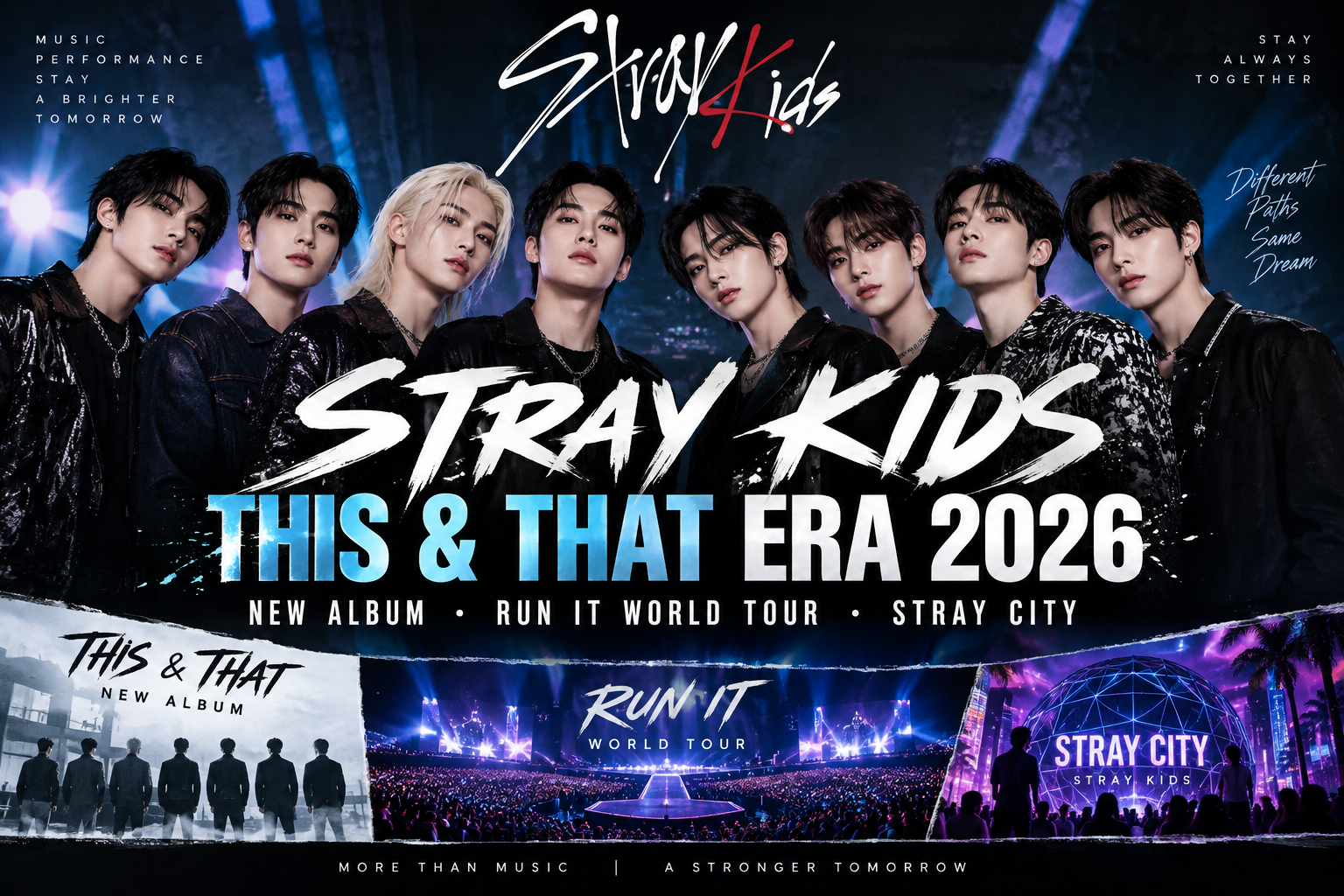
  • Stray Kids THIS & THAT Era Explained: New Album, RUN IT World Tour & STRAY CITY in 2026

    Stray Kids THIS & THAT Era Explained: New Album, RUN IT World Tour & STRAY CITY in 2026

    Stray Kids Enter a New Chapter in 2026

    Stray Kids have built their career around constant evolution, self-produced music, and a performance style that is instantly recognizable. In 2026, that story has entered another major chapter with THIS & THAT, the RUN IT World Tour, and the expanding STRAY CITY experience.

    For STAYs, these projects are more than separate releases and concerts. Together, they show how Stray Kids continue to expand their music, live performances, and global identity while staying connected to the sound and creative direction that made the group distinctive.

    The THIS & THAT era also gives newer fans a useful entry point into where Stray Kids stand in 2026—years after their debut and after growing into one of K-pop’s most internationally recognized groups.

    In this guide, we’ll explore the THIS & THAT era, the RUN IT World Tour, STRAY CITY, and what this latest chapter means for Stray Kids and STAYs in 2026.

    What Is THIS & THAT?

    THIS & THAT marks a new musical chapter for Stray Kids in 2026. Released on August 7, 2026, the EP arrived as the group continued to expand its global activities and explore new ideas within the powerful, self-driven style that has defined much of its career.

    Rather than viewing the release as an isolated comeback, THIS & THAT can be understood as part of a broader 2026 era. New music, large-scale live performances, and international fan experiences are unfolding around the same period, giving STAYs several ways to experience the group.

    For newer listeners, the release also offers a snapshot of Stray Kids at this stage of their career: an established global act continuing to experiment while maintaining a strong creative identity.

    The Sound and Meaning of the THIS & THAT Era

    One reason Stray Kids continue to stand out is their ability to combine intensity with experimentation. Their music has long moved between hip-hop, electronic sounds, rock influences, melodic moments, and unexpected structural changes.

    The THIS & THAT era continues that sense of contrast. Even the title suggests the idea of moving between different sides rather than being limited to a single musical identity.

    For longtime STAYs, this fits naturally into the group’s broader story. Stray Kids have repeatedly built their identity around choosing their own direction, challenging expectations, and turning experimentation into part of their signature sound.

    For newer fans discovering the group in 2026, THIS & THAT therefore works not only as new music but also as an introduction to one of the central ideas behind Stray Kids: their identity has always been built around movement, change, and creative freedom.

    RUN IT World Tour: Taking the 2026 Era to the Stage

    The RUN IT World Tour brings Stray Kids’ latest chapter into the live-performance space. For a group known for high-energy stages, choreography, and strong audience interaction, touring remains an important part of how their music reaches fans around the world.

    The tour also gives STAYs an opportunity to experience songs from different periods of the group’s career within the context of their newest era. Rather than focusing only on a single release, a Stray Kids concert can connect earlier fan favorites with newer material and show how the group’s performance style has evolved.

    In 2026, the tour also reflects just how international the Stray Kids audience has become. Their activities increasingly extend beyond traditional K-pop promotion cycles, with concerts and large-scale events becoming a major part of the group’s global presence.

    STRAY CITY: Expanding the Stray Kids Experience

    Another notable part of Stray Kids’ 2026 activities is STRAY CITY, a large-scale live event concept that expands the fan experience beyond a conventional concert.

    The project reflects a broader trend in K-pop: major artists are increasingly creating experiences that combine music, performance, fandom, and destination-scale events. For Stray Kids, this format is especially fitting because their concerts have long emphasized powerful performance and direct interaction with STAYs.

    STRAY CITY also demonstrates how the group’s international reach has developed. Events connected with the concept in Latin America give fans outside Korea another opportunity to participate in a major Stray Kids experience closer to home.

    For STAYs, the significance is clear: Stray Kids’ global activities are no longer defined only by album releases and traditional tours. The group is continuing to experiment with how its music and fandom can be experienced on a larger scale.

    Why 2026 Matters for Stray Kids

    By 2026, Stray Kids are no longer simply proving that they can succeed internationally. The more interesting question is how they continue developing after reaching a much larger global audience.

    The combination of THIS & THAT, the RUN IT World Tour, and STRAY CITY illustrates three important parts of that development: new music, global touring, and larger fan-centered experiences.

    It also shows why the group continues to attract both longtime STAYs and new listeners. Fans can enter the Stray Kids story through different doors—an album, a performance, a concert, or even a major international event—and then explore the group’s earlier music and history.

    That makes 2026 another useful milestone in the Stray Kids timeline: a year defined not simply by expansion, but by finding new ways to connect their music, performances, and global fandom.

    Frequently Asked Questions

    What is Stray Kids’ THIS & THAT?

    THIS & THAT is a 2026 Stray Kids EP released on August 7, 2026. It forms an important part of the group’s latest era alongside their expanding global activities.

    What is the RUN IT World Tour?

    The RUN IT World Tour is part of Stray Kids’ 2026 live activities, bringing the group’s music and performance to audiences across international markets.

    What is STRAY CITY?

    STRAY CITY is a large-scale Stray Kids live-event concept that expands the fan experience beyond the format of a conventional concert, with activities reaching international audiences including Latin America.

    Is THIS & THAT a good starting point for new Stray Kids fans?

    Yes. New fans can use the THIS & THAT era as a starting point and then explore Stray Kids’ earlier albums, performances, and career history to understand how their sound has evolved.

    Where can new STAYs learn about the Stray Kids members?

    New fans who want to learn the members’ names, ages, roles, and basic profiles can also read our Stray Kids Members Guide 2026.

    Final Thoughts

    Stray Kids’ 2026 chapter shows a group continuing to evolve rather than relying only on past success. With THIS & THAT, the RUN IT World Tour, and STRAY CITY, their latest era connects new music with increasingly ambitious live experiences around the world.

    For longtime STAYs, it is another stage in a career built on experimentation and self-expression. For new fans, it offers an ideal moment to discover Stray Kids and then explore the albums, members, and milestones that brought them here.

    As Stray Kids continue their 2026 activities, one thing remains consistent: their story keeps moving forward, and STAYs around the world continue moving with them.

  • BLACKPINK Members 2026: Ages, Positions & Solo Careers

    BLACKPINK Members 2026: Ages, Positions & Solo Careers

    BLACKPINK is one of the most influential K-pop groups in the world. Since their debut in 2016, JISOO, JENNIE, ROSÉ, and LISA have grown from YG Entertainment rookies into global stars with successful careers in music, fashion, acting, and entertainment.

    What makes BLACKPINK especially interesting in 2026 is that each member has developed a distinct solo identity while remaining connected to the group. Their individual careers have introduced them to new audiences around the world, while BLACKPINK continues to hold an important place in global K-pop culture.

    In this guide, we’ll introduce all four BLACKPINK members, including their names, ages, roles, nationalities, solo careers, and key facts that new BLINKs should know.

    Whether you have followed BLACKPINK for years or have just discovered their music, this guide is a simple starting point for getting to know JISOO, JENNIE, ROSÉ, and LISA.

    BLACKPINK at a Glance

    BLACKPINK is a four-member South Korean girl group formed by YG Entertainment. The group officially debuted on August 8, 2016, with the single album Square One, featuring “Whistle” and “Boombayah.”

    The four members are JISOO, JENNIE, ROSÉ, and LISA. Unlike many K-pop groups, BLACKPINK does not have an officially designated leader, and each member brings a different combination of vocals, rap, dance, performance, and personality to the group.

    The members also have diverse international backgrounds. JISOO and JENNIE were born in South Korea, ROSÉ was born in New Zealand and raised in Australia, while LISA was born and raised in Thailand.

    Over the years, BLACKPINK expanded far beyond the traditional K-pop market, building a worldwide fanbase known as BLINK and establishing major individual careers alongside their group activities.

    JISOO: Vocalist, Actress, and Solo Artist

    Full name: Kim Jisoo
    Born: January 3, 1995
    Nationality: South Korean

    JISOO is the oldest member of BLACKPINK and is known for her distinctive vocal tone, elegant stage presence, and acting career. She trained under YG Entertainment before debuting with BLACKPINK in 2016.

    Alongside her group activities, JISOO expanded into acting and solo music. She made her solo debut in 2023 with the single album ME, led by the track “FLOWER,” which became one of her signature songs.

    Her career later entered a new phase when she established BLISSOO for her individual activities. She has continued developing both her music and acting careers while remaining a member of BLACKPINK.

    For new BLINKs, JISOO represents an important part of BLACKPINK’s identity: a performer whose career connects K-pop, acting, fashion, and entertainment.

    JENNIE: Rapper, Vocalist, and Global Solo Star

    Full name: Kim Jennie
    Born: January 16, 1996
    Nationality: South Korean

    JENNIE is one of BLACKPINK’s most recognizable members, known for combining rap, vocals, fashion, and a powerful stage presence. Before debuting with BLACKPINK, she spent several years training under YG Entertainment and also lived and studied in New Zealand.

    In 2018, JENNIE became the first BLACKPINK member to officially debut as a solo artist with “SOLO.” The song established her individual identity outside the group and became a major milestone in BLACKPINK’s solo history.

    Her independent career later expanded through ODDATELIER (OA), the company she founded for her individual activities. She has continued developing her own musical direction while participating in BLACKPINK’s group activities.

    JENNIE’s influence also extends well beyond music. Her work in fashion, entertainment, and global brand partnerships has helped make her one of the most internationally visible figures associated with modern K-pop.

    ROSÉ: Vocalist, Songwriter, and International Solo Artist

    Full name: Roseanne Park (Park Chaeyoung)
    Born: February 11, 1997
    Nationality: New Zealand–born Korean artist, raised in Australia

    ROSÉ is widely recognized for her distinctive singing voice and emotional performance style. Born in New Zealand and raised in Australia, she moved to South Korea after successfully auditioning for YG Entertainment in 2012.

    She made her solo debut in 2021 with the single album R, featuring “On the Ground” and “Gone.” Her solo career later entered a major new phase as she pursued individual activities outside YG Entertainment while continuing her BLACKPINK group activities with the company.

    ROSÉ reached an even broader global audience with “APT.,” her collaboration with Bruno Mars. The song became a major international hit and introduced her solo music to listeners far beyond the traditional K-pop audience.

    Her career demonstrates how a BLACKPINK member can maintain a strong connection to the group while developing a distinctive musical identity as an international solo artist.

    LISA: Rapper, Dancer, and Global Solo Performer

    Full name: Lalisa Manobal
    Born: March 27, 1997
    Nationality: Thai

    LISA is BLACKPINK’s Thai member and is especially known for her dance skills, rap performances, and charismatic stage presence. Born and raised in Thailand, she successfully auditioned for YG Entertainment and moved to South Korea to train before BLACKPINK’s debut.

    She launched her solo career in 2021 with the single album LALISA, featuring “LALISA” and “MONEY.” The latter became a major international success and helped expand her audience beyond K-pop.

    LISA later established LLOUD to manage her individual activities and continued expanding into international music, fashion, and entertainment. Her solo career has increasingly positioned her as a global performer with an identity distinct from, but still connected to, BLACKPINK.

    As the only Thai member of BLACKPINK, LISA has also played an important role in the group’s international appeal, particularly across Southeast Asia and the wider global K-pop audience.

    BLACKPINK Members: Ages, Nationalities, and Roles

    BLACKPINK’s four members bring different backgrounds and strengths to the group.

    MemberAge in 2026*NationalityRoles
    JISOO31South KoreanVocals, acting
    JENNIE30South KoreanRap, vocals
    ROSÉ29New Zealand-born, raised in AustraliaVocals, songwriting
    LISA29ThaiDance, rap

    *Ages are international ages reached during 2026. Actual age before each birthday is one year younger.

    One detail that often surprises new fans is that BLACKPINK does not have an official leader. Rather than organizing the group around a designated leader, the four members contribute different strengths to BLACKPINK’s identity.

    Frequently Asked Questions About BLACKPINK Members

    Who are the four members of BLACKPINK?
    BLACKPINK consists of JISOO, JENNIE, ROSÉ, and LISA.

    Who is the oldest BLACKPINK member?
    JISOO is the oldest member. She was born on January 3, 1995.

    Who is the youngest BLACKPINK member?
    LISA is the youngest member. She was born on March 27, 1997.

    Does BLACKPINK have a leader?
    No. BLACKPINK does not have an officially designated group leader.

    Which BLACKPINK member is from Thailand?
    LISA was born and raised in Thailand before moving to South Korea to train under YG Entertainment.

    Which BLACKPINK member grew up in Australia?
    ROSÉ was born in New Zealand and raised in Australia before moving to South Korea.

    Do the BLACKPINK members have solo careers?
    Yes. All four members have developed individual careers alongside BLACKPINK, including solo music as well as activities in fashion, acting, and entertainment.

    Final Thoughts

    BLACKPINK’s story is built around four artists with very different backgrounds and individual strengths. JISOO, JENNIE, ROSÉ, and LISA have each developed successful careers beyond the group while remaining central to BLACKPINK’s identity.

    For new BLINKs, learning about each member is one of the best ways to understand why BLACKPINK has become such an influential name in global pop culture. From music and performance to fashion and acting, each member has created a distinctive path of her own.

    As BLACKPINK continues its journey, the combination of four individual careers and their work together as a group remains one of the most fascinating parts of the BLACKPINK story.

  • BTS Military Service Dates: All 7 Members (2022–2025)

    BTS Military Service Dates: All 7 Members (2022–2025)

    All seven BTS members have now completed their military service. Jin enlisted first on December 13, 2022, and SUGA became the final member to complete his service on June 21, 2025.

    Between 2022 and 2025, all seven BTS members — RM, Jin, SUGA, j-hope, Jimin, V, and Jung Kook — completed their mandatory service obligations in South Korea. For ARMY around the world, this period became an important part of the BTS story, filled with solo projects, temporary goodbyes, and long-awaited returns.

    In this guide, we’ll follow the BTS military service timeline from the group’s early years through 2026, including when each member enlisted, when they completed their service, and what happened as BTS entered a new chapter together.

    Whether you are a longtime ARMY or a new fan discovering BTS, this timeline will help you understand one of the most significant periods in the group’s history.

    Why BTS Had to Complete Military Service

    In South Korea, most able-bodied men are required to complete mandatory military service. For years, BTS’s global success led to widespread discussion about how the country’s military service rules would apply to the group.

    In 2020, South Korea revised its laws to allow certain pop culture artists who had received government recognition to postpone enlistment until age 30. This allowed eligible BTS members to delay their service, but it did not provide a full exemption.

    The next major turning point came in October 2022, when BIGHIT MUSIC announced that the BTS members would move forward with plans to fulfill their military service obligations. Jin, the group’s oldest member, became the first to enlist in December 2022.

    His enlistment marked the beginning of a new era in BTS history — one in which the seven members would temporarily focus on military service and individual activities before eventually returning as a complete group.

    BTS Military Service Timeline: All Seven Members

    MemberEnlistedCompletedService Type
    JinDec 13, 2022Jun 12, 2024Active duty
    j-hopeApr 18, 2023Oct 17, 2024Active duty
    SUGASep 22, 2023Jun 21, 2025Social service
    RMDec 11, 2023Jun 10, 2025Active duty
    VDec 11, 2023Jun 10, 2025Active duty
    JiminDec 12, 2023Jun 11, 2025Active duty
    Jung KookDec 12, 2023Jun 11, 2025Active duty

    BTS completed its military service chapter step by step, beginning with Jin in December 2022 and ending when SUGA completed his alternative service in June 2025.

    Jin
    Jin became the first BTS member to enlist, entering military service on December 13, 2022. He served as an active-duty soldier and was discharged on June 12, 2024. His return was especially meaningful for ARMY because he became the first member to complete his service.

    j-hope
    j-hope enlisted on April 18, 2023. After serving as an active-duty soldier and working as an assistant instructor, he was discharged on October 17, 2024.

    SUGA
    SUGA began his service obligation on September 22, 2023. Due to circumstances related to a previous shoulder injury, he fulfilled his duty as a social service worker rather than an active-duty soldier. He completed his service on June 21, 2025.

    RM and V
    RM and V enlisted on December 11, 2023. Both completed their military service and were discharged on June 10, 2025.

    Jimin and Jung Kook
    Jimin and Jung Kook enlisted together on December 12, 2023. They were discharged on June 11, 2025, leaving SUGA as the final BTS member still completing his service obligation.

    By June 21, 2025, all seven BTS members had officially completed their military service obligations, closing a major chapter in the group’s history.

    What Happened to BTS During the Military Service Period?

    BTS did not simply disappear while the members completed their military service. Instead, this period became one of the most important eras for their individual careers.

    Before and during their enlistments, the members released solo albums, singles, documentaries, and other projects that allowed each artist to show a different musical identity.

    Jin released solo music surrounding his military-service period, while j-hope continued expanding his solo career through music and special projects. RM explored a more experimental side of his artistry, and SUGA developed his Agust D catalog further through his solo album and tour.

    Jimin, V, and Jung Kook also achieved major international success with their individual releases. Their solo projects introduced different sides of BTS to listeners who may not previously have followed the group closely.

    This strategy helped BTS remain visible globally even while group activities were limited. Instead of becoming an empty period in BTS history, the military-service era became a bridge between the group’s first decade and the next stage of their career.

    BTS Reunites: A New Chapter After Military Service

    June 2025 became a historic month for BTS and ARMY. With RM, V, Jimin, Jung Kook, and finally SUGA completing their service obligations, all seven members were once again free to pursue group activities.

    The end of military service did not simply represent a return to the past. BTS entered a different stage of its career: all seven members had experienced years of solo work, personal growth, and time away from full-group promotions.

    That made the next chapter especially significant. Fans around the world began looking toward new group music, performances, and opportunities to see RM, Jin, SUGA, j-hope, Jimin, V, and Jung Kook together again.

    For new fans, the military-service timeline is therefore more than a collection of enlistment and discharge dates. It marks the transition between two major eras of BTS — the extraordinary rise of the group before enlistment and the beginning of their post-military era.

    Frequently Asked Questions About BTS Military Service

    When did BTS begin military service?
    Jin became the first BTS member to enlist when he entered military service on December 13, 2022.

    Who was the first BTS member to finish military service?
    Jin was the first member to complete his service, returning on June 12, 2024.

    Who was the last BTS member to complete military service?
    SUGA was the final member to complete his service obligation, finishing his alternative service on June 21, 2025.

    Did all seven BTS members serve at the same time?
    No. Their service periods overlapped, but the members enlisted on different dates between December 2022 and December 2023.

    When did all BTS members finish military service?
    All seven members had completed their respective service obligations by June 21, 2025.

    Is BTS together again after military service?
    With all seven members having completed their service obligations, BTS entered its post-military chapter with the members able to resume full-group activities.

    Final Thoughts

    BTS’s military service period was a unique chapter in the group’s remarkable journey. From Jin’s enlistment in December 2022 to SUGA’s completion of alternative service in June 2025, ARMY waited as each of the seven members fulfilled his obligation and returned.

    At the same time, the members continued building their individual musical identities, helping BTS remain a major presence in global music even without regular full-group promotions.

    Now, the military-service chapter is complete. For BTS and millions of fans around the world, the focus has shifted from waiting for seven individual returns to discovering what RM, Jin, SUGA, j-hope, Jimin, V, and Jung Kook will create together in the next era of BTS history.