
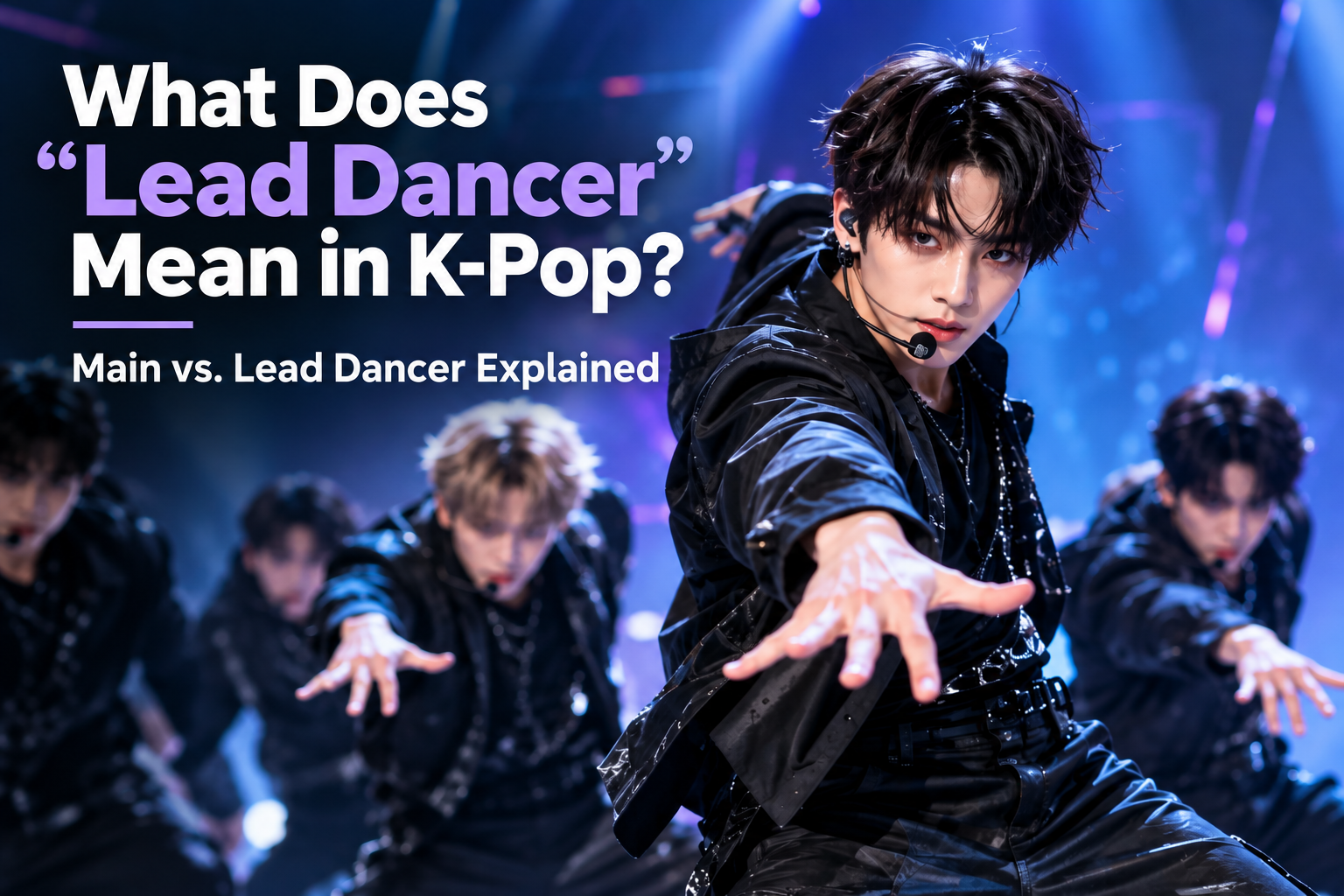
What Is a Lead Dancer in K-Pop?
If you are new to K-pop, positions such as main dancer, lead dancer, and vocalist can sometimes be confusing.
The words “main” and “lead” sound similar, and in everyday English, a “lead dancer” might sound like the most important dancer in a group.
K-pop traditionally uses these terms differently.
A lead dancer is generally one of the stronger dancers in a K-pop group. They often perform important choreography, appear prominently during dance-focused sections, and support the main dancer in creating a strong overall performance.
However, these positions are not strict rules.
Different groups organize their members differently, and many newer K-pop groups do not emphasize official positions as much as earlier generations did.
So what exactly does a lead dancer do?
Main Dancer vs. Lead Dancer: What Is the Difference?
Traditionally, the main dancer is considered the member with the strongest or most advanced dance role in the group.
Main dancers may be given difficult choreography, dance breaks, solo moments, or positions that highlight their technique.
The lead dancer is also a highly capable dancer but usually plays a supporting role within the group’s dance line.
Lead dancers may frequently appear near the front of formations, perform important choreography, and help maintain the group’s performance quality.
A simple way to remember the traditional distinction is:
Main dancer = usually handles the most technically demanding or highlighted dance moments.
Lead dancer = usually performs important dance sections and supports the group’s overall choreography.
But real K-pop performances are much more flexible than these definitions suggest.
Why Is It Called “Lead Dancer” If the Main Dancer Is Usually the Top Dance Position?
This terminology can be confusing for international fans.
In everyday English, the word “lead” often suggests the person who is primarily responsible for something.
But within traditional K-pop position terminology, main generally represents the highest specialized position, while lead describes another prominent member in that area.
The same pattern can appear in vocal positions.
A group may have a main vocalist and one or more lead vocalists.
Similarly, it may have a main dancer and one or more lead dancers.
Understanding this naming system makes many K-pop profiles easier to read.
What Does a Lead Dancer Usually Do?
The responsibilities vary between groups, but several patterns are common.
Perform Important Choreography
Lead dancers often receive visible positions during important sections of a performance.
They may move toward the center or front when choreography becomes particularly memorable.
Support Dance Breaks
A main dancer may receive the central role in a dance break, but lead dancers can perform alongside them and strengthen the overall visual impact.
In some groups, several members may share the spotlight during dance-focused sections.
Maintain Strong Group Formations
K-pop choreography depends heavily on synchronization.
A powerful performance is not created by one dancer alone.
Lead dancers help maintain clean formations, timing, transitions, and overall performance energy.
Handle Difficult Dance Sections
Although the main dancer may be associated with the most demanding choreography, lead dancers are also often capable of performing technically challenging sections.
Their presence gives choreographers more flexibility when designing performances.
Combine Dance with Other Roles
A lead dancer may also be a vocalist, rapper, center, or visual.
K-pop idols rarely perform only one function within a group.
Does the Main Dancer Always Stand in the Center?
No.
The main dancer and the center are different positions.
The main dancer is traditionally defined by dance ability and performance responsibilities.
The center is generally the member positioned prominently during particular moments to create visual focus and represent the performance effectively.
A main dancer may move to the center during a dance break.
But another member may take the center position during the chorus, opening, ending, or another important section.
This is why watching the formation of an entire performance can reveal more than focusing on one member.
Can a Group Have More Than One Lead Dancer?
Yes.
Many K-pop groups have more than one member with strong dance responsibilities.
This is especially useful in larger groups.
One dancer may excel at powerful choreography, while another may be particularly strong at fluid movements, facial expressions, or a different performance style.
Having several strong dancers allows choreographers to create more varied formations and distribute demanding sections throughout a performance.
Lead Dancer vs. Main Dancer vs. Center
These three terms can easily be confused, but traditionally they describe different responsibilities.
Main Dancer
Usually one of the group’s strongest dancers and often responsible for difficult choreography or major dance highlights.
Lead Dancer
Usually another strong dancer who performs prominent choreography and supports the dance line.
Center
The member who is placed in a visually important position during key moments of a performance.
One person can hold more than one of these positions.
For example, a main dancer may also frequently perform as the center.
But the positions themselves do not mean exactly the same thing.
Is a Lead Dancer Less Talented Than a Main Dancer?
Not necessarily.
Position titles should not be treated as permanent rankings of talent.
A member may have been officially introduced as a lead dancer when the group debuted, but their skills can develop significantly over time.
Different dance styles also require different strengths.
One member may excel at hip-hop-based choreography, another at contemporary movement, and another at highly synchronized idol choreography.
A song’s concept can therefore influence which dancer receives the most attention.
Why Synchronization Matters in K-Pop
K-pop dance is often built around group synchronization.
Even when one member is standing in the center, the entire formation contributes to the visual effect.
Precise timing, spacing, transitions, and movement can make a performance feel powerful.
This is one reason lead dancers are important.
They strengthen the overall dance line rather than simply waiting for a solo moment.
In highly synchronized choreography, the quality of the group can matter just as much as the ability of its strongest individual dancer.
What Is a Dance Break?
A dance break is a section of a song or performance where choreography becomes the primary focus.
Vocals may become minimal, instrumental elements may become stronger, and dancers are given an opportunity to showcase more dramatic movements.
Main dancers frequently receive prominent roles during these sections.
However, lead dancers and other strong performers may also participate.
Dance breaks are especially common in award-show performances, concert stages, special versions of songs, and choreography-focused K-pop tracks.
They allow idols to demonstrate performance skills beyond singing and rapping.
Can a Lead Dancer Also Be a Main Vocalist or Rapper?
Yes.
K-pop members frequently hold multiple roles.
A strong dancer may also be an important vocalist.
Another member may combine dance and rap.
This versatility is one of the defining characteristics of the idol system.
Trainees typically study several performance skills before debut, including dance, vocals, stage performance, and sometimes rap.
As a result, official positions describe a member’s major responsibilities but do not necessarily describe everything that member can do.
How Choreography Affects Line Distribution
K-pop performances combine music and movement, so line distribution and choreography are often connected.
A member singing a difficult vocal section may have less demanding choreography during that moment.
Another member may move into a more visually prominent position while someone else sings.
Producers and choreographers therefore have to balance several factors:
- vocal ability
- dance ability
- stamina
- stage presence
- visual formations
- concept
- individual strengths
This helps explain why the member in the center is not always the person singing.
K-pop is designed as both a musical and visual performance.
Why Lead Dancers Matter During Live Performances
Live stages require consistency.
Idols must remember complex formations while performing choreography, interacting with cameras, maintaining facial expressions, and sometimes singing or rapping at the same time.
Strong lead dancers can help make the entire group appear more confident and polished.
Their role may not always be obvious to casual viewers, but they contribute significantly to the quality of the performance.
This is particularly important during complicated transitions and fast choreography.
Do New K-Pop Groups Still Use Lead Dancer Positions?
Not always.
Many earlier K-pop groups were introduced with clearly defined positions such as:
leader, main vocalist, lead vocalist, main rapper, main dancer, lead dancer, center, and visual.
Some newer groups use fewer official labels.
Instead, companies may emphasize that members are versatile performers who can take different roles depending on the song.
A member who receives a major dance section in one comeback may have a less prominent dance role in another.
This flexibility reflects the growing importance of the all-rounder in modern K-pop.
Official Positions vs. Fan-Made Positions
Fans often create detailed member profiles based on performances, interviews, and their own observations.
These profiles can be useful, but they should not always be treated as official.
If an entertainment company or the group itself has never announced that a member is a lead dancer, the label may simply be a fan interpretation.
This becomes particularly important with newer groups that intentionally avoid fixed positions.
When researching K-pop members, it is useful to distinguish between:
officially announced positions
and
positions commonly assumed by fans.
The two are not always identical.
Are Dance Positions Becoming Less Important?
In many modern groups, fixed dance positions are becoming less important.
K-pop idols are increasingly expected to perform at a high level across multiple areas.
A vocalist may be an excellent dancer.
A rapper may take the center during an important choreography section.
A member without an official dance position may become especially prominent in a particular comeback.
This does not mean dance roles have disappeared.
Instead, they are becoming more flexible.
Traditional terms such as main dancer and lead dancer are still useful for understanding K-pop history and group structure, but they should not be treated as rigid rules.
Final Thoughts
A lead dancer is traditionally one of the stronger dancers in a K-pop group.
They often perform important choreography, support the main dancer, strengthen formations, and help maintain the overall quality of live performances.
The simplest distinction is:
Main dancer: usually handles the most technically demanding or highlighted dance moments.
Lead dancer: usually performs important choreography and supports the group’s overall dance line.
But modern K-pop is increasingly flexible.
Some groups no longer use detailed official positions, and members can take different roles depending on the song, choreography, and concept.
Understanding the term “lead dancer” is therefore not about deciding who is the second-best dancer.
It is about understanding how multiple performers work together to make K-pop choreography look powerful, synchronized, and memorable.
Leave a Reply