What Is K-Pop and How Did It Become a Global Phenomenon?
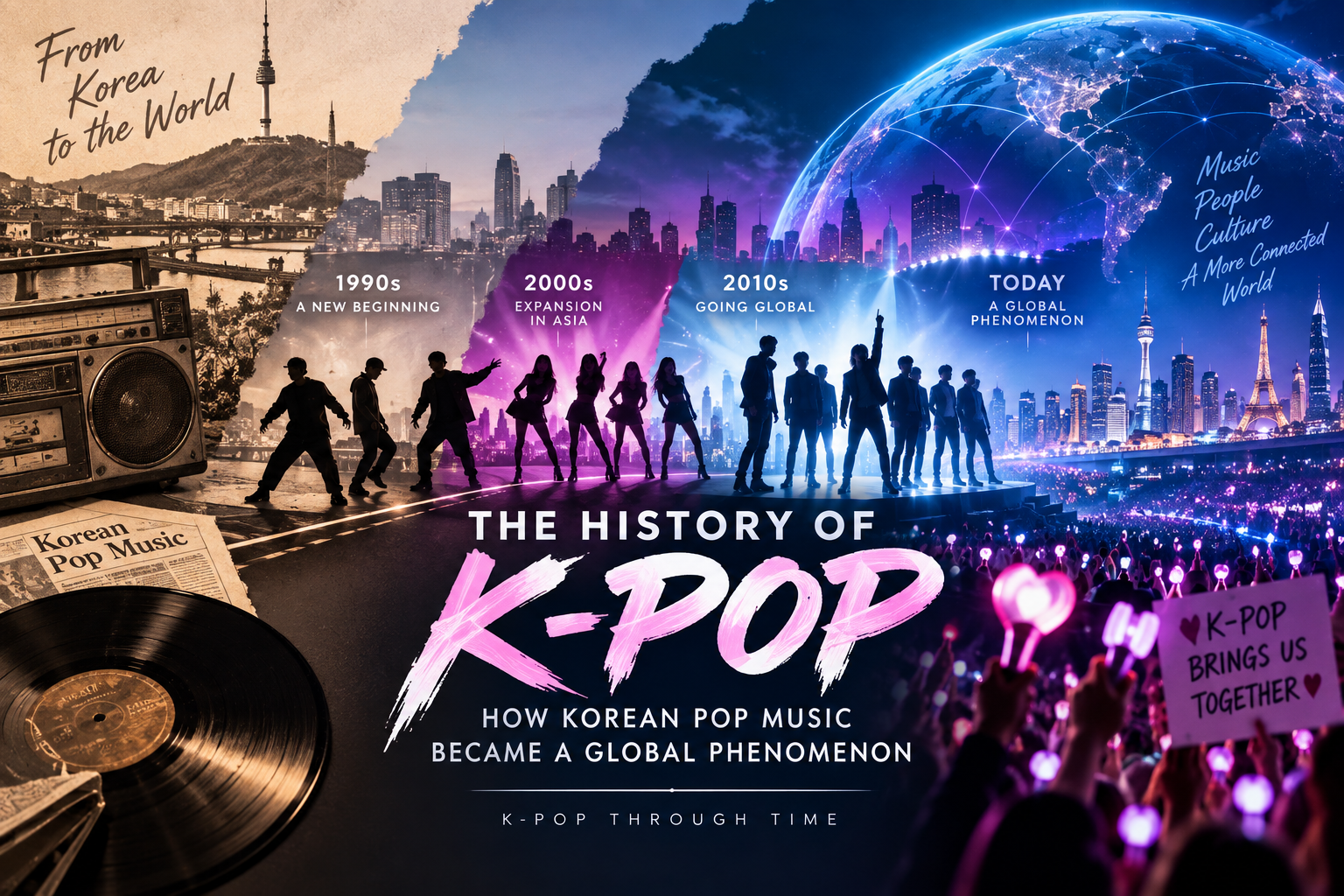
K-pop, short for Korean pop music, has grown from a local music scene in South Korea into one of the most recognizable cultural forces in the world. Today, K-pop artists attract millions of fans across Asia, North America, Europe, Latin America, and beyond. Their music videos reach global audiences, international concert tours fill large venues, and Korean artists regularly appear on major global music charts and media platforms.
But K-pop did not become a worldwide phenomenon overnight.
The history of K-pop is a story of continuous change. It reflects South Korea’s social transformation, the development of its entertainment industry, advances in digital technology, and the changing ways people around the world discover and enjoy music.
To understand modern K-pop, we need to look beyond famous groups and viral songs. Its roots can be traced through several decades of Korean popular music, from the influences that shaped the country’s early modern music scene to the rise of highly organized entertainment companies and idol training systems.
The Meaning of K-Pop
The term “K-pop” is commonly used outside South Korea to describe Korean popular music, especially music associated with idol groups and solo performers. However, K-pop is not a single musical genre.
A K-pop song may combine elements of pop, hip-hop, R&B, electronic dance music, rock, funk, or other styles. What makes modern K-pop distinctive is often the way music is combined with performance, visual storytelling, choreography, fashion, and carefully developed artist concepts.
This combination helped K-pop become more than a collection of songs. For many international fans, it became an entry point into Korean language, entertainment, fashion, food, and culture.
Before the Modern K-Pop Era
The story begins long before today’s idol groups.
South Korean popular music developed through decades of political, economic, and cultural change. Western musical influences entered Korea and mixed with existing Korean musical traditions. As television and radio became increasingly important, popular singers gained greater visibility and new styles of music reached larger audiences.
By the late twentieth century, South Korea was changing rapidly. Economic growth, expanding youth culture, and increasing exposure to international music created an environment in which younger musicians began experimenting with new sounds.
This transition would eventually produce one of the most important turning points in K-pop history: the emergence of a new generation of performers in the early 1990s who challenged conventional ideas about Korean popular music.
K-Pop History Timeline: Key Milestones
| Period | Key milestone | Why it mattered |
|---|---|---|
| 1992 | Seo Taiji and Boys emerge | Helped reshape modern Korean pop music |
| Late 1990s | First-generation idol groups rise | Established the modern idol system |
| 2000s | K-Pop expands across Asia | Built international fan communities |
| 2012 | PSY’s “Gangnam Style” goes viral | Demonstrated worldwide digital reach |
| 2010s | BTS, BLACKPINK and other groups expand globally | Accelerated international fandom growth |
| 2020s | Global streaming and digital fandom deepen | Made worldwide audiences central to K-Pop |
The Birth of Modern K-Pop: A Turning Point in the 1990s
For many observers of Korean popular music, the early 1990s marked a major turning point. South Korea was becoming more connected to global culture, and younger audiences were increasingly interested in musical styles such as hip-hop, rap, dance music, and R&B.
One of the most influential moments came in 1992 with the debut of Seo Taiji and Boys.
Their approach was dramatically different from much of the mainstream Korean music that had come before. They incorporated rap, hip-hop, dance, and other international influences into Korean-language songs while also presenting a new image of youth culture.
Their success demonstrated something important: younger Korean audiences were ready for new sounds, new performances, and new ways for artists to express themselves.
The impact extended beyond a single group. The changes of the 1990s helped create an environment in which a new entertainment industry could develop.
The Rise of the Idol System
During the 1990s, entertainment companies began developing a more organized system for discovering and preparing young performers.
Instead of focusing only on singers who were already established, companies could recruit promising trainees and provide structured preparation in areas such as singing, dancing, stage performance, and media presentation.
This system became one of the defining characteristics of the modern K-pop industry.
Groups such as H.O.T., Sechs Kies, S.E.S., and Fin.K.L became closely associated with what is now commonly called the first generation of K-pop idols.
These artists helped establish many features that would later become familiar to K-pop fans: organized fandoms, distinctive group concepts, synchronized performances, official fan communities, and strong relationships between artists and their supporters.
Entertainment Companies Become a Driving Force
The growth of K-pop was also closely connected to the development of entertainment companies.
Companies such as SM Entertainment, YG Entertainment, and JYP Entertainment became influential in shaping different generations of artists. Over time, the industry developed increasingly sophisticated systems for training, music production, promotion, choreography, visual design, and overseas expansion.
This business model allowed K-pop to combine many creative disciplines into a single entertainment product.
A successful release was no longer simply about recording a song. Music could be supported by choreography, music videos, fashion, storytelling, television appearances, fan activities, and carefully planned promotional campaigns.
That combination would become especially powerful as the internet began changing how music traveled across national borders.
From Korea to the Rest of Asia
Before K-pop became a major phenomenon in North America and Europe, Korean popular culture was already gaining audiences elsewhere in Asia.
During the late 1990s and early 2000s, the broader Korean Wave, or Hallyu, expanded through television dramas, movies, music, and other forms of popular culture.
K-pop artists increasingly promoted outside South Korea, particularly in markets such as Japan, China, and Southeast Asia.
This regional expansion was an essential stage in K-pop’s development. Entertainment companies learned how to communicate with audiences in different countries, organize overseas activities, and build international fan communities.
K-pop was beginning to move beyond its domestic market.
But an even bigger transformation was approaching.
The rise of online video, social media, and global digital platforms would eventually allow Korean artists to reach listeners almost anywhere in the world.
The Second Generation: When K-Pop Began Going Global
The mid-2000s and early 2010s brought another major stage in the history of K-pop. A new generation of idol groups emerged, while the internet made it increasingly possible for people outside South Korea to discover Korean music without relying on traditional television or radio.
Artists including TVXQ, Super Junior, BIGBANG, Girls’ Generation, Wonder Girls, SHINee, and 2NE1 became important names during this period.
Although these artists had different musical styles and concepts, together they helped expand the international visibility of Korean pop music.
YouTube Changed How International Fans Discovered K-Pop
One of the most important changes was the growth of online video.
In earlier decades, international expansion often depended on physical albums, television broadcasts, overseas promotions, and local distribution agreements. Digital platforms gradually reduced many of those barriers.
Music videos could now be discovered by viewers thousands of kilometers away from South Korea.
This was particularly important for K-pop because the industry had developed a strong visual component. Elaborate music videos, memorable fashion, distinctive concepts, and synchronized choreography could attract viewers even when they did not understand Korean.
Fans also began sharing performances, translations, dance covers, reaction videos, and information about their favorite artists online.
As a result, international K-pop fandom became increasingly connected across national borders.
“Gangnam Style” Becomes a Worldwide Viral Phenomenon
In 2012, PSY’s “Gangnam Style” demonstrated the extraordinary global reach that Korean popular music could achieve in the digital era.
The song and its distinctive music video spread rapidly around the world. People who had little or no previous knowledge of Korean popular music encountered a Korean-language song through online sharing, television coverage, parodies, and social media.
“Gangnam Style” did not create K-pop’s international audience by itself. Korean artists had already spent years building fan communities throughout Asia and beyond.
However, its enormous global visibility showed that language did not necessarily prevent a Korean song from reaching a mass international audience.
That lesson would become increasingly important during the next stage of K-pop’s development.
The Third Generation and the Expansion of Global Fandom
During the 2010s, groups commonly associated with K-pop’s third generation expanded the industry’s international presence even further.
Artists such as EXO, BTS, TWICE, BLACKPINK, Red Velvet, and SEVENTEEN developed large fan communities both inside and outside South Korea.
By this point, social media had become central to the relationship between artists and fans.
Fans no longer had to depend entirely on traditional media to follow an artist. They could watch videos, follow updates, participate in online communities, discuss releases, and communicate with other fans across the world.
This created a powerful network effect.
A music release in Seoul could generate conversations among fans in Los Angeles, Tokyo, Bangkok, Paris, Mexico City, and many other places within hours.
BTS, BLACKPINK, and a New Level of International Recognition
The international achievements of BTS and BLACKPINK became particularly visible examples of K-pop’s growing global influence.
Their success reflected more than the popularity of individual songs. It demonstrated how far the infrastructure surrounding K-pop had developed.
Global fandom communities, streaming platforms, social media, international touring, digital marketing, and increasingly accessible Korean entertainment content all contributed to an environment in which K-pop artists could build audiences on a worldwide scale.
At the same time, international listeners were becoming more comfortable discovering music beyond their own languages and national markets.
K-pop was no longer simply traveling from South Korea to foreign audiences.
It was becoming part of an increasingly interconnected global pop culture.
Why Did K-Pop Become So Popular Around the World?
K-pop’s global success cannot be explained by a single artist, song, or platform. Instead, several factors developed together over many years.
One important factor is the combination of music and performance. K-pop places strong emphasis on choreography, stage presentation, music videos, fashion, and visual concepts. These elements make performances engaging even for audiences who may not understand every lyric.
Another factor is the industry’s ability to adapt to new technology.
K-pop companies and artists embraced platforms that allowed content to travel quickly across borders. Music videos, dance practices, behind-the-scenes footage, livestreams, short-form videos, and social media updates gave international fans many ways to discover and follow artists.
The Power of K-Pop Fandom
Fans have also played a major role in K-pop’s international growth.
K-pop fandoms are often highly organized and digitally connected. Fans translate content, create guides for new listeners, discuss music and performances, organize fan projects, and introduce artists to people in their own communities.
This participation can transform listening to music into a broader social experience.
For international fans, discovering K-pop may also lead to curiosity about the Korean language, television, movies, food, fashion, beauty, and travel.
In this sense, K-pop has become an important part of the wider Korean Wave.
Understanding the Generations of K-Pop
Fans and media frequently describe K-pop history through “generations.”
There is no single official rule that determines exactly when one generation ends and another begins. The boundaries can vary depending on the source. However, the concept is useful for understanding major changes in artists, technology, fandom, and the entertainment industry.
The first generation, generally associated with the late 1990s and early 2000s, helped establish the modern idol system and organized fan culture.
The second generation expanded K-pop significantly throughout Asia and benefited from the early growth of global online video and social media.
The third generation experienced a dramatic expansion of worldwide fandom, streaming, social media engagement, and international touring.
The fourth generation have entered an environment in which global audiences are considered from the beginning of an artist’s career. Digital platforms, multilingual communication, short-form content, and international fan communities are now deeply integrated into the K-pop ecosystem.
Rather than treating these generations as rigid historical boundaries, it is more useful to see them as a way of understanding how K-pop continually reinvents itself.
K-Pop Is More Than an Exported Music Genre
The history of K-pop also reflects a broader change in global popular culture.
For much of the twentieth century, the international music industry was heavily dominated by a relatively small number of major markets. Digital technology has made it easier for music from different languages and cultures to travel beyond traditional geographic boundaries.
K-pop became one of the clearest examples of this transformation.
Its global popularity demonstrated that audiences could develop strong connections with artists even when they did not share the same language or cultural background.
At the same time, K-pop continues to evolve through interaction with musical influences from around the world. This makes it both distinctly connected to South Korea and deeply involved in global pop culture.
What Comes Next for K-Pop?
The next chapter of K-pop is still being written.
New artists continue to debut, technology continues to change how fans experience music, and entertainment companies are experimenting with new ways to reach international audiences.
The industry also faces important questions about sustainability, competition, artist well-being, creative identity, and how to maintain meaningful relationships with increasingly diverse global audiences.
What is clear is that K-pop has already traveled an extraordinary distance.
From the transformation of Korean popular music in the early 1990s to the rise of idol groups, the Korean Wave, YouTube, social media, streaming, and worldwide fandoms, K-pop developed through decades of cultural and technological change.
Understanding that history helps explain why K-pop became a global phenomenon—and why it continues to change.
Continue Exploring the History of K-Pop
This article provides an overview of K-pop’s journey, but every era has its own story.
In future articles on K-Pop Through Time, we will explore the generations of K-pop in greater depth, the artists who changed the industry, the evolution of the idol training system, the rise of the Korean Wave, the role of fandom, and the moments that helped Korean popular music reach audiences around the world.
K-pop did not become global in a single moment.
It became global through time.
Leave a Reply