What Was the First Generation of K-Pop?
Before K-pop became a global phenomenon, before social media connected idols with fans around the world, and before Korean groups regularly performed in major international venues, a new kind of music industry was taking shape in South Korea.
The first generation of K-pop generally refers to the era in which the modern Korean idol system began to emerge, particularly from the mid-to-late 1990s into the early 2000s.
There is no universally agreed date that marks the exact beginning or end of a K-pop generation. The term “generation” is an informal way of describing important changes in artists, music, fandom, technology, and the entertainment business.
What makes the first generation especially important is not simply that it came first.
This era established many of the ideas that still define K-pop today: professionally managed idol groups, structured trainee systems, synchronized choreography, distinctive concepts, organized fandoms, official fan colors, merchandise, and entertainment companies that developed artists as long-term projects.
To understand how modern K-pop works, we first need to understand how this system began.
Before K-Pop Idols: Korean Popular Music Was Changing
The emergence of first-generation idols did not happen in isolation.
South Korea experienced enormous social, economic, and cultural changes during the late twentieth century. Younger audiences were increasingly exposed to musical influences from outside Korea, including American pop, hip-hop, rap, R&B, rock, and electronic dance music.
At the same time, Korean youth culture was becoming increasingly visible.
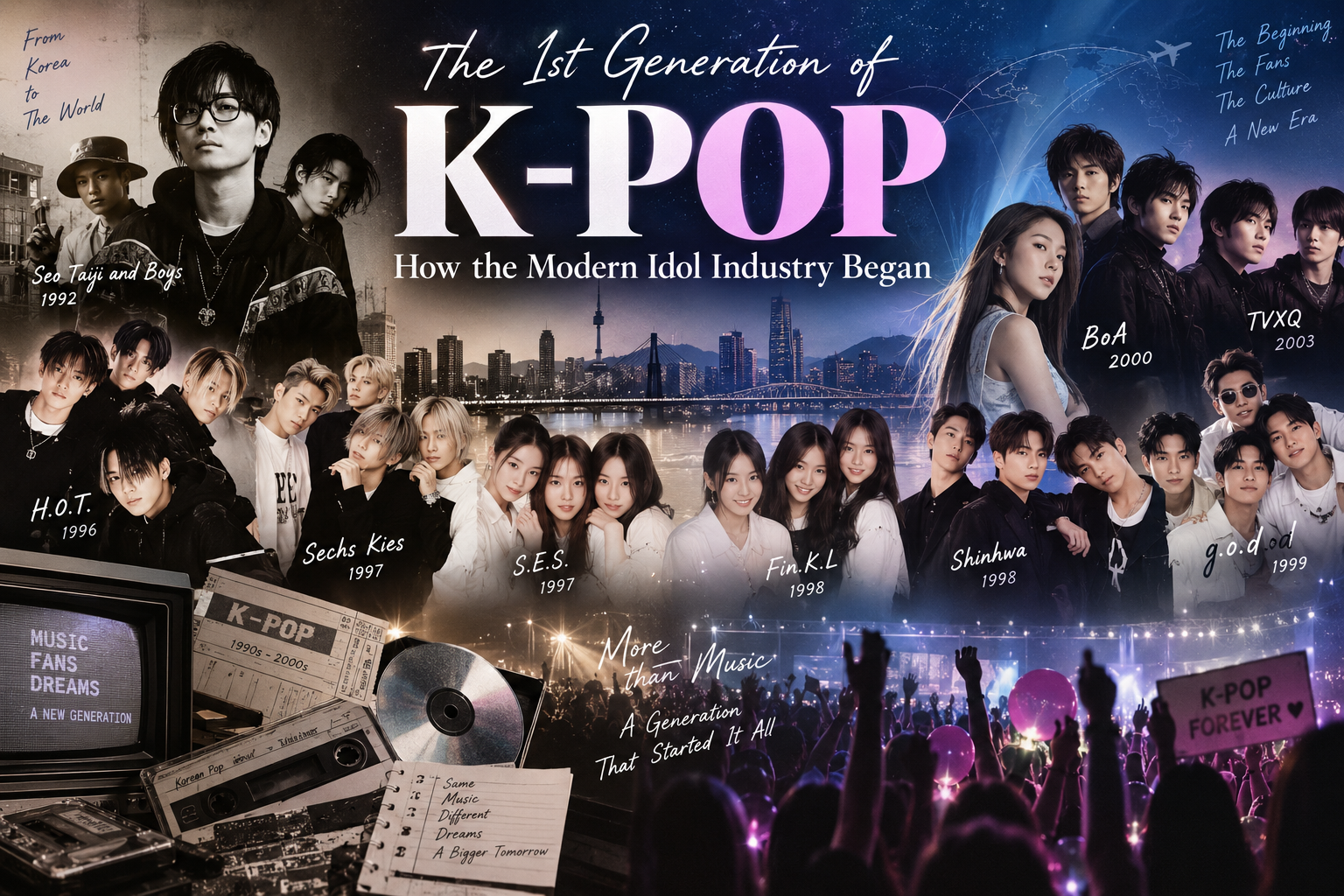
One of the most frequently cited turning points came in 1992, when Seo Taiji and Boys debuted.
The trio was not an idol group in the later sense of the term, but its influence on the development of modern Korean popular music was profound.
Seo Taiji and Boys incorporated musical styles such as rap, hip-hop, dance music, and rock into Korean popular music in ways that felt new to many young listeners. Their music and image also reflected the interests and concerns of a younger generation.
Their success demonstrated that Korean audiences—particularly teenagers and young adults—were ready for something different.
This shift helped open the door for entertainment companies to imagine a new type of performer.
From Singers to Carefully Developed Idol Groups
During the 1990s, Korean entertainment companies began creating increasingly systematic methods for discovering and developing young talent.
Rather than simply signing an established singer and releasing an album, companies could recruit young trainees and prepare them for debut.
Training could include singing, dancing, stage performance, media appearances, teamwork, and other skills required of an idol performer.
This approach allowed entertainment companies to plan not only the music but also the identity of a group.
How many members should it have?
What roles would those members perform?
What image should the group present?
What kind of audience should it appeal to?
How should the music, choreography, fashion, and promotional activities work together?
These questions became increasingly important as the idol industry developed.
H.O.T. and the Emergence of the Modern Idol Model
A landmark moment arrived with the debut of H.O.T. in 1996 under SM Entertainment.
H.O.T. became one of the defining acts of first-generation K-pop and demonstrated the enormous commercial potential of a carefully developed idol group aimed at younger audiences.
Their popularity went beyond simply listening to music.
Fans followed the members, attended performances, bought albums and merchandise, joined fan communities, and developed strong identities around their support for the group.
This helped establish a model that would become central to K-pop: the relationship between an idol group and an organized fandom.
Soon, competition within the rapidly developing idol industry intensified.
Groups such as Sechs Kies attracted their own passionate supporters, while the growing popularity of idol culture showed entertainment companies that the market was capable of supporting multiple major groups.
K-pop was beginning to become not only a style of popular entertainment, but an organized cultural ecosystem.
And that ecosystem was about to expand dramatically.
The Expansion of First-Generation Idol Culture
Once the commercial potential of idol groups became clear, the Korean entertainment industry began to expand rapidly.
The late 1990s and early 2000s produced a wider range of groups, each with different musical identities, concepts, and fan communities. This period helped establish the idea that K-pop could support an entire ecosystem of competing artists rather than relying on only a few major stars.
Among the most influential developments was the rise of successful girl groups.
S.E.S. and Fin.K.L: The Rise of First-Generation Girl Groups
S.E.S., formed by SM Entertainment, debuted in 1997 and became one of the most prominent girl groups of the first-generation era.
Their success demonstrated that the developing idol system could produce major female acts with dedicated fan communities and recognizable musical and visual identities.
The following year, Fin.K.L debuted under DSP Entertainment and became another defining girl group of the period.
S.E.S. and Fin.K.L were frequently viewed as major competitors, much as H.O.T. and Sechs Kies were on the male idol side of the industry.
This competitive environment became an important feature of K-pop culture. Fans did not simply follow songs; they often developed strong emotional connections to particular groups and individual members.
Over time, this relationship between artists and fans became one of K-pop’s greatest strengths.
Shinhwa, g.o.d, and the Growing Variety of Idol Groups
First-generation K-pop was not defined by only four groups.
Shinhwa, which debuted in 1998, became another significant act of the era. The group would later become especially notable for its longevity, demonstrating that an idol group’s identity could continue well beyond its original debut period.
g.o.d, which debuted in 1999, developed broad public popularity and showed another side of idol culture. Their music and public image helped them connect with listeners beyond a narrowly defined teenage fandom.
Other artists and groups contributed to an increasingly diverse popular music landscape.
The result was an industry learning how to create different types of stars for different audiences.
Some groups emphasized powerful choreography. Others focused on emotional songs, distinctive personalities, fashion, or concepts that helped separate them from their competitors.
Many of these strategies remain familiar in K-pop today.
How First-Generation Fandom Changed Korean Pop Culture
One of the most lasting legacies of first-generation K-pop was the development of highly organized fandom culture.
Fans gathered through fan clubs, attended music broadcasts and concerts, purchased albums, followed television appearances, and supported artists through coordinated activities.
Official fan colors and other visual symbols made fandom identity highly visible.
At large events, sections of an audience could become associated with particular groups through balloons, colors, and coordinated displays of support.
This created a powerful sense of community.
Being a fan could mean more than liking an artist’s music. It could involve belonging to a group of people who shared the same enthusiasm, language, symbols, and collective experiences.
Today’s light sticks, fan platforms, streaming projects, social-media communities, and international fan networks are technologically very different from the fandom culture of the 1990s.
But the underlying idea—a highly involved community built around sustained support for an artist—has deep roots in this earlier era.
Rivalries Were Part of the Story
Strong fandoms could also create intense rivalries.
Competition between major groups sometimes extended to their supporters, particularly when artists were competing for popularity, music awards, media attention, and cultural influence.
These rivalries are an important reminder that early K-pop fandom was not simply a smaller version of today’s global online fandom.
It developed under very different technological conditions.
There was no YouTube, TikTok, or modern social media ecosystem through which fans could instantly communicate with millions of people around the world.
Instead, fan culture grew through television, radio, physical albums, concerts, magazines, fan clubs, and increasingly through early online communities.
Despite these limitations, first-generation fandom became remarkably powerful.
Physical Albums and Television Were Essential
The way people consumed K-pop was also very different.
Physical albums were central to the music business, while television programs played an enormous role in determining which artists audiences saw.
Music shows, variety programs, interviews, and other television appearances gave idols opportunities to build recognition beyond their recorded music.
This encouraged performers to become versatile entertainers.
An idol could be expected not only to sing and dance but also to communicate effectively on television, develop a recognizable public personality, and maintain a relationship with fans.
This combination of music, performance, personality, visual identity, and fan engagement became one of the foundations of the K-pop model.
The first generation had created much of the basic structure.
The next challenge was to take that structure beyond South Korea.
From the First Generation to a Wider Asian Market
By the end of the 1990s, the foundations of the modern K-pop industry were becoming clearer. Entertainment companies had learned how to recruit and train performers, develop group concepts, build dedicated fandoms, and promote idols through television, albums, concerts, and fan activities.
The next major opportunity was expansion beyond South Korea.
This did not happen all at once. Before K-pop could become a truly global phenomenon, Korean entertainment companies first had to learn how to reach audiences in other Asian markets.
BoA and the Importance of the Japanese Market
One of the most important figures in this transition was BoA.
BoA debuted in South Korea under SM Entertainment in 2000 and later established a major career in Japan. Her success demonstrated that a Korean entertainment company could prepare an artist specifically for sustained promotion in another major music market.
Language ability, localization, media appearances, and releases designed for Japanese audiences were important parts of this strategy.
This represented an important shift.
Rather than expecting Korean music simply to travel abroad on its own, entertainment companies were beginning to think strategically about how artists could build careers across national borders.
BoA’s achievements in Japan became an influential example for later K-pop expansion.
TVXQ and the Transition Toward the Second Generation
The transition between K-pop generations does not have a universally agreed boundary. Artists, business strategies, and technologies overlapped, and different observers may classify particular acts differently.
However, the early and mid-2000s clearly represented a period of change.
TVXQ, which debuted under SM Entertainment in 2003, became one of the most significant groups of this transitional period. The group developed a major following in South Korea while also pursuing extensive activities in Japan and elsewhere in Asia.
Their overseas career demonstrated that Korean idol groups could build sustained international fan bases rather than relying only on occasional foreign promotions.
As the 2000s progressed, the industry was preparing for what would later be widely described as K-pop’s second generation.
Entertainment Companies Became More Systematic
The first-generation era also provided entertainment companies with years of experience.
They learned from successful debuts, unsuccessful projects, changing musical trends, fandom behavior, overseas promotions, and intense competition.
As a result, the idol development system became increasingly sophisticated.
Companies could coordinate multiple parts of an artist’s career, including:
- trainee recruitment and development
- vocal and dance preparation
- music production
- choreography
- styling and visual concepts
- television and media promotion
- album production
- fan activities
- concerts and live performances
- overseas marketing
This integrated structure became one of the defining features of the K-pop business model.
It also meant that debuting an idol group increasingly required significant planning, investment, and coordination.
The Trainee System Became a Defining Feature
The trainee system is now one of the most widely recognized aspects of K-pop, but its development was gradual.
Entertainment companies sought young people with potential and provided training before deciding whether they were ready to debut.
Not every trainee became an idol, and the amount of time spent training could vary greatly.
For those who eventually debuted, preparation could involve much more than singing.
Dance, stage presence, teamwork, language skills, media communication, physical conditioning, and the ability to perform under pressure could all become important.
This helped create performers capable of delivering the highly coordinated stages that would later become internationally associated with K-pop.
At the same time, the demanding nature of the system would eventually lead to broader discussions about working conditions, contracts, competition, and artist well-being.
These issues remain part of the continuing story of the K-pop industry.
The Korean Wave Created New Opportunities
K-pop’s overseas growth was also connected to a much broader cultural development: the Korean Wave, commonly known as Hallyu.
Korean television dramas, films, music, and other cultural products were attracting increasing attention in parts of Asia.
As audiences became more familiar with Korean entertainment, new opportunities emerged for Korean singers and idol groups.
K-pop therefore did not expand internationally in isolation.
It was part of a larger movement in which South Korean popular culture became increasingly visible beyond the country’s borders.
This regional foundation would prove extremely important.
When online video platforms and social media later made international distribution dramatically easier, K-pop already had experience with overseas promotion and audiences outside South Korea.
What the First Generation Passed On
By the time a new generation of idols began to emerge, first-generation K-pop had established much of the industry’s basic vocabulary.
The idea of the trainee.
The carefully planned group.
The synchronized performance.
The dedicated fandom.
The visual concept.
The entertainment company as a central creative and business organization.
The expansion into overseas markets.
None of these elements remained unchanged. Each would evolve significantly during later generations.
But the foundation was there.
The first generation had turned the Korean idol group from an emerging experiment into a repeatable entertainment model.
The second generation would take that model into a new technological era—and much further across the world.
The Lasting Legacy of First-Generation K-Pop
The first generation of K-pop existed in a world very different from the one today’s fans know.
There were no global streaming platforms connecting millions of listeners to new Korean releases within seconds. Social media had not yet transformed communication between artists and fans, and international audiences could not easily watch every music show performance or behind-the-scenes video online.
Yet many of the structures that define modern K-pop were already taking shape.
First-generation artists and entertainment companies helped establish a model in which music, choreography, fashion, personality, visual concepts, media appearances, and fandom were closely connected.
Later generations would refine and globalize that model, but its foundations were built during this formative period.
How First-Generation Fandom Still Influences K-Pop
Modern K-pop fandom looks technologically advanced compared with fandom in the 1990s.
Fans today communicate through social media and dedicated fan platforms. They stream music, watch online performances, organize international projects, purchase merchandise across borders, and interact with other fans almost instantly.
The technology changed dramatically, but several fundamental ideas remained.
Fans still develop collective identities around artists. They use symbols to represent their communities, organize projects, attend concerts together, celebrate anniversaries, and build lasting relationships with other fans.
Modern light sticks provide a particularly visible example of this evolution.
Earlier fan communities became strongly associated with particular colors and visual displays at concerts and music programs. Today’s sophisticated light sticks use new technology, but they continue the tradition of making fandom identity visible inside a performance venue.
First-Generation Idols Helped Define the Role of an “Idol”
The word idol in K-pop came to represent more than someone who records music.
An idol could be a singer, dancer, performer, television personality, spokesperson, and public figure at the same time.
This multi-dimensional role became increasingly important as entertainment companies realized that audiences were interested not only in songs but also in the personalities and stories surrounding performers.
Variety shows, interviews, fan meetings, concerts, and other appearances allowed audiences to develop a stronger sense of familiarity with artists.
Later digital platforms would make this connection much more immediate, but the basic relationship between idols and highly engaged fans had already become a defining feature of the industry.
K-Pop Generations Are Useful, but They Are Not Official Rules
When discussing the history of K-pop, it is important not to treat generations as perfectly defined historical periods.
There is no official organization that determines the exact date when the first generation ended or the second generation began.
Some artists debuted during transitional periods. Others remained active across multiple generations and continued influencing younger performers.
For this reason, labels such as first generation, second generation, third generation, and later generations are best understood as useful frameworks rather than strict rules.
They help us discuss broad changes in the industry: new artists, new technology, different business strategies, changing fandom culture, and expanding international markets.
The boundaries may be debated, but the historical changes they describe are real.
Why the First Generation Still Matters
For someone discovering K-pop today, first-generation groups may seem far removed from the polished music videos, enormous world tours, and global streaming numbers associated with contemporary artists.
But modern K-pop becomes easier to understand when we look at what came before it.
The first generation demonstrated that carefully developed idol groups could attract passionate audiences.
It showed the commercial power of organized fandom.
It helped entertainment companies develop training and production systems.
It established intense competition between agencies and artists.
And it began exploring how Korean performers could reach audiences outside South Korea.
These developments created the foundation upon which later generations could build.
From H.O.T. to a Global Industry
The distance between the debut of H.O.T. in 1996 and today’s global K-pop industry is enormous.
Technology changed.
Music changed.
The scale of fandom changed.
The international ambitions of entertainment companies changed.
Yet there is a recognizable line connecting those eras.
The first generation established the idol model. Later artists expanded it throughout Asia. Digital platforms then helped K-pop reach audiences on a scale that would have been difficult to imagine during the 1990s.
This is why the history of first-generation K-pop is more than nostalgia.
It is the story of how an industry learned to build the system that would eventually support a worldwide cultural phenomenon.
The Next Chapter: K-Pop’s Second Generation
The end of the first-generation era did not mean its ideas disappeared.
Instead, those ideas evolved.
During the next stage of K-pop history, a new wave of artists would emerge alongside major changes in digital technology and international communication.
Groups such as TVXQ, Super Junior, BIGBANG, Girls’ Generation, Wonder Girls, SHINee, and 2NE1 would help expand K-pop’s reach across Asia and introduce growing numbers of international listeners to Korean idol music.
At the same time, online video and social media would begin changing how fans discovered and shared music.
That transformation marks the next major chapter in the story of K-pop.
On K-Pop Through Time, we will explore how the second generation helped take the foundations created by the first generation and turn K-pop into an increasingly international cultural force.
Leave a Reply