
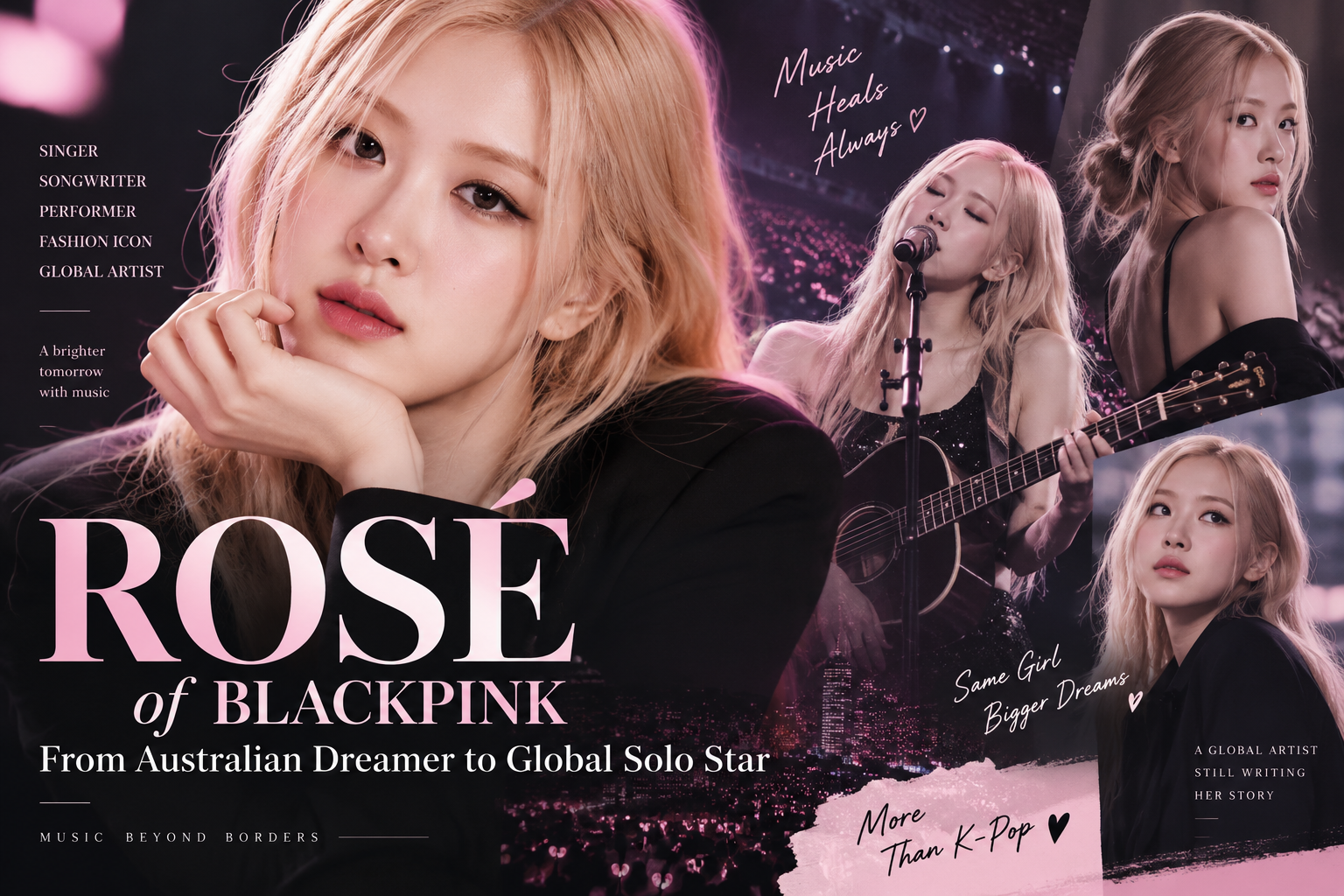
Who Is ROSÉ?
ROSÉ is a Korean-New Zealand singer and songwriter best known as a member of BLACKPINK and for her distinctive voice as a solo artist.
Born Roseanne Park in Auckland, New Zealand, and raised in Australia, she grew up surrounded by music before moving to South Korea to pursue a career in K-pop.
Her journey from a teenager in Australia to one of the most recognizable voices in global pop is a story of talent, persistence, and artistic growth.
How Did ROSÉ Join BLACKPINK?
Before becoming a BLACKPINK member, ROSÉ lived with her family in Australia.
Music was already an important part of her life. She sang, played instruments, and developed a strong interest in performing.
In 2012, she auditioned for YG Entertainment in Australia. After succeeding in the audition, she moved to South Korea and became a trainee.
The decision meant leaving behind the familiar environment of her family and school life to enter the demanding K-pop training system.
After several years of training, ROSÉ debuted with Jisoo, Jennie, and Lisa as BLACKPINK in August 2016.
What Is ROSÉ’s Role in BLACKPINK?
ROSÉ quickly became recognizable for her distinctive vocal tone.
BLACKPINK’s music often moves between rap, powerful electronic production, and melodic vocal sections. ROSÉ’s voice provides a sound that listeners can identify almost immediately.
Her performances also reveal her musical background. In addition to singing and dancing, she has frequently shown her ability to play guitar and piano.
That combination helped establish an image of ROSÉ not only as a K-pop performer but also as an artist deeply interested in music itself.
Why Is ROSÉ’s Voice So Recognizable?
One of the most common discussions about ROSÉ is the uniqueness of her voice.
Her vocal tone can sound delicate and emotional in quieter songs while still cutting through the powerful production associated with BLACKPINK’s biggest tracks.
A recognizable voice is particularly valuable in pop music. Listeners can often identify ROSÉ within seconds, even when she is performing outside BLACKPINK.
That vocal identity would later become one of the foundations of her solo career.
ROSÉ’s First Solo Era
ROSÉ officially began her solo career in 2021 with the single album R.
Its lead single, “On The Ground,” explored ideas about success, ambition, and realizing what truly matters after chasing larger dreams.
Another track, “Gone,” presented a more emotional and stripped-back side of her music.
Together, the songs allowed ROSÉ to step outside BLACKPINK’s group sound and show listeners a more personal musical identity.
Her solo debut demonstrated that she could carry a project independently while maintaining the qualities that had made her voice recognizable within BLACKPINK.
From BLACKPINK to a New Solo Chapter
As BLACKPINK’s members began expanding their individual careers, ROSÉ entered another important stage of her artistic development.
Her later solo work allowed her to explore songwriting and musical styles in ways that were increasingly distinct from BLACKPINK.
Rather than simply recreating the group’s sound as a solo performer, ROSÉ began shaping music around her own voice, emotions, and experiences.
This transition helped audiences see her not only as a member of a major K-pop group but as an individual pop artist.
“APT.” and a New Global Audience
A major moment in ROSÉ’s solo career arrived with “APT.,” her collaboration with Bruno Mars.
The song combined an instantly memorable hook with playful energy and a concept inspired by a Korean drinking game.
Its appeal crossed language and cultural boundaries, introducing another side of ROSÉ to audiences around the world.
“APT.” also demonstrated something important about the changing position of K-pop artists. Collaborations between Korean artists and major international musicians are no longer unusual side projects. They can become central moments in global pop culture.
For ROSÉ, the song marked another step from K-pop star to internationally recognized solo artist.
The Meaning of rosie
ROSÉ’s first full-length solo studio album, rosie, represented a more personal stage in her career.
The title itself comes from a familiar nickname, immediately suggesting a project closer to the person behind the global celebrity.
Through her solo music, ROSÉ has increasingly explored relationships, vulnerability, loneliness, ambition, and the emotional experiences that exist behind public success.
This more personal approach distinguishes her individual career from the large-scale performance identity associated with BLACKPINK.
ROSÉ as a Songwriter and Musician
ROSÉ’s evolution is also connected to her growing role in shaping her own music.
For many K-pop artists, the transition from idol performer to individual artist involves greater participation in songwriting, creative direction, and musical decision-making.
ROSÉ’s background with guitar, piano, and singing made this progression feel natural.
Her solo work gives listeners a clearer sense of the musical influences and emotions that matter to her personally.
ROSÉ and Global Fashion
Like the other BLACKPINK members, ROSÉ has also developed a major presence in international fashion.
Her appearances at global fashion events and partnerships with luxury brands have expanded her influence beyond music.
This crossover reflects one of BLACKPINK’s most significant cultural effects: the members operate simultaneously in music, fashion, beauty, and global celebrity culture.
ROSÉ’s distinctive style has become another recognizable part of her public identity.
Is ROSÉ Still a Member of BLACKPINK?
ROSÉ’s growing solo career does not mean that her history with BLACKPINK has disappeared.
BLACKPINK remains the group that brought Jisoo, Jennie, Rosé, and Lisa together and introduced their different talents to a worldwide audience.
At the same time, the members have reached a stage where each can develop an independent artistic career.
ROSÉ’s journey shows how a K-pop artist can maintain a group identity while building a musical world of her own.
What Makes ROSÉ Different?
ROSÉ’s story stands out because of the distance—both literal and artistic—that she has traveled.
She grew up in Australia, moved to South Korea as a teenager, survived years of training, debuted in one of K-pop’s biggest groups, and eventually developed into a global solo artist.
Yet through each stage, music has remained at the center of her identity.
Her distinctive voice may have first introduced her to millions of BLACKPINK listeners, but her solo career has allowed audiences to discover more of the musician behind that voice.
From Australian Dreamer to Global Solo Star
ROSÉ’s journey began far from the center of the Korean entertainment industry.
A successful audition changed the direction of her life, taking her from Australia to Seoul and eventually onto stages around the world with BLACKPINK.
Years later, songs such as “On The Ground” and “APT.,” along with her album rosie, have opened another chapter.
Her career now exists at the intersection of K-pop and global pop, group history and individual artistry.
And as ROSÉ continues to develop her own musical identity, her story is becoming much larger than the journey that first brought her to BLACKPINK.
Leave a Reply