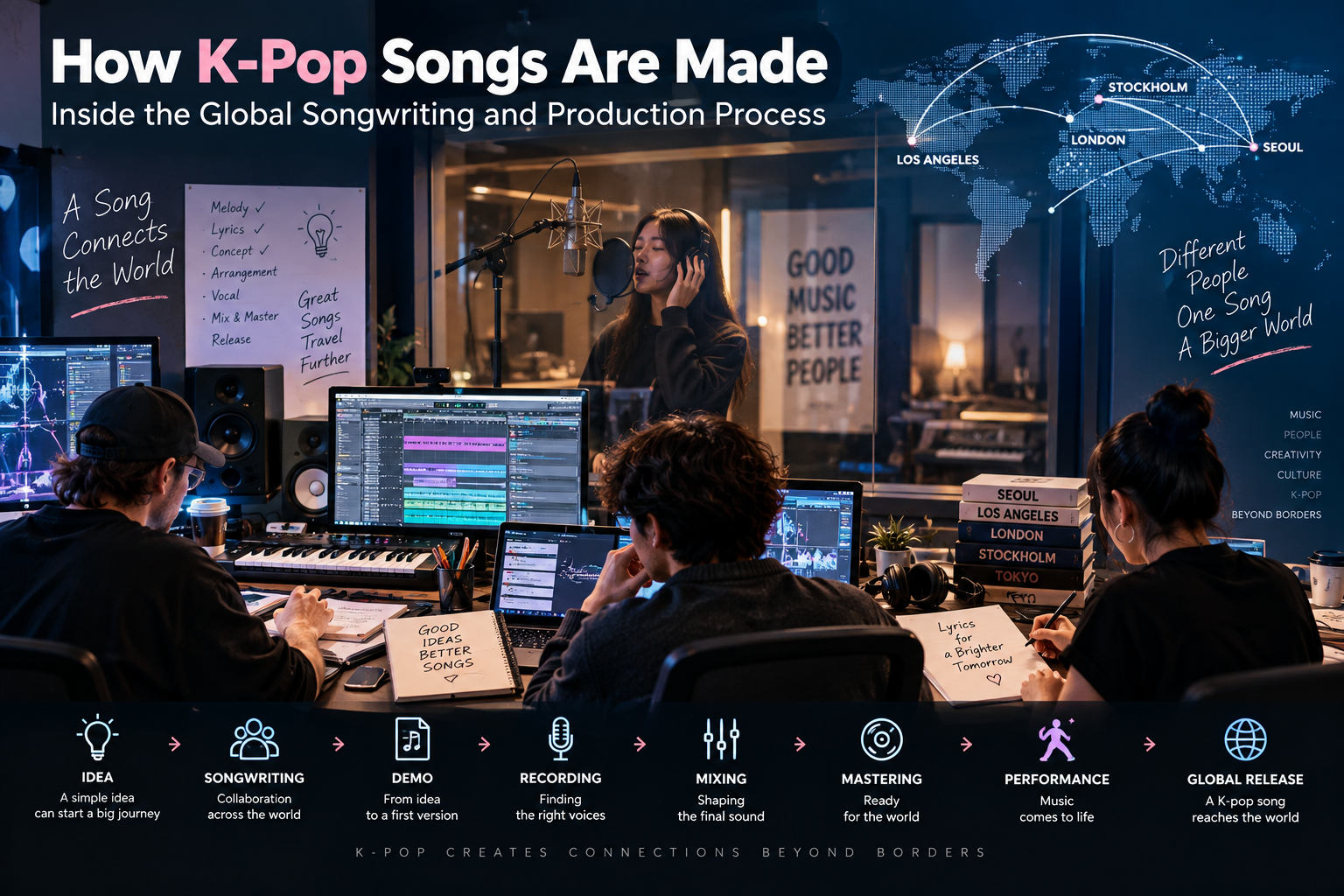
K-pop is often discussed through idols, choreography, fandom, fashion, and global popularity. Yet beneath all of these elements lies something more fundamental: the music itself.
Listen to a selection of K-pop songs from different generations and one characteristic quickly becomes clear. K-pop rarely stays inside a single musical category.
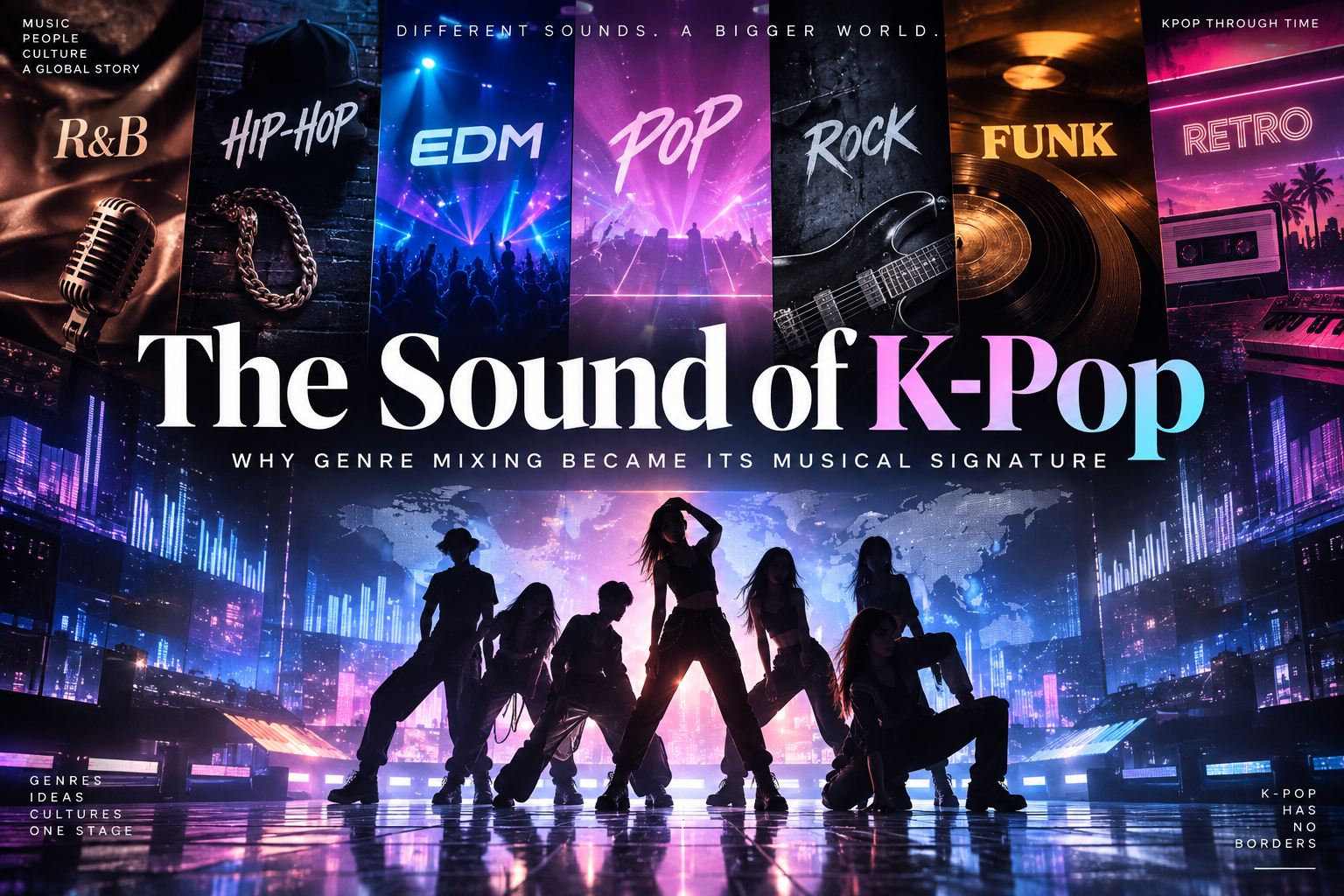
A track may begin with R&B-inspired vocals, move into a hip-hop verse, explode into an electronic chorus, introduce a trap rhythm, and finish with a dramatic bridge that seems to belong to an entirely different song. Another release may combine funk bass lines, disco strings, rock guitars, house beats, or retro synthesizers within a polished pop structure.
This constant movement between styles has become one of K-pop’s most recognizable musical characteristics.
But why did genre mixing become so important to K-pop?
The answer lies partly in the history of modern Korean popular music, partly in the structure of the idol industry, and partly in K-pop’s unusual willingness to treat genre not as a boundary but as a creative resource.
K-Pop Is an Industry, Not a Single Genre
The term “K-pop” can be misleading.
It sounds as if it describes one specific style of music in the same way that jazz, reggae, or heavy metal might. In reality, artists identified as K-pop can sound dramatically different from one another.
Some releases are built around hip-hop. Others lean toward R&B, electronic dance music, rock, synth-pop, funk, house, ballads, or experimental pop. Many combine several of these influences within the same track.
For this reason, K-pop is better understood as a broad popular-music ecosystem connected to South Korea’s entertainment industry rather than as one narrowly defined musical genre.
This distinction helps explain its flexibility.
If K-pop were tied to one fixed sound, major changes in musical style might threaten its identity. Instead, the industry has repeatedly absorbed new influences while maintaining recognizable systems of idol groups, training, performance, visual concepts, promotion, and fandom.
The sound can change while the broader cultural framework remains identifiable.
That flexibility created ideal conditions for genre mixing.
The Foundations of Modern K-Pop
Modern K-pop emerged during a period when Korean popular music was becoming increasingly exposed to international musical influences.
In the early 1990s, new combinations of rap, dance music, electronic production, and youth-oriented performance began challenging older expectations of mainstream Korean pop.
Seo Taiji and Boys are frequently discussed as an important turning point in this history. Their music drew from styles including rap, hip-hop, dance, and rock while presenting them within a Korean cultural context.
The significance was larger than any one genre.
It demonstrated that Korean popular music could actively reinterpret contemporary international sounds rather than simply remain within established domestic conventions.
As the idol industry developed later in the 1990s, this openness to musical combination became increasingly useful.
First-generation idol groups needed songs that could support singing, rap, synchronized dance, and distinctive member roles. A single musical tradition did not always provide all of those elements.
Genre blending offered a solution.
Why Idol Groups Encouraged Musical Variety
The structure of an idol group naturally creates opportunities for contrast.
A group may contain strong vocalists, rappers, dancers, and members with different vocal colors. Songs therefore need enough space to showcase multiple abilities.
Genre changes can help create that space.
A melodic verse may highlight vocals. A rhythmic section can provide room for rap. An electronic drop may become a dance-focused moment. A dramatic bridge can feature a powerful singer before the final chorus.
This means genre mixing is not always experimentation for its own sake.
It can serve the practical needs of group performance.
The music has to organize multiple performers while keeping the listener’s attention.
Contrast becomes a useful tool.
Instead of asking every member to fit into exactly the same musical texture, producers can build songs with changing textures around the members.
Over time, this relationship between group structure and musical structure became an important part of K-pop’s sound.
Hip-Hop and R&B Become Essential Ingredients
Among the many international influences on K-pop, hip-hop and R&B have been particularly important.
Hip-hop introduced more than rap sections.
Rhythmic vocal delivery, beat-centered production, sampling traditions, fashion, dance, and performance attitudes all influenced the development of Korean idol music.
R&B contributed another set of musical tools.
Vocal harmonies, melismatic singing, groove, emotional phrasing, and sophisticated chord progressions became common features across many K-pop releases.
These influences could also exist together.
A song might use an R&B-influenced verse before shifting toward rap, then move into a larger pop chorus designed for choreography.
Such combinations helped establish a pattern that would become increasingly common: K-pop did not need to choose between different styles when it could reorganize them into a new structure.
Dance Music and the Importance of Performance
Dance music also became central to the development of idol pop.
This connection is easy to understand.
K-pop places unusual emphasis on synchronized choreography and televised performance. Music with a strong rhythmic foundation naturally supports that environment.
As electronic dance music developed internationally, K-pop producers gained access to an expanding vocabulary of synthesizers, programmed drums, bass drops, build-ups, and electronic textures.
These sounds could create dramatic stage moments.
A rising pre-chorus could build anticipation. A powerful electronic chorus could support large synchronized movements. An instrumental break could give dancers a moment to dominate the performance.
The relationship between music and choreography therefore encouraged certain forms of sonic experimentation.
K-pop songs were not simply competing for radio attention.
They also needed to work on music-show stages, concert platforms, dance-practice videos, and eventually short-form digital media.
The sound became inseparable from movement.
The Second Generation Expands the Palette
As K-pop entered its second generation, musical variety became even more visible.
The industry was growing more competitive, and groups needed recognizable identities.
Some artists became associated with powerful electronic production. Others leaned toward vocal-focused R&B, bright pop, retro influences, hip-hop, or more experimental arrangements.
At the same time, advances in digital production made it easier to manipulate and combine sounds.
Producers could move between acoustic and electronic textures, layer vocals more densely, transform samples, and create dramatic structural changes with increasing precision.
This period helped reinforce the idea that a K-pop comeback could involve musical reinvention.
A group did not necessarily need to reproduce the same sound with every release.
A new album could introduce a new concept—and a new concept could justify a new musical language.
That relationship between comeback culture and stylistic change would become increasingly important.
The Comeback as Musical Reinvention
In many music industries, artists are encouraged to develop a consistent sound that audiences can immediately recognize.
K-pop often balances consistency with something different: transformation.
The comeback system creates repeated opportunities for reinvention.
A group may return with a darker concept, a brighter summer track, a retro-inspired release, an aggressive performance song, or a softer R&B direction.
Music, styling, choreography, album design, and visual presentation can all change together.
Genre becomes part of the storytelling.
A disco-influenced track can suggest nostalgia and glamour. Rock guitars can communicate intensity or rebellion. House rhythms may create sophistication or club energy. Funk can produce playfulness and movement. Trap production can add weight and tension.
These associations are not fixed rules, but they give creative teams a large vocabulary for building distinct eras around an artist.
As a result, genre mixing became useful not only musically but conceptually.
It allowed K-pop artists to change without completely abandoning their identity.
And as the industry entered its third generation, this flexibility would combine with global songwriting networks and increasingly ambitious production—pushing genre mixing into even more complex territory.
The Third Generation and a More Global Sound
By the third generation, K-pop was reaching a much larger international audience.
This expansion did not force the industry toward one universal sound. In many cases, it encouraged even greater musical variety.
Producers could draw from contemporary R&B, trap, tropical house, future bass, EDM, funk, synth-pop, and other styles circulating through global popular music. These influences entered K-pop at different speeds and were frequently reshaped to fit idol performance.
The result was not simply imitation of international trends.
A musical style that existed elsewhere could take on a different function inside K-pop. A trap rhythm might support a rap section before giving way to a melodic pop chorus. Tropical sounds could be combined with Korean vocal melodies and highly structured choreography. Funk-inspired instrumentation could become the foundation for an elaborate visual concept.
This ability to reorganize familiar musical ingredients became increasingly important as K-pop competed for attention both inside and outside South Korea.
Listeners might recognize individual influences while still experiencing the complete track as distinctly connected to K-pop.
When One Song Contains Several Musical Worlds
One of the most discussed characteristics of K-pop is the dramatic way some songs change direction.
A track may shift tempo, rhythm, instrumentation, vocal style, or atmosphere within a few minutes.
To listeners accustomed to more uniform pop structures, these changes can initially feel surprising.
Within K-pop, however, contrast can be part of the design.
A song may function almost like a sequence of scenes.
The verse establishes one atmosphere. The pre-chorus increases tension. The chorus opens into another sonic space. A rap section interrupts the melodic flow, while the bridge introduces a new emotional or harmonic direction before the final section brings the different elements together.
Not every K-pop song follows this approach, and many use conventional pop structures.
But the industry has developed an unusually high tolerance for structural contrast.
That tolerance gives producers freedom to place several musical identities inside a single track.
The Power of the “Switch-Up”
A sudden musical change is sometimes described informally as a “switch-up.”
The effect can be created in many ways.
The instrumental may disappear unexpectedly. The beat may change. A bright section can become darker. A song can move from singing to rap or from a dense electronic arrangement to a minimal passage.
When handled effectively, the switch-up resets the listener’s attention.
This is especially valuable in performance-oriented music.
A change in sound can accompany a change in choreography, camera direction, formation, lighting, or visual intensity.
The audience does not merely hear the transition.
They experience it.
This relationship helps explain why some K-pop arrangements may appear unusually fragmented when examined only as audio but feel coherent when experienced through the complete performance.
Musical contrast becomes part of visual contrast.
Three K-Pop Songs That Show Genre Mixing in Action
Girls’ Generation – “I Got a Boy” (2013)
“I Got a Boy” is a well-known example of K-pop’s willingness to combine contrasting musical sections. The track moves between hip-hop-influenced passages, electronic dance elements, and melodic pop, with noticeable changes in rhythm and energy. Rather than maintaining one consistent mood, it uses these transitions as part of its identity.
aespa – “Next Level” (2021)
“Next Level” features a distinctive mid-song shift that interrupts its established groove with a contrasting musical section. The change creates a dramatic turning point before the song returns to familiar material, showing how structural surprises can become a defining feature of a K-pop release.
NMIXX – “O.O” (2022)
NMIXX’s debut single “O.O” demonstrates the group’s MIXXPOP approach through sharply contrasting musical sections. Its abrupt changes in sound and atmosphere make genre contrast a central part of the listening experience rather than a subtle background influence.
These songs represent different approaches to musical contrast. They do not suggest that every K-pop song uses abrupt genre changes, but they show how some artists make stylistic shifts an important part of their musical identity.
The Bridge as a Space for Transformation
The bridge has traditionally provided contrast in popular songwriting, but K-pop often makes particularly dramatic use of it.
After repeated verses and choruses, a bridge can temporarily suspend the established pattern.
The instrumentation may become quieter. Harmonies may change. A lead vocalist can deliver a more demanding passage, or the song may build toward a dance break or final chorus.
In genre-blending tracks, the bridge can also introduce an entirely new style.
This creates a sense that the song has traveled somewhere before returning.
The final chorus can then feel larger because the listener has experienced a period of contrast.
For idol groups, bridges also create opportunities to redistribute attention among members.
A vocalist who had fewer lines earlier may receive a central moment. Harmonies can expand. Ad-libs can appear. Choreography can shift from group synchronization toward individual focus.
Musical structure and member presentation become closely connected.
Retro Sounds Return in New Forms
Genre mixing does not only involve contemporary styles.
K-pop frequently revisits sounds associated with earlier decades.
Disco, funk, city pop, synth-pop, new jack swing, and other retro influences have appeared in different forms across modern releases.
Nostalgia can be creatively useful because it provides sounds that feel familiar while leaving room for reinterpretation.
A retro-inspired K-pop track does not need to reproduce the past exactly.
Modern production can make drums heavier, vocals cleaner, bass more prominent, and arrangements more compatible with contemporary performance.
Visual concepts can reinforce the effect through clothing, typography, lighting, sets, or music-video references.
This creates a layered form of nostalgia.
Older musical ideas are introduced to younger audiences through modern idols, while listeners familiar with the original styles may recognize the references.
K-pop therefore often treats musical history as another source of material for reinvention.
Rock, Guitars, and the Expansion of Idol Pop
Rock influences have also played an important role in broadening K-pop’s musical vocabulary.
Electric guitars, live-style drums, pop-punk energy, alternative textures, and heavier rock elements can provide a different kind of intensity from electronic dance production.
For some artists, these sounds support themes of youth, rebellion, anxiety, freedom, or emotional release.
Rock elements can also change the physical character of a performance.
Where electronic production may emphasize precise rhythmic movement, guitar-driven sections can encourage a more explosive or band-like energy.
Again, the boundaries remain flexible.
A track does not need to become fully “rock” in order to use rock as a meaningful ingredient.
A distorted guitar may appear only in the chorus. A pop song may borrow the rhythmic energy of punk. An electronic track can suddenly introduce a guitar solo.
This partial borrowing is central to K-pop’s genre-mixing logic.
Styles can be used as colors rather than complete rulebooks.
Hip-Hop, Trap, and Changing Rap Styles
As global hip-hop changed, K-pop’s use of hip-hop-related production changed with it.
Trap rhythms, deep bass, sparse beats, and new approaches to rap delivery became increasingly visible.
These sounds offered producers another way to create contrast within idol music.
A melodic chorus could be placed next to a stripped-down rap verse. Heavy bass could interrupt a brighter pop arrangement. Rhythmic sections could create space for performers whose strengths were different from those of the main vocalists.
At the same time, the use of hip-hop within K-pop has generated continuing discussions about cultural influence, appropriation, authenticity, and the origins of musical styles.
These questions matter because genres do not appear from nowhere.
Hip-hop emerged from specific Black American cultural and historical contexts, just as other musical traditions have their own histories.
Understanding genre mixing therefore requires more than identifying sounds.
It also requires recognizing where those sounds came from and how they are transformed when they travel between cultures.
Genre Mixing Is Also Cultural Exchange
K-pop’s musical flexibility is closely connected to cultural exchange.
Music has always traveled.
Artists borrow instruments, rhythms, production methods, performance practices, and songwriting ideas from other places. Technologies and media accelerate that movement.
K-pop provides a particularly visible example because its production system operates within international networks while maintaining a strong base in South Korea.
This can produce creative innovation, but it can also create responsibility.
Using an influence effectively is not the same as understanding its history.
As K-pop becomes increasingly global, audiences are also more capable of recognizing references and questioning how particular cultures are represented.
Genre mixing is therefore both a musical opportunity and a cultural conversation.
The Fourth Generation and the Attention Economy
By the fourth generation, K-pop was developing inside an environment shaped by streaming platforms, short-form video, global fandom, and intense competition for attention.
This environment affected how music was encountered.
A listener might first discover a song through a few seconds of choreography, a performance clip, a dance challenge, or a memorable musical transition rather than hearing the full track from beginning to end.
Distinctive moments became especially valuable.
A sudden beat change, unusual hook, instrumental break, or dramatic chorus could give a song an immediately recognizable identity.
Genre contrast was well suited to this environment because contrast creates moments.
However, reducing K-pop’s musical evolution to TikTok or algorithms would be misleading. The industry had been experimenting with abrupt changes and hybrid genres long before short-form platforms became dominant.
Digital media amplified an existing tendency rather than creating it from nothing.
This distinction is important.
K-pop’s genre mixing developed through decades of musical and industrial evolution. The contemporary attention economy simply gave some of its most dramatic characteristics new ways to circulate.
Complexity Versus Coherence
Mixing genres creates a fundamental creative challenge.
More variety does not automatically produce a better song.
If too many elements compete without a clear relationship, a track can feel disconnected rather than adventurous.
The challenge is coherence.
Producers can create coherence through recurring melodies, rhythmic motifs, vocal tones, harmonic relationships, repeated sounds, or a strong overall concept.
Even when sections differ dramatically, something must persuade the listener that they belong to the same musical experience.
This balance between surprise and familiarity is central to successful genre mixing.
Too much predictability can make a song forgettable.
Too much disruption can make it difficult to follow.
K-pop frequently operates in the space between those extremes—and that tension is one reason its sound continues to generate debate, excitement, and experimentation.
Genre Mixing as a Form of Musical Identity
If K-pop can borrow from so many genres, an obvious question follows: how can an artist maintain a recognizable identity?
The answer is that musical identity does not always depend on staying within one genre.
A group can develop continuity through vocal character, production choices, recurring themes, performance style, or the way different influences are combined.
Two artists may both use R&B, hip-hop, and electronic music while producing very different results.
One may favor minimal arrangements and restrained vocals. Another may emphasize dramatic transitions and powerful choruses. A third may build its identity around bright melodies, unusual harmonies, or aggressive rhythmic production.
Genre is therefore only one layer of identity.
The arrangement of influences can become an identity of its own.
This helps explain why stylistic change does not necessarily make a K-pop group unrecognizable. The surface genre may change while other characteristics remain consistent.
Concepts Can Shape the Sound
K-pop’s concept-driven culture also gives genre a narrative function.
Music is often developed alongside a larger creative direction involving styling, choreography, album design, photography, video, and storytelling.
A futuristic concept may encourage electronic textures and unusual sound design. A nostalgic concept may draw from disco or synth-pop. A youthful concept could use energetic guitars or bright dance production, while a more restrained image might be paired with R&B or minimal pop.
These relationships are flexible rather than absolute.
What matters is that musical style can help build the world surrounding a release.
This makes genre selection part of a larger creative language.
Listeners are not only hearing a house rhythm, a funk bass line, or a rock guitar. They are experiencing those sounds as part of a particular era in an artist’s career.
Why Genre Labels Can Be Difficult
K-pop also demonstrates the limitations of genre labels.
Listeners naturally use labels because they help describe music. Calling a track “R&B,” “house,” “pop-rock,” or “trap-influenced” gives people a useful starting point.
But hybrid songs often resist simple classification.
A track may contain a house-inspired beat without being a house song in the traditional sense. It may use guitars associated with rock while retaining the structure and production of idol pop. It may borrow rhythmic characteristics from hip-hop while emphasizing melodic vocals.
For this reason, genre labels are most useful when treated as descriptions rather than rigid categories.
They tell us something about the ingredients.
They do not always describe the complete result.
K-pop has flourished partly because its creators have been willing to work within this ambiguity.
Familiar Sounds Can Cross Borders
Genre mixing has also helped K-pop communicate with listeners outside South Korea.
A new listener may encounter Korean-language music while recognizing familiar musical elements.
An R&B groove, disco rhythm, hip-hop beat, or electronic drop can provide an immediate point of entry even when the listener does not understand the lyrics.
This does not mean that global audiences all hear music in the same way.
Musical preferences vary enormously between countries, communities, and individuals.
But familiar genre elements can create bridges.
A listener who enjoys electronic music may discover K-pop through a dance-oriented track. Someone interested in R&B may enter through a vocal-focused release. A rock listener may become curious after hearing guitars used within an idol song.
Because K-pop contains so many musical pathways, there is no single doorway into it.
That diversity has been useful in a global market.
Localization Without a Single Global Formula
International expansion can create pressure to make music more universally accessible.
Yet K-pop’s history suggests that global appeal does not necessarily require reducing musical complexity.
Some internationally successful releases are straightforward pop songs. Others are highly hybrid, structurally unusual, or strongly connected to Korean idol-performance conventions.
There is no single global formula.
This matters because audiences can respond to difference as well as familiarity.
A song may attract attention precisely because it does something unexpected.
The most interesting form of localization, therefore, is not necessarily making every release sound the same. It can involve finding points of connection while preserving enough distinctiveness to remain memorable.
Genre mixing offers both possibilities.
It can provide recognizable sounds and surprising combinations at the same time.
The Difference Between Influence and Innovation
K-pop’s use of international genres sometimes leads to another question: is combining existing influences truly innovative?
Innovation does not always require inventing a musical language from nothing.
Popular music has long developed through borrowing, exchange, adaptation, and recombination.
What matters is what creators do with the influences available to them.
A familiar rhythm can become part of an unfamiliar structure. An older genre can be placed inside a new visual and performance context. Sounds associated with different traditions can be reorganized around a multilingual idol group.
The innovation may exist in the combination rather than the individual ingredient.
At the same time, not every combination is automatically original.
Genre mixing can become formulaic if the same transitions, sounds, or trends are repeated without a meaningful creative purpose.
The strength of hybrid music depends on execution.
When Experimentation Divides Listeners
Some of K-pop’s most experimental songs produce strongly divided reactions.
One listener may hear excitement and unpredictability. Another may hear a collection of sections that do not belong together.
Both responses are understandable.
Genre mixing asks listeners to accept transitions that may challenge expectations about how a pop song should develop.
Repeated listening can sometimes change that perception.
A transition that initially feels abrupt may become the most anticipated moment in the song once the listener understands its structure.
This phenomenon has helped create a particular kind of K-pop conversation.
Fans do not only debate whether they like a song. They discuss its sections, transitions, production decisions, choreography, and how their opinion changed after multiple listens.
The structure itself becomes part of the cultural experience surrounding the release.
Genre Mixing Beyond Title Tracks
The most dramatic examples of genre blending often appear in title tracks because those songs receive the greatest promotional attention.
But albums and EPs can reveal a wider musical range.
B-sides may explore styles that would be less obvious choices for a main promotional single. Artists can experiment with slower R&B, house, acoustic pop, hip-hop, electronic music, ballads, rock, or other influences without requiring every track to support the same type of choreography or visual campaign.
Looking beyond title tracks therefore gives a fuller picture of K-pop’s musical diversity.
It can also reveal how groups develop over time.
An artist’s musical identity may be distributed across an entire discography rather than contained in one famous song.
The Future Will Bring New Combinations
K-pop’s sound will continue to change because the musical environment around it continues to change.
Genres rise, decline, return, and transform.
Sounds once considered old-fashioned can become fashionable again. Underground styles can enter mainstream pop. New production technologies can create textures that were previously difficult or impossible to produce.
K-pop is particularly well positioned to respond to these changes because adaptation is already built into its history.
Future releases may draw more heavily from regional music scenes around the world, emerging electronic styles, renewed interest in live instrumentation, or musical traditions that have not yet had a major influence on idol pop.
But greater access to global music also creates greater responsibility.
As creators work with sounds associated with particular cultures and communities, questions of context, credit, respect, and collaboration will remain important.
The future of genre mixing should not only be more diverse.
Ideally, it should also become more informed.
Technology May Expand the Musical Palette
Production technology will continue to influence this evolution.
Software instruments, advanced sound design, remote recording, immersive audio, and new forms of digital collaboration are already expanding what musicians can create.
AI-assisted production may add another layer.
Such tools could make it easier to experiment with arrangements or sounds, but they also raise questions about authorship, copyright, training data, and the value of human creative decisions.
Technology can provide more possibilities.
It cannot decide which possibilities are meaningful.
The most memorable music will still depend on choices—what to combine, what to leave out, when to surprise the listener, and when to give the listener something familiar.
A Sound Built on Change
Across its history, K-pop has repeatedly changed its musical vocabulary.
Early combinations of rap, dance, rock, and pop opened new possibilities. Hip-hop and R&B became major influences. Electronic dance music expanded the scale of performance-oriented production. Trap, house, funk, retro pop, rock, and many other styles entered the palette.
Yet the most important story is not the arrival of any individual genre.
It is the habit of combination.
K-pop developed an environment in which musical categories could be treated as flexible building materials.
That flexibility allowed artists to reinvent themselves, producers to experiment, performances to become more dramatic, and listeners with very different musical tastes to find their own entry points.
Conclusion: K-Pop’s Signature Is Its Flexibility
There may never be one sound that defines K-pop.
That may be precisely the point.
K-pop’s musical signature is not a single beat, instrument, chord progression, or genre. It is the willingness to move between them.
Genre mixing allows familiarity and surprise to exist together. It connects different generations of popular music, supports the changing identities of idol groups, and creates songs designed to work across audio, choreography, and visual performance.
Sometimes the result is smooth and immediately accessible.
Sometimes it is strange, divisive, or deliberately unpredictable.
But that capacity for change has helped prevent K-pop from becoming musically fixed.
The sounds will continue to evolve. New genres will enter the system, older styles will return, and producers will discover new ways to combine them.
The individual ingredients may change.
The instinct to mix them is likely to remain.