K-Pop Albums Are No Longer Just About Release Week
For years, one of the easiest ways to measure a K-pop comeback was to look at what happened during its first week.
How many albums were sold? How high did the album debut? How many views did the music video receive?
Those numbers still matter. But the global growth of K-pop has created another important question:
What happens after the first week?
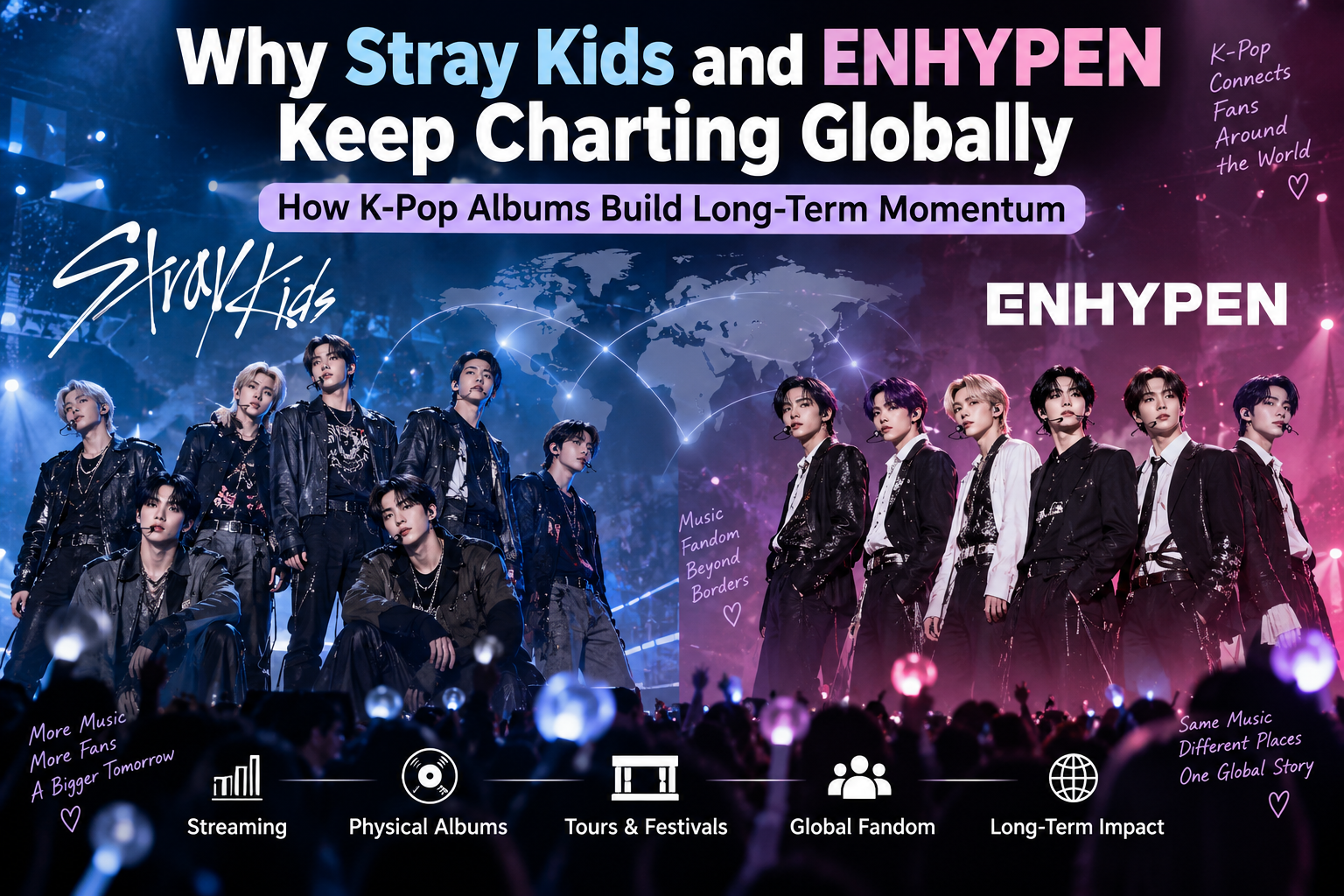
Stray Kids and ENHYPEN offer two useful examples of how modern K-pop albums can continue generating attention well after their initial release.
Recent global chart activity has shown both groups maintaining visibility beyond the first burst of comeback promotions. Stray Kids have also seen older releases return to international album charts, while ENHYPEN have continued to maintain a presence across major global rankings.
This is not simply a story about two successful groups.
It reflects a larger change in the way K-pop works internationally.
Albums today can gain new momentum through touring, festival appearances, fan discovery, physical album collecting, social media, streaming, and the continued growth of international fandoms.
To understand why Stray Kids and ENHYPEN keep charting globally, it helps to look beyond release-day numbers and examine the system that keeps a K-pop album alive.
From a Comeback Event to a Longer Album Cycle
Traditionally, a K-pop comeback is built around an intense promotional period.
A group announces a new release, teaser photos and videos appear, pre-orders begin, the album arrives, music-show promotions follow, and fans concentrate much of their activity around the launch.
That structure still exists.
What has changed is what can happen afterward.
A successful album can now move through several additional stages:
- Fans discover songs through concerts and festival performances.
- New listeners explore an artist’s older catalog.
- Physical albums continue selling to collectors.
- Songs receive new attention through short-form video and social media.
- International promotions introduce the group to new audiences.
- Touring keeps the album visible months after its original release.
This means a comeback is no longer necessarily a short promotional event.
For globally established K-pop acts, it can become a long-running album cycle in which new music, older albums, touring, and fandom activity continuously reinforce one another.
Stray Kids: When Touring Keeps the Catalog Moving
Stray Kids are a strong example of how global touring can extend the life of K-pop music far beyond a comeback period.
Their international growth has been built not only around new album releases but also around large-scale touring, festival appearances, and an expanding audience across multiple regions.
When a group performs in front of new audiences, listeners do not necessarily start with only the newest single.
They may search for the songs they heard live, explore previous title tracks, stream older albums, or buy physical releases they missed when they were first released.
That creates something especially valuable for an established artist: catalog momentum.
Instead of each new comeback replacing the previous one, new activity can send attention backward through the group’s discography.
For Stray Kids, that effect is particularly relevant because their musical identity is recognizable across releases. Listeners who discover one high-energy performance can quickly find a much larger catalog built around the group’s distinctive production and performance style.
Festivals Can Create a Different Kind of Discovery
Festival appearances add another layer.
A K-pop concert is largely filled with people who already chose to see that artist. A major music festival can put a group in front of a broader audience, including listeners who may not normally attend a K-pop-specific show.
That difference matters.
Someone who encounters Stray Kids through a large international festival may begin with a performance clip rather than an album release. From there, discovery can move backward:
festival performance → song search → streaming → older music → fandom
This is one reason international live exposure can have effects that continue after the event itself.
It turns touring and festivals into more than ticket businesses. They can also function as long-term discovery channels for an artist’s music.
Physical Albums Still Matter in K-Pop
Another reason K-pop albums can maintain momentum is that the physical album remains unusually important.
For many music listeners, an album is primarily something to stream. In K-pop, physical releases are also collectible products.
Different versions, photobooks, photocards, packaging, and other inclusions give fans reasons to purchase physical albums even when the music itself is available digitally.
This creates a different sales pattern from a market in which most consumption happens only through streaming.
New fans who join a fandom months or even years later can begin collecting older releases, which means an album’s commercial life does not necessarily end when its original promotional cycle is over.
That helps explain why an older K-pop release can sometimes reappear in conversations or charts when an artist experiences another wave of global attention.
ENHYPEN: Building Momentum Through a Global Fandom
ENHYPEN show another side of long-term K-pop momentum.
The group developed with an international audience in mind from an early stage, and their music, performances, visual storytelling, and online content have helped fans enter the fandom through many different routes.
Some listeners discover ENHYPEN through a new album. Others may first encounter a performance, a short video, a member-focused clip, a concert, or an older song recommended online.
Once that happens, discovery rarely stops with a single track.
A new listener can move from the latest release to previous title tracks, B-sides, music videos, performances, and eventually older albums.
That creates a discovery loop:
new release → new listener → older songs → deeper fandom engagement → renewed interest in the catalog
As the international fandom grows, every new promotional cycle has the potential to introduce more people to music that was released before they became fans.
Why an Older Album Can Become Relevant Again
In the traditional release model, older albums gradually disappear as newer releases take their place.
K-pop can behave differently because fandom growth continuously introduces new buyers and listeners.
Imagine someone becoming an ENHYPEN fan after seeing the group perform in 2026.
That person may begin with the newest album, but the next step could be listening to earlier releases, watching older music videos, learning the group’s history, or collecting previous physical albums.
Multiply that behavior across thousands of new fans in different countries and an older catalog can receive a meaningful second life.
This is particularly important for groups whose global audiences are still expanding.
Their newest release does not only generate demand for new music. It can increase the value and visibility of everything that came before it.
Streaming and Physical Sales Reinforce Each Other
K-pop’s global momentum also comes from the interaction between digital listening and physical collecting.
Streaming makes discovery easy. A listener can hear a song immediately and move through an artist’s catalog within minutes.
Physical albums create a different relationship. They turn the release into something fans can own, collect, display, trade, and revisit.
The two behaviors can reinforce each other:
stream a song → become interested in the group → explore the album → join the fandom → buy a physical release → discover more music
Not every fan follows this exact path, of course. But the combination helps explain why physical albums remain important even in a streaming-dominated music industry.
For groups such as Stray Kids and ENHYPEN, global digital discovery and physical album demand do not have to compete with each other. They can become parts of the same fandom ecosystem.
Why Long-Term Chart Momentum Matters for K-Pop
The importance of long-term chart activity goes beyond the ranking itself.
A high debut can show that a fandom was ready for a comeback. Continued activity can reveal something different: whether music continues circulating after the initial promotional push.
That circulation can come from several places at once.
1. Global Fandoms Do Not Discover Artists at the Same Time
K-pop is now consumed across many countries, platforms, and time zones.
A fan in one market may discover an artist during an album release, while someone elsewhere may first encounter the same group months later through a concert, festival, recommendation, or viral clip.
There is no longer one universal moment when everyone discovers an album.
That makes the potential lifespan of a release much longer.
2. Every Comeback Can Promote the Back Catalog
A new album does more than compete for attention with older releases.
It can advertise them.
When a comeback attracts new fans, those listeners often want to understand what came before. That sends attention toward earlier title tracks, albums, performances, and music videos.
For artists with several successful eras behind them, the catalog becomes an increasingly valuable asset.
3. Touring Connects Music Markets
Global tours also connect regions that once experienced K-pop mainly through online content.
A concert can create local media attention, social posts, fan videos, searches, streams, and album purchases around the same period.
As K-pop tours expand geographically, this cycle can repeat across multiple markets rather than happening only once around the original Korean comeback.
4. Fandom Is Part of the Distribution System
K-pop fandoms do more than consume music.
Fans translate content, recommend songs, share performances, organize communities, introduce friends to groups, discuss older releases, and keep an artist visible between comebacks.
This does not mean every chart movement can be explained by fandom activity alone. Touring, promotion, distribution, playlist exposure, media coverage, and the music itself also matter.
But fandom gives K-pop something unusually powerful: a global network that can continue circulating an artist’s catalog long after release day.
Stray Kids and ENHYPEN Represent a Broader Shift
Stray Kids and ENHYPEN have different histories, sounds, and fandom journeys.
What connects them is the way their international audiences can sustain attention across more than one release cycle.
Their recent chart visibility illustrates a broader transition in K-pop:
success is increasingly about building a catalog and a global audience that can keep interacting over time—not simply producing one large comeback week.
That changes how we should think about K-pop’s international growth.
The most important question may no longer be only:
“How high did the new album debut?”
It may also be:
“How much new attention did this era create for everything the group has already built?”
FAQ
Why do K-pop albums sometimes return to global charts?
There is no single reason. New tours, festival appearances, growing fandoms, renewed streaming, physical album purchases, social media exposure, and new releases can all bring attention back to an artist’s older music.
When a group gains new fans, those listeners often explore earlier albums rather than listening only to the newest release.
Why are physical albums still important in K-pop?
K-pop physical albums are often designed as collectible products as well as music releases.
Photobooks, photocards, multiple versions, and other inclusions can give fans additional reasons to buy an album even when they already stream the music digitally.
This allows physical sales and streaming to play different roles within the same fandom.
How does touring help K-pop albums?
Tours keep artists visible between comeback periods and introduce their music to audiences in different markets.
Concert performances can lead people to search for songs, stream albums, watch older performances, and explore an artist’s catalog. Major festivals can also expose K-pop acts to listeners outside their existing fan communities.
Why can older Stray Kids or ENHYPEN music gain attention again?
Both groups continue reaching new international listeners.
Someone becoming a fan today has years of existing music to discover. As the audience grows, older songs and albums can receive new streams, purchases, searches, and discussion even though their original promotional periods have ended.
Does staying on a chart automatically mean an album is more successful?
Not necessarily.
Charts use different methodologies and measure different forms of activity. A chart position should therefore be understood within the rules and market represented by that particular chart.
Longer chart activity is useful as one signal of continued consumption, but it is not a complete measurement of an artist’s overall popularity or success.
Final Thoughts
Stray Kids and ENHYPEN help illustrate how the meaning of a K-pop album has changed in the global era.
An album can begin with a comeback, but its story does not necessarily end when music-show promotions finish.
Touring can introduce the songs to new audiences. Festivals can create unexpected discovery. Streaming can send listeners backward through a group’s discography. Physical collecting can keep older releases commercially relevant. And every new wave of fans can give an existing catalog another opportunity to be discovered.
That is why long-term momentum matters.
The global K-pop market is increasingly built not only around big release weeks, but around relationships between new music, older catalogs, touring, collecting, and continuously expanding fandoms.
For groups such as Stray Kids and ENHYPEN, the result is a music catalog that can keep moving long after release day.
Leave a Reply