Tag: K-Pop Globalization

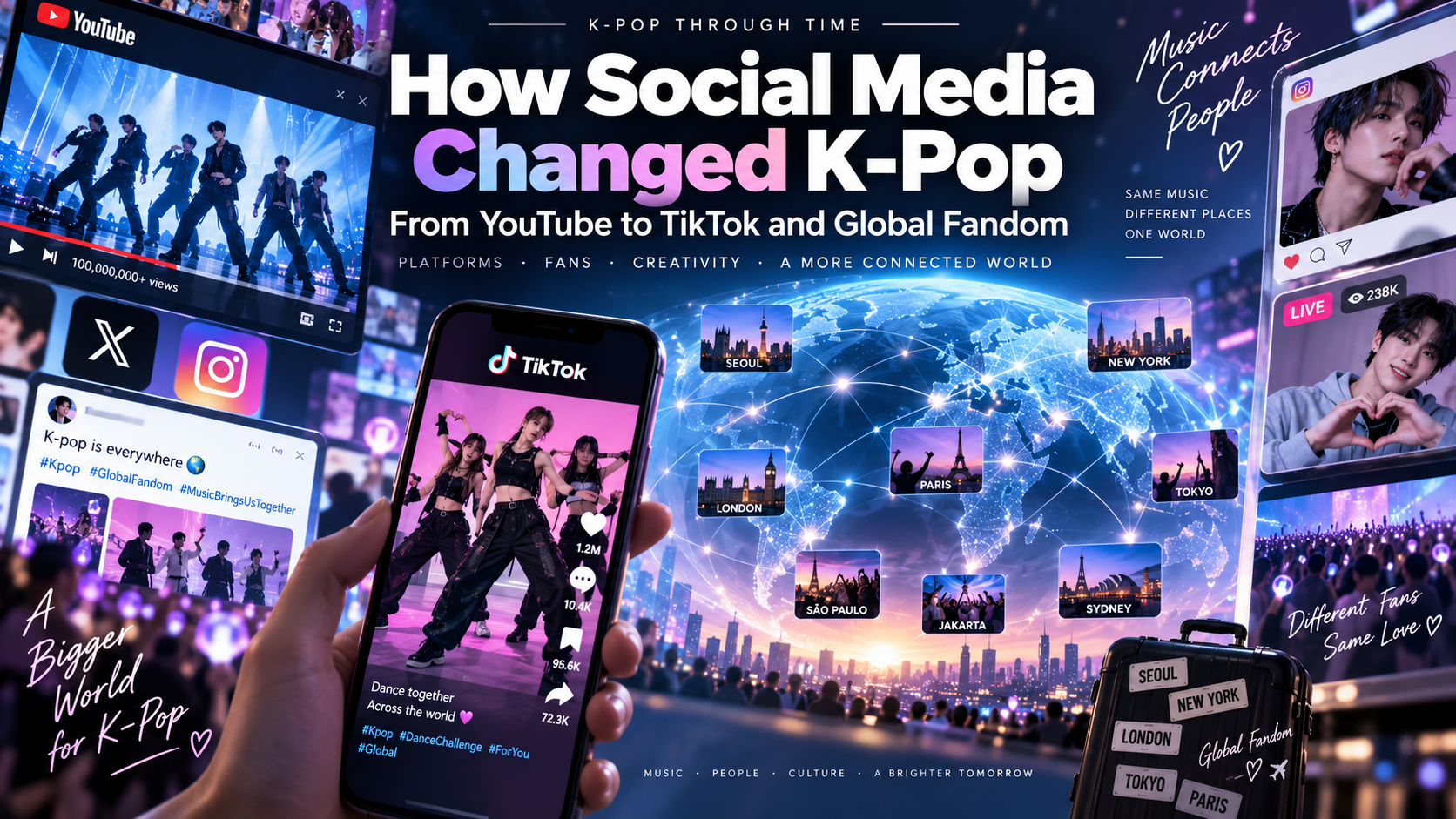
  • How Social Media Changed K-Pop: From YouTube to TikTok and Global Fandom

    How Social Media Changed K-Pop: From YouTube to TikTok and Global Fandom

    K-Pop Before the Social Media Revolution

    Today, it is difficult to imagine K-pop without social media.

    A new music video can reach viewers around the world within minutes. A short dance clip can introduce a song to people who have never heard of the artist. Fans can follow updates, watch livestreams, share performances, and discuss a comeback across multiple time zones at once.

    But K-pop did not begin in this environment.

    Before social media became central to the industry, Korean artists depended much more heavily on traditional media.

    Television music programs mattered enormously.

    Radio, newspapers, magazines, variety shows, and physical album distribution helped determine which artists became visible.

    International expansion was more difficult.

    To reach audiences outside South Korea, entertainment companies often needed local broadcasters, record labels, distributors, promotional partners, or physical events in foreign markets.

    The internet did not eliminate these institutions.

    But it dramatically changed the balance of power.

    From Gatekeepers to Platforms

    Traditional media relies heavily on gatekeepers.

    A television network decides what to broadcast.

    A radio station decides what to play.

    A magazine decides whom to feature.

    A distributor decides where a product will be available.

    These organizations can provide enormous exposure, but they also control access to audiences.

    Digital platforms created another route.

    An entertainment company could upload a music video online and potentially reach viewers in countries where the artist had never appeared on television.

    A fan could discover a Korean group without waiting for a local broadcaster to introduce them.

    This was a fundamental change.

    K-pop no longer needed to cross every national border through traditional media institutions.

    Digital content could travel first.

    Business expansion could follow.

    YouTube Became a Global Window

    Among the platforms that helped transform K-pop, YouTube was especially important.

    Music is naturally suited to video, and K-pop already had a strong visual tradition built around choreography, styling, performance, and music videos.

    YouTube gave those strengths global distribution.

    A viewer did not necessarily need to know anything about Korean popular culture.

    They could encounter a music video through search, a recommendation, a shared link, or another piece of related content.

    One video could lead to another.

    A music video could lead to a dance practice.

    A dance practice could lead to a live performance.

    A performance could lead to an interview.

    The discovery process became nonlinear.

    This was very different from traditional promotion, where companies attempted to guide audiences through carefully controlled channels.

    The Music Video Became a Global Advertisement

    In the digital era, a K-pop music video performs several jobs simultaneously.

    It is an artistic work.

    It showcases choreography.

    It introduces the members.

    It communicates the visual concept of a comeback.

    And it acts as a global advertisement for the artist.

    This helps explain why visual production became so important to K-pop’s international strategy.

    A compelling video can attract someone who does not understand the lyrics.

    The image creates curiosity.

    Curiosity leads to further exploration.

    The previous chapter examined how K-pop became a visual culture.

    Social media gave that visual culture a worldwide distribution system.

    The two developments reinforced each other.

    Dance Practice Videos Revealed the Process

    YouTube also helped popularize content that traditional television might not have treated as a major product.

    The dance practice video is a good example.

    Instead of elaborate sets and editing, viewers could see performers rehearsing choreography in a relatively simple environment.

    These videos gave international audiences a clearer understanding of the technical work behind K-pop performance.

    They also made choreography easier to learn.

    Fans could pause.

    Replay.

    Slow down sections.

    Study formations.

    Practice movements.

    A rehearsal format therefore became both entertainment and an educational resource for global dance-cover culture.

    Fans Became Distributors

    Social media changed another fundamental relationship.

    Fans became part of distribution.

    In the traditional model, a company promoted an artist to an audience.

    In the networked model, the audience could promote the artist to another audience.

    A fan could share a music video with a friend.

    A translation account could explain an interview.

    A dance-cover creator could introduce a song to viewers interested in choreography.

    A reaction channel could expose an artist to a different online community.

    A short clip could circulate far beyond the original fandom.

    This created a powerful multiplier effect.

    Entertainment companies produced official content.

    Fans extended its reach.

    International Fans No Longer Had to Wait

    Before digital distribution became widespread, international fans often experienced Korean entertainment later than domestic audiences.

    Content might need to be licensed, broadcast locally, imported, translated, or circulated through fan communities.

    Social platforms reduced that delay dramatically.

    A music video released in Seoul could be watched almost immediately in São Paulo, Paris, Jakarta, Toronto, Manila, or Sydney.

    This created something historically important:

    a more synchronized global audience.

    Fans in different countries could experience the same release at approximately the same moment.

    The comeback became an international event rather than a sequence of separate national launches.

    Twitter Turned Fandom Into a Real-Time Network

    If YouTube helped K-pop content travel, Twitter—now known as X—helped conversation travel.

    The platform became especially useful for rapid communication.

    Fans could share links.

    Translate updates.

    Discuss performances.

    Circulate photographs.

    Track schedules.

    Organize hashtags.

    React to announcements in real time.

    This made fandom faster and more interconnected.

    Information that once moved through smaller forums or fan cafes could now circulate through enormous international networks.

    The important transformation was not merely that fans talked online.

    They could communicate across fandoms, languages, and national borders almost instantly.

    Hashtags Created Temporary Global Public Spaces

    Hashtags became a simple but powerful organizational tool.

    Fans discussing the same artist, release, concert, or event could gather around a shared phrase.

    This created temporary digital spaces around specific moments.

    A comeback announcement could generate worldwide conversation.

    A concert could produce real-time commentary from people inside and outside the venue.

    An award appearance could become a global online event.

    Hashtags also made fandom activity visible to outsiders.

    Someone who did not follow a particular group might still encounter a trending discussion.

    Fandom therefore gained a new ability:

    it could make its own attention visible.

    Social Media Changed the Speed of K-Pop

    Traditional promotional cycles operated according to schedules controlled largely by broadcasters, magazines, and companies.

    Social media accelerated everything.

    Teasers could spread immediately.

    A hairstyle change could become a topic within minutes.

    A performance clip could circulate before a television program had finished airing.

    A joke from a livestream could become a meme the same day.

    A controversy could also spread at the same speed.

    K-pop entered a continuous information cycle.

    This created opportunities for visibility, but it also created pressure.

    Artists and companies increasingly operated in an environment where audiences expected frequent updates and rapid responses.

    The Idol Became a Continuous Media Presence

    Earlier celebrities could disappear from public view between major promotional activities.

    Social media made that more difficult—and sometimes less desirable.

    Fans wanted ongoing contact.

    Artists could post photographs, short messages, behind-the-scenes moments, recommendations, or casual updates.

    The idol’s public identity therefore extended beyond official songs and television appearances.

    Daily life, or at least a carefully selected version of it, could become content.

    This strengthened emotional connection.

    Fans could feel that they were following an artist’s journey rather than simply consuming finished releases.

    But it also blurred the boundary between professional performance and private life.

    Instagram Turned the Idol Into a Personal Brand

    Image-centered platforms such as Instagram strengthened another dimension of idol culture: the individual public brand.

    A group may have a carefully designed collective identity.

    Individual members can simultaneously develop recognizable personal styles.

    Fashion becomes important.

    Photography becomes important.

    Travel, art, beauty, food, hobbies, and brand partnerships can become part of the public image.

    This can extend an idol’s career beyond group promotions.

    A member may become influential in fashion, advertising, television, acting, or other industries.

    Social media therefore helps transform the idol from a performer into a broader cultural brand.

    Livestreaming Changed the Feeling of Distance

    Livestreaming introduced something even more powerful: simultaneity.

    Recorded content says:

    “This happened.”

    A livestream says:

    “This is happening now.”

    That difference can create a strong sense of connection.

    An artist may speak casually from a studio, backstage area, hotel room, or another setting while fans around the world respond in real time.

    The interaction is still limited.

    Thousands or millions of viewers may be watching, and the artist cannot personally know most of them.

    But psychologically, the experience can feel much more immediate than television.

    The distance between celebrity and audience appears to shrink.

    The Rise of Direct-to-Fan Communication

    As digital fandom expanded, specialized platforms also developed around closer artist-fan communication.

    Memberships, exclusive content, community posts, livestreams, and various forms of direct messaging became increasingly important parts of the K-pop ecosystem.

    This reduced dependence on traditional entertainment media.

    An artist or company could communicate directly with an established fan community.

    For businesses, this relationship was valuable because it created a channel that did not begin with a television network or newspaper.

    For fans, it created greater access to content.

    But the word direct requires caution.

    Communication may feel personal even when it is delivered at enormous scale.

    That distinction becomes important when discussing parasocial relationships and the commercialization of intimacy.

    Social Media Did Not Simply Promote K-Pop

    This is the key point.

    It is easy to say that social media helped advertise K-pop.

    That is true, but incomplete.

    Social media changed how K-pop was produced and experienced.

    Songs could be designed with visual circulation in mind.

    Choreography could generate shareable moments.

    Artists could communicate continuously.

    Fans could become translators and distributors.

    International releases could happen simultaneously.

    Companies could measure audience reactions almost immediately.

    The boundaries between promotion, entertainment, community, and commerce became increasingly difficult to separate.

    Social media was no longer simply a marketing tool outside the K-pop system.

    It became part of the system itself.

    Then the Algorithm Became a Gatekeeper

    Digital platforms appeared to reduce the power of traditional gatekeepers.

    But they did not create a world without gatekeepers.

    They created new ones.

    Recommendation systems began deciding which videos appeared next.

    Search systems influenced what people found.

    Trending systems amplified certain conversations.

    Short-form platforms learned which clips kept users watching.

    The new gatekeeper was not necessarily a television producer or magazine editor.

    Increasingly, it was an algorithm.

    And as K-pop entered the TikTok era, understanding that algorithmic environment became essential to understanding how a song could travel around the world.

    TikTok Changed the Logic of Music Discovery

    YouTube helped make the full music video globally accessible.

    TikTok introduced a different model.

    Instead of asking users to search for an artist or watch an entire video, short-form platforms continuously place new content in front of them.

    A person can therefore encounter a K-pop song without knowing the group, the song title, or even that the music is Korean.

    They may first hear only a few seconds.

    That short encounter can be enough to create curiosity.

    This changed an important question for the music industry.

    The challenge was no longer only:

    How do we convince people to watch our content?

    It was also:

    How do we become the content they encounter unexpectedly?

    The Shortest Moment Could Open the Biggest Door

    In short-form media, a small section of a song can take on a life of its own.

    A memorable chorus.

    A distinctive beat.

    A dramatic transition.

    A recognizable hand movement.

    A facial expression.

    A few seconds of choreography.

    Any of these can become the entry point through which a much larger audience discovers the full song.

    This does not mean that every successful K-pop release depends on a viral moment.

    Many songs build audiences through fandom, concerts, playlists, traditional promotion, or long-term reputation.

    But short-form platforms created an additional path to discovery—one based on rapid repetition and participation.

    Dance Challenges Connected Artists and Audiences

    Dance challenges became one of the most visible expressions of this new environment.

    A short section of choreography could be reproduced by fans, dancers, influencers, and other artists.

    The format worked especially well for K-pop because choreography was already deeply embedded in the industry.

    The important change was scale.

    A dance no longer needed to remain primarily within concerts, music shows, or dedicated dance-cover communities.

    A simplified section could circulate through millions of short videos.

    The song traveled every time someone recreated the movement.

    Promotion became participation.

    Idol-to-Idol Challenges Changed Promotion

    K-pop artists also began appearing together in short dance-challenge clips.

    Members of different groups could perform one another’s choreography during overlapping promotional periods.

    These videos may appear casual, but they represent an interesting shift in entertainment marketing.

    Artists who might once have been presented mainly as competitors can temporarily become collaborators in one another’s promotional ecosystems.

    A short video can expose one fandom to another artist.

    It can also create a sense of connection across the industry.

    The promotional network becomes less dependent on formal advertising and more dependent on shareable interaction.

    Viral Success Can Be Unpredictable

    One of the defining characteristics of algorithmic platforms is uncertainty.

    Companies can plan content carefully.

    They can invest in promotion.

    They can invite popular creators to participate.

    But they cannot completely control what becomes culturally contagious.

    Sometimes an unexpected song section attracts attention.

    Sometimes an older track is rediscovered.

    Sometimes a fan-made clip becomes more influential than the official promotional material.

    Sometimes a dance challenge spreads far beyond the original fandom.

    This unpredictability can benefit smaller artists because discovery is not always proportional to company size.

    But it also makes the industry more volatile.

    Everyone can attempt to create virality.

    No one can reliably manufacture it every time.

    Algorithms Became Invisible Editors

    Traditional media gatekeepers were relatively easy to identify.

    Viewers knew that television stations selected programs and radio stations selected songs.

    Algorithmic platforms are less visible.

    Users see a personalized feed, but the decisions behind that feed are complex.

    Recommendation systems analyze patterns of behavior to determine what content might keep a person engaged.

    This means two people can open the same platform and encounter completely different cultural worlds.

    For K-pop, this creates both opportunity and risk.

    An algorithm can introduce a Korean artist to someone who has never intentionally searched for K-pop.

    But it can also repeatedly show similar content to people who are already interested, creating the impression that a particular trend is more universal than it actually is.

    Global Does Not Mean Universal

    Social media numbers can be enormous.

    Millions of views can create the impression that everyone knows an artist.

    But online popularity is often unevenly distributed.

    A group may be extremely influential in particular countries, age groups, platforms, or fan communities while remaining relatively unknown elsewhere.

    This is why the word global should be used carefully.

    Global K-pop does not mean that every group is equally popular everywhere.

    It means that the infrastructure now exists for Korean popular music to circulate, build communities, and generate commercial activity across many different markets.

    Social media helped create that infrastructure.

    Streaming Platforms Changed the Life of a Song

    Video platforms were only part of the transformation.

    Music streaming services changed how listeners accessed songs.

    Instead of purchasing every individual album or track, users could move rapidly between artists and playlists.

    This lowered the barrier to experimentation.

    A listener could discover one K-pop song and immediately explore an entire catalog.

    Playlists also became important discovery environments.

    An artist could reach listeners who were not yet members of the fandom.

    At the same time, streaming created new forms of measurement.

    Listening became data.

    Data Became Part of Entertainment Strategy

    Digital platforms generate enormous amounts of information.

    Companies can observe where audiences are located.

    They can see which videos attract attention.

    They can examine engagement patterns.

    They can monitor how audiences respond to different types of content.

    This does not mean companies know exactly what every individual fan wants.

    Nor does data guarantee creative success.

    But compared with earlier entertainment eras, companies can receive feedback from international audiences much more quickly.

    That information can influence decisions about touring, promotion, subtitles, partnerships, merchandise, and market priorities.

    Global fandom became not only visible but increasingly measurable.

    The Comeback Became a Multi-Platform Campaign

    A modern K-pop comeback rarely exists on only one platform.

    A company may release concept images through social media.

    Teasers appear on video platforms.

    Short clips circulate through TikTok or similar services.

    Artists communicate through fan platforms.

    Music becomes available through streaming services.

    Performance stages generate additional videos.

    Behind-the-scenes content extends the promotional period.

    Fans create their own edits, reactions, translations, and discussions.

    The comeback becomes a multi-platform ecosystem.

    Each platform performs a different function.

    One builds anticipation.

    Another provides the full music video.

    Another encourages short-form participation.

    Another strengthens the fan community.

    Another delivers the music itself.

    The release is no longer a single event.

    It is a coordinated sequence of digital experiences.

    Global Release Timing Changed Expectations

    Digital platforms also changed the meaning of release time.

    When audiences are distributed around the world, companies must think about multiple time zones and international chart systems.

    A release can be promoted as a global event from the beginning.

    Fans may organize countdowns across countries.

    Online communities wait together.

    The first hours of a release can become intensely visible.

    This creates excitement.

    But it can also create pressure to judge success immediately.

    How many views?

    How many streams?

    What chart position?

    How many sales?

    The digital environment encourages instant measurement.

    Yet cultural impact often takes much longer to understand.

    A song that grows slowly can become historically important.

    A song with an explosive first day may disappear quickly.

    Speed and significance are not the same thing.

    Social Media Shortened the Feedback Loop

    In earlier eras, artists might wait for sales reports, television ratings, reviews, or fan letters to understand public reaction.

    Today, reaction can appear within seconds.

    Comments arrive immediately.

    Clips circulate.

    Hashtags emerge.

    Fans praise particular lyrics, outfits, choreography, or members.

    Criticism spreads just as quickly.

    This creates an extremely short feedback loop between release and response.

    For companies, the information can be useful.

    For artists, it can be psychologically difficult.

    A performer may encounter thousands of opinions about their work—and sometimes about their appearance or personality—almost instantly.

    The Attention Economy Never Sleeps

    Social platforms compete for attention.

    Artists therefore operate in an environment where visibility can fade rapidly.

    A successful comeback may be followed immediately by new releases from other artists.

    Trends change.

    Memes change.

    Algorithms change.

    Audiences move to new platforms.

    This encourages continuous content production.

    Behind-the-scenes clips.

    Challenges.

    Photographs.

    Livestreams.

    Interviews.

    Short videos.

    Tour updates.

    Fan messages.

    The idol’s work increasingly includes maintaining digital presence between major musical releases.

    This can strengthen fandom relationships, but it can also create exhaustion.

    Accessibility and Overexposure Exist Together

    Social media solved one of the old problems of international fandom: lack of access.

    But it created another problem: possible overexposure.

    Fans can receive more content than ever before.

    Artists can appear constantly available.

    The boundary between promotion and everyday life can become difficult to see.

    When audiences become accustomed to continuous access, silence itself may begin to feel unusual.

    An artist taking time away from social media can generate speculation.

    This reveals an important contradiction of digital celebrity.

    Greater access can strengthen connection.

    But healthy relationships also require boundaries.

    Parasocial Relationships Became Easier to Monetize

    Digital platforms can make communication feel personal.

    A message appears on a fan’s phone.

    An artist speaks directly into a camera.

    A livestream feels spontaneous.

    Membership content may create a sense of exclusivity.

    These experiences can be enjoyable and meaningful.

    But they also have commercial value.

    Entertainment companies increasingly operate businesses built around sustained fan engagement.

    The closer fans feel to an artist, the more likely some may be to remain active consumers.

    This does not mean the emotional connection is necessarily fake.

    Artists can genuinely appreciate fans.

    Fans can genuinely find comfort in artists.

    The important point is that authentic emotion and commercial systems can exist at the same time.

    Understanding both is essential to understanding modern K-pop.

    Social Media Gave Artists More Voice—and More Risk

    Digital communication can also give idols greater control over how they present themselves.

    Instead of relying entirely on television editing or newspaper interviews, artists can communicate through their own accounts or official community spaces.

    They can show interests that may not appear in formal promotions.

    They can speak more casually.

    They can build individual identities.

    But greater visibility also creates risk.

    A poorly understood comment can circulate globally.

    Old content can resurface.

    Translation can remove nuance.

    A joke may be interpreted differently across cultures.

    An action acceptable in one context may cause controversy in another.

    The global audience therefore creates a new challenge:

    artists are communicating across cultural boundaries continuously.

    Translation Became Faster but Not Always Better

    International fandom depends heavily on translation.

    Professional subtitles have become more common, and automatic translation technologies continue to improve.

    But speed can create problems.

    A short phrase may require cultural context.

    Honorifics may not translate neatly.

    Humor can disappear.

    Tone can be misread.

    Machine translation can produce errors.

    Fan translations can also contain mistakes.

    In a real-time social-media environment, an inaccurate translation may spread before a corrected version appears.

    Global communication therefore requires more than technical translation.

    It requires cultural interpretation.

    The Platform Can Change the Art

    Perhaps the most important question is whether social media merely distributes entertainment or begins to shape what entertainment becomes.

    When short clips are important, memorable short sections become valuable.

    When thumbnails influence clicks, visual presentation matters.

    When algorithms reward frequent activity, continuous content becomes useful.

    When audiences expect direct communication, idols spend more time communicating.

    When global fans respond strongly to certain formats, companies may create more of them.

    The platform does not completely control creativity.

    Artists and producers still make artistic choices.

    But the environment influences those choices.

    Distribution begins to shape production.

    And once that happens, social media is no longer simply a place where K-pop is promoted.

    It becomes one of the forces influencing what modern K-pop looks and sounds like.


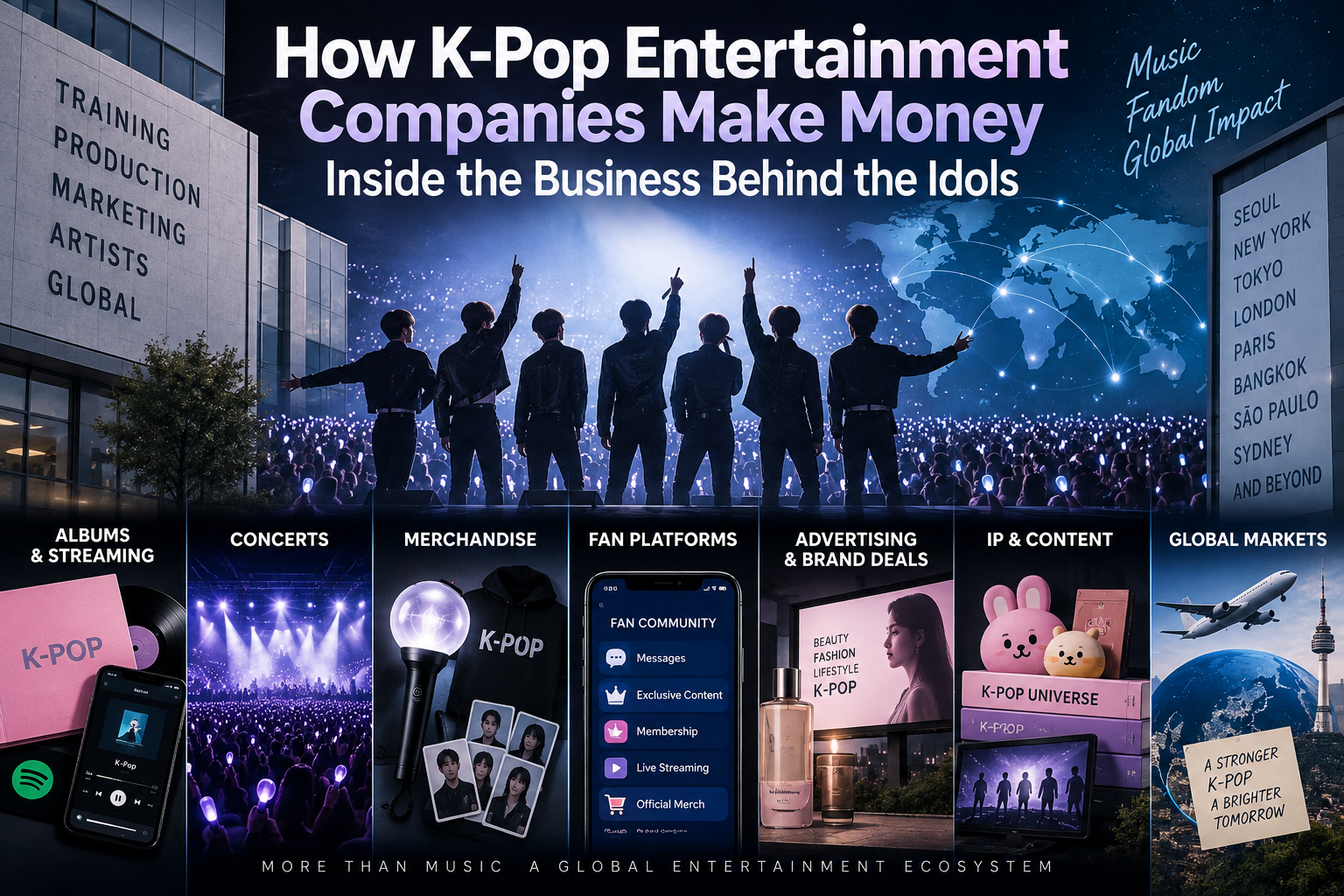
  • How K-Pop Entertainment Companies Make Money: Inside the Business Behind the Idols

    How K-Pop Entertainment Companies Make Money: Inside the Business Behind the Idols

    K-Pop Is More Than a Music Business

    When people think about how K-pop companies make money, the first answer seems obvious:

    They sell music.

    That is true—but it explains only part of the business.

    Modern K-pop has developed into an entertainment ecosystem in which a successful artist can generate revenue through physical albums, streaming, concerts, merchandise, advertising, licensing, fan platforms, intellectual property, and international partnerships.

    A song can therefore be much more than a product by itself.

    It can introduce a new concept.

    That concept can support an album.

    The album can strengthen a fandom.

    The fandom can support a tour.

    The tour can sell merchandise.

    The group’s popularity can attract brand partnerships.

    Characters, documentaries, games, exhibitions, and other intellectual property can extend the relationship even further.

    This interconnected structure is one reason K-pop has become such an interesting global entertainment business.

    To understand it, however, we need to begin with something that is easy to forget:

    Before an idol group makes money, someone has to spend money creating it.

    The Cost of Creating a K-Pop Group

    As we explored in the previous article about the K-pop trainee system, idols may spend months or years preparing before debut.

    That preparation requires resources.

    Entertainment companies may spend money on training, instructors, practice facilities, staff, accommodation, music production, choreography, styling, photography, video production, marketing, and administration.

    Then comes the debut itself.

    Songs need to be recorded.

    Producers and songwriters need to be involved.

    Choreography must be created and rehearsed.

    Music videos can require sets, locations, costumes, visual effects, directors, camera crews, and post-production.

    Albums must be designed and manufactured.

    Promotional content must be produced.

    Managers and staff must coordinate schedules.

    A new group can therefore represent a substantial investment before the public has decided whether it cares about the group at all.

    This is one of the central risks of the idol business.

    A company can prepare extensively.

    It cannot manufacture public interest with certainty.

    The Hit-Driven Nature of Entertainment

    Entertainment is an unusual business because success is difficult to predict.

    A company can analyze trends, recruit talented performers, hire experienced producers, and spend heavily on promotion.

    The release can still underperform.

    Meanwhile, another song may become far more successful than expected.

    This uncertainty makes the economics of K-pop fundamentally different from industries in which demand is easier to forecast.

    A successful entertainment company therefore needs more than creativity.

    It needs risk management.

    Large companies may manage this risk by operating multiple groups, solo artists, labels, platforms, or other businesses.

    Smaller agencies may depend much more heavily on the performance of one or two acts.

    That difference can have enormous consequences.

    For a small company, one successful group can transform the entire business.

    One unsuccessful debut can create serious financial pressure.

    Physical Albums: Why K-Pop Still Sells CDs

    One of the most distinctive features of K-pop’s business model is the continued importance of physical albums.

    In many music markets, streaming reduced the practical need to purchase CDs.

    K-pop responded by changing what an album represents.

    A physical K-pop album is often not simply a container for recorded music.

    It can be a collectible experience.

    Albums may include photobooks, photocards, posters, stickers, special packaging, or other items. Multiple versions may offer different photographs, designs, or collectible inclusions.

    For fans, purchasing an album can therefore serve several purposes at once.

    It supports the artist.

    It provides a physical collectible.

    It becomes part of fandom culture.

    And for some buyers, the randomized nature of photocards creates an additional collecting experience.

    The industry effectively separated two activities:

    Listening to music could happen digitally.

    Owning the comeback could happen physically.

    That distinction helped physical albums remain commercially meaningful in the streaming era.

    Why Fans Sometimes Buy Multiple Albums

    To someone outside K-pop fandom, buying several copies of the same album may seem unusual.

    Within K-pop, there can be several motivations.

    Different versions may contain different concepts or packaging.

    Fans may collect photocards.

    Purchases can sometimes be connected to opportunities such as fan events, depending on the promotion.

    Fandoms may also organize purchases around chart performance or sales milestones.

    This demonstrates a major strength of K-pop’s commercial model:

    It turns participation into part of the product experience.

    Fans are not always purchasing only because they need access to the songs.

    They may be purchasing because ownership itself expresses membership, support, collecting, and participation.

    But this strategy also creates criticism.

    Multiple versions and collectible incentives can encourage excessive consumption and generate environmental waste.

    The commercial effectiveness of the model therefore comes with questions about sustainability and responsible fandom practices.

    Streaming: Massive Reach, Complicated Economics

    Streaming transformed how K-pop travels around the world.

    A listener in another country can discover a new release almost immediately without importing a physical album.

    Platforms can expose songs to audiences who have never followed K-pop before.

    Playlists, recommendations, fan sharing, and algorithmic discovery can all contribute to visibility.

    From a business perspective, streaming can generate revenue, but the economics are more complicated than simply multiplying the number of plays by one universal payment rate.

    Payments can vary according to platform, market, subscription type, rights ownership, contractual arrangements, and other factors.

    Revenue may also need to be divided among different rights holders and participants.

    For this reason, statements such as “one stream is worth exactly this amount” should be treated cautiously.

    The more important point is that streaming has both direct and indirect economic value.

    It can generate music-related revenue.

    But it can also help create something potentially more valuable:

    attention.

    Attention Can Become Revenue Somewhere Else

    Suppose a listener discovers a group through a streaming playlist.

    They enjoy the song.

    Then they watch the music video.

    They follow the group’s social accounts.

    Later, they purchase an album.

    Eventually, they buy a concert ticket.

    They may purchase merchandise or follow the group through a dedicated fan platform.

    The original stream was only the first step.

    This is why evaluating K-pop purely through streaming revenue can miss the larger business model.

    Music attracts attention.

    Fandom deepens the relationship.

    Other products and experiences monetize that relationship in different ways.

    In business terms, K-pop companies are not simply selling songs.

    They are building long-term audience ecosystems.

    YouTube Has Value Beyond the Advertisement

    YouTube has played an extraordinary role in K-pop’s international growth.

    Music videos, dance practices, performance videos, behind-the-scenes footage, variety content, interviews, and short-form clips can reach global audiences without traditional television distribution.

    Advertising can create direct revenue on eligible content, but YouTube’s larger value to K-pop may extend beyond advertising itself.

    A music video can introduce an artist to a new country.

    A dance practice can demonstrate performance quality.

    Behind-the-scenes content can strengthen emotional attachment.

    An interview can help viewers learn individual members’ personalities.

    Each piece of content can move a viewer further from casual awareness toward fandom.

    This is a recurring pattern in the K-pop business:

    Content that appears to be free can still have enormous commercial value if it strengthens the relationship between artist and audience.

    The Comeback Is a Business Cycle

    In K-pop, a new release is often described as a comeback.

    Commercially, a comeback can activate many parts of the business at once.

    Teasers generate attention.

    Concept photographs create anticipation.

    Preorders begin.

    Albums are released.

    Music videos generate traffic.

    Television and online performances increase exposure.

    Short-form challenges circulate.

    Fan events strengthen engagement.

    Merchandise may accompany the era.

    Future concerts gain new songs and concepts.

    A comeback is therefore not simply the day a song appears.

    It is a coordinated cycle of content, promotion, fandom activity, and commercial opportunity.

    This helps explain why K-pop companies invest so heavily in visual concepts and promotional schedules.

    The release is not only music.

    It is an event.

    Concerts Transform Digital Fans Into Physical Audiences

    If streaming demonstrates global reach, concerts reveal whether that reach can become physical demand.

    Live performance is especially important to K-pop because choreography and stage production are central to the genre’s identity.

    Fans who have watched performers for years through screens can finally experience them in the same venue.

    The economic activity surrounding a tour can extend far beyond the ticket.

    There may be merchandise sales, VIP packages, venue-related spending, sponsorships, and other commercial arrangements depending on the tour.

    But concerts are also expensive to produce.

    Venues, transportation, equipment, stage production, dancers, staff, security, insurance, accommodation, and logistics all create costs.

    International touring adds another layer of complexity.

    Revenue can be substantial, but revenue is not the same as profit.

    That distinction is essential when discussing entertainment-company finances.

    Touring Also Reveals the Geography of Fandom

    Concerts provide companies with another valuable resource:

    information.

    Online metrics may suggest that a group has fans in a particular country.

    Ticket demand provides stronger evidence that people are willing to spend money and travel to see that group.

    A successful tour can therefore influence future business decisions.

    Should the next tour include a larger venue?

    Should the company add another city?

    Is there enough demand for local merchandise distribution?

    Could a brand partnership work in that market?

    Should more promotional content be produced in a particular language?

    K-pop’s global business expansion is therefore not based only on cultural popularity.

    Companies continuously learn where fandom can become sustainable economic activity.

    And once a large fandom is established, one of the industry’s most powerful businesses becomes possible:

    merchandise and intellectual property.


    Merchandise: Turning Fandom Into a Physical Experience

    K-pop merchandise extends an artist’s identity beyond music.

    Official products can include clothing, accessories, posters, photobooks, light sticks, character goods, tour merchandise, season’s greetings packages, and limited-edition collaborations.

    To an outsider, these may appear to be ordinary consumer products with an artist’s name attached.

    For fans, their meaning can be much deeper.

    A light stick becomes part of the concert experience.

    A tour shirt can preserve the memory of attending a performance.

    A character associated with a member can become a recognizable symbol of fandom.

    Merchandise therefore combines commerce with identity.

    This is particularly powerful because K-pop fandom is highly visual and community-oriented.

    Fans do not simply listen to an artist.

    They often participate in a shared culture surrounding that artist.

    The Light Stick as a Business and Cultural Symbol

    Few objects demonstrate this relationship better than the official K-pop light stick.

    Originally, fandoms used various colors and objects to identify themselves at concerts. Over time, entertainment companies developed increasingly elaborate official light sticks associated with individual artists.

    Today, these devices can function as merchandise, fandom symbols, and elements of concert production.

    At large shows, synchronized light sticks can transform an audience into part of the visual performance.

    Thousands of individual purchases become a coordinated sea of light.

    This is a remarkable example of K-pop’s ability to combine product design, technology, fandom identity, and live entertainment.

    The fan buys the object.

    But the value of that object increases when thousands of other fans bring theirs to the same place.

    Intellectual Property Extends Beyond the Idol

    Successful K-pop artists can also generate intellectual property that extends beyond their recorded music.

    Characters, fictional universes, logos, visual concepts, documentaries, web content, games, exhibitions, and branded products can all expand an artist’s commercial ecosystem.

    This matters because intellectual property can sometimes continue generating value without requiring the artist to personally appear in every transaction.

    A character associated with an artist, for example, may appear on stationery, clothing, accessories, digital products, or licensed collaborations.

    The commercial idea is simple:

    Build something fans recognize, then allow that identity to exist across multiple products and experiences.

    When executed well, this can diversify revenue and deepen the cultural footprint of an artist.

    Fan Platforms Changed the Relationship

    Another major development has been the rise of dedicated fan-community platforms.

    In earlier generations, international fans often relied heavily on fan cafes, forums, unofficial translations, and social networks to follow artists.

    Modern platforms can bring communication, content, memberships, merchandise, livestreams, and community functions into a more centralized environment.

    For entertainment companies, this creates a strategically valuable relationship.

    Instead of depending entirely on third-party social networks, companies and their partners can build environments specifically designed around fandom.

    These platforms can generate revenue through memberships, paid content, commerce, digital products, and other services depending on the platform.

    But their value is not only financial.

    They can also provide companies with a more direct connection to audiences.

    Why Direct Fan Relationships Matter

    Imagine two businesses.

    The first knows that millions of people watched a music video on an external platform.

    The second also knows that hundreds of thousands of fans joined a dedicated community, purchased products, attended events, and repeatedly engaged with artist content.

    The second relationship provides a much deeper understanding of the audience.

    This is one reason direct-to-fan business models have become so important.

    A casual viewer is valuable.

    A committed fan who maintains a long-term relationship with the artist can be much more valuable.

    The K-pop business model has become increasingly sophisticated at turning broad attention into deeper levels of participation.

    Memberships Create Recurring Relationships

    Official fan-club memberships are another example.

    Depending on the artist and platform, memberships may provide access to exclusive content, ticketing benefits, special merchandise opportunities, or other privileges.

    From the fan’s perspective, membership can strengthen the feeling of belonging to an official community.

    From the business perspective, it can create a more continuous relationship than a single album purchase.

    This distinction matters.

    A music company that depends only on occasional hits faces considerable uncertainty.

    A company supported by large communities that repeatedly purchase albums, tickets, merchandise, memberships, and other experiences has a more diversified economic foundation.

    This does not eliminate risk.

    But it can reduce dependence on any single revenue source.

    Advertising and Brand Partnerships

    As idols become more famous, their commercial value can extend well beyond the music industry.

    Companies may partner with artists for advertising campaigns, product endorsements, fashion events, beauty campaigns, luxury-brand relationships, and other promotional activities.

    The value of an idol to a brand is not simply fame.

    It is attention plus association.

    An artist may represent youth, sophistication, creativity, confidence, luxury, or another identity that a company wants consumers to connect with its products.

    K-pop’s international reach makes this particularly attractive.

    An idol with fans across several continents may offer a brand access to audiences that traditional domestic advertising would struggle to reach simultaneously.

    Fashion and K-Pop Became Closely Connected

    The relationship between K-pop and fashion has become especially visible.

    Idols attend major fashion events.

    Luxury houses appoint Korean artists as ambassadors.

    Music videos and airport appearances can generate discussion about clothing and accessories.

    Fans may follow not only what an idol sings but what the idol wears.

    This relationship benefits both industries.

    Fashion brands gain access to highly engaged global fandoms.

    K-pop artists gain additional cultural visibility and commercial opportunities outside recorded music.

    The result demonstrates how far the idol business has expanded.

    An artist can operate simultaneously within music, fashion, advertising, social media, and global celebrity culture.

    The Value of an Idol’s Personal Brand

    Group identity remains central to K-pop, but individual members can also develop valuable personal brands.

    One member may become associated with fashion.

    Another may act in television dramas or films.

    Another may appear regularly on variety programs.

    Others may release solo music, host programs, write songs, model, or participate in advertising.

    These activities can diversify both the artist’s career and the company’s business opportunities.

    They can also extend an idol’s professional life beyond the period when group promotions are most intense.

    This is strategically important because idol groups do not remain in the same stage of their careers forever.

    A sustainable entertainment business must think beyond the next comeback.

    Licensing and Partnerships Multiply Reach

    Entertainment companies do not necessarily need to manufacture every product themselves.

    Intellectual property can be licensed or developed through partnerships.

    A company may collaborate with fashion brands, cosmetics companies, food companies, game developers, retailers, media companies, or other businesses.

    The exact financial arrangements vary widely, but the broader principle is important.

    A recognizable K-pop brand can generate value in industries far removed from music.

    This is one reason successful entertainment companies increasingly resemble IP companies as much as traditional record labels.

    Music remains the foundation.

    But the intellectual property built around artists can travel much further.

    Global Distribution Became Essential

    As international fandom grew, companies faced a practical challenge:

    How do you sell products efficiently to people thousands of kilometers away?

    Global distribution became increasingly important.

    Albums and merchandise need international shipping.

    Concerts require local partners.

    Digital content may need subtitles and regional marketing.

    Payment systems must accommodate international customers.

    Customer service becomes more complex.

    Taxes, customs, regulations, and licensing rules differ across markets.

    K-pop globalization therefore required more than popular songs.

    It required business infrastructure.

    The industry’s international success depends partly on invisible systems that allow a fan in another country to purchase an album, join a platform, stream content, or attend a concert.

    Localization Without Losing Identity

    Global expansion also creates a strategic tension.

    How much should a K-pop company adapt to international markets?

    English-language songs may reach certain listeners more easily.

    Japanese releases can serve Japan’s large music market.

    International producers can introduce new musical approaches.

    Local partnerships can improve distribution and promotion.

    But excessive adaptation can create another risk.

    If K-pop removes everything that makes it culturally and industrially distinctive, what makes it K-pop?

    Successful globalization therefore requires balance.

    Companies need to make artists accessible internationally without reducing them to generic global pop products.

    K-pop’s Korean identity is not necessarily an obstacle to globalization.

    In many cases, it is part of what international audiences find interesting.

    Revenue Is Not the Same as Profit

    This distinction is essential when reading headlines about entertainment-company success.

    Suppose a tour generates a large amount of ticket revenue.

    That does not mean the entire amount becomes profit.

    Venues must be paid.

    Promoters may receive shares.

    Production costs money.

    Staff must be compensated.

    Transportation and accommodation are expensive.

    Taxes and other expenses apply.

    The same principle affects albums, merchandise, videos, and other activities.

    A company can generate impressive revenue while also carrying substantial costs.

    Therefore, understanding the K-pop business requires looking beyond headline sales numbers.

    The important questions are:

    How much did the activity cost?

    Who receives a share of the revenue?

    How much remains after expenses?

    Those questions lead to one of the most debated areas of the entire industry:

    How is the money divided between entertainment companies and the artists themselves?


    How Do K-Pop Idols Actually Get Paid?

    This is one of the questions fans ask most frequently—and one of the easiest to oversimplify.

    There is no single formula that applies to every K-pop artist.

    Payment structures can vary according to the company, contract, artist, activity, expenses, rights ownership, and career stage.

    Different revenue sources may also be divided differently.

    Income from album sales may not be treated in exactly the same way as concert revenue, advertising, songwriting royalties, acting, or individual endorsements.

    This means that claims such as “the company always takes this percentage” should be treated carefully unless they refer to a specific verified contract or financial disclosure.

    The broader principle is more useful:

    The money generated by an idol’s activity usually passes through a network of costs, contracts, and rights before becoming personal income.

    Revenue Sharing Is More Complicated Than a Percentage

    Imagine that a group sells an album.

    The retail price of that album is not simply divided between the entertainment company and the idols.

    Manufacturing, distribution, retail margins, production expenses, rights payments, and other costs may be involved.

    Songs themselves may have multiple rights holders, including composers, lyricists, publishers, and other participants.

    Concerts involve another set of costs and partners.

    Advertising contracts may follow different arrangements again.

    This is why comparing idol income based only on album sales or streaming numbers can be misleading.

    Two artists with similar public popularity may have very different financial outcomes depending on their contracts, costs, intellectual-property ownership, and outside activities.

    Songwriting and Production Can Create Additional Value

    For idols who participate in songwriting, composition, or production, creative involvement can have both artistic and economic significance.

    Depending on the rights involved and contractual arrangements, creators may receive royalties connected to their work.

    A song that continues to be streamed, performed, licensed, or used commercially may therefore generate value beyond the original promotional period.

    This helps explain why creative participation can become increasingly important as an idol’s career develops.

    It can allow an artist to move from being primarily a performer of intellectual property to becoming one of its creators.

    That transition can matter enormously over a long career.

    Ownership Is One of the Most Important Questions in Entertainment

    Behind almost every entertainment business lies a question:

    Who owns what?

    Who owns the sound recording?

    Who controls publishing rights?

    Who owns the group’s trademarks?

    Who controls the characters, logos, visual identities, and other intellectual property?

    Who owns or operates the fan platform?

    Who has the right to license content to another company?

    These questions can determine where money flows for years.

    A hit song creates immediate attention.

    Ownership can create long-term economic value.

    This is one reason modern entertainment companies increasingly focus on intellectual property rather than thinking only about short-term record sales.

    Why Large Entertainment Companies Have an Advantage

    Large entertainment companies benefit from scale.

    They may have established relationships with producers, choreographers, distributors, broadcasters, advertisers, concert partners, and international platforms.

    They may operate multiple labels or business divisions.

    They can invest more heavily in training, content, technology, and global marketing.

    Most importantly, they can spread risk.

    If one release performs poorly, the company may have other successful artists or businesses generating revenue.

    A small agency may not have that protection.

    This does not mean large companies always produce successful groups or that smaller companies cannot compete.

    K-pop history contains important examples of artists who grew far beyond the initial scale of their agencies.

    But financial resources can determine how long a company can continue investing before success arrives.

    Small Agencies Face a Different Economic Reality

    For a smaller entertainment company, launching a new group can be an enormous gamble.

    The company still needs songs, choreography, styling, videos, staff, promotion, and training.

    But it may have fewer financial reserves and less negotiating power.

    A comeback that attracts little attention can therefore be much more damaging.

    Smaller companies may need to find creative ways to compete.

    Some focus on distinctive musical identities.

    Others build strong international fandoms.

    Some use social media aggressively because traditional promotional opportunities are limited.

    Others target specific markets or niches.

    Digital platforms have made it possible for smaller agencies to reach audiences that would once have been extremely difficult to access.

    But visibility is not the same as financial stability.

    A viral video can create attention.

    Building a sustainable company requires converting that attention into reliable revenue.

    Why One Successful Group Can Transform a Company

    K-pop contains dramatic examples of companies whose fortunes changed because one artist became exceptionally successful.

    This reveals the asymmetric economics of entertainment.

    Many projects may produce modest returns or losses.

    A small number of highly successful artists can create enormous value.

    When that happens, the effects can spread throughout the company.

    A successful group can finance better facilities.

    It can support new trainees.

    It can attract investors and employees.

    It can strengthen international partnerships.

    It can give future groups immediate visibility.

    It may even allow the company to expand into technology, platforms, gaming, media production, or other businesses.

    A hit artist does not simply earn money.

    The artist can change the company’s entire strategic position.

    Diversification Reduces Dependence on One Artist

    But relying too heavily on one group creates risk.

    What happens when members take breaks?

    What happens when contracts expire?

    What happens when musical trends change?

    What happens when touring becomes impossible?

    The COVID-19 pandemic demonstrated how quickly a major source of entertainment revenue could be disrupted.

    For this reason, successful entertainment companies often seek diversification.

    They may manage multiple artists.

    They may operate labels.

    They may invest in fan platforms.

    They may acquire other companies.

    They may develop intellectual property outside music.

    They may enter gaming, technology, media, education, or merchandise businesses.

    The goal is to become less dependent on any single comeback, tour, or artist.

    K-Pop Companies Are Becoming Entertainment Ecosystems

    This is perhaps the most important business transformation in modern K-pop.

    The largest companies increasingly resemble entertainment ecosystems rather than conventional record labels.

    Music can sit at the center, but surrounding it are multiple businesses:

    artist management,

    concerts,

    commerce,

    technology,

    content,

    intellectual property,

    advertising,

    platforms,

    and international partnerships.

    These businesses can reinforce one another.

    A fan discovers music.

    The music leads to content.

    The content builds fandom.

    The fandom uses a platform.

    The platform sells merchandise.

    The fan attends a concert.

    The artist attracts a brand partnership.

    The intellectual property reaches another industry.

    One relationship generates multiple commercial opportunities.

    The Business Power of Fandom

    At the center of this entire system is fandom.

    Without sustained audience interest, the other pieces become much weaker.

    This is why K-pop companies invest so heavily in maintaining fan relationships.

    Regular content keeps audiences engaged.

    Livestreams create immediacy.

    Fan platforms create community.

    Collectibles encourage participation.

    Concerts create shared memories.

    Social media allows constant communication.

    From a business perspective, fandom represents something extremely valuable:

    repeat engagement.

    A casual listener may stream one song.

    A dedicated fan may remain economically active for years.

    But this also creates ethical responsibilities.

    When Fandom Becomes Too Commercialized

    The same mechanisms that make K-pop commercially powerful can create pressure on fans.

    Multiple album versions may encourage repeated purchases.

    Random photocards can stimulate collecting.

    Limited merchandise can create urgency.

    Fan-event opportunities may be connected to purchases.

    Constant releases can make some fans feel that supporting an artist requires continual spending.

    None of these practices affects every fan in the same way, and participation remains a personal choice.

    Still, the industry benefits from emotional attachment.

    That creates an important ethical question:

    Where is the line between giving fans meaningful ways to participate and exploiting their loyalty?

    A sustainable fandom economy should not require fans to prove affection through excessive consumption.

    Artist Welfare Is Also a Business Issue

    Artist welfare is often discussed as an ethical concern.

    It is also a business concern.

    K-pop depends heavily on the people at the center of its intellectual property.

    If performers experience chronic exhaustion, serious health problems, or unsustainable schedules, the consequences affect both people and companies.

    Long-term careers require rest, health, professional development, and reasonable working conditions.

    The old assumption that maximum activity automatically creates maximum value can be shortsighted.

    A sustainable artist career may generate cultural and economic value for many years.

    Protecting the performer is therefore not opposed to business success.

    It can be part of good business.

    The Seven-Year Question

    K-pop fans frequently discuss the importance of contract renewal periods, particularly because long-term exclusive contracts in the industry have historically attracted regulatory attention.

    Rather than assuming every artist follows an identical timeline, it is more useful to focus on the underlying business problem.

    Eventually, successful idols gain greater bargaining power.

    They may negotiate new terms.

    Some members may remain with the original company.

    Others may move elsewhere while continuing certain group activities.

    Some groups establish new arrangements for individual careers.

    Others end their activities entirely.

    This creates a crucial moment for entertainment companies.

    The company may have spent years developing an artist.

    But successful artists are not permanent company assets.

    They are people with careers and choices.

    The stronger their individual value becomes, the more important negotiation becomes.

    K-Pop’s Future May Depend on Better Partnerships

    The earliest idol business model could often appear highly company-centered.

    The agency recruited, trained, selected, managed, and promoted the performer.

    But as K-pop artists become more experienced and globally valuable, the relationship can evolve.

    Established artists may want greater creative control.

    They may want better financial terms.

    They may create their own companies.

    They may develop solo careers while maintaining group relationships.

    They may become producers, executives, or entrepreneurs themselves.

    This suggests that the long-term future of K-pop may depend less on companies simply controlling artists and more on companies building partnerships with them.

    Why K-Pop’s Business Model Became Globally Influential

    K-pop did not invent concerts, merchandise, fandoms, endorsements, or physical albums.

    Its innovation lies partly in how effectively these elements became interconnected.

    Music is connected to performance.

    Performance is connected to personality.

    Personality is connected to content.

    Content is connected to fandom.

    Fandom is connected to commerce.

    Commerce is connected to platforms and intellectual property.

    The result is a highly integrated entertainment system.

    This integration helped Korean entertainment companies build global businesses from music produced in a relatively small domestic market.

    K-pop’s commercial story is therefore not simply about selling Korean songs overseas.

    It is about creating global communities around entertainment brands.

    The Real Product Is the Relationship

    At first glance, the products of K-pop appear obvious.

    Albums.

    Songs.

    Tickets.

    Light sticks.

    Photocards.

    Merchandise.

    But underneath them lies something more fundamental.

    The most valuable asset may be the continuing relationship between artist and audience.

    A strong relationship can survive between album releases.

    It can cross national borders.

    It can move from streaming to concerts, merchandise, memberships, advertising, and other experiences.

    This does not mean fandom is purely commercial.

    For fans, music can provide genuine joy, identity, friendship, inspiration, and community.

    That emotional reality is precisely why the business surrounding it can become so powerful.

    The challenge is ensuring that the commercial system respects the people who make that relationship possible—both artists and fans.

    From Training Room to Global Business

    The previous chapter of K-Pop Through Time examined how trainees are prepared before debut.

    This chapter reveals what happens when that preparation enters the marketplace.

    A company invests in talent.

    The talent becomes a group.

    The group releases music.

    Music attracts attention.

    Attention becomes fandom.

    Fandom creates demand.

    Demand supports albums, concerts, merchandise, platforms, advertising, and intellectual property.

    If that cycle becomes strong enough, a K-pop group can grow from a debut project into a global business.

    But money alone does not explain why the system works.

    Without music people want to hear, performers people want to follow, and experiences people value, the commercial machinery has nothing to build upon.

    K-pop’s business model may be sophisticated.

    Its foundation remains remarkably simple:

    Create something people care about.

    What Comes Next?

    Once we understand how K-pop companies develop idols and build businesses around them, another question becomes unavoidable.

    How did fans become powerful enough to influence charts, concerts, album sales, social media, and even the international visibility of entire groups?

    The answer lies in one of the most distinctive forces in modern popular culture:

    K-pop fandom.

    In the next chapter, we will explore how K-pop fandom evolved from organized fan clubs in South Korea into a worldwide digital network—and how fans became active participants in K-pop’s global success.


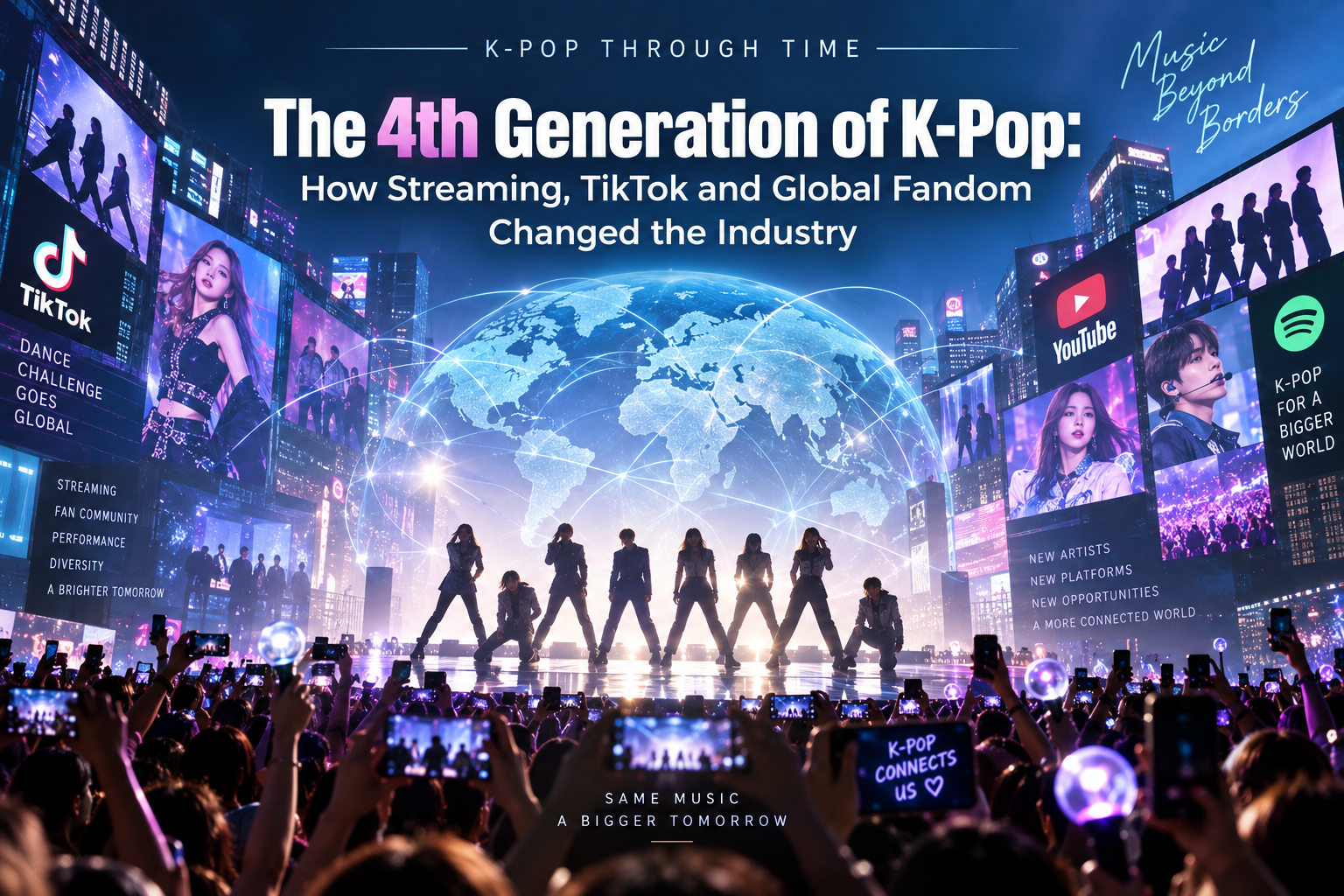
  • The 4th Generation of K-Pop: How Streaming, TikTok and Global Fandom Changed the Industry

    The 4th Generation of K-Pop: How Streaming, TikTok and Global Fandom Changed the Industry

    What Is the Fourth Generation of K-Pop?

    By the time K-pop entered the late 2010s and early 2020s, becoming “global” was no longer a distant ambition.

    The foundations had already been built.

    Earlier generations established the idol training system, expanded the Korean Wave across Asia, embraced YouTube and social media, and demonstrated that Korean artists could build enormous international audiences.

    The fourth generation inherited that world.

    For many newer groups, international fans were present almost from the moment of debut. Music videos were released to worldwide audiences simultaneously. Albums could reach overseas buyers quickly, and fans could follow performances, livestreams, interviews, dance practices, and social-media updates regardless of where they lived.

    The central question had changed.

    Earlier generations often asked:

    How can K-pop reach the world?

    The fourth generation increasingly faced a different challenge:

    How can a K-pop group stand out when the whole world is already watching?

    When Did the Fourth Generation Begin?

    As with every K-pop generation, there is no universally accepted starting date.

    The boundaries are debated, and some artists may be classified differently depending on the source or fan community.

    In general, the fourth generation is commonly associated with groups that emerged from the late 2010s into the early 2020s.

    Artists frequently connected with this era include Stray Kids, ATEEZ, TXT, ITZY, aespa, ENHYPEN, IVE, and LE SSERAFIM, among others.

    They entered an industry transformed by streaming, smartphones, global e-commerce, social media, and increasingly sophisticated international fandoms.

    This technological environment affected almost every stage of an idol group’s career.

    Stray Kids and the Importance of Musical Identity

    Stray Kids, who debuted under JYP Entertainment in 2018, became one of the era’s most prominent examples of a group developing a strong musical identity alongside substantial member participation in music creation.

    Their work often emphasized powerful production, intense performance, and a recognizable sonic character.

    This mattered in an increasingly crowded industry.

    As more groups competed for attention, having polished choreography and attractive visual concepts was no longer enough by itself.

    Successful artists needed to become recognizable.

    A listener encountering only a short section of a song or performance needed a reason to remember the group and search for more.

    Fourth-generation competition therefore placed growing importance on identity—musical, visual, conceptual, and personal.

    ATEEZ and the Global Potential of Performance

    ATEEZ, who also debuted in 2018, demonstrated another important feature of the era: an artist could develop significant international momentum even without beginning at one of the industry’s historically largest agencies.

    Strong performances, ambitious concepts, touring, and highly engaged fandom helped the group build recognition across international markets.

    This reflected a broader change in the structure of K-pop discovery.

    Traditional agency power still mattered enormously. Large companies had advantages in investment, distribution, media access, established fan attention, and promotional infrastructure.

    But digital platforms created additional pathways.

    An impressive performance could circulate online.

    A fan could recommend a group across borders.

    A concert clip could introduce an artist to thousands of new viewers.

    Global fandom could begin growing before mainstream domestic recognition reached the same scale.

    The route to success was becoming less predictable.

    TXT and a Generation Raised Inside Global K-Pop

    When TOMORROW X TOGETHER (TXT) debuted under Big Hit Entertainment in 2019, they entered a company whose global position had been transformed by BTS.

    That context illustrated how dramatically K-pop had changed within only a few years.

    New groups could now debut in an environment where international media attention, global fan communities, overseas distribution, and worldwide digital promotion were already part of the industry’s infrastructure.

    TXT developed themes around youth, friendship, growth, uncertainty, and transition while building an audience across multiple markets.

    Their career reflected a defining characteristic of fourth-generation K-pop:

    Global expansion did not necessarily have to happen after domestic success.

    Domestic and international growth could occur at the same time.

    ITZY and the Continuing Evolution of Girl-Group Identity

    ITZY, who debuted under JYP Entertainment in 2019, arrived with an identity centered strongly on confidence and individuality.

    Their early releases demonstrated how girl-group concepts continued to evolve beyond older expectations about what female idols should look, sound, or perform like.

    Powerful choreography became increasingly central.

    Performance videos and dance practices could attract audiences of their own.

    This was particularly important in the fourth-generation environment because fans were consuming music through many different formats.

    A song might be discovered through its official music video.

    But it could just as easily be discovered through a dance clip, a concert performance, a short-form video, or a fan-created edit.

    Music and performance were becoming inseparable parts of digital discovery.

    aespa and the Expansion of K-Pop’s Digital Imagination

    When aespa debuted under SM Entertainment in 2020, their early concept incorporated virtual and digital elements into the group’s identity.

    The idea reflected a larger cultural moment.

    Online life was becoming increasingly intertwined with offline identity. Gaming, virtual worlds, artificial characters, social platforms, and digital communities were becoming familiar parts of everyday culture.

    K-pop had always been interested in elaborate concepts and fictional worlds.

    The fourth generation pushed those experiments further.

    Music could be connected to narrative universes.

    Visual symbols could continue across multiple releases.

    Fans could interpret clues and debate storylines.

    A comeback could function not only as a collection of songs but as another chapter in a larger fictional world.

    Then the Pandemic Changed Everything

    Just as the fourth generation was developing, the COVID-19 pandemic disrupted the global entertainment industry.

    Concerts were canceled or postponed.

    International travel became difficult.

    In-person fan events were restricted.

    For newly debuted groups, this created an extraordinary problem.

    K-pop had become a global performance industry at precisely the moment when artists could no longer easily meet global audiences face to face.

    But the industry had one major advantage.

    Its digital infrastructure was already mature.

    Livestreams, online concerts, social-media communication, video content, virtual fan events, and other forms of remote interaction became even more important.

    Groups that could not physically travel around the world could still build communities around the world.

    The pandemic accelerated a transformation that was already underway.

    TikTok Changed the Speed of Music Discovery

    At the same time, short-form video was becoming one of the most influential forces in popular music.

    TikTok changed the way songs could spread.

    A listener no longer needed to encounter an entire music video or even a complete song.

    Sometimes a few seconds were enough.

    A memorable dance movement, chorus, beat, lyric, or visual moment could become the starting point for millions of short videos.

    This created a new form of music discovery.

    Songs could travel through challenges, memes, edits, dance clips, and user-generated content.

    For K-pop—an industry already built around choreography, visual performance, memorable concepts, and highly active fandoms—the format was especially powerful.

    But it also created a new pressure.

    In an environment of endless scrolling, artists were competing not only for listeners.

    They were competing for seconds of attention.

    And that would fundamentally influence how fourth-generation K-pop was promoted, performed, and consumed.


    ENHYPEN and the Rise of the Global Fan From Day One

    ENHYPEN, formed through the survival program I-LAND and debuting in 2020, illustrated how dramatically the relationship between debut and international fandom had changed.

    Viewers from different countries could follow the members before the group officially debuted.

    This meant that fandom formation could begin before the first album was released.

    That was a major departure from earlier eras.

    Traditionally, an idol group would debut in South Korea, establish recognition, and then gradually pursue overseas markets. By the fourth generation, digital platforms and internationally accessible survival programs could create audiences across borders from the beginning.

    Fans were no longer simply waiting for Korean popularity to determine which artists they should follow.

    They could participate in the discovery process themselves.

    The Debut Stage Became Global

    This change affected the meaning of a K-pop debut.

    A new group’s first music video could immediately receive comments from viewers in multiple languages.

    International fans could preorder albums.

    Fan accounts could translate interviews within hours.

    Performance clips could circulate across social platforms before traditional media had fully evaluated the group.

    The first weeks of an idol career were therefore no longer purely domestic.

    For many fourth-generation acts, the debut stage itself had become global.

    That increased opportunity—but it also increased pressure.

    New groups were expected to develop a distinctive identity almost immediately.

    IVE and the Power of Immediate Impact

    When IVE debuted in 2021, the group quickly demonstrated the importance of strong songs, recognizable member presence, visual identity, and highly repeatable performance moments.

    Their rapid rise showed that fourth-generation competition could move extremely quickly.

    Digital audiences did not necessarily require years to decide that a group mattered.

    A successful release could generate enormous attention in a short period of time.

    But maintaining that attention was harder.

    One popular song might create visibility.

    Building a lasting career required repeated releases capable of strengthening the group’s identity rather than simply reproducing the same formula.

    This distinction between viral attention and sustainable fandom became increasingly important in the streaming era.

    LE SSERAFIM and the Performance-Driven Era

    LE SSERAFIM, debuting in 2022, entered an environment where performance itself had become a major form of global content.

    Choreography was no longer something audiences saw mainly on televised music programs.

    It existed everywhere.

    Dance practices, studio performances, fancams, concert clips, challenge videos, award-show stages, and short-form content could all become separate points of discovery.

    This encouraged groups to develop performances that remained compelling even when removed from the traditional music-video format.

    The result was an era in which a K-pop song increasingly lived several lives at once:

    as audio,

    as a music video,

    as choreography,

    as short-form content,

    as a live performance,

    and as fan-generated media.

    The Extraordinary Competition Among Fourth-Generation Girl Groups

    One of the defining features of this period was the remarkable strength and diversity of girl groups.

    ITZY emphasized confidence and high-energy performance.

    aespa combined powerful music with futuristic imagery and digital-world concepts.

    IVE developed an elegant, self-assured pop identity.

    LE SSERAFIM built a performance-centered image around ambition, confidence, and resilience.

    Other influential acts contributed additional sounds and approaches to an increasingly competitive landscape.

    Rather than one dominant formula defining the era, audiences encountered multiple interpretations of what a successful K-pop girl group could be.

    This variety helped broaden the market.

    Listeners could move between groups based on music, choreography, fashion, personality, concept, or visual style.

    Streaming Changed What Success Looked Like

    The rise of global streaming platforms also changed how K-pop success could be measured.

    Physical album sales remained extremely important, particularly because K-pop albums often functioned as collectible objects containing photobooks, photocards, and other exclusive materials.

    But streaming created another layer of visibility.

    Listeners could access songs instantly without purchasing an album.

    International audiences could participate in a comeback at the same moment as Korean audiences.

    Playlist placement could introduce songs to people outside established fandoms.

    Streaming data also provided companies with faster evidence of where international audiences were developing.

    The geography of fandom became easier to see.

    That information could influence touring, promotion, partnerships, and future market strategies.

    Short-Form Video Changed Song Promotion

    TikTok and other short-form platforms did more than create another place to advertise songs.

    They changed promotional behavior itself.

    The dance challenge became a recognizable part of K-pop comeback culture.

    Idols from different groups could appear together performing a short section of choreography.

    These collaborations created cross-fandom exposure while also presenting idols in a more casual format than traditional television stages.

    A promotional clip could be filmed quickly and distributed globally almost instantly.

    This made marketing faster, more collaborative, and more participatory.

    Fans were not simply watching official promotion.

    They could recreate it.

    The Advantage—and Risk—of Virality

    Virality offered enormous opportunities.

    A short clip could expose a song to millions of people who had never intentionally searched for K-pop.

    But virality also had limitations.

    A person who watches a fifteen-second challenge is not automatically a long-term fan.

    A trend can disappear as quickly as it appears.

    Algorithms can redirect attention toward something new within days.

    This created a central challenge for fourth-generation artists:

    How do you convert attention into attachment?

    The most successful groups needed more than viral moments.

    They needed recognizable music, compelling members, strong performances, consistent content, and a reason for casual viewers to become invested fans.

    Global Fandom Became an Organized Network

    Fourth-generation fandom was not simply larger geographically.

    It was increasingly organized as a network.

    Fans translated content.

    They created streaming guides.

    They organized album purchases.

    They shared voting information.

    They produced edits, memes, tutorials, and explanatory videos.

    They created online communities dedicated to particular members or groups.

    In many cases, fans acted as informal international promoters.

    This activity was not controlled entirely by entertainment companies.

    It emerged from fandom itself.

    The relationship between company marketing and fan activity therefore became increasingly interconnected.

    Official content generated fan activity, and fan activity generated additional visibility for official content.

    Language Became Less of a Barrier—but It Did Not Disappear

    K-pop’s international expansion also demonstrated that a song did not necessarily need to be entirely in English to reach global listeners.

    Audiences had become increasingly comfortable encountering music in languages they did not speak fluently.

    Subtitles, fan translations, lyric explanations, and online communities helped reduce language barriers.

    At the same time, companies increasingly experimented with English-language releases, multilingual versions, international collaborations, and members with diverse linguistic backgrounds.

    The goal was not always to replace Korean.

    Instead, the industry developed multiple ways to make Korean-centered pop culture more accessible internationally.

    This distinction is important.

    K-pop’s globalization was not simply a process of becoming more Western.

    It was also a process of teaching global audiences how to participate in a cultural industry that continued to retain a strong Korean center.

    International Fans Became Part of Business Strategy

    By the fourth generation, international fandom could no longer be treated as a bonus.

    It influenced fundamental business decisions.

    Companies considered overseas album distribution earlier.

    International touring plans became more ambitious.

    Global brand partnerships became increasingly valuable.

    Social-media communication targeted multiple markets.

    Content was often designed with international circulation in mind.

    Even smaller agencies could recognize that a dedicated overseas fandom might become commercially significant.

    This changed the economics of the idol industry.

    The domestic Korean market remained crucial, but it was now one part of a much larger commercial landscape.

    From Exporting K-Pop to Building for Global Audiences

    Perhaps the biggest shift was conceptual.

    Earlier K-pop globalization often involved taking a successful Korean product and introducing it overseas.

    Fourth-generation K-pop increasingly developed within a global environment from the beginning.

    That does not mean every group was created specifically for Western audiences, nor does it mean domestic popularity became unimportant.

    Rather, the distinction between “Korean promotion” and “international promotion” became less clear.

    A music video uploaded in Seoul could immediately become content in São Paulo, Los Angeles, Bangkok, Paris, Manila, Tokyo, or Jakarta.

    A fan community could form across several continents simultaneously.

    K-pop was moving beyond the idea of export.

    It was becoming a globally networked industry.

    And that transformation would bring both extraordinary opportunities and new problems.


    Performance Became a Global Competitive Advantage

    Fourth-generation K-pop developed in an environment where almost every performance could become global content.

    A television stage filmed in Seoul might be watched hours later by fans across several continents. A dance practice could attract millions of views. A fancam focused on a single member could introduce an entire group to new listeners.

    This changed the value of performance.

    Precise choreography had long been part of K-pop, but fourth-generation groups faced audiences who could replay, slow down, compare, edit, and redistribute performances endlessly.

    Groups such as Stray Kids, ATEEZ, TXT, ITZY, aespa, ENHYPEN, IVE, and LE SSERAFIM therefore competed not only through songs but through the complete visual experience surrounding those songs.

    Stage presence became digital currency.

    The Algorithm Became a New Gatekeeper

    Digital platforms weakened some of the traditional barriers that once determined which artists could reach international audiences.

    But they created another powerful force: the algorithm.

    YouTube recommendations, streaming playlists, TikTok feeds, and other personalized systems increasingly influenced what people encountered.

    This could benefit K-pop enormously.

    Someone who had never deliberately searched for Korean music might encounter a dance challenge or performance clip and become curious about the original song.

    But algorithmic discovery also created uncertainty.

    Entertainment companies could plan a comeback carefully, but they could not completely control which fifteen-second moment would become popular—or whether the algorithm would amplify it at all.

    The industry gained access to a larger audience while becoming increasingly dependent on platforms it did not control.

    More Content, More Competition for Attention

    The fourth generation also accelerated K-pop’s already demanding content cycle.

    Fans could expect concept photographs, trailers, teasers, music videos, dance practices, behind-the-scenes footage, livestreams, short-form challenges, variety content, interviews, and social-media updates.

    This abundance helped maintain fan engagement between releases.

    But it created a paradox.

    The more content the industry produced, the more content every individual artist had to compete against.

    K-pop groups were no longer competing only with other K-pop groups.

    They were competing with global musicians, influencers, games, television, streaming entertainment, and an endless social-media feed.

    The scarce resource was no longer access to content.

    It was human attention.

    Physical Albums Survived the Streaming Revolution

    One of the most interesting features of modern K-pop is the continued importance of physical albums.

    In many music markets, streaming reduced the role of CDs as the primary way people consumed recorded music.

    K-pop developed a different relationship with the physical album.

    Albums became collectible experiences.

    Photobooks, photocards, posters, multiple versions, limited inclusions, and elaborate packaging gave fans reasons to own a physical object even when they listened to the music digitally.

    This model supported strong album sales and encouraged collectors to purchase multiple versions.

    It also demonstrated a broader strength of the K-pop business model:

    The industry learned to combine digital access with physical ownership rather than treating them as opposites.

    But Commercial Success Created New Questions

    The collectible-album model also generated criticism.

    Multiple versions and randomized inclusions can encourage repeated purchases, raising questions about consumer pressure and environmental waste.

    The rapid production of merchandise and physical products creates additional sustainability concerns.

    These debates matter because K-pop’s global growth has increased the scale of its commercial footprint.

    Success creates responsibility.

    As the industry grows, questions about sustainability, ethical marketing, and the environmental cost of fandom are likely to become more important.

    The Human Cost of Constant Visibility

    Fourth-generation idols also operate in an environment of unprecedented visibility.

    Social media can create closeness between artists and fans, but constant visibility has a cost.

    Every performance can be analyzed.

    Every interview can be clipped.

    Minor mistakes can spread internationally.

    Appearance, behavior, relationships, and personal decisions may become subjects of intense public discussion.

    Young performers can face pressure from training, competition, touring, public expectations, and continuous online judgment.

    This creates an important tension at the center of modern K-pop.

    Fans often value a feeling of closeness to idols.

    But idols also need boundaries, privacy, rest, and space to exist as people rather than permanent content.

    The future health of the industry will depend partly on how well companies and fan cultures recognize that distinction.

    Globalization Also Changed Who Can Become a K-Pop Idol

    As K-pop’s audience became more international, the industry itself became increasingly diverse.

    Non-Korean members had existed in earlier generations, but multinational lineups became more familiar as companies recruited talent from different countries.

    This served several purposes.

    International members could bring linguistic and cultural knowledge.

    They could help groups communicate with overseas audiences.

    And their presence reflected the fact that K-pop’s talent pool was becoming increasingly international.

    This raises a fascinating question:

    Does K-pop have to be made only by Koreans to remain K-pop?

    The industry’s evolution suggests that nationality alone is not enough to define the genre.

    K-pop is also shaped by its training systems, production practices, performance culture, entertainment companies, promotional structures, fan relationships, and historical roots in South Korea.

    What Makes K-Pop “K-Pop” in a Global Age?

    This question becomes more complicated as Korean entertainment companies develop artists for international markets and collaborate with producers, songwriters, choreographers, and business partners around the world.

    K-pop has never existed in cultural isolation.

    It has absorbed and reinterpreted influences from American pop, hip-hop, R&B, electronic music, Japanese popular culture, and many other sources.

    What makes modern K-pop distinctive is not that every musical element originated in Korea.

    Rather, it is the particular entertainment ecosystem that South Korea developed around those influences.

    Fourth-generation globalization made that ecosystem increasingly international without completely removing its Korean center.

    From the Fourth Generation to What Comes Next

    By the early and mid-2020s, another debate began appearing among fans and media:

    Had K-pop already entered a fifth generation?

    As always, there is no official authority responsible for declaring a new generation.

    Generational labels are useful ways of discussing historical change, but they should not be treated as rigid scientific categories.

    What matters more than the label is the transformation taking place underneath it.

    New groups are entering an industry shaped by short-form video, global streaming, artificial intelligence, virtual performers, multinational talent, increasingly sophisticated fandom platforms, and international business strategies.

    The next era may therefore be defined less by K-pop’s ability to reach the world and more by how deeply global structures become embedded inside K-pop itself.

    Why the Fourth Generation Matters

    The fourth generation may not have needed to prove that K-pop could become global.

    Previous generations had already done that.

    Its historical importance lies elsewhere.

    It demonstrated what happens after globalization becomes normal.

    Stray Kids and ATEEZ showed how powerful performance and distinctive identity could build major international audiences.

    TXT and ENHYPEN reflected an industry where global fandom could develop from the beginning of a career.

    ITZY helped reinforce the importance of high-impact performance.

    aespa explored the relationship between K-pop and digital-world concepts.

    IVE and LE SSERAFIM emerged during an extraordinarily competitive period for girl groups and demonstrated how quickly new acts could achieve widespread visibility.

    Together, these artists helped define an era in which K-pop no longer had to knock on the world’s door.

    The door was already open.

    The challenge was standing out once everyone could enter.

    Four Generations, One Continuing Transformation

    Looking across the history of modern K-pop reveals a remarkable progression.

    The first generation helped build the idol system.

    The second generation expanded the Korean Wave across Asia and used the early digital world to reach new audiences.

    The third generation transformed that growing international interest into sustained global influence.

    The fourth generation inherited a worldwide audience and learned to compete inside an algorithm-driven, streaming-centered, short-form-video culture.

    Each generation did not erase the one before it.

    It inherited its infrastructure and responded to a new technological and cultural environment.

    That is why K-pop history is best understood not as a sequence of disconnected eras but as a continuing transformation.

    The Next Question for K-Pop

    K-pop has already answered one of the biggest questions in its history:

    Can music centered in South Korea become a worldwide cultural force?

    The answer is clearly yes.

    The more interesting questions now concern what comes next.

    Can the industry remain innovative in an increasingly crowded global market?

    Can it balance commercial growth with artist well-being?

    Can physical fandom culture become more sustainable?

    Can global expansion occur without erasing the cultural identity that made K-pop distinctive?

    And as Korean entertainment companies create increasingly international groups, where will the boundary between K-pop and global pop eventually lie?

    Those questions will shape the next chapter.

    Because the history of K-pop is no longer simply the story of Korean music traveling outward.

    It is increasingly the story of how Korea and the world are reshaping popular music together.

    Continue Through the History of K-Pop

    This article is part of the continuing history explored on K-Pop Through Time.

    The earlier chapters examine the origins of modern K-pop, the first generation that established the idol system, the second generation that expanded the Korean Wave, and the third generation that turned K-pop into a sustained global cultural force.

    The fourth generation shows what happened after global success became part of the industry’s normal environment.

    Next, we will move beyond generations and examine one of the most important forces behind K-pop’s worldwide success:

    How the K-pop trainee system works—and why it became one of the most influential and controversial parts of the Korean entertainment industry.


  • The 3rd Generation of K-Pop: How BTS, BLACKPINK and a New Era Took K-Pop Global

    The 3rd Generation of K-Pop: How BTS, BLACKPINK and a New Era Took K-Pop Global

    What Was the Third Generation of K-Pop?

    By the early 2010s, K-pop had already traveled a remarkable distance.

    The first generation had helped establish the modern idol system. The second generation expanded that system across Asia and learned how to use YouTube, social media, international concerts, and increasingly connected fandoms to reach audiences beyond South Korea.

    The third generation of K-pop entered a very different world.

    Smartphones were becoming part of everyday life. YouTube was firmly established as a global entertainment platform. Social media allowed information to cross borders almost instantly, while streaming services were beginning to change how people discovered and consumed music.

    For K-pop, these changes created an extraordinary opportunity.

    Artists no longer had to depend entirely on traditional broadcasters, physical distribution networks, or local media companies to reach international listeners.

    A performance uploaded in Seoul could be watched in Los Angeles, Paris, Bangkok, São Paulo, or Manila within minutes.

    K-pop had spent years building a bridge to the world.

    The third generation would begin crossing it at unprecedented scale.

    When Did the Third Generation of K-Pop Begin?

    There is no official authority that defines exactly where one K-pop generation ends and another begins.

    Generational boundaries are debated among fans, journalists, and researchers, and different sources may classify certain artists differently.

    However, the third generation is commonly associated with groups that emerged and became prominent during much of the 2010s.

    Among the era’s most influential acts were EXO, BTS, Red Velvet, TWICE, SEVENTEEN, and BLACKPINK, alongside many other successful artists.

    These groups did not all follow the same path.

    Some developed enormous fandoms in South Korea and across Asia. Others became especially powerful in album sales, touring, digital music, or social media. Some eventually reached levels of mainstream international recognition that earlier generations had rarely experienced.

    Together, they helped redefine the possible scale of K-pop.

    EXO and the Power of a Massive Fandom

    When EXO debuted under SM Entertainment in 2012, the group arrived with an ambitious concept and a strategy designed with multiple markets in mind.

    Their rise demonstrated that the traditional strengths of the idol industry were still extremely powerful.

    Physical albums mattered.

    Music shows mattered.

    Fan communities mattered.

    Carefully planned concepts, choreography, visual storytelling, and member personalities mattered.

    EXO developed a large and highly organized fandom and became one of the defining boy groups of their generation.

    Their success was especially important during a period when the music industry was becoming increasingly digital.

    While many observers predicted the decline of physical music, K-pop demonstrated that albums could remain culturally and commercially valuable when connected to fandom.

    Photobooks, collectible inclusions, multiple versions, distinctive packaging, and fan participation helped transform physical albums into more than simple containers for recorded music.

    They became part of the relationship between artists and fans.

    This model would become increasingly important across the K-pop industry.

    BTS Entered From Outside the Largest Agencies

    In 2013, BTS debuted under Big Hit Entertainment.

    At the time, Big Hit was not one of the companies traditionally regarded as the dominant powers of the Korean idol industry.

    BTS therefore entered a highly competitive market without the same institutional advantages enjoyed by some artists from larger agencies.

    Their early years did not immediately resemble the extraordinary global success for which they would later become known.

    Instead, their rise was gradual.

    The group developed music and storytelling that frequently addressed youth, ambition, pressure, uncertainty, identity, and personal growth.

    Their members also became closely associated with communication through digital platforms.

    This combination of music, narrative, personality, and online interaction helped create a strong relationship with an expanding fan community.

    That relationship would eventually become one of the most important examples of digital-era fandom in popular music.

    Social Media Was No Longer Just a Promotional Tool

    Second-generation K-pop had already demonstrated the international power of YouTube and online fan communities.

    During the third generation, digital platforms became even more deeply integrated into everyday idol culture.

    Social media was no longer simply a place to announce a new album.

    It became part of the ongoing story of an artist.

    Fans could encounter music videos, dance practices, behind-the-scenes footage, livestreams, interviews, short clips, photographs, and informal updates.

    This created a continuous stream of content between major releases.

    For international fans, the effect was particularly important.

    Physical distance from South Korea mattered less than before.

    Someone living thousands of kilometers away could follow an artist’s activities daily and participate in a fan community that operated across countries and time zones.

    The traditional boundary between a “domestic fan” and an “international fan” was becoming increasingly difficult to define.

    Red Velvet and the Expanding Range of Girl-Group Music

    Red Velvet, who debuted under SM Entertainment in 2014, illustrated another important characteristic of third-generation K-pop: the growing sophistication and variety of group concepts.

    Their identity became associated with contrasting musical and visual approaches, allowing the group to explore different styles rather than remaining within a single formula.

    This reflected a broader development across the industry.

    K-pop audiences were becoming accustomed to frequent conceptual changes.

    A group could move between bright and darker imagery, experiment with different genres, develop complex visual worlds, and still maintain a recognizable identity.

    Concept itself was becoming a form of storytelling.

    And as international audiences grew, these visual and musical identities could be discussed, interpreted, and shared by fans around the world.

    SEVENTEEN and the Appeal of Creative Participation

    When SEVENTEEN debuted under Pledis Entertainment in 2015, the group became known not only for its large membership and synchronized performances but also for significant member participation in aspects of its music and performance creation.

    This helped reinforce an increasingly important idea within K-pop.

    Idols could be highly trained performers while also contributing creatively to the work associated with their groups.

    For audiences, this could deepen the sense of artistic identity surrounding an act.

    It also demonstrated how the idol system continued to evolve rather than remaining fixed.

    The industry was becoming larger, but successful groups still needed ways to distinguish themselves.

    The Stage Was Set for an Even Bigger Transformation

    By the middle of the 2010s, K-pop had developed nearly all the ingredients necessary for much larger global expansion.

    There were experienced entertainment companies.

    There were sophisticated trainee and production systems.

    There were strong domestic and Asian markets.

    There were international fan communities.

    There was YouTube.

    There was social media.

    And increasingly, there was a global audience that did not see Korean-language music as something that could only be enjoyed inside Korea.

    Then two developments would accelerate the transformation.

    One was the rise of a new generation of enormously influential girl groups, including TWICE and BLACKPINK.

    The other was the extraordinary international growth of BTS.

    Together with the broader third-generation ecosystem, these artists would help move K-pop into spaces that once seemed extraordinarily difficult for Korean musicians to reach.

    Major global charts.

    Large-scale world tours.

    International award shows.

    Global brand campaigns.

    Stadiums.

    And the center of worldwide pop-culture conversation.

    The third generation was about to change the meaning of the word “global” in K-pop.


    TWICE and the Power of a New Generation of Girl Groups

    When TWICE debuted under JYP Entertainment in 2015, the group entered a K-pop industry that was already becoming increasingly international.

    Their rise showed that strong domestic popularity and overseas expansion did not have to be separate strategies.

    With memorable songs, recognizable choreography, distinctive member personalities, and an accessible group identity, TWICE built a powerful fan base in South Korea while also gaining substantial popularity elsewhere in Asia.

    Japan became particularly important.

    The group’s success there continued a tradition established by earlier Korean artists, but it also reflected how deeply K-pop had become integrated into the Japanese music market.

    By this point, Korean idol groups were no longer simply occasional foreign visitors.

    For leading acts, international promotion could be built into a long-term career.

    BLACKPINK and a New Model of Global Visibility

    In 2016, YG Entertainment debuted BLACKPINK.

    From the beginning, the group combined music, performance, fashion, and visual identity in ways that were highly compatible with the global social-media era.

    Their music videos became major digital events.

    Their individual members developed recognizable public identities, while the group’s association with fashion and luxury brands extended their cultural presence beyond music.

    This was significant.

    K-pop artists were increasingly becoming global cultural figures whose influence could move between music, fashion, advertising, beauty, and social media.

    BLACKPINK’s international growth demonstrated how a K-pop group could build visibility simultaneously across multiple markets rather than following a simple Korea-first, overseas-later path.

    Their rise also showed the growing importance of digital audiences.

    A fan did not necessarily need to encounter BLACKPINK through Korean television or radio.

    The first point of contact could be a music video, a performance clip, a social-media post, a fashion campaign, or a recommendation from another fan.

    K-pop discovery had become decentralized.

    BTS and the Expansion of Global Fandom

    At roughly the same time, BTS was undergoing an extraordinary transformation.

    The group’s international audience had grown steadily through music, online content, performances, and direct digital communication.

    Their fandom, known as ARMY, became increasingly international and highly connected.

    This mattered because fandom in the digital era could do far more than simply admire an artist.

    Fans could organize.

    They could translate interviews and lyrics, share performances, recommend songs, coordinate online activities, discuss albums, introduce new listeners to the group, and connect communities across languages and countries.

    The internet allowed millions of individual acts of participation to reinforce one another.

    BTS did not invent global fan culture, and K-pop fandom had been highly organized long before their debut.

    But their rise demonstrated how powerful that culture could become when combined with globally accessible digital platforms.

    When Language Became Less of a Barrier

    For decades, the international music business often treated language as a major limitation.

    English-language music enjoyed enormous advantages in many global markets, and artists singing primarily in other languages frequently faced barriers to mainstream exposure.

    Third-generation K-pop challenged some of those assumptions.

    International listeners were increasingly comfortable discovering songs before understanding every lyric.

    Translations were easy to find.

    Fans explained cultural references.

    Subtitles made video content more accessible.

    Most importantly, digital platforms allowed listeners themselves to decide what they wanted to hear rather than depending entirely on traditional gatekeepers.

    This did not make language irrelevant.

    But it changed the balance of power.

    A Korean-language song no longer needed to become an English-language song before it could build a meaningful international audience.

    From Online Popularity to Global Charts

    One of the defining changes of the third generation was the growing connection between online fandom and established music-industry institutions.

    Digital attention increasingly translated into measurable commercial success.

    Album purchases, streaming, concert tickets, social engagement, and chart performance demonstrated that international K-pop fandom was not merely a niche internet phenomenon.

    BTS became particularly important in this transition.

    As their international popularity increased, the group gained greater visibility in the United States and other major music markets.

    Their appearances on American television, participation in major award events, chart achievements, and increasingly ambitious tours made K-pop visible to audiences who may never have actively searched for Korean music.

    This created a feedback loop.

    Greater fan activity generated greater industry attention.

    Greater industry attention introduced the group to more listeners.

    Those listeners could then immediately explore years of music and content online.

    The old barriers between discovery, fandom, and consumption were weakening.

    K-Pop Fans Became Global Communities

    Third-generation fandom also became increasingly transnational.

    A single fan community could include people from Seoul, Tokyo, Jakarta, Manila, London, Paris, Mexico City, New York, São Paulo, and countless other locations.

    They might speak different languages and live in different cultural environments, yet participate in many of the same online conversations.

    This gave K-pop an unusual form of global connectivity.

    Fans often helped one another understand content.

    Translations moved rapidly.

    News traveled across time zones.

    Music releases became worldwide online events.

    International fandom was no longer simply a collection of separate overseas audiences.

    It was becoming a network.

    Streaming Changed How Success Was Measured

    The growth of streaming also changed the music industry itself.

    During earlier eras, physical album sales, television exposure, radio play, and downloads had been major indicators of commercial success.

    Those measures did not disappear, but streaming introduced another way for listeners around the world to access music immediately.

    For K-pop, this was especially valuable.

    International listeners no longer needed to locate imported albums or wait for local distribution.

    A growing number of songs could be discovered through digital music platforms alongside artists from many other countries.

    This reduced friction.

    K-pop was still Korean popular music, but technologically it could increasingly travel through the same global systems as other international pop.

    Music Videos Became Global Premieres

    YouTube’s importance also continued to grow.

    During the second generation, online video had helped international fans discover K-pop.

    During the third generation, major music-video releases increasingly became global fan events.

    Fans waited for release times.

    They discussed teasers.

    They shared videos immediately.

    Reaction videos appeared.

    Dance practices attracted their own audiences.

    Performance videos could accumulate enormous attention separate from the original music video.

    This created an entire visual ecosystem around a single song.

    K-pop’s investment in choreography, styling, set design, editing, and performance made it particularly well suited to this environment.

    The music was no longer represented by one recording alone.

    Each comeback could generate a network of connected content.

    The “Comeback” Became a Global Event

    The Korean music industry’s concept of a comeback also became increasingly familiar to international audiences.

    In K-pop, a comeback does not necessarily mean that an artist has returned after a long disappearance.

    It commonly refers to the promotional cycle surrounding a new release.

    That cycle can include concept photos, teasers, track lists, music videos, showcase performances, music-show stages, interviews, dance practices, behind-the-scenes footage, and fan interactions.

    During the third generation, international fans increasingly followed these cycles in real time.

    This helped create anticipation long before a song was released and extended engagement after its release.

    K-pop had developed a sophisticated method for turning music releases into continuing narratives.

    World Tours Changed the Geography of the Industry

    Online popularity eventually had to prove itself offline.

    World tours provided that proof.

    As third-generation artists performed across Asia, North America, Europe, Latin America, and other regions, international fandom became physically visible.

    Concert venues filled with fans singing Korean lyrics thousands of kilometers from Seoul.

    The significance extended beyond ticket sales.

    Every successful overseas concert provided evidence that Korean artists could sustain audiences in markets where K-pop had once received little mainstream attention.

    Tours also strengthened local fan communities and generated media coverage.

    The map of the K-pop industry was expanding.

    Seoul remained its creative and institutional center, but its audience was becoming unmistakably worldwide.

    From Cultural Export to Global Pop Culture

    This distinction is important.

    Earlier discussions of K-pop often described it primarily as a Korean cultural export.

    That description remained accurate, but it was becoming incomplete.

    By the later third-generation era, leading K-pop artists were increasingly participating directly in global popular culture.

    They were not simply being observed from outside the world’s major entertainment markets.

    They were appearing inside them.

    They were entering major charts, performing on international stages, collaborating across borders, attracting global brands, filling arenas, and generating worldwide media attention.

    The transformation had taken decades.

    But during the third generation, the results became impossible to ignore.

    K-pop was no longer only traveling around the world.

    It was becoming part of how the world experienced pop music.


    BTS and the Breakthrough Into the U.S. Mainstream

    For decades, entering the United States had been one of the most difficult challenges for artists from outside the English-speaking music industry.

    Earlier Korean artists had already made important attempts.

    Wonder Girls promoted directly in the United States. PSY’s “Gangnam Style” became an extraordinary viral phenomenon. Other K-pop acts gradually built American fan communities through concerts, conventions, online platforms, and digital releases.

    But BTS represented something different.

    Their rise was not centered on a single viral song.

    Instead, a large international audience had developed over time around the group’s music, storytelling, performances, personalities, and digital communication.

    As that audience grew, its commercial impact became increasingly difficult for the established music industry to overlook.

    Billboard Became a Symbol of a Larger Change

    BTS’s growing presence on Billboard’s U.S. charts became one of the clearest symbols of K-pop’s changing global position.

    Their albums achieved increasingly significant chart results, culminating in multiple No. 1 albums on the Billboard 200.

    In 2020, “Dynamite” became BTS’s first song to reach No. 1 on the Billboard Hot 100.

    Other chart-topping singles followed.

    These achievements were historically important, but their meaning went beyond rankings.

    They demonstrated that an artist rooted in the Korean idol industry could compete at the highest commercial levels of one of the world’s most influential music markets.

    The pathway was no longer theoretical.

    It had become visible.

    The Grammy Stage and Global Recognition

    As BTS’s profile increased, the group appeared across major American television programs and award ceremonies and eventually performed on the Grammy Awards stage.

    This visibility represented a major shift in perception.

    K-pop was increasingly being discussed not merely as an interesting foreign trend but as part of the contemporary global music business.

    Recognition from established institutions did not create BTS’s international audience.

    In many ways, the audience came first.

    Millions of fans had already demonstrated demand through albums, streaming, social engagement, and concert attendance.

    Traditional institutions increasingly responded to a global audience that was already there.

    That reversal is essential to understanding the third generation.

    Fans Could Challenge Traditional Gatekeepers

    Historically, record labels, radio programmers, television networks, distributors, music retailers, and entertainment media exercised enormous influence over which artists reached large audiences.

    Digital technology did not eliminate these gatekeepers.

    But it reduced their exclusive control over discovery.

    A listener could encounter BTS through a shared YouTube video.

    Another could discover BLACKPINK through a dance performance.

    Someone else might find TWICE through a recommendation algorithm or discover SEVENTEEN through a fan-created clip.

    The audience no longer had to wait for a local broadcaster or radio station to decide that Korean music deserved attention.

    This changed the relationship between fans and the music industry.

    International K-pop audiences could demonstrate demand before traditional media fully recognized it.

    BLACKPINK and the Global Power of Visual Culture

    BLACKPINK’s rise provides another important example of this new environment.

    The group’s international visibility was closely connected to the highly visual nature of digital culture.

    Music videos, choreography, fashion, member identities, performance clips, and social media all contributed to a recognizable global brand.

    BLACKPINK became increasingly visible at major international events and developed relationships with prominent global fashion houses.

    Their success illustrated how the boundaries between musician, performer, fashion figure, influencer, and global celebrity were becoming less distinct.

    This was especially compatible with K-pop.

    The idol industry had always placed significant emphasis on visual presentation.

    In the social-media era, that strength could operate on a worldwide scale.

    Coachella and the Changing Meaning of a K-Pop Stage

    One of the clearest signs of this transformation came through appearances at major international music festivals.

    BLACKPINK performed at Coachella in 2019 and later returned in 2023 as a headlining act.

    The significance was larger than a single concert.

    A major Western festival stage represented a different environment from a K-pop-specific concert filled primarily with existing fans.

    It placed a Korean girl group inside a broader global music conversation.

    Such appearances demonstrated that the industry’s leading artists could increasingly move between K-pop spaces and mainstream international music spaces.

    The walls separating those worlds were becoming more permeable.

    Global Success Was Bigger Than Two Groups

    The international story of third-generation K-pop should not be reduced to BTS and BLACKPINK.

    Their achievements were extraordinary, but the wider ecosystem mattered.

    EXO built enormous album sales and fandom power.

    TWICE developed major audiences across Asia and expanded their international reach.

    Red Velvet demonstrated musical and conceptual versatility.

    SEVENTEEN developed a strong identity around performance, teamwork, and creative participation while building a substantial international fandom.

    Numerous other artists contributed to the era’s diversity.

    Together, they created an industry in which global audiences could explore many different sounds, concepts, personalities, and performance styles.

    That variety made the K-pop ecosystem more resilient.

    International listeners did not have to become fans of one group to become interested in K-pop as a broader cultural phenomenon.

    K-Pop Became a Global Content Ecosystem

    Another reason third-generation K-pop expanded so effectively was that the industry offered much more than songs.

    A fan could watch music videos.

    Then dance practices.

    Then variety content.

    Then livestreams.

    Then interviews.

    Then behind-the-scenes footage.

    Then concert clips.

    Then documentaries or travel programs.

    This abundance of content created multiple entry points into fandom.

    Someone who first arrived for a song might remain because of choreography.

    Someone who discovered a member through a variety program might begin exploring the group’s albums.

    Someone interested in fashion might encounter an idol through a luxury campaign and later discover the music.

    K-pop had become a content ecosystem.

    The Economics of Fandom Also Changed

    This ecosystem had major commercial implications.

    A highly engaged international fan could participate in the K-pop economy in many ways.

    Albums, concerts, official merchandise, memberships, digital content, streaming, fan events, and brand partnerships all became parts of a much larger business environment.

    Physical albums remained particularly interesting.

    At a time when much of the global music industry was moving toward streaming, K-pop continued to demonstrate strong demand for physical releases.

    Collectible packaging, photobooks, photocards, multiple versions, and other inclusions gave albums value beyond the audio recording itself.

    The album became both music product and fan object.

    This helped K-pop maintain a distinctive commercial model in the streaming era.

    Entertainment Companies Became Global Businesses

    As international demand increased, Korean entertainment companies also changed.

    Overseas touring became more important.

    International distribution expanded.

    Foreign partnerships increased.

    Content was designed for audiences across multiple platforms.

    Subtitles and multilingual communication became increasingly valuable.

    Global marketing could begin at the same time as domestic promotion rather than months or years later.

    The largest entertainment companies were no longer thinking only about exporting successful Korean artists.

    They were increasingly operating within a global entertainment marketplace.

    This would have major consequences for the generations that followed.

    K-Pop Also Faced New Questions

    Global expansion brought opportunities, but it also created new challenges.

    As K-pop reached increasingly diverse audiences, cultural misunderstandings could travel just as quickly as music.

    Questions about cultural appropriation, representation, beauty standards, working conditions, privacy, intense fan behavior, artist well-being, and the pressures of the trainee system became part of international conversations about the industry.

    The same digital platforms that could generate enthusiasm could also amplify criticism.

    This was another sign that K-pop had become global.

    International audiences were no longer simply consuming Korean entertainment from a distance.

    They were actively debating how the industry operated and what responsibilities artists, agencies, platforms, and fans should have.

    Globalization Did Not Erase K-Pop’s Korean Roots

    As K-pop expanded internationally, an important question emerged:

    If artists work with international producers, promote worldwide, collaborate with foreign musicians, and attract audiences from dozens of countries, what makes K-pop “K-pop”?

    There is no simple answer.

    K-pop has always absorbed influences from different musical traditions, including American pop, hip-hop, R&B, electronic music, and Japanese idol culture, while developing them within South Korea’s own entertainment ecosystem.

    Globalization intensified this exchange.

    Yet the industry’s institutional center remained strongly connected to South Korea: its entertainment agencies, trainee systems, broadcasting culture, production networks, promotional practices, and language.

    K-pop’s global expansion therefore did not simply mean becoming less Korean.

    It meant that a Korean-centered entertainment system was learning to operate inside an increasingly interconnected global culture.

    The Third Generation Changed What Seemed Possible

    By the end of the 2010s, the assumptions surrounding K-pop had changed dramatically.

    A Korean idol group selling large numbers of albums internationally was no longer unimaginable.

    Neither was a major world tour.

    Neither was sustained performance on American charts.

    Neither was a Korean artist appearing at the world’s most visible award ceremonies or music festivals.

    The third generation did not accomplish this alone.

    Its success rested on foundations built by decades of Korean artists, producers, entertainment companies, and fans.

    But this generation dramatically expanded the ceiling.

    The question was no longer:

    “Can K-pop become global?”

    Increasingly, the question became:

    “What happens now that K-pop already is global?”


    The Lasting Legacy of Third-Generation K-Pop

    The third generation did more than produce some of the most internationally recognized artists in K-pop history.

    It changed the structure of the industry itself.

    Before this era, overseas success was often treated as an expansion beyond an artist’s primary Korean market. By the end of the third generation, international audiences were increasingly part of the equation from the beginning.

    Fans around the world could discover a new group almost immediately after debut.

    Music videos could be released globally.

    Albums could be distributed internationally.

    Social-media conversations could cross borders in seconds.

    World tours could connect online fandoms with physical audiences.

    K-pop was no longer simply being exported.

    It was operating as a global entertainment system.

    BTS Changed Expectations for Korean Artists

    Few stories illustrate this transformation more clearly than BTS.

    Their rise altered expectations about what a Korean artist could achieve internationally.

    But the most important part of that legacy is not simply a collection of chart records or awards.

    It is the change in possibility.

    After BTS demonstrated that a Korean group could build a massive, sustained global audience, future artists entered an industry with a different understanding of what their careers might become.

    The international market was no longer only an ambitious destination for a small number of acts.

    It could be part of the fundamental strategy of a K-pop career.

    BLACKPINK Expanded the Meaning of Global K-Pop Stardom

    BLACKPINK demonstrated another dimension of that transformation.

    Their international influence extended across music, performance, fashion, advertising, social media, and celebrity culture.

    This reflected an increasingly interconnected entertainment economy.

    A K-pop star could be simultaneously associated with a music release, a major fashion campaign, a festival appearance, a global brand, and an enormous social-media audience.

    That visibility helped make K-pop recognizable even to people who did not consider themselves K-pop fans.

    In this sense, the third generation expanded not only K-pop’s audience but also its cultural footprint.

    The Industry Learned to Speak to the World in Real Time

    One of the third generation’s most important changes was speed.

    Earlier international expansion often required separate overseas campaigns.

    By the late 2010s, a release could reach fans across continents at essentially the same moment.

    This changed marketing.

    It changed fandom.

    It changed expectations.

    International audiences increasingly expected subtitles, accessible digital content, international distribution, tour announcements, and communication that recognized them as part of the same fan community.

    Entertainment companies gradually adapted.

    The idea of a distant “foreign market” became less useful when fans everywhere could participate in the same release cycle online.

    The COVID-19 Pandemic Tested the Digital K-Pop System

    Then, in 2020, the global music industry faced an extraordinary disruption.

    The COVID-19 pandemic forced concerts to be postponed or canceled and severely limited international travel and in-person events.

    For an industry increasingly dependent on world tours, this was a major challenge.

    Yet K-pop entered the pandemic with one significant advantage:

    It already had a highly developed digital relationship with fans.

    Artists and companies expanded online concerts, livestreams, virtual fan interactions, and other forms of digital content.

    These experiences could not fully replace the atmosphere or economics of physical concerts.

    But they demonstrated how adaptable the K-pop ecosystem had become.

    Fans separated by thousands of kilometers could still participate in shared events.

    The digital infrastructure developed during the previous decade became even more important.

    The Pandemic Accelerated Changes Already Underway

    The pandemic did not create digital fandom.

    It accelerated it.

    Livestreaming became more important.

    Online fan events became more familiar.

    Entertainment companies experimented with new technologies and formats.

    Global audiences became accustomed to participating remotely in events centered in South Korea.

    When large-scale touring returned, the industry did not simply return to its previous form.

    The future increasingly combined physical and digital experiences.

    This hybrid environment would become part of the landscape inherited by the next generation of K-pop artists.

    The Fourth Generation Inherited a Global Infrastructure

    Artists commonly associated with K-pop’s fourth generation entered an industry transformed by everything that came before them.

    Groups such as Stray Kids, ATEEZ, TXT, ITZY, aespa, ENHYPEN, IVE, and LE SSERAFIM emerged into a world where international fandom was no longer unusual.

    Again, generational boundaries are debated, and not every observer classifies every artist in exactly the same way.

    But the larger historical shift is clear.

    Newer groups could attract international attention extremely early in their careers.

    Global streaming platforms were already established.

    YouTube was already central to music promotion.

    Short-form video was becoming increasingly influential.

    International album distribution was stronger.

    Overseas tours were a realistic goal.

    Fans already understood the language and rituals of K-pop fandom.

    The infrastructure did not need to be invented again.

    It could be expanded.

    From Globalization to Global Competition

    This success also created a new challenge.

    Once K-pop became global, K-pop artists were no longer competing only with one another.

    They were competing for attention in an enormous international entertainment market.

    Listeners had access to nearly unlimited music.

    Social-media trends changed rapidly.

    New artists could appear constantly.

    Attention became one of the industry’s most valuable resources.

    This increased pressure on entertainment companies to produce distinctive concepts, compelling performances, continuous content, and memorable visual identities.

    The same digital platforms that allowed K-pop to grow internationally also created a much more crowded environment.

    Global opportunity came with global competition.

    K-Pop’s Success Created Difficult Questions About Sustainability

    Rapid expansion also raised questions about the human cost of the industry’s competitive structure.

    The idol system can demand years of training, intensive schedules, frequent public exposure, constant evaluation, and significant pressure on performers.

    As K-pop became more visible internationally, discussions about artist well-being, privacy, contracts, working conditions, and mental health became increasingly prominent.

    These issues cannot be separated completely from the industry’s success.

    The same system capable of producing highly polished performances can also create intense expectations.

    A mature understanding of K-pop therefore requires more than celebrating records and popularity.

    It also requires examining how the industry can grow while protecting the people who make that growth possible.

    Why the Third Generation Was a Turning Point

    Every generation contributed something essential to K-pop’s development.

    The first generation helped establish the modern idol system.

    The second generation expanded throughout Asia and built a bridge toward global digital fandom.

    The third generation demonstrated what could happen when that bridge connected with a fully networked world.

    BTS showed that sustained global success at the highest levels of the music industry was possible.

    BLACKPINK demonstrated the enormous international power of music combined with visual culture, fashion, performance, and social media.

    EXO, TWICE, Red Velvet, SEVENTEEN, and many others demonstrated the depth and diversity of the era.

    Together, these artists helped transform K-pop from a rapidly expanding Korean cultural export into an established force within global popular culture.

    The Globalization of K-Pop Was a Process, Not a Single Moment

    There is no single date when K-pop “became global.”

    Seo Taiji and Boys changed Korean popular music in the early 1990s.

    First-generation idol groups built the modern industry.

    BoA and TVXQ demonstrated the importance of sustained overseas activity.

    Second-generation groups expanded the Korean Wave across Asia.

    YouTube removed geographic barriers.

    Wonder Girls tested the American market.

    PSY showed the extraordinary viral potential of Korean-language music.

    And third-generation artists converted decades of progress into sustained global scale.

    K-pop’s globalization was therefore not one miracle.

    It was an accumulation of experiments, successes, failures, technological changes, business decisions, creative risks, and fan participation across generations.

    Understanding that longer history makes the achievements of the third generation even more meaningful.

    From a Korean Industry to a Worldwide Cultural Network

    Perhaps the most important legacy of the third generation is that K-pop became more than music traveling outward from South Korea.

    It became a worldwide cultural network.

    Songs still originated within a Korean-centered entertainment industry, but their audiences could exist almost anywhere.

    Fans translated, discussed, purchased, streamed, performed, collected, traveled, organized, and formed communities around the music.

    The result was something earlier generations could only begin to imagine:

    A cultural phenomenon with a clear Korean center but a genuinely international community.

    The Story Continues

    The third generation did not represent the end of K-pop’s globalization.

    It created the conditions for the next stage.

    Fourth-generation artists entered an industry where global ambitions could begin at debut rather than arrive years later.

    New platforms would change how songs became popular.

    Short-form video would influence music discovery.

    Virtual technology would create new experiments in artist identity and fan interaction.

    And K-pop companies would increasingly look beyond exporting Korean groups toward building more globally distributed systems of talent, production, and fandom.

    Those developments raise an even bigger question:

    What happens to K-pop after becoming global?

    That is where the next chapter begins.

    Continue Through the History of K-Pop

    This article is part of the continuing history explored on K-Pop Through Time.

    The journey begins with the broader history of K-pop, followed by the first generation and the creation of the modern idol industry, and the second generation that expanded the Korean Wave across Asia and the digital world.

    The third generation transformed that foundation into sustained global influence.

    Next, we will explore the fourth generation of K-pop—an era shaped by global-first fandoms, streaming, short-form video, increasingly powerful performance culture, and a music industry in which the world was no longer simply K-pop’s destination.

    It had become K-pop’s stage.