K-Pop Is Music You Can See
K-pop is obviously a form of music.
But listening alone does not fully explain why it became such a powerful global phenomenon.
For many people, the first encounter with K-pop is visual.
A perfectly synchronized dance performance appears on YouTube. A music video presents an unfamiliar world of color and symbolism. An idol group walks onto a stage wearing carefully coordinated fashion. A short choreography clip spreads across TikTok before some viewers even know the name of the song.
This is one of the defining characteristics of modern K-pop.
K-pop is not only designed to be heard. It is designed to be seen, performed, remembered, and shared.
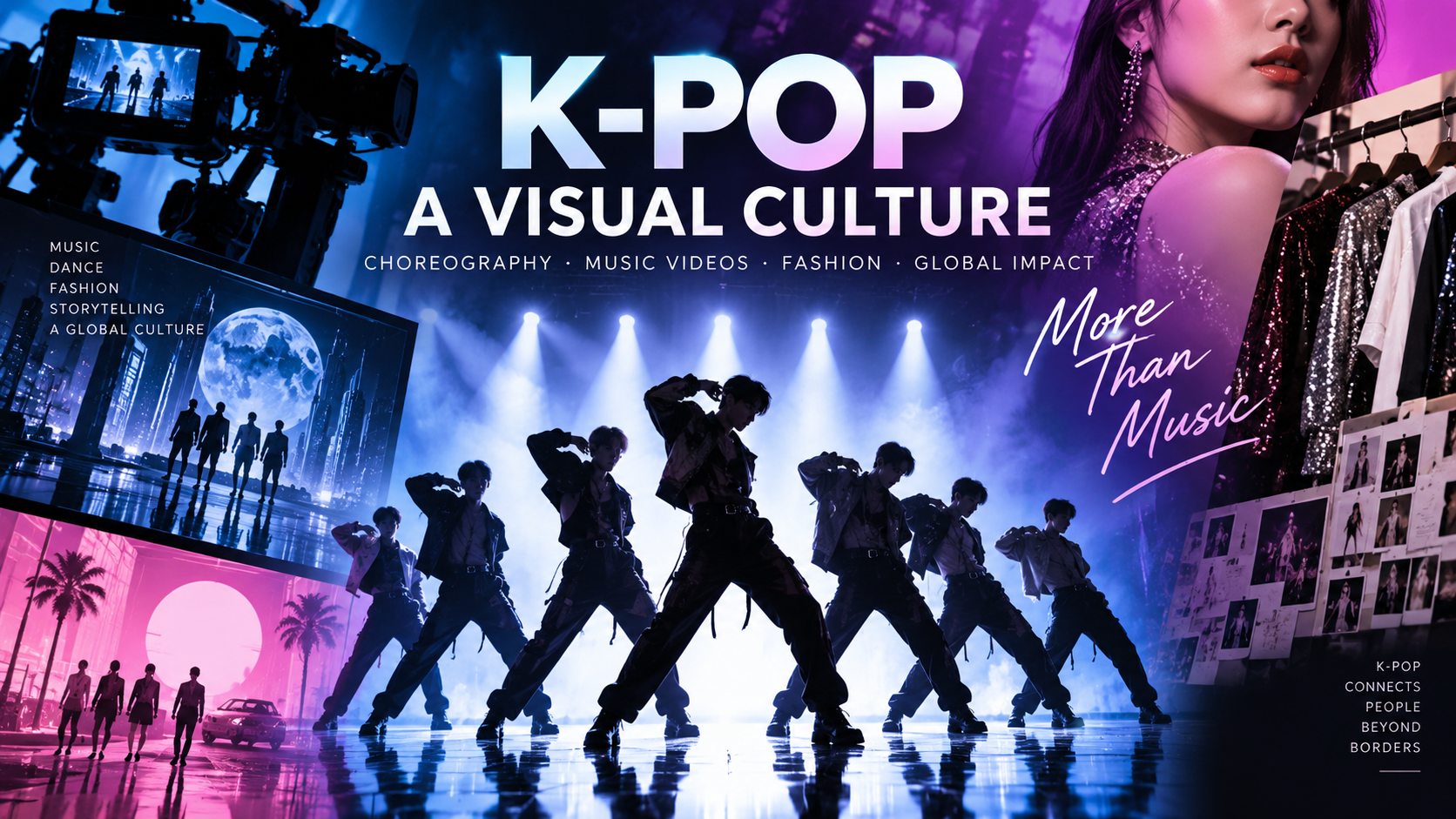
Music remains at the center, but choreography, fashion, music videos, styling, stage design, photography, and visual storytelling work together to create a larger cultural product.
Understanding this visual system helps explain why K-pop traveled so effectively across languages and borders.
Visual Communication Can Cross Language Barriers
Language can create a barrier when music enters a new market.
A listener who does not speak Korean may not immediately understand every lyric.
But visual communication works differently.
A dramatic dance move does not require translation.
A striking costume can be understood instantly.
A powerful facial expression can communicate emotion.
A memorable music-video scene can create curiosity even before a viewer understands the story behind the song.
This gave K-pop an important advantage in the digital era.
When Korean-language music began reaching larger international audiences through online video, viewers did not need to understand every word to become interested.
The visual performance could attract them first.
Understanding could come later.
Performance Has Deep Roots in the Idol System
K-pop’s emphasis on performance did not suddenly appear with YouTube.
It developed alongside the modern Korean idol system.
From the early generations of idol groups, dance was an important part of how artists were presented.
Entertainment companies were not simply preparing singers.
They were developing performers who might need to sing, dance, appear on television, communicate with fans, participate in variety programs, model for advertisements, and maintain a recognizable public image.
As the trainee system became more structured, dance training became one of its central components.
Trainees could spend years developing coordination, rhythm, stamina, stage presence, and the ability to perform as part of a group.
The result was a performance culture in which choreography was not merely decoration added to a song.
It became part of the song’s identity.
The Rise of Synchronized Group Choreography
One of the visual signatures associated with K-pop is highly synchronized group choreography.
When several performers execute difficult movements at nearly the same moment, the group can appear to function as a single visual unit.
This requires more than individual dancing ability.
Members must understand spacing.
Timing matters.
Transitions matter.
Body angles matter.
The position of each performer matters.
A movement that looks impressive alone may need to be adjusted when performed by seven, nine, or more people.
This is why K-pop choreography often depends on formations.
Members move between positions as the song progresses.
The center changes.
The group may form lines, triangles, circles, symmetrical shapes, or more complex patterns.
The choreography becomes a kind of moving architecture.
Why Synchronization Became So Important
Synchronization communicates several ideas at once.
First, it demonstrates technical discipline.
Viewers understand intuitively that many people moving together with precision requires extensive practice.
Second, it creates visual satisfaction.
Repeated movements and clean formations can make performances highly rewatchable.
Third, synchronization reinforces the identity of the group.
K-pop groups often need to balance two goals that might seem contradictory:
each member should have an individual identity, but the group must also feel unified.
Choreography helps solve that problem.
Different members can receive individual moments while remaining part of a larger performance.
The Center Position and Visual Attention
K-pop choreography frequently directs attention toward particular members at particular moments.
The performer singing a key line may move toward the center.
Other members may create a formation around them.
The focus can then shift rapidly when another member begins a verse or dance section.
This creates a constantly changing visual hierarchy.
The audience is guided through the performance.
Instead of watching an unchanging arrangement of singers, viewers experience a sequence of visual focal points.
This structure is especially effective for idol groups because it gives multiple members opportunities to become memorable.
A few seconds in the center can become one of the most recognizable moments of an entire comeback.
The Point Choreography
Not every memorable dance move needs to be difficult.
In fact, some of the most culturally powerful choreography is relatively simple.
K-pop often includes a recognizable point choreography—a movement or short sequence closely associated with a particular song.
The purpose is partly memory.
A listener hears the chorus and immediately imagines the movement.
Or they see the movement and immediately remember the song.
This creates a powerful connection between sound and image.
Point choreography can also encourage participation.
Fans may learn it.
Dance-cover teams may reproduce it.
Television personalities may imitate it.
Short-form video users may incorporate it into challenges.
A movement created for one performance can therefore become a distribution mechanism for the song itself.
Dance Practice Videos Changed How Fans Watched Performance
One of the most influential formats in K-pop visual culture is surprisingly simple:
the dance practice video.
Unlike highly edited music videos or elaborate television stages, dance practice videos often place performers in a rehearsal space with relatively straightforward camera work.
This allows viewers to see the choreography clearly.
Fans can observe formations.
They can compare individual styles.
They can learn movements.
They can appreciate details that may be difficult to notice in a rapidly edited broadcast performance.
The format became so popular that dance practice videos developed into an important category of K-pop content in their own right.
This reveals something significant about the audience.
Fans are not interested only in the finished illusion.
They are also interested in the craft behind the performance.
Dance Covers Turned Viewers Into Performers
K-pop choreography also helped create a global dance-cover culture.
Fans around the world began learning dances and recreating performances.
Some practiced alone.
Others formed teams.
Public dance covers appeared in plazas, parks, universities, studios, conventions, and online videos.
The importance of this phenomenon goes beyond imitation.
A person who learns a K-pop choreography engages with a song differently from someone who simply streams it.
They study the rhythm.
They memorize the structure.
They understand transitions.
They experience physically how the performance works.
The audience becomes a performer.
This is another example of the participatory culture we explored in the previous chapter on K-pop fandom.
Random Play Dance and Global Community
The relationship between choreography and community can be seen clearly in random play dance events.
Participants gather while short sections of K-pop songs are played.
People who know the choreography move into the performance space and dance together.
The song changes.
A different group of participants enters.
The result is both entertainment and a demonstration of shared cultural knowledge.
People who may not speak the same language can recognize the same choreography.
They know when the chorus begins.
They know the signature movement.
Dance becomes a common vocabulary.
This illustrates why K-pop choreography has been so effective internationally.
It can create participation without requiring linguistic fluency.
Performance Became Content
In earlier music industries, choreography was often experienced primarily through concerts or television.
Digital platforms changed that.
A single K-pop comeback can generate many performance-related pieces of content:
the official music video,
music-show stages,
dance practice videos,
performance videos,
studio choreography videos,
fancams,
short-form dance clips,
concert recordings,
behind-the-scenes rehearsals,
and fan-created dance covers.
The same song can therefore produce an extended visual life.
This matters economically as well as culturally.
Each format creates another opportunity for discovery and engagement.
One song is no longer only one recording.
It becomes the center of a network of visual content.
The Fancam Changed Individual Visibility
The rise of the fancam added another dimension to K-pop performance culture.
Rather than showing the entire group, a fancam may focus primarily on one performer throughout a stage.
This allows viewers to study an individual idol’s dance style, expressions, stage presence, and details that may not appear in the main broadcast edit.
Fancams can give individual members extraordinary visibility.
A memorable performance may circulate far beyond the existing fandom and introduce new viewers to an artist or group.
This also changes the demands placed on performers.
An idol may be filmed even when they are not at the center of the official camera shot.
The expectation of continuous performance becomes stronger.
Every moment can potentially become content.
Facial Expression Became Part of Choreography
K-pop performance is not only about moving the body correctly.
Facial expression can be equally important.
A bright concept may require playful expressions.
A darker concept may depend on intensity.
A dramatic song may demand controlled emotional expression.
Performers learn how to communicate with cameras as well as audiences.
This is particularly important because modern K-pop performances are often consumed through close-up video.
A movement designed for a stadium must also work on a smartphone screen.
The idol performer therefore operates simultaneously at multiple scales:
for the live audience,
for the television camera,
for the fancam,
and for the short clip that may later circulate online.
Choreography Became a Global Competitive Advantage
By the time K-pop entered a more mature stage of global expansion, performance quality had become one of the industry’s strongest recognizable features.
International viewers might disagree about musical genres or favorite groups, but the level of preparation behind many K-pop performances was difficult to ignore.
This created expectations.
New groups were increasingly judged not only on their songs but on how well they performed them.
Dance difficulty increased in many parts of the industry.
Performance videos became more ambitious.
Choreography became a major element of branding.
But this success also created pressure.
When technical perfection becomes expected, performers must continually deliver under demanding conditions.
That tension between spectacle and human limitation will become important later in this chapter.
Music Videos Built Worlds Around Songs
If choreography transformed songs into performances, music videos transformed them into worlds.
K-pop music videos often do much more than show artists singing in attractive locations.
They may use elaborate sets, changing costumes, symbolic objects, narrative fragments, cinematic lighting, fantasy environments, futuristic technology, historical references, or surreal imagery.
A three-minute song can become the foundation for an entire visual universe.
Fans may watch repeatedly not only to hear the music but to search for details.
Why was that object placed in the background?
Does this scene connect to an earlier video?
What does the color change mean?
Is the story continuing?
Visual curiosity encourages repeat viewing.
And repeat viewing is extremely valuable in the digital attention economy.
The Concept Became Central to K-Pop
This leads to one of the most important words in idol culture:
concept.
A concept is more than a costume or a background.
At its strongest, it provides a coherent identity connecting music, choreography, fashion, photography, album design, stage production, and storytelling.
A group may present a bright concept for one era and a darker or more experimental concept later.
Some artists develop recurring themes across multiple releases.
Others use dramatic reinvention as part of their identity.
The comeback therefore becomes more than the release of a new song. It can become the unveiling of a new visual world.
As K-pop became increasingly global, these carefully constructed visual identities also became closely connected with fashion, styling, and image-making—another powerful part of the K-pop experience.
Fashion Became Part of the K-Pop Language
Fashion in K-pop is not simply about making performers look attractive.
Clothing can communicate the mood of a song, distinguish one era from another, reinforce a group’s identity, and help audiences understand a concept before they fully understand the lyrics.
A school-inspired outfit may suggest youth.
Tailored suits can communicate sophistication or authority.
Streetwear can create a rebellious or contemporary image.
Futuristic styling can support a technology-driven concept.
The clothing becomes part of the storytelling.
This is why a K-pop comeback often includes noticeable changes in hairstyles, makeup, costumes, accessories, and overall visual direction.
The artist may remain the same, but the visual identity is deliberately renewed.
The Comeback Became a Visual Transformation
In K-pop, the word comeback usually refers to the promotional return surrounding a new release rather than necessarily returning after a long absence.
A comeback can introduce a completely new visual era.
Before the music is released, audiences may encounter concept photographs, posters, logos, teaser films, track information, and short video clips.
These materials gradually reveal the atmosphere of the upcoming project.
This creates anticipation.
Fans do not simply wait for a song.
They watch a visual campaign unfold.
By the time the official music video appears, the audience may already recognize the colors, symbols, clothing, and aesthetic associated with the release.
Concept Photos Turn Promotion Into Storytelling
Concept photography has become particularly important.
Instead of releasing one ordinary promotional photograph, artists may present multiple sets of images representing different versions of an album or different aspects of its concept.
The photography can be cinematic, minimalist, surreal, glamorous, nostalgic, futuristic, or experimental.
These images serve several purposes.
They generate online conversation.
They establish the visual language of the comeback.
They provide material for physical albums and merchandise.
And they encourage fans to examine the project as a complete creative package rather than simply a collection of songs.
This is one reason K-pop albums can function as visual objects as well as musical products.
Physical Albums Became Designed Experiences
The continued importance of physical albums in K-pop is closely connected to visual culture.
In many music markets, streaming reduced the everyday importance of physical music formats.
K-pop developed a different relationship with them.
A physical album may contain a photobook, photocards, posters, postcards, stickers, lyric materials, or other collectible elements.
Different versions may feature different visual concepts.
The album therefore becomes something to explore and collect.
Its value is not based only on access to the music, because the music is often already available digitally.
Instead, the physical album offers ownership of a visual and emotional artifact associated with a particular era of the artist’s career.
This helps explain why album design remains so important within the K-pop business model.
Photocards Made the Idol Image Collectible
Few objects demonstrate the connection between fandom, visual culture, and commerce as clearly as the photocard.
A photocard is small.
Its production cost may be modest compared with the album itself.
Yet particular cards can become highly desirable within fan communities.
Why?
Because they transform the image of an idol into a collectible object.
Fans may trade cards to find a favorite member.
They may organize collections by album era.
They may display them in cases or carry them as personal accessories.
An apparently simple photograph becomes part of a social and economic system involving collecting, trading, scarcity, and emotional attachment.
The photocard shows how successfully K-pop has connected visual identity with fandom participation.
Luxury Fashion and the Global Idol
As K-pop expanded internationally, the relationship between idols and the fashion industry became increasingly visible.
Major fashion houses began working with prominent Korean artists through campaigns, events, magazine features, and ambassador relationships.
This connection makes sense for both industries.
Fashion brands seek culturally influential figures with global audiences.
K-pop artists benefit from association with internationally recognized luxury and fashion identities.
The relationship also extends the idol’s influence beyond music.
A performer may become visible at fashion weeks, in advertising campaigns, on magazine covers, and across fashion-focused social media.
The modern K-pop star can therefore operate simultaneously as musician, performer, celebrity, and fashion figure.
Airport Fashion Became Content
Even moments outside formal performances became part of K-pop’s visual ecosystem.
One well-known example is airport fashion.
When idols travel for international schedules, their clothing can attract attention from fans and entertainment media.
An airport is not a concert stage.
Yet the appearance can still become widely circulated content.
Fans identify clothing.
Fashion accounts discuss brands.
Photographs spread through social media.
This demonstrates how thoroughly image has become integrated into idol culture.
The public presentation of an artist does not begin when the stage lights turn on.
It can continue through many parts of public life.
Beauty and Styling Became Globally Influential
K-pop’s visual influence also extends into hairstyles, makeup, skincare aesthetics, accessories, and beauty trends.
International fans may become interested in products or styles after seeing them used by artists.
Entertainment, beauty, and fashion therefore reinforce one another.
This does not mean every Korean beauty trend originates in K-pop or that K-pop represents Korean society as a whole.
But idols can function as highly visible cultural intermediaries.
Their appearance travels through music videos, performances, advertising, magazines, and social media.
A hairstyle or makeup look seen in Seoul can quickly become a reference point for fans thousands of kilometers away.
Visual Identity Helps Differentiate Groups
The K-pop industry contains many artists competing for attention.
Music is obviously essential, but visual identity can help distinguish one group from another.
A recognizable logo matters.
Album packaging matters.
Typography matters.
Colors matter.
Stage styling matters.
Even the way teaser photographs are released can contribute to brand identity.
Successful visual branding gives audiences something they can recognize immediately.
This becomes especially important in the digital environment, where people scroll rapidly through enormous quantities of content.
An image may have only a few seconds to attract attention.
Strong visual identity helps an artist become recognizable before a viewer even reads the name.
Music Videos Became High-Value Cultural Products
K-pop music videos occupy a particularly important position in this system.
They combine many creative disciplines:
music,
performance,
cinematography,
editing,
fashion,
set design,
lighting,
makeup,
visual effects,
and sometimes narrative storytelling.
The result can function almost like a short film built around a song.
For international audiences, music videos also provide an easily accessible entry point.
A viewer may encounter one through a recommendation without knowing anything about the group.
If the video is visually compelling, curiosity can lead to another song, a dance practice, an interview, or eventually deeper participation in the fandom.
The music video therefore works simultaneously as artwork, advertisement, performance showcase, and gateway.
The YouTube Era Rewarded Spectacle
YouTube was particularly compatible with K-pop’s visual strengths.
The platform allowed music videos and performances to circulate internationally without requiring traditional television distribution in every country.
More importantly, YouTube rewards content that people choose to watch, share, discuss, and revisit.
K-pop already had many characteristics suited to this environment.
Strong choreography encouraged repeat viewing.
Detailed music videos invited interpretation.
Memorable styling created shareable images.
Individual members gave viewers multiple personalities to discover.
Dance practice videos extended the life of a song.
The digital platform and the K-pop production system reinforced each other.
This was not the only reason K-pop became global, but it was an important part of the process.
The Smartphone Changed Visual Strategy Again
The next major transformation came from mobile viewing.
Music videos had often been designed for television and computer screens.
Increasingly, audiences consumed entertainment through smartphones.
This changed the competitive environment.
A complicated visual idea needed to remain understandable on a small screen.
A memorable movement might need to communicate its appeal within seconds.
Facial expressions became highly shareable.
Vertical video formats became more important.
Short clips could circulate independently from the original performance.
K-pop’s visual culture adapted.
TikTok Made the Memorable Moment More Valuable
Short-form platforms strengthened the importance of immediately recognizable moments.
A full choreography may be complex, but a short section can become a challenge.
A song may last three minutes, but fifteen seconds can introduce it to millions of potential listeners.
This does not mean every K-pop song is designed for TikTok.
Nor does viral popularity guarantee long-term artistic success.
But the possibility of short-form circulation now influences the environment in which pop music competes for attention.
A distinctive gesture, facial expression, lyric, beat change, or dance move can become an entry point into a much larger body of content.
Performance and Algorithms Began to Interact
This creates an important modern relationship:
visual performance and algorithmic discovery.
Algorithms do not experience choreography the way humans do.
They respond indirectly to human behavior—what people watch, replay, share, search for, comment on, and interact with.
Visually memorable content can encourage those behaviors.
A striking performance generates clips.
Clips generate reactions.
Reactions generate additional visibility.
Visibility can generate curiosity.
Curiosity can lead people back to the original song.
K-pop’s visual system therefore works unusually well within an attention economy built around continuous circulation.
Visual Storytelling Encouraged Fan Interpretation
Some K-pop artists also developed complex fictional or symbolic worlds around their releases.
Recurring images, characters, locations, symbols, and narrative ideas could connect different songs or albums.
Fans responded by developing theories.
They compared scenes.
They searched earlier videos for clues.
They discussed possible meanings online.
This transformed the audience from viewer into interpreter.
Not every visual detail necessarily contains a hidden message, and fan theories can sometimes go far beyond what creators intended.
But the practice itself is important.
Interpretation increases engagement.
A music video becomes something to investigate rather than simply watch once.
Reinvention Became Part of the Appeal
K-pop visual culture also makes reinvention possible.
An artist can move from youthful styling to a more mature image.
A group can shift from bright pop to darker themes.
A performer can experiment with retro aesthetics, science fiction, fantasy, minimalism, street culture, or high fashion.
This flexibility creates anticipation around each new release.
Fans ask not only:
“What will the new song sound like?”
They also ask:
“What will this era look like?”
That question reveals how deeply visual culture has become embedded in the K-pop experience.
But Spectacle Has a Cost
K-pop’s demand for striking visuals comes with real pressures. Constant reinvention, demanding performances, and public scrutiny of idols’ appearances can make visual excellence difficult to sustain without affecting artist well-being.
These pressures deserve closer attention because the polished performances audiences enjoy often conceal considerable physical and emotional work.
The Pressure Behind Visual Perfection
K-pop’s visual precision can be impressive.
A performance may appear effortless: synchronized movement, carefully styled clothing, controlled facial expressions, dramatic lighting, and cameras arriving at exactly the right moment.
But what audiences see is the final result of extensive preparation.
Behind a few minutes on stage may be hours of rehearsal, costume fittings, makeup, camera rehearsals, recording sessions, travel, and promotional schedules.
The polished surface can make the labor behind it easy to forget.
This is one of the central contradictions of K-pop visual culture.
The industry creates extraordinary spectacle partly by making extraordinary effort look natural.
Idols Perform Even When They Are Not Singing
In a large group, a member may sing only a limited number of lines during a particular song.
But visually, there may be almost no true break.
When another member takes the center, the surrounding performers remain part of the composition.
They must maintain choreography, positioning, expressions, and energy.
Fancams intensify this expectation because an individual performer can remain visible throughout an entire stage.
A moment that once might have disappeared outside the main television camera can now circulate online independently.
The modern idol therefore performs not only during their own lines.
They may be expected to remain camera-ready throughout the performance.
Appearance Can Become a Form of Labor
Visual presentation is also part of an idol’s work.
Hair, makeup, clothing, fitness, posture, expressions, and photography all contribute to public image.
Some degree of appearance management is common throughout entertainment industries.
But idol culture can make it unusually continuous.
High-resolution cameras and social media allow audiences to examine performers closely.
Images can be captured, enlarged, compared, edited, and discussed almost immediately.
This can create unrealistic expectations of consistency.
Human beings naturally change.
Weight changes.
Skin changes.
People become tired.
They age.
They have good days and difficult days.
A sustainable entertainment culture must leave room for performers to remain human even when their profession depends partly on image.
Beauty Standards and the Risk of Uniformity
K-pop’s visual influence has helped popularize Korean fashion and beauty aesthetics internationally.
At the same time, the industry has faced continuing discussion about narrow appearance standards.
When certain facial features, body types, skin presentations, or styling conventions repeatedly receive the greatest visibility, audiences may begin to interpret them as requirements rather than preferences.
This can affect performers.
It can also affect fans who compare themselves with professionally styled images produced under controlled lighting, makeup, editing, and photography.
Visual culture becomes healthier when it offers greater room for difference.
Individuality can be as powerful as perfection.
The Camera Does Not Show the Entire Reality
A polished music video is constructed.
Lighting is selected.
Angles are selected.
Scenes are edited.
Colors may be adjusted.
Images may be retouched.
A performance broadcast is also mediated through camera choices and production decisions.
None of this makes the result false.
Film, photography, and television have always involved creative construction.
The important point is understanding what we are looking at.
A carefully produced idol image should not become the standard by which ordinary people judge their everyday appearance.
Media literacy is therefore increasingly important in visual fandom.
Visual Perfection Can Hide Physical Difficulty
Complex choreography also places physical demands on performers.
Repeated rehearsals can be exhausting.
Touring can add travel and disrupted schedules.
Singing while performing demanding choreography requires stamina and technical control.
Stage costumes may prioritize appearance while performers still need to move safely and comfortably.
The audience sees three or four minutes of performance.
The body experiences the preparation before it and the recovery after it.
As K-pop becomes increasingly professionalized, performance quality and artist welfare should not be treated as opposing goals.
A stronger industry should be capable of pursuing both.
Technology Can Enhance Performance Without Replacing It
K-pop’s visual future will almost certainly involve more technology.
Concert production already uses large screens, sophisticated lighting, synchronized audience devices, augmented visual effects, and complex stage systems.
Virtual environments and digital performers have also expanded discussions about what an idol or performance can be.
Artificial intelligence may eventually influence parts of music production, visual design, translation, marketing, and content creation.
These technologies can expand creative possibilities.
But technology does not automatically create emotional connection.
A spectacular stage matters because people care about the performers standing on it.
The strongest visual technology supports the human performance rather than distracting from it.
Virtual Idols Complicate the Meaning of Performance
The development of virtual artists and digitally represented performers raises interesting questions.
Does an idol need to appear physically on screen to create fandom?
Can a digital avatar produce the same emotional attachment as a conventional celebrity?
What happens when motion capture, animation, artificial intelligence, and human performance overlap?
K-pop is particularly well positioned to explore these questions because it has always combined music with constructed visual identities.
The boundaries between performer, character, avatar, and brand may become increasingly complex.
Yet even highly technological projects still depend on storytelling, creativity, music, and audience connection.
Technology changes the form.
It does not eliminate the need for meaning.
Visual Culture Helped K-Pop Travel
When considering K-pop’s international success, it is tempting to search for one explanation.
Perhaps it was social media.
Perhaps it was fandom.
Perhaps it was the trainee system.
Perhaps it was particular artists.
In reality, global expansion resulted from many interacting factors.
Visual culture was one of them.
Choreography could communicate without translation.
Music videos could circulate through global platforms.
Fashion created recognizable images.
Dance covers encouraged participation.
Concepts encouraged curiosity.
Fancams highlighted individual performers.
Short-form clips created new discovery routes.
Together, these elements made K-pop exceptionally suited to an increasingly visual internet.
The Visual System Also Strengthened Memory
Popular culture depends partly on memory.
People remember a song, but they may also remember the image attached to it.
A particular dance move.
A costume.
A hairstyle.
A music-video set.
A light-stick-filled stadium.
A dramatic ending pose.
These visual memories help separate one era from another.
For long-term fans, looking at an old concept photograph can immediately bring back the period surrounding a particular release.
This is why visual identity has historical value.
It becomes part of how fans remember the evolution of K-pop.
Every Generation Developed Its Own Visual Language
The visual history of K-pop also reflects changes between generations.
Earlier idol groups developed recognizable styling, choreography, fandom colors, and television performance traditions.
Second-generation artists benefited from the rapid growth of online video and helped make synchronized performance internationally recognizable.
Third-generation groups entered an environment where music videos, social media, fancams, fashion partnerships, and global touring could reinforce one another.
Fourth-generation artists grew within an even faster visual ecosystem shaped by performance videos, short-form content, global digital fandom, and algorithmic discovery.
These boundaries are not absolute.
K-pop generations overlap, and visual innovations do not belong neatly to one period.
But the overall direction is clear.
The visual dimension of K-pop became increasingly central to how the industry communicated with the world.
Music and Image Work Best Together
None of this means that visual presentation is more important than music.
A beautiful music video cannot guarantee that a song will remain meaningful for years.
Perfect choreography cannot replace musical identity.
Fashion cannot create emotional connection by itself.
The strongest K-pop projects succeed when these elements reinforce one another.
The song establishes emotion.
The choreography gives that emotion movement.
The music video gives it an environment.
Fashion gives it texture and identity.
The performers give it personality.
Fans give it memory and community.
The result is larger than any individual component.
K-Pop Became a Total Performance Culture
This may be the best way to understand K-pop’s visual power.
K-pop developed into a total performance culture in which music interacts continuously with movement, image, personality, technology, and audience participation.
A comeback can involve weeks of visual preparation before the main release.
A song can generate months or years of images afterward.
Fans may remember an era through its choreography and fashion as strongly as through its melody.
That does not make K-pop less musical.
It shows how broadly the industry has defined the experience of music.
The Power of Being Recognizable
In a global entertainment market filled with endless choices, recognition is valuable.
K-pop learned how to create recognizable moments.
A silhouette can identify a choreography.
A light stick can identify a fandom.
A color palette can identify an album era.
A logo can identify a group.
A few seconds of a music video can identify a song.
This visual vocabulary makes culture easier to circulate.
And because digital platforms increasingly operate through images and short videos, recognizability can become a major competitive advantage.
More Than a Pretty Image
It would therefore be a mistake to dismiss K-pop’s visual culture as superficial packaging.
Visual presentation is part of the industry’s creative language.
Choreographers communicate through bodies and space.
Directors communicate through cameras and editing.
Stylists communicate through clothing.
Designers communicate through albums and graphics.
Performers communicate through movement and expression.
These are creative disciplines.
At their best, they deepen the emotional and artistic impact of the music.
At their worst, unrealistic expectations of perfection can create pressure on the people responsible for maintaining the image.
Both realities deserve attention.
Why the World Watched
K-pop became globally successful because people listened.
But they also watched.
They watched choreography that made songs physically memorable.
They watched music videos that created unfamiliar worlds.
They watched idols reinvent themselves through concepts and fashion.
They watched dance practices to understand the craft.
They watched fancams to focus on individual performers.
Then many stopped being passive viewers.
They learned the dances.
They created covers.
They shared clips.
They interpreted stories.
They reproduced fashion.
They turned visual consumption into participation.
That cycle helped K-pop move through the digital world with extraordinary speed.
K-pop did not simply give global audiences something new to hear. It gave them something distinctive to see, remember, recreate, and share.
What Comes Next?
We have now explored how K-pop developed historically, how its generations changed, how trainees become idols, how entertainment companies build businesses, how fandom became a global force, and how visual culture helped K-pop travel across borders.
But another question remains at the center of the industry’s global success:
How did social media transform the relationship between K-pop idols and the world?
YouTube opened international doors.
Twitter and other social networks accelerated communication.
TikTok changed music discovery.
Livestreaming reduced the distance between artist and fan.
Digital platforms did not merely promote K-pop.
They changed how K-pop itself operates.
That is where the next chapter of K-Pop Through Time will begin.
Leave a Reply