Tag: K-Pop Fandom

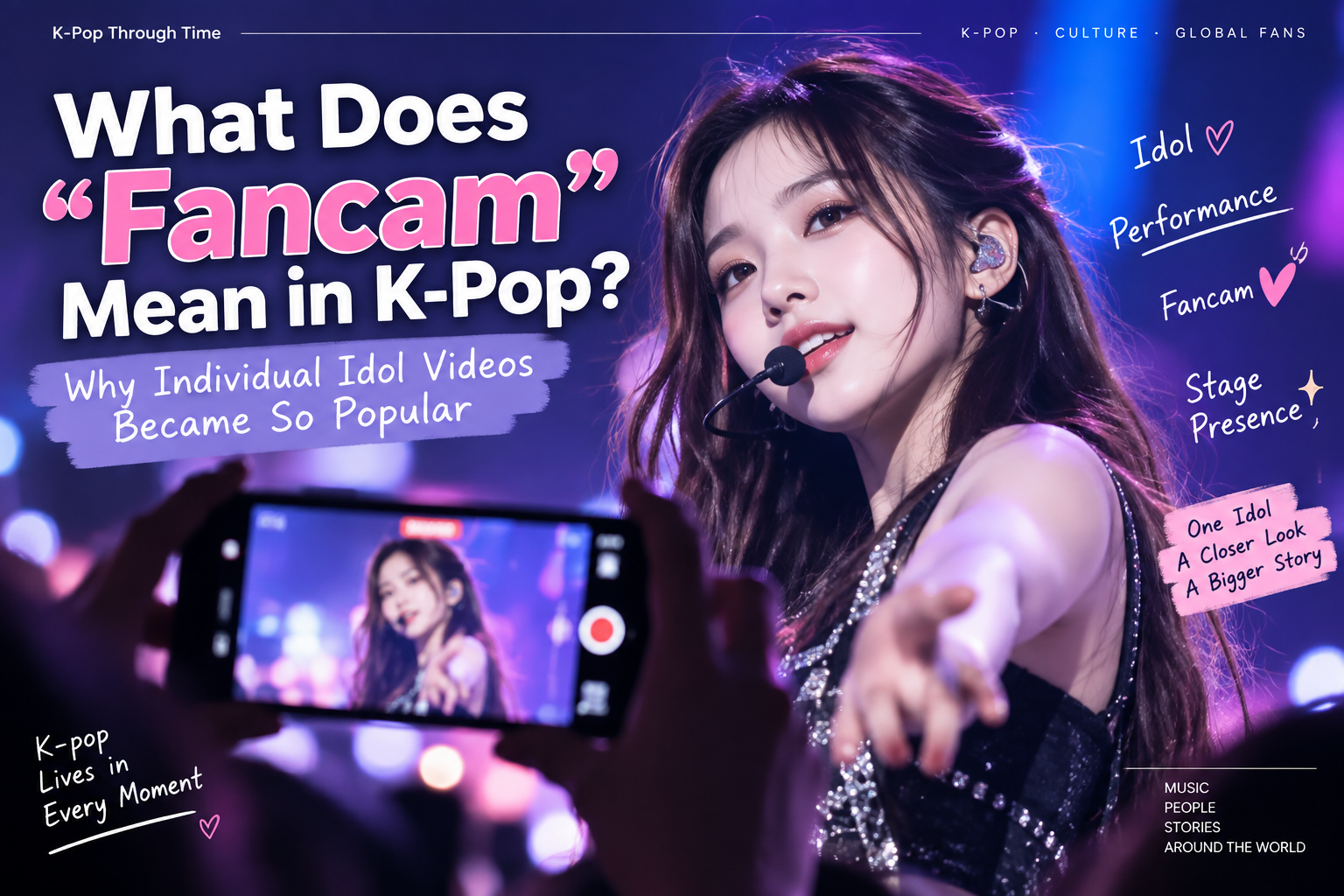
  • What Does “Fancam” Mean in K-Pop? Why Individual Idol Videos Became So Popular

    What Does “Fancam” Mean in K-Pop? Why Individual Idol Videos Became So Popular

    What Does “Fancam” Mean in K-Pop?

    If you are new to K-pop, you may have seen the word “fancam” on YouTube, TikTok, X, or other social media platforms. A single idol performance can generate dozens of fancams, and some of these videos attract millions of views.

    But what exactly is a fancam, and why have fancams become such an important part of K-pop culture?

    A fancam is a video that focuses primarily on one particular performer during a performance or public appearance. In K-pop, fancams often follow an individual idol throughout an entire song, allowing fans to watch that member’s dancing, facial expressions, stage presence, and performance details more closely.

    Over time, fancams have evolved from simple fan recordings into one of the most recognizable forms of K-pop video content.

    Where Did the Word “Fancam” Come From?

    The word fancam combines the words “fan” and “camera.”

    Originally, the term commonly referred to videos recorded by fans at concerts, festivals, public events, or performances. Instead of filming the entire group equally, the camera would often follow one specific member.

    As K-pop grew, the idea became much more organized.

    Korean music programs and entertainment channels began releasing professionally recorded individual-member performance videos as well. These videos are often described internationally as fancams even though they may be filmed by professional broadcast cameras rather than fans.

    How Is a K-Pop Fancam Different from a Regular Performance Video?

    A normal K-pop performance video usually shows the entire group.

    The camera may move between members, switch angles, show wide shots of the choreography, and focus on whoever is singing at that moment.

    A fancam works differently.

    It usually keeps one idol as the main focus for most or all of the performance.

    This means that even when another member is singing, viewers can continue watching their favorite idol.

    Fans can therefore notice details that may be difficult to see in the regular broadcast, including choreography, facial expressions, interactions between members, and how an idol performs when they are not at the center of the stage.

    Why Are Fancams So Popular in K-Pop?

    One reason is simple: K-pop fans often develop a special interest in particular members.

    In K-pop fan culture, a fan’s favorite member is commonly called their bias.

    If someone has a bias in a group, watching that member’s fancam provides a very different experience from watching the full-group performance.

    Instead of waiting for the broadcast camera to show that idol, fans can follow the member throughout the entire song.

    This makes fancams particularly appealing in groups with many members.

    Fancams Can Show an Idol’s Stage Presence

    Fancams are also popular because they reveal how performers behave throughout an entire stage.

    In an edited television performance, camera shots change constantly.

    A fancam can show what one performer is doing from beginning to end.

    Fans may notice small details such as:

    • facial expressions
    • dance technique
    • energy
    • gestures
    • interactions with other members
    • reactions when the idol is not singing

    For this reason, fancams can become a way for viewers to evaluate and appreciate an idol’s stage presence.

    Can a Fancam Make an Idol More Popular?

    Sometimes, yes.

    A particularly memorable fancam can spread far beyond an idol’s existing fandom.

    People who were not previously familiar with a performer may discover them through a short clip or viral performance video.

    This can lead viewers to search for the idol’s name, watch other performances, listen to the group’s music, or learn more about the group.

    In some cases, a single performance becomes strongly associated with a particular idol because the fancam attracts widespread attention online.

    However, not every popular idol becomes famous because of a fancam, and not every viral fancam leads to long-term popularity.

    What Is a Viral Fancam?

    A viral fancam is simply a fancam that spreads rapidly online and receives unusually high attention.

    It may become popular because of an idol’s performance, choreography, facial expressions, outfit, a memorable moment, or widespread sharing by fans.

    Social media has made this process much faster.

    A short section of a performance can circulate on TikTok, X, Instagram, or YouTube Shorts and lead viewers to the original full-length fancam.

    As a result, a performance recorded in Korea can quickly reach K-pop fans around the world.

    What Is a “Facecam”?

    You may also encounter the term facecam.

    While a typical fancam often shows most or all of an idol’s body so viewers can see the choreography, a facecam focuses more closely on the performer’s face and upper body.

    This makes facial expressions and reactions much easier to see.

    Different broadcasters and channels may use slightly different names for these videos, but the general idea is similar: giving viewers a closer look at an individual performer.

    Are All Fancams Recorded by Fans?

    No.

    This is one of the confusing parts of the term.

    Traditional fancams were commonly recorded by fans, but today many of the fancams K-pop viewers encounter online are professionally filmed.

    Korean music programs and official channels frequently upload individual-member videos alongside regular group performances.

    Therefore, the word fancam in modern K-pop culture can refer broadly to an individual-focused performance video, even when a professional camera crew recorded it.

    What Is the Connection Between Fancams and K-Pop Comebacks?

    Fancams become especially visible during a comeback.

    When a K-pop artist releases new music, groups often perform the new song on music programs and other stages.

    Those performances may produce group videos as well as individual fancams for different members.

    Fans can then compare performances from different stages, outfits, choreography, and individual members throughout the promotional period.

    This is one reason fancams are closely connected with the way fans experience K-pop comeback promotions online.

    What Is the Connection Between Fancams and K-Pop Fandom?

    Fancams are also closely connected with fandom culture.

    Fans share performances, recommend memorable fancams, create edits, discuss stage presence, and introduce other people to their favorite idols.

    For international fans who cannot attend performances in Korea, these videos can provide another way to experience an idol’s stage performances in detail.

    Fancams therefore function as more than simple recordings. They have become part of how K-pop performances circulate between fans around the world.

    Do You Need to Watch Fancams to Be a K-Pop Fan?

    Absolutely not.

    There is no requirement to watch fancams, choose a bias, buy albums, own a lightstick, or participate in an official fandom to enjoy K-pop.

    Some people mainly listen to the music.

    Others enjoy choreography, performances, variety shows, fashion, collecting albums, or following particular artists.

    Fancams are simply one part of the much larger culture surrounding K-pop.

    Why Do Fancams Matter in Global K-Pop Culture?

    K-pop is a highly visual form of popular music.

    Songs are often experienced together with choreography, styling, music videos, live performances, and the individual personalities of group members.

    Fancams fit naturally into this environment because they allow viewers to move from watching the group to watching one performer within the group.

    They also make performances easier to share across digital platforms.

    A viewer may discover a ten-second performance clip, watch the full fancam, learn the idol’s name, discover the group, and eventually become part of its fandom.

    That pathway has become one of many ways people encounter K-pop in the digital era.

    Final Thoughts

    In K-pop, a fancam is generally a video focused on one particular idol during a performance.

    What began largely as fan-recorded footage has expanded into professionally produced individual performance videos distributed through broadcasters, entertainment channels, and social media.

    Fancams allow fans to see choreography, facial expressions, stage presence, and individual performance details that may be difficult to notice in a normal group broadcast.

    More importantly, they demonstrate how deeply K-pop and digital fan culture have become connected.

    A single camera following one performer can turn a stage moment into something watched and shared by fans around the world.


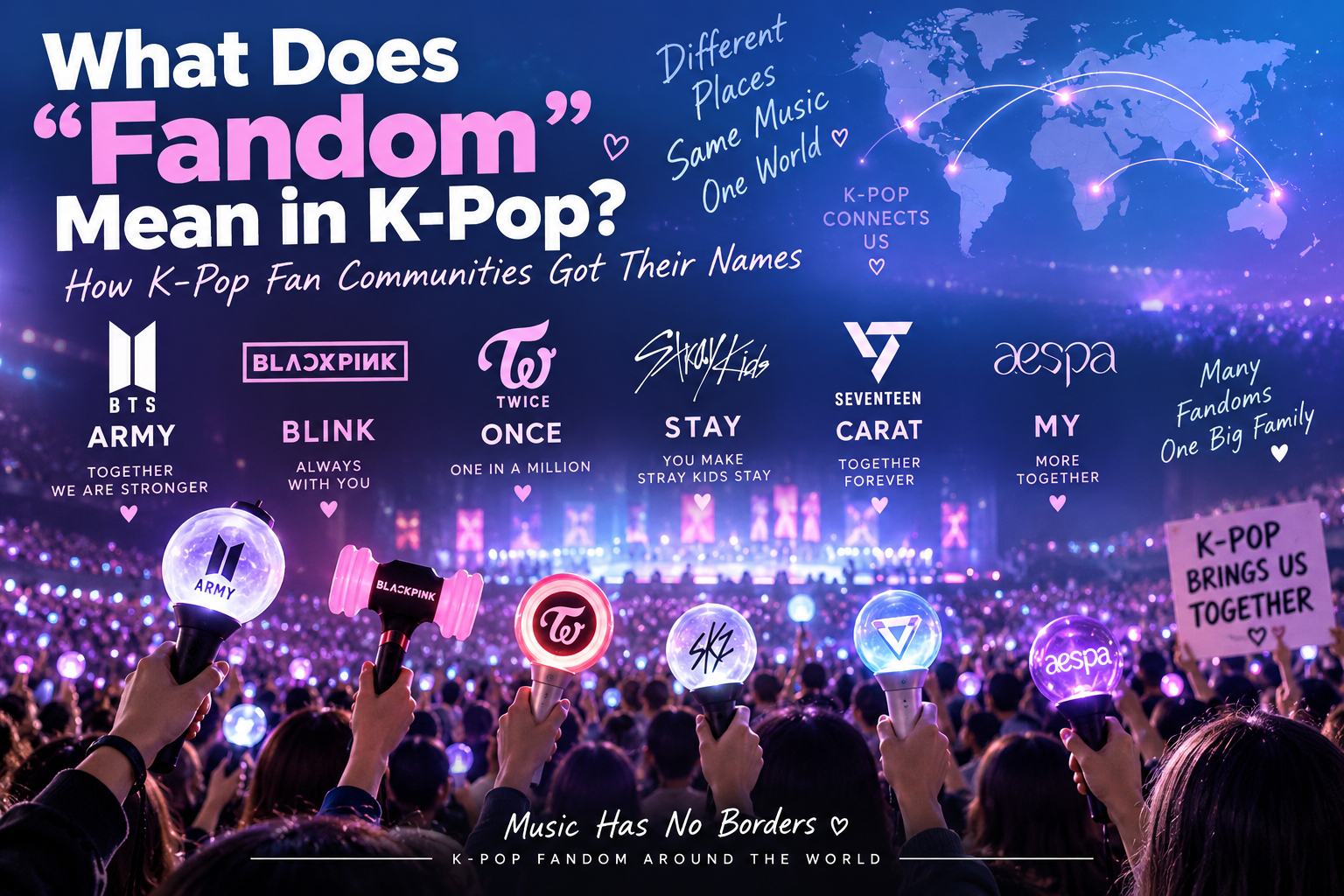
  • What Does “Fandom” Mean in K-Pop? How K-Pop Fan Communities Got Their Names

    What Does “Fandom” Mean in K-Pop? How K-Pop Fan Communities Got Their Names

    What Does “Fandom” Mean in K-Pop?

    If you are new to K-pop, you will quickly notice that fans are rarely described simply as “fans.”

    Many K-pop artists have an official fandom name.

    BTS fans are known as ARMY, BLACKPINK fans are called BLINK, and many other groups have names created especially for the communities that support them.

    But why are fandom names so important in K-pop?

    To understand that, we first need to understand what the word fandom means.

    What Is a K-Pop Fandom?

    A fandom is a community of people who share an interest in a particular artist, group, or form of entertainment.

    Fandoms exist throughout music, movies, sports, books, and popular culture.

    K-pop, however, has developed an especially organized and visible form of fandom culture.

    Fans do much more than listen to songs.

    They attend concerts, collect albums and photocards, watch music videos, follow artists on social media, participate in fan communities, celebrate anniversaries, and support new releases.

    For many people, becoming part of a fandom is an important part of the K-pop experience.

    Why Do K-Pop Fandoms Have Names?

    Official fandom names create a shared identity.

    Instead of simply saying “BTS fans,” people can say ARMY.

    Instead of “BLACKPINK fans,” they can say BLINK.

    A fandom name creates a direct connection between the artist and the community supporting them.

    These names are often announced by entertainment companies or artists and may have special meanings connected with the group’s name, concept, or message.

    Once established, the fandom name can become almost as recognizable as the artist’s name itself.

    What Does BTS ARMY Mean?

    BTS has one of the most internationally recognized fandoms in modern music.

    Their fans are known as ARMY.

    The fandom name was officially announced in 2013, shortly after BTS debuted.

    Over time, ARMY became much more than a label.

    As BTS gained international popularity, fans around the world used the name to identify themselves as part of a shared global community.

    Today, the relationship between BTS and ARMY is frequently discussed as an important part of the group’s history.

    What Does BLACKPINK’s BLINK Mean?

    BLACKPINK’s official fandom is called BLINK.

    The name combines parts of the words BLACK and PINK.

    It creates a short, memorable identity directly connected to the group’s name.

    As BLACKPINK expanded internationally, BLINK became a familiar term across social media, concerts, fan communities, and entertainment coverage.

    Like ARMY, the name allows fans in different countries to identify as members of the same global community.

    Other Famous K-Pop Fandom Names

    K-pop is filled with creative fandom names.

    TWICE fans are known as ONCE.

    Stray Kids fans are called STAY.

    SEVENTEEN fans are known as CARAT.

    aespa fans are called MY.

    Each fandom name has its own story and relationship with the artist.

    For new K-pop fans, learning these names can initially feel like learning another vocabulary.

    But after spending time in K-pop communities, they quickly become familiar.

    What Do K-Pop Fandoms Actually Do?

    K-pop fandoms participate in many different activities.

    The most obvious is supporting music.

    Fans may listen to new releases, purchase albums, watch music videos, attend concerts, and follow performances.

    But fandom activity extends far beyond music consumption.

    Fans create translations, artwork, dance covers, video edits, discussion communities, guides for new fans, and social media content.

    Some fan communities also organize charitable projects or events in an artist’s name.

    This level of participation helps explain why K-pop fandoms are so visible online.

    Why Are Lightsticks Important to K-Pop Fandoms?

    One of the most distinctive symbols of K-pop fandom culture is the official lightstick.

    Many groups have their own specially designed lightstick.

    At concerts, thousands of fans holding matching lightsticks can transform an arena into a sea of color.

    Modern lightsticks can sometimes synchronize with concert production, creating coordinated patterns across the audience.

    The result makes fans visually part of the performance.

    A lightstick therefore becomes more than concert merchandise.

    For many fans, it represents belonging to a particular fandom.

    Why Do Fandoms Have Official Colors?

    Earlier generations of K-pop fandoms were often strongly associated with particular colors.

    Fans could identify groups through balloons, banners, and other objects displaying those colors.

    As K-pop evolved, official lightsticks and more elaborate visual branding became increasingly important.

    The basic idea, however, remained similar.

    A shared symbol or color helps thousands of individual fans feel like part of one community.

    K-Pop Fandoms and Social Media

    Social media transformed K-pop fandom culture.

    In earlier generations, international fans had fewer ways to follow Korean artists closely.

    Today, fans can receive updates almost instantly.

    A music video released in Seoul can be watched within seconds by audiences in New York, London, Bangkok, Manila, São Paulo, Sydney, and countless other cities.

    Fans can also translate interviews, discuss performances, share clips, and organize community projects across national borders.

    This digital network is one of the major reasons modern K-pop fandoms can operate globally.

    What Is a Multi-Stan?

    Not every fan belongs to only one fandom.

    A person who follows and supports several K-pop groups may describe themselves as a multi-stan.

    For example, someone might enjoy BTS, BLACKPINK, TWICE, Stray Kids, and aespa at the same time.

    They may have a bias in each group and participate in several fandom communities.

    K-pop fandom identities are therefore not always exclusive.

    Many listeners explore multiple generations, groups, and musical styles.

    Do You Have to Join a Fandom to Enjoy K-Pop?

    No.

    There is no requirement to use a fandom name, buy albums, collect merchandise, stream music videos, or participate in online communities.

    You can simply enjoy the music.

    Fandom culture provides additional ways for people to connect with artists and other listeners, but everyone can participate at their own level.

    Being a K-pop fan should ultimately begin with enjoying the music and performances.

    Can K-Pop Fandoms Have Negative Sides?

    Like any large online community, fandoms can sometimes experience conflict.

    Arguments may develop between different fan communities or even among fans of the same artist.

    Competition over charts, awards, popularity, and social media can occasionally become intense.

    However, these conflicts should not define all K-pop fandom culture.

    Millions of fans simply enjoy sharing music, attending concerts, meeting other fans, and celebrating artists they appreciate.

    Understanding both the positive and competitive sides gives a more realistic picture of modern fandom.

    Why K-Pop Fandoms Became Global Communities

    The most remarkable feature of modern K-pop fandom may be its international scale.

    A fan in Korea, India, the United States, the Philippines, Brazil, France, or Australia can belong to the same fandom.

    They may speak different languages and live thousands of kilometers apart, yet recognize the same fandom name, songs, symbols, and artists.

    Digital platforms made this type of community possible on an unprecedented scale.

    K-pop fandoms therefore demonstrate how popular culture can create connections that cross national and linguistic boundaries.

    More Than Just a Fan Name

    A K-pop fandom name may appear to be a simple nickname.

    But names such as ARMY, BLINK, ONCE, STAY, CARAT, and MY represent communities that can span the world.

    They give fans a shared identity and artists a recognizable way to address the people supporting them.

    That is why understanding fandom culture is useful for anyone beginning to explore K-pop.

    Sooner or later, every new fan encounters the same question:

    Which fandoms are you part of?

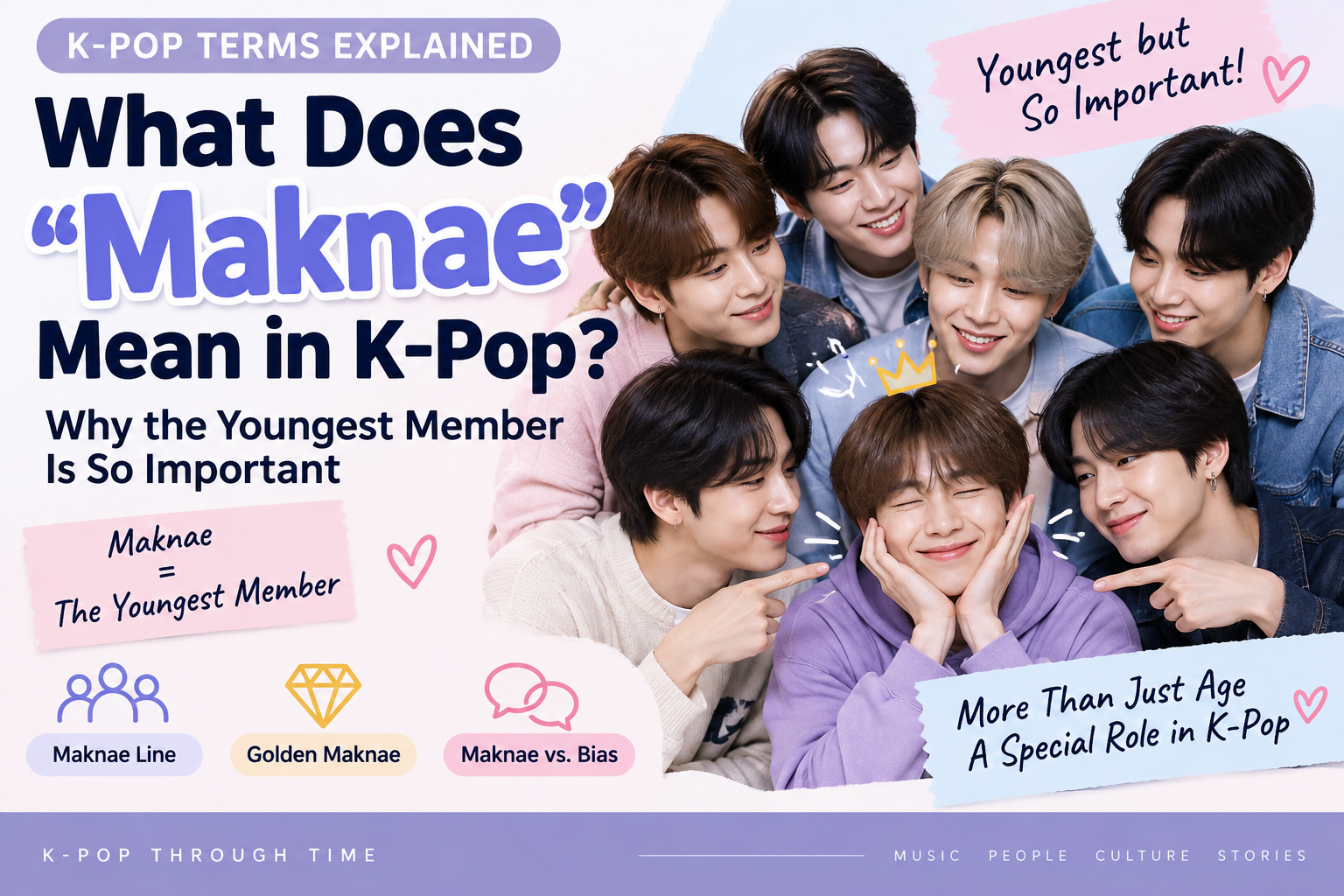
  • What Does Maknae Mean in K-Pop?

    What Does Maknae Mean in K-Pop?

    If you are new to K-pop, you may often hear fans describe someone as the maknae of a group.

    The word appears in interviews, fan conversations, variety shows, and social media posts. You may also hear expressions such as “golden maknae” or “maknae line.”

    So what exactly does maknae mean?

    In Korean, maknae (막내) simply means the youngest person in a family or group.

    In K-pop, it usually refers to the youngest member of an idol group.

    But the meaning of maknae in K-pop culture goes beyond age. The youngest member often develops a recognizable role within the group’s relationships, humor, and public image.

    What Is a Maknae in K-Pop?

    Every K-pop group has members of different ages.

    The youngest member is commonly called the maknae.

    For example, if a group has five members born in different years, the member with the latest birth date would normally be considered the group’s maknae.

    Unlike positions such as main vocalist, rapper, or dancer, being the maknae is not a performance role.

    It is simply based on age.

    However, because age plays an important role in Korean language and social relationships, the maknae position can influence how members interact with one another.

    Why Does Age Matter in Korean Culture?

    To understand the idea of maknae, it helps to understand that age can affect social interaction in Korea.

    The Korean language includes different levels of speech, and people often consider age and social relationships when deciding how to address one another.

    Older and younger people may therefore interact differently depending on their relationship and level of familiarity.

    K-pop groups naturally reflect some of these cultural patterns.

    Members often know exactly who is older or younger, and fans quickly learn the group’s age order as well.

    That is why terms connected to age can become an important part of K-pop fandom.

    Is the Maknae Always Cute?

    K-pop entertainment often presents the youngest member as playful, energetic, or cute.

    Older members may tease the maknae, take care of them, or jokingly treat them like the younger sibling of the group.

    But this is not a rule.

    Some maknaes are quiet.

    Others are confident, competitive, serious, or even the members who tease their older teammates the most.

    The contrast between the expected “youngest member” image and the person’s actual personality often becomes part of the group’s humor.

    What Is a “Golden Maknae”?

    One of the most famous expressions connected with the word is golden maknae.

    The phrase is commonly used to describe a youngest member who appears talented in many different areas.

    A golden maknae might be skilled at singing, dancing, performing, sports, art, or other activities.

    The expression became particularly well known internationally through BTS member Jung Kook, who has frequently been associated with the nickname.

    Because BTS developed such a large global audience, many international fans encountered the Korean word maknae through conversations about him.

    What Is the Maknae Line?

    Fans also use the expression maknae line.

    Instead of referring only to the single youngest member, the maknae line generally refers to several of the younger members of a group.

    The exact meaning depends on the group and fandom.

    Fans may informally divide members into an older line and a younger line based on age.

    These labels make it easier to talk about friendships, chemistry, performances, or funny interactions between particular groups of members.

    What Is the Hyung Line?

    If there is a younger line, fans may also talk about an older line.

    In male groups, you may encounter the expression hyung line.

    “Hyung” is a Korean term used by a male to refer to or address an older male with whom he has a close relationship.

    K-pop fans sometimes use “hyung line” informally when discussing the older members of a boy group.

    The terminology reflects how Korean relationship words have become familiar to international K-pop audiences.

    Maknae vs. Bias: What Is the Difference?

    New K-pop fans sometimes encounter words such as maknae and bias at the same time, but they mean completely different things.

    The maknae is determined by age.

    A bias is a fan’s personal favorite member.

    For example, the youngest member of a group remains the maknae regardless of which member you personally like most.

    Your bias, however, can be any member.

    Your bias can even change over time, while the group’s maknae normally does not.

    Can the Maknae Be the Leader?

    Yes.

    Being the youngest member does not automatically determine a person’s leadership position.

    K-pop group roles depend on many factors, including personality, communication skills, experience, company decisions, and group dynamics.

    Although many leaders are among the older members, age alone does not determine who can lead a group.

    This is another reason it is useful to separate age-related terms from official or informal performance roles.

    Why Do Fans Care About the Maknae?

    K-pop fans often become interested in the relationships between group members, not just their music.

    Concert footage, interviews, livestreams, behind-the-scenes videos, and variety programs reveal how members interact away from formal performances.

    The maknae’s relationship with older members can become one of the most recognizable dynamics within a group.

    Fans may enjoy watching older members care for the youngest member—or watching the youngest member confidently tease everyone else.

    These relationships help audiences see the group as a collection of individual personalities rather than only performers on a stage.

    Famous Maknaes Helped Spread the Term Globally

    As K-pop became more international, Korean words that were once unfamiliar to overseas audiences became part of everyday fandom vocabulary.

    Maknae is one of the clearest examples.

    International fans may use the Korean word even while speaking entirely in English.

    Popular idols have helped make the term recognizable far beyond Korea, and new fans often learn it shortly after entering K-pop communities.

    The same process has happened with other expressions such as comeback, bias, fandom, and honorific terms.

    Do You Need to Use the Word “Maknae”?

    Not at all.

    You can simply say “the youngest member.”

    Understanding the word is useful because it appears so frequently in K-pop content and fan discussions.

    But enjoying K-pop does not require memorizing Korean terminology.

    These words are simply part of the cultural vocabulary that many fans gradually pick up as they watch more content.

    Why the Maknae Is More Than Just the Youngest Member

    Technically, maknae has a very simple definition: the youngest person.

    But within K-pop, the word can represent much more.

    It can shape group jokes, relationships, fan discussions, nicknames, and the way audiences understand the personalities of individual members.

    That is why a simple Korean word has become familiar to millions of K-pop fans around the world.

    Once you understand what maknae means, you will probably start noticing the word everywhere.

    And the next time someone asks, “Who is the maknae of this group?” you will know exactly what they mean.

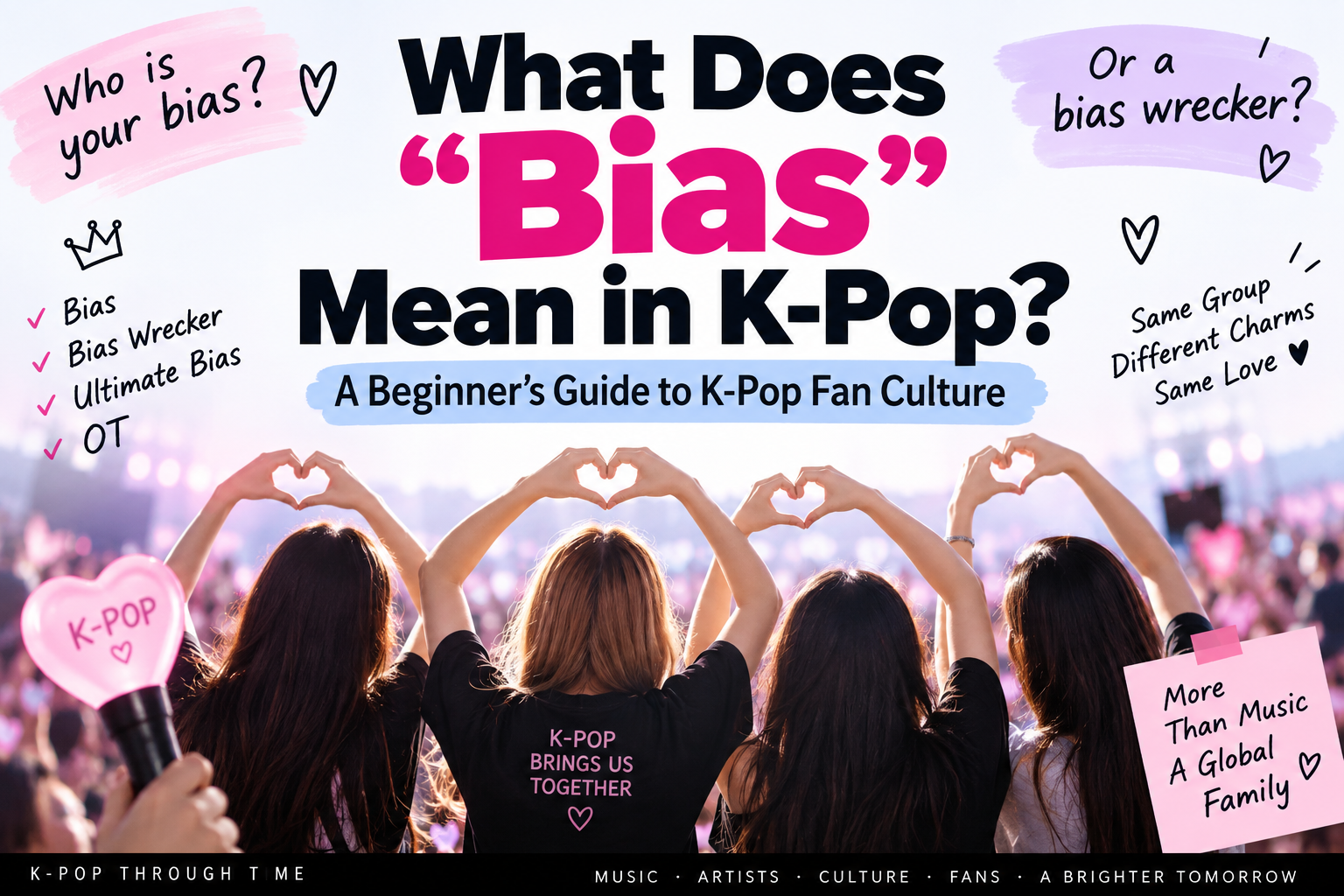
  • What Does Bias Mean in K-Pop? Bias Wrecker & Ult Bias Explained

    What Does Bias Mean in K-Pop? Bias Wrecker & Ult Bias Explained

    If you are new to K-pop, you may quickly encounter a word that seems unusual at first: bias.

    Fans might say, “Who is your bias?” or “She became my bias after that performance.”

    Outside K-pop, the word “bias” usually refers to a preference or prejudice. But in K-pop fan culture, it has developed a much more specific meaning.

    Simply put, your bias is your favorite member of a K-pop group.

    But as with many K-pop terms, there is more to the story.

    What Is a K-Pop Bias?

    A bias is the member of a K-pop group that a fan personally likes or connects with the most.

    For example, someone who follows BTS might enjoy all seven members but feel especially drawn to one member because of his music, personality, performances, or sense of humor.

    A BLACKPINK fan might admire the entire group while having Jisoo, Jennie, Rosé, or Lisa as their bias.

    Having a bias does not mean that a fan dislikes the other members.

    It simply describes a personal favorite within the group.

    In Korean fan communities, a similar term is choe-ae (최애), meaning someone or something you love most. Fans often use it for their favorite idol or group member. While bias and choe-ae are closely related, their usage can vary depending on the fandom and context.

    Why Do K-Pop Fans Choose a Bias?

    There is no single reason people choose a bias.

    Some fans first notice a member because of appearance or fashion.

    Others are attracted to a particular singing voice, rap style, dance ability, stage presence, personality, or sense of humor.

    Sometimes the connection develops slowly.

    A fan may initially notice one member in a music video and later become interested in another after watching interviews, variety shows, concerts, or behind-the-scenes content.

    That is one reason choosing a bias can become part of the fun of discovering a new K-pop group.

    What Is a Bias Wrecker?

    Once you understand “bias,” another popular K-pop expression becomes much easier to understand: bias wrecker.

    A bias wrecker is another member who repeatedly challenges your choice of favorite member.

    Imagine that one member has always been your bias.

    Then another member gives an unforgettable concert performance, appears in a funny interview, or releases an impressive solo song.

    Suddenly, you begin wondering whether your original favorite is still your favorite.

    Fans jokingly describe that second member as a bias wrecker.

    The expression reflects the playful way K-pop fans talk about their attachment to different members.

    Can You Have More Than One Bias?

    Yes.

    There are no official rules about how many biases a fan can have.

    Some fans choose one favorite member in each group. Others have two or more favorites.

    A person who follows many groups may have a different bias in BTS, BLACKPINK, TWICE, Stray Kids, SEVENTEEN, aespa, or other groups.

    Fan culture develops naturally, so the terminology is flexible rather than strictly regulated.

    The most important point is that “bias” describes personal preference, not a formal position within K-pop.

    What Does “Ultimate Bias” Mean?

    Fans who follow several K-pop groups sometimes use the term ultimate bias, often shortened to ult bias.

    An ultimate bias is a fan’s favorite idol across all the groups and artists they follow.

    For example, someone might have a bias in several different groups but still consider one particular artist their overall favorite.

    The term demonstrates how K-pop fandom often develops across multiple groups rather than remaining focused on only one artist.

    What Does “OT” Mean in K-Pop?

    Another expression that often appears alongside bias discussions is OT, followed by a number.

    Fans commonly use expressions such as OT7 or OT4 to express support for all members of a particular group lineup.

    For example, BTS fans may use OT7 when talking about supporting all seven members, while BLACKPINK fans may use OT4 for all four members.

    The expression can carry different nuances depending on the fandom and context, but it is commonly associated with recognizing or supporting the full group.

    Do You Need a Bias to Be a K-Pop Fan?

    No.

    You can enjoy a K-pop group without choosing a favorite member at all.

    Some fans prefer the group’s music as a whole.

    Others enjoy different members for different reasons and do not want to rank them.

    K-pop terminology helps fans communicate with one another, but it is not a set of rules that everyone must follow.

    You do not need a bias, a bias wrecker, or an ultimate bias to enjoy K-pop.

    How Does Someone Become Your Bias?

    For many fans, the process happens naturally.

    You may first notice a singer’s voice in a song.

    Then you watch a live performance and become impressed by the person’s stage presence.

    Later, an interview reveals a personality you find interesting or relatable.

    After watching more content, you realize that you consistently pay attention to the same member.

    At that point, many fans would simply say, “That’s my bias.”

    Why Is the Idea of a Bias So Important in K-Pop?

    K-pop groups are often designed around members with distinctive roles, personalities, talents, and public images.

    One member may be known for powerful vocals, another for rap, another for dance, and another for variety or performance skills.

    This gives fans many different ways to connect with a group.

    The bias concept reflects that structure.

    Fans can support the group collectively while developing a particularly strong interest in one member’s individual career and personality.

    Bias Culture and Solo Careers

    Bias culture also helps explain why solo projects by group members can attract large audiences.

    Fans who become especially interested in one member may follow that artist’s solo albums, acting roles, fashion activities, collaborations, or other projects.

    BTS and BLACKPINK provide clear examples.

    Their members have strong group identities while also developing individual careers that attract their own audiences.

    This relationship between group fandom and individual fandom has become an important feature of modern K-pop.

    Is “Bias” Only Used for K-Pop?

    The term is most strongly associated with K-pop fandom, but online fan communities sometimes use it more broadly.

    As K-pop culture has spread internationally, expressions such as bias, bias wrecker, comeback, maknae, and fandom names have also become familiar to global audiences.

    These words are part of the vocabulary that new fans gradually learn as they explore K-pop.

    Understanding them makes conversations within international fan communities much easier to follow.

    A Simple Example

    Imagine you have just discovered BLACKPINK.

    You enjoy songs from the entire group, but you find yourself watching Lisa’s dance performances more often than anything else.

    Lisa might become your bias.

    Then you watch Rosé perform a solo song and suddenly become fascinated by her voice.

    Rosé might become your bias wrecker.

    You can still enjoy and support all four BLACKPINK members.

    The terms simply provide a playful way to describe your personal preferences.

    K-Pop Fan Culture Is About Connection

    The popularity of the word “bias” reveals something important about K-pop.

    Fans are often interested not only in songs but also in the individual artists who perform them.

    Music videos, concerts, interviews, social media, variety content, and solo projects allow audiences to discover different sides of each member.

    That creates a stronger sense of connection between artists and fans.

    And for many people entering the K-pop world for the first time, answering one simple question becomes part of the experience:

    Who is your bias?

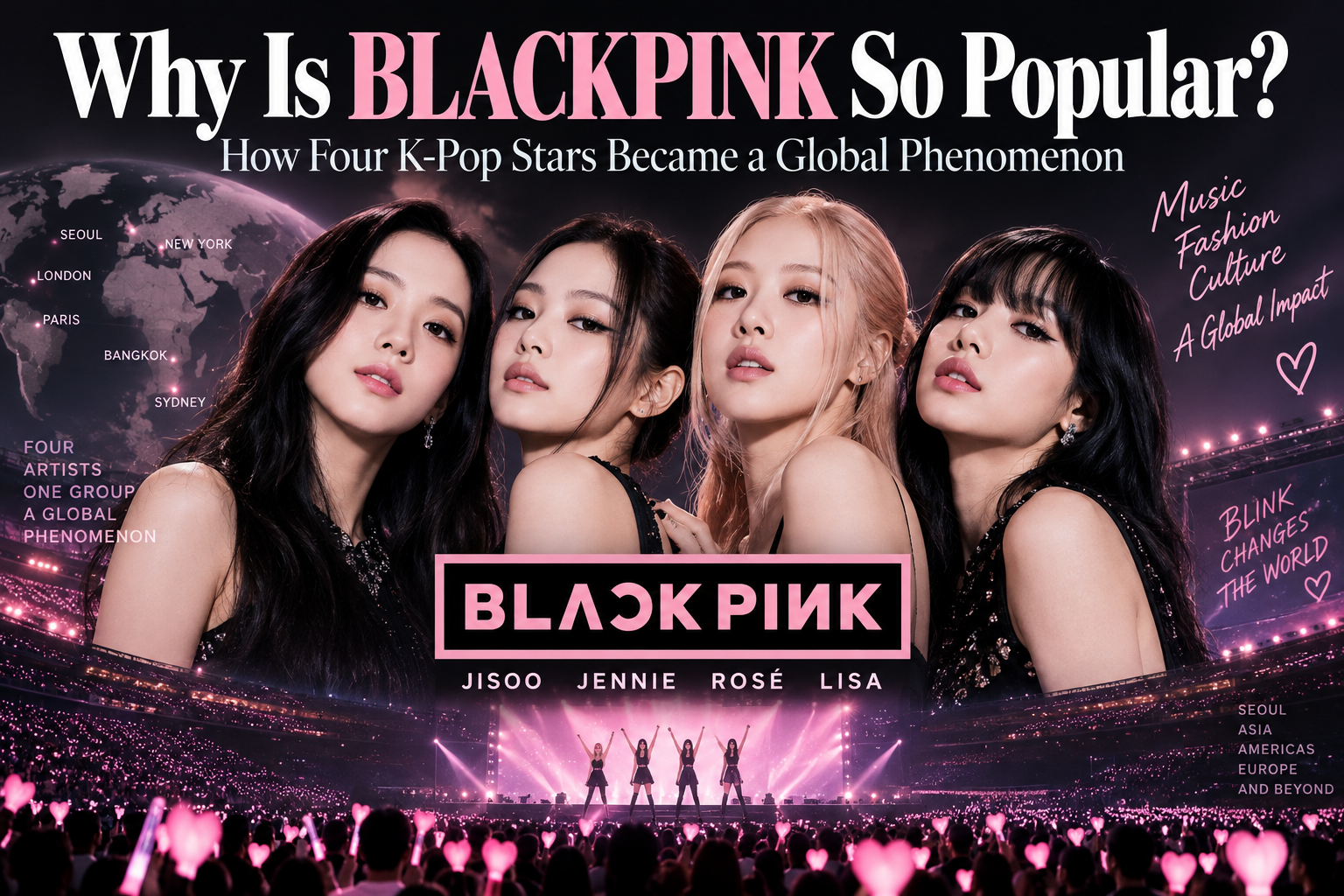
  • Why Is BLACKPINK So Popular? How Four K-Pop Stars Became a Global Phenomenon

    Why Is BLACKPINK So Popular? How Four K-Pop Stars Became a Global Phenomenon

    Since debuting in 2016, Jisoo, Jennie, Rosé, and Lisa have grown from promising YG Entertainment artists into global stars whose influence extends far beyond South Korea.

    Their music videos attract enormous international audiences, their concerts bring together fans from many countries, and each member has developed an individual identity in music, fashion, entertainment, and popular culture.

    But BLACKPINK‘s success raises an interesting question.

    Why did this particular group become such a powerful global phenomenon?

    The answer involves much more than a few hit songs.

    Four Members with Distinct Identities

    One of BLACKPINK’s greatest strengths is that the four members are easy to distinguish from one another.

    Jisoo brings a calm and elegant presence while developing careers in both music and acting.

    Jennie combines rap, vocals, fashion, and a strong individual image.

    Rosé is instantly recognizable for her distinctive vocal tone and increasingly personal approach to solo music.

    Lisa stands out through dance, rap, stage presence, and her international background.

    These differences allow fans to connect with individual members while still supporting BLACKPINK as a group.

    Rather than four performers competing for the same identity, BLACKPINK works because each member contributes something different.

    Music Designed for Immediate Impact

    BLACKPINK’s biggest songs are built to make an impression quickly.

    Tracks such as “DDU-DU DDU-DU,” “Kill This Love,” “How You Like That,” and “Pink Venom” combine powerful beats, memorable hooks, rap sections, dramatic vocal moments, and choreography designed for the stage.

    Many of their songs also move between contrasting moods.

    A track may begin with a confident rap, shift into a melodic vocal section, and then explode into a large chorus or dance break.

    That structure gives BLACKPINK’s music a strong visual and performance dimension.

    The songs are not simply meant to be heard.

    They are designed to be experienced.

    The Power of BLACKPINK’s Music Videos

    Visual storytelling has played a major role in BLACKPINK’s rise.

    Their music videos often feature elaborate sets, striking fashion, bold colors, dramatic camera work, and memorable choreography.

    For international audiences who may not understand every Korean lyric, these visual elements provide another way to connect with the music.

    A BLACKPINK release can therefore function simultaneously as a song, fashion event, dance performance, and visual spectacle.

    This made platforms such as YouTube especially important to the group’s international expansion.

    BLACKPINK and the Growth of YouTube K-Pop

    BLACKPINK emerged during a period when global audiences were increasingly discovering music through digital platforms rather than traditional television or radio.

    This was particularly important for K-pop.

    Fans did not need to live in South Korea to watch a new music video, learn choreography, follow performances, or share content with friends.

    BLACKPINK’s highly visual style was perfectly suited to this environment.

    Every major release could immediately reach viewers across Asia, North America, Europe, Latin America, and other regions.

    The internet helped remove one of the biggest barriers that earlier generations of Korean artists had faced: geography.

    Fashion Became Part of the BLACKPINK Brand

    BLACKPINK’s influence is not limited to music.

    Jisoo, Jennie, Rosé, and Lisa have each developed strong connections with international fashion and luxury culture.

    Their appearances at major fashion events introduced them to audiences who might not have originally followed K-pop.

    This created an unusual crossover.

    A person could first discover a BLACKPINK member through a fashion campaign and later become interested in the group’s music.

    At the same time, existing fans followed the members into the fashion world.

    BLACKPINK therefore became not only a music group but also a major cultural brand.

    Why International Fans Connect with BLACKPINK

    BLACKPINK has always had an unusually international identity.

    Lisa is Thai.

    Rosé grew up in Australia after being born in New Zealand.

    Jennie spent part of her youth in New Zealand.

    The members’ different backgrounds and language abilities helped the group communicate naturally with audiences outside South Korea.

    But international appeal is not simply about speaking different languages.

    BLACKPINK’s music, fashion, choreography, and personalities created multiple entry points for fans.

    Some listeners discovered them through songs.

    Others arrived through dance videos, fashion, social media, collaborations, or individual members.

    The Importance of BLINK

    No global pop phenomenon exists without a highly engaged fan community.

    BLACKPINK’s fandom, known as BLINK, has played a major role in spreading the group’s music and content.

    Fans share performances, discuss releases, create translations, participate in online communities, and introduce BLACKPINK to new listeners.

    Digital fandom can turn every comeback into an international event.

    When a new song or video arrives, millions of fans across different time zones can respond almost simultaneously.

    This level of participation has become one of the defining characteristics of modern K-pop.

    Global Collaborations Expanded Their Audience

    BLACKPINK has also worked with major international artists.

    Collaborations with musicians such as Dua Lipa, Lady Gaga, Selena Gomez, and Cardi B helped connect the group with audiences already familiar with Western pop.

    These collaborations were important not because BLACKPINK needed Western artists to become successful, but because they demonstrated how naturally the group could operate within the wider global music industry.

    BLACKPINK increasingly appeared less like a Korean group visiting the international pop market and more like a permanent part of it.

    Coachella and the Global Stage

    Festival appearances became another important symbol of BLACKPINK’s international rise.

    Performing at Coachella placed the group in front of a large global festival audience and demonstrated that K-pop could occupy major stages outside the traditional idol concert system.

    Their later return to the festival at an even higher level of prominence reflected how much their global position had grown.

    These performances were significant not only for BLACKPINK but also for the broader visibility of K-pop.

    Solo Careers Made the Group Even Bigger

    Another unusual strength of BLACKPINK is the individual popularity of its members.

    Jennie, Rosé, Lisa, and Jisoo have all developed solo careers while remaining strongly associated with the group.

    Their individual projects reveal different artistic directions.

    One member may focus more heavily on music, another may expand into acting, while others explore fashion, performance, songwriting, or business.

    Instead of weakening the BLACKPINK identity, these individual careers can bring new audiences back to the group.

    Fans who discover one member’s solo work may eventually explore BLACKPINK’s wider history.

    Scarcity Also Created Anticipation

    BLACKPINK has often released music less frequently than many K-pop groups.

    This has sometimes frustrated fans, but it also created enormous anticipation around major comebacks.

    Because releases were relatively limited, each new era could feel like a major event.

    New music meant new styling, choreography, music videos, performances, interviews, and international attention.

    The result was a cycle in which anticipation itself became part of the BLACKPINK experience.

    BLACKPINK Helped Redefine the Global K-Pop Girl Group

    Before BLACKPINK, Korean girl groups had already built significant international audiences.

    But BLACKPINK helped push the possibilities even further.

    They demonstrated that a K-pop girl group could become a major force in global touring, fashion, streaming, festivals, advertising, and celebrity culture simultaneously.

    Their success also contributed to greater international interest in other Korean girl groups.

    In that sense, BLACKPINK’s impact extends beyond their own achievements.

    They helped expand expectations for what a K-pop girl group could become.

    So, Why Is BLACKPINK So Popular?

    There is no single reason.

    BLACKPINK’s global success comes from the combination of four distinctive members, memorable music, powerful performances, visually ambitious videos, fashion influence, digital platforms, international backgrounds, and a highly active global fandom.

    Timing also mattered.

    They emerged when K-pop was becoming increasingly accessible around the world and when social media could turn a Korean music release into an immediate international conversation.

    But opportunity alone does not create a global phenomenon.

    BLACKPINK had the songs, personalities, performances, and visual identity capable of taking advantage of that moment.

    From K-Pop Group to Global Phenomenon

    BLACKPINK began as four artists debuting under YG Entertainment in Seoul.

    Over time, Jisoo, Jennie, Rosé, and Lisa became recognizable figures across music, fashion, entertainment, and global popular culture.

    Their story demonstrates how dramatically K-pop has changed.

    A group can now begin in South Korea, include members with international backgrounds, communicate with fans through global digital platforms, perform on some of the world’s biggest stages, and build individual careers that reach far beyond the traditional boundaries of an idol group.

    That is why BLACKPINK’s story is about more than popularity.

    It is also a story about how K-pop itself became global.

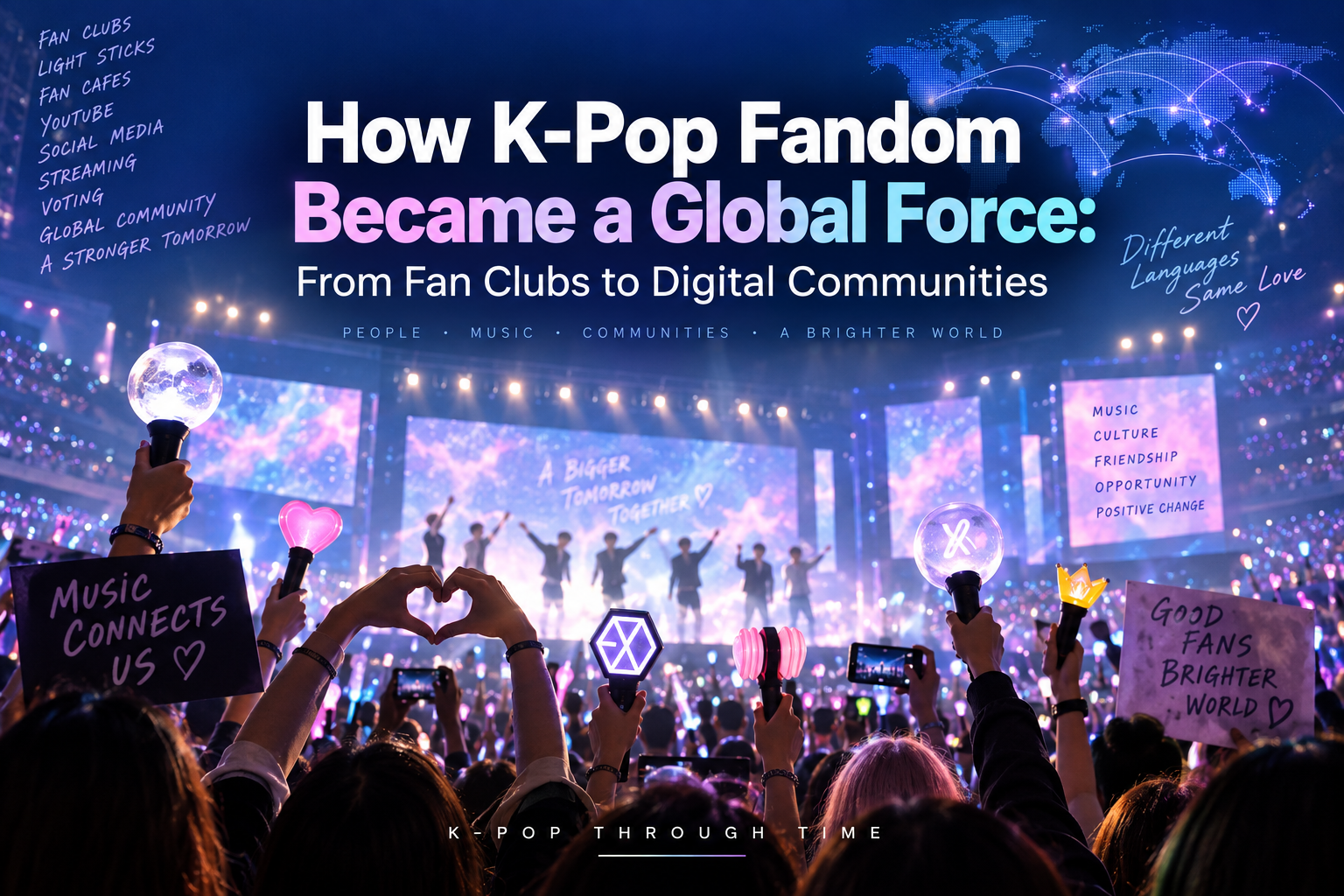
  • The Evolution of K-Pop Fandom: From Fan Clubs to Global Communities

    The Evolution of K-Pop Fandom: From Fan Clubs to Global Communities

    K-Pop Fandom Is More Than an Audience

    Every music industry has fans.

    But K-pop developed something more organized, visible, and participatory than a conventional audience.

    Fans do not simply listen to songs or attend concerts. They create communities, translate content, organize projects, collect albums, learn fan chants, vote in competitions, share performances, promote artists, and connect with other fans across national borders.

    In some cases, they also organize charitable campaigns or social projects in an artist’s name.

    This makes K-pop fandom an important part of the industry’s history.

    The global rise of K-pop cannot be explained only through entertainment companies and artists.

    It also requires understanding the people on the other side of the stage.

    The fans helped build the network through which K-pop traveled.

    Before Social Media: The Rise of Organized Fan Clubs

    Modern K-pop fandom did not begin with Twitter, TikTok, or YouTube.

    Its foundations were established much earlier.

    As South Korea’s idol industry expanded during the first generation of K-pop in the 1990s, large organized fan communities formed around popular groups.

    Groups such as H.O.T. and Sechs Kies attracted passionate supporters who developed strong collective identities.

    Fans gathered at performances.

    They joined organized communities.

    They used colors and symbols to identify themselves.

    They learned coordinated ways to support their favorite artists.

    The important development was not simply that many people liked the same group.

    They began to think of themselves as members of a fandom.

    The Official Fan Club Created a Shared Identity

    Entertainment companies recognized the power of these communities and increasingly formalized relationships through official fan clubs.

    An official fandom could have a name, membership structure, color, symbols, and specific ways of supporting the artist.

    This transformed fandom into something resembling a cultural identity.

    A fan could say not only:

    “I like this group.”

    They could say:

    “I belong to this fandom.”

    That difference matters.

    Personal preference became collective membership.

    Once fans saw themselves as part of a community, they could organize activities that an isolated listener could never accomplish alone.

    Fandom Names Became Cultural Symbols

    One of K-pop’s most recognizable traditions is the official fandom name.

    Over time, names such as Cassiopeia, S♡NE, ELF, VIP, SHINee World, ARMY, BLINK, CARAT, STAY, and many others became meaningful identities within K-pop culture.

    To outsiders, these may appear to be branding devices.

    To fans, they can represent years of memories, friendships, concerts, releases, and shared experiences.

    A fandom name also gives artists a convenient way to address their supporters as a community.

    Instead of speaking to an undefined mass of consumers, an artist can speak to a named group with its own history.

    This strengthens one of K-pop’s most powerful characteristics:

    the feeling of an ongoing relationship between artist and audience.

    Fandom Colors Made the Audience Visible

    Before sophisticated official light sticks became widespread, colors played an important role in identifying fandoms.

    Fans could use balloons, clothing, banners, or other objects associated with particular colors.

    At large music events, sections of an audience could become visually identifiable through those colors.

    This turned fandom into something that could literally be seen.

    The audience was no longer simply a dark crowd facing the stage.

    It became part of the spectacle.

    A large area filled with one fandom’s color could demonstrate the size and organization of that community.

    The idea eventually evolved into one of the most visually distinctive features of modern K-pop concerts.

    From Balloons to Light Sticks

    Official light sticks transformed fandom symbolism.

    Modern K-pop light sticks can be elaborate objects designed specifically for individual artists.

    Their shapes, colors, logos, and names can become instantly recognizable.

    But their importance goes beyond merchandise.

    At concerts, thousands of light sticks can create coordinated patterns across an arena or stadium.

    Technology may allow them to synchronize with songs and stage production.

    The audience becomes part of the show’s visual design.

    This is a powerful reversal of the traditional relationship between performer and spectator.

    Fans are watching the concert.

    But they are also helping create what the concert looks like.

    Fan Chants Turned Listening Into Participation

    Another distinctive feature of K-pop concert and music-show culture is the fan chant.

    Fans may learn specific words, member names, or responses to perform at particular moments in a song.

    The effect can be striking.

    The artist performs one part.

    The audience answers with another.

    A song that originally existed as a recording becomes a coordinated exchange between stage and crowd.

    Fan chants demonstrate why K-pop fandom is best understood as participatory culture.

    The ideal fan experience is often not simply:

    Watch.

    It is:

    Learn. Respond. Participate. Belong.

    The Fan Cafe Era

    Before today’s global social-media platforms became dominant, online fan cafes played an important role in Korean fandom culture.

    These communities provided spaces where fans could share information, discuss artists, organize activities, and sometimes receive official updates.

    They helped move fandom beyond physical concerts and television broadcasts.

    A fan did not need to be standing outside a broadcasting station to participate in the community.

    They could connect online.

    This was an important step toward the digital fandom that would later become essential to K-pop’s international expansion.

    But early online communities still had limitations.

    Language was one of the biggest.

    For international fans, finding information about Korean artists could be difficult.

    And that problem produced one of the most important unofficial roles in global K-pop fandom:

    the fan translator.

    Fan Translators Became Bridges Between Korea and the World

    Imagine discovering a Korean group before international subtitles became common.

    You enjoy the music.

    You want to understand an interview.

    You want to know what the members said during a livestream or television appearance.

    But you do not speak Korean.

    For many international fans, other fans solved the problem.

    People translated interviews, television clips, social-media posts, lyrics, and news.

    They created subtitles.

    They explained cultural references.

    They summarized information.

    They shared translations through forums, blogs, video platforms, and social networks.

    These activities were often unpaid.

    Yet their cultural impact was enormous.

    Fan translators helped reduce one of the biggest barriers between Korean artists and international audiences.

    Translation Was a Form of Distribution

    Traditional entertainment distribution focuses on moving products.

    Fan translation moved meaning.

    A music video could travel internationally on its own.

    But personality-driven content was harder to export without language support.

    Translation allowed overseas fans to understand jokes, conversations, interviews, and emotional moments.

    That deeper understanding could strengthen attachment to individual members and groups.

    In this sense, fan translators became part of K-pop’s unofficial international infrastructure.

    Entertainment companies eventually expanded professional subtitling and multilingual communication, but fandom had already demonstrated the demand.

    Fans did not wait for every barrier to be removed.

    They began removing barriers themselves.

    YouTube Changed Everything

    The rise of YouTube dramatically accelerated this process.

    K-pop performances no longer depended entirely on television broadcasts reaching foreign markets.

    Music videos could be uploaded once and watched around the world.

    Dance practices could attract enormous audiences.

    Fans could discover older performances years after they originally aired.

    Reaction videos, dance covers, lyric explanations, compilations, and fan-created content generated additional paths into K-pop.

    This gave fandom a new function.

    Fans were no longer only consuming official media.

    They were producing an enormous secondary layer of media around it.

    Every fan-made video had the potential to introduce another person to the artist.

    The Recommendation Chain

    K-pop often spreads through a simple but powerful process.

    One person discovers a song.

    They send it to a friend.

    The friend watches another video.

    An algorithm recommends a dance practice.

    They search for member profiles.

    They watch interviews.

    They encounter fan translations.

    They learn the fandom name.

    Eventually, they may purchase an album or concert ticket.

    This process rarely follows a company’s official marketing plan exactly.

    It is distributed across fans, platforms, algorithms, and communities.

    That is why K-pop’s global expansion cannot be understood only as traditional cultural export.

    It also functioned as networked cultural transmission.

    Millions of small acts of sharing collectively produced enormous visibility.

    Social Media Removed Geographic Distance

    As social platforms became central to everyday communication, the relationship between K-pop artists and international fans changed again.

    A fan living thousands of kilometers from Seoul could receive an artist’s update almost immediately.

    They could respond.

    They could share it.

    They could discuss it with fans in several countries at once.

    Geographic distance still mattered for concerts and physical events.

    But it mattered much less for everyday fandom.

    An international fan could participate in comeback excitement at the same time as a Korean fan.

    The K-pop audience was becoming synchronized across time zones.

    And once those globally connected fans learned how to coordinate their activity, fandom would gain a new kind of power:

    the ability to influence visibility, charts, voting, and commercial outcomes together.


    Streaming Turned Fandom Into Coordinated Action

    As streaming platforms became central to the music industry, K-pop fandom developed new ways of participating in an artist’s success.

    Listening was no longer always treated as an entirely private activity.

    Fans could organize around release dates, encourage others to discover new songs, share playlists, explain how particular platforms worked, and celebrate milestones together.

    This reflected a broader transformation in fandom.

    Supporting an artist increasingly meant understanding the digital systems through which music became visible.

    Charts, recommendations, playlists, video views, and social-media trends became part of everyday fan conversation.

    For some fans, the comeback experience now included not only enjoying the music but helping it reach a wider audience.

    Streaming Guides and the Culture of Organization

    Large fandoms often became highly organized during major releases.

    Fan communities created guides explaining where music could be heard or purchased. Accounts specialized in chart information. Others translated schedules, organized reminders, or collected information about promotional activities.

    This organization could be remarkably sophisticated.

    A fandom spread across dozens of countries might coordinate without having a conventional headquarters.

    Instead, networks of volunteer accounts and communities distributed information.

    This is one of the defining features of digital K-pop fandom:

    Organization can emerge without centralized control.

    Entertainment companies may provide the official content, but fans frequently build their own systems around it.

    When Support Becomes Pressure

    However, organized support can have a difficult side.

    When streaming goals or sales targets become highly visible, some fans may feel that enjoying the music is no longer enough.

    They may feel pressure to stream repeatedly, purchase multiple albums, vote continuously, or prove that they are sufficiently dedicated.

    This can turn fandom from a source of enjoyment into an obligation.

    There is an important difference between:

    “I want to support this artist.”

    and

    “I must do this or I am a bad fan.”

    Healthy fandom should leave room for different levels of participation.

    A person does not need to spend large amounts of money or devote every free hour to prove that music matters to them.

    Voting Became Another Arena of Competition

    Music programs, award ceremonies, online polls, and other competitions gave fans another way to influence visible outcomes.

    Voting could become highly organized.

    Fans shared instructions.

    They created multiple-language guides.

    They reminded one another about deadlines.

    International fans who could not attend Korean music broadcasts could still feel that they were participating in the competition surrounding a comeback.

    This strengthened global engagement.

    But it also intensified rivalry between fandoms.

    When rankings become symbolic measures of an artist’s importance, disagreement can quickly become emotional.

    The competitive structure of K-pop can therefore unite people inside a fandom while creating conflict between fandoms.

    Charts Became Part of Fan Vocabulary

    As K-pop expanded globally, fans became increasingly familiar with music charts in different countries.

    Chart performance could symbolize international recognition.

    Fans discussed album rankings, digital performance, streaming numbers, sales figures, and other measurements.

    This created a highly data-aware fan culture.

    But numbers require context.

    Different charts measure different things.

    Rules can change.

    Markets vary in size.

    Physical sales and streaming represent different forms of consumption.

    A high ranking on one chart does not automatically mean the same thing as a high ranking on another.

    The danger appears when numbers stop being tools for understanding success and become the only definition of success.

    Music has cultural value that cannot always be reduced to a ranking.

    Social Media Created Global Fan Headquarters

    Platforms such as X, Instagram, TikTok, YouTube, and other online communities allowed fandoms to operate continuously across borders.

    There was no single closing time.

    When fans in Seoul went to sleep, fans in Europe or the Americas could continue discussions.

    Information moved across time zones.

    Translations appeared.

    Performance clips circulated.

    Memes spread.

    Voting reminders continued.

    The global fandom effectively became a twenty-four-hour network.

    This was something earlier generations of fan clubs could not easily achieve.

    Physical distance no longer prevented coordinated participation.

    Fan Accounts Became Specialized Media Channels

    As fandoms grew, some fan accounts developed specialized roles.

    One account might focus on translations.

    Another might track schedules.

    Another might explain charts.

    Another might archive photographs or performances.

    Some focused on fashion, choreography, lyrics, music production, or individual members.

    These accounts could attract large audiences of their own.

    In effect, fandom created an unofficial media ecosystem surrounding the official entertainment industry.

    This ecosystem could be extraordinarily useful.

    It helped fans navigate enormous amounts of content.

    But it also created a new challenge:

    Who verifies the information?

    The Problem of Rumors and Misinformation

    Speed is one of social media’s greatest strengths and greatest weaknesses.

    A translation can reach thousands of people within minutes.

    So can an incorrect translation.

    A rumor can travel globally before reliable information appears.

    An edited video clip can remove important context.

    A mistranslated sentence can create unnecessary controversy.

    Fan communities therefore carry responsibilities as well as power.

    The larger an account becomes, the more influence it may have over how other fans understand events.

    Responsible fandom requires distinguishing confirmed information from speculation.

    It also requires recognizing that being first is not always more important than being accurate.

    Parasocial Relationships Became More Intense

    K-pop has always encouraged emotional connection between idols and fans.

    Digital media made that connection feel more immediate.

    Fans can watch livestreams from artists.

    They can receive frequent updates.

    They can see behind-the-scenes content.

    Some platforms allow forms of paid or membership-based communication that can feel highly personal.

    This can create genuine comfort and enjoyment.

    An artist’s music or messages may help someone through a difficult period.

    A fandom can provide friendships and a sense of belonging.

    But the relationship remains structurally unequal.

    A fan may know hundreds of details about an idol.

    The idol usually does not know the individual fan personally.

    This is known as a parasocial relationship—a one-sided sense of familiarity with a public figure.

    Parasocial relationships are not automatically unhealthy.

    The problem begins when emotional closeness is mistaken for personal ownership.

    Fans Do Not Own Idols

    One of the most difficult tensions in idol culture appears when some fans believe that financial or emotional support gives them authority over an artist’s private life.

    Dating can become controversial.

    Personal decisions may be intensely criticized.

    Some individuals may attempt to discover private schedules, travel information, addresses, or other personal details.

    This crosses a fundamental boundary.

    Supporting an artist does not create ownership of that person.

    Buying albums does not purchase control over an idol’s relationships.

    Following someone online does not create a right to their private life.

    A sustainable fan culture must recognize that idols are public performers with private human lives.

    Sasaeng Behavior Shows the Extreme

    K-pop discussions often use the term sasaeng to describe obsessive behavior that seriously violates an artist’s privacy or safety.

    Such behavior can include stalking or intrusive attempts to access private information and spaces.

    It should not be confused with ordinary enthusiastic fandom.

    Most fans do not behave this way.

    In fact, fan communities often criticize invasive behavior themselves.

    The distinction is important because intense enthusiasm and harmful intrusion are not the same thing.

    A person can be deeply devoted to an artist while still respecting boundaries.

    Respect is not the opposite of fandom.

    It is one of the conditions for healthy fandom.

    Fan Wars and the Cost of Competition

    Competition between fandoms has existed since early idol culture.

    Digital platforms amplified it.

    Disagreements over charts, awards, popularity, records, or perceived disrespect can escalate rapidly.

    Anonymous or semi-anonymous accounts can make aggressive behavior easier.

    Sometimes the original artists have little or nothing to do with the conflict.

    This reveals another paradox.

    Fandom can create friendship across countries and cultures.

    The same group identity can also produce tribal behavior.

    When supporting one artist becomes inseparable from attacking another, fandom loses much of what makes music valuable in the first place.

    K-Pop Fandom Can Also Mobilize for Good

    The organizational abilities developed by K-pop fandom are not used only for charts or voting.

    Fan communities have also organized charitable donations, fundraising campaigns, environmental projects, disaster support, and other forms of social action.

    Some projects are organized in connection with birthdays or anniversaries.

    Others respond to particular causes or emergencies.

    The important point is not that every fandom participates in the same activities.

    It is that the infrastructure created for entertainment can also be redirected toward other goals.

    Fans already know how to communicate quickly.

    They know how to coordinate internationally.

    They know how to collect small contributions from large numbers of people.

    Those same skills can support social initiatives.

    Fandom Creates Friendships Across Borders

    One of the least measurable but most important effects of K-pop fandom is social connection.

    People who might never otherwise meet can become friends because they follow the same artist.

    They may live in different countries.

    They may speak different first languages.

    They may come from different generations or cultural backgrounds.

    Music gives them an initial reason to communicate.

    Over time, the relationship can become larger than the artist who introduced them.

    This is one reason fandom cannot be understood purely as consumer behavior.

    People purchase products, but they also create relationships.

    The economic value of fandom is significant.

    Its social value can be just as meaningful.

    From Community to Economic Power

    As fandom became larger, more organized, and more international, entertainment companies could no longer treat fans simply as the final consumers of finished music.

    Fans had become active participants in the entire K-pop ecosystem.

    They influenced album demand.

    They filled concert venues.

    They purchased merchandise.

    They supported fan platforms.

    They amplified promotional content.

    They helped new listeners discover artists.

    They created cultural communities that could persist between releases.

    In other words, fandom became both a cultural network and an economic force.

    And that raises an important question:

    When millions of highly organized fans can influence visibility, sales, and global conversation, how much power do fans actually have—and where are the limits of that power?


    How Much Power Do K-Pop Fans Really Have?

    Modern K-pop fandom can be remarkably powerful.

    Fans can help songs gain visibility, fill arenas, create demand for albums and merchandise, translate content, organize international communities, and attract attention from media and brands.

    But fan power has limits.

    Fans can amplify an artist.

    They cannot completely control the music industry.

    They cannot guarantee that a song will become a lasting hit.

    They cannot determine every company decision.

    And they do not own the artists they support.

    Understanding this balance is important because K-pop works through an unusual relationship between three major forces:

    artists, entertainment companies, and fandoms.

    Each depends on the others, but none has complete control.

    Fans Can Influence Companies

    Organized fandoms can make their opinions difficult for entertainment companies to ignore.

    Fans may object to poor promotion, demand better treatment, criticize scheduling decisions, or raise concerns about an artist’s health and safety.

    They may organize statements, petitions, boycotts, or other collective actions.

    Because fandom contributes directly to album sales, concerts, merchandise, platforms, and online visibility, companies have economic reasons to pay attention.

    This does not mean every fan demand is reasonable or that companies should automatically follow every online campaign.

    But the relationship is no longer entirely one-directional.

    Companies communicate with fans.

    Fans respond.

    And sometimes that response affects business decisions.

    The Consumer Became a Participant

    Traditional entertainment businesses often followed a relatively simple model:

    A company created a product.

    The audience purchased it.

    K-pop complicated that relationship.

    Fans help circulate promotional material.

    They create translations.

    They organize streaming and voting information.

    They produce fan art, edits, dance covers, reaction videos, memes, and educational content.

    They create communities that keep artists culturally visible between releases.

    The consumer therefore becomes a participant in the distribution and interpretation of the product.

    This is one reason K-pop could expand globally so efficiently.

    Entertainment companies did not have to build every international connection themselves.

    Fans helped build many of them.

    But Fan Labor Raises Difficult Questions

    The phrase fan labor is sometimes used to describe unpaid activities through which fans create value around entertainment.

    This does not mean every fan project should be understood as exploitation.

    Many fans translate, edit, organize, or create content because they genuinely enjoy doing it.

    The activity itself may provide friendship, creativity, status within the community, or personal satisfaction.

    But the economic relationship is worth examining.

    When unpaid fan activity increases an artist’s visibility, it can also increase the commercial value of the company behind that artist.

    The boundary between participation and labor can therefore become complicated.

    K-pop provides a particularly clear example of how modern digital entertainment can turn audience enthusiasm into productive activity.

    Fandom Is Not One Unified Mind

    Large fandoms are often discussed as though they were single individuals.

    “ARMY thinks this.”

    “BLINK wants that.”

    “Fans are angry.”

    But a fandom may contain millions of people with different ages, nationalities, values, personalities, and opinions.

    No single social-media account speaks for everyone.

    A trending hashtag does not necessarily represent the entire community.

    The loudest voices are not always the majority.

    Recognizing this diversity helps prevent one of the most common mistakes in discussions of K-pop:

    treating the behavior of a small number of people as evidence about every fan of an artist.

    Different Countries Create Different Fan Cultures

    As K-pop expanded internationally, fandom practices were adapted to local environments.

    Fans in South Korea may have different opportunities for music-show attendance or domestic events.

    Japanese fandom operates within a distinctive music market and concert culture.

    Fans in North America, Europe, Southeast Asia, Latin America, the Middle East, and other regions encounter K-pop through different languages, platforms, media environments, and economic conditions.

    This means there is no single global K-pop fan experience.

    The culture travels, but it also changes as people participate in it.

    That process is one reason K-pop has become genuinely global rather than simply internationally distributed.

    Fans Became Cultural Interpreters

    International fandom does more than translate Korean words.

    Fans often explain Korean cultural references, honorifics, television formats, food, school culture, holidays, military service, and other aspects of Korean society to one another.

    This can create curiosity about South Korea beyond music.

    Some fans begin studying Korean.

    Others become interested in Korean dramas, food, fashion, beauty, history, or travel.

    K-pop can therefore operate as an entry point into a much larger cultural landscape.

    However, fan explanations are not always accurate.

    Korean society is complex, and entertainment content cannot represent an entire country.

    Responsible cultural exchange requires curiosity without assuming that fandom expertise automatically equals expertise about Korea.

    K-Pop Fandom and the Korean Wave

    This broader cultural curiosity connects fandom to the Korean Wave, or Hallyu.

    K-pop is only one part of Hallyu, alongside television, film, food, beauty, fashion, gaming, and other cultural industries.

    But fandom can create pathways between these areas.

    A person may discover Korea through an idol group and later watch a Korean film.

    Another may begin with a drama and later explore K-pop.

    Another may visit South Korea after years of engagement with Korean culture.

    The economic impact can therefore extend beyond entertainment companies.

    K-pop fandom can influence tourism, consumer products, language learning, and perceptions of South Korea itself.

    This gives fandom significance beyond the music industry.

    The Global Concert as a Meeting Place

    Perhaps nowhere is global fandom more visible than at an international K-pop concert.

    Online communities suddenly become physical.

    People who have communicated through screens meet in person.

    Fans trade photocards.

    They distribute banners.

    They wear clothing associated with the artist.

    They carry light sticks.

    They learn fan chants.

    For several hours, strangers behave like members of the same community.

    The concert is therefore more than a performance.

    It is a temporary physical home for a fandom that normally exists across countries and digital platforms.

    This helps explain why concerts can have such powerful emotional value.

    They transform an online identity into a shared real-world experience.

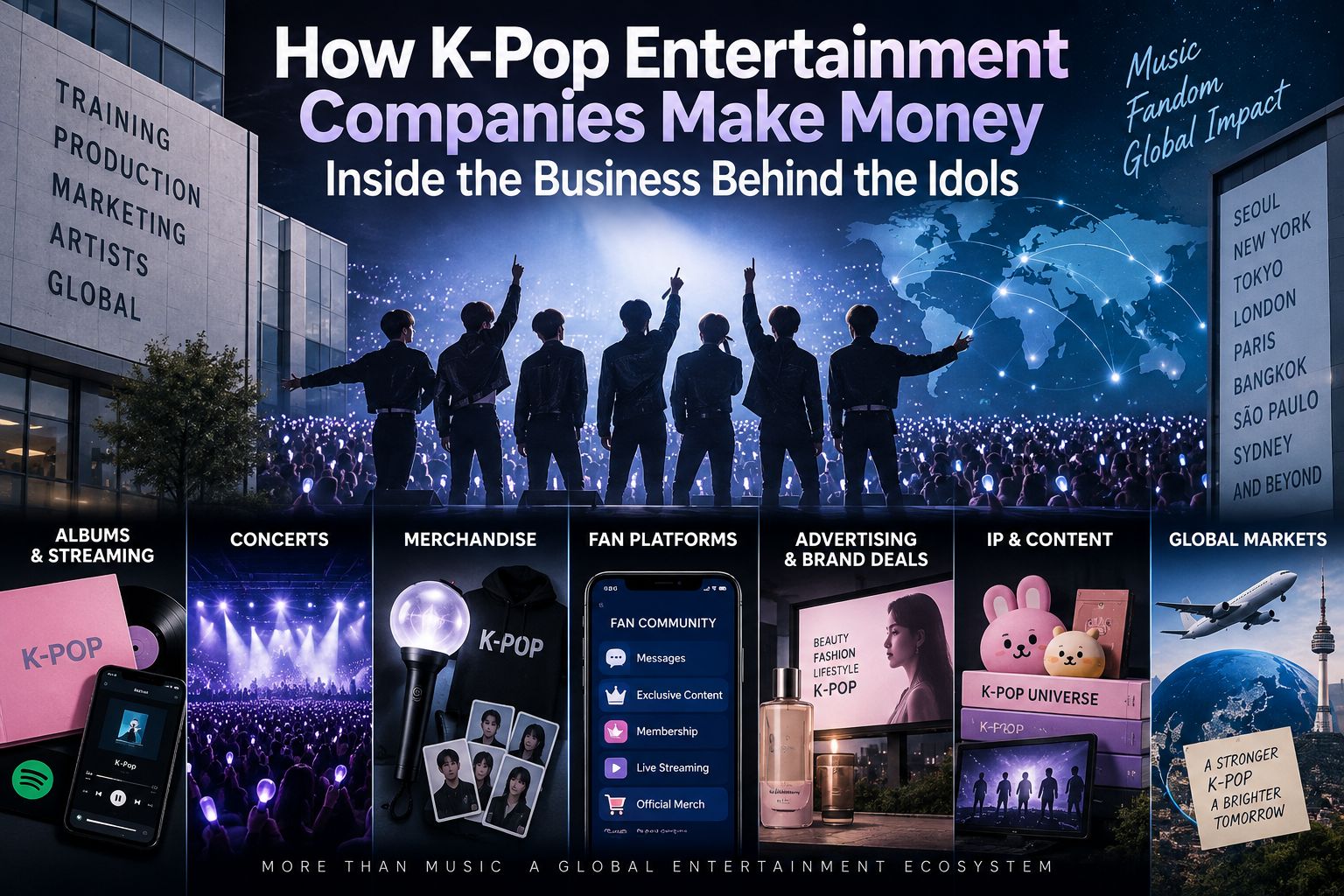
    Why Fandom Is So Valuable to the K-Pop Business

    In the previous chapter, we examined how K-pop entertainment companies make money.

    Fandom is the thread connecting many of those revenue sources.

    A dedicated fan may stream music.

    Purchase albums.

    Attend concerts.

    Buy merchandise.

    Join memberships.

    Use fan platforms.

    Follow brand collaborations.

    Consume additional content.

    But the most valuable characteristic of fandom may be continuity.

    A hit song can disappear from public attention quickly.

    A strong fandom can remain for years.

    It can support an artist through changing musical trends, individual projects, military-service periods, hiatuses, contract changes, and later stages of a career.

    For entertainment companies, that long-term relationship can be more valuable than temporary viral attention.

    Why Trust Matters

    Because fandom has economic value, trust becomes essential.

    Fans need to believe that the company respects the artist.

    They need to believe official products provide reasonable value.

    They need confidence that communication is authentic enough to sustain the relationship.

    Repeated disappointment can damage that trust.

    Artists also need trust.

    They need fans who respect boundaries and understand that performers have private lives.

    The strongest fandom relationship is therefore not one of unlimited access.

    It is one of mutual respect at an appropriate distance.

    Can K-Pop Fandom Become More Sustainable?

    The future of fandom will also involve environmental and economic questions.

    Multiple album versions, international shipping, collectible merchandise, concert travel, and frequent product releases all have environmental costs.

    At the same time, fandom participation can become financially demanding.

    Future fan culture may increasingly ask whether support can be meaningful without requiring constant consumption.

    Digital collectibles, more sustainable packaging, responsible merchandise production, and new forms of participation may become more important.

    The question is not whether fans should stop supporting artists.

    It is whether the industry can create ways of supporting them that remain enjoyable and sustainable over the long term.

    The Next Generation of Fandom

    Technology will continue changing the relationship between artists and audiences.

    Artificial intelligence, real-time translation, virtual spaces, immersive concerts, new community platforms, and other technologies could reduce geographic and language barriers even further.

    A fan may eventually experience a concert or fan event in ways that are difficult to imagine today.

    But technological change will not remove the basic human reason fandom exists.

    People want to connect.

    They want to share excitement.

    They want to belong to communities.

    They want music to mean something beyond the moment it plays through a speaker.

    The platforms will change.

    That emotional need probably will not.

    From Fan Clubs to a Global Network

    The history of K-pop fandom reflects the history of K-pop itself.

    Early idol fan clubs established strong collective identities.

    Fandom colors made communities visible.

    Fan chants turned audiences into participants.

    Online fan cafes created new spaces for organization.

    Fan translators helped international audiences cross language barriers.

    YouTube made performances globally accessible.

    Social media connected fandoms across time zones.

    Streaming and voting created new forms of coordinated participation.

    Dedicated platforms brought fandom and commerce closer together.

    What began as organized support around Korean idol groups evolved into a worldwide digital network.

    Fans Did Not Simply Watch K-Pop Go Global

    This is the central point.

    K-pop was not created by fans alone.

    Artists, producers, songwriters, choreographers, entertainment companies, media organizations, technology platforms, and many others all contributed to its expansion.

    But fans were not passive passengers on that journey.

    They translated.

    They recommended.

    They organized.

    They purchased.

    They traveled.

    They created communities.

    They introduced K-pop to friends who had never heard Korean pop music before.

    Millions of individual actions accumulated into global cultural momentum.

    Fans did not simply watch K-pop go global.

    They helped carry it there.

    What Comes Next?

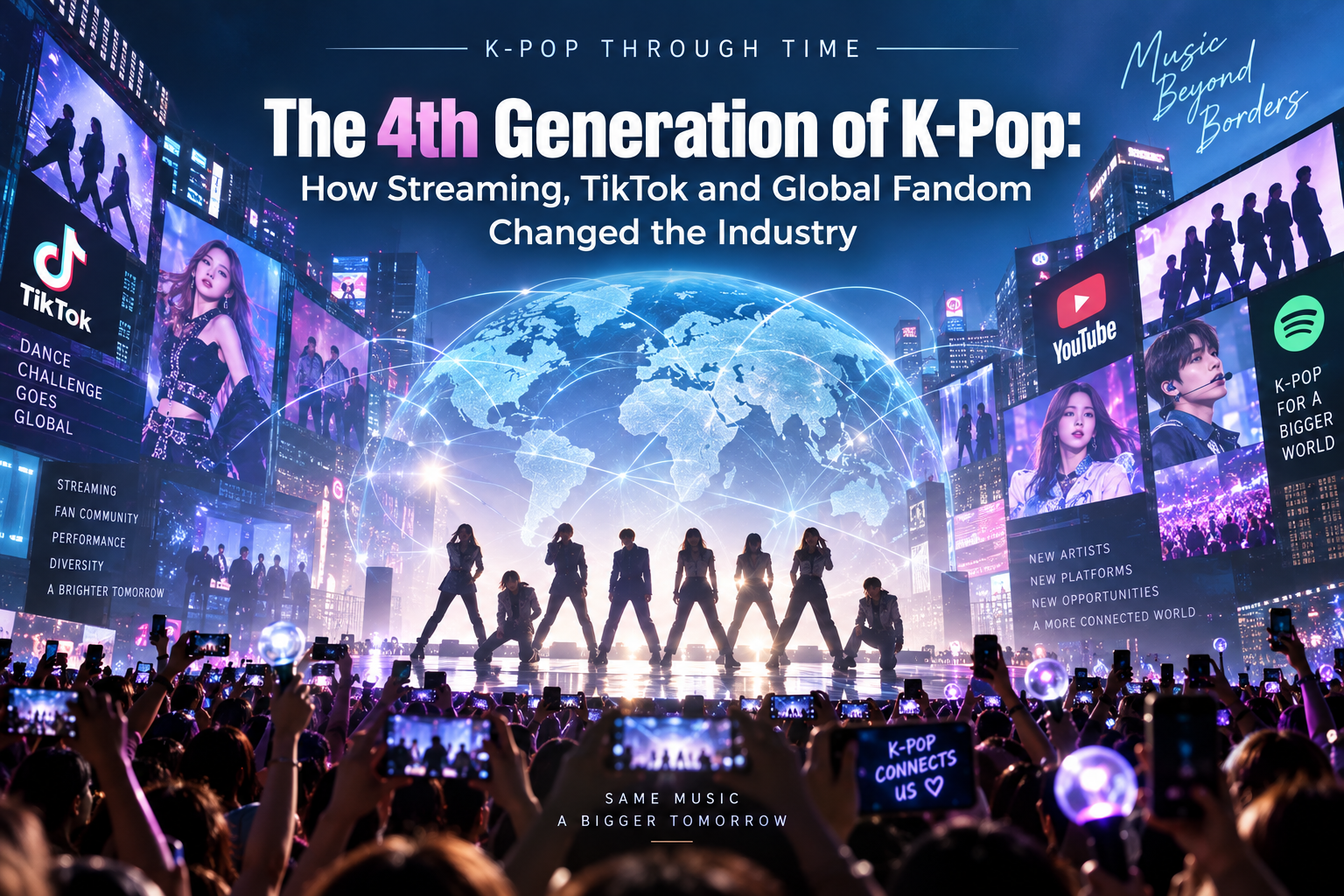
    We have now followed K-pop from its historical development through four generations, into the trainee system, the entertainment business, and the global power of fandom.

    The next question takes us to another defining feature of the industry:

    Why does K-pop look so different from much of global pop music?

    The answer lies in the extraordinary importance of choreography, music videos, fashion, concepts, stage design, and visual storytelling.

    In the next chapter of K-Pop Through Time, we will explore how K-pop became a visual culture—and why performance and image became almost as important as the music itself.


  • How Do K-Pop Companies Make Money?

    How Do K-Pop Companies Make Money?

    K-pop companies earn money from more than album sales. Recorded music, concerts, merchandise, licensing, content and fan memberships can all contribute to the business.

    But three numbers should never be treated as interchangeable: what fans spend, what a company recognizes as revenue, and what an artist receives. They describe different stages of the money flow.

    This guide explains the main revenue streams, the costs behind them and what public financial reports can—and cannot—tell us about artist payments.

    The main revenue streams at a glance

    Revenue streamWhat customers pay forCosts and arrangements to examine
    Recorded musicPhysical albums, downloads and licensed streaming accessProduction, manufacturing, distribution and rights arrangements
    ConcertsTickets and related live experiencesVenues, staging, crews, travel and promoter agreements
    MerchandiseOfficial products and collectiblesDesign, manufacturing, fulfillment and unsold inventory
    LicensingPermission to use protected music, images, characters or other intellectual propertyWho owns the rights and what the agreement permits
    ContentPaid videos, broadcasts or other productionsProduction costs, distribution and platform terms
    MembershipsPaid fan-club benefits and servicesBenefit delivery, platform operation and service costs

    These are useful categories for understanding the business. They are not a universal accounting template: each company’s reporting and contracts can differ.

    Before these revenue streams begin, entertainment companies often invest in training, production and debut preparation. For a closer look at that process, see our guide to how the K-pop trainee system works.

    A documented example: HYBE’s revenue categories

    HYBE’s July 28, 2026 second-quarter announcement separates revenue from artist-driven activities, including concerts and recorded music, from indirect artist activities, including official merchandise, licensing, content and fan-club memberships.

    For that quarter, HYBE reported approximately KRW 1.45 trillion in revenue and KRW 170.9 billion in operating profit. Using those rounded figures, operating profit was about 11.8% of revenue.

    This illustrates the difference between revenue and profit. It does not tell us what any particular artist was paid, and one company’s quarter should not be treated as the typical result for every K-pop agency.

    For detailed comparisons, use the company’s earnings materials and financial statements, rather than combine figures from different reporting periods.

    Album sales and streaming: follow the rights and distribution

    A physical album is a product with recording, packaging, manufacturing and distribution costs. A retail selling price is not automatically the amount that the entertainment company records as revenue.

    Streaming adds another layer. A listener’s subscription payment is not transferred directly and entirely to the artist whose song they play. Platforms, distributors and rights holders participate in the payment chain.

    It is also useful to distinguish the recorded performance from the underlying composition. A performer and a songwriter may participate in different rights and payment arrangements—even when they are the same person.

    Before claiming that an agency earns a particular amount per album or stream, identify the source, rights involved, reporting period and calculation method. There is no single per-stream number that explains every artist’s income.

    Concerts: a sold-out show is not a profit statement

    Ticket revenue can be substantial, but a concert also requires production and delivery. Venue arrangements, staging, sound, lighting, crews, transportation and travel can all affect the result.

    The company’s role matters too. An agency, promoter and venue may have different responsibilities and financial arrangements. A headline reporting a tour’s gross ticket sales does not establish the agency’s own recognized revenue or final profit.

    To interpret a tour figure, ask:

    • Is it gross ticket sales or company revenue?
    • Does it cover one concert, a regional leg or the full tour?
    • Are production expenses already deducted?
    • Does the figure include merchandise or only tickets?

    Audience size helps describe demand. It cannot answer all of these financial questions.

    Merchandise and licensing are different businesses

    Selling an official light stick or shirt involves a physical product: design, manufacturing, storage and delivery matter. High sales do not remove the risk of production costs or leftover inventory.

    Licensing works differently. It gives another party permission to use specified intellectual property under agreed terms. A collaboration can involve a license, product sales, promotional services or a combination of arrangements.

    Do not assume that every branded product sends the same share of its retail price to the agency or artist. The relevant agreement determines the arrangement.

    Fan memberships and paid content

    Memberships and paid content can create revenue beyond individual music releases. However, the company must also deliver what customers purchased: content, services or membership benefits.

    A membership fee is therefore a business receipt with associated obligations and costs. Subscriber counts alone are not enough to calculate profit without knowing prices, periods, fees and delivery expenses.

    Different activities may support one another. A concert can encourage merchandise purchases; a release can draw attention to a fan platform. That connection is a useful way to understand the business, but it does not replace financial evidence.

    Revenue, operating profit and artist payments

    Revenue describes income recognized from the company’s activities under its accounting rules.

    Operating profit reflects operating revenue and operating expenses. It is different from net profit, which includes additional items such as financing and tax effects.

    Artist payments depend on the relevant contracts and rights. Public company revenue is not an artist’s personal income, and a company’s operating margin is not an artist’s revenue share.

    When someone says an idol receives a certain percentage, ask: a percentage of what? Gross receipts, revenue after specified deductions, songwriting royalties and performance income are different bases.

    A number without a clear source and calculation basis can be misleading.

    Why there is no universal idol payment formula

    Contract terms can differ by company, artist, activity and period. Questions about cost recovery, allocation of expenses and payment timing require the actual agreement or a reliable disclosure.

    It would be inaccurate to assume that every trainee owes the same debt, every group splits income equally, or every company applies one industry-wide percentage.

    Songwriting, producing, individual activities and other rights can introduce additional income arrangements. Even a detailed annual report will usually not reveal a complete individual artist settlement.

    If the terms are not public, state that limitation rather than fill the gap with a fan estimate.

    How to read a K-pop company earnings headline

    Before drawing a conclusion, check five things:

    1. Period: Is the figure quarterly, annual or cumulative?
    2. Scope: Does it cover the parent company or a consolidated group?
    3. Measure: Is it revenue, operating profit, net profit or concert gross?
    4. Mix: Which activities contributed to the result?
    5. Evidence: Does the claim link to an official release or financial statement?

    A stronger quarter may reflect the timing of releases and tours. Compare like periods and reporting scopes before describing a lasting trend.

    Frequently asked questions

    Do album sales show how much an idol earns?

    No. Sales are one input to a larger business and contractual process. Manufacturing, distribution, rights and settlement arrangements also matter.

    Are concerts always the most profitable activity?

    Not necessarily. Revenue size and profitability are different questions, and results depend on costs and agreements.

    Can fans calculate an artist’s income from agency revenue?

    Not reliably without the necessary contract and settlement information. Company-wide figures are not personal earnings disclosures.

    Where should I check financial claims?

    Start with official earnings releases, investor-relations materials and financial statements. Use media reports to find the underlying source, then check the original period and definition.

    Understanding the K-pop business means following both the revenue and the costs. Music, live events and fan products can support the same artist ecosystem, while company profit and individual artist income remain separate questions.

    Sources and further reading


  • The 4th Generation of K-Pop: How Streaming, TikTok and Global Fandom Changed the Industry

    The 4th Generation of K-Pop: How Streaming, TikTok and Global Fandom Changed the Industry

    What Is the Fourth Generation of K-Pop?

    By the time K-pop entered the late 2010s and early 2020s, becoming “global” was no longer a distant ambition.

    The foundations had already been built.

    Earlier generations established the idol training system, expanded the Korean Wave across Asia, embraced YouTube and social media, and demonstrated that Korean artists could build enormous international audiences.

    The fourth generation inherited that world.

    For many newer groups, international fans were present almost from the moment of debut. Music videos were released to worldwide audiences simultaneously. Albums could reach overseas buyers quickly, and fans could follow performances, livestreams, interviews, dance practices, and social-media updates regardless of where they lived.

    The central question had changed.

    Earlier generations often asked:

    How can K-pop reach the world?

    The fourth generation increasingly faced a different challenge:

    How can a K-pop group stand out when the whole world is already watching?

    When Did the Fourth Generation Begin?

    As with every K-pop generation, there is no universally accepted starting date.

    The boundaries are debated, and some artists may be classified differently depending on the source or fan community.

    In general, the fourth generation is commonly associated with groups that emerged from the late 2010s into the early 2020s.

    Artists frequently connected with this era include Stray Kids, ATEEZ, TXT, ITZY, aespa, ENHYPEN, IVE, and LE SSERAFIM, among others.

    They entered an industry transformed by streaming, smartphones, global e-commerce, social media, and increasingly sophisticated international fandoms.

    This technological environment affected almost every stage of an idol group’s career.

    Stray Kids and the Importance of Musical Identity

    Stray Kids, who debuted under JYP Entertainment in 2018, became one of the era’s most prominent examples of a group developing a strong musical identity alongside substantial member participation in music creation.

    Their work often emphasized powerful production, intense performance, and a recognizable sonic character.

    This mattered in an increasingly crowded industry.

    As more groups competed for attention, having polished choreography and attractive visual concepts was no longer enough by itself.

    Successful artists needed to become recognizable.

    A listener encountering only a short section of a song or performance needed a reason to remember the group and search for more.

    Fourth-generation competition therefore placed growing importance on identity—musical, visual, conceptual, and personal.

    ATEEZ and the Global Potential of Performance

    ATEEZ, who also debuted in 2018, demonstrated another important feature of the era: an artist could develop significant international momentum even without beginning at one of the industry’s historically largest agencies.

    Strong performances, ambitious concepts, touring, and highly engaged fandom helped the group build recognition across international markets.

    This reflected a broader change in the structure of K-pop discovery.

    Traditional agency power still mattered enormously. Large companies had advantages in investment, distribution, media access, established fan attention, and promotional infrastructure.

    But digital platforms created additional pathways.

    An impressive performance could circulate online.

    A fan could recommend a group across borders.

    A concert clip could introduce an artist to thousands of new viewers.

    Global fandom could begin growing before mainstream domestic recognition reached the same scale.

    The route to success was becoming less predictable.

    TXT and a Generation Raised Inside Global K-Pop

    When TOMORROW X TOGETHER (TXT) debuted under Big Hit Entertainment in 2019, they entered a company whose global position had been transformed by BTS.

    That context illustrated how dramatically K-pop had changed within only a few years.

    New groups could now debut in an environment where international media attention, global fan communities, overseas distribution, and worldwide digital promotion were already part of the industry’s infrastructure.

    TXT developed themes around youth, friendship, growth, uncertainty, and transition while building an audience across multiple markets.

    Their career reflected a defining characteristic of fourth-generation K-pop:

    Global expansion did not necessarily have to happen after domestic success.

    Domestic and international growth could occur at the same time.

    ITZY and the Continuing Evolution of Girl-Group Identity

    ITZY, who debuted under JYP Entertainment in 2019, arrived with an identity centered strongly on confidence and individuality.

    Their early releases demonstrated how girl-group concepts continued to evolve beyond older expectations about what female idols should look, sound, or perform like.

    Powerful choreography became increasingly central.

    Performance videos and dance practices could attract audiences of their own.

    This was particularly important in the fourth-generation environment because fans were consuming music through many different formats.

    A song might be discovered through its official music video.

    But it could just as easily be discovered through a dance clip, a concert performance, a short-form video, or a fan-created edit.

    Music and performance were becoming inseparable parts of digital discovery.

    aespa and the Expansion of K-Pop’s Digital Imagination

    When aespa debuted under SM Entertainment in 2020, their early concept incorporated virtual and digital elements into the group’s identity.

    The idea reflected a larger cultural moment.

    Online life was becoming increasingly intertwined with offline identity. Gaming, virtual worlds, artificial characters, social platforms, and digital communities were becoming familiar parts of everyday culture.

    K-pop had always been interested in elaborate concepts and fictional worlds.

    The fourth generation pushed those experiments further.

    Music could be connected to narrative universes.

    Visual symbols could continue across multiple releases.

    Fans could interpret clues and debate storylines.

    A comeback could function not only as a collection of songs but as another chapter in a larger fictional world.

    Then the Pandemic Changed Everything

    Just as the fourth generation was developing, the COVID-19 pandemic disrupted the global entertainment industry.

    Concerts were canceled or postponed.

    International travel became difficult.

    In-person fan events were restricted.

    For newly debuted groups, this created an extraordinary problem.

    K-pop had become a global performance industry at precisely the moment when artists could no longer easily meet global audiences face to face.

    But the industry had one major advantage.

    Its digital infrastructure was already mature.

    Livestreams, online concerts, social-media communication, video content, virtual fan events, and other forms of remote interaction became even more important.

    Groups that could not physically travel around the world could still build communities around the world.

    The pandemic accelerated a transformation that was already underway.

    TikTok Changed the Speed of Music Discovery

    At the same time, short-form video was becoming one of the most influential forces in popular music.

    TikTok changed the way songs could spread.

    A listener no longer needed to encounter an entire music video or even a complete song.

    Sometimes a few seconds were enough.

    A memorable dance movement, chorus, beat, lyric, or visual moment could become the starting point for millions of short videos.

    This created a new form of music discovery.

    Songs could travel through challenges, memes, edits, dance clips, and user-generated content.

    For K-pop—an industry already built around choreography, visual performance, memorable concepts, and highly active fandoms—the format was especially powerful.

    But it also created a new pressure.

    In an environment of endless scrolling, artists were competing not only for listeners.

    They were competing for seconds of attention.

    And that would fundamentally influence how fourth-generation K-pop was promoted, performed, and consumed.


    ENHYPEN and the Rise of the Global Fan From Day One

    ENHYPEN, formed through the survival program I-LAND and debuting in 2020, illustrated how dramatically the relationship between debut and international fandom had changed.

    Viewers from different countries could follow the members before the group officially debuted.

    This meant that fandom formation could begin before the first album was released.

    That was a major departure from earlier eras.

    Traditionally, an idol group would debut in South Korea, establish recognition, and then gradually pursue overseas markets. By the fourth generation, digital platforms and internationally accessible survival programs could create audiences across borders from the beginning.

    Fans were no longer simply waiting for Korean popularity to determine which artists they should follow.

    They could participate in the discovery process themselves.

    The Debut Stage Became Global

    This change affected the meaning of a K-pop debut.

    A new group’s first music video could immediately receive comments from viewers in multiple languages.

    International fans could preorder albums.

    Fan accounts could translate interviews within hours.

    Performance clips could circulate across social platforms before traditional media had fully evaluated the group.

    The first weeks of an idol career were therefore no longer purely domestic.

    For many fourth-generation acts, the debut stage itself had become global.

    That increased opportunity—but it also increased pressure.

    New groups were expected to develop a distinctive identity almost immediately.

    IVE and the Power of Immediate Impact

    When IVE debuted in 2021, the group quickly demonstrated the importance of strong songs, recognizable member presence, visual identity, and highly repeatable performance moments.

    Their rapid rise showed that fourth-generation competition could move extremely quickly.

    Digital audiences did not necessarily require years to decide that a group mattered.

    A successful release could generate enormous attention in a short period of time.

    But maintaining that attention was harder.

    One popular song might create visibility.

    Building a lasting career required repeated releases capable of strengthening the group’s identity rather than simply reproducing the same formula.

    This distinction between viral attention and sustainable fandom became increasingly important in the streaming era.

    LE SSERAFIM and the Performance-Driven Era

    LE SSERAFIM, debuting in 2022, entered an environment where performance itself had become a major form of global content.

    Choreography was no longer something audiences saw mainly on televised music programs.

    It existed everywhere.

    Dance practices, studio performances, fancams, concert clips, challenge videos, award-show stages, and short-form content could all become separate points of discovery.

    This encouraged groups to develop performances that remained compelling even when removed from the traditional music-video format.

    The result was an era in which a K-pop song increasingly lived several lives at once:

    as audio,

    as a music video,

    as choreography,

    as short-form content,

    as a live performance,

    and as fan-generated media.

    The Extraordinary Competition Among Fourth-Generation Girl Groups

    One of the defining features of this period was the remarkable strength and diversity of girl groups.

    ITZY emphasized confidence and high-energy performance.

    aespa combined powerful music with futuristic imagery and digital-world concepts.

    IVE developed an elegant, self-assured pop identity.

    LE SSERAFIM built a performance-centered image around ambition, confidence, and resilience.

    Other influential acts contributed additional sounds and approaches to an increasingly competitive landscape.

    Rather than one dominant formula defining the era, audiences encountered multiple interpretations of what a successful K-pop girl group could be.

    This variety helped broaden the market.

    Listeners could move between groups based on music, choreography, fashion, personality, concept, or visual style.

    Streaming Changed What Success Looked Like

    The rise of global streaming platforms also changed how K-pop success could be measured.

    Physical album sales remained extremely important, particularly because K-pop albums often functioned as collectible objects containing photobooks, photocards, and other exclusive materials.

    But streaming created another layer of visibility.

    Listeners could access songs instantly without purchasing an album.

    International audiences could participate in a comeback at the same moment as Korean audiences.

    Playlist placement could introduce songs to people outside established fandoms.

    Streaming data also provided companies with faster evidence of where international audiences were developing.

    The geography of fandom became easier to see.

    That information could influence touring, promotion, partnerships, and future market strategies.

    Short-Form Video Changed Song Promotion

    TikTok and other short-form platforms did more than create another place to advertise songs.

    They changed promotional behavior itself.

    The dance challenge became a recognizable part of K-pop comeback culture.

    Idols from different groups could appear together performing a short section of choreography.

    These collaborations created cross-fandom exposure while also presenting idols in a more casual format than traditional television stages.

    A promotional clip could be filmed quickly and distributed globally almost instantly.

    This made marketing faster, more collaborative, and more participatory.

    Fans were not simply watching official promotion.

    They could recreate it.

    The Advantage—and Risk—of Virality

    Virality offered enormous opportunities.

    A short clip could expose a song to millions of people who had never intentionally searched for K-pop.

    But virality also had limitations.

    A person who watches a fifteen-second challenge is not automatically a long-term fan.

    A trend can disappear as quickly as it appears.

    Algorithms can redirect attention toward something new within days.

    This created a central challenge for fourth-generation artists:

    How do you convert attention into attachment?

    The most successful groups needed more than viral moments.

    They needed recognizable music, compelling members, strong performances, consistent content, and a reason for casual viewers to become invested fans.

    Global Fandom Became an Organized Network

    Fourth-generation fandom was not simply larger geographically.

    It was increasingly organized as a network.

    Fans translated content.

    They created streaming guides.

    They organized album purchases.

    They shared voting information.

    They produced edits, memes, tutorials, and explanatory videos.

    They created online communities dedicated to particular members or groups.

    In many cases, fans acted as informal international promoters.

    This activity was not controlled entirely by entertainment companies.

    It emerged from fandom itself.

    The relationship between company marketing and fan activity therefore became increasingly interconnected.

    Official content generated fan activity, and fan activity generated additional visibility for official content.

    Language Became Less of a Barrier—but It Did Not Disappear

    K-pop’s international expansion also demonstrated that a song did not necessarily need to be entirely in English to reach global listeners.

    Audiences had become increasingly comfortable encountering music in languages they did not speak fluently.

    Subtitles, fan translations, lyric explanations, and online communities helped reduce language barriers.

    At the same time, companies increasingly experimented with English-language releases, multilingual versions, international collaborations, and members with diverse linguistic backgrounds.

    The goal was not always to replace Korean.

    Instead, the industry developed multiple ways to make Korean-centered pop culture more accessible internationally.

    This distinction is important.

    K-pop’s globalization was not simply a process of becoming more Western.

    It was also a process of teaching global audiences how to participate in a cultural industry that continued to retain a strong Korean center.

    International Fans Became Part of Business Strategy

    By the fourth generation, international fandom could no longer be treated as a bonus.

    It influenced fundamental business decisions.

    Companies considered overseas album distribution earlier.

    International touring plans became more ambitious.

    Global brand partnerships became increasingly valuable.

    Social-media communication targeted multiple markets.

    Content was often designed with international circulation in mind.

    Even smaller agencies could recognize that a dedicated overseas fandom might become commercially significant.

    This changed the economics of the idol industry.

    The domestic Korean market remained crucial, but it was now one part of a much larger commercial landscape.

    From Exporting K-Pop to Building for Global Audiences

    Perhaps the biggest shift was conceptual.

    Earlier K-pop globalization often involved taking a successful Korean product and introducing it overseas.

    Fourth-generation K-pop increasingly developed within a global environment from the beginning.

    That does not mean every group was created specifically for Western audiences, nor does it mean domestic popularity became unimportant.

    Rather, the distinction between “Korean promotion” and “international promotion” became less clear.

    A music video uploaded in Seoul could immediately become content in São Paulo, Los Angeles, Bangkok, Paris, Manila, Tokyo, or Jakarta.

    A fan community could form across several continents simultaneously.

    K-pop was moving beyond the idea of export.

    It was becoming a globally networked industry.

    And that transformation would bring both extraordinary opportunities and new problems.


    Performance Became a Global Competitive Advantage

    Fourth-generation K-pop developed in an environment where almost every performance could become global content.

    A television stage filmed in Seoul might be watched hours later by fans across several continents. A dance practice could attract millions of views. A fancam focused on a single member could introduce an entire group to new listeners.

    This changed the value of performance.

    Precise choreography had long been part of K-pop, but fourth-generation groups faced audiences who could replay, slow down, compare, edit, and redistribute performances endlessly.

    Groups such as Stray Kids, ATEEZ, TXT, ITZY, aespa, ENHYPEN, IVE, and LE SSERAFIM therefore competed not only through songs but through the complete visual experience surrounding those songs.

    Stage presence became digital currency.

    The Algorithm Became a New Gatekeeper

    Digital platforms weakened some of the traditional barriers that once determined which artists could reach international audiences.

    But they created another powerful force: the algorithm.

    YouTube recommendations, streaming playlists, TikTok feeds, and other personalized systems increasingly influenced what people encountered.

    This could benefit K-pop enormously.

    Someone who had never deliberately searched for Korean music might encounter a dance challenge or performance clip and become curious about the original song.

    But algorithmic discovery also created uncertainty.

    Entertainment companies could plan a comeback carefully, but they could not completely control which fifteen-second moment would become popular—or whether the algorithm would amplify it at all.

    The industry gained access to a larger audience while becoming increasingly dependent on platforms it did not control.

    More Content, More Competition for Attention

    The fourth generation also accelerated K-pop’s already demanding content cycle.

    Fans could expect concept photographs, trailers, teasers, music videos, dance practices, behind-the-scenes footage, livestreams, short-form challenges, variety content, interviews, and social-media updates.

    This abundance helped maintain fan engagement between releases.

    But it created a paradox.

    The more content the industry produced, the more content every individual artist had to compete against.

    K-pop groups were no longer competing only with other K-pop groups.

    They were competing with global musicians, influencers, games, television, streaming entertainment, and an endless social-media feed.

    The scarce resource was no longer access to content.

    It was human attention.

    Physical Albums Survived the Streaming Revolution

    One of the most interesting features of modern K-pop is the continued importance of physical albums.

    In many music markets, streaming reduced the role of CDs as the primary way people consumed recorded music.

    K-pop developed a different relationship with the physical album.

    Albums became collectible experiences.

    Photobooks, photocards, posters, multiple versions, limited inclusions, and elaborate packaging gave fans reasons to own a physical object even when they listened to the music digitally.

    This model supported strong album sales and encouraged collectors to purchase multiple versions.

    It also demonstrated a broader strength of the K-pop business model:

    The industry learned to combine digital access with physical ownership rather than treating them as opposites.

    But Commercial Success Created New Questions

    The collectible-album model also generated criticism.

    Multiple versions and randomized inclusions can encourage repeated purchases, raising questions about consumer pressure and environmental waste.

    The rapid production of merchandise and physical products creates additional sustainability concerns.

    These debates matter because K-pop’s global growth has increased the scale of its commercial footprint.

    Success creates responsibility.

    As the industry grows, questions about sustainability, ethical marketing, and the environmental cost of fandom are likely to become more important.

    The Human Cost of Constant Visibility

    Fourth-generation idols also operate in an environment of unprecedented visibility.

    Social media can create closeness between artists and fans, but constant visibility has a cost.

    Every performance can be analyzed.

    Every interview can be clipped.

    Minor mistakes can spread internationally.

    Appearance, behavior, relationships, and personal decisions may become subjects of intense public discussion.

    Young performers can face pressure from training, competition, touring, public expectations, and continuous online judgment.

    This creates an important tension at the center of modern K-pop.

    Fans often value a feeling of closeness to idols.

    But idols also need boundaries, privacy, rest, and space to exist as people rather than permanent content.

    The future health of the industry will depend partly on how well companies and fan cultures recognize that distinction.

    Globalization Also Changed Who Can Become a K-Pop Idol

    As K-pop’s audience became more international, the industry itself became increasingly diverse.

    Non-Korean members had existed in earlier generations, but multinational lineups became more familiar as companies recruited talent from different countries.

    This served several purposes.

    International members could bring linguistic and cultural knowledge.

    They could help groups communicate with overseas audiences.

    And their presence reflected the fact that K-pop’s talent pool was becoming increasingly international.

    This raises a fascinating question:

    Does K-pop have to be made only by Koreans to remain K-pop?

    The industry’s evolution suggests that nationality alone is not enough to define the genre.

    K-pop is also shaped by its training systems, production practices, performance culture, entertainment companies, promotional structures, fan relationships, and historical roots in South Korea.

    What Makes K-Pop “K-Pop” in a Global Age?

    This question becomes more complicated as Korean entertainment companies develop artists for international markets and collaborate with producers, songwriters, choreographers, and business partners around the world.

    K-pop has never existed in cultural isolation.

    It has absorbed and reinterpreted influences from American pop, hip-hop, R&B, electronic music, Japanese popular culture, and many other sources.

    What makes modern K-pop distinctive is not that every musical element originated in Korea.

    Rather, it is the particular entertainment ecosystem that South Korea developed around those influences.

    Fourth-generation globalization made that ecosystem increasingly international without completely removing its Korean center.

    From the Fourth Generation to What Comes Next

    By the early and mid-2020s, another debate began appearing among fans and media:

    Had K-pop already entered a fifth generation?

    As always, there is no official authority responsible for declaring a new generation.

    Generational labels are useful ways of discussing historical change, but they should not be treated as rigid scientific categories.

    What matters more than the label is the transformation taking place underneath it.

    New groups are entering an industry shaped by short-form video, global streaming, artificial intelligence, virtual performers, multinational talent, increasingly sophisticated fandom platforms, and international business strategies.

    The next era may therefore be defined less by K-pop’s ability to reach the world and more by how deeply global structures become embedded inside K-pop itself.

    Why the Fourth Generation Matters

    The fourth generation may not have needed to prove that K-pop could become global.

    Previous generations had already done that.

    Its historical importance lies elsewhere.

    It demonstrated what happens after globalization becomes normal.

    Stray Kids and ATEEZ showed how powerful performance and distinctive identity could build major international audiences.

    TXT and ENHYPEN reflected an industry where global fandom could develop from the beginning of a career.

    ITZY helped reinforce the importance of high-impact performance.

    aespa explored the relationship between K-pop and digital-world concepts.

    IVE and LE SSERAFIM emerged during an extraordinarily competitive period for girl groups and demonstrated how quickly new acts could achieve widespread visibility.

    Together, these artists helped define an era in which K-pop no longer had to knock on the world’s door.

    The door was already open.

    The challenge was standing out once everyone could enter.

    Four Generations, One Continuing Transformation

    Looking across the history of modern K-pop reveals a remarkable progression.

    The first generation helped build the idol system.

    The second generation expanded the Korean Wave across Asia and used the early digital world to reach new audiences.

    The third generation transformed that growing international interest into sustained global influence.

    The fourth generation inherited a worldwide audience and learned to compete inside an algorithm-driven, streaming-centered, short-form-video culture.

    Each generation did not erase the one before it.

    It inherited its infrastructure and responded to a new technological and cultural environment.

    That is why K-pop history is best understood not as a sequence of disconnected eras but as a continuing transformation.

    The Next Question for K-Pop

    K-pop has already answered one of the biggest questions in its history:

    Can music centered in South Korea become a worldwide cultural force?

    The answer is clearly yes.

    The more interesting questions now concern what comes next.

    Can the industry remain innovative in an increasingly crowded global market?

    Can it balance commercial growth with artist well-being?

    Can physical fandom culture become more sustainable?

    Can global expansion occur without erasing the cultural identity that made K-pop distinctive?

    And as Korean entertainment companies create increasingly international groups, where will the boundary between K-pop and global pop eventually lie?

    Those questions will shape the next chapter.

    Because the history of K-pop is no longer simply the story of Korean music traveling outward.

    It is increasingly the story of how Korea and the world are reshaping popular music together.

    Continue Through the History of K-Pop

    This article is part of the continuing history explored on K-Pop Through Time.

    The earlier chapters examine the origins of modern K-pop, the first generation that established the idol system, the second generation that expanded the Korean Wave, and the third generation that turned K-pop into a sustained global cultural force.

    The fourth generation shows what happened after global success became part of the industry’s normal environment.

    Next, we will move beyond generations and examine one of the most important forces behind K-pop’s worldwide success:

    How the K-pop trainee system works—and why it became one of the most influential and controversial parts of the Korean entertainment industry.


  • The 3rd Generation of K-Pop: How BTS, BLACKPINK and a New Era Took K-Pop Global

    The 3rd Generation of K-Pop: How BTS, BLACKPINK and a New Era Took K-Pop Global

    What Was the Third Generation of K-Pop?

    By the early 2010s, K-pop had already traveled a remarkable distance.

    The first generation had helped establish the modern idol system. The second generation expanded that system across Asia and learned how to use YouTube, social media, international concerts, and increasingly connected fandoms to reach audiences beyond South Korea.

    The third generation of K-pop entered a very different world.

    Smartphones were becoming part of everyday life. YouTube was firmly established as a global entertainment platform. Social media allowed information to cross borders almost instantly, while streaming services were beginning to change how people discovered and consumed music.

    For K-pop, these changes created an extraordinary opportunity.

    Artists no longer had to depend entirely on traditional broadcasters, physical distribution networks, or local media companies to reach international listeners.

    A performance uploaded in Seoul could be watched in Los Angeles, Paris, Bangkok, São Paulo, or Manila within minutes.

    K-pop had spent years building a bridge to the world.

    The third generation would begin crossing it at unprecedented scale.

    When Did the Third Generation of K-Pop Begin?

    There is no official authority that defines exactly where one K-pop generation ends and another begins.

    Generational boundaries are debated among fans, journalists, and researchers, and different sources may classify certain artists differently.

    However, the third generation is commonly associated with groups that emerged and became prominent during much of the 2010s.

    Among the era’s most influential acts were EXO, BTS, Red Velvet, TWICE, SEVENTEEN, and BLACKPINK, alongside many other successful artists.

    These groups did not all follow the same path.

    Some developed enormous fandoms in South Korea and across Asia. Others became especially powerful in album sales, touring, digital music, or social media. Some eventually reached levels of mainstream international recognition that earlier generations had rarely experienced.

    Together, they helped redefine the possible scale of K-pop.

    EXO and the Power of a Massive Fandom

    When EXO debuted under SM Entertainment in 2012, the group arrived with an ambitious concept and a strategy designed with multiple markets in mind.

    Their rise demonstrated that the traditional strengths of the idol industry were still extremely powerful.

    Physical albums mattered.

    Music shows mattered.

    Fan communities mattered.

    Carefully planned concepts, choreography, visual storytelling, and member personalities mattered.

    EXO developed a large and highly organized fandom and became one of the defining boy groups of their generation.

    Their success was especially important during a period when the music industry was becoming increasingly digital.

    While many observers predicted the decline of physical music, K-pop demonstrated that albums could remain culturally and commercially valuable when connected to fandom.

    Photobooks, collectible inclusions, multiple versions, distinctive packaging, and fan participation helped transform physical albums into more than simple containers for recorded music.

    They became part of the relationship between artists and fans.

    This model would become increasingly important across the K-pop industry.

    BTS Entered From Outside the Largest Agencies

    In 2013, BTS debuted under Big Hit Entertainment.

    At the time, Big Hit was not one of the companies traditionally regarded as the dominant powers of the Korean idol industry.

    BTS therefore entered a highly competitive market without the same institutional advantages enjoyed by some artists from larger agencies.

    Their early years did not immediately resemble the extraordinary global success for which they would later become known.

    Instead, their rise was gradual.

    The group developed music and storytelling that frequently addressed youth, ambition, pressure, uncertainty, identity, and personal growth.

    Their members also became closely associated with communication through digital platforms.

    This combination of music, narrative, personality, and online interaction helped create a strong relationship with an expanding fan community.

    That relationship would eventually become one of the most important examples of digital-era fandom in popular music.

    Social Media Was No Longer Just a Promotional Tool

    Second-generation K-pop had already demonstrated the international power of YouTube and online fan communities.

    During the third generation, digital platforms became even more deeply integrated into everyday idol culture.

    Social media was no longer simply a place to announce a new album.

    It became part of the ongoing story of an artist.

    Fans could encounter music videos, dance practices, behind-the-scenes footage, livestreams, interviews, short clips, photographs, and informal updates.

    This created a continuous stream of content between major releases.

    For international fans, the effect was particularly important.

    Physical distance from South Korea mattered less than before.

    Someone living thousands of kilometers away could follow an artist’s activities daily and participate in a fan community that operated across countries and time zones.

    The traditional boundary between a “domestic fan” and an “international fan” was becoming increasingly difficult to define.

    Red Velvet and the Expanding Range of Girl-Group Music

    Red Velvet, who debuted under SM Entertainment in 2014, illustrated another important characteristic of third-generation K-pop: the growing sophistication and variety of group concepts.

    Their identity became associated with contrasting musical and visual approaches, allowing the group to explore different styles rather than remaining within a single formula.

    This reflected a broader development across the industry.

    K-pop audiences were becoming accustomed to frequent conceptual changes.

    A group could move between bright and darker imagery, experiment with different genres, develop complex visual worlds, and still maintain a recognizable identity.

    Concept itself was becoming a form of storytelling.

    And as international audiences grew, these visual and musical identities could be discussed, interpreted, and shared by fans around the world.

    SEVENTEEN and the Appeal of Creative Participation

    When SEVENTEEN debuted under Pledis Entertainment in 2015, the group became known not only for its large membership and synchronized performances but also for significant member participation in aspects of its music and performance creation.

    This helped reinforce an increasingly important idea within K-pop.

    Idols could be highly trained performers while also contributing creatively to the work associated with their groups.

    For audiences, this could deepen the sense of artistic identity surrounding an act.

    It also demonstrated how the idol system continued to evolve rather than remaining fixed.

    The industry was becoming larger, but successful groups still needed ways to distinguish themselves.

    The Stage Was Set for an Even Bigger Transformation

    By the middle of the 2010s, K-pop had developed nearly all the ingredients necessary for much larger global expansion.

    There were experienced entertainment companies.

    There were sophisticated trainee and production systems.

    There were strong domestic and Asian markets.

    There were international fan communities.

    There was YouTube.

    There was social media.

    And increasingly, there was a global audience that did not see Korean-language music as something that could only be enjoyed inside Korea.

    Then two developments would accelerate the transformation.

    One was the rise of a new generation of enormously influential girl groups, including TWICE and BLACKPINK.

    The other was the extraordinary international growth of BTS.

    Together with the broader third-generation ecosystem, these artists would help move K-pop into spaces that once seemed extraordinarily difficult for Korean musicians to reach.

    Major global charts.

    Large-scale world tours.

    International award shows.

    Global brand campaigns.

    Stadiums.

    And the center of worldwide pop-culture conversation.

    The third generation was about to change the meaning of the word “global” in K-pop.


    TWICE and the Power of a New Generation of Girl Groups

    When TWICE debuted under JYP Entertainment in 2015, the group entered a K-pop industry that was already becoming increasingly international.

    Their rise showed that strong domestic popularity and overseas expansion did not have to be separate strategies.

    With memorable songs, recognizable choreography, distinctive member personalities, and an accessible group identity, TWICE built a powerful fan base in South Korea while also gaining substantial popularity elsewhere in Asia.

    Japan became particularly important.

    The group’s success there continued a tradition established by earlier Korean artists, but it also reflected how deeply K-pop had become integrated into the Japanese music market.

    By this point, Korean idol groups were no longer simply occasional foreign visitors.

    For leading acts, international promotion could be built into a long-term career.

    BLACKPINK and a New Model of Global Visibility

    In 2016, YG Entertainment debuted BLACKPINK.

    From the beginning, the group combined music, performance, fashion, and visual identity in ways that were highly compatible with the global social-media era.

    Their music videos became major digital events.

    Their individual members developed recognizable public identities, while the group’s association with fashion and luxury brands extended their cultural presence beyond music.

    This was significant.

    K-pop artists were increasingly becoming global cultural figures whose influence could move between music, fashion, advertising, beauty, and social media.

    BLACKPINK’s international growth demonstrated how a K-pop group could build visibility simultaneously across multiple markets rather than following a simple Korea-first, overseas-later path.

    Their rise also showed the growing importance of digital audiences.

    A fan did not necessarily need to encounter BLACKPINK through Korean television or radio.

    The first point of contact could be a music video, a performance clip, a social-media post, a fashion campaign, or a recommendation from another fan.

    K-pop discovery had become decentralized.

    BTS and the Expansion of Global Fandom

    At roughly the same time, BTS was undergoing an extraordinary transformation.

    The group’s international audience had grown steadily through music, online content, performances, and direct digital communication.

    Their fandom, known as ARMY, became increasingly international and highly connected.

    This mattered because fandom in the digital era could do far more than simply admire an artist.

    Fans could organize.

    They could translate interviews and lyrics, share performances, recommend songs, coordinate online activities, discuss albums, introduce new listeners to the group, and connect communities across languages and countries.

    The internet allowed millions of individual acts of participation to reinforce one another.

    BTS did not invent global fan culture, and K-pop fandom had been highly organized long before their debut.

    But their rise demonstrated how powerful that culture could become when combined with globally accessible digital platforms.

    When Language Became Less of a Barrier

    For decades, the international music business often treated language as a major limitation.

    English-language music enjoyed enormous advantages in many global markets, and artists singing primarily in other languages frequently faced barriers to mainstream exposure.

    Third-generation K-pop challenged some of those assumptions.

    International listeners were increasingly comfortable discovering songs before understanding every lyric.

    Translations were easy to find.

    Fans explained cultural references.

    Subtitles made video content more accessible.

    Most importantly, digital platforms allowed listeners themselves to decide what they wanted to hear rather than depending entirely on traditional gatekeepers.

    This did not make language irrelevant.

    But it changed the balance of power.

    A Korean-language song no longer needed to become an English-language song before it could build a meaningful international audience.

    From Online Popularity to Global Charts

    One of the defining changes of the third generation was the growing connection between online fandom and established music-industry institutions.

    Digital attention increasingly translated into measurable commercial success.

    Album purchases, streaming, concert tickets, social engagement, and chart performance demonstrated that international K-pop fandom was not merely a niche internet phenomenon.

    BTS became particularly important in this transition.

    As their international popularity increased, the group gained greater visibility in the United States and other major music markets.

    Their appearances on American television, participation in major award events, chart achievements, and increasingly ambitious tours made K-pop visible to audiences who may never have actively searched for Korean music.

    This created a feedback loop.

    Greater fan activity generated greater industry attention.

    Greater industry attention introduced the group to more listeners.

    Those listeners could then immediately explore years of music and content online.

    The old barriers between discovery, fandom, and consumption were weakening.

    K-Pop Fans Became Global Communities

    Third-generation fandom also became increasingly transnational.

    A single fan community could include people from Seoul, Tokyo, Jakarta, Manila, London, Paris, Mexico City, New York, São Paulo, and countless other locations.

    They might speak different languages and live in different cultural environments, yet participate in many of the same online conversations.

    This gave K-pop an unusual form of global connectivity.

    Fans often helped one another understand content.

    Translations moved rapidly.

    News traveled across time zones.

    Music releases became worldwide online events.

    International fandom was no longer simply a collection of separate overseas audiences.

    It was becoming a network.

    Streaming Changed How Success Was Measured

    The growth of streaming also changed the music industry itself.

    During earlier eras, physical album sales, television exposure, radio play, and downloads had been major indicators of commercial success.

    Those measures did not disappear, but streaming introduced another way for listeners around the world to access music immediately.

    For K-pop, this was especially valuable.

    International listeners no longer needed to locate imported albums or wait for local distribution.

    A growing number of songs could be discovered through digital music platforms alongside artists from many other countries.

    This reduced friction.

    K-pop was still Korean popular music, but technologically it could increasingly travel through the same global systems as other international pop.

    Music Videos Became Global Premieres

    YouTube’s importance also continued to grow.

    During the second generation, online video had helped international fans discover K-pop.

    During the third generation, major music-video releases increasingly became global fan events.

    Fans waited for release times.

    They discussed teasers.

    They shared videos immediately.

    Reaction videos appeared.

    Dance practices attracted their own audiences.

    Performance videos could accumulate enormous attention separate from the original music video.

    This created an entire visual ecosystem around a single song.

    K-pop’s investment in choreography, styling, set design, editing, and performance made it particularly well suited to this environment.

    The music was no longer represented by one recording alone.

    Each comeback could generate a network of connected content.

    The “Comeback” Became a Global Event

    The Korean music industry’s concept of a comeback also became increasingly familiar to international audiences.

    In K-pop, a comeback does not necessarily mean that an artist has returned after a long disappearance.

    It commonly refers to the promotional cycle surrounding a new release.

    That cycle can include concept photos, teasers, track lists, music videos, showcase performances, music-show stages, interviews, dance practices, behind-the-scenes footage, and fan interactions.

    During the third generation, international fans increasingly followed these cycles in real time.

    This helped create anticipation long before a song was released and extended engagement after its release.

    K-pop had developed a sophisticated method for turning music releases into continuing narratives.

    World Tours Changed the Geography of the Industry

    Online popularity eventually had to prove itself offline.

    World tours provided that proof.

    As third-generation artists performed across Asia, North America, Europe, Latin America, and other regions, international fandom became physically visible.

    Concert venues filled with fans singing Korean lyrics thousands of kilometers from Seoul.

    The significance extended beyond ticket sales.

    Every successful overseas concert provided evidence that Korean artists could sustain audiences in markets where K-pop had once received little mainstream attention.

    Tours also strengthened local fan communities and generated media coverage.

    The map of the K-pop industry was expanding.

    Seoul remained its creative and institutional center, but its audience was becoming unmistakably worldwide.

    From Cultural Export to Global Pop Culture

    This distinction is important.

    Earlier discussions of K-pop often described it primarily as a Korean cultural export.

    That description remained accurate, but it was becoming incomplete.

    By the later third-generation era, leading K-pop artists were increasingly participating directly in global popular culture.

    They were not simply being observed from outside the world’s major entertainment markets.

    They were appearing inside them.

    They were entering major charts, performing on international stages, collaborating across borders, attracting global brands, filling arenas, and generating worldwide media attention.

    The transformation had taken decades.

    But during the third generation, the results became impossible to ignore.

    K-pop was no longer only traveling around the world.

    It was becoming part of how the world experienced pop music.


    BTS and the Breakthrough Into the U.S. Mainstream

    For decades, entering the United States had been one of the most difficult challenges for artists from outside the English-speaking music industry.

    Earlier Korean artists had already made important attempts.

    Wonder Girls promoted directly in the United States. PSY’s “Gangnam Style” became an extraordinary viral phenomenon. Other K-pop acts gradually built American fan communities through concerts, conventions, online platforms, and digital releases.

    But BTS represented something different.

    Their rise was not centered on a single viral song.

    Instead, a large international audience had developed over time around the group’s music, storytelling, performances, personalities, and digital communication.

    As that audience grew, its commercial impact became increasingly difficult for the established music industry to overlook.

    Billboard Became a Symbol of a Larger Change

    BTS’s growing presence on Billboard’s U.S. charts became one of the clearest symbols of K-pop’s changing global position.

    Their albums achieved increasingly significant chart results, culminating in multiple No. 1 albums on the Billboard 200.

    In 2020, “Dynamite” became BTS’s first song to reach No. 1 on the Billboard Hot 100.

    Other chart-topping singles followed.

    These achievements were historically important, but their meaning went beyond rankings.

    They demonstrated that an artist rooted in the Korean idol industry could compete at the highest commercial levels of one of the world’s most influential music markets.

    The pathway was no longer theoretical.

    It had become visible.

    The Grammy Stage and Global Recognition

    As BTS’s profile increased, the group appeared across major American television programs and award ceremonies and eventually performed on the Grammy Awards stage.

    This visibility represented a major shift in perception.

    K-pop was increasingly being discussed not merely as an interesting foreign trend but as part of the contemporary global music business.

    Recognition from established institutions did not create BTS’s international audience.

    In many ways, the audience came first.

    Millions of fans had already demonstrated demand through albums, streaming, social engagement, and concert attendance.

    Traditional institutions increasingly responded to a global audience that was already there.

    That reversal is essential to understanding the third generation.

    Fans Could Challenge Traditional Gatekeepers

    Historically, record labels, radio programmers, television networks, distributors, music retailers, and entertainment media exercised enormous influence over which artists reached large audiences.

    Digital technology did not eliminate these gatekeepers.

    But it reduced their exclusive control over discovery.

    A listener could encounter BTS through a shared YouTube video.

    Another could discover BLACKPINK through a dance performance.

    Someone else might find TWICE through a recommendation algorithm or discover SEVENTEEN through a fan-created clip.

    The audience no longer had to wait for a local broadcaster or radio station to decide that Korean music deserved attention.

    This changed the relationship between fans and the music industry.

    International K-pop audiences could demonstrate demand before traditional media fully recognized it.

    BLACKPINK and the Global Power of Visual Culture

    BLACKPINK’s rise provides another important example of this new environment.

    The group’s international visibility was closely connected to the highly visual nature of digital culture.

    Music videos, choreography, fashion, member identities, performance clips, and social media all contributed to a recognizable global brand.

    BLACKPINK became increasingly visible at major international events and developed relationships with prominent global fashion houses.

    Their success illustrated how the boundaries between musician, performer, fashion figure, influencer, and global celebrity were becoming less distinct.

    This was especially compatible with K-pop.

    The idol industry had always placed significant emphasis on visual presentation.

    In the social-media era, that strength could operate on a worldwide scale.

    Coachella and the Changing Meaning of a K-Pop Stage

    One of the clearest signs of this transformation came through appearances at major international music festivals.

    BLACKPINK performed at Coachella in 2019 and later returned in 2023 as a headlining act.

    The significance was larger than a single concert.

    A major Western festival stage represented a different environment from a K-pop-specific concert filled primarily with existing fans.

    It placed a Korean girl group inside a broader global music conversation.

    Such appearances demonstrated that the industry’s leading artists could increasingly move between K-pop spaces and mainstream international music spaces.

    The walls separating those worlds were becoming more permeable.

    Global Success Was Bigger Than Two Groups

    The international story of third-generation K-pop should not be reduced to BTS and BLACKPINK.

    Their achievements were extraordinary, but the wider ecosystem mattered.

    EXO built enormous album sales and fandom power.

    TWICE developed major audiences across Asia and expanded their international reach.

    Red Velvet demonstrated musical and conceptual versatility.

    SEVENTEEN developed a strong identity around performance, teamwork, and creative participation while building a substantial international fandom.

    Numerous other artists contributed to the era’s diversity.

    Together, they created an industry in which global audiences could explore many different sounds, concepts, personalities, and performance styles.

    That variety made the K-pop ecosystem more resilient.

    International listeners did not have to become fans of one group to become interested in K-pop as a broader cultural phenomenon.

    K-Pop Became a Global Content Ecosystem

    Another reason third-generation K-pop expanded so effectively was that the industry offered much more than songs.

    A fan could watch music videos.

    Then dance practices.

    Then variety content.

    Then livestreams.

    Then interviews.

    Then behind-the-scenes footage.

    Then concert clips.

    Then documentaries or travel programs.

    This abundance of content created multiple entry points into fandom.

    Someone who first arrived for a song might remain because of choreography.

    Someone who discovered a member through a variety program might begin exploring the group’s albums.

    Someone interested in fashion might encounter an idol through a luxury campaign and later discover the music.

    K-pop had become a content ecosystem.

    The Economics of Fandom Also Changed

    This ecosystem had major commercial implications.

    A highly engaged international fan could participate in the K-pop economy in many ways.

    Albums, concerts, official merchandise, memberships, digital content, streaming, fan events, and brand partnerships all became parts of a much larger business environment.

    Physical albums remained particularly interesting.

    At a time when much of the global music industry was moving toward streaming, K-pop continued to demonstrate strong demand for physical releases.

    Collectible packaging, photobooks, photocards, multiple versions, and other inclusions gave albums value beyond the audio recording itself.

    The album became both music product and fan object.

    This helped K-pop maintain a distinctive commercial model in the streaming era.

    Entertainment Companies Became Global Businesses

    As international demand increased, Korean entertainment companies also changed.

    Overseas touring became more important.

    International distribution expanded.

    Foreign partnerships increased.

    Content was designed for audiences across multiple platforms.

    Subtitles and multilingual communication became increasingly valuable.

    Global marketing could begin at the same time as domestic promotion rather than months or years later.

    The largest entertainment companies were no longer thinking only about exporting successful Korean artists.

    They were increasingly operating within a global entertainment marketplace.

    This would have major consequences for the generations that followed.

    K-Pop Also Faced New Questions

    Global expansion brought opportunities, but it also created new challenges.

    As K-pop reached increasingly diverse audiences, cultural misunderstandings could travel just as quickly as music.

    Questions about cultural appropriation, representation, beauty standards, working conditions, privacy, intense fan behavior, artist well-being, and the pressures of the trainee system became part of international conversations about the industry.

    The same digital platforms that could generate enthusiasm could also amplify criticism.

    This was another sign that K-pop had become global.

    International audiences were no longer simply consuming Korean entertainment from a distance.

    They were actively debating how the industry operated and what responsibilities artists, agencies, platforms, and fans should have.

    Globalization Did Not Erase K-Pop’s Korean Roots

    As K-pop expanded internationally, an important question emerged:

    If artists work with international producers, promote worldwide, collaborate with foreign musicians, and attract audiences from dozens of countries, what makes K-pop “K-pop”?

    There is no simple answer.

    K-pop has always absorbed influences from different musical traditions, including American pop, hip-hop, R&B, electronic music, and Japanese idol culture, while developing them within South Korea’s own entertainment ecosystem.

    Globalization intensified this exchange.

    Yet the industry’s institutional center remained strongly connected to South Korea: its entertainment agencies, trainee systems, broadcasting culture, production networks, promotional practices, and language.

    K-pop’s global expansion therefore did not simply mean becoming less Korean.

    It meant that a Korean-centered entertainment system was learning to operate inside an increasingly interconnected global culture.

    The Third Generation Changed What Seemed Possible

    By the end of the 2010s, the assumptions surrounding K-pop had changed dramatically.

    A Korean idol group selling large numbers of albums internationally was no longer unimaginable.

    Neither was a major world tour.

    Neither was sustained performance on American charts.

    Neither was a Korean artist appearing at the world’s most visible award ceremonies or music festivals.

    The third generation did not accomplish this alone.

    Its success rested on foundations built by decades of Korean artists, producers, entertainment companies, and fans.

    But this generation dramatically expanded the ceiling.

    The question was no longer:

    “Can K-pop become global?”

    Increasingly, the question became:

    “What happens now that K-pop already is global?”


    The Lasting Legacy of Third-Generation K-Pop

    The third generation did more than produce some of the most internationally recognized artists in K-pop history.

    It changed the structure of the industry itself.

    Before this era, overseas success was often treated as an expansion beyond an artist’s primary Korean market. By the end of the third generation, international audiences were increasingly part of the equation from the beginning.

    Fans around the world could discover a new group almost immediately after debut.

    Music videos could be released globally.

    Albums could be distributed internationally.

    Social-media conversations could cross borders in seconds.

    World tours could connect online fandoms with physical audiences.

    K-pop was no longer simply being exported.

    It was operating as a global entertainment system.

    BTS Changed Expectations for Korean Artists

    Few stories illustrate this transformation more clearly than BTS.

    Their rise altered expectations about what a Korean artist could achieve internationally.

    But the most important part of that legacy is not simply a collection of chart records or awards.

    It is the change in possibility.

    After BTS demonstrated that a Korean group could build a massive, sustained global audience, future artists entered an industry with a different understanding of what their careers might become.

    The international market was no longer only an ambitious destination for a small number of acts.

    It could be part of the fundamental strategy of a K-pop career.

    BLACKPINK Expanded the Meaning of Global K-Pop Stardom

    BLACKPINK demonstrated another dimension of that transformation.

    Their international influence extended across music, performance, fashion, advertising, social media, and celebrity culture.

    This reflected an increasingly interconnected entertainment economy.

    A K-pop star could be simultaneously associated with a music release, a major fashion campaign, a festival appearance, a global brand, and an enormous social-media audience.

    That visibility helped make K-pop recognizable even to people who did not consider themselves K-pop fans.

    In this sense, the third generation expanded not only K-pop’s audience but also its cultural footprint.

    The Industry Learned to Speak to the World in Real Time

    One of the third generation’s most important changes was speed.

    Earlier international expansion often required separate overseas campaigns.

    By the late 2010s, a release could reach fans across continents at essentially the same moment.

    This changed marketing.

    It changed fandom.

    It changed expectations.

    International audiences increasingly expected subtitles, accessible digital content, international distribution, tour announcements, and communication that recognized them as part of the same fan community.

    Entertainment companies gradually adapted.

    The idea of a distant “foreign market” became less useful when fans everywhere could participate in the same release cycle online.

    The COVID-19 Pandemic Tested the Digital K-Pop System

    Then, in 2020, the global music industry faced an extraordinary disruption.

    The COVID-19 pandemic forced concerts to be postponed or canceled and severely limited international travel and in-person events.

    For an industry increasingly dependent on world tours, this was a major challenge.

    Yet K-pop entered the pandemic with one significant advantage:

    It already had a highly developed digital relationship with fans.

    Artists and companies expanded online concerts, livestreams, virtual fan interactions, and other forms of digital content.

    These experiences could not fully replace the atmosphere or economics of physical concerts.

    But they demonstrated how adaptable the K-pop ecosystem had become.

    Fans separated by thousands of kilometers could still participate in shared events.

    The digital infrastructure developed during the previous decade became even more important.

    The Pandemic Accelerated Changes Already Underway

    The pandemic did not create digital fandom.

    It accelerated it.

    Livestreaming became more important.

    Online fan events became more familiar.

    Entertainment companies experimented with new technologies and formats.

    Global audiences became accustomed to participating remotely in events centered in South Korea.

    When large-scale touring returned, the industry did not simply return to its previous form.

    The future increasingly combined physical and digital experiences.

    This hybrid environment would become part of the landscape inherited by the next generation of K-pop artists.

    The Fourth Generation Inherited a Global Infrastructure

    Artists commonly associated with K-pop’s fourth generation entered an industry transformed by everything that came before them.

    Groups such as Stray Kids, ATEEZ, TXT, ITZY, aespa, ENHYPEN, IVE, and LE SSERAFIM emerged into a world where international fandom was no longer unusual.

    Again, generational boundaries are debated, and not every observer classifies every artist in exactly the same way.

    But the larger historical shift is clear.

    Newer groups could attract international attention extremely early in their careers.

    Global streaming platforms were already established.

    YouTube was already central to music promotion.

    Short-form video was becoming increasingly influential.

    International album distribution was stronger.

    Overseas tours were a realistic goal.

    Fans already understood the language and rituals of K-pop fandom.

    The infrastructure did not need to be invented again.

    It could be expanded.

    From Globalization to Global Competition

    This success also created a new challenge.

    Once K-pop became global, K-pop artists were no longer competing only with one another.

    They were competing for attention in an enormous international entertainment market.

    Listeners had access to nearly unlimited music.

    Social-media trends changed rapidly.

    New artists could appear constantly.

    Attention became one of the industry’s most valuable resources.

    This increased pressure on entertainment companies to produce distinctive concepts, compelling performances, continuous content, and memorable visual identities.

    The same digital platforms that allowed K-pop to grow internationally also created a much more crowded environment.

    Global opportunity came with global competition.

    K-Pop’s Success Created Difficult Questions About Sustainability

    Rapid expansion also raised questions about the human cost of the industry’s competitive structure.

    The idol system can demand years of training, intensive schedules, frequent public exposure, constant evaluation, and significant pressure on performers.

    As K-pop became more visible internationally, discussions about artist well-being, privacy, contracts, working conditions, and mental health became increasingly prominent.

    These issues cannot be separated completely from the industry’s success.

    The same system capable of producing highly polished performances can also create intense expectations.

    A mature understanding of K-pop therefore requires more than celebrating records and popularity.

    It also requires examining how the industry can grow while protecting the people who make that growth possible.

    Why the Third Generation Was a Turning Point

    Every generation contributed something essential to K-pop’s development.

    The first generation helped establish the modern idol system.

    The second generation expanded throughout Asia and built a bridge toward global digital fandom.

    The third generation demonstrated what could happen when that bridge connected with a fully networked world.

    BTS showed that sustained global success at the highest levels of the music industry was possible.

    BLACKPINK demonstrated the enormous international power of music combined with visual culture, fashion, performance, and social media.

    EXO, TWICE, Red Velvet, SEVENTEEN, and many others demonstrated the depth and diversity of the era.

    Together, these artists helped transform K-pop from a rapidly expanding Korean cultural export into an established force within global popular culture.

    The Globalization of K-Pop Was a Process, Not a Single Moment

    There is no single date when K-pop “became global.”

    Seo Taiji and Boys changed Korean popular music in the early 1990s.

    First-generation idol groups built the modern industry.

    BoA and TVXQ demonstrated the importance of sustained overseas activity.

    Second-generation groups expanded the Korean Wave across Asia.

    YouTube removed geographic barriers.

    Wonder Girls tested the American market.

    PSY showed the extraordinary viral potential of Korean-language music.

    And third-generation artists converted decades of progress into sustained global scale.

    K-pop’s globalization was therefore not one miracle.

    It was an accumulation of experiments, successes, failures, technological changes, business decisions, creative risks, and fan participation across generations.

    Understanding that longer history makes the achievements of the third generation even more meaningful.

    From a Korean Industry to a Worldwide Cultural Network

    Perhaps the most important legacy of the third generation is that K-pop became more than music traveling outward from South Korea.

    It became a worldwide cultural network.

    Songs still originated within a Korean-centered entertainment industry, but their audiences could exist almost anywhere.

    Fans translated, discussed, purchased, streamed, performed, collected, traveled, organized, and formed communities around the music.

    The result was something earlier generations could only begin to imagine:

    A cultural phenomenon with a clear Korean center but a genuinely international community.

    The Story Continues

    The third generation did not represent the end of K-pop’s globalization.

    It created the conditions for the next stage.

    Fourth-generation artists entered an industry where global ambitions could begin at debut rather than arrive years later.

    New platforms would change how songs became popular.

    Short-form video would influence music discovery.

    Virtual technology would create new experiments in artist identity and fan interaction.

    And K-pop companies would increasingly look beyond exporting Korean groups toward building more globally distributed systems of talent, production, and fandom.

    Those developments raise an even bigger question:

    What happens to K-pop after becoming global?

    That is where the next chapter begins.

    Continue Through the History of K-Pop

    This article is part of the continuing history explored on K-Pop Through Time.

    The journey begins with the broader history of K-pop, followed by the first generation and the creation of the modern idol industry, and the second generation that expanded the Korean Wave across Asia and the digital world.

    The third generation transformed that foundation into sustained global influence.

    Next, we will explore the fourth generation of K-pop—an era shaped by global-first fandoms, streaming, short-form video, increasingly powerful performance culture, and a music industry in which the world was no longer simply K-pop’s destination.

    It had become K-pop’s stage.

  • The 2nd Generation of K-Pop: How Korean Idols Conquered Asia and Went Global

    The 2nd Generation of K-Pop: How Korean Idols Conquered Asia and Went Global

    What Was the Second Generation of K-Pop?

    If the first generation built the foundations of the modern Korean idol industry, the second generation of K-pop was the era when that system expanded dramatically across Asia and began reaching a much wider global audience.

    The exact boundaries of K-pop generations are not officially defined. Different fans, media outlets, and researchers may use slightly different timelines. In general, however, the second generation is commonly associated with artists who rose to prominence from the mid-2000s through the early 2010s.

    This was a crucial period in K-pop history.

    Groups such as TVXQ, Super Junior, BIGBANG, Girls’ Generation, Wonder Girls, KARA, SHINee, 2PM, 2NE1, and f(x) helped establish a new level of visibility for Korean idol music.

    They entered an industry that already had trainee systems, organized fandoms, music shows, entertainment agencies, and carefully planned group concepts.

    But the world around them was changing.

    Broadband internet was expanding. Online video was becoming part of everyday life. Social media was beginning to connect people across borders, and digital platforms were making it easier to discover music from countries thousands of kilometers away.

    For K-pop, the timing was transformative.

    Building on the First Generation

    Second-generation K-pop did not replace everything that came before it.

    Instead, it built upon the systems established during the 1990s and early 2000s.

    Entertainment companies continued recruiting and training young performers. Groups were developed around distinctive concepts and member roles. Choreography, styling, television appearances, fan clubs, physical albums, and concerts remained essential parts of the industry.

    What changed was the scale.

    Korean entertainment companies became increasingly ambitious about overseas markets. Japan remained particularly important, while China, Southeast Asia, and other regions offered growing opportunities.

    Artists could now be developed with international promotion in mind.

    Language training, overseas releases, foreign television appearances, concerts, and localized marketing became increasingly important parts of the K-pop business.

    TVXQ and the Importance of Japan

    TVXQ, who debuted in 2003, played an important role in the transition into this new era.

    After establishing themselves in South Korea, the group pursued extensive activities in Japan. Rather than relying only on their Korean popularity, they worked to develop a sustained presence in the Japanese music market.

    This was significant because Japan was—and remains—one of the world’s largest recorded-music markets.

    Success there required more than simply exporting Korean songs. Artists needed to communicate with local audiences, release music for the market, appear in Japanese media, and build a long-term fan base.

    The experience gained through these efforts helped demonstrate how Korean idol groups could operate across national borders.

    Super Junior and the Expansion of the Idol Group Model

    When Super Junior debuted in 2005, the group represented another evolution in the idol system.

    With a large number of members and activities that extended beyond music, Super Junior demonstrated how an idol group could function across multiple areas of entertainment.

    Members participated in variety programs, acting, radio, hosting, and other media activities.

    This helped strengthen an idea that had begun developing during the first generation: a K-pop idol did not have to be only a singer.

    An idol could become a multi-platform entertainer.

    Super Junior also became highly popular in various international markets, contributing to the growing visibility of K-pop throughout Asia.

    BIGBANG and a Different Image of the K-Pop Idol

    BIGBANG, who debuted in 2006 under YG Entertainment, brought another influential approach to the second-generation landscape.

    The group became known for a distinctive musical and fashion identity and for the creative involvement of members in their music.

    Their success helped broaden perceptions of what an idol group could look and sound like.

    K-pop was becoming increasingly diverse.

    Highly synchronized group performances remained important, but audiences were also responding to distinctive musical identities, individual personalities, fashion, songwriting, and different approaches to performance.

    This diversity helped K-pop appeal to a wider range of listeners.

    A New Era Was Taking Shape

    By the second half of the 2000s, the Korean idol industry was no longer an experiment.

    It had become a highly competitive entertainment ecosystem populated by major agencies, established fandoms, television programs, album releases, concerts, and an expanding number of idol groups.

    At the same time, a technological revolution was beginning outside the entertainment companies themselves.

    A new generation of fans would soon be able to discover Korean music without living in Korea, buying an imported album, or waiting for a television broadcaster to show it.

    All they would need was an internet connection.

    That change would help transform second-generation K-pop from a rapidly expanding Asian cultural phenomenon into the foundation of a truly global music movement.


    The Rise of Second-Generation Girl Groups

    The second generation was also a defining era for K-pop girl groups.

    During the late 2000s, several groups developed distinctive identities and became major forces in Korean popular culture. Their songs, choreography, fashion, and personalities reached audiences far beyond their established fan communities.

    Among the most influential were Girls’ Generation, Wonder Girls, KARA, and 2NE1.

    Each represented a different approach to the rapidly evolving K-pop industry, and together they demonstrated how diverse the idol market had become.

    Girls’ Generation and the Power of a National Hit

    Girls’ Generation, also known as SNSD, debuted under SM Entertainment in 2007.

    The group grew into one of the defining acts of second-generation K-pop. Their music combined memorable melodies with coordinated performances and strong visual concepts, while the individual members became familiar faces through television, advertising, acting, and other entertainment activities.

    Their 2009 song “Gee” became one of the era’s signature K-pop hits.

    Its popularity illustrated an important feature of second-generation idol culture: a successful song could extend far beyond an established fandom and become part of mainstream popular culture.

    Girls’ Generation later expanded their activities in Japan, further demonstrating the growing ability of Korean girl groups to build audiences outside South Korea.

    Wonder Girls and an Early Push Toward the United States

    Wonder Girls, who debuted under JYP Entertainment in 2007, followed a different international path.

    Their song “Nobody” became enormously popular and helped introduce the group to audiences across Asia.

    The group later pursued activities in the United States at a time when sustained American promotion by a Korean idol group was still unusual.

    In 2009, the English-language version of “Nobody” entered the Billboard Hot 100, making Wonder Girls an important early example of a K-pop act reaching a major U.S. singles chart.

    Their American activities did not immediately create the kind of mass-market breakthrough that later K-pop artists would experience. However, they demonstrated both the possibilities and difficulties of entering a market where Korean idol music was still unfamiliar to much of the general public.

    These early attempts provided valuable lessons for the industry’s future international expansion.

    KARA and the Strength of K-Pop in Japan

    KARA, who debuted under DSP Media in 2007, became particularly successful in Japan.

    Their popularity showed that the Japanese market was not accessible only to male Korean idol groups. K-pop girl groups could also establish strong fan bases there through localized promotion, Japanese releases, television appearances, and live performances.

    KARA’s success was part of a broader wave of Korean artists gaining visibility in Japan during this period.

    This mattered because overseas success was becoming less exceptional.

    International activities were increasingly becoming a normal part of the career strategy for leading K-pop acts.

    2NE1 and a New Kind of Girl Group Image

    When 2NE1 debuted under YG Entertainment in 2009, they brought another distinctive identity to the second-generation landscape.

    Their music and presentation emphasized confidence, individuality, strong performance energy, and a fashion-forward image.

    This helped broaden the range of concepts associated with female K-pop groups.

    Rather than assuming that successful girl groups needed to follow one particular formula, the industry increasingly demonstrated that different identities could attract different audiences.

    The contrast among groups such as Girls’ Generation, Wonder Girls, KARA, and 2NE1 became one of the strengths of the era.

    K-pop was developing enough variety to support multiple interpretations of what an idol group could be.

    SHINee, 2PM, and an Increasingly Competitive Industry

    The expansion was not limited to the largest names.

    SHINee, who debuted in 2008 under SM Entertainment, became known for strong performance skills, contemporary musical styles, and fashion that influenced youth trends.

    2PM, who debuted under JYP Entertainment the same year, developed a powerful performance identity that distinguished them within the crowded boy-group market.

    Many other groups also competed for public attention during this period.

    As more artists debuted, entertainment companies had to find clearer ways to differentiate their groups.

    Music alone was not always enough.

    Concept, choreography, styling, member personalities, variety-show appearances, fan communication, and visual storytelling became increasingly important.

    This intense competition encouraged constant experimentation.

    K-Pop Was Becoming Designed to Be Seen as Well as Heard

    Second-generation K-pop developed during a period when music was becoming increasingly visual.

    Choreography had always mattered to idol performances, but online video gave dance and visual presentation a much larger international audience.

    A memorable movement could become closely associated with a song.

    Fans could learn choreography, upload dance covers, share performances, and introduce songs to people who might never encounter them through Korean television or radio.

    Music videos therefore became more than promotional accessories.

    They were becoming one of K-pop’s most effective international gateways.

    A viewer did not need to understand every Korean lyric to appreciate a striking music video, synchronized choreography, distinctive styling, or charismatic performance.

    That advantage would become enormously important as one particular online video platform grew around the world.

    YouTube Changed the Geography of K-Pop

    The rise of YouTube fundamentally changed how international audiences could encounter Korean music.

    Before widespread online video, access to K-pop outside South Korea could depend heavily on imported albums, television broadcasts, local distributors, fan communities, or physical proximity to Asian entertainment markets.

    Online video weakened those geographic barriers.

    A fan in another country could discover a Korean music video, share it with friends, search for more performances, and begin exploring other artists—all without waiting for traditional media to introduce them.

    International fans also created their own ecosystem around K-pop.

    Dance covers, translated content, fan-made guides, discussion communities, and other forms of participation helped Korean music circulate beyond the industry’s official promotional channels.

    The relationship between K-pop and the internet was becoming mutually reinforcing.

    Entertainment companies gained access to international viewers, while fans gained unprecedented tools to spread the music themselves.

    This digital transformation would soon produce moments that demonstrated just how far Korean popular music could travel.


    How the Internet Turned K-Pop Fandom Global

    By the late 2000s and early 2010s, K-pop had developed strong audiences across several Asian markets. But digital technology was beginning to remove one of the biggest obstacles Korean artists had previously faced: geography.

    International fans no longer needed to live near a Korean cultural center, find imported CDs, or wait for local television stations to broadcast Korean entertainment.

    Music videos, performances, interviews, and fan-created content could travel online.

    This shift changed not only how K-pop was distributed, but also how fandom itself worked.

    YouTube Became a Global Gateway

    YouTube gave K-pop something extraordinarily valuable: a platform through which visual performances could reach viewers almost anywhere.

    This suited K-pop particularly well.

    The industry had already invested heavily in choreography, styling, music videos, stage performance, and memorable concepts. These elements could attract viewers even when they did not speak Korean.

    A person might discover one music video by accident, watch another performance, search for the members, and eventually explore an entire catalog of Korean artists.

    Discovery could happen without traditional radio or television support.

    This represented a fundamental change in how Korean music could enter international markets.

    Fans Became Part of K-Pop’s Distribution Network

    The growth of international K-pop was not driven only by entertainment companies.

    Fans became active participants.

    They shared music videos, created subtitles and translations, uploaded dance covers, wrote introductory guides, discussed artists in online communities, and recommended songs to people who had never listened to Korean music before.

    This fan activity helped information cross language barriers.

    A new international listener could often find explanations of member names, song meanings, television appearances, fandom terminology, and Korean cultural references created by other fans.

    In effect, global fandom became an informal distribution and education network.

    This remains one of K-pop’s most distinctive strengths.

    Social Media Changed the Artist-Fan Relationship

    Social media added another important dimension.

    Earlier generations of fans often experienced idols primarily through television, magazines, concerts, official fan clubs, and entertainment-company announcements.

    Digital platforms made communication feel faster and more direct.

    Artists could share updates with fans, while fans could react and spread information almost immediately.

    International supporters could participate in conversations at roughly the same time as Korean fans.

    This reduced the psychological distance between Seoul and the rest of the world.

    K-pop fandom was becoming less defined by where someone lived and more by whether they could connect online.

    Dance Covers Created a New Form of Participation

    Dance also played an important role in K-pop’s international growth.

    Second-generation K-pop produced many songs with recognizable choreography, and online video allowed fans around the world to learn and recreate those performances.

    Dance-cover communities emerged in numerous countries.

    Fans were no longer only consuming K-pop. They were performing it themselves.

    This created another route through which Korean music could enter local communities.

    A dance cover performed at a school, university, cultural event, or uploaded online could introduce K-pop to people who had never actively searched for Korean music.

    The participatory nature of fandom helped transform K-pop from imported entertainment into a cultural activity shared by communities around the world.

    International Concerts Made Online Fandom Visible

    As overseas fan communities grew, concerts and festivals provided physical evidence that online interest could translate into real audiences.

    K-pop artists increasingly performed outside South Korea, and international fans gathered to see groups they had often discovered primarily through the internet.

    These events were important for entertainment companies.

    Online views could suggest that an artist had international interest, but ticket sales and enthusiastic concert audiences demonstrated that those fans were willing to participate in the industry economically as well.

    International touring gradually became a more important part of K-pop’s business model.

    The global audience was becoming measurable.

    2012: “Gangnam Style” Changes the Scale

    Then came a moment that dramatically expanded worldwide awareness of Korean popular music.

    In 2012, PSY released “Gangnam Style.”

    The song’s music video spread internationally at extraordinary speed.

    Its distinctive choreography, humorous visual style, memorable chorus, and highly shareable video made it accessible even to viewers who knew little about South Korea or K-pop.

    “Gangnam Style” became a global viral phenomenon.

    The song reached audiences far beyond existing K-pop fandoms and became widely discussed across television, news media, social networks, and popular culture.

    Its success demonstrated something that would have seemed far less obvious only a few years earlier:

    A Korean-language song could become a worldwide mainstream phenomenon.

    “Gangnam Style” Did Not Create Global K-Pop From Nothing

    It is tempting to describe “Gangnam Style” as the moment K-pop suddenly became global.

    The history is more complicated.

    By 2012, second-generation artists had already spent years building international audiences. Korean entertainment companies had promoted artists throughout Asia. Fans had created communities around the world. YouTube had already become an important discovery platform, and Korean music was circulating internationally through digital networks.

    PSY’s breakthrough therefore did not appear from nowhere.

    Instead, it revealed the scale that online distribution could achieve.

    Millions of people who had never deliberately searched for K-pop suddenly encountered a Korean artist.

    For the wider Korean music industry, the implications were enormous.

    The World Was Becoming Ready for the Next Generation

    By the early 2010s, many pieces of the global K-pop ecosystem were already in place.

    Entertainment companies had experience promoting internationally.

    Artists had established audiences across Asia.

    YouTube allowed music videos to travel worldwide.

    Social media connected fans across borders.

    Online communities helped overcome language barriers.

    International concerts demonstrated real demand.

    And “Gangnam Style” had shown that Korean-language music could capture mainstream global attention on an unprecedented scale.

    The second generation had helped build the bridge between the early Korean idol industry and the worldwide K-pop culture that followed.

    The next generation would cross that bridge—and take K-pop to levels of international recognition the industry had never experienced before.


    The Lasting Legacy of Second-Generation K-Pop

    The second generation occupies a unique place in K-pop history.

    The first generation established many of the foundations of the idol system. Later generations would achieve unprecedented success on global charts, streaming platforms, social media, and international tours.

    The second generation connected those two worlds.

    It inherited the trainee system, organized fandoms, television-centered promotion, physical album culture, and carefully developed group concepts of earlier K-pop. At the same time, it experienced the rise of YouTube, social media, digital music, and increasingly connected international fan communities.

    For this reason, the second generation can be understood as one of the most important bridges between domestic idol culture and global K-pop.

    Performance Became Central to K-Pop’s International Identity

    Second-generation artists helped establish the performance style that many international audiences would come to associate with K-pop.

    Synchronized choreography, memorable dance moves, carefully coordinated styling, ambitious music videos, and distinctive concepts became increasingly important.

    These qualities worked particularly well in the online-video era.

    A listener might not understand Korean, but choreography and visual storytelling did not require translation.

    This gave K-pop an important advantage as music discovery became increasingly global and visual.

    Songs were not simply heard.

    They were watched, shared, imitated, and performed by fans around the world.

    Different Groups Proved There Was No Single K-Pop Formula

    Another important legacy of the era was diversity.

    TVXQ demonstrated the potential for sustained overseas activity.

    Super Junior showed how a large idol group could extend into multiple areas of entertainment.

    BIGBANG emphasized distinctive musical identity, fashion, and member participation in music creation.

    Girls’ Generation became one of the defining girl groups of the era.

    Wonder Girls tested the possibilities of direct promotion in the United States.

    KARA became a major example of Korean girl-group success in Japan.

    SHINee became known for performance, musical experimentation, and style.

    2NE1 presented a powerful alternative image for female idols.

    These artists did not succeed by following exactly the same formula.

    Instead, they demonstrated that the K-pop system could produce very different musical and visual identities.

    That flexibility would become essential as the industry expanded internationally.

    The Korean Wave Became More Visible Around the World

    Second-generation K-pop also strengthened the broader Korean Wave, or Hallyu.

    International fans who discovered Korean music often became interested in other aspects of Korean culture.

    Some began watching Korean dramas and variety programs. Others became interested in the Korean language, food, fashion, beauty, movies, or travel.

    The relationship also worked in the opposite direction.

    People who first discovered Korean dramas or films sometimes became curious about Korean music.

    This interaction helped create a wider cultural ecosystem in which different forms of Korean entertainment supported one another.

    K-pop was becoming one of the most visible gateways into contemporary Korean culture.

    From Second Generation to Third Generation

    By the early 2010s, another transition was beginning.

    New groups were entering an industry that was already much more internationally connected than it had been only a decade earlier.

    Artists commonly associated with the third generation of K-pop would benefit from an infrastructure that second-generation performers had helped develop.

    International fans already knew where to find Korean music online.

    Fan communities already translated and shared content.

    Entertainment companies understood that overseas audiences mattered.

    YouTube and social media were already important promotional tools.

    International concerts had demonstrated demand outside Asia.

    The question was no longer simply whether K-pop could attract international fans.

    The question was how large that global audience could become.

    A New Generation Pushes Beyond Asia

    During the 2010s, groups such as EXO, BTS, TWICE, BLACKPINK, Red Velvet, and SEVENTEEN would emerge into this rapidly changing environment.

    Their careers developed alongside the continued growth of smartphones, streaming services, social media, and global online fandom.

    The scale of international K-pop would increase dramatically.

    World tours became larger.

    Online fan communities became more powerful.

    Korean artists gained greater visibility on major international charts, award shows, festivals, and media platforms.

    What had been built gradually during the second generation was becoming a truly global infrastructure.

    Why the Second Generation Still Matters

    It is easy to judge earlier K-pop eras using today’s measurements.

    Modern fans can compare streaming totals, social-media followers, video views, chart positions, and stadium attendance.

    But many of those measurements either did not exist or did not function in the same way during much of the second-generation era.

    Its importance therefore cannot be understood only through modern statistics.

    The second generation helped change where K-pop could travel and how people could discover it.

    It strengthened Korean idol music throughout Asia.

    It experimented with difficult overseas markets.

    It embraced online video.

    It benefited from—and contributed to—the growth of international fandom.

    And it helped prove that Korean popular music could connect with listeners who did not speak Korean.

    Those achievements created opportunities that later generations would expand dramatically.

    The Generation That Built the Global Bridge

    The story of second-generation K-pop is ultimately a story of transition.

    It began in an industry still heavily shaped by television, physical albums, domestic promotion, and regional Asian markets.

    It ended in a world increasingly shaped by YouTube, social media, viral videos, international fan communities, and the possibility of worldwide digital distribution.

    Few periods in K-pop history experienced such a dramatic change in the way music could travel.

    That is why the second generation deserves to be remembered as more than an era of iconic groups and memorable songs.

    It was the generation that helped build the global bridge.

    The first generation created much of the modern idol system.

    The second generation carried that system across borders.

    And the third generation would turn that growing international movement into a global pop-culture force.

    Continue Through the History of K-Pop

    This article is part of the continuing history explored on K-Pop Through Time.

    To understand where the second generation came from, explore the story of first-generation K-pop and the origins of the modern idol industry.

    Next, we will examine the third generation of K-pop—the era in which artists such as BTS, BLACKPINK, EXO, TWICE, Red Velvet, and SEVENTEEN helped push K-pop to an entirely new level of global recognition.

    The story continues.