Every autumn, K-pop fandoms enter award season with a familiar sense of urgency.
Voting guides spread across social media. Fan accounts organize reminders. Screenshots of rankings appear hourly, and supporters encourage one another to keep voting before the deadline.
But there is a question behind all that activity:
If your favorite artist wins the fan vote, does that mean they will win the award?
In some categories, voting is the decisive factor. In others, votes contribute only a fraction of the final score. And for certain awards, fan votes do not count at all.
The 2026 MAMA Awards and Melon Music Awards (MMA) provide a particularly useful comparison because they use noticeably different evaluation systems.
This guide is not another nominee list or a promise that a particular group will win.
Instead, it explains how to read the rules, interpret voting percentages, understand the limits of rankings, and decide what your vote can actually influence.
Last reviewed: October 19, 2026. Award schedules and voting instructions can change. Always consult the organizers’ official pages before participating.
The Short Answer: Yes, Your Vote Matters—but Not in Every Category
The influence of fan voting depends on the award.
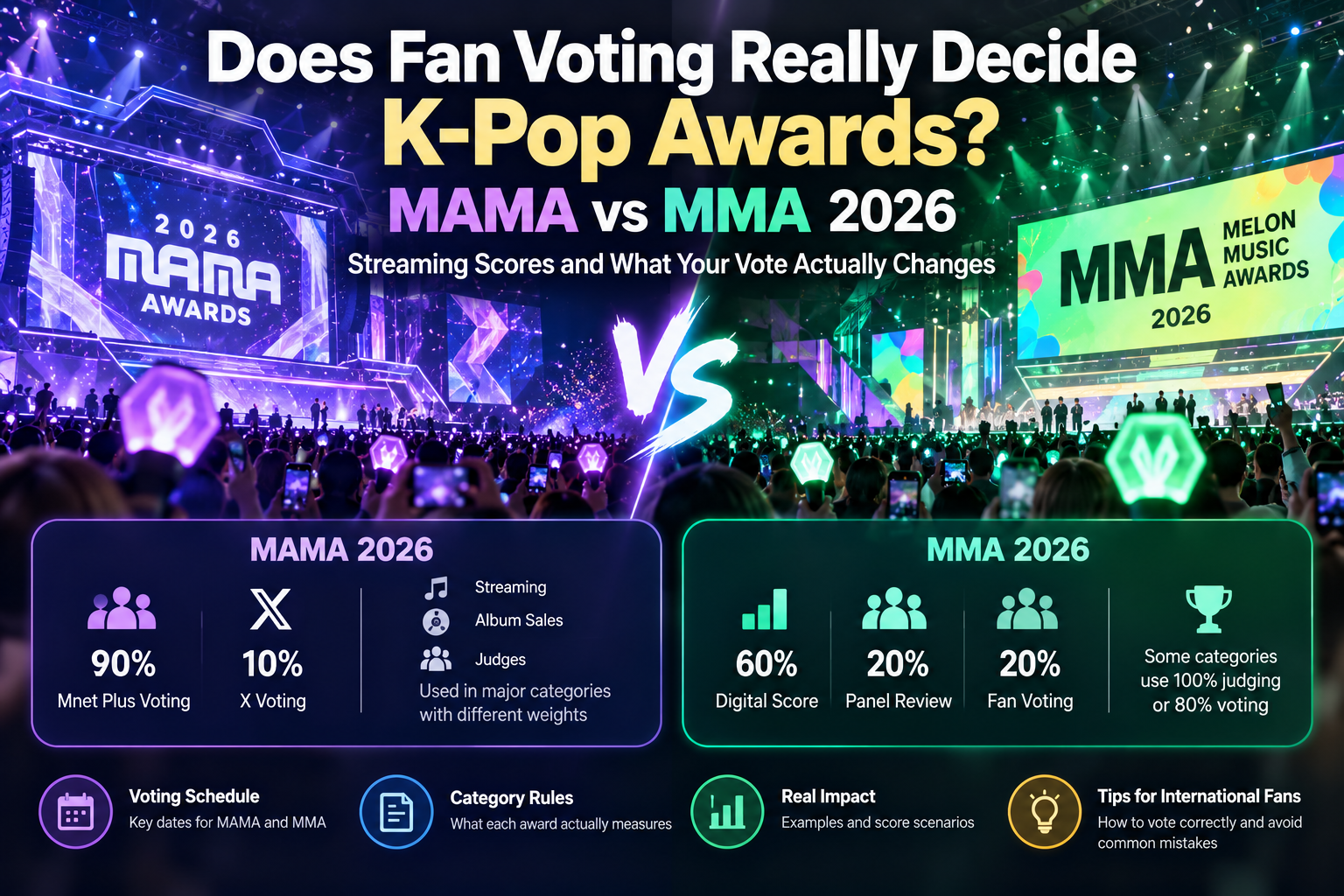
At the 2026 MAMA Awards, Fans’ Choice categories rely on designated fan-voting channels. Meanwhile, major categories such as Artist of the Year use judges, music consumption and album sales rather than the Fans’ Choice vote.
At MMA 2026, fan voting contributes 20% to several major awards, including Artist of the Year and TOP10. However, some categories are judged entirely by a panel, while KakaoBank Everyone’s Star allocates 80% to voting.
The most important rule is simple:
Never assume that the voting percentage for one award applies to the entire ceremony.
The 2026 comparison at a glance
| Question | 2026 MAMA Awards | 2026 Melon Music Awards |
|---|---|---|
| Are there fan-voted categories? | Yes, including Fans’ Choice | Yes, including TOP10 and popularity awards |
| Does voting determine every award? | No | No |
| Do music consumption figures matter? | Yes, for specified categories | Yes, for many categories |
| Do judges matter? | Yes, for specified categories | Yes, including 100%-judged awards |
| Can a fan-vote leader still lose another award? | Yes | Yes |
| Should fans follow category-specific rules? | Absolutely | Absolutely |
The real difference is not simply which awards show has more voting.
It is how each program defines the relationship between popularity, measurable music performance, and professional evaluation.
1. MAMA 2026: Where Fan Voting Has the Strongest Influence
The 2026 MAMA Awards are scheduled for November 20–21 in Osaka, Japan.
The nominees were announced on October 12.
According to the published 2026 award criteria, the Fans’ Choice categories use two voting components:
- Mnet Plus voting: 90%
- X voting: 10%
The same distribution applies to the regular first and second Fans’ Choice voting rounds.
Fans’ Choice of the Year also includes an additional live Mnet Plus voting component worth 10% under the published rules.
Important: That additional live component should not be interpreted as simply making an ordinary 110-point score. Its treatment must follow the organizer’s category-specific calculation rules.
The practical lesson is that fans must read the instructions for the particular round and award rather than combining all visible numbers themselves.
What does 90% Mnet Plus and 10% X actually mean?
Imagine two candidates with very different strengths across the voting channels.
One artist might perform strongly on Mnet Plus while another receives greater support through X.
The final calculation reflects the announced weighting and whatever vote normalization and eligibility rules the organizer applies.
This does not mean one Mnet Plus vote is automatically worth nine individual votes on X.
Those are different platforms, potentially with different voting totals and validation mechanisms.
A percentage weight represents a category’s contribution to the final evaluation—not necessarily an exchange rate between individual votes.
The key warning for fans
A screenshot of an artist leading on one platform does not prove they lead the combined Fans’ Choice score.
Nor does a first-round lead guarantee victory in a later round.
Each stage has its own rules, deadline, eligible candidates and purpose.
2. MAMA’s Major Awards Are Not Simply Fan Popularity Contests
Now consider MAMA’s larger award categories.
The 2026 published criteria distinguish Fans’ Choice from the awards based on judges and music performance.
| MAMA 2026 category | Published evaluation criteria |
|---|---|
| Artist of the Year and artist categories | Jury 40%, domestic streaming/downloads 15%, global streaming/downloads 15%, album sales 30% |
| Song of the Year and genre categories | Jury 50%, domestic streaming/downloads 25%, global streaming/downloads 25% |
| Album of the Year | Jury 40%, album sales 60%, subject to the published eligibility threshold |
| Best Music Video and Best Choreography | Jury 100% |
| Best Song Top 10 | Streaming/downloads 100%, split between domestic and global measures |
| Fans’ Choice Male/Female | Mnet Plus 90%, X 10% |
The Album of the Year criteria also include an eligibility condition involving albums with at least one million sales, according to the published 2026 rules.
That condition should not be confused with a guarantee that the highest-selling eligible album will win.
The jury component still matters.
What this means in practice
A group can have an exceptionally organized international voting fandom without winning Artist of the Year.
Another artist might have outstanding music consumption scores or strong jury evaluation but not dominate Fans’ Choice.
Both outcomes can be consistent with the published rules.
A Fans’ Choice win and an Artist of the Year win measure different things.
Treating them as interchangeable creates unnecessary confusion.
3. MMA 2026: The 60–20–20 Model Explained
The Melon Music Awards take a different approach.
For MMA 2026, the official Melon rules list the following weighting for TOP10:
- Digital score: 60%
- Panel review: 20%
- Fan voting: 20%
The same 60–20–20 framework applies to several other categories, including Artist of the Year, Song of the Year, and New Artist of the Year.
However, not every MMA award uses that model.
The organizer’s official English guide also lists multiple special awards evaluated entirely by a judging panel.
And the KakaoBank Everyone’s Star category uses a much more vote-oriented allocation:
- Panel review: 20%
- Fan voting: 80%
This is why asking whether “MMA is based on fan voting” is the wrong question.
The right question is: Which MMA category are you talking about?
What does a 20% fan-vote allocation mean?
Imagine an award where the total evaluation is divided into 100 weighted points.
The vote component can contribute up to 20 points.
An artist who performs better in voting may gain an advantage, but the digital and panel components together account for the remaining 80 points.
That means voting can change a close result without automatically overcoming a large deficit elsewhere.
It also means a category’s public voting leaderboard is not necessarily its overall awards leaderboard.
4. Three Examples That Show What Voting Can—and Cannot—Change
The following examples are deliberately simplified.
They are mathematical illustrations using hypothetical normalized category scores—not real 2026 artist rankings, secret jury scores, or predictions.
Example A: Winning the public vote but losing overall at MMA
Suppose two artists are competing for an award with MMA’s 60–20–20 model.
| Component | Artist A | Artist B |
|---|---|---|
| Digital performance, maximum 60 | 35 | 52 |
| Panel review, maximum 20 | 14 | 16 |
| Fan voting, maximum 20 | 20 | 12 |
| Hypothetical total | 69 | 80 |
Artist A wins the voting component.
Artist B wins the overall hypothetical score because of stronger combined performance in the other categories.
Lesson: First place in fan voting is not equivalent to first place overall.
Example B: A close race where the vote changes the result
Now imagine two artists with much closer digital and panel scores.
| Component | Artist C | Artist D |
|---|---|---|
| Digital performance, maximum 60 | 49 | 52 |
| Panel review, maximum 20 | 16 | 17 |
| Fan voting, maximum 20 | 19 | 12 |
| Hypothetical total | 84 | 81 |
Artist D leads before fan votes are considered.
Artist C wins in this simplified example because of the voting advantage.
Lesson: Even a 20% component can be decisive when the other scores are close.
Example C: MAMA’s Fans’ Choice is a different type of contest
Imagine one artist performs very strongly in MAMA’s Fans’ Choice voting but has modest album sales.
That could be sufficient for a strong Fans’ Choice result, depending on the complete voting totals and rules.
It does not mean the same artist automatically leads Album of the Year, where jury review and eligible album sales carry the published weighting.
Lesson: Never transfer one category’s voting result into another category’s award prediction.
These examples illustrate possible scoring behavior. They do not reveal the actual 2026 scoring systems’ full internal normalization formulas or any unpublished results.
5. Why Streaming Numbers, Album Sales and Votes Are Different
Fans often discuss streaming, album sales and voting as if all three are interchangeable expressions of popularity.
But award organizers may use them to measure different forms of success.
Digital performance
A digital score is based on music consumption metrics selected by the organizer.
For MAMA 2026, the published criteria distinguish domestic and global streaming/download measurements for specified categories.
For MMA, the 2026 guide relies heavily on digital performance for many major awards.
But neither framework means that a public Spotify screenshot necessarily equals an award’s official digital score.
The eligible services, dates, territories and calculation rules matter.
Physical album sales
Physical sales can influence certain MAMA categories, including Artist of the Year and Album of the Year.
But physical sales are not a universal component of all 2026 categories.
A high album-sales total does not by itself settle Song of the Year or Fans’ Choice.
Fan voting
Voting measures eligible participation under a specific event’s rules.
A large fandom can be highly effective at organizing voting campaigns.
Yet vote totals do not automatically substitute for album sales, digital performance or judging.
This is especially important for international fans trying to understand why a globally popular artist did not win a particular Korean awards category.
6. The Overlooked Detail: Eligibility Windows Can Change the Race
Award outcomes also depend on which releases qualify for consideration.
The 2026 MAMA Awards use an eligible music-release period from October 1, 2025, through September 30, 2026, according to the published nomination criteria.
MMA 2026’s standard eligibility period for digital tracks is November 20, 2025, through October 14, 2026.
But MMA makes exceptions for certain categories.
For example, the official rules specify a different evaluation period for Global TOP10, from May 11 to October 14, 2026.
They also outline a separate period for TrackZero Choice, while Hot Trend has no release-date restriction.
Why this matters
Two hit songs released only a few weeks apart might be treated differently by the two ceremonies.
A song released outside one show’s qualification period may still be eligible elsewhere.
And an award category may assess chart activity during a specific period rather than only considering a release date.
Before comparing artists, check whether the same music and time period are actually being measured.
This is one reason fans should be cautious about comparing MAMA and MMA rankings directly.
7. The 2026 Voting Calendar: What International Fans Need to Know
As of the October 19 review, the published schedules include:
| Event | Stage | Scheduled period |
|---|---|---|
| MAMA 2026 | Fans’ Choice first-round voting | Through October 22, 11:59 p.m. KST |
| MAMA 2026 | Fans’ Choice second-round voting | October 28, 6 p.m. to November 18, 11:59 p.m. KST, as reported in the October 12 published criteria |
| MMA 2026 | TOP10 voting | October 15–29 |
| MMA 2026 | Category voting | October 30–November 13 |
| MMA 2026 | Award ceremony | November 14–15 |
| MAMA 2026 | Award ceremony | November 20–21 |
These are announced schedules, not a promise that event organizers cannot revise them.
Some third-party articles display conflicting information about the MAMA second-round closing date. Fans should use the current Mnet Plus announcement for the relevant voting round as the final operational reference.
Official places to check
MAMA Awards: Mnet Plus — 2026 MAMA Awards
Melon Music Awards: MMA 2026 — Official English Guide
If voting requires an account, identity verification, country-specific eligibility, or a particular app, those conditions must come from the official platform.
Avoid relying on unofficial promises about unlimited voting, bonus votes or guaranteed ranking improvements.
8. Five Mistakes Fans Make When Reading Award Rankings
Mistake 1: Treating a voting leaderboard as the final award result
A visible voting ranking may represent only one portion of an award’s total calculation.
Check the other components.
Mistake 2: Using one category’s criteria for every trophy
An MMA TOP10 vote does not have the same influence as a vote in KakaoBank Everyone’s Star.
Likewise, MAMA’s Fans’ Choice criteria are not the criteria for Artist of the Year.
Mistake 3: Assuming more social-media posts equal more valid votes
Social-media activity may encourage participation, but only votes that satisfy the event’s official rules count toward the specified voting component.
Posting volume is not automatically an award metric.
Mistake 4: Comparing different tracking periods
A music chart’s public weekly ranking may not represent the award’s complete evaluation period.
Always look for the eligibility window and measurement rules.
Mistake 5: Treating every loss as evidence of unfairness
Award shows can be criticized, and transparency matters.
But a mismatch between a public fan-voting ranking and the final award result is not, by itself, proof of manipulation.
First establish whether the category also includes digital performance, sales or panel scores.
If the organizer provides insufficient detail to verify a result independently, describe that as a transparency limitation rather than claiming a specific cause without evidence.
9. How to Interpret Results Without Seeing Every Internal Score
When the ceremony announces a winner, try this four-question method.
Question 1: Which category was awarded?
Find the specific award, not just the overall event.
Question 2: What was the published weighting?
Identify whether votes, digital performance, sales or judging contributed.
Question 3: Which results are publicly visible?
A voting ranking may be visible, while other components remain unpublished or less granular.
Question 4: What can actually be concluded?
If the full component scores are not public, you may know who won without knowing exactly how many points separated the candidates.
This distinction matters for responsible reporting.
A fan community can discuss whether the process was sufficiently transparent without inventing hidden numerical scores.
10. What Does Fan Voting Mean Beyond Winning?
Voting has a cultural role as well as a numerical one.
A K-pop fandom is a community that follows, supports and organizes around an artist.
Voting campaigns can strengthen a sense of connection among fans, especially when supporters live across different countries and time zones.
They can also introduce new listeners to an artist through award-season discussions.
But healthy fandom does not require participating in every voting campaign.
Fans can support music through listening, attending performances, discussing releases and engaging with other fans.
If you are new to Korean fandom culture, our article What Does “Fandom” Mean in K-Pop? How K-Pop Fan Communities Got Their Names explains the basic terminology.
For a wider view of how organized fan communities developed, read How K-Pop Fandom Became a Global Force.
These articles explain the fandom itself; this guide focuses specifically on how award rules translate that participation into evaluation.
11. A Practical Checklist for International Fans
Before you cast a vote, verify the following:
- You are using the official voting platform.
- The voting round is currently active.
- Your artist is eligible for that category.
- You understand whether the vote is a category’s full score or only one component.
- You know the closing time in Korea Standard Time (UTC+9).
- You have checked any account, region, age or other eligibility requirements.
- You are following the platform’s permitted voting limits.
- You do not assume preliminary rankings guarantee a final award.
It is also worth checking whether the category uses an additional live-voting stage, a separate application or a special final-round procedure.
Official event rules should always take priority over screenshots circulated without a date or source.
Frequently Asked Questions
Does the artist with the most votes automatically win MAMA?
Not every MAMA award is decided by fan voting. The Fans’ Choice categories use designated fan-vote weighting, while other major awards use judges, music consumption or album sales.
Are MAMA and MMA the same awards show?
No. MAMA and the Melon Music Awards are separate ceremonies with different organizers, schedules and evaluation systems.
How much do fan votes count at MMA 2026?
For TOP10 and several main awards, the official rules allocate 20% to fan voting. Other categories may be judged entirely by a panel or use different voting percentages, including 80% for KakaoBank Everyone’s Star.
Why can an artist lead the vote but lose an award?
Because a public vote may represent only part of the final evaluation. The other components can produce a different overall result.
Does Spotify streaming count toward every K-pop award?
No. The answer depends on the organizer’s designated data sources and category rules. A streaming screenshot cannot be assumed to equal an official award score.
What does 90% Mnet Plus and 10% X mean?
It describes the published weighting of those two voting components for MAMA’s relevant Fans’ Choice categories. It does not necessarily mean that a single vote on one platform has a fixed nine-to-one exchange rate with an individual vote on the other.
Can fans outside South Korea participate?
Participation depends on the particular category and voting platform. Some events support international voting, while specific awards use regional apps or eligibility restrictions. Check the current official instructions.
Is winning Fans’ Choice the same as winning Artist of the Year?
No. They are separate awards that can have fundamentally different criteria.
Final Verdict: Your Vote Has Real Influence When the Rules Give It Influence
Fan voting is an important part of modern K-pop award culture.
But it does not operate as a universal popularity referendum across every category.
For the 2026 MAMA Awards, Fans’ Choice gives fans direct influence through dedicated voting channels, while major awards use other criteria.
For MMA 2026, voting contributes meaningfully to several major categories, yet often shares the final score with digital performance and panel review.
The difference matters for how fans interpret leaderboards, communicate about results and decide where to focus their participation.
A voting victory is not always an awards victory—and an awards victory is not always a fan-voting victory.
The fairest way to interpret a result is to read the criteria for the specific category, distinguish published facts from assumptions, and acknowledge what the organizer has not disclosed.
That makes award season more understandable for new fans and more meaningful for experienced ones.
Sources and Editorial Methodology
This article is an explanatory comparison of published 2026 criteria. K-Pop Through Time has not conducted its own vote count, obtained confidential judging scores, or predicted winners.
- Mnet Plus — Official 2026 MAMA Awards Page — Organizer’s event and voting information.
- Soompi — 2026 MAMA Awards Announces Nominees and Fans’ Choice Voting — Published October 12, 2026; category criteria and announced voting schedule.
- MMA 2026 — Official English Award Criteria — Category-specific score weights, evaluation periods and timeline.
- MMA 2026 — Official TOP10 Voting — Official TOP10 voting page.
- Kakao Entertainment — MMA 2026 TOP10 Voting Announcement — October 15, 2026, announcement and confirmation of the 60% digital, 20% panel, 20% voting model.
The mathematical examples are hypothetical and use simplified normalized weighted scores. They should not be interpreted as actual 2026 artist scores or predictions. Award organizers may update schedules and rules after publication.
Information reviewed October 19, 2026.
Leave a Reply