
Tag: K-Pop

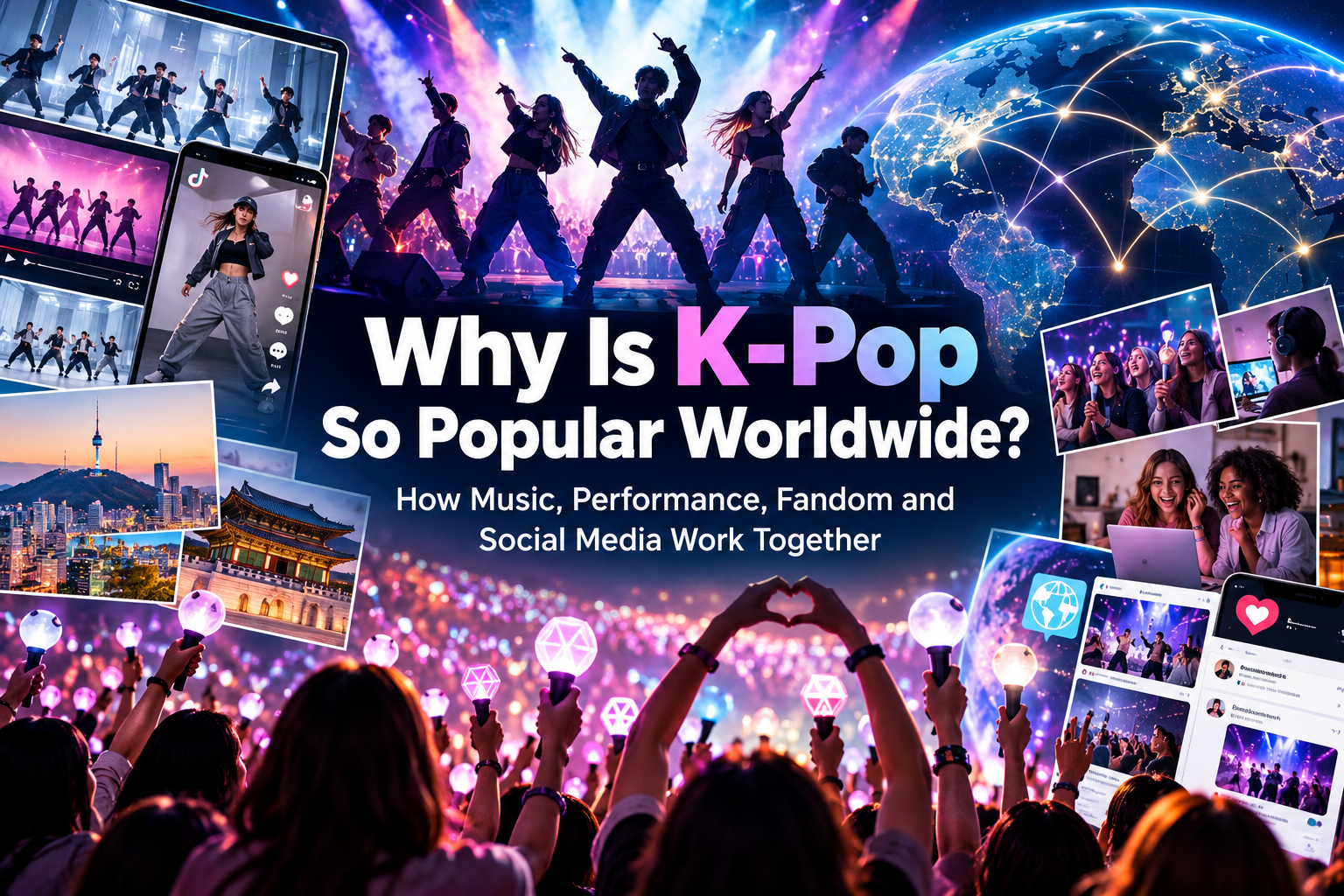
  • Why Is K-Pop So Popular Worldwide? How Music, Performance, Fandom and Social Media Work Together

    Why Is K-Pop So Popular Worldwide? How Music, Performance, Fandom and Social Media Work Together

    Why Is K-Pop So Popular Worldwide? How Music, Performance, Fandom and Social Media Work Together

    Why is K-pop so popular worldwide, even among people who do not speak Korean?

    The usual answers are catchy songs, synchronized choreography, attractive music videos and passionate fans. All of these matter, but they do not fully explain how a music industry rooted in South Korea developed audiences across languages, cultures and continents.

    The more revealing question is what happens after someone discovers a K-pop song.

    A listener may watch a performance, become curious about the members, discover behind-the-scenes videos, join an online fan community and eventually introduce the music to someone else. Each experience creates a reason to continue engaging.

    K-pop’s global success is not the result of one powerful ingredient. It comes from several connected experiences that help turn initial curiosity into lasting participation.

    Understanding those connections explains both how K-pop became popular worldwide and why its influence has lasted beyond individual viral hits.

    The K-Pop Popularity Loop: From First Discovery to Global Fandom

    Imagine someone encountering a K-pop dance clip on social media.

    They may not know the group’s name or understand the lyrics. But the choreography, visual presentation or musical hook catches their attention.

    What happens next can follow a recognizable pattern:

    1. Discovery: A song, performance or short video attracts attention.
    2. Curiosity: The viewer looks for the full music video or another performance.
    3. Recognition: Members, personalities and musical styles become familiar.
    4. Connection: Interviews, livestreams and other content build interest beyond one song.
    5. Community: The listener encounters fans who share information, translations and recommendations.
    6. Participation: The listener begins following releases, sharing content or attending events.
    7. New discovery: That participation introduces K-pop to additional people.

    This is not a fixed journey that every fan follows. Some people remain casual listeners, while others become deeply involved in fandom.

    But the pattern illustrates an important distinction: K-pop does not depend entirely on repeatedly attracting new listeners through new songs. Existing audiences can also help new audiences discover the music.

    That is one reason its international growth cannot be explained by music quality or marketing alone.

    1. K-Pop Music Creates the First Connection

    Before choreography, fan communities or elaborate concepts can matter, something usually needs to attract the listener.

    For many people, that starting point is the music itself.

    K-pop incorporates influences from pop, hip-hop, R&B, electronic dance music, rock and other styles. Individual releases may combine several influences within one song, while other tracks use relatively straightforward pop arrangements.

    This musical variety gives international listeners multiple entry points.

    Someone who enjoys energetic dance music may discover one group, while a listener interested in vocal performances or emotional ballads may connect with another.

    Does the Korean language limit K-pop’s appeal?

    Language can create a barrier to understanding lyrics immediately, but it does not prevent listeners from responding to melody, rhythm, vocal delivery or emotion.

    International audiences have long enjoyed music in languages they do not speak.

    K-pop also exists in a digital environment where translations, subtitles and fan explanations are widely available.

    A listener can enjoy a song before understanding its words and explore its meaning afterward.

    That creates an important sequence:

    Musical attraction can come before linguistic understanding.

    The language difference may even encourage some listeners to investigate lyrics, cultural references and Korean expressions more closely.

    However, language alone is neither the secret to K-pop’s success nor a barrier that has completely disappeared. Its importance varies among listeners and markets.

    2. Performance Turns a Song Into Something People Can Watch and Share

    K-pop is not simply recorded music accompanied by occasional live performances.

    In much of the idol industry, choreography, stage presentation, styling and camera work are closely connected to the musical release.

    A song can therefore reach audiences through several different formats:

    • The official music video
    • A television music-show performance
    • A choreography or dance-practice video
    • A live concert clip
    • A short-form dance challenge
    • A fan-recorded performance moment

    These formats offer different ways to encounter the same music.

    Someone may discover a song through a dance challenge rather than a streaming playlist. Another person may become interested after watching a live vocal performance.

    Why synchronized choreography matters

    Group choreography can create a strong visual identity.

    Formation changes, coordinated movement and memorable gestures make performances recognizable even when the viewer is unfamiliar with the artists.

    Dance also gives audiences something they can reproduce.

    A memorable movement can become a dance cover, tutorial or short video.

    This is where performance begins to connect with social distribution.

    The choreography is not only part of the entertainment. It can also become material that audiences participate in and share.

    Still, not every successful K-pop act depends on difficult choreography. Musical identity, vocals, songwriting and live performance remain important, and the balance differs among artists.

    3. Music Videos and Concepts Give Fans Something to Explore

    A K-pop music video often introduces more than a song.

    It may present a visual concept through fashion, sets, cinematography, color, symbolism or storytelling.

    Some artists develop recurring themes across releases. Others change concepts dramatically from one comeback to another.

    This creates additional reasons for viewers to return.

    A person might watch a music video once for the music and again to notice a detail in the choreography, understand the story or recognize individual members.

    Fans may discuss how a new release connects to an artist’s earlier work.

    Why concepts can extend interest

    In a conventional listening experience, someone may hear a song, enjoy it and move on.

    With a concept-driven release, the same listener may also explore:

    • Performance versions
    • Concept photographs
    • Album artwork
    • Behind-the-scenes production content
    • Earlier music videos
    • Interpretations shared by other fans

    These materials do not guarantee loyalty. But they create opportunities for deeper engagement.

    The music becomes an entry point into a broader creative identity.

    4. Member Identity Helps Turn Curiosity Into Attachment

    One of K-pop’s distinctive features is the attention given to individual members within many idol groups.

    Listeners may initially notice a group as a whole.

    Over time, they begin recognizing individual voices, performance styles, personalities and artistic contributions.

    This can make a large group feel more approachable.

    A fan who first enjoys the music may become interested in how particular members sing, dance, write, produce or interact with one another.

    Why non-musical content matters

    Interviews, variety appearances, documentaries and livestreams can reveal aspects of artists that are less visible in a three-minute song.

    For some fans, these experiences build familiarity and a sense of connection.

    That connection can encourage continued interest between major releases.

    It also creates an important distinction between discovering an artist and following an artist.

    A person may discover a group through one song but continue following it because of its music, members, creative direction and community.

    These relationships can be meaningful, although viewers should remember that publicly presented artist identities are not the same as knowing someone personally.

    5. The Comeback System Gives Fans Reasons to Return

    K-pop’s release culture provides another connection in the popularity loop.

    A comeback is generally a new promotional period associated with a musical release, rather than necessarily a return after a long absence.

    For many idol acts, a comeback can involve teasers, concept photographs, music videos, live performances, interviews and fan activities.

    Instead of experiencing only a release date, audiences may follow a sequence of related events.

    Why this matters internationally

    A fan living outside South Korea may not be able to attend a music-show recording or local promotional event.

    But digital content makes many parts of the release cycle accessible internationally.

    Fans can follow announcements, watch performances and discuss new material with people in other countries.

    This gives the audience recurring opportunities to reconnect with an artist.

    The comeback system also helps explain why K-pop discussions can remain active between albums.

    However, the system has drawbacks. Frequent releases and promotional expectations can contribute to pressure on artists and fans, and the pace is not equally sustainable for every act.

    Regular content can support engagement, but it does not automatically produce lasting artistic success.

    6. K-Pop Fandom Turns Individual Interest Into Community

    This is where the popularity loop becomes especially important.

    A listener who enjoys a song may remain an individual consumer.

    But joining a fan community can change the experience.

    Fans share recommendations, discuss releases, translate material, organize events and help newcomers understand unfamiliar terminology.

    The music becomes something people experience together.

    Fans help reduce the barriers to entry

    Imagine discovering a Korean-language interview with no official translation available.

    A multilingual fan may summarize or translate it.

    Someone else may explain references that international viewers would otherwise miss.

    Another person may compile a beginner’s guide to a group’s members and discography.

    These activities can make unfamiliar artists easier to explore.

    They also demonstrate why global K-pop growth is not simply a top-down process directed by entertainment companies.

    Fans are not only the audience for K-pop. They can also help distribute, explain and reinterpret it.

    Academic research on transnational K-pop fandom has examined how translation, online participation and fan-created content contribute to the movement of Korean music across borders.

    Community creates reasons to stay

    Fan communities also offer social experiences.

    People may form friendships, attend concerts together or participate in discussions that continue long after a release.

    For some, these relationships become part of the appeal.

    This does not mean all K-pop fans participate in organized fandoms. Many enjoy the music without joining fan communities or purchasing merchandise.

    Both kinds of listeners contribute to K-pop’s international audience.

    7. Social Media Connects Every Stage of the Experience

    Social media is often described as the reason K-pop became popular worldwide.

    That explanation is incomplete.

    Social platforms are better understood as the infrastructure connecting many of the other elements.

    YouTube can introduce viewers to music videos, performances and fan-created content.

    TikTok and other short-form platforms can expose people to memorable song excerpts or choreography.

    Online communities can help viewers find translations, recommendations and discussions.

    Streaming services make it easier to continue listening.

    The crucial advantage is not merely that K-pop exists online.

    It is that one encounter can lead quickly to another.

    A dance clip can lead to a full performance.

    A full performance can lead to an artist’s channel.

    An artist’s channel can lead to interviews.

    An interview can lead to a fan community.

    And that community can introduce the artist to someone new.

    Algorithms amplify discovery, but they do not guarantee success

    Recommendation systems can help unfamiliar content reach interested audiences.

    However, platforms also change their recommendation systems, and viral attention can be temporary.

    A viral video may produce millions of views without creating a lasting audience.

    For sustainable growth, an artist still needs music and experiences that give listeners reasons to return.

    This is why social media should be viewed as an amplifier rather than a complete explanation.

    8. How Did K-Pop Become Popular Worldwide?

    The modern popularity loop developed over several decades. K-pop did not suddenly become international when one group achieved a major Western breakthrough.

    The 1990s: Foundations of the modern idol industry

    South Korea’s popular music industry changed significantly during the 1990s.

    Artists such as Seo Taiji and Boys helped transform expectations around contemporary Korean popular music, while early idol groups contributed to the development of organized fandom and agency-led artist promotion.

    These developments helped establish the foundations of modern K-pop.

    The 2000s: Regional expansion through the Korean Wave

    Korean entertainment gained audiences in other Asian markets through music, television and the broader Korean Wave, or Hallyu.

    Artists including BoA, TVXQ, BIGBANG, Girls’ Generation and others contributed to the growth of K-pop beyond South Korea, although their international paths differed.

    This period demonstrated that Korean popular music could develop substantial audiences outside its home market.

    The early 2010s: Global online visibility accelerates

    YouTube and social media reduced dependence on traditional international distribution channels.

    PSY’s “Gangnam Style” became a major global viral phenomenon in 2012, demonstrating the reach Korean-language music could achieve through online video.

    But one viral hit did not create the entire global K-pop industry.

    The broader expansion depended on artists, companies, digital platforms and fan communities building audiences over time.

    The late 2010s and early 2020s: Global fandom becomes central

    Groups such as BTS and BLACKPINK achieved major international visibility, while numerous other artists expanded K-pop’s reach across different markets.

    Global streaming, online communities, international tours and increasingly accessible digital content made it easier for audiences to follow Korean artists directly.

    K-pop was no longer experienced internationally only through occasional breakout songs.

    For many fans, it became part of everyday listening and online culture.

    The mid-2020s: A more diverse global industry

    By the mid-2020s, K-pop encompassed a wider range of musical identities, group concepts, international collaborations and digital experiences.

    Global audiences could discover both established artists and newer acts through overlapping music and social platforms.

    The international audience also became more diverse in how it engaged: some listeners followed albums and concerts, while others participated primarily through short videos, online communities or fan-created content.

    This history matters because each period added something to the next.

    The idol system helped build recognizable artists. Regional expansion demonstrated international demand. Digital platforms increased access. Global fandom made participation and continued discovery easier.

    9. Why BTS and BLACKPINK Matter—But Do Not Explain Everything

    Any discussion of K-pop’s global success should recognize the importance of BTS and BLACKPINK.

    Their international achievements helped expand the visibility of Korean popular music and introduced many people to the industry.

    BTS demonstrated the power of sustained musical storytelling, digital communication and international fan engagement.

    BLACKPINK helped extend K-pop’s presence across music, fashion, performance and global popular culture.

    But treating either group as the sole explanation would overlook the artists and audiences that came before them, as well as the broader industry and digital environment.

    K-pop’s international rise was cumulative.

    Earlier generations helped establish regional markets and fan practices. Later artists expanded those foundations, while digital platforms made international discovery increasingly accessible.

    Individual breakthroughs matter, but they occur within a larger history.

    10. Why K-Pop Fans Keep Coming Back

    Discovery explains how someone first encounters K-pop.

    Retention explains why they continue following it.

    These are different questions.

    A memorable chorus might produce a first listen.

    A strong performance might produce a second.

    But lasting interest may depend on several overlapping experiences:

    Music: New releases provide fresh reasons to listen.

    Artistic identity: Listeners develop preferences for particular artists and styles.

    Performance: Live stages and concerts offer experiences beyond recordings.

    Continuity: Comebacks and other content maintain visibility between releases.

    Community: Shared interests make following artists a social experience.

    Personal meaning: Songs, performances and artists may become associated with important moments in listeners’ lives.

    Not every fan needs all six.

    The strength of the wider K-pop ecosystem is that people can connect through different combinations.

    That flexibility helps explain why K-pop appeals to audiences with different ages, musical tastes and levels of fandom participation.

    11. Can the K-Pop Popularity Loop Break?

    The same system that helps K-pop grow also has weaknesses.

    A steady flow of content can create expectations that are difficult to maintain.

    Competition for attention can encourage increasingly intense promotional activity.

    Organized fandom can foster friendship and creativity, but it can also produce conflicts, unhealthy comparisons or pressure to spend money.

    Algorithm-driven discovery can reward brief viral moments rather than long-term artistic development.

    And international popularity does not guarantee that every artist benefits equally.

    These challenges matter because K-pop’s continued global success depends on more than maximizing attention.

    Artists need room to develop their music and careers. Audiences need reasons to remain interested beyond promotional campaigns.

    A sustainable popularity loop requires meaningful creative work—not simply more content.

    12. Is K-Pop Popular Because of the Music or the Fandom?

    Both matter, but they play different roles.

    Music and performance often create the initial attraction.

    Artist identity, ongoing content and community can deepen the connection.

    Social platforms help those experiences circulate internationally.

    Fandom can then introduce new people to the music.

    The relationship is therefore better understood as a connected process than as a competition between music and marketing.

    Consider two hypothetical listeners.

    Listener A discovers a K-pop song, adds it to a playlist and continues enjoying the music without participating in fandom.

    Listener B discovers the same song, watches performances, learns about the members, joins a fan community and shares content with friends.

    Both are genuine listeners.

    But Listener B also participates in activities that can introduce the artist to additional people.

    When this pattern occurs across many artists and countries, it helps explain how K-pop can sustain international visibility.

    Frequently Asked Questions About K-Pop’s Global Popularity

    Why is K-pop so popular outside South Korea?

    K-pop combines accessible music, visually engaging performances, recognizable artist identities, frequent digital content and international fan communities. Social platforms help connect these experiences and introduce Korean artists to listeners around the world.

    How did K-pop become popular worldwide?

    K-pop expanded gradually through the Korean Wave, regional Asian markets, online video, international artist breakthroughs and global fan participation. YouTube, streaming and social media made Korean music easier to discover and follow across borders.

    Why do people like K-pop if they don’t understand Korean?

    Listeners can connect with melody, rhythm, vocal expression and performance without understanding every lyric. Translations and subtitles also make it easier to explore songs and artists more deeply.

    Is K-pop popular only because of BTS and BLACKPINK?

    No. BTS and BLACKPINK played major roles in expanding international visibility, but K-pop’s global development also reflects earlier generations of artists, entertainment companies, digital platforms and fan communities.

    What makes K-pop different from Western pop?

    The distinction is not absolute, and both industries influence each other. However, many K-pop idol acts place particular emphasis on coordinated group performance, comeback promotions, visual concepts, member-focused content and organized fan participation.

    Will K-pop remain popular in the future?

    Its future cannot be guaranteed. Continued success will depend on musical creativity, artist development, changing audience preferences, international accessibility and the industry’s ability to sustain healthy relationships with fans.

    Final Thoughts: K-Pop’s Global Success Is a Connected System

    K-pop became popular worldwide through more than catchy music, impressive choreography or social media promotion.

    Those elements work together.

    A song attracts attention.

    A performance encourages discovery.

    Artist identity and continuing content create opportunities for deeper interest.

    Fan communities help people participate, understand and share what they enjoy.

    Digital platforms connect those activities across borders.

    And the resulting visibility introduces new listeners to Korean music.

    That is the central explanation for K-pop’s international growth: a connected system in which music creates interest, participation sustains it and global communities help it spread.

    Not every listener becomes a dedicated fan. Not every artist follows the same path. And no popularity system can guarantee success.

    But understanding how these experiences connect reveals why K-pop has become more than a series of international hits.

    It has developed into a global music culture shaped by artists, performances, platforms and the people who listen.


  • BTS and Stray Kids Skip the 2027 Grammys: Why the New Asian Pop Category Is Dividing K-Pop

    BTS and Stray Kids Skip the 2027 Grammys: Why the New Asian Pop Category Is Dividing K-Pop

    The Grammy Awards have spent years trying to catch up with K-pop’s global rise. In 2026, the Recording Academy appeared to take another step forward by creating a new category: Best Asian Pop Music Performance.

    On paper, that sounds like recognition.

    But the reaction from two of K-pop’s biggest names has raised a much more uncomfortable question.

    What if creating a separate space for Asian pop is not the same thing as treating Asian artists as part of global pop?

    BTS chose not to submit music for the 2027 Grammy Awards, while Stray Kids also did not submit their work for consideration. The circumstances are not identical. BTS publicly explained its position, while JYP Entertainment confirmed Stray Kids’ non-submission without giving an official reason.

    That distinction matters.

    But taken together, the developments have turned what might have been celebrated as a milestone for Asian music into a larger debate about how the Grammys understand K-pop in the first place.

    Why BTS Decided Not to Submit for the 2027 Grammys

    BTS’s position goes beyond disappointment over nominations or awards.

    The group expressed the view that music should be heard and loved as music itself rather than being divided primarily by region or language.

    That argument goes directly to the problem created by the new Best Asian Pop Music Performance category.

    K-pop has “Korean” in its name, but its modern identity has become increasingly difficult to contain within a regional box.

    BTS is perhaps the clearest example.

    The group has topped major charts around the world, filled stadiums far beyond South Korea and competed in the Grammy Awards’ major pop ecosystem before the creation of a dedicated Asian Pop category.

    From that perspective, a new regional category creates a strange contradiction.

    K-pop is global enough to influence the international music business, but at the Grammys it may now be encouraged to compete inside a category defined partly by geography and language.

    For BTS, that distinction appears to matter.

    Stray Kids Made a Different — but Equally Interesting — Decision

    Stray Kids also did not submit music for the 2027 Grammys.

    However, this needs to be described carefully.

    JYP Entertainment confirmed the non-submission, but did not publicly state that Stray Kids made the decision as a protest against the Asian Pop category.

    So it would be misleading to simply say that BTS and Stray Kids issued the same boycott for the same reason.

    What makes the Stray Kids situation especially interesting is something else.

    The decision also comes at a moment when Stray Kids’ global presence has expanded far beyond the traditional K-pop circuit, including their historic role as the first K-pop act to headline Rock in Rio.

    All eight members were invited to become voting members of the Recording Academy.

    That means their relationship with the Grammys is not simply one of rejection.

    They can participate in the institution while choosing not to enter their own work into this year’s competition.

    That distinction makes the story more complicated — and more important.

    Why the New Asian Pop Grammy Sounds Like Progress

    The Recording Academy has a reasonable argument of its own.

    Creating Best Asian Pop Music Performance gives music from across Asia another opportunity to receive Grammy recognition.

    The category can potentially provide visibility to artists who might otherwise struggle to break into categories dominated by the American and broader Western music industries.

    And entering the Asian Pop category does not automatically prevent an eligible artist from competing in the Grammy General Field.

    So the new award should not simply be dismissed as a category designed to keep Asian artists away from the major prizes.

    But that still leaves a difficult question.

    Why does Asian pop need to be geographically separated at the moment when some Asian artists have become fully global pop stars?

    The Problem With Treating “Asian Pop” as One Musical Space

    Asia is not a musical genre.

    K-pop, J-pop, C-pop and other Asian popular music traditions operate in different languages, industries and cultural contexts.

    Even within K-pop, the music can move between hip-hop, R&B, EDM, rock, ballads and mainstream pop within a single album.

    Putting these artists together because they are “Asian” therefore creates an unusual category.

    Compare that with categories built primarily around musical characteristics.

    Rock describes a musical tradition. Rap describes one. R&B has its own historical and musical lineage.

    “Asian,” by contrast, describes geography.

    That does not automatically make the category illegitimate. Music awards have long used cultural and regional categories to recognize traditions that might otherwise receive little institutional attention.

    But K-pop presents a particularly difficult case because its biggest artists are no longer operating only as regional acts seeking international exposure.

    They are already competing for the same listeners, chart positions, touring markets and cultural attention as Western pop stars.

    That is why the new Grammy category can simultaneously look like recognition and separation.

    BTS Has Already Tested the Limits of Grammy Recognition

    This debate also cannot be separated from BTS’s history with the Grammys.

    That history becomes even more significant when viewed alongside BTS’s evolution from a Korean idol group into one of the defining global pop acts of its generation.

    BTS received multiple Grammy nominations before the creation of the Asian Pop category and performed on the Grammy stage.

    Yet despite becoming one of the most commercially and culturally significant pop groups of their era, they did not win a Grammy during those earlier nominations.

    That history matters because BTS did not need a separate Asian category in order to prove that its music could compete globally.

    The group had already entered the mainstream Grammy conversation.

    Creating a specifically Asian category afterward therefore raises a legitimate question about what kind of recognition the institution is actually offering.

    Is the Grammys expanding the table?

    Or is it creating a new table?

    Those are not necessarily the same thing.

    Why This Moment Is Bigger Than BTS and Stray Kids

    The significance of this controversy is not limited to two groups.

    For years, K-pop artists sought recognition from Western institutions because those institutions represented access to the center of the global music business.

    But K-pop’s position has changed.

    Major Korean acts now headline international festivals, sell out stadiums, dominate physical album sales, build enormous global fandoms and collaborate directly with major international artists and producers.

    That changes the balance of power.

    The question is no longer simply:

    “Will the Grammys recognize K-pop?”

    Increasingly, another question matters:

    “What kind of Grammy recognition does K-pop consider meaningful?”

    That is a very different stage in K-pop history.

    The Recording Academy Now Faces a Harder Question

    The Recording Academy can reasonably argue that more categories mean more opportunities for recognition.

    And for many Asian artists, the new category may indeed become valuable.

    But BTS’s response exposes the weakness in treating representation as a simple numbers problem.

    Adding an award does not automatically solve the deeper question of how an institution categorizes the artists receiving it.

    If an artist has already become part of global mainstream pop, defining that artist primarily through geography can feel less like inclusion and more like a boundary.

    That does not mean the Asian Pop category has no value.

    It means its value will ultimately depend on how the Grammys use it.

    If Asian artists continue to compete seriously across the General Field and major genre categories while the new award provides an additional path to recognition, the category could broaden representation.

    If it instead becomes the place where internationally successful Asian acts are expected to compete, criticism of the category will become much harder to dismiss.

    What BTS and Stray Kids’ Decision Could Mean for K-Pop

    It is too early to know whether other K-pop artists will make similar choices.

    And Stray Kids’ reason for not submitting should not be assumed without an official explanation.

    But BTS has already made the larger debate impossible to ignore.

    For much of K-pop’s international expansion, success was measured partly by whether Korean artists could enter institutions such as Billboard, the Grammys and major Western award shows.

    Now one of K-pop’s most globally recognized groups is asking a different question.

    Not simply whether K-pop is allowed inside.

    But on what terms it is being invited in.

    That may be the most important part of this story.

    The creation of Best Asian Pop Music Performance was supposed to demonstrate how much Asian pop has grown.

    The controversy surrounding it may demonstrate something even more significant:

    K-pop has become global enough to question whether it still needs Western institutions to define where it belongs.

  • Why Is BLACKPINK So Popular? How Four K-Pop Stars Became a Global Phenomenon

    Why Is BLACKPINK So Popular? How Four K-Pop Stars Became a Global Phenomenon

    Since debuting in 2016, Jisoo, Jennie, Rosé, and Lisa have grown from promising YG Entertainment artists into global stars whose influence extends far beyond South Korea.

    Their music videos attract enormous international audiences, their concerts bring together fans from many countries, and each member has developed an individual identity in music, fashion, entertainment, and popular culture.

    But BLACKPINK‘s success raises an interesting question.

    Why did this particular group become such a powerful global phenomenon?

    The answer involves much more than a few hit songs.

    Four Members with Distinct Identities

    One of BLACKPINK’s greatest strengths is that the four members are easy to distinguish from one another.

    Jisoo brings a calm and elegant presence while developing careers in both music and acting.

    Jennie combines rap, vocals, fashion, and a strong individual image.

    Rosé is instantly recognizable for her distinctive vocal tone and increasingly personal approach to solo music.

    Lisa stands out through dance, rap, stage presence, and her international background.

    These differences allow fans to connect with individual members while still supporting BLACKPINK as a group.

    Rather than four performers competing for the same identity, BLACKPINK works because each member contributes something different.

    Music Designed for Immediate Impact

    BLACKPINK’s biggest songs are built to make an impression quickly.

    Tracks such as “DDU-DU DDU-DU,” “Kill This Love,” “How You Like That,” and “Pink Venom” combine powerful beats, memorable hooks, rap sections, dramatic vocal moments, and choreography designed for the stage.

    Many of their songs also move between contrasting moods.

    A track may begin with a confident rap, shift into a melodic vocal section, and then explode into a large chorus or dance break.

    That structure gives BLACKPINK’s music a strong visual and performance dimension.

    The songs are not simply meant to be heard.

    They are designed to be experienced.

    The Power of BLACKPINK’s Music Videos

    Visual storytelling has played a major role in BLACKPINK’s rise.

    Their music videos often feature elaborate sets, striking fashion, bold colors, dramatic camera work, and memorable choreography.

    For international audiences who may not understand every Korean lyric, these visual elements provide another way to connect with the music.

    A BLACKPINK release can therefore function simultaneously as a song, fashion event, dance performance, and visual spectacle.

    This made platforms such as YouTube especially important to the group’s international expansion.

    BLACKPINK and the Growth of YouTube K-Pop

    BLACKPINK emerged during a period when global audiences were increasingly discovering music through digital platforms rather than traditional television or radio.

    This was particularly important for K-pop.

    Fans did not need to live in South Korea to watch a new music video, learn choreography, follow performances, or share content with friends.

    BLACKPINK’s highly visual style was perfectly suited to this environment.

    Every major release could immediately reach viewers across Asia, North America, Europe, Latin America, and other regions.

    The internet helped remove one of the biggest barriers that earlier generations of Korean artists had faced: geography.

    Fashion Became Part of the BLACKPINK Brand

    BLACKPINK’s influence is not limited to music.

    Jisoo, Jennie, Rosé, and Lisa have each developed strong connections with international fashion and luxury culture.

    Their appearances at major fashion events introduced them to audiences who might not have originally followed K-pop.

    This created an unusual crossover.

    A person could first discover a BLACKPINK member through a fashion campaign and later become interested in the group’s music.

    At the same time, existing fans followed the members into the fashion world.

    BLACKPINK therefore became not only a music group but also a major cultural brand.

    Why International Fans Connect with BLACKPINK

    BLACKPINK has always had an unusually international identity.

    Lisa is Thai.

    Rosé grew up in Australia after being born in New Zealand.

    Jennie spent part of her youth in New Zealand.

    The members’ different backgrounds and language abilities helped the group communicate naturally with audiences outside South Korea.

    But international appeal is not simply about speaking different languages.

    BLACKPINK’s music, fashion, choreography, and personalities created multiple entry points for fans.

    Some listeners discovered them through songs.

    Others arrived through dance videos, fashion, social media, collaborations, or individual members.

    The Importance of BLINK

    No global pop phenomenon exists without a highly engaged fan community.

    BLACKPINK’s fandom, known as BLINK, has played a major role in spreading the group’s music and content.

    Fans share performances, discuss releases, create translations, participate in online communities, and introduce BLACKPINK to new listeners.

    Digital fandom can turn every comeback into an international event.

    When a new song or video arrives, millions of fans across different time zones can respond almost simultaneously.

    This level of participation has become one of the defining characteristics of modern K-pop.

    Global Collaborations Expanded Their Audience

    BLACKPINK has also worked with major international artists.

    Collaborations with musicians such as Dua Lipa, Lady Gaga, Selena Gomez, and Cardi B helped connect the group with audiences already familiar with Western pop.

    These collaborations were important not because BLACKPINK needed Western artists to become successful, but because they demonstrated how naturally the group could operate within the wider global music industry.

    BLACKPINK increasingly appeared less like a Korean group visiting the international pop market and more like a permanent part of it.

    Coachella and the Global Stage

    Festival appearances became another important symbol of BLACKPINK’s international rise.

    Performing at Coachella placed the group in front of a large global festival audience and demonstrated that K-pop could occupy major stages outside the traditional idol concert system.

    Their later return to the festival at an even higher level of prominence reflected how much their global position had grown.

    These performances were significant not only for BLACKPINK but also for the broader visibility of K-pop.

    Solo Careers Made the Group Even Bigger

    Another unusual strength of BLACKPINK is the individual popularity of its members.

    Jennie, Rosé, Lisa, and Jisoo have all developed solo careers while remaining strongly associated with the group.

    Their individual projects reveal different artistic directions.

    One member may focus more heavily on music, another may expand into acting, while others explore fashion, performance, songwriting, or business.

    Instead of weakening the BLACKPINK identity, these individual careers can bring new audiences back to the group.

    Fans who discover one member’s solo work may eventually explore BLACKPINK’s wider history.

    Scarcity Also Created Anticipation

    BLACKPINK has often released music less frequently than many K-pop groups.

    This has sometimes frustrated fans, but it also created enormous anticipation around major comebacks.

    Because releases were relatively limited, each new era could feel like a major event.

    New music meant new styling, choreography, music videos, performances, interviews, and international attention.

    The result was a cycle in which anticipation itself became part of the BLACKPINK experience.

    BLACKPINK Helped Redefine the Global K-Pop Girl Group

    Before BLACKPINK, Korean girl groups had already built significant international audiences.

    But BLACKPINK helped push the possibilities even further.

    They demonstrated that a K-pop girl group could become a major force in global touring, fashion, streaming, festivals, advertising, and celebrity culture simultaneously.

    Their success also contributed to greater international interest in other Korean girl groups.

    In that sense, BLACKPINK’s impact extends beyond their own achievements.

    They helped expand expectations for what a K-pop girl group could become.

    So, Why Is BLACKPINK So Popular?

    There is no single reason.

    BLACKPINK’s global success comes from the combination of four distinctive members, memorable music, powerful performances, visually ambitious videos, fashion influence, digital platforms, international backgrounds, and a highly active global fandom.

    Timing also mattered.

    They emerged when K-pop was becoming increasingly accessible around the world and when social media could turn a Korean music release into an immediate international conversation.

    But opportunity alone does not create a global phenomenon.

    BLACKPINK had the songs, personalities, performances, and visual identity capable of taking advantage of that moment.

    From K-Pop Group to Global Phenomenon

    BLACKPINK began as four artists debuting under YG Entertainment in Seoul.

    Over time, Jisoo, Jennie, Rosé, and Lisa became recognizable figures across music, fashion, entertainment, and global popular culture.

    Their story demonstrates how dramatically K-pop has changed.

    A group can now begin in South Korea, include members with international backgrounds, communicate with fans through global digital platforms, perform on some of the world’s biggest stages, and build individual careers that reach far beyond the traditional boundaries of an idol group.

    That is why BLACKPINK’s story is about more than popularity.

    It is also a story about how K-pop itself became global.

  • RM’s Solo Music: How His Sound Evolved

    RM’s Solo Music: How His Sound Evolved

    RM’s solo music shows how his artistic identity has changed from his early hip-hop roots to more introspective and experimental sounds.

    Beginning with his 2015 mixtape RM, followed by mono. (2018), Indigo (2022), and Right Place, Wrong Person (2024), his solo releases explore different approaches to rap, songwriting, collaboration, and personal expression.

    This guide follows that musical evolution, comparing the sound and themes of each project rather than focusing on his leadership role in BTS.

    Before BTS: From Rap Monster to RM

    RM was born Kim Namjoon in 1994.

    Before becoming a K-pop idol, he developed a strong interest in hip-hop and began writing rap lyrics while he was young. His early experience in Korea’s underground hip-hop scene became an important foundation for the artist he would later become.

    When BTS debuted in 2013, he performed under the stage name Rap Monster.

    The name reflected the hip-hop-centered identity of BTS’s early years. The group’s earliest music featured strong rap elements and often addressed subjects such as youth, education, ambition, and social expectations.

    As BTS evolved, however, RM evolved with it.

    In 2017, he officially changed his stage name from Rap Monster to RM. The change represented more than a shorter name. It reflected his desire for an artistic identity that could grow beyond the meaning associated with his original stage name.

    RM’s leadership in BTS is an important part of his career, but his solo releases reveal a different side of his artistic identity.

    To understand why he became the group’s leader and how his role developed, read our detailed guide: Why Is RM the Leader of BTS?

    Lyrics as a Central Part of RM’s Identity

    One of RM’s defining characteristics as an artist is his attention to language.

    Rap naturally places great importance on words, rhythm, metaphor, and storytelling, and RM has used these elements throughout his career.

    His lyrics frequently explore contradictions.

    Success can exist alongside anxiety. Confidence can exist alongside insecurity. Love can exist alongside loneliness. A person can know who they are and still continue searching for themselves.

    These tensions became increasingly important as BTS moved from songs about teenage frustration toward broader questions about adulthood and identity.

    RM’s writing therefore offers an interesting window into the development of BTS itself.

    As the group grew older, its language grew with it.

    The Beginning of RM’s Solo Journey

    RM’s individual music gave him space to explore ideas that did not always fit naturally within BTS albums.

    His first solo mixtape, RM, released in 2015, presented a rawer and more confrontational side of his musical identity.

    Three years later, mono. showed a noticeably different atmosphere.

    Released in 2018, mono. was quieter, more introspective, and often melancholic. Rather than emphasizing the image of a powerful rapper, the project explored loneliness, exhaustion, reflection, and emotional uncertainty.

    The contrast between these projects demonstrated something important about RM.

    He was not interested in maintaining only one artistic identity.

    He was changing.

    Indigo and the Portrait of an Artist in Transition

    RM’s 2022 solo album Indigo represented another major stage in that development.

    The album brought together music, visual art, collaboration, and personal reflection. Instead of presenting itself simply as a collection of songs, Indigo felt like a record of a particular period in RM’s life.

    It explored what happens when a young artist who has experienced extraordinary success begins to look back at his twenties.

    What remains after achievement?

    How does a person separate public identity from private identity?

    How does an artist continue growing when millions of people already have expectations about who that artist should be?

    These questions helped distinguish RM’s solo work from the conventional idea of an idol’s solo debut.

    Right Place, Wrong Person and Artistic Experimentation

    RM continued this exploration with Right Place, Wrong Person in 2024.

    The album pushed further into alternative and experimental sounds, demonstrating his willingness to move outside the musical expectations often associated with mainstream K-pop.

    Its title itself captures a recurring theme in RM’s work: the feeling of existing between different identities and environments.

    Celebrity and ordinary person.

    Group leader and solo artist.

    Korean musician and global public figure.

    Confidence and uncertainty.

    Rather than trying to eliminate these contradictions, RM increasingly turned them into artistic material.

    That willingness to remain uncertain is one of the most interesting aspects of his development.

    RM, Art and Korean Culture

    RM’s public interest in visual art has also become an important part of his cultural identity.

    He has frequently visited museums and exhibitions and expressed admiration for Korean and international artists. Through these interests, he has helped introduce parts of Korean modern and contemporary art to global fans who might otherwise never have encountered them.

    This matters because the global influence of K-pop increasingly extends beyond music.

    Fans who discover Korean music may become interested in Korean language, literature, museums, fashion, food, history, and visual art.

    RM represents this broader cultural connection particularly well.

    His influence therefore exists not only in songs but also in the conversations surrounding culture.

    From Idol to Individual Artist

    For many years, K-pop idols were often expected to maintain carefully defined public identities.

    The industry has gradually changed.

    More artists now participate in songwriting, production, artistic direction, and individual projects. The boundary between “idol” and “artist” has become increasingly difficult to define.

    RM’s career is an important example of this transformation.

    He can perform in one of the world’s biggest pop groups while also releasing experimental solo music.

    He can participate in stadium-scale entertainment while discussing poetry, painting, identity, and uncertainty.

    These identities do not have to cancel each other out.

    They can exist together.

    What Makes RM’s Solo Music Different?

    RM’s solo work stands apart through its willingness to change direction. Rather than repeating one musical formula, his projects move between rap, atmospheric introspection, collaboration, and experimental sounds.

    From the direct energy of RM to the reflective mood of mono., the collaborative approach of Indigo, and the unconventional production of Right Place, Wrong Person, each release offers a different perspective on his identity as an artist.

    Together, these projects show how RM uses solo music to explore ideas and sounds that extend beyond his work with BTS.

    Final Thoughts: A Leader Still Growing

    RM’s story is not simply the story of the leader of BTS.

    It is the story of artistic evolution.

    From his early hip-hop influences to BTS’s global success, from mono. to Indigo and Right Place, Wrong Person, his career has repeatedly moved between confidence and questioning.

    Perhaps that is why his work resonates with so many listeners.

    He does not always present growth as finding a final answer.

    Sometimes growth means becoming comfortable with continuing to ask questions.

    And as both BTS and K-pop continue to evolve, RM’s journey remains an important part of the story of how a Korean idol became a global artist without giving up the search for his own voice.