K-Pop Before the Social Media Revolution
Today, it is difficult to imagine K-pop without social media.
A new music video can reach viewers around the world within minutes. A short dance clip can introduce a song to people who have never heard of the artist. Fans can follow updates, watch livestreams, share performances, and discuss a comeback across multiple time zones at once.
But K-pop did not begin in this environment.
Before social media became central to the industry, Korean artists depended much more heavily on traditional media.
Television music programs mattered enormously.
Radio, newspapers, magazines, variety shows, and physical album distribution helped determine which artists became visible.
International expansion was more difficult.
To reach audiences outside South Korea, entertainment companies often needed local broadcasters, record labels, distributors, promotional partners, or physical events in foreign markets.
The internet did not eliminate these institutions.
But it dramatically changed the balance of power.
From Gatekeepers to Platforms
Traditional media relies heavily on gatekeepers.
A television network decides what to broadcast.
A radio station decides what to play.
A magazine decides whom to feature.
A distributor decides where a product will be available.
These organizations can provide enormous exposure, but they also control access to audiences.
Digital platforms created another route.
An entertainment company could upload a music video online and potentially reach viewers in countries where the artist had never appeared on television.
A fan could discover a Korean group without waiting for a local broadcaster to introduce them.
This was a fundamental change.
K-pop no longer needed to cross every national border through traditional media institutions.
Digital content could travel first.
Business expansion could follow.
YouTube Became a Global Window
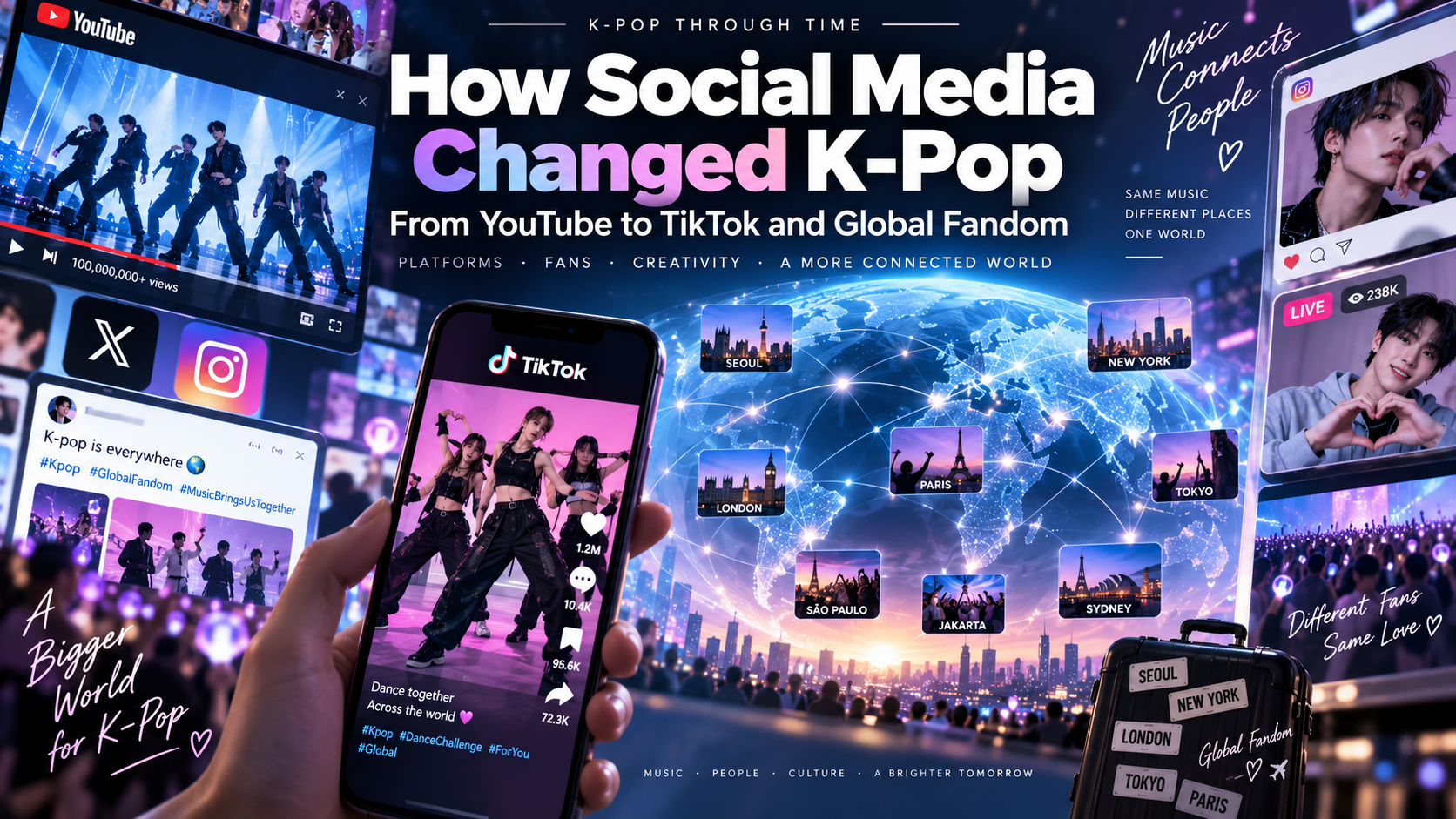
Among the platforms that helped transform K-pop, YouTube was especially important.
Music is naturally suited to video, and K-pop already had a strong visual tradition built around choreography, styling, performance, and music videos.
YouTube gave those strengths global distribution.
A viewer did not necessarily need to know anything about Korean popular culture.
They could encounter a music video through search, a recommendation, a shared link, or another piece of related content.
One video could lead to another.
A music video could lead to a dance practice.
A dance practice could lead to a live performance.
A performance could lead to an interview.
The discovery process became nonlinear.
This was very different from traditional promotion, where companies attempted to guide audiences through carefully controlled channels.
The Music Video Became a Global Advertisement
In the digital era, a K-pop music video performs several jobs simultaneously.
It is an artistic work.
It showcases choreography.
It introduces the members.
It communicates the visual concept of a comeback.
And it acts as a global advertisement for the artist.
This helps explain why visual production became so important to K-pop’s international strategy.
A compelling video can attract someone who does not understand the lyrics.
The image creates curiosity.
Curiosity leads to further exploration.
The previous chapter examined how K-pop became a visual culture.
Social media gave that visual culture a worldwide distribution system.
The two developments reinforced each other.
Dance Practice Videos Revealed the Process
YouTube also helped popularize content that traditional television might not have treated as a major product.
The dance practice video is a good example.
Instead of elaborate sets and editing, viewers could see performers rehearsing choreography in a relatively simple environment.
These videos gave international audiences a clearer understanding of the technical work behind K-pop performance.
They also made choreography easier to learn.
Fans could pause.
Replay.
Slow down sections.
Study formations.
Practice movements.
A rehearsal format therefore became both entertainment and an educational resource for global dance-cover culture.
Fans Became Distributors
Social media changed another fundamental relationship.
Fans became part of distribution.
In the traditional model, a company promoted an artist to an audience.
In the networked model, the audience could promote the artist to another audience.
A fan could share a music video with a friend.
A translation account could explain an interview.
A dance-cover creator could introduce a song to viewers interested in choreography.
A reaction channel could expose an artist to a different online community.
A short clip could circulate far beyond the original fandom.
This created a powerful multiplier effect.
Entertainment companies produced official content.
Fans extended its reach.
International Fans No Longer Had to Wait
Before digital distribution became widespread, international fans often experienced Korean entertainment later than domestic audiences.
Content might need to be licensed, broadcast locally, imported, translated, or circulated through fan communities.
Social platforms reduced that delay dramatically.
A music video released in Seoul could be watched almost immediately in São Paulo, Paris, Jakarta, Toronto, Manila, or Sydney.
This created something historically important:
a more synchronized global audience.
Fans in different countries could experience the same release at approximately the same moment.
The comeback became an international event rather than a sequence of separate national launches.
Twitter Turned Fandom Into a Real-Time Network
If YouTube helped K-pop content travel, Twitter—now known as X—helped conversation travel.
The platform became especially useful for rapid communication.
Fans could share links.
Translate updates.
Discuss performances.
Circulate photographs.
Track schedules.
Organize hashtags.
React to announcements in real time.
This made fandom faster and more interconnected.
Information that once moved through smaller forums or fan cafes could now circulate through enormous international networks.
The important transformation was not merely that fans talked online.
They could communicate across fandoms, languages, and national borders almost instantly.
Hashtags Created Temporary Global Public Spaces
Hashtags became a simple but powerful organizational tool.
Fans discussing the same artist, release, concert, or event could gather around a shared phrase.
This created temporary digital spaces around specific moments.
A comeback announcement could generate worldwide conversation.
A concert could produce real-time commentary from people inside and outside the venue.
An award appearance could become a global online event.
Hashtags also made fandom activity visible to outsiders.
Someone who did not follow a particular group might still encounter a trending discussion.
Fandom therefore gained a new ability:
it could make its own attention visible.
Social Media Changed the Speed of K-Pop
Traditional promotional cycles operated according to schedules controlled largely by broadcasters, magazines, and companies.
Social media accelerated everything.
Teasers could spread immediately.
A hairstyle change could become a topic within minutes.
A performance clip could circulate before a television program had finished airing.
A joke from a livestream could become a meme the same day.
A controversy could also spread at the same speed.
K-pop entered a continuous information cycle.
This created opportunities for visibility, but it also created pressure.
Artists and companies increasingly operated in an environment where audiences expected frequent updates and rapid responses.
The Idol Became a Continuous Media Presence
Earlier celebrities could disappear from public view between major promotional activities.
Social media made that more difficult—and sometimes less desirable.
Fans wanted ongoing contact.
Artists could post photographs, short messages, behind-the-scenes moments, recommendations, or casual updates.
The idol’s public identity therefore extended beyond official songs and television appearances.
Daily life, or at least a carefully selected version of it, could become content.
This strengthened emotional connection.
Fans could feel that they were following an artist’s journey rather than simply consuming finished releases.
But it also blurred the boundary between professional performance and private life.
Instagram Turned the Idol Into a Personal Brand
Image-centered platforms such as Instagram strengthened another dimension of idol culture: the individual public brand.
A group may have a carefully designed collective identity.
Individual members can simultaneously develop recognizable personal styles.
Fashion becomes important.
Photography becomes important.
Travel, art, beauty, food, hobbies, and brand partnerships can become part of the public image.
This can extend an idol’s career beyond group promotions.
A member may become influential in fashion, advertising, television, acting, or other industries.
Social media therefore helps transform the idol from a performer into a broader cultural brand.
Livestreaming Changed the Feeling of Distance
Livestreaming introduced something even more powerful: simultaneity.
Recorded content says:
“This happened.”
A livestream says:
“This is happening now.”
That difference can create a strong sense of connection.
An artist may speak casually from a studio, backstage area, hotel room, or another setting while fans around the world respond in real time.
The interaction is still limited.
Thousands or millions of viewers may be watching, and the artist cannot personally know most of them.
But psychologically, the experience can feel much more immediate than television.
The distance between celebrity and audience appears to shrink.
The Rise of Direct-to-Fan Communication
As digital fandom expanded, specialized platforms also developed around closer artist-fan communication.
Memberships, exclusive content, community posts, livestreams, and various forms of direct messaging became increasingly important parts of the K-pop ecosystem.
This reduced dependence on traditional entertainment media.
An artist or company could communicate directly with an established fan community.
For businesses, this relationship was valuable because it created a channel that did not begin with a television network or newspaper.
For fans, it created greater access to content.
But the word direct requires caution.
Communication may feel personal even when it is delivered at enormous scale.
That distinction becomes important when discussing parasocial relationships and the commercialization of intimacy.
Social Media Did Not Simply Promote K-Pop
This is the key point.
It is easy to say that social media helped advertise K-pop.
That is true, but incomplete.
Social media changed how K-pop was produced and experienced.
Songs could be designed with visual circulation in mind.
Choreography could generate shareable moments.
Artists could communicate continuously.
Fans could become translators and distributors.
International releases could happen simultaneously.
Companies could measure audience reactions almost immediately.
The boundaries between promotion, entertainment, community, and commerce became increasingly difficult to separate.
Social media was no longer simply a marketing tool outside the K-pop system.
It became part of the system itself.
Then the Algorithm Became a Gatekeeper
Digital platforms appeared to reduce the power of traditional gatekeepers.
But they did not create a world without gatekeepers.
They created new ones.
Recommendation systems began deciding which videos appeared next.
Search systems influenced what people found.
Trending systems amplified certain conversations.
Short-form platforms learned which clips kept users watching.
The new gatekeeper was not necessarily a television producer or magazine editor.
Increasingly, it was an algorithm.
And as K-pop entered the TikTok era, understanding that algorithmic environment became essential to understanding how a song could travel around the world.
TikTok Changed the Logic of Music Discovery
YouTube helped make the full music video globally accessible.
TikTok introduced a different model.
Instead of asking users to search for an artist or watch an entire video, short-form platforms continuously place new content in front of them.
A person can therefore encounter a K-pop song without knowing the group, the song title, or even that the music is Korean.
They may first hear only a few seconds.
That short encounter can be enough to create curiosity.
This changed an important question for the music industry.
The challenge was no longer only:
How do we convince people to watch our content?
It was also:
How do we become the content they encounter unexpectedly?
The Shortest Moment Could Open the Biggest Door
In short-form media, a small section of a song can take on a life of its own.
A memorable chorus.
A distinctive beat.
A dramatic transition.
A recognizable hand movement.
A facial expression.
A few seconds of choreography.
Any of these can become the entry point through which a much larger audience discovers the full song.
This does not mean that every successful K-pop release depends on a viral moment.
Many songs build audiences through fandom, concerts, playlists, traditional promotion, or long-term reputation.
But short-form platforms created an additional path to discovery—one based on rapid repetition and participation.
Dance Challenges Connected Artists and Audiences
Dance challenges became one of the most visible expressions of this new environment.
A short section of choreography could be reproduced by fans, dancers, influencers, and other artists.
The format worked especially well for K-pop because choreography was already deeply embedded in the industry.
The important change was scale.
A dance no longer needed to remain primarily within concerts, music shows, or dedicated dance-cover communities.
A simplified section could circulate through millions of short videos.
The song traveled every time someone recreated the movement.
Promotion became participation.
Idol-to-Idol Challenges Changed Promotion
K-pop artists also began appearing together in short dance-challenge clips.
Members of different groups could perform one another’s choreography during overlapping promotional periods.
These videos may appear casual, but they represent an interesting shift in entertainment marketing.
Artists who might once have been presented mainly as competitors can temporarily become collaborators in one another’s promotional ecosystems.
A short video can expose one fandom to another artist.
It can also create a sense of connection across the industry.
The promotional network becomes less dependent on formal advertising and more dependent on shareable interaction.
Viral Success Can Be Unpredictable
One of the defining characteristics of algorithmic platforms is uncertainty.
Companies can plan content carefully.
They can invest in promotion.
They can invite popular creators to participate.
But they cannot completely control what becomes culturally contagious.
Sometimes an unexpected song section attracts attention.
Sometimes an older track is rediscovered.
Sometimes a fan-made clip becomes more influential than the official promotional material.
Sometimes a dance challenge spreads far beyond the original fandom.
This unpredictability can benefit smaller artists because discovery is not always proportional to company size.
But it also makes the industry more volatile.
Everyone can attempt to create virality.
No one can reliably manufacture it every time.
Algorithms Became Invisible Editors
Traditional media gatekeepers were relatively easy to identify.
Viewers knew that television stations selected programs and radio stations selected songs.
Algorithmic platforms are less visible.
Users see a personalized feed, but the decisions behind that feed are complex.
Recommendation systems analyze patterns of behavior to determine what content might keep a person engaged.
This means two people can open the same platform and encounter completely different cultural worlds.
For K-pop, this creates both opportunity and risk.
An algorithm can introduce a Korean artist to someone who has never intentionally searched for K-pop.
But it can also repeatedly show similar content to people who are already interested, creating the impression that a particular trend is more universal than it actually is.
Global Does Not Mean Universal
Social media numbers can be enormous.
Millions of views can create the impression that everyone knows an artist.
But online popularity is often unevenly distributed.
A group may be extremely influential in particular countries, age groups, platforms, or fan communities while remaining relatively unknown elsewhere.
This is why the word global should be used carefully.
Global K-pop does not mean that every group is equally popular everywhere.
It means that the infrastructure now exists for Korean popular music to circulate, build communities, and generate commercial activity across many different markets.
Social media helped create that infrastructure.
Streaming Platforms Changed the Life of a Song
Video platforms were only part of the transformation.
Music streaming services changed how listeners accessed songs.
Instead of purchasing every individual album or track, users could move rapidly between artists and playlists.
This lowered the barrier to experimentation.
A listener could discover one K-pop song and immediately explore an entire catalog.
Playlists also became important discovery environments.
An artist could reach listeners who were not yet members of the fandom.
At the same time, streaming created new forms of measurement.
Listening became data.
Data Became Part of Entertainment Strategy
Digital platforms generate enormous amounts of information.
Companies can observe where audiences are located.
They can see which videos attract attention.
They can examine engagement patterns.
They can monitor how audiences respond to different types of content.
This does not mean companies know exactly what every individual fan wants.
Nor does data guarantee creative success.
But compared with earlier entertainment eras, companies can receive feedback from international audiences much more quickly.
That information can influence decisions about touring, promotion, subtitles, partnerships, merchandise, and market priorities.
Global fandom became not only visible but increasingly measurable.
The Comeback Became a Multi-Platform Campaign
A modern K-pop comeback rarely exists on only one platform.
A company may release concept images through social media.
Teasers appear on video platforms.
Short clips circulate through TikTok or similar services.
Artists communicate through fan platforms.
Music becomes available through streaming services.
Performance stages generate additional videos.
Behind-the-scenes content extends the promotional period.
Fans create their own edits, reactions, translations, and discussions.
The comeback becomes a multi-platform ecosystem.
Each platform performs a different function.
One builds anticipation.
Another provides the full music video.
Another encourages short-form participation.
Another strengthens the fan community.
Another delivers the music itself.
The release is no longer a single event.
It is a coordinated sequence of digital experiences.
Global Release Timing Changed Expectations
Digital platforms also changed the meaning of release time.
When audiences are distributed around the world, companies must think about multiple time zones and international chart systems.
A release can be promoted as a global event from the beginning.
Fans may organize countdowns across countries.
Online communities wait together.
The first hours of a release can become intensely visible.
This creates excitement.
But it can also create pressure to judge success immediately.
How many views?
How many streams?
What chart position?
How many sales?
The digital environment encourages instant measurement.
Yet cultural impact often takes much longer to understand.
A song that grows slowly can become historically important.
A song with an explosive first day may disappear quickly.
Speed and significance are not the same thing.
Social Media Shortened the Feedback Loop
In earlier eras, artists might wait for sales reports, television ratings, reviews, or fan letters to understand public reaction.
Today, reaction can appear within seconds.
Comments arrive immediately.
Clips circulate.
Hashtags emerge.
Fans praise particular lyrics, outfits, choreography, or members.
Criticism spreads just as quickly.
This creates an extremely short feedback loop between release and response.
For companies, the information can be useful.
For artists, it can be psychologically difficult.
A performer may encounter thousands of opinions about their work—and sometimes about their appearance or personality—almost instantly.
The Attention Economy Never Sleeps
Social platforms compete for attention.
Artists therefore operate in an environment where visibility can fade rapidly.
A successful comeback may be followed immediately by new releases from other artists.
Trends change.
Memes change.
Algorithms change.
Audiences move to new platforms.
This encourages continuous content production.
Behind-the-scenes clips.
Challenges.
Photographs.
Livestreams.
Interviews.
Short videos.
Tour updates.
Fan messages.
The idol’s work increasingly includes maintaining digital presence between major musical releases.
This can strengthen fandom relationships, but it can also create exhaustion.
Accessibility and Overexposure Exist Together
Social media solved one of the old problems of international fandom: lack of access.
But it created another problem: possible overexposure.
Fans can receive more content than ever before.
Artists can appear constantly available.
The boundary between promotion and everyday life can become difficult to see.
When audiences become accustomed to continuous access, silence itself may begin to feel unusual.
An artist taking time away from social media can generate speculation.
This reveals an important contradiction of digital celebrity.
Greater access can strengthen connection.
But healthy relationships also require boundaries.
Parasocial Relationships Became Easier to Monetize
Digital platforms can make communication feel personal.
A message appears on a fan’s phone.
An artist speaks directly into a camera.
A livestream feels spontaneous.
Membership content may create a sense of exclusivity.
These experiences can be enjoyable and meaningful.
But they also have commercial value.
Entertainment companies increasingly operate businesses built around sustained fan engagement.
The closer fans feel to an artist, the more likely some may be to remain active consumers.
This does not mean the emotional connection is necessarily fake.
Artists can genuinely appreciate fans.
Fans can genuinely find comfort in artists.
The important point is that authentic emotion and commercial systems can exist at the same time.
Understanding both is essential to understanding modern K-pop.
Social Media Gave Artists More Voice—and More Risk
Digital communication can also give idols greater control over how they present themselves.
Instead of relying entirely on television editing or newspaper interviews, artists can communicate through their own accounts or official community spaces.
They can show interests that may not appear in formal promotions.
They can speak more casually.
They can build individual identities.
But greater visibility also creates risk.
A poorly understood comment can circulate globally.
Old content can resurface.
Translation can remove nuance.
A joke may be interpreted differently across cultures.
An action acceptable in one context may cause controversy in another.
The global audience therefore creates a new challenge:
artists are communicating across cultural boundaries continuously.
Translation Became Faster but Not Always Better
International fandom depends heavily on translation.
Professional subtitles have become more common, and automatic translation technologies continue to improve.
But speed can create problems.
A short phrase may require cultural context.
Honorifics may not translate neatly.
Humor can disappear.
Tone can be misread.
Machine translation can produce errors.
Fan translations can also contain mistakes.
In a real-time social-media environment, an inaccurate translation may spread before a corrected version appears.
Global communication therefore requires more than technical translation.
It requires cultural interpretation.
The Platform Can Change the Art
Perhaps the most important question is whether social media merely distributes entertainment or begins to shape what entertainment becomes.
When short clips are important, memorable short sections become valuable.
When thumbnails influence clicks, visual presentation matters.
When algorithms reward frequent activity, continuous content becomes useful.
When audiences expect direct communication, idols spend more time communicating.
When global fans respond strongly to certain formats, companies may create more of them.
The platform does not completely control creativity.
Artists and producers still make artistic choices.
But the environment influences those choices.
Distribution begins to shape production.
And once that happens, social media is no longer simply a place where K-pop is promoted.
It becomes one of the forces influencing what modern K-pop looks and sounds like.