
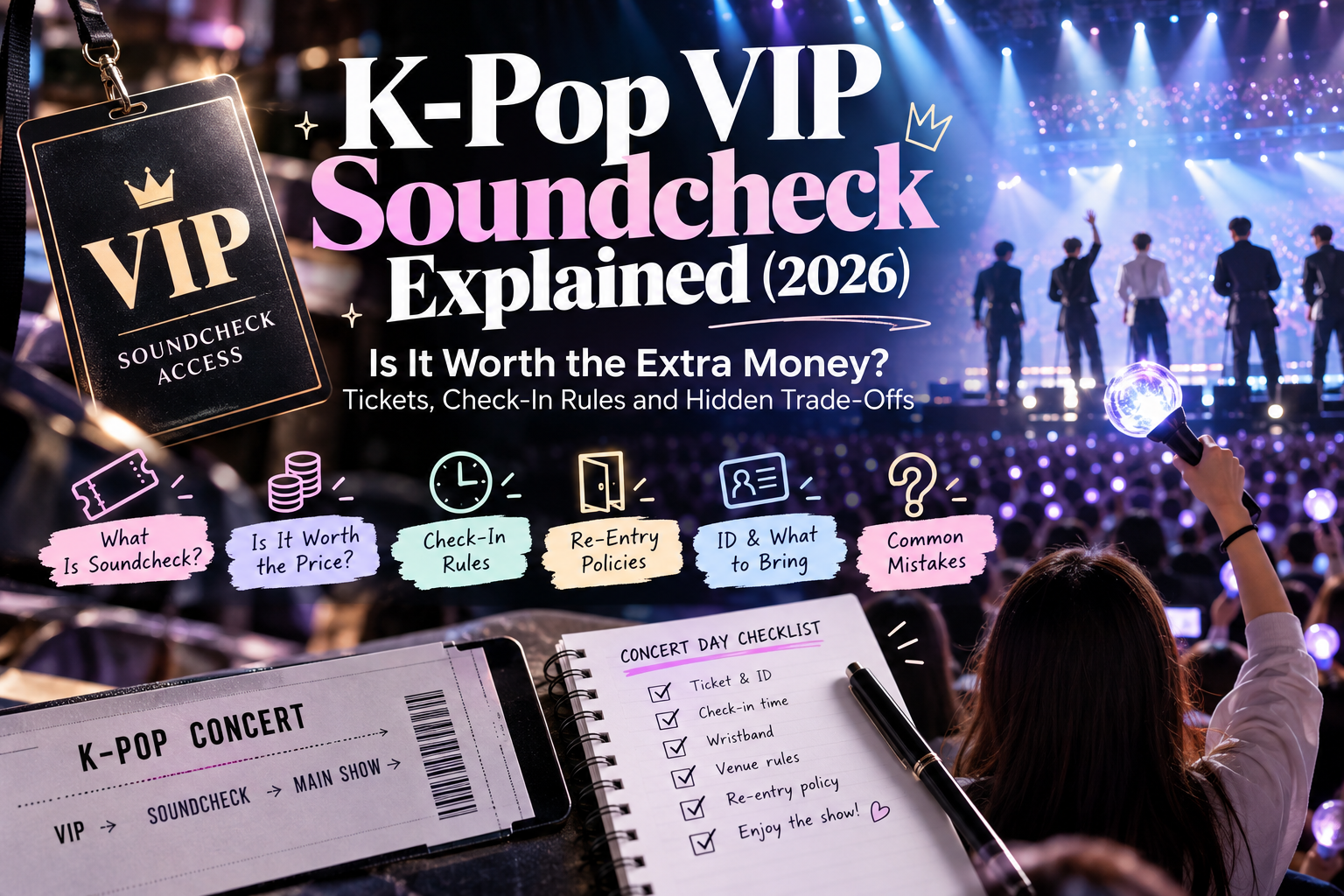
You finally find tickets for the K-pop concert you’ve been dreaming about.
Then another option appears on the booking page: VIP with soundcheck access.
The price is higher. The description promises an exclusive pre-show experience. And suddenly, the decision feels much more complicated.
Will you actually get closer to your favorite artist? Is soundcheck a mini-concert? What happens if you arrive late? And could you pay for VIP only to miss the part you wanted most?
The answers are not as straightforward as many ticket listings make them seem.
In 2026, official concert announcements show that soundcheck benefits can work very differently depending on the artist, venue and organizer.
This guide explains what you’re really paying for, how the rules affect your experience, and when a VIP upgrade makes financial and practical sense.
1. What Is K-Pop Soundcheck, Exactly?
A soundcheck is traditionally part of a concert’s technical preparation.
Before the main performance, artists and production teams may check microphones, instruments, stage audio or other elements of the live show.
A VIP soundcheck event, however, is a fan-facing experience built around that pre-concert period.
Depending on the tour, eligible fans may enter the venue early and watch a short performance or special appearance before the main concert begins.
But here’s something worth understanding.
A soundcheck event isn’t necessarily a technical rehearsal, a private concert or an opportunity to personally meet the artists.
It is a specific event benefit, and the organizer decides what that benefit includes.
You should never assume that a VIP soundcheck automatically comes with a meet-and-greet, a signed item, a group photo or direct interaction.
Those benefits must be explicitly listed in the official package.
Three different ways fans can access soundcheck
| Access type | How it works | What to check |
|---|---|---|
| VIP concert ticket | Soundcheck is included with an eligible seat or package | Ticket tier, included benefits, seating rules |
| VIP upgrade | An existing qualifying ticket becomes eligible for additional benefits | Membership, lottery and upgrade conditions |
| Promotional soundcheck event | Access comes through a separate promotion or lottery | Winner verification, eligibility and assigned entry procedures |
These are not interchangeable.
For example, a Weverse album-purchase soundcheck event may use a separate winner list and assigned seats, while a concert’s VIP ticket tier may have its own admission system.
Before comparing prices, identify which kind of access you’re actually being offered.
2. Is VIP Soundcheck Worth the Extra Money?
This is the question that matters most.
And there’s no universal answer.
The value of soundcheck depends on what you receive beyond a regular ticket — and what you must give up to receive it.
Consider a real example.
For EXO’s April 2026 EXhOrizon concerts in Seoul, the announced VIP ticket price was KRW 198,000, compared with KRW 165,000 for a general ticket.
That’s a difference of KRW 33,000 for the specified ticket categories.
However, the premium was not simply a fixed price for a separate soundcheck. The ticket categories and their associated benefits were sold as packages.
Official source: https://weverse.io/exo/notice/33571
This distinction matters because the difference between two ticket prices does not automatically tell you what soundcheck alone is worth.
A VIP package may also differ in seating, admission arrangements or other benefits.
And you may not have the option to purchase a regular seat and add soundcheck separately.
The real cost isn’t just the ticket difference
Imagine two fans considering the same VIP ticket.
Fan A lives near the venue, can arrive early and would treasure an additional performance experience.
Fan B is flying into the city that afternoon, has a tight schedule and mainly wants to hear the complete concert setlist.
Even at the same price, VIP may be an excellent choice for Fan A and a frustrating purchase for Fan B.
Why?
Because the effective cost includes more than money.
You should consider:
- The additional ticket or upgrade cost
- Travel and accommodation changes required for early check-in
- The possibility of missing the benefit because of an arrival delay
- Extra time spent waiting at the venue
- Restrictions on leaving and returning
- Whether the actual experience matches your expectations
A premium ticket offers an opportunity, not unlimited flexibility.
3. The Most Overlooked Rule: Soundcheck Check-In Is Not Concert Entry
One of the most expensive mistakes a fan can make is assuming that arriving before the main concert is early enough.
It may not be.
Soundcheck often operates on a separate timeline.
A concert could begin in the evening while the soundcheck registration deadline falls much earlier.
Your official instructions may list several different times:
| Time listed | What it means |
|---|---|
| VIP identity-verification window | When staff confirm your eligibility |
| VIP check-in deadline | The final time registration is accepted |
| VIP gate admission | When eligible attendees are allowed through a specified entrance |
| Soundcheck start | When the pre-show event begins |
| Main concert admission | Regular concert entry procedures |
| Main concert start | The advertised performance time |
The mistake is planning your journey around only the final row.
A real example: LE SSERAFIM’s 2026 Japan tour
An official PUREFLOW soundcheck notice instructed VIP attendees to complete identity verification, receive a wristband and arrive at the designated gate within the announced admission procedure.
It also warned that fans who were late might not be able to attend soundcheck, even though they could still enter later for the main concert.
Official source: https://weverse.io/lesserafim/notice/37575
That’s a crucial distinction.
Missing soundcheck does not always mean losing your concert ticket. But keeping your concert admission doesn’t mean you can recover the missed VIP benefit.
Always read the event-specific late-arrival policy before making travel plans.
4. Can You Leave After Soundcheck and Come Back?
Here’s where things get particularly interesting.
There is no single K-pop industry rule for re-entry.
Two official concert notices illustrate why.
Example A: EXO — Exit and return required
For EXO’s November 2026 EXhOrizon [dot] concerts, the official notice states that soundcheck attendees will be asked to leave after the event and prepare to re-enter for the main concert.
It also states that missing soundcheck for personal reasons does not qualify for a partial refund.
Official source: https://weverse.io/exo/notice/38455
Example B: Jin — Leaving was not permitted
For Jin’s #RUNSEOKJIN_EP.TOUR in JAPAN, the official VIP instructions took a different approach.
After entering soundcheck, attendees were required to remain within the venue through the main concert.
Leaving the venue meant re-entry would not be permitted, although the rules allowed movement to designated facilities inside.
Official source: https://weverse.io/bts/notice/28049
These are specific event policies, not universal rules for EXO, BTS or any future concerts.
But they demonstrate something important.
The same word — soundcheck — can describe experiences with completely different logistics.
Before booking, find the official re-entry clause for your exact performance date.
Never rely on a video, social media comment or guide from another tour stop.
5. What Do You Actually Need to Bring?
For many VIP experiences, buying a ticket is only the beginning.
The organizer may require identity verification before allowing you to collect benefits or enter the venue.
Depending on the event, you may need:
- An accepted original identification document
- The ticket or official digital ticket
- Booking confirmation or reservation details
- Evidence of eligible fan-club membership
- A matching purchaser or attendee name
- A wristband or another access item issued at the venue
The precise requirements differ by event.
International fans should pay particular attention to identification and account-name rules.
A name entered differently on a ticketing account may create problems if the organizer requires an exact match with an accepted ID.
But don’t assume every show follows identical document rules.
Follow the accepted-ID list published by the actual organizer or ticket seller.
An especially useful example is the official BTS ARIRANG soundcheck event guidance, which describes assigned verification windows, ticket collection and wristband procedures.
Official source: https://shop.weverse.io/en/shop/USD/artists/2/notices/13339
What about the wristband?
Think of a soundcheck wristband as an access credential, not a souvenir you can casually remove.
Some events require the issued wristband to remain on your wrist until the soundcheck finishes or even until the main show ends.
Lost or damaged credentials may not be replaceable.
Keep your wristband, ticket and ID secure until the organizer’s requirements have been satisfied.
6. Does VIP Guarantee a Better View or a Personal Interaction?
Not necessarily.
There are two separate questions here.
First: Where will you stand or sit?
Some VIP packages include access to a particular seating section. Others use assigned or randomized positions.
A soundcheck prize from an album promotion may have completely different seating rules from a premium concert ticket.
Second: What will the artists actually do?
A soundcheck can be memorable because the atmosphere is different from the main show.
But the artist’s appearance, number of songs, interaction and duration are not standardized across K-pop concerts.
The best mindset is to evaluate the benefit that has actually been promised, not the most exciting fan video you’ve seen online.
If your primary goal is a specific view of the main stage, prioritize confirmed seating information rather than assuming soundcheck access automatically means a superior concert view.
7. A Practical VIP Decision Matrix
Still undecided?
Use this table before paying more.
| Your situation | VIP soundcheck verdict | Why |
|---|---|---|
| You’ve followed the artist for years and value exclusive experiences | Strong candidate | The additional experience may be personally meaningful |
| You can arrive well before the VIP deadline | More practical | Lower risk of missing check-in |
| You’re arriving by flight on concert day | Higher risk | Travel delays could cost you the benefit |
| You’re on a strict travel budget | Compare carefully | Extra cost may reduce what you can spend on the trip |
| You mainly want a good view of the full concert | Check seating first | Soundcheck access doesn’t guarantee your preferred view |
| You expect a meet-and-greet | Verify explicitly | Soundcheck isn’t automatically a fan interaction event |
| You’re buying through an unofficial resale listing | Proceed cautiously | Transfer and identity rules may block access |
The takeaway is straightforward.
VIP is most valuable when the included experience is something you genuinely want and your schedule lets you use it.
It is less attractive when the biggest selling point is a benefit you might miss.
8. Four Common Soundcheck Mistakes — and How to Avoid Them
Mistake 1: Assuming every VIP package includes soundcheck
The word VIP is a ticket category, not a universal list of benefits.
Better approach: Read the exact package inclusions before purchasing.
Mistake 2: Arriving before the concert but after VIP check-in
You might still be allowed into the concert while losing soundcheck access.
Better approach: Plan around the earliest required VIP checkpoint, not the advertised showtime.
Mistake 3: Assuming you can leave the venue between events
As the EXO and Jin examples demonstrate, procedures vary.
Better approach: Check the exact exit and re-entry wording before entering.
Mistake 4: Treating a premium ticket as an interaction guarantee
Soundcheck does not necessarily include selfies, autographs, conversations or a fixed number of songs.
Better approach: Pay for the listed benefits, not for expectations the organizer hasn’t promised.
9. Your Soundcheck Day: A Timeline That Actually Works
A careful plan can make the difference between enjoying the experience and spending the afternoon panicking.
Here’s a framework rather than a universal concert schedule.
The day before
Read the latest official event notice. Confirm the venue, entry gate, check-in window, accepted identification and prohibited items.
Save the relevant information somewhere accessible even if your phone connection becomes unreliable.
Before leaving your accommodation
Check that you have your ticket, required documents and any applicable membership information.
Confirm that your bag meets venue rules.
At the venue
Find the designated VIP verification location rather than joining the first concert queue you see.
Follow the staff’s instructions for registration, wristbands and entry.
After soundcheck
Follow the event-specific re-entry procedure. Do not assume you’re allowed to leave — or required to leave — without checking.
Before the main show
Keep any required credentials secure, locate your assigned area and allow enough time for the final entry process.
And if something doesn’t match the instructions, ask official venue staff rather than relying solely on other attendees’ experiences.
10. Your First K-Pop Concert? Prepare for the Experience, Not Just the Ticket
Soundcheck is only one part of concert culture.
The main show often includes coordinated fan chants, official lightsticks and shared audience moments that can be just as memorable as a premium pre-show benefit.
If you’re attending for the first time, these guides can help:
What Is a K-Pop Fan Chant? Why Fans Shout Together During Performances — Learn how fans participate in songs and performances.
K-Pop Lightstick Not Connecting in 2026? Concert Pairing, Seat Registration, Battery and Compatibility Fixes — Troubleshoot a common concert-day problem.
These preparations matter whether you choose a regular ticket or a VIP package.
11. Frequently Asked Questions
Is K-pop soundcheck a private concert?
Not necessarily. It is a scheduled pre-show benefit with an experience defined by the organizer. Its duration, format and attendance rules vary.
Can I buy soundcheck separately from my concert ticket?
Sometimes organizers offer an eligible upgrade process, but many packages do not allow a separate add-on purchase. Check the official sales structure for your event.
Can I enter soundcheck if my friend bought my ticket?
Only if the ticketing and identity rules permit that arrangement. Never assume transferability based on another concert.
Do I lose my main concert ticket if I miss soundcheck?
Not always. Some official notices allow later entry to the main concert, but the consequence depends on the exact event policy.
Are photographs and videos allowed during soundcheck?
Rules vary. Some events prohibit recording entirely, even if attendees have seen videos from other concerts. Follow the organizer’s filming policy.
Does VIP mean I can meet the artists?
No. Soundcheck, hi-touch, send-off, meet-and-greet and fansign are different benefits. Only expect an interaction if it is explicitly included.
Final Verdict: Is VIP Soundcheck Worth It in 2026?
Here’s the simplest way to decide.
Don’t ask only, “How much more does VIP cost?”
Ask three better questions.
What exactly am I getting?
Check the confirmed benefits, seating terms and whether the experience matches what you want.
Can I realistically attend every required checkpoint?
Check identification, admission deadlines and travel timing.
Would I still feel satisfied if the experience were short and offered no personal interaction?
If the answer is yes, VIP soundcheck may be a rewarding way to make a special concert feel even more memorable.
If the answer is no, a good regular ticket — with less logistical pressure and money left in your travel budget — may be the smarter choice.
Ultimately, the best K-pop concert experience isn’t defined by the word VIP.
It’s defined by knowing what you’ve purchased, arriving prepared and enjoying the show you came to see.
Last reviewed: October 17, 2026. Official soundcheck policies vary by artist, tour, performance date and ticket provider. The linked notices are examples, not blanket rules for future shows.