
Tag: K-Pop Concert

  • What Is a K-Pop Fan Meeting? How It Differs From a Concert and Fan Sign

    What Is a K-Pop Fan Meeting? How It Differs From a Concert and Fan Sign

    If you are new to K-pop, the different types of fan events can be confusing.

    You may hear that an artist is holding a concert, a fan sign, or a fan meeting.

    All three events bring artists and fans together, but they are not the same experience.

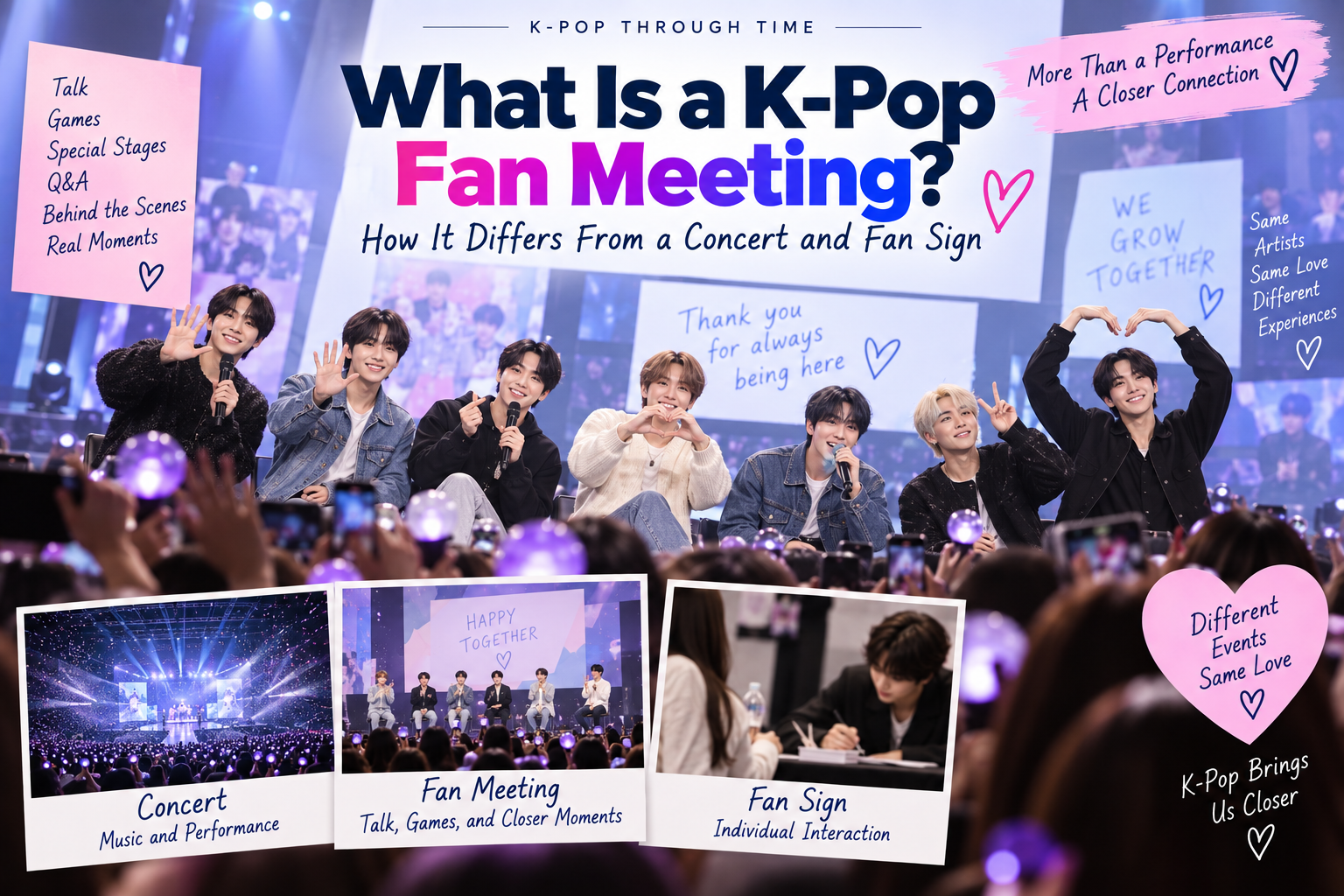
    A concert focuses mainly on music and performance. A fan sign offers brief individual interactions with selected fans. A fan meeting falls somewhere in between, combining performances, conversations, games, and special moments designed specifically for fans.

    So what exactly happens at a K-pop fan meeting?

    What Is a K-Pop Fan Meeting?

    A K-pop fan meeting is a special event where artists spend time with fans through a mixture of entertainment and interaction.

    Unlike a regular concert, the schedule may include much more than songs.

    Artists might talk with the audience, answer questions, play games, perform special stages, watch old videos, share stories, or participate in activities prepared specifically for the fandom.

    The atmosphere is often more relaxed and personal than a large concert.

    Fan Meeting vs. Concert

    The biggest difference is the main purpose of the event.

    A concert is primarily built around musical performances.

    Fans usually attend expecting a setlist filled with songs, choreography, stage production, costumes, lighting, and other performance elements.

    A fan meeting, however, focuses more heavily on communication between artists and fans.

    Music is still important, but performances may take up only part of the event.

    There can be long talking segments, games, audience participation, and humorous moments that would not normally appear during a standard concert.

    Fan Meeting vs. Fan Sign

    A fan meeting is also different from a fan sign.

    At a fan sign, selected fans generally interact with idols individually for a short period while receiving autographs.

    At a fan meeting, a much larger audience watches the event together.

    Most attendees will not have an individual conversation with the artist.

    Instead, the interaction happens collectively through conversations, games, audience responses, and special activities.

    A simple way to think about it is:

    Concert = performance-focused

    Fan sign = brief individual interaction

    Fan meeting = group entertainment and fan interaction

    What Happens at a Fan Meeting?

    Every fan meeting is different, but several activities are common.

    Artists may begin by greeting the audience and talking about recent activities.

    There may be question-and-answer segments, games between members, challenges, behind-the-scenes stories, or discussions about memorable moments.

    Some events also include surprise missions or activities suggested by fans.

    Because the format is flexible, fan meetings can reveal more of an artist’s personality than a tightly planned music performance.

    Are There Performances at Fan Meetings?

    Yes.

    Fan meetings often include musical performances, but usually fewer songs than a full concert.

    Artists might perform popular songs, fan favorites, acoustic versions, solo stages, covers, or songs they rarely perform elsewhere.

    Sometimes a fan meeting includes a special performance created specifically for that event.

    This is one reason fans may consider fan meetings unique even if they have already attended the artist’s concert.

    Games and Challenges

    Games are a familiar part of many K-pop fan meetings.

    Members might compete against one another, answer trivia questions, complete missions, or participate in playful challenges.

    These segments often create funny and unpredictable moments.

    Fans get to see idols outside the highly polished environment of a music-show stage or music video.

    That relaxed atmosphere is part of the appeal.

    Talking With Fans

    Conversation is another major part of fan meetings.

    Artists may discuss their music, recent activities, memories, future goals, or experiences with the fandom.

    They may also read questions or messages submitted by fans.

    These conversations can make the event feel more intimate, even when hundreds or thousands of people are attending.

    Special Videos and Behind-the-Scenes Content

    Fan meetings sometimes include videos that are not normally available elsewhere.

    These may show rehearsals, backstage moments, funny missions, interviews, or messages prepared for fans.

    Artists may watch the videos together with the audience and react to them in real time.

    This gives fans another opportunity to see a more casual side of their favorite artists.

    Fan Meetings and Anniversaries

    Fan meetings are often connected to meaningful dates.

    An artist may organize one to celebrate a debut anniversary, the anniversary of a fandom, or another milestone.

    Anniversary fan meetings can include discussions about past years, old photographs, memorable performances, and messages of appreciation.

    For long-time fans, these events can feel like celebrating shared history with the artist.

    What Is a Fan Concert?

    Another term you may encounter is fan concert or sometimes fan-con.

    A fan concert generally combines characteristics of both a fan meeting and a concert.

    It may contain more musical performances than a traditional fan meeting while still including talking segments, games, and fan interaction.

    There is no universal formula, however.

    Different entertainment companies and artists may use these terms somewhat differently.

    Can International Fans Attend?

    Yes.

    Many K-pop artists hold fan meetings outside South Korea, especially as their international audiences grow.

    Cities across Asia and other parts of the world may be included in fan meeting tours.

    Some events may also offer online streaming options.

    Ticketing procedures vary, so international fans should always check official announcements for dates, venues, ticket sales, and participation rules.

    Do Fan Meetings Have Special Merchandise?

    Often, yes.

    Some fan meetings have merchandise designed specifically for the event.

    This can include photocards, posters, clothing, accessories, photo sets, or other collectibles.

    Because these products may be connected to one particular event, they can become memorable souvenirs for fans who attended.

    However, purchasing merchandise is optional and is not necessary to enjoy the event.

    Why Do Fans Love Fan Meetings?

    Concerts allow fans to experience the power of live music.

    Fan signs provide short personal interactions.

    Fan meetings offer something different: the feeling of spending a longer, more relaxed period with the artist.

    Fans can hear stories, watch members joke with one another, enjoy unusual performances, and participate in moments created specifically for the fandom.

    This can make the relationship between artist and fandom feel more personal.

    The Role of Fandom at a Fan Meeting

    Fan meetings are often designed around a particular fandom.

    The fandom name, inside jokes, memorable moments, fan chants, and shared history between artists and fans may all become part of the program.

    Someone unfamiliar with the artist can still enjoy the event, but long-time fans may recognize references that carry special meaning.

    In this sense, a fan meeting can feel like a celebration of the community surrounding an artist.

    Are Fan Meetings Smaller Than Concerts?

    Sometimes, but not always.

    Some fan meetings take place in relatively small venues, creating a more intimate atmosphere.

    Popular artists may hold fan meetings in large arenas or organize multiple dates because of high demand.

    The defining difference is therefore not necessarily the size of the venue.

    It is the style and purpose of the event.

    Do You Need to Attend a Fan Meeting to Be a Dedicated Fan?

    No.

    Like concerts, fan signs, albums, and merchandise, fan meetings are simply one way to experience K-pop.

    Tickets, travel, and other expenses can make attendance difficult or impossible for many fans.

    Someone who enjoys the music from home is no less of a fan than someone who attends multiple events.

    K-pop fandom can be experienced in many different ways.

    Fan Meeting, Concert, or Fan Sign: Which Is Best?

    There is no single answer.

    If you mainly want to hear many songs performed live, a concert may be the best choice.

    If you dream of having a brief individual interaction with an idol, a fan sign offers a very different experience.

    If you enjoy conversations, games, special stages, and a relaxed atmosphere, a fan meeting may be especially appealing.

    Each event reveals a different side of K-pop.

    Final Thoughts

    A K-pop fan meeting is more than a smaller version of a concert.

    It is an event designed around the relationship between artists and their fans.

    Music may be part of the experience, but so are conversations, games, special videos, unexpected performances, and moments of shared laughter.

    Concerts show us artists as performers.

    Fan signs can create brief one-to-one encounters.

    Fan meetings give artists and fans the chance to spend time together as a community.

    And that combination of music, personality, interaction, and shared memories is what makes the K-pop fan meeting a distinctive part of fandom culture.

  • What Is a K-Pop Lightstick? Why Every Fandom Has Its Own Design

    What Is a K-Pop Lightstick? Why Every Fandom Has Its Own Design

    What Is a K-Pop Lightstick?

    If you have ever watched a K-pop concert, you may have noticed thousands of fans holding glowing objects in the audience. These colorful lights often move together, turning an entire concert venue into a sea of light.

    These objects are called lightsticks, and they have become one of the most recognizable symbols of K-pop fandom culture.

    But what exactly is a K-pop lightstick, why does each fandom have its own design, and do you need one to enjoy a K-pop concert?

    A K-pop lightstick is a handheld electronic light designed to represent a particular K-pop artist or group. Fans commonly use lightsticks at concerts, fan meetings, and other events to show support for their favorite artists.

    Unlike ordinary glow sticks, official K-pop lightsticks usually have unique designs, colors, logos, and features connected to the identity of the artist and fandom.

    Why Do K-Pop Groups Have Their Own Lightsticks?

    K-pop fandoms often have their own names, symbols, colors, and traditions.

    A lightstick turns that identity into something fans can physically hold.

    Instead of every concert audience using the same generic glow stick, each artist can have a recognizable design associated with their music, image, and fandom.

    This means a lightstick can serve several purposes at once.

    It can be a concert accessory, a collectible item, a symbol of fandom identity, and a visual connection between artists and fans.

    Why Do K-Pop Lightsticks Have Different Designs?

    One of the most interesting things about K-pop lightsticks is how different they can look.

    Some are simple and elegant. Others are playful, futuristic, symbolic, or highly unusual.

    Designs may incorporate:

    • a group’s logo
    • fandom colors
    • symbols connected to the artist
    • album or concept imagery
    • shapes associated with the group’s identity

    Because of this, fans can often recognize which artist a lightstick belongs to even before seeing the group’s name.

    The design itself becomes part of the artist’s visual identity.

    What Are Some Famous K-Pop Lightsticks?

    Many major K-pop artists have lightsticks that fans immediately recognize.

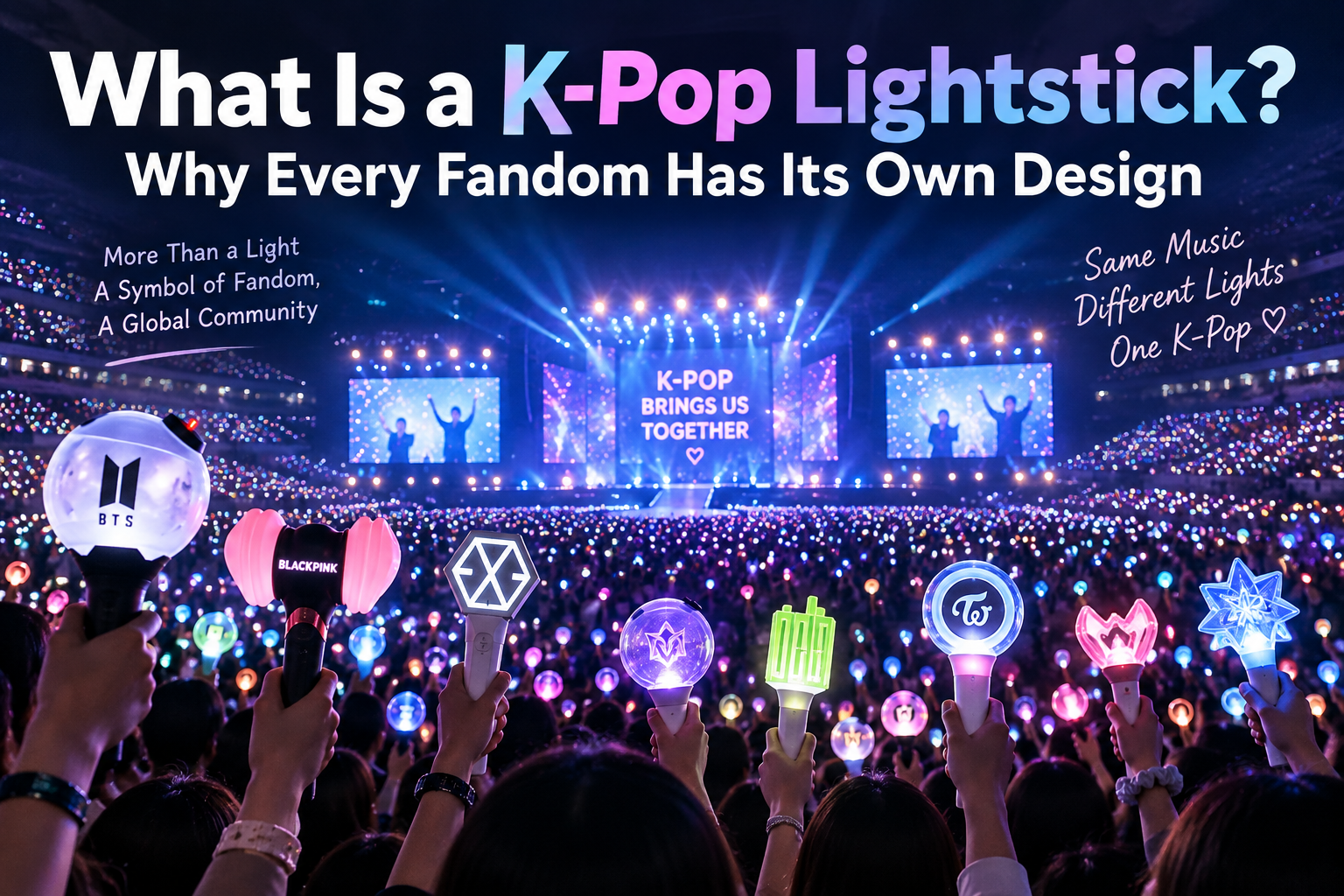
    BTS fans, known as ARMY, use the official BTS lightstick commonly known as the ARMY Bomb.

    BLACKPINK’s official lightstick has a distinctive pink-and-black design with heart-shaped ends.

    Other groups have developed equally recognizable designs, each reflecting the personality and identity of the artist and fandom.

    As K-pop has expanded internationally, these lightsticks have also become familiar sights at concerts around the world.

    How Do K-Pop Lightsticks Work at Concerts?

    Modern K-pop lightsticks can do much more than simply turn on and off.

    Depending on the artist, venue, event, and lightstick model, some official lightsticks can connect to concert systems or supported apps.

    During a performance, large numbers of lightsticks may change colors or lighting patterns together.

    From the stage, this can transform the audience into a coordinated field of light.

    Different songs or moments in the concert may produce different lighting effects, adding another visual layer to the performance.

    What Is an “Ocean” in K-Pop Concert Culture?

    K-pop fans sometimes use the word “ocean” to describe the visual effect created when thousands of audience lights fill a concert venue.

    For example, a venue filled with lights associated with one artist or fandom can look like a glowing ocean from the stage.

    These concert oceans can become memorable images because they visually represent the size and unity of a fandom.

    For artists, seeing an arena filled with their fandom’s lights can also create a powerful connection with the audience.

    Why Are Lightsticks Important to K-Pop Fandoms?

    Lightsticks are closely connected with fandom identity.

    When thousands of people hold the same lightstick at a concert, each person is participating individually while also becoming part of a much larger visual community.

    This reflects an important part of K-pop fandom culture.

    Fans may live in different countries, speak different languages, and discover an artist at different times, but symbols such as fandom names and lightsticks give them something recognizable to share.

    That is why a lightstick can have emotional meaning beyond its practical use at a concert.

    Are K-Pop Lightsticks Official Merchandise?

    Many well-known K-pop lightsticks are released as official merchandise associated with an artist.

    Official versions may be sold through an artist’s official store, entertainment company, concert merchandise booth, or authorized retailer.

    However, unofficial products and imitations also exist.

    This matters especially when a lightstick includes features intended to work with a particular concert or application, because unofficial products may not support the same functions.

    Fans who want a lightstick for an upcoming concert should therefore check the artist’s official information for the event and the specific lightstick version being supported.

    Do You Need a Lightstick to Attend a K-Pop Concert?

    No.

    Owning a lightstick is not a requirement for being a K-pop fan, and in most situations you do not need one simply to enjoy a concert.

    Many fans attend concerts without lightsticks.

    Others choose to buy one because they enjoy participating in the concert atmosphere or want an official collectible connected to their favorite artist.

    Being part of a fandom is not determined by how much merchandise someone owns.

    Listening to and enjoying the music is enough.

    Can You Bring Another Group’s Lightstick to a K-Pop Concert?

    This is a question new K-pop fans sometimes ask.

    Fan expectations can vary depending on the artist, fandom, venue, and event.

    Because lightsticks are strongly associated with particular groups, some fans prefer to use the performing artist’s official lightstick or no lightstick at all.

    More importantly, concert rules can vary.

    Before attending a concert, it is best to check the organizer’s or artist’s official event information rather than assuming that every type of lightstick will be permitted or supported.

    What Is the Difference Between a Lightstick and a Regular Glow Stick?

    A regular glow stick is usually a simple light source.

    A K-pop lightstick is more closely connected to an artist’s brand and fandom.

    It may include a distinctive design, official logo, multiple lighting modes, replaceable batteries, wireless functions, or app connectivity, depending on the product.

    Most importantly, it carries symbolic meaning.

    Fans do not simply see it as a light. They often see it as a representation of their relationship with an artist and fellow fans.

    Why Do Fans Collect K-Pop Lightsticks?

    Not everyone buys a lightstick only for concerts.

    Some fans collect them in the same way others collect albums, photocards, posters, or other official merchandise.

    Because each group’s lightstick has a different design, a collection can also represent a fan’s history with K-pop.

    A lightstick may remind someone of their first concert, favorite comeback, favorite group, or a particular period in their life.

    For this reason, older or redesigned versions can sometimes have special sentimental value to fans.

    How Are Lightsticks Connected to K-Pop’s Global Growth?

    Lightsticks were once most strongly associated with Korean concert and fandom culture, but international K-pop tours have made them increasingly visible around the world.

    When a K-pop group performs in cities such as Los Angeles, London, Paris, Tokyo, Bangkok, or Singapore, audiences may use the same official fandom lightstick seen at concerts in Seoul.

    This creates a recognizable visual language across borders.

    Fans may speak different languages, but when an arena lights up with thousands of matching lightsticks, the meaning is immediately understandable.

    Do All K-Pop Artists Have Official Lightsticks?

    No.

    Some established groups and solo artists have official lightsticks, while newer or smaller artists may not.

    Lightstick designs can also change over time, and new versions may be released as technology or branding evolves.

    Therefore, fans should not assume that every K-pop artist has one or that every version works in exactly the same way.

    Lightsticks, Fandom, and the K-Pop Experience

    K-pop is not only experienced through recorded music.

    Fans also encounter it through music videos, choreography, concerts, social media, fancams, albums, merchandise, and fandom communities.

    The lightstick sits at the intersection of many of these experiences.

    It is merchandise, but it is also part of concert participation.

    It represents an individual artist, but thousands of fans can use it together.

    And although it is a physical object, its meaning comes largely from the community surrounding it.

    Final Thoughts

    A K-pop lightstick is much more than a glowing concert accessory.

    It is a symbol designed to represent an artist and their fandom, and it can transform thousands of individual fans into one coordinated visual audience.

    From distinctive designs and fandom colors to synchronized concert effects and collectible value, lightsticks have become an important part of modern K-pop culture.

    But owning one is never what makes someone a fan.

    Whether you are holding an official lightstick in a stadium or simply listening to your favorite K-pop song at home, the most important part is the connection you have with the music and artists you enjoy.