What Was the Second Generation of K-Pop?
If the first generation built the foundations of the modern Korean idol industry, the second generation of K-pop was the era when that system expanded dramatically across Asia and began reaching a much wider global audience.
The exact boundaries of K-pop generations are not officially defined. Different fans, media outlets, and researchers may use slightly different timelines. In general, however, the second generation is commonly associated with artists who rose to prominence from the mid-2000s through the early 2010s.
This was a crucial period in K-pop history.
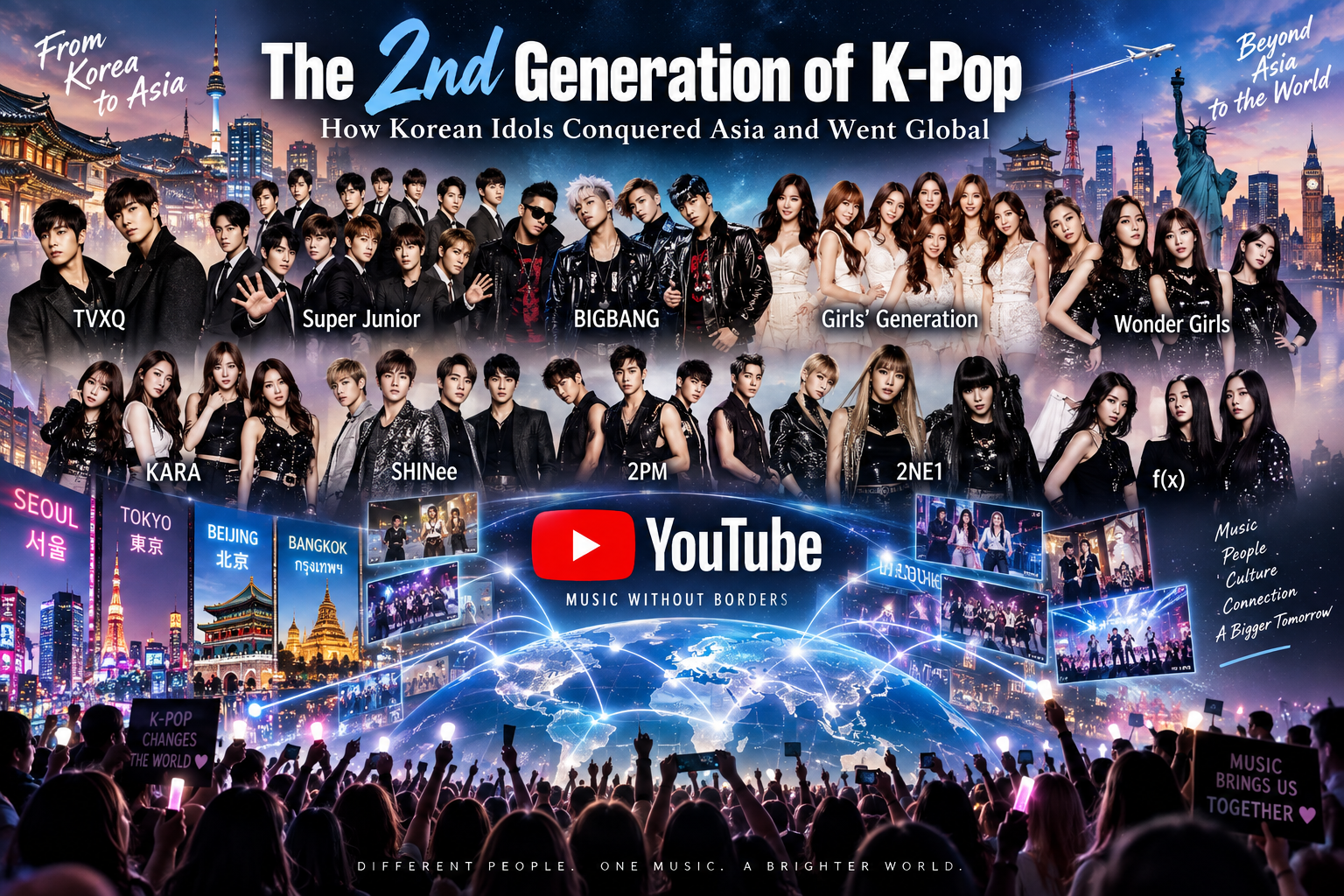
Groups such as TVXQ, Super Junior, BIGBANG, Girls’ Generation, Wonder Girls, KARA, SHINee, 2PM, 2NE1, and f(x) helped establish a new level of visibility for Korean idol music.
They entered an industry that already had trainee systems, organized fandoms, music shows, entertainment agencies, and carefully planned group concepts.
But the world around them was changing.
Broadband internet was expanding. Online video was becoming part of everyday life. Social media was beginning to connect people across borders, and digital platforms were making it easier to discover music from countries thousands of kilometers away.
For K-pop, the timing was transformative.
Building on the First Generation
Second-generation K-pop did not replace everything that came before it.
Instead, it built upon the systems established during the 1990s and early 2000s.
Entertainment companies continued recruiting and training young performers. Groups were developed around distinctive concepts and member roles. Choreography, styling, television appearances, fan clubs, physical albums, and concerts remained essential parts of the industry.
What changed was the scale.
Korean entertainment companies became increasingly ambitious about overseas markets. Japan remained particularly important, while China, Southeast Asia, and other regions offered growing opportunities.
Artists could now be developed with international promotion in mind.
Language training, overseas releases, foreign television appearances, concerts, and localized marketing became increasingly important parts of the K-pop business.
TVXQ and the Importance of Japan
TVXQ, who debuted in 2003, played an important role in the transition into this new era.
After establishing themselves in South Korea, the group pursued extensive activities in Japan. Rather than relying only on their Korean popularity, they worked to develop a sustained presence in the Japanese music market.
This was significant because Japan was—and remains—one of the world’s largest recorded-music markets.
Success there required more than simply exporting Korean songs. Artists needed to communicate with local audiences, release music for the market, appear in Japanese media, and build a long-term fan base.
The experience gained through these efforts helped demonstrate how Korean idol groups could operate across national borders.
Super Junior and the Expansion of the Idol Group Model
When Super Junior debuted in 2005, the group represented another evolution in the idol system.
With a large number of members and activities that extended beyond music, Super Junior demonstrated how an idol group could function across multiple areas of entertainment.
Members participated in variety programs, acting, radio, hosting, and other media activities.
This helped strengthen an idea that had begun developing during the first generation: a K-pop idol did not have to be only a singer.
An idol could become a multi-platform entertainer.
Super Junior also became highly popular in various international markets, contributing to the growing visibility of K-pop throughout Asia.
BIGBANG and a Different Image of the K-Pop Idol
BIGBANG, who debuted in 2006 under YG Entertainment, brought another influential approach to the second-generation landscape.
The group became known for a distinctive musical and fashion identity and for the creative involvement of members in their music.
Their success helped broaden perceptions of what an idol group could look and sound like.
K-pop was becoming increasingly diverse.
Highly synchronized group performances remained important, but audiences were also responding to distinctive musical identities, individual personalities, fashion, songwriting, and different approaches to performance.
This diversity helped K-pop appeal to a wider range of listeners.
A New Era Was Taking Shape
By the second half of the 2000s, the Korean idol industry was no longer an experiment.
It had become a highly competitive entertainment ecosystem populated by major agencies, established fandoms, television programs, album releases, concerts, and an expanding number of idol groups.
At the same time, a technological revolution was beginning outside the entertainment companies themselves.
A new generation of fans would soon be able to discover Korean music without living in Korea, buying an imported album, or waiting for a television broadcaster to show it.
All they would need was an internet connection.
That change would help transform second-generation K-pop from a rapidly expanding Asian cultural phenomenon into the foundation of a truly global music movement.
The Rise of Second-Generation Girl Groups
The second generation was also a defining era for K-pop girl groups.
During the late 2000s, several groups developed distinctive identities and became major forces in Korean popular culture. Their songs, choreography, fashion, and personalities reached audiences far beyond their established fan communities.
Among the most influential were Girls’ Generation, Wonder Girls, KARA, and 2NE1.
Each represented a different approach to the rapidly evolving K-pop industry, and together they demonstrated how diverse the idol market had become.
Girls’ Generation and the Power of a National Hit
Girls’ Generation, also known as SNSD, debuted under SM Entertainment in 2007.
The group grew into one of the defining acts of second-generation K-pop. Their music combined memorable melodies with coordinated performances and strong visual concepts, while the individual members became familiar faces through television, advertising, acting, and other entertainment activities.
Their 2009 song “Gee” became one of the era’s signature K-pop hits.
Its popularity illustrated an important feature of second-generation idol culture: a successful song could extend far beyond an established fandom and become part of mainstream popular culture.
Girls’ Generation later expanded their activities in Japan, further demonstrating the growing ability of Korean girl groups to build audiences outside South Korea.
Wonder Girls and an Early Push Toward the United States
Wonder Girls, who debuted under JYP Entertainment in 2007, followed a different international path.
Their song “Nobody” became enormously popular and helped introduce the group to audiences across Asia.
The group later pursued activities in the United States at a time when sustained American promotion by a Korean idol group was still unusual.
In 2009, the English-language version of “Nobody” entered the Billboard Hot 100, making Wonder Girls an important early example of a K-pop act reaching a major U.S. singles chart.
Their American activities did not immediately create the kind of mass-market breakthrough that later K-pop artists would experience. However, they demonstrated both the possibilities and difficulties of entering a market where Korean idol music was still unfamiliar to much of the general public.
These early attempts provided valuable lessons for the industry’s future international expansion.
KARA and the Strength of K-Pop in Japan
KARA, who debuted under DSP Media in 2007, became particularly successful in Japan.
Their popularity showed that the Japanese market was not accessible only to male Korean idol groups. K-pop girl groups could also establish strong fan bases there through localized promotion, Japanese releases, television appearances, and live performances.
KARA’s success was part of a broader wave of Korean artists gaining visibility in Japan during this period.
This mattered because overseas success was becoming less exceptional.
International activities were increasingly becoming a normal part of the career strategy for leading K-pop acts.
2NE1 and a New Kind of Girl Group Image
When 2NE1 debuted under YG Entertainment in 2009, they brought another distinctive identity to the second-generation landscape.
Their music and presentation emphasized confidence, individuality, strong performance energy, and a fashion-forward image.
This helped broaden the range of concepts associated with female K-pop groups.
Rather than assuming that successful girl groups needed to follow one particular formula, the industry increasingly demonstrated that different identities could attract different audiences.
The contrast among groups such as Girls’ Generation, Wonder Girls, KARA, and 2NE1 became one of the strengths of the era.
K-pop was developing enough variety to support multiple interpretations of what an idol group could be.
SHINee, 2PM, and an Increasingly Competitive Industry
The expansion was not limited to the largest names.
SHINee, who debuted in 2008 under SM Entertainment, became known for strong performance skills, contemporary musical styles, and fashion that influenced youth trends.
2PM, who debuted under JYP Entertainment the same year, developed a powerful performance identity that distinguished them within the crowded boy-group market.
Many other groups also competed for public attention during this period.
As more artists debuted, entertainment companies had to find clearer ways to differentiate their groups.
Music alone was not always enough.
Concept, choreography, styling, member personalities, variety-show appearances, fan communication, and visual storytelling became increasingly important.
This intense competition encouraged constant experimentation.
K-Pop Was Becoming Designed to Be Seen as Well as Heard
Second-generation K-pop developed during a period when music was becoming increasingly visual.
Choreography had always mattered to idol performances, but online video gave dance and visual presentation a much larger international audience.
A memorable movement could become closely associated with a song.
Fans could learn choreography, upload dance covers, share performances, and introduce songs to people who might never encounter them through Korean television or radio.
Music videos therefore became more than promotional accessories.
They were becoming one of K-pop’s most effective international gateways.
A viewer did not need to understand every Korean lyric to appreciate a striking music video, synchronized choreography, distinctive styling, or charismatic performance.
That advantage would become enormously important as one particular online video platform grew around the world.
YouTube Changed the Geography of K-Pop
The rise of YouTube fundamentally changed how international audiences could encounter Korean music.
Before widespread online video, access to K-pop outside South Korea could depend heavily on imported albums, television broadcasts, local distributors, fan communities, or physical proximity to Asian entertainment markets.
Online video weakened those geographic barriers.
A fan in another country could discover a Korean music video, share it with friends, search for more performances, and begin exploring other artists—all without waiting for traditional media to introduce them.
International fans also created their own ecosystem around K-pop.
Dance covers, translated content, fan-made guides, discussion communities, and other forms of participation helped Korean music circulate beyond the industry’s official promotional channels.
The relationship between K-pop and the internet was becoming mutually reinforcing.
Entertainment companies gained access to international viewers, while fans gained unprecedented tools to spread the music themselves.
This digital transformation would soon produce moments that demonstrated just how far Korean popular music could travel.
How the Internet Turned K-Pop Fandom Global
By the late 2000s and early 2010s, K-pop had developed strong audiences across several Asian markets. But digital technology was beginning to remove one of the biggest obstacles Korean artists had previously faced: geography.
International fans no longer needed to live near a Korean cultural center, find imported CDs, or wait for local television stations to broadcast Korean entertainment.
Music videos, performances, interviews, and fan-created content could travel online.
This shift changed not only how K-pop was distributed, but also how fandom itself worked.
YouTube Became a Global Gateway
YouTube gave K-pop something extraordinarily valuable: a platform through which visual performances could reach viewers almost anywhere.
This suited K-pop particularly well.
The industry had already invested heavily in choreography, styling, music videos, stage performance, and memorable concepts. These elements could attract viewers even when they did not speak Korean.
A person might discover one music video by accident, watch another performance, search for the members, and eventually explore an entire catalog of Korean artists.
Discovery could happen without traditional radio or television support.
This represented a fundamental change in how Korean music could enter international markets.
Fans Became Part of K-Pop’s Distribution Network
The growth of international K-pop was not driven only by entertainment companies.
Fans became active participants.
They shared music videos, created subtitles and translations, uploaded dance covers, wrote introductory guides, discussed artists in online communities, and recommended songs to people who had never listened to Korean music before.
This fan activity helped information cross language barriers.
A new international listener could often find explanations of member names, song meanings, television appearances, fandom terminology, and Korean cultural references created by other fans.
In effect, global fandom became an informal distribution and education network.
This remains one of K-pop’s most distinctive strengths.
Social Media Changed the Artist-Fan Relationship
Social media added another important dimension.
Earlier generations of fans often experienced idols primarily through television, magazines, concerts, official fan clubs, and entertainment-company announcements.
Digital platforms made communication feel faster and more direct.
Artists could share updates with fans, while fans could react and spread information almost immediately.
International supporters could participate in conversations at roughly the same time as Korean fans.
This reduced the psychological distance between Seoul and the rest of the world.
K-pop fandom was becoming less defined by where someone lived and more by whether they could connect online.
Dance Covers Created a New Form of Participation
Dance also played an important role in K-pop’s international growth.
Second-generation K-pop produced many songs with recognizable choreography, and online video allowed fans around the world to learn and recreate those performances.
Dance-cover communities emerged in numerous countries.
Fans were no longer only consuming K-pop. They were performing it themselves.
This created another route through which Korean music could enter local communities.
A dance cover performed at a school, university, cultural event, or uploaded online could introduce K-pop to people who had never actively searched for Korean music.
The participatory nature of fandom helped transform K-pop from imported entertainment into a cultural activity shared by communities around the world.
International Concerts Made Online Fandom Visible
As overseas fan communities grew, concerts and festivals provided physical evidence that online interest could translate into real audiences.
K-pop artists increasingly performed outside South Korea, and international fans gathered to see groups they had often discovered primarily through the internet.
These events were important for entertainment companies.
Online views could suggest that an artist had international interest, but ticket sales and enthusiastic concert audiences demonstrated that those fans were willing to participate in the industry economically as well.
International touring gradually became a more important part of K-pop’s business model.
The global audience was becoming measurable.
2012: “Gangnam Style” Changes the Scale
Then came a moment that dramatically expanded worldwide awareness of Korean popular music.
In 2012, PSY released “Gangnam Style.”
The song’s music video spread internationally at extraordinary speed.
Its distinctive choreography, humorous visual style, memorable chorus, and highly shareable video made it accessible even to viewers who knew little about South Korea or K-pop.
“Gangnam Style” became a global viral phenomenon.
The song reached audiences far beyond existing K-pop fandoms and became widely discussed across television, news media, social networks, and popular culture.
Its success demonstrated something that would have seemed far less obvious only a few years earlier:
A Korean-language song could become a worldwide mainstream phenomenon.
“Gangnam Style” Did Not Create Global K-Pop From Nothing
It is tempting to describe “Gangnam Style” as the moment K-pop suddenly became global.
The history is more complicated.
By 2012, second-generation artists had already spent years building international audiences. Korean entertainment companies had promoted artists throughout Asia. Fans had created communities around the world. YouTube had already become an important discovery platform, and Korean music was circulating internationally through digital networks.
PSY’s breakthrough therefore did not appear from nowhere.
Instead, it revealed the scale that online distribution could achieve.
Millions of people who had never deliberately searched for K-pop suddenly encountered a Korean artist.
For the wider Korean music industry, the implications were enormous.
The World Was Becoming Ready for the Next Generation
By the early 2010s, many pieces of the global K-pop ecosystem were already in place.
Entertainment companies had experience promoting internationally.
Artists had established audiences across Asia.
YouTube allowed music videos to travel worldwide.
Social media connected fans across borders.
Online communities helped overcome language barriers.
International concerts demonstrated real demand.
And “Gangnam Style” had shown that Korean-language music could capture mainstream global attention on an unprecedented scale.
The second generation had helped build the bridge between the early Korean idol industry and the worldwide K-pop culture that followed.
The next generation would cross that bridge—and take K-pop to levels of international recognition the industry had never experienced before.
The Lasting Legacy of Second-Generation K-Pop
The second generation occupies a unique place in K-pop history.
The first generation established many of the foundations of the idol system. Later generations would achieve unprecedented success on global charts, streaming platforms, social media, and international tours.
The second generation connected those two worlds.
It inherited the trainee system, organized fandoms, television-centered promotion, physical album culture, and carefully developed group concepts of earlier K-pop. At the same time, it experienced the rise of YouTube, social media, digital music, and increasingly connected international fan communities.
For this reason, the second generation can be understood as one of the most important bridges between domestic idol culture and global K-pop.
Performance Became Central to K-Pop’s International Identity
Second-generation artists helped establish the performance style that many international audiences would come to associate with K-pop.
Synchronized choreography, memorable dance moves, carefully coordinated styling, ambitious music videos, and distinctive concepts became increasingly important.
These qualities worked particularly well in the online-video era.
A listener might not understand Korean, but choreography and visual storytelling did not require translation.
This gave K-pop an important advantage as music discovery became increasingly global and visual.
Songs were not simply heard.
They were watched, shared, imitated, and performed by fans around the world.
Different Groups Proved There Was No Single K-Pop Formula
Another important legacy of the era was diversity.
TVXQ demonstrated the potential for sustained overseas activity.
Super Junior showed how a large idol group could extend into multiple areas of entertainment.
BIGBANG emphasized distinctive musical identity, fashion, and member participation in music creation.
Girls’ Generation became one of the defining girl groups of the era.
Wonder Girls tested the possibilities of direct promotion in the United States.
KARA became a major example of Korean girl-group success in Japan.
SHINee became known for performance, musical experimentation, and style.
2NE1 presented a powerful alternative image for female idols.
These artists did not succeed by following exactly the same formula.
Instead, they demonstrated that the K-pop system could produce very different musical and visual identities.
That flexibility would become essential as the industry expanded internationally.
The Korean Wave Became More Visible Around the World
Second-generation K-pop also strengthened the broader Korean Wave, or Hallyu.
International fans who discovered Korean music often became interested in other aspects of Korean culture.
Some began watching Korean dramas and variety programs. Others became interested in the Korean language, food, fashion, beauty, movies, or travel.
The relationship also worked in the opposite direction.
People who first discovered Korean dramas or films sometimes became curious about Korean music.
This interaction helped create a wider cultural ecosystem in which different forms of Korean entertainment supported one another.
K-pop was becoming one of the most visible gateways into contemporary Korean culture.
From Second Generation to Third Generation
By the early 2010s, another transition was beginning.
New groups were entering an industry that was already much more internationally connected than it had been only a decade earlier.
Artists commonly associated with the third generation of K-pop would benefit from an infrastructure that second-generation performers had helped develop.
International fans already knew where to find Korean music online.
Fan communities already translated and shared content.
Entertainment companies understood that overseas audiences mattered.
YouTube and social media were already important promotional tools.
International concerts had demonstrated demand outside Asia.
The question was no longer simply whether K-pop could attract international fans.
The question was how large that global audience could become.
A New Generation Pushes Beyond Asia
During the 2010s, groups such as EXO, BTS, TWICE, BLACKPINK, Red Velvet, and SEVENTEEN would emerge into this rapidly changing environment.
Their careers developed alongside the continued growth of smartphones, streaming services, social media, and global online fandom.
The scale of international K-pop would increase dramatically.
World tours became larger.
Online fan communities became more powerful.
Korean artists gained greater visibility on major international charts, award shows, festivals, and media platforms.
What had been built gradually during the second generation was becoming a truly global infrastructure.
Why the Second Generation Still Matters
It is easy to judge earlier K-pop eras using today’s measurements.
Modern fans can compare streaming totals, social-media followers, video views, chart positions, and stadium attendance.
But many of those measurements either did not exist or did not function in the same way during much of the second-generation era.
Its importance therefore cannot be understood only through modern statistics.
The second generation helped change where K-pop could travel and how people could discover it.
It strengthened Korean idol music throughout Asia.
It experimented with difficult overseas markets.
It embraced online video.
It benefited from—and contributed to—the growth of international fandom.
And it helped prove that Korean popular music could connect with listeners who did not speak Korean.
Those achievements created opportunities that later generations would expand dramatically.
The Generation That Built the Global Bridge
The story of second-generation K-pop is ultimately a story of transition.
It began in an industry still heavily shaped by television, physical albums, domestic promotion, and regional Asian markets.
It ended in a world increasingly shaped by YouTube, social media, viral videos, international fan communities, and the possibility of worldwide digital distribution.
Few periods in K-pop history experienced such a dramatic change in the way music could travel.
That is why the second generation deserves to be remembered as more than an era of iconic groups and memorable songs.
It was the generation that helped build the global bridge.
The first generation created much of the modern idol system.
The second generation carried that system across borders.
And the third generation would turn that growing international movement into a global pop-culture force.
Continue Through the History of K-Pop
This article is part of the continuing history explored on K-Pop Through Time.
To understand where the second generation came from, explore the story of first-generation K-pop and the origins of the modern idol industry.
Next, we will examine the third generation of K-pop—the era in which artists such as BTS, BLACKPINK, EXO, TWICE, Red Velvet, and SEVENTEEN helped push K-pop to an entirely new level of global recognition.
The story continues.