When people first discover BTS, RM is often introduced simply as the leader of the group.
But what does that actually mean?
RM’s role in BTS has never been limited to standing at the front during interviews or speaking on behalf of the members. From the group’s early hip-hop years to its rise as a global act, he has played an important role in songwriting, communication, musical identity and the way BTS has presented its ideas to the world.
At the same time, RM’s own career has changed dramatically.
He began as an underground-influenced rapper, became the leader of one of the world’s biggest music groups, and gradually developed a solo catalog that explores identity, art, uncertainty and personal growth.
To understand RM’s career, it helps to look at how these different roles developed together.
RM’s Career at a Glance: From Underground Rapper to BTS Leader and Solo Artist
Pre-debut: RM developed his skills as an underground-influenced rapper and lyricist before BTS debuted.
2013: BTS debuted with RM as the group’s leader and a key rapper and songwriter.
2015: His first solo mixtape, RM, introduced a more individual voice outside BTS.
2018: mono. showed a quieter, more introspective side of his music.
2022: Indigo, his first official solo album, expanded his work across genres, art and collaboration.
2024: Right Place, Wrong Person pushed his solo music further into alternative and experimental territory.
2025–2026: After completing his military service, RM entered a new stage with BTS while his public role increasingly extended beyond music into art and Korean culture.
Why Is RM the Leader of BTS?
RM, born Kim Namjoon, became part of the project that would eventually become BTS during the group’s early formation.
Before BTS debuted in 2013, he had already developed experience as a rapper and lyricist.
As BTS took shape, RM became its leader.
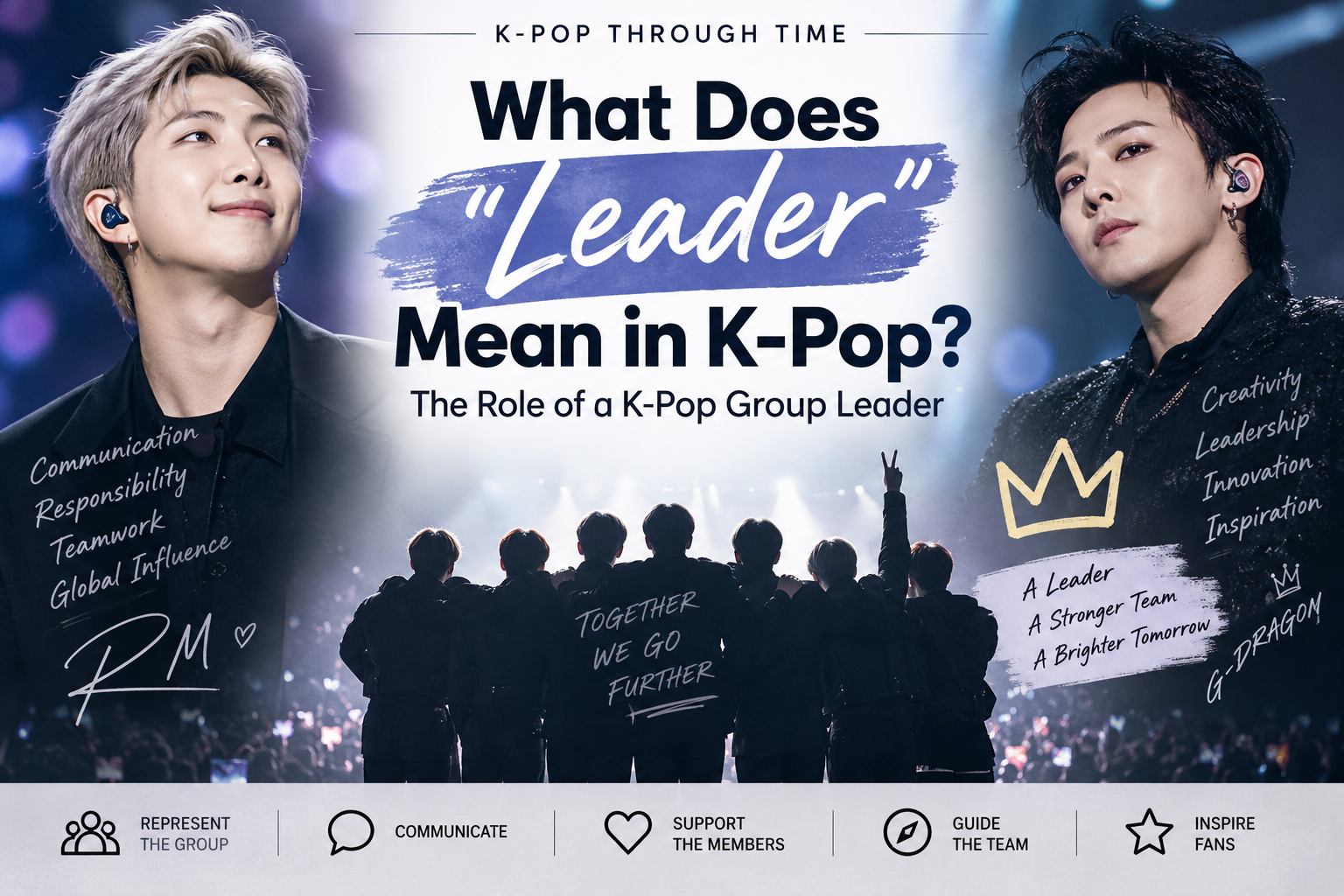
In K-pop, the leader is not necessarily the oldest member or the most popular member. The role often involves helping the group communicate, representing the team in certain situations and supporting coordination among the members.
For BTS, RM’s leadership became especially visible as the group’s international profile grew.
But his importance to the group began long before BTS became globally famous.
RM’s Early Role Was Closely Connected to Hip-Hop
Early BTS had a much stronger public emphasis on hip-hop than many newer fans may realize.
Songs from the group’s early years dealt with school pressure, ambition, expectations placed on young people and the desire to define one’s own future.
RM’s background as a rapper fit naturally into this direction.
He participated extensively in writing lyrics and helped establish the language through which BTS expressed many of its early themes.
This is important because BTS did not begin with the same musical identity that later produced songs such as “Dynamite” or “Butter.”
The group changed considerably over time.
RM changed with it.
His Role Expanded as BTS’s Music Expanded
As BTS moved beyond its early school-era concepts, its music began exploring broader subjects.
Youth, loneliness, temptation, self-acceptance, fear, success and identity became recurring themes.
RM remained involved as a rapper and songwriter, but his musical role became harder to describe with a single label.
He could deliver aggressive rap verses, contribute reflective lyrics and participate in songs built around completely different genres.
That flexibility became increasingly important as BTS moved from a primarily hip-hop-influenced sound into pop, R&B, EDM, rock and other musical styles.
RM’s career therefore provides a useful way to trace the musical evolution of BTS itself.
RM Is More Than BTS’s English Speaker
One reason international audiences quickly noticed RM was his ability to communicate in English.
As BTS expanded internationally, he frequently took a prominent role during English-language interviews, award shows and overseas appearances.
This led some casual viewers to associate his leadership primarily with translation.
But that description is too narrow.
Language ability made RM especially visible internationally, but BTS’s leadership structure cannot be reduced to one member translating for the others.
His role also involved representing the group’s ideas, explaining its music and helping connect conversations between BTS and audiences unfamiliar with Korean pop culture.
That became particularly important when BTS began appearing in settings far beyond traditional K-pop promotion.
BTS’s United Nations Appearances Showed a Different Side of RM’s Leadership
One of the clearest examples came through BTS’s appearances connected with the United Nations.
In 2018, RM delivered a speech at the United Nations as part of BTS’s work with UNICEF.
The speech centered on the idea of “Speak Yourself,” encouraging young people to find their own voices rather than allowing mistakes, expectations or insecurity to define them.
BTS later returned to UN-related events, further expanding the group’s role as cultural representatives.
These moments did not make RM the leader of BTS—they showed publicly a leadership role that had already existed for years.
They also demonstrated how dramatically the scale of that role had changed.
A rapper who debuted in a relatively small K-pop company was now speaking in one of the world’s most recognizable international institutions.
RM’s Leadership Style Is Not About Controlling the Other Members
It is easy to misunderstand what “leader” means when talking about a K-pop group.
It does not mean RM makes every decision for BTS.
The members have individual personalities, musical interests and careers, and BTS has repeatedly emphasized the importance of the group as seven members.
RM’s public leadership is therefore better understood as representation, communication and coordination rather than authority over the other members.
This distinction matters.
BTS’s longevity has depended not on one person controlling the group but on seven members developing together while maintaining individual identities.
RM’s role exists within that collective structure.
Songwriting Has Always Been Central to RM’s Career
Leadership receives much of the public attention, but songwriting is equally important to understanding RM.
He has accumulated extensive songwriting credits across BTS’s catalog.
His work as a lyricist reflects one of the characteristics that became closely associated with BTS: songs that often attempt to communicate an idea rather than simply fit a concept.
Those ideas have changed as the members have grown older.
Early frustrations about school and social expectations gradually gave way to questions about adulthood, fame, identity and what success actually means.
RM’s own lyrics evolved alongside those changes.
His Solo Music Reveals Another Side of His Development
RM’s solo career makes that evolution even clearer.
His 2015 mixtape RM emphasized his identity as a rapper and contained a more confrontational energy.
Three years later, mono. presented a noticeably different atmosphere.
Released in 2018, the project was quieter and more introspective, exploring loneliness, uncertainty and emotional isolation.
Then came Indigo in 2022.
Rather than feeling like a straightforward continuation of his earlier work, Indigo reflected an artist thinking about his twenties, creative identity and the transition into another stage of life.
RM described the project as an archive of that period.
Right Place, Wrong Person Pushed RM Further
RM’s 2024 album Right Place, Wrong Person moved in another direction again.
The project explored feelings of displacement and the uncomfortable experience of feeling like the wrong person in a particular place.
Musically, it also demonstrated his willingness to move outside conventional expectations of what a K-pop solo album should sound like.
The progression is striking:
RM → mono. → Indigo → Right Place, Wrong Person
These projects do not simply show a rapper becoming more successful.
They show an artist repeatedly reconsidering what kind of music he wants to make.
Art and Literature Became Part of RM’s Public Identity
Another noticeable development in RM’s career has been his relationship with visual art and literature.
His museum visits, reading interests and engagement with Korean and international art became familiar to fans over the years.
This matters musically because RM’s solo work increasingly feels connected to a broader creative world rather than only the conventions of idol music.
That does not mean every lyric can be explained by a particular painting or book.
Instead, art provides useful context for understanding how his creative interests expanded.
RM increasingly came to be seen not only as a rapper within BTS but as an artist interested in how music can interact with literature, visual art and personal reflection.
By 2026, that relationship with art had moved beyond personal interest and become a more public part of RM’s cultural role. In June, he was appointed Global Public Relations Ambassador for the National Museum of Korea, a role focused on introducing Korean history and cultural heritage to wider audiences.
That connection became even more significant in October 2026 with RM x SFMOMA: Between You and Me at the San Francisco Museum of Modern Art. The exhibition, co-curated by RM with SFMOMA curators América Castillo and Hyoeun Kim, brings works from his personal collection into conversation with works from the museum’s collection.
The exhibition marks the first museum presentation of artworks from RM’s personal collection. It also shows how far his public identity has expanded: the rapper and songwriter who once became known internationally as BTS’s leader is now participating directly in conversations about Korean modern art and global culture
How Has RM Influenced Modern K-Pop?
RM’s influence on modern K-pop can be seen in three areas: artist participation in songwriting, the global communication of Korean music, and the growing freedom for idols to develop distinct artistic identities beyond their groups.
RM’s career developed during a period when international expectations surrounding K-pop changed dramatically.
BTS demonstrated that a Korean group could reach massive audiences without abandoning Korean-language music or the cultural context from which it emerged.
RM played a visible part in that expansion.
His songwriting, interviews and public speeches helped international audiences understand that K-pop artists could participate directly in conversations about their own work rather than simply perform material created around them.
That does not mean BTS or RM alone created every change in modern K-pop.
K-pop’s global expansion resulted from decades of work by many artists, companies, fandoms and industry figures.
But BTS became one of the most influential examples of that expansion, and RM’s role within BTS made him an important figure in that history.
For a broader look at RM as a leader, artist and thinker, read our RM of BTS profile.
RM’s Career Is Really Several Careers at Once
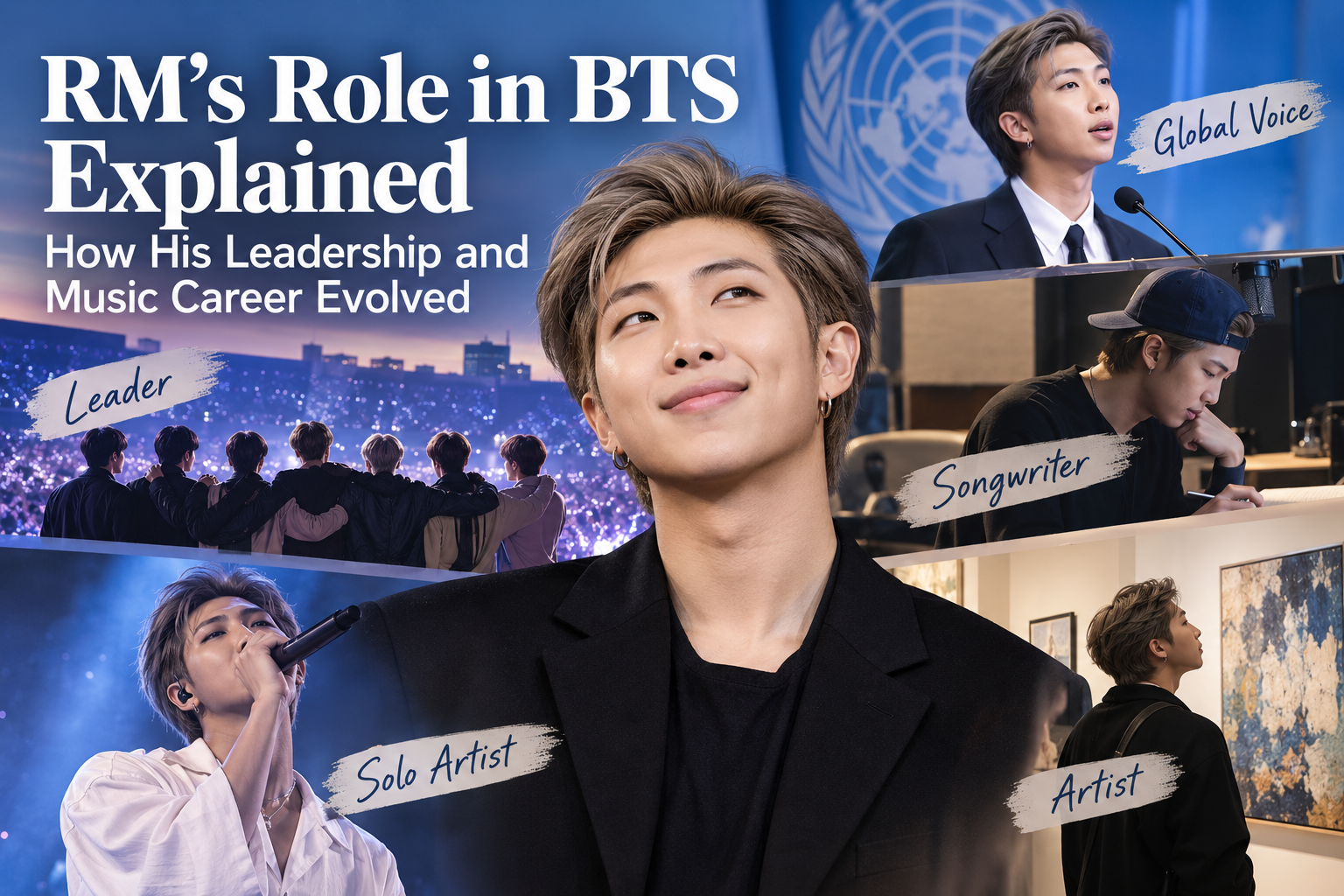
One reason RM can be difficult to summarize is that several different career paths overlap.
He is:
- the leader of BTS
- a rapper
- a songwriter
- a solo artist
- a public speaker
- a collaborator
- an artist increasingly connected with visual art and cultural projects
These roles have not developed separately.
His experiences as BTS’s leader influenced his understanding of fame and identity.
His songwriting influenced how he communicated BTS’s ideas.
His solo work gave him space to explore subjects that did not always fit naturally within a seven-member group.
Together, those experiences explain why RM’s career looks so different now from when BTS debuted in 2013.
FAQ
Why is RM the leader of BTS?
RM became BTS’s leader during the group’s formation. His experience as a rapper, ability to communicate and role in the group’s musical development made him an important coordinating and representative figure from BTS’s early years.
Is RM the oldest member of BTS?
No. Jin is the oldest member of BTS. A K-pop group’s leader does not necessarily have to be its oldest member.
What does RM do in BTS?
RM is BTS’s leader and one of its rappers. He has also contributed extensively as a songwriter and has frequently represented the group during speeches, interviews and international appearances.
Did RM write BTS songs?
Yes. RM has songwriting credits across many BTS releases and has been involved in the group’s lyrics throughout its career.
What are RM’s solo albums and projects?
His major solo projects include the 2015 mixtape RM, the 2018 playlist mono., the 2022 album Indigo and the 2024 album Right Place, Wrong Person.
Why is RM important to BTS’s international career?
His English ability helped during international interviews, but his role goes beyond translation. RM frequently helped communicate the group’s ideas, music and messages to global audiences.
How has RM’s music changed over time?
His early solo work emphasized rap and a more confrontational style, while later projects became increasingly introspective and experimental. Indigo and Right Place, Wrong Person particularly demonstrate his growing interest in exploring identity and artistic experimentation.
Conclusion
RM’s role in BTS cannot be explained simply by saying that he is “the leader.”
His career developed through several interconnected roles: rapper, songwriter, spokesperson, solo artist and creative thinker.
In BTS’s early years, his hip-hop background and songwriting were central to the group’s identity. As BTS became a global act, his communication skills made his leadership increasingly visible to international audiences.
At the same time, his solo career continued moving in new directions—from the intensity of RM to the introspection of mono., the reflective character of Indigo and the experimentation of Right Place, Wrong Person.
That evolution helps explain both RM’s individual career and part of BTS’s larger history.
The most interesting thing about RM’s role may therefore be that it has never remained fixed.
As BTS changed, RM changed with it.