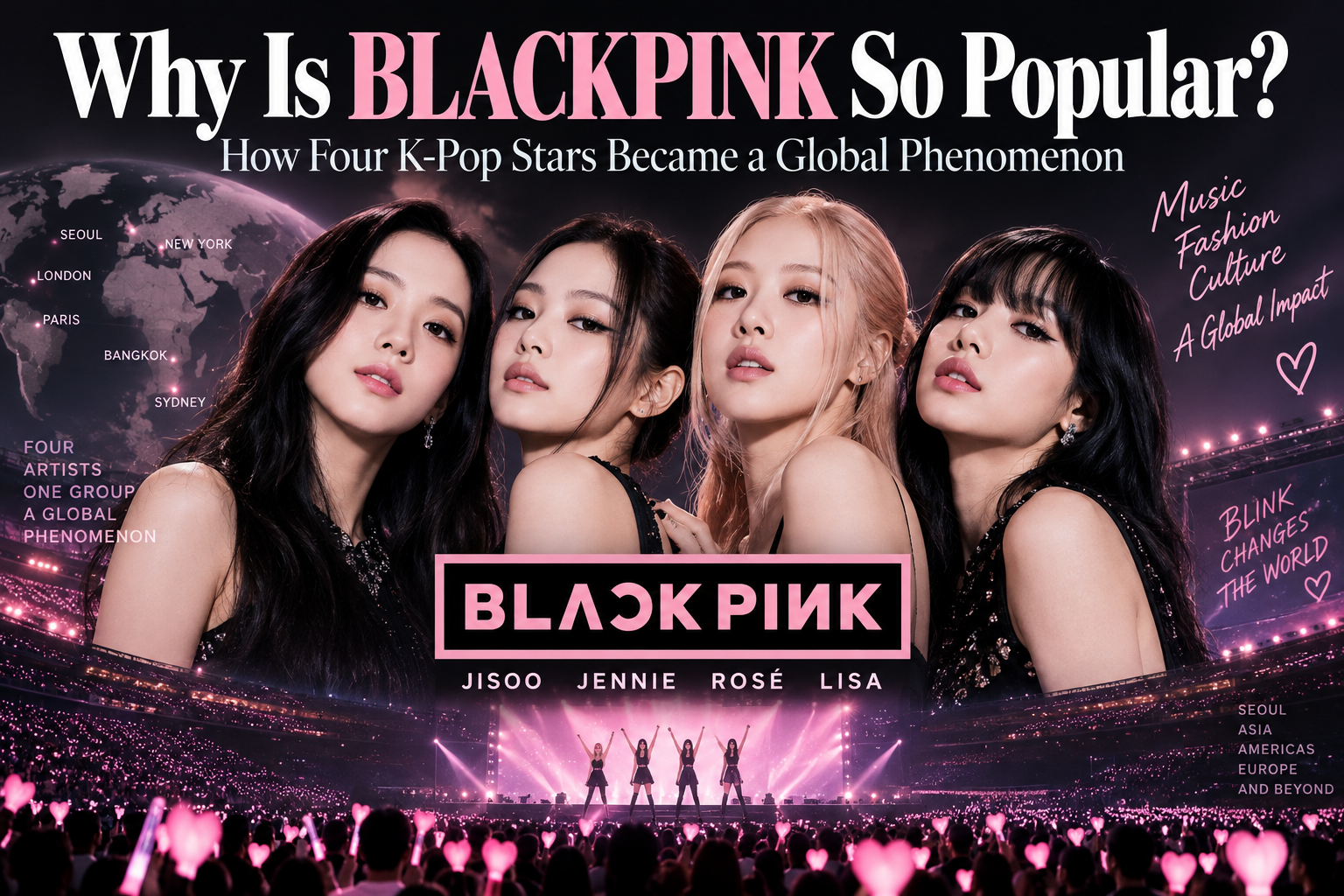
Since debuting in 2016, Jisoo, Jennie, Rosé, and Lisa have grown from promising YG Entertainment artists into global stars whose influence extends far beyond South Korea.
Their music videos attract enormous international audiences, their concerts bring together fans from many countries, and each member has developed an individual identity in music, fashion, entertainment, and popular culture.
But BLACKPINK‘s success raises an interesting question.
Why did this particular group become such a powerful global phenomenon?
The answer involves much more than a few hit songs.
Four Members with Distinct Identities
One of BLACKPINK’s greatest strengths is that the four members are easy to distinguish from one another.
Jisoo brings a calm and elegant presence while developing careers in both music and acting.
Jennie combines rap, vocals, fashion, and a strong individual image.
Rosé is instantly recognizable for her distinctive vocal tone and increasingly personal approach to solo music.
Lisa stands out through dance, rap, stage presence, and her international background.
These differences allow fans to connect with individual members while still supporting BLACKPINK as a group.
Rather than four performers competing for the same identity, BLACKPINK works because each member contributes something different.
Music Designed for Immediate Impact
BLACKPINK’s biggest songs are built to make an impression quickly.
Tracks such as “DDU-DU DDU-DU,” “Kill This Love,” “How You Like That,” and “Pink Venom” combine powerful beats, memorable hooks, rap sections, dramatic vocal moments, and choreography designed for the stage.
Many of their songs also move between contrasting moods.
A track may begin with a confident rap, shift into a melodic vocal section, and then explode into a large chorus or dance break.
That structure gives BLACKPINK’s music a strong visual and performance dimension.
The songs are not simply meant to be heard.
They are designed to be experienced.
The Power of BLACKPINK’s Music Videos
Visual storytelling has played a major role in BLACKPINK’s rise.
Their music videos often feature elaborate sets, striking fashion, bold colors, dramatic camera work, and memorable choreography.
For international audiences who may not understand every Korean lyric, these visual elements provide another way to connect with the music.
A BLACKPINK release can therefore function simultaneously as a song, fashion event, dance performance, and visual spectacle.
This made platforms such as YouTube especially important to the group’s international expansion.
BLACKPINK and the Growth of YouTube K-Pop
BLACKPINK emerged during a period when global audiences were increasingly discovering music through digital platforms rather than traditional television or radio.
This was particularly important for K-pop.
Fans did not need to live in South Korea to watch a new music video, learn choreography, follow performances, or share content with friends.
BLACKPINK’s highly visual style was perfectly suited to this environment.
Every major release could immediately reach viewers across Asia, North America, Europe, Latin America, and other regions.
The internet helped remove one of the biggest barriers that earlier generations of Korean artists had faced: geography.
Fashion Became Part of the BLACKPINK Brand
BLACKPINK’s influence is not limited to music.
Jisoo, Jennie, Rosé, and Lisa have each developed strong connections with international fashion and luxury culture.
Their appearances at major fashion events introduced them to audiences who might not have originally followed K-pop.
This created an unusual crossover.
A person could first discover a BLACKPINK member through a fashion campaign and later become interested in the group’s music.
At the same time, existing fans followed the members into the fashion world.
BLACKPINK therefore became not only a music group but also a major cultural brand.
Why International Fans Connect with BLACKPINK
BLACKPINK has always had an unusually international identity.
Lisa is Thai.
Rosé grew up in Australia after being born in New Zealand.
Jennie spent part of her youth in New Zealand.
The members’ different backgrounds and language abilities helped the group communicate naturally with audiences outside South Korea.
But international appeal is not simply about speaking different languages.
BLACKPINK’s music, fashion, choreography, and personalities created multiple entry points for fans.
Some listeners discovered them through songs.
Others arrived through dance videos, fashion, social media, collaborations, or individual members.
The Importance of BLINK
No global pop phenomenon exists without a highly engaged fan community.
BLACKPINK’s fandom, known as BLINK, has played a major role in spreading the group’s music and content.
Fans share performances, discuss releases, create translations, participate in online communities, and introduce BLACKPINK to new listeners.
Digital fandom can turn every comeback into an international event.
When a new song or video arrives, millions of fans across different time zones can respond almost simultaneously.
This level of participation has become one of the defining characteristics of modern K-pop.
Global Collaborations Expanded Their Audience
BLACKPINK has also worked with major international artists.
Collaborations with musicians such as Dua Lipa, Lady Gaga, Selena Gomez, and Cardi B helped connect the group with audiences already familiar with Western pop.
These collaborations were important not because BLACKPINK needed Western artists to become successful, but because they demonstrated how naturally the group could operate within the wider global music industry.
BLACKPINK increasingly appeared less like a Korean group visiting the international pop market and more like a permanent part of it.
Coachella and the Global Stage
Festival appearances became another important symbol of BLACKPINK’s international rise.
Performing at Coachella placed the group in front of a large global festival audience and demonstrated that K-pop could occupy major stages outside the traditional idol concert system.
Their later return to the festival at an even higher level of prominence reflected how much their global position had grown.
These performances were significant not only for BLACKPINK but also for the broader visibility of K-pop.
Solo Careers Made the Group Even Bigger
Another unusual strength of BLACKPINK is the individual popularity of its members.
Jennie, Rosé, Lisa, and Jisoo have all developed solo careers while remaining strongly associated with the group.
Their individual projects reveal different artistic directions.
One member may focus more heavily on music, another may expand into acting, while others explore fashion, performance, songwriting, or business.
Instead of weakening the BLACKPINK identity, these individual careers can bring new audiences back to the group.
Fans who discover one member’s solo work may eventually explore BLACKPINK’s wider history.
Scarcity Also Created Anticipation
BLACKPINK has often released music less frequently than many K-pop groups.
This has sometimes frustrated fans, but it also created enormous anticipation around major comebacks.
Because releases were relatively limited, each new era could feel like a major event.
New music meant new styling, choreography, music videos, performances, interviews, and international attention.
The result was a cycle in which anticipation itself became part of the BLACKPINK experience.
BLACKPINK Helped Redefine the Global K-Pop Girl Group
Before BLACKPINK, Korean girl groups had already built significant international audiences.
But BLACKPINK helped push the possibilities even further.
They demonstrated that a K-pop girl group could become a major force in global touring, fashion, streaming, festivals, advertising, and celebrity culture simultaneously.
Their success also contributed to greater international interest in other Korean girl groups.
In that sense, BLACKPINK’s impact extends beyond their own achievements.
They helped expand expectations for what a K-pop girl group could become.
So, Why Is BLACKPINK So Popular?
There is no single reason.
BLACKPINK’s global success comes from the combination of four distinctive members, memorable music, powerful performances, visually ambitious videos, fashion influence, digital platforms, international backgrounds, and a highly active global fandom.
Timing also mattered.
They emerged when K-pop was becoming increasingly accessible around the world and when social media could turn a Korean music release into an immediate international conversation.
But opportunity alone does not create a global phenomenon.
BLACKPINK had the songs, personalities, performances, and visual identity capable of taking advantage of that moment.
From K-Pop Group to Global Phenomenon
BLACKPINK began as four artists debuting under YG Entertainment in Seoul.
Over time, Jisoo, Jennie, Rosé, and Lisa became recognizable figures across music, fashion, entertainment, and global popular culture.
Their story demonstrates how dramatically K-pop has changed.
A group can now begin in South Korea, include members with international backgrounds, communicate with fans through global digital platforms, perform on some of the world’s biggest stages, and build individual careers that reach far beyond the traditional boundaries of an idol group.
That is why BLACKPINK’s story is about more than popularity.
It is also a story about how K-pop itself became global.