
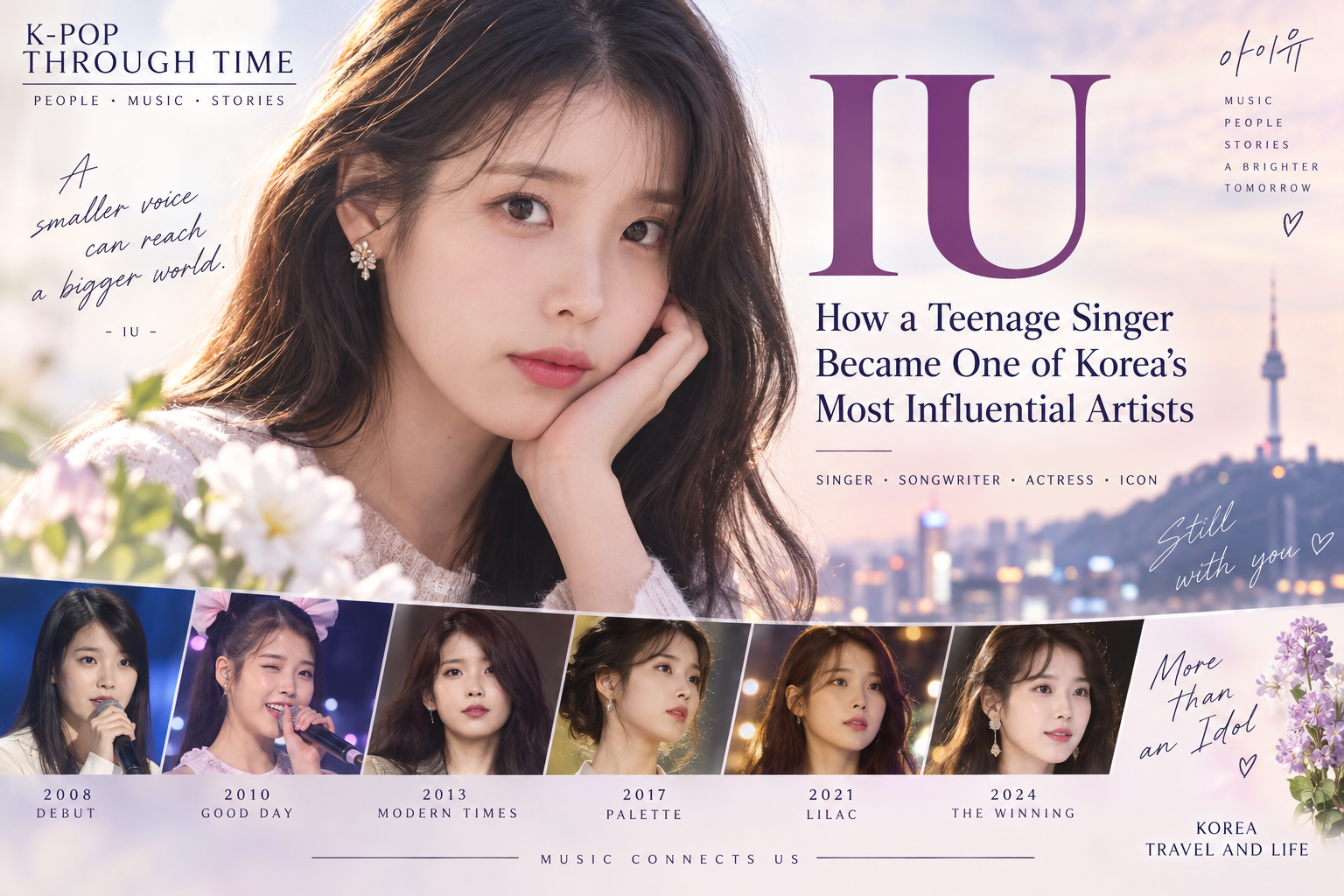
In an industry famous for idol groups, elaborate performances, and rapidly changing trends, IU built a career that followed a different path.
She debuted as a teenager and initially struggled to attract widespread attention. But over time, her distinctive voice, songwriting ability, emotional storytelling, and carefully developed musical identity transformed her into one of South Korea’s most respected and successful solo artists.
IU’s career also demonstrates something important about K-pop history: Korean popular music is much broader than idol groups alone.
From “Good Day” to Palette, LILAC, and her later work, IU grew from a young singer into a songwriter, producer, actress, and cultural figure whose career has lasted across multiple generations of Korean pop music.
This is the story of how Lee Ji-eun became IU.
Before IU: Lee Ji-eun’s Early Years
IU was born Lee Ji-eun on May 16, 1993, in South Korea.
She developed an interest in performing while she was young and eventually decided to pursue a career as a singer.
The road was not easy.
Before her debut, she attended numerous auditions and experienced repeated rejection. Eventually, she joined LOEN Entertainment and began preparing for her professional debut.
Her stage name, IU, was created around the idea of “I and You,” representing the connection between the artist and her listeners through music.
That relationship with listeners would eventually become one of the strongest foundations of her career.
2008: IU Makes Her Debut
IU officially debuted in September 2008 with the song “Lost Child” from her debut EP Lost and Found.
She was only fifteen years old.
Her debut did not immediately turn her into a major star. At a time when idol groups were becoming increasingly dominant in Korean popular culture, a young female solo singer faced a difficult competitive environment.
IU continued releasing music and appearing on television while gradually building public recognition.
Instead of achieving instant success, her career developed step by step.
That slow beginning makes what happened next even more significant.
2010: “Good Day” Changes Everything
IU’s breakthrough arrived in 2010 with “Good Day.”
The song became a major hit and transformed her public profile.
One of its most famous moments was IU’s three-note high-note sequence near the climax of the song, which became widely discussed and helped demonstrate her vocal ability to a much larger audience.
“Good Day” did more than produce a successful single.
It turned IU into one of the most recognizable young singers in South Korea.
But becoming famous created a new challenge: she now had to prove that she could develop beyond the image of a talented teenage vocalist.
From Popular Singer to Serious Artist
As IU matured, her music began to change with her.
Rather than remaining within one successful formula, she gradually became more involved in songwriting and the creative direction of her work.
This transition was important.
IU was beginning to move from being primarily a performer of songs created for her toward becoming an artist whose own perspective increasingly shaped her music.
Her lyrics often explored growing up, relationships, insecurity, memory, fame, and the complicated emotions of adulthood.
Listeners who had discovered IU when she was a teenager were able to grow alongside her.
2013: Modern Times Shows a Different IU
The 2013 album Modern Times marked an important stage in IU’s artistic development.
The project explored sounds influenced by jazz, swing, bossa nova, and other styles that were different from the youthful pop image associated with some of her earlier hits.
It demonstrated that IU was willing to experiment with musical genres and challenge expectations about her identity.
Instead of simply following current trends, she was developing a musical world that could change from album to album.
This versatility would become one of the defining strengths of her career.
2015: CHAT-SHIRE and a Stronger Creative Voice
IU took another major step with the 2015 EP CHAT-SHIRE.
By this stage, she had become deeply involved in the writing and creative development of her music.
The project reflected a more personal and self-directed approach.
It also showed how dramatically IU’s position had changed since her debut.
The teenager who once struggled for attention had become an established artist capable of shaping her own musical narrative.
That evolution helped distinguish her from the traditional image of a solo performer whose career was controlled almost entirely by an entertainment company.
2017: Palette Defines a New Era
In 2017, IU released Palette, one of the most important albums of her career.
The title track “Palette,” featuring G-DRAGON, explored IU’s thoughts about growing older and becoming more comfortable with herself.
The song felt especially meaningful because audiences had watched her grow up in public.
IU was no longer the teenage singer introduced to Korea years earlier.
She was now an adult artist reflecting openly on identity, taste, confidence, and change.
The album strengthened her reputation not only as a successful vocalist but also as a songwriter capable of turning personal experiences into widely relatable music.
“Through the Night” and the Power of Quiet Songs
IU’s career is particularly interesting because her biggest cultural moments have not depended exclusively on spectacular performances or powerful dance tracks.
Songs such as “Through the Night” demonstrated the strength of quieter music.
With intimate vocals and emotionally direct lyrics, IU could create songs that listeners connected with in very personal ways.
This ability became one of her greatest advantages.
In an increasingly visual and performance-driven music industry, IU showed that storytelling and emotional intimacy could remain extraordinarily powerful.
IU the Actress
IU’s influence also expanded beyond music.
Under her birth name Lee Ji-eun, she developed a substantial acting career.
She appeared in television dramas and films while gradually earning greater recognition for her acting.
Major projects including My Mister and Hotel del Luna introduced different sides of her as a performer and expanded her audience beyond music.
Her success in both fields made her one of the relatively rare Korean entertainers able to maintain major careers simultaneously as a singer and actress.
Importantly, the two identities did not completely replace one another.
IU the musician and Lee Ji-eun the actress developed alongside each other.
2019: “Love Poem” and Emotional Connection
In 2019, IU released the EP Love Poem.
The project continued to emphasize the emotional connection between IU and her listeners.
The title “Love Poem” itself reflected a recurring quality in her work: songs often feel like messages addressed directly to another person.
Her ability to communicate vulnerability without losing artistic control helped create an unusually strong relationship with her audience.
By this stage, IU had moved far beyond her early reputation as a promising young vocalist.
She had become one of Korea’s defining singer-songwriters.
2021: LILAC and Leaving Her Twenties
IU released her fifth studio album, LILAC, in March 2021.
The album arrived as she approached the end of her twenties and explored themes of transition, farewell, and new beginnings.
The title track “LILAC” presented change not simply as something sad, but as something that could be celebrated.
Another major track, “Celebrity,” delivered a message about individuality and self-worth.
Together, the songs reflected an artist who had spent much of her youth in public and was now consciously closing one chapter of her life.
For longtime listeners, the album carried additional meaning because they had witnessed many of those years alongside her.
A Career That Crosses K-Pop Generations
IU’s longevity is particularly remarkable when viewed through the history of K-pop.
She debuted in 2008, during the era commonly associated with second-generation K-pop.
She remained one of Korea’s leading artists throughout the rise of third-generation groups and continued her success as K-pop became increasingly global during the fourth-generation era.
The industry changed around her.
Social media became central to fandom. Streaming transformed listening habits. Korean artists reached increasingly global audiences. New generations of idols appeared.
Yet IU remained relevant.
That kind of longevity is difficult in any music industry, especially one known for rapid change.
2024: The Winning Opens Another Chapter
In February 2024, IU released the EP The Winning.
The project included “Love wins all,” a dramatic ballad accompanied by a cinematic music video featuring BTS member V.
The release again demonstrated IU’s ability to create major cultural moments without abandoning the emotional storytelling that had long defined her music.
More than fifteen years after her debut, a new IU release could still become a major event.
That longevity illustrates the unusual position she occupies in Korean popular culture.
More Than an Idol
IU is frequently discussed within the broader world of K-pop, but her career does not fit neatly into the traditional idol model.
She is a solo singer, songwriter, performer, actress, and increasingly an artist associated with creative control over her work.
That distinction is important.
K-pop is often introduced internationally through groups, synchronized choreography, fandom culture, and entertainment companies.
IU represents another major tradition within Korean popular music: the singer-songwriter whose strength comes from songs, storytelling, voice, and a long-term relationship with the public.
Understanding her career therefore helps create a more complete picture of what Korean pop music can be.
Why IU Matters in K-Pop History
IU’s importance comes partly from success, but longevity and artistic development may be even more significant.
She survived an uncertain beginning.
She became a teenage star.
Then she successfully moved beyond that teenage image.
She developed as a songwriter.
She experimented with different musical styles.
She built a major acting career.
And she continued releasing music that connected with audiences many years after her debut.
Each stage required reinvention without completely abandoning what listeners valued about her.
That balance between change and continuity is one of the hardest achievements in popular music.
From Teenage Singer to One of Korea’s Most Influential Artists
When IU debuted in 2008, there was no guarantee that her career would last.
Her first releases did not make her an immediate superstar, and the Korean music industry around her was intensely competitive.
But her career became a story of gradual growth.
“Good Day” made her famous.
Albums such as Modern Times expanded her musical identity.
CHAT-SHIRE strengthened her creative voice.
Palette showed an artist becoming comfortable with adulthood.
LILAC marked another transition.
And later releases demonstrated that her connection with listeners had survived years of change.
IU’s journey shows that longevity in K-pop is not simply about remaining visible.
It is about continuing to grow while giving audiences a reason to keep listening.
From Lee Ji-eun, the teenager pursuing an uncertain dream, to IU, one of Korea’s most recognizable and respected artists, her career has become an important chapter in the history of Korean popular music.