
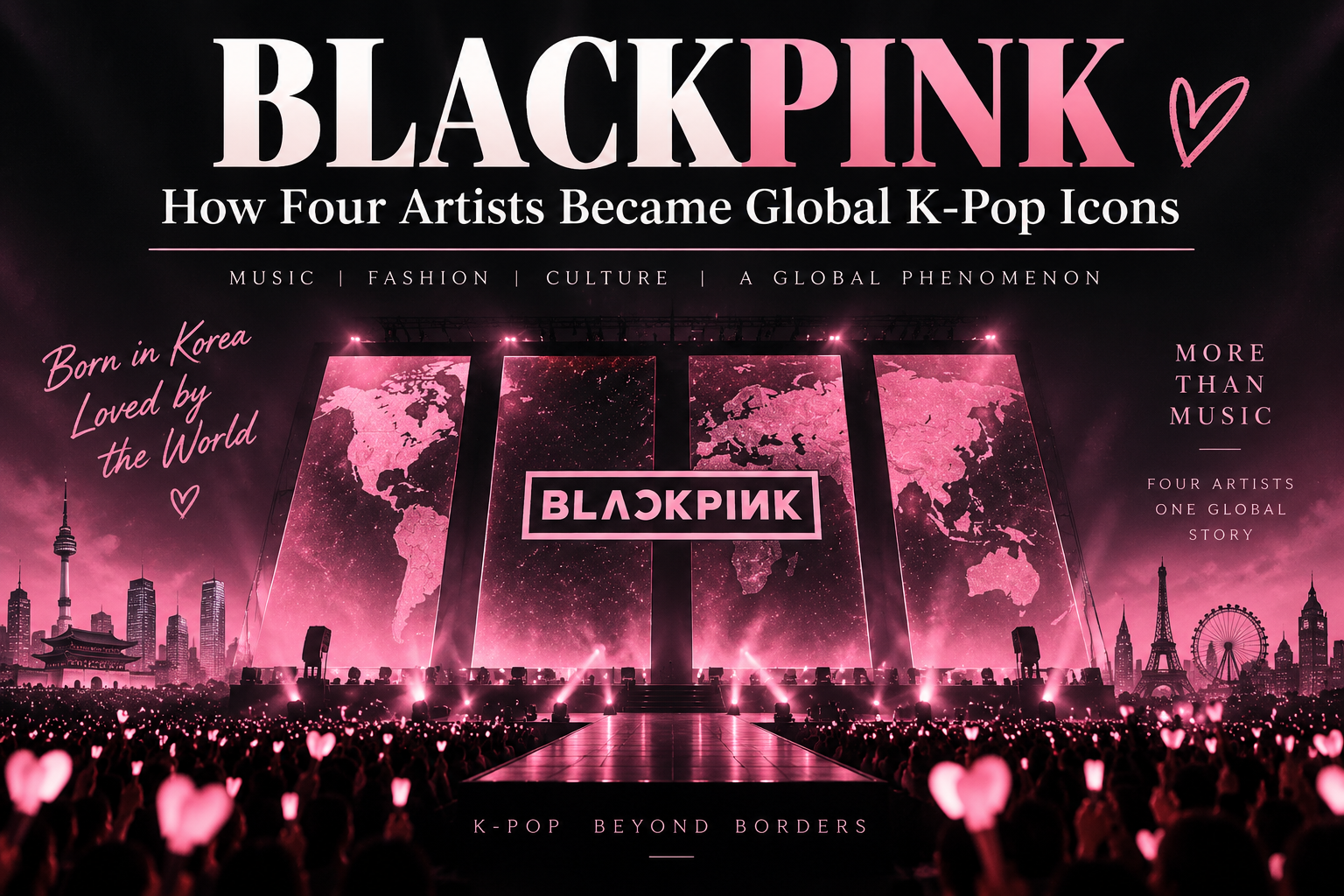
From Seoul to the Global Stage
BLACKPINK is one of the most recognizable names in modern K-pop. Made up of Jisoo, Jennie, Rosé, and Lisa, the group has grown from a highly anticipated YG Entertainment debut into a global music phenomenon.
Their story is not simply about hit songs or record-breaking performances. It is also the story of four artists with different backgrounds, personalities, and talents who came together to create a distinctive identity.
From music and fashion to international tours and solo careers, BLACKPINK has played an important role in expanding the global reach of K-pop.
How Did BLACKPINK Begin?
BLACKPINK debuted under YG Entertainment on August 8, 2016.
Their debut single album, Square One, introduced the songs “Boombayah” and “Whistle.” From the beginning, the group attracted attention for its combination of powerful performances, confident visual style, memorable choreography, and distinctive musical sound.
The group name BLACKPINK reflects a contrast between two ideas. “Pink” can represent beauty and femininity, while “black” adds strength and confidence. That contrast became an important part of the group’s image.
Rather than presenting all four members in exactly the same way, BLACKPINK allowed each member to develop a recognizable individual identity.
Who Are the Four Members of BLACKPINK?
BLACKPINK consists of four members: Jisoo, Jennie, Rosé, and Lisa.
Jisoo became known for her distinctive voice, calm presence, visual identity, and later her work as both a solo singer and actress.
Jennie emerged as a versatile performer who could move between rap and vocals. Her confident stage presence also helped establish her as an influential figure in music and fashion.
Rosé became especially recognizable for her unique vocal tone and strong connection to music. Born in New Zealand and raised in Australia, she brought an international background to the group.
Lisa, who was born in Thailand, became widely recognized for her dancing, rap performances, and charismatic stage presence.
Their differences became one of BLACKPINK’s greatest strengths.
Why Did BLACKPINK Become So Popular?
There is no single reason for BLACKPINK’s global success.
Their music combined elements of K-pop, hip-hop, EDM, and pop with highly polished visual concepts. Songs such as “DDU-DU DDU-DU,” “Kill This Love,” “How You Like That,” and “Pink Venom” helped establish a sound and image that could reach listeners far beyond South Korea.
Their music videos also played an important role. Bold sets, fashion, choreography, and memorable visual moments made BLACKPINK particularly suited to the global era of YouTube and social media.
But the four members themselves were equally important.
Fans were not only following BLACKPINK as a group. They were also developing connections with Jisoo, Jennie, Rosé, and Lisa as individual artists.
How Did BLACKPINK Help K-Pop Become More Global?
BLACKPINK arrived at an important moment in the international expansion of K-pop.
As global audiences became increasingly familiar with Korean music, BLACKPINK helped introduce another powerful image of what a K-pop group could look and sound like.
Their international collaborations with artists including Dua Lipa, Lady Gaga, Selena Gomez, and Cardi B connected them with audiences who might not previously have followed K-pop.
Major international performances also expanded their visibility.
In 2019, BLACKPINK became the first K-pop girl group to perform at Coachella. Their return to the festival as headliners in 2023 demonstrated how dramatically their international position had grown.
BLACKPINK was no longer simply a Korean group attracting international attention. They had become part of the global pop music landscape.
BLACKPINK and the Power of Fashion
BLACKPINK’s influence extends beyond music.
Each member developed relationships with major global fashion and luxury brands, helping strengthen the connection between K-pop, fashion, beauty, and celebrity culture.
Their appearances at fashion shows and international campaigns introduced the members to audiences who may not have first encountered them through music.
This helped demonstrate something important about modern K-pop: an artist’s influence can extend across multiple cultural industries.
BLACKPINK became not only musicians but also global cultural figures.
From Group Members to Solo Artists
Another important chapter in BLACKPINK’s story has been the development of the members’ individual careers.
Jennie was the first member to make an official solo debut with “SOLO” in 2018.
Rosé followed with her single album R in 2021, while Lisa released Lalisa later that year. Jisoo made her solo debut with ME in 2023.
Over time, all four members continued expanding their individual careers in music, acting, fashion, and entertainment.
Their solo activities reveal something interesting about BLACKPINK’s structure: the members can maintain strong individual identities while still remaining connected to the group that introduced them to a global audience.
Are BLACKPINK Still Together?
As the members developed increasingly independent careers, fans naturally began asking what the future would mean for BLACKPINK.
The group’s career demonstrates that the relationship between group activities and solo careers in K-pop is evolving.
A successful idol group no longer has to define every part of an artist’s career. Members can build individual musical identities, acting careers, businesses, or fashion partnerships while still sharing an important history and identity as a group.
For BLACKPINK, this balance between individual growth and group identity has become part of the next chapter of their story.
What Makes BLACKPINK Different?
BLACKPINK’s impact comes from more than statistics.
Jisoo, Jennie, Rosé, and Lisa each bring a different personality, artistic style, and cultural background to the group. Together, those differences created a group that could appeal to audiences across countries and cultures.
Their rise also represents a larger change in K-pop.
K-pop artists are no longer limited to being successful within the Korean entertainment industry. They can become global musicians, fashion figures, actors, entrepreneurs, and cultural ambassadors.
BLACKPINK helped make that possibility more visible.
Four Artists, One Global Story
BLACKPINK began with four young artists pursuing their careers within the demanding K-pop training system.
Years later, Jisoo, Jennie, Rosé, and Lisa have become internationally recognized artists with individual careers of their own.
Yet the story of BLACKPINK remains the story that connects them.
Their journey shows how K-pop changed from a primarily regional music industry into a global cultural force—and how four very different artists became some of the most recognizable faces of that transformation.
As each member continues to build her own path, BLACKPINK’s place in K-pop history continues to evolve.