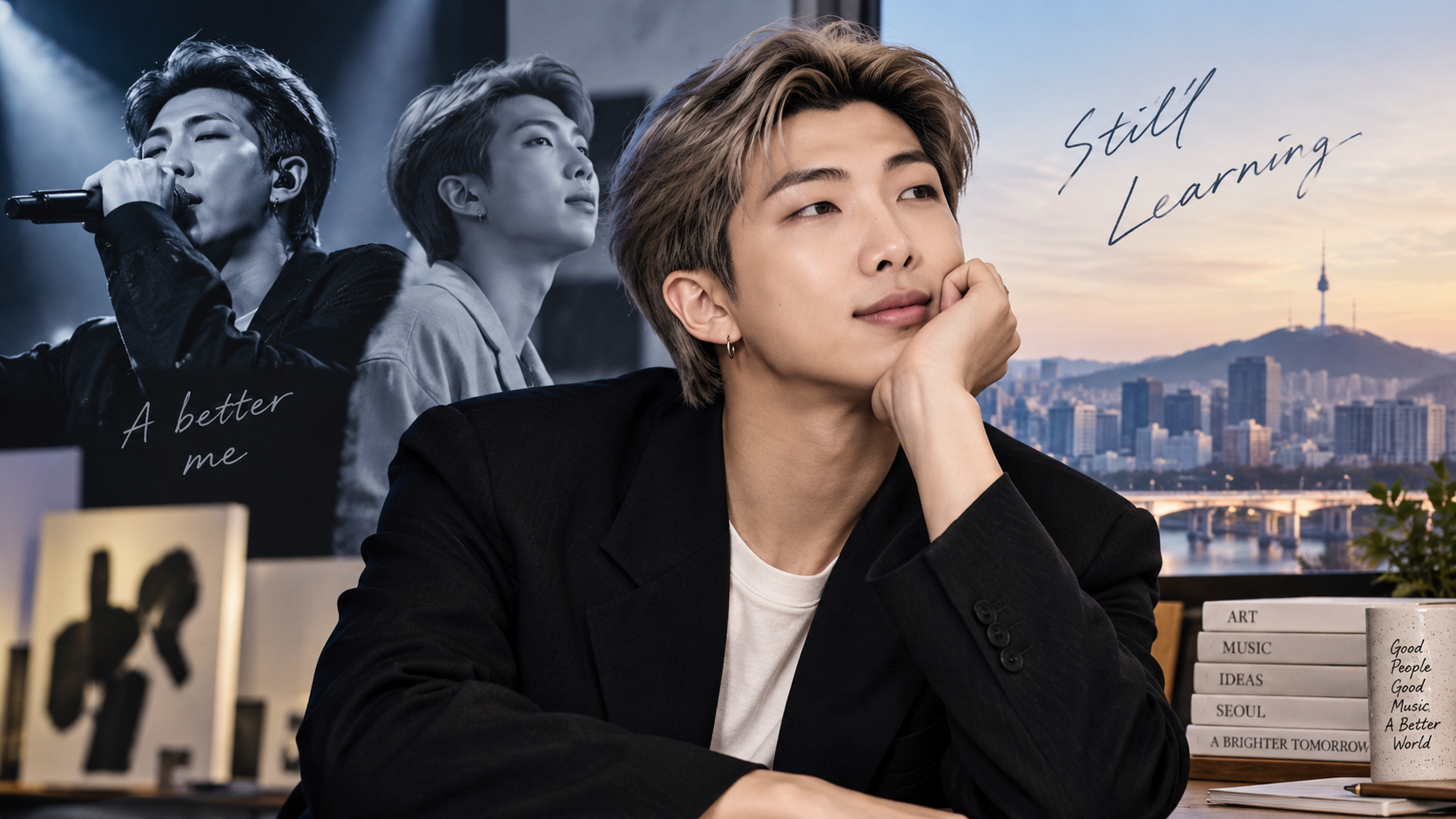
RM’s solo music shows how his artistic identity has changed from his early hip-hop roots to more introspective and experimental sounds.
Beginning with his 2015 mixtape RM, followed by mono. (2018), Indigo (2022), and Right Place, Wrong Person (2024), his solo releases explore different approaches to rap, songwriting, collaboration, and personal expression.
This guide follows that musical evolution, comparing the sound and themes of each project rather than focusing on his leadership role in BTS.
Before BTS: From Rap Monster to RM
RM was born Kim Namjoon in 1994.
Before becoming a K-pop idol, he developed a strong interest in hip-hop and began writing rap lyrics while he was young. His early experience in Korea’s underground hip-hop scene became an important foundation for the artist he would later become.
When BTS debuted in 2013, he performed under the stage name Rap Monster.
The name reflected the hip-hop-centered identity of BTS’s early years. The group’s earliest music featured strong rap elements and often addressed subjects such as youth, education, ambition, and social expectations.
As BTS evolved, however, RM evolved with it.
In 2017, he officially changed his stage name from Rap Monster to RM. The change represented more than a shorter name. It reflected his desire for an artistic identity that could grow beyond the meaning associated with his original stage name.
RM’s leadership in BTS is an important part of his career, but his solo releases reveal a different side of his artistic identity.
To understand why he became the group’s leader and how his role developed, read our detailed guide: Why Is RM the Leader of BTS?
Lyrics as a Central Part of RM’s Identity
One of RM’s defining characteristics as an artist is his attention to language.
Rap naturally places great importance on words, rhythm, metaphor, and storytelling, and RM has used these elements throughout his career.
His lyrics frequently explore contradictions.
Success can exist alongside anxiety. Confidence can exist alongside insecurity. Love can exist alongside loneliness. A person can know who they are and still continue searching for themselves.
These tensions became increasingly important as BTS moved from songs about teenage frustration toward broader questions about adulthood and identity.
RM’s writing therefore offers an interesting window into the development of BTS itself.
As the group grew older, its language grew with it.
The Beginning of RM’s Solo Journey
RM’s individual music gave him space to explore ideas that did not always fit naturally within BTS albums.
His first solo mixtape, RM, released in 2015, presented a rawer and more confrontational side of his musical identity.
Three years later, mono. showed a noticeably different atmosphere.
Released in 2018, mono. was quieter, more introspective, and often melancholic. Rather than emphasizing the image of a powerful rapper, the project explored loneliness, exhaustion, reflection, and emotional uncertainty.
The contrast between these projects demonstrated something important about RM.
He was not interested in maintaining only one artistic identity.
He was changing.
Indigo and the Portrait of an Artist in Transition
RM’s 2022 solo album Indigo represented another major stage in that development.
The album brought together music, visual art, collaboration, and personal reflection. Instead of presenting itself simply as a collection of songs, Indigo felt like a record of a particular period in RM’s life.
It explored what happens when a young artist who has experienced extraordinary success begins to look back at his twenties.
What remains after achievement?
How does a person separate public identity from private identity?
How does an artist continue growing when millions of people already have expectations about who that artist should be?
These questions helped distinguish RM’s solo work from the conventional idea of an idol’s solo debut.
Right Place, Wrong Person and Artistic Experimentation
RM continued this exploration with Right Place, Wrong Person in 2024.
The album pushed further into alternative and experimental sounds, demonstrating his willingness to move outside the musical expectations often associated with mainstream K-pop.
Its title itself captures a recurring theme in RM’s work: the feeling of existing between different identities and environments.
Celebrity and ordinary person.
Group leader and solo artist.
Korean musician and global public figure.
Confidence and uncertainty.
Rather than trying to eliminate these contradictions, RM increasingly turned them into artistic material.
That willingness to remain uncertain is one of the most interesting aspects of his development.
RM, Art and Korean Culture
RM’s public interest in visual art has also become an important part of his cultural identity.
He has frequently visited museums and exhibitions and expressed admiration for Korean and international artists. Through these interests, he has helped introduce parts of Korean modern and contemporary art to global fans who might otherwise never have encountered them.
This matters because the global influence of K-pop increasingly extends beyond music.
Fans who discover Korean music may become interested in Korean language, literature, museums, fashion, food, history, and visual art.
RM represents this broader cultural connection particularly well.
His influence therefore exists not only in songs but also in the conversations surrounding culture.
From Idol to Individual Artist
For many years, K-pop idols were often expected to maintain carefully defined public identities.
The industry has gradually changed.
More artists now participate in songwriting, production, artistic direction, and individual projects. The boundary between “idol” and “artist” has become increasingly difficult to define.
RM’s career is an important example of this transformation.
He can perform in one of the world’s biggest pop groups while also releasing experimental solo music.
He can participate in stadium-scale entertainment while discussing poetry, painting, identity, and uncertainty.
These identities do not have to cancel each other out.
They can exist together.
What Makes RM’s Solo Music Different?
RM’s solo work stands apart through its willingness to change direction. Rather than repeating one musical formula, his projects move between rap, atmospheric introspection, collaboration, and experimental sounds.
From the direct energy of RM to the reflective mood of mono., the collaborative approach of Indigo, and the unconventional production of Right Place, Wrong Person, each release offers a different perspective on his identity as an artist.
Together, these projects show how RM uses solo music to explore ideas and sounds that extend beyond his work with BTS.
Final Thoughts: A Leader Still Growing
RM’s story is not simply the story of the leader of BTS.
It is the story of artistic evolution.
From his early hip-hop influences to BTS’s global success, from mono. to Indigo and Right Place, Wrong Person, his career has repeatedly moved between confidence and questioning.
Perhaps that is why his work resonates with so many listeners.
He does not always present growth as finding a final answer.
Sometimes growth means becoming comfortable with continuing to ask questions.
And as both BTS and K-pop continue to evolve, RM’s journey remains an important part of the story of how a Korean idol became a global artist without giving up the search for his own voice.