What Does “Bias” Mean in K-Pop?
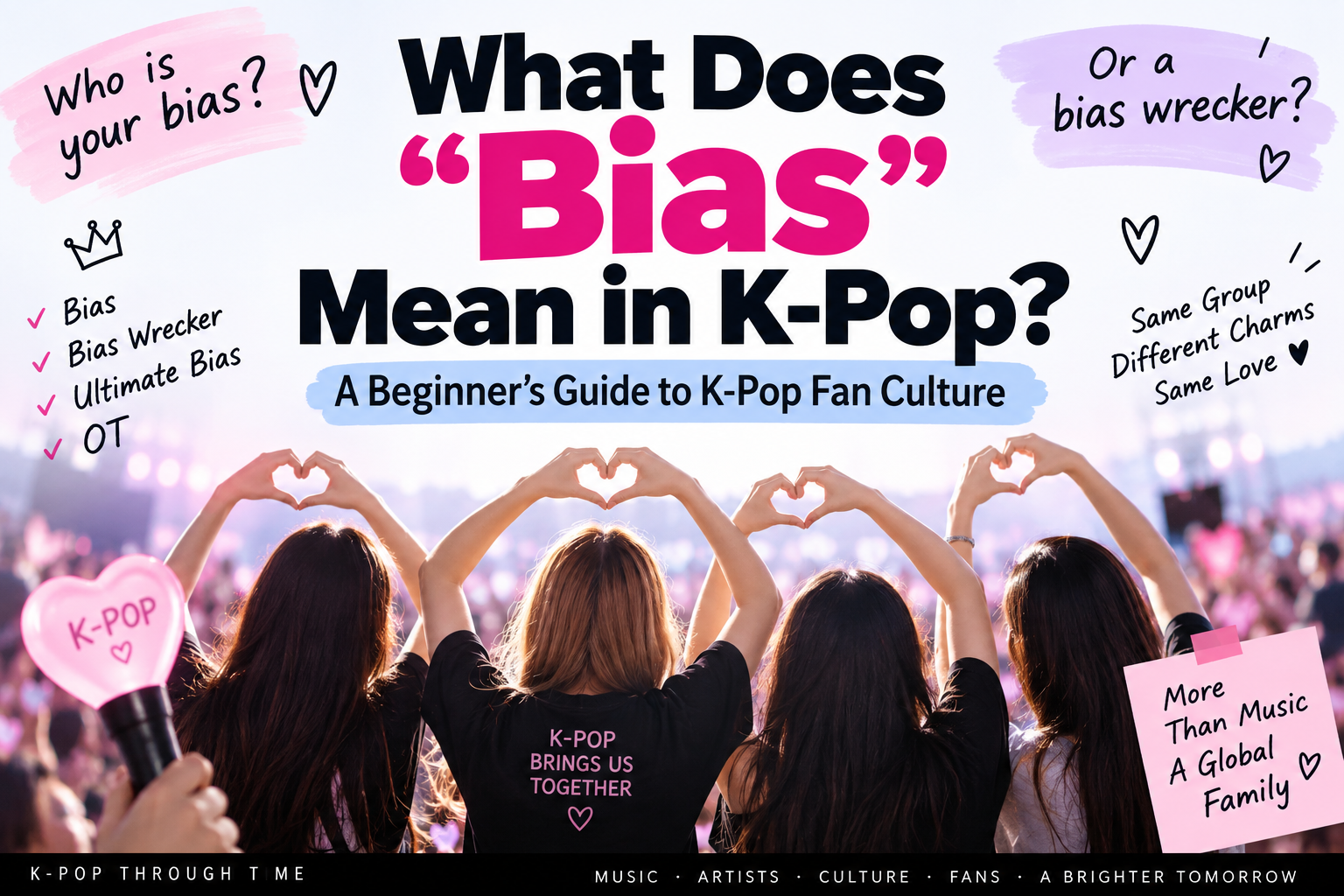
If you are new to K-pop, you may quickly encounter a word that seems unusual at first: bias.
Fans might say, “Who is your bias?” or “She became my bias after that performance.”
Outside K-pop, the word “bias” usually refers to a preference or prejudice. But in K-pop fan culture, it has developed a much more specific meaning.
Simply put, your bias is your favorite member of a K-pop group.
But as with many K-pop terms, there is more to the story.
What Is a K-Pop Bias?
A bias is the member of a K-pop group that a fan personally likes or connects with the most.
For example, someone who follows BTS might enjoy all seven members but feel especially drawn to one member because of his music, personality, performances, or sense of humor.
A BLACKPINK fan might admire the entire group while having Jisoo, Jennie, Rosé, or Lisa as their bias.
Having a bias does not mean that a fan dislikes the other members.
It simply describes a personal favorite within the group.
Why Do K-Pop Fans Choose a Bias?
There is no single reason people choose a bias.
Some fans first notice a member because of appearance or fashion.
Others are attracted to a particular singing voice, rap style, dance ability, stage presence, personality, or sense of humor.
Sometimes the connection develops slowly.
A fan may initially notice one member in a music video and later become interested in another after watching interviews, variety shows, concerts, or behind-the-scenes content.
That is one reason choosing a bias can become part of the fun of discovering a new K-pop group.
What Is a Bias Wrecker?
Once you understand “bias,” another popular K-pop expression becomes much easier to understand: bias wrecker.
A bias wrecker is another member who repeatedly challenges your choice of favorite member.
Imagine that one member has always been your bias.
Then another member gives an unforgettable concert performance, appears in a funny interview, or releases an impressive solo song.
Suddenly, you begin wondering whether your original favorite is still your favorite.
Fans jokingly describe that second member as a bias wrecker.
The expression reflects the playful way K-pop fans talk about their attachment to different members.
Can You Have More Than One Bias?
Yes.
There are no official rules about how many biases a fan can have.
Some fans choose one favorite member in each group. Others have two or more favorites.
A person who follows many groups may have a different bias in BTS, BLACKPINK, TWICE, Stray Kids, SEVENTEEN, aespa, or other groups.
Fan culture develops naturally, so the terminology is flexible rather than strictly regulated.
The most important point is that “bias” describes personal preference, not a formal position within K-pop.
What Does “Ultimate Bias” Mean?
Fans who follow several K-pop groups sometimes use the term ultimate bias, often shortened to ult bias.
An ultimate bias is a fan’s favorite idol across all the groups and artists they follow.
For example, someone might have a bias in several different groups but still consider one particular artist their overall favorite.
The term demonstrates how K-pop fandom often develops across multiple groups rather than remaining focused on only one artist.
What Does “OT” Mean in K-Pop?
Another expression that often appears alongside bias discussions is OT, followed by a number.
Fans commonly use expressions such as OT7 or OT4 to express support for all members of a particular group lineup.
For example, BTS fans may use OT7 when talking about supporting all seven members, while BLACKPINK fans may use OT4 for all four members.
The expression can carry different nuances depending on the fandom and context, but it is commonly associated with recognizing or supporting the full group.
Do You Need a Bias to Be a K-Pop Fan?
No.
You can enjoy a K-pop group without choosing a favorite member at all.
Some fans prefer the group’s music as a whole.
Others enjoy different members for different reasons and do not want to rank them.
K-pop terminology helps fans communicate with one another, but it is not a set of rules that everyone must follow.
You do not need a bias, a bias wrecker, or an ultimate bias to enjoy K-pop.
How Does Someone Become Your Bias?
For many fans, the process happens naturally.
You may first notice a singer’s voice in a song.
Then you watch a live performance and become impressed by the person’s stage presence.
Later, an interview reveals a personality you find interesting or relatable.
After watching more content, you realize that you consistently pay attention to the same member.
At that point, many fans would simply say, “That’s my bias.”
Why Is the Idea of a Bias So Important in K-Pop?
K-pop groups are often designed around members with distinctive roles, personalities, talents, and public images.
One member may be known for powerful vocals, another for rap, another for dance, and another for variety or performance skills.
This gives fans many different ways to connect with a group.
The bias concept reflects that structure.
Fans can support the group collectively while developing a particularly strong interest in one member’s individual career and personality.
Bias Culture and Solo Careers
Bias culture also helps explain why solo projects by group members can attract large audiences.
Fans who become especially interested in one member may follow that artist’s solo albums, acting roles, fashion activities, collaborations, or other projects.
BTS and BLACKPINK provide clear examples.
Their members have strong group identities while also developing individual careers that attract their own audiences.
This relationship between group fandom and individual fandom has become an important feature of modern K-pop.
Is “Bias” Only Used for K-Pop?
The term is most strongly associated with K-pop fandom, but online fan communities sometimes use it more broadly.
As K-pop culture has spread internationally, expressions such as bias, bias wrecker, comeback, maknae, and fandom names have also become familiar to global audiences.
These words are part of the vocabulary that new fans gradually learn as they explore K-pop.
Understanding them makes conversations within international fan communities much easier to follow.
A Simple Example
Imagine you have just discovered BLACKPINK.
You enjoy songs from the entire group, but you find yourself watching Lisa’s dance performances more often than anything else.
Lisa might become your bias.
Then you watch Rosé perform a solo song and suddenly become fascinated by her voice.
Rosé might become your bias wrecker.
You can still enjoy and support all four BLACKPINK members.
The terms simply provide a playful way to describe your personal preferences.
K-Pop Fan Culture Is About Connection
The popularity of the word “bias” reveals something important about K-pop.
Fans are often interested not only in songs but also in the individual artists who perform them.
Music videos, concerts, interviews, social media, variety content, and solo projects allow audiences to discover different sides of each member.
That creates a stronger sense of connection between artists and fans.
And for many people entering the K-pop world for the first time, answering one simple question becomes part of the experience:
Who is your bias?