
Tag: MUSE

  • Jimin FACE vs MUSE: Album Themes, Key Songs and What the Producers Explained

    Jimin FACE vs MUSE: Album Themes, Key Songs and What the Producers Explained

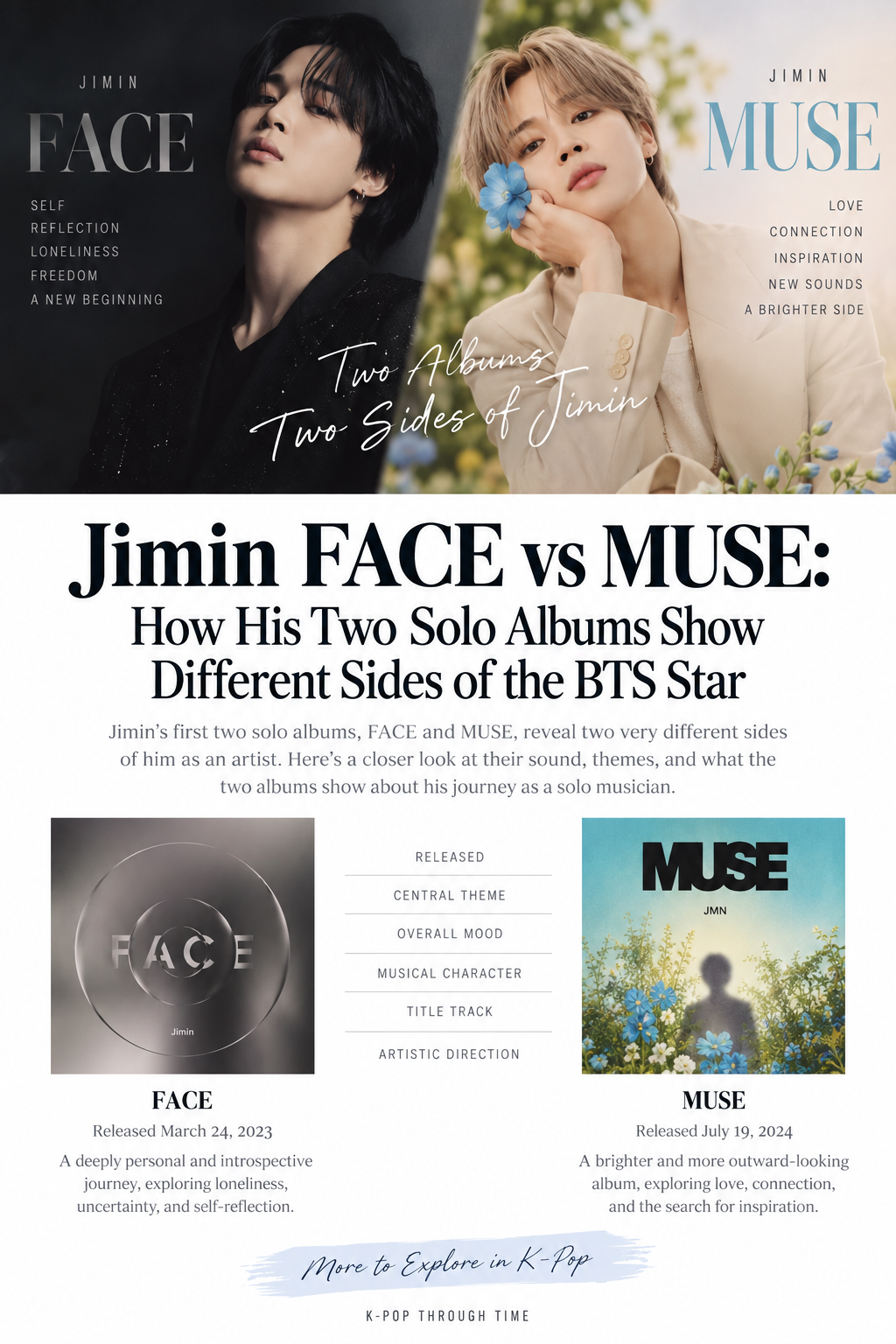
    Jimin’s first two solo albums, FACE and MUSE, approach different questions. FACE centers on confronting the self, while MUSE explores the search for inspiration and connection.

    That contrast comes from BIGHIT MUSIC’s album descriptions and the producers’ own explanations. However, the albums should not be treated as a simple story in which Jimin finished one emotional chapter and only then began creating the next.

    In a Weverse Magazine interview, producers Pdogg and GHSTLOOP explained that FACE and MUSE were developed largely at the same time, with their contrasting moods leading to separate albums.

    This guide compares the albums’ documented concepts, selected songs and production background. Listening observations are identified separately from statements made by the label or producers.

    FACE vs MUSE at a glance

    DetailFACEMUSE
    Release dateMarch 24, 2023July 19, 2024
    Solo album orderFirst solo albumSecond solo album
    Title track“Like Crazy”“Who”
    Official conceptConfronting the inner selfFinding inspiration from the surrounding world
    Selected songs discussed here“Like Crazy,” “Alone,” “Set Me Free Pt.2”“Who,” “Slow Dance,” “Smeraldo Garden Marching Band”
    Production contextDeveloped alongside material that became MUSESeparated from FACE because the material had a different mood

    The release dates establish the order in which listeners received the albums. They do not establish a completely separate writing process for each project.

    What the official album descriptions tell us

    BIGHIT MUSIC introduces FACE as an album about Jimin facing himself and preparing for a new beginning as a solo artist.

    Its description of MUSE explicitly contrasts the projects: while FACE dealt with confronting the inner self, MUSE presents a journey of finding inspiration from Jimin’s surroundings.

    These descriptions provide a reliable starting point. They support a comparison between self-reflection and inspiration, but they should not be stretched into claims about every lyric being a literal account of Jimin’s private life.

    An album’s concept and a song’s narrator are useful ways to discuss the music. Neither gives listeners complete access to the artist’s personal experiences.

    The production detail that changes the comparison

    In their MUSE interview, Pdogg and GHSTLOOP describe FACE as connected to emotions from the pandemic period, when Jimin spent a long time away from performing onstage.

    They explain MUSE through a different emphasis: searching for someone else, with love becoming a source of inspiration.

    The producers also discuss working on the two projects largely together. The darker character of FACE and the different atmosphere of the MUSE material helped determine how the songs were separated.

    This makes the comparison more interesting than “a dark album followed by a happy album.”

    The two releases can instead be heard as different directions explored within a connected creative period. Their contrasting concepts do not require us to assume that Jimin’s feelings changed in a neat, linear sequence.

    “Like Crazy” and “Who”: two different starting points

    The title tracks are useful entry points, but they do not represent every sound on either album.

    “Like Crazy”

    On FACE, “Like Crazy” places Jimin’s voice inside a synth-pop arrangement. As a listening observation, its dance-oriented sound can feel inviting even when the song’s atmosphere suggests uncertainty and escape.

    That combination is more specific than calling the entire album “sad.” The track allows movement, brightness and unease to exist together.

    Listen first to the title track, then compare its atmosphere with “Alone” and the more forceful presentation of “Set Me Free Pt.2.”

    “Who”

    On MUSE, “Who” places the search for an imagined connection at the center of the song.

    As a listening observation, its prominent hook and rhythmic delivery make it a direct introduction to the album. However, it should not be used to claim that every MUSE track has the same energy.

    Follow it with “Slow Dance” and “Smeraldo Garden Marching Band” to hear different approaches to the album’s broader theme.

    The useful comparison is how each song presents its question—not which one proves Jimin became a better singer or a happier person.

    Compare songs, not just album labels

    A practical way to hear the contrast is to choose a small set of tracks and ask the same questions.

    Listening comparisonWhat to notice
    “Like Crazy” and “Who”How the arrangement supports the central vocal hook and the song’s perspective
    “Alone” and “Slow Dance”Differences in pace, atmosphere and the way the vocal sits within the production
    “Set Me Free Pt.2” and “Smeraldo Garden Marching Band”How contrasting arrangements create different kinds of momentum

    These pairings are suggestions for listening, not claims that the songs are official counterparts.

    For each pair, listen for the opening texture, the transition into the chorus and the relationship between the voice and the instrumental. This produces a more useful comparison than repeatedly describing one album as dark and the other as bright.

    What can we say about Jimin’s vocals?

    The recordings offer different vocal textures and production choices. That does not automatically establish a measurable improvement between albums.

    A vocal comparison should distinguish:

    • Performance: phrasing, articulation, intensity and delivery.
    • Arrangement: where the melody sits and how the song is structured.
    • Production: layering, effects and mixing that shape the finished recording.

    Listeners can describe what they hear, but technical claims about range, technique or improvement require more evidence than a contrast between two mixed studio recordings.

    For this guide, the emphasis is on how the voice serves each song, rather than ranking the albums by vocal ability.

    Which album should a new listener play first?

    Start with FACE if you want to follow the release order and explore the official concept of confronting the self.

    Start with MUSE if the idea of inspiration and connection interests you more.

    For a shorter introduction, play “Like Crazy” and “Who,” then choose one additional track from each album. After that, listen to both albums in their released sequence to experience the transitions and pacing.

    For the wider release timeline, see our Jimin solo career guide. That article covers his earlier individual songs and solo album milestones; this comparison focuses on the relationship between FACE and MUSE.

    Frequently asked questions

    Which album came first?

    FACE was released on March 24, 2023. MUSE followed on July 19, 2024.

    Were FACE and MUSE made completely separately?

    The producers describe substantial overlap in their development. Their different moods helped shape the decision to release the material as two albums.

    Is FACE dark and MUSE bright?

    That is a convenient shorthand, but it is incomplete. Individual tracks have different energies, and the official concepts are better described as confronting the self and searching for inspiration.

    Does MUSE reveal who Jimin is dating?

    The album’s exploration of love does not establish facts about his private relationships. Discussing a song’s concept is different from making a biographical claim.

    Is one album better than the other?

    That is a matter of preference. A useful comparison explains the concepts, production background and listening experience rather than presenting personal taste as an objective ranking.

    FACE and MUSE offer contrasting perspectives within Jimin’s early solo album work. Their release order matters, but the producers’ account of their overlapping development adds an important layer.

    Listen to the albums as separate projects with a shared creative background, and let the individual songs complicate the simple labels.

    Sources and further listening


  • Jimin of BTS: From Contemporary Dancer to Global Solo Star

    Jimin of BTS: From Contemporary Dancer to Global Solo Star

    From Busan to the World Stage

    Before Jimin became one of the most recognizable performers in K-pop, his story began in Busan, South Korea.

    Born Park Jimin on October 13, 1995, Jimin developed a strong interest in dance while he was young. His background was unusual for a future K-pop idol because his training extended beyond typical pop choreography.

    He studied contemporary dance and developed an understanding of movement, balance, expression, and storytelling through the body.

    Those foundations would eventually become one of the defining characteristics of his career.

    Years later, millions of fans around the world would recognize Jimin not only for his voice, but also for the graceful and emotionally expressive performance style that made him stand out on stage.

    A Young Dancer with an Unusual Path

    Jimin attended Busan High School of Arts, where he studied contemporary dance.

    His dance education gave him a foundation that differed from many idol trainees. Contemporary dance emphasizes emotion, control, lines, and the ability to communicate meaning through movement.

    But becoming a professional K-pop artist required another transformation.

    After auditioning for Big Hit Entertainment, Jimin moved to Seoul and entered the demanding trainee system.

    The transition was challenging. He had to adapt his existing dance skills to idol choreography while developing his singing and performance abilities.

    Eventually, he became the final member to join the lineup that would debut as BTS.

    Debuting with BTS

    On June 13, 2013, BTS officially debuted.

    The group consisted of RM, Jin, SUGA, j-hope, Jimin, V, and Jung Kook.

    In BTS’s early years, the group presented a powerful hip-hop-influenced image. Their performances demanded precision, energy, and intense choreography.

    Jimin quickly became an important part of the group’s performance identity.

    His combination of contemporary dance technique and K-pop choreography allowed him to bring a distinctive physical style to BTS performances.

    As BTS evolved musically, Jimin evolved with them.

    Finding His Voice Inside BTS

    Dance may have been Jimin’s original specialty, but his vocal identity gradually became equally important.

    His light, expressive vocal tone created a striking contrast with the group’s rap line and other vocalists.

    Over time, BTS songs increasingly gave Jimin opportunities to explore emotional storytelling through his voice.

    One of the most important examples was “Lie,” his solo track from the 2016 album Wings.

    The song combined dramatic orchestration, emotional vocals, and theatrical performance. It demonstrated how naturally Jimin could connect dance, music, and storytelling.

    Another major moment arrived with “Serendipity.”

    Originally introduced during BTS’s Love Yourself era, the song presented a softer and more intimate side of Jimin.

    Its elegant choreography and delicate vocal performance became closely associated with his artistic identity.

    The Performer Who Turns Movement into Emotion

    Jimin’s dancing is often described in terms of technique, but technique alone does not explain his appeal.

    His greatest strength as a performer is the ability to make movement feel emotional.

    Contemporary dance taught him how to use the entire body as part of a story. In K-pop performances, he combined that background with sharper choreography, powerful stage presence, and detailed facial expression.

    This versatility allowed him to move between very different concepts.

    He could appear powerful in one performance and delicate in another.

    That flexibility became increasingly valuable as BTS expanded beyond its early hip-hop sound into pop, R&B, electronic music, and more experimental styles.

    BTS Becomes a Global Phenomenon

    During the second half of the 2010s, BTS grew from a rising Korean group into one of the world’s biggest music acts.

    Albums such as The Most Beautiful Moment in Life series, Wings, Love Yourself, Map of the Soul, and BE helped expand the group’s international audience.

    Songs including “DNA,” “Fake Love,” “Boy With Luv,” “Dynamite,” and “Butter” brought BTS to audiences far beyond the traditional K-pop market.

    As the scale of BTS performances grew, Jimin’s stage presence became increasingly visible to global audiences.

    His dance performances, vocal moments, and distinctive style helped shape the visual identity of many BTS stages.

    But eventually, the members began exploring their individual artistic identities more deeply.

    For Jimin, that journey led to FACE.

    FACE: Jimin Steps Forward as a Solo Artist

    On March 24, 2023, Jimin released his first official solo album, FACE.

    The album marked a major turning point in his career.

    Instead of simply presenting the polished image audiences knew from BTS, FACE explored more personal emotions and inner conflict.

    The album included songs such as “Face-off,” “Interlude : Dive,” “Like Crazy,” “Alone,” “Set Me Free Pt.2,” and the English version of “Like Crazy.”

    “Set Me Free Pt.2” presented a dramatic and forceful side of Jimin.

    Its intense choreography and production emphasized liberation and determination.

    Then came “Like Crazy.”

    Built around a synth-pop sound, the song highlighted Jimin’s distinctive voice while presenting a dreamlike atmosphere that contrasted with the emotional emptiness running beneath it.

    The success of FACE demonstrated that Jimin could create a musical identity that was connected to BTS but still clearly his own.

    From FACE to MUSE

    Jimin’s solo story did not stop with FACE.

    His second solo album, MUSE, was released on July 19, 2024.

    While FACE focused heavily on confronting the self, MUSE moved toward another theme: searching for inspiration and love.

    Jimin took a leading role in the album’s production and used its seven tracks to explore different stages of that search.

    The album includes “Rebirth (Intro),” “Interlude : Showtime,” “Smeraldo Garden Marching Band (feat. Loco),” “Slow Dance (feat. Sofia Carson),” “Be Mine,” “Who,” and “Closer Than This.”

    Together, the songs revealed another stage in Jimin’s development as a solo artist.

    “Who” and a New Global Solo Era

    The central track of MUSE is “Who.”

    The song became one of the defining releases of Jimin’s solo career.

    Rather than simply recreating the emotional atmosphere of FACE, MUSE presented a broader and more romantic musical direction.

    “Who” sits at the climax of the album’s exploration of love, bringing together Jimin’s vocals, performance instincts, and pop sensibility.

    The contrast between FACE and MUSE is important.

    FACE introduced a solo artist confronting complicated emotions within himself.

    MUSE showed an artist looking outward, searching for connection and inspiration.

    Together, the two albums created a clearer picture of Jimin as an individual musician.

    More Than a BTS Member

    Being part of BTS will always be central to Jimin’s story.

    But his solo career demonstrates why individual projects matter for the members.

    Within a group, every artist contributes to a shared identity.

    Solo music allows each member to explore ideas that might not naturally fit within that shared framework.

    For Jimin, the result has been music that emphasizes vulnerability, movement, atmosphere, and emotional contrast.

    His solo work does not erase his BTS identity.

    Instead, it expands it.

    Why Dance Still Matters

    Even as Jimin has developed as a vocalist and solo recording artist, dance remains at the center of his artistic identity.

    His career represents an interesting meeting point between contemporary dance and modern K-pop performance.

    Rather than treating choreography simply as a visual addition to music, Jimin often uses movement as another form of expression.

    That approach helped demonstrate how K-pop performance can incorporate techniques and influences from different dance traditions.

    It also helped inspire younger performers who see dance not merely as choreography to memorize, but as a language through which an artist can communicate emotion.

    Jimin’s Role in Modern K-Pop

    Jimin’s career reflects several important changes in modern K-pop.

    First, it shows how specialized artistic backgrounds can become strengths within the idol system.

    Second, it demonstrates how group members can develop distinctive solo identities without abandoning the musical legacy of their group.

    And third, Jimin’s international popularity illustrates how K-pop artists increasingly operate within a global pop landscape.

    His journey from a dance student in Busan to a member of BTS and then to a global solo artist would have been difficult to imagine when BTS debuted in 2013.

    Today, it is part of the larger story of how Korean pop music expanded around the world.

    Essential Jimin Songs

    For listeners discovering Jimin’s music, several songs help trace his artistic development.

    “Lie” reveals his dramatic early solo style within BTS.

    “Serendipity” highlights his graceful and intimate performance identity.

    “Promise” offers another glimpse into his individual musical expression.

    “Set Me Free Pt.2” captures the intensity of his first official solo era.

    “Like Crazy” became the defining centerpiece of FACE.

    “Smeraldo Garden Marching Band (feat. Loco)” reveals the brighter musical world of MUSE.

    And “Who” represents another major step in his evolution as a global solo performer.

    Together, these songs show how much Jimin’s musical identity has expanded over time.

    Jimin Through Time

    Jimin’s career can be understood as a series of transformations.

    He began as a young dancer in Busan.

    He became a trainee in Seoul.

    He debuted as a member of BTS.

    He developed into one of the group’s most distinctive performers.

    Then he began revealing a more personal musical identity through his solo work.

    FACE explored confrontation with the self.

    MUSE explored inspiration, connection, and love.

    Through each stage, one element has remained consistent: Jimin’s ability to communicate emotion through both movement and voice.

    Final Thoughts

    Jimin’s journey is more than the story of a successful K-pop idol.

    It is the story of an artist who transformed a foundation in dance into a much broader creative identity.

    From contemporary dance classrooms in Busan to enormous stages with BTS, and from “Lie” and “Serendipity” to FACE, MUSE, “Like Crazy,” and “Who,” his career shows continuous artistic evolution.

    That evolution is exactly what makes Jimin an important figure in the history of modern K-pop.

    His story is still connected to BTS, but it has also become something distinctly his own.

    And as both BTS and its individual members continue to evolve, Jimin’s journey remains one of the clearest examples of how a K-pop performer can grow from an idol-group member into an artist with a recognizable voice, movement, and identity.