
Tag: K-pop visual

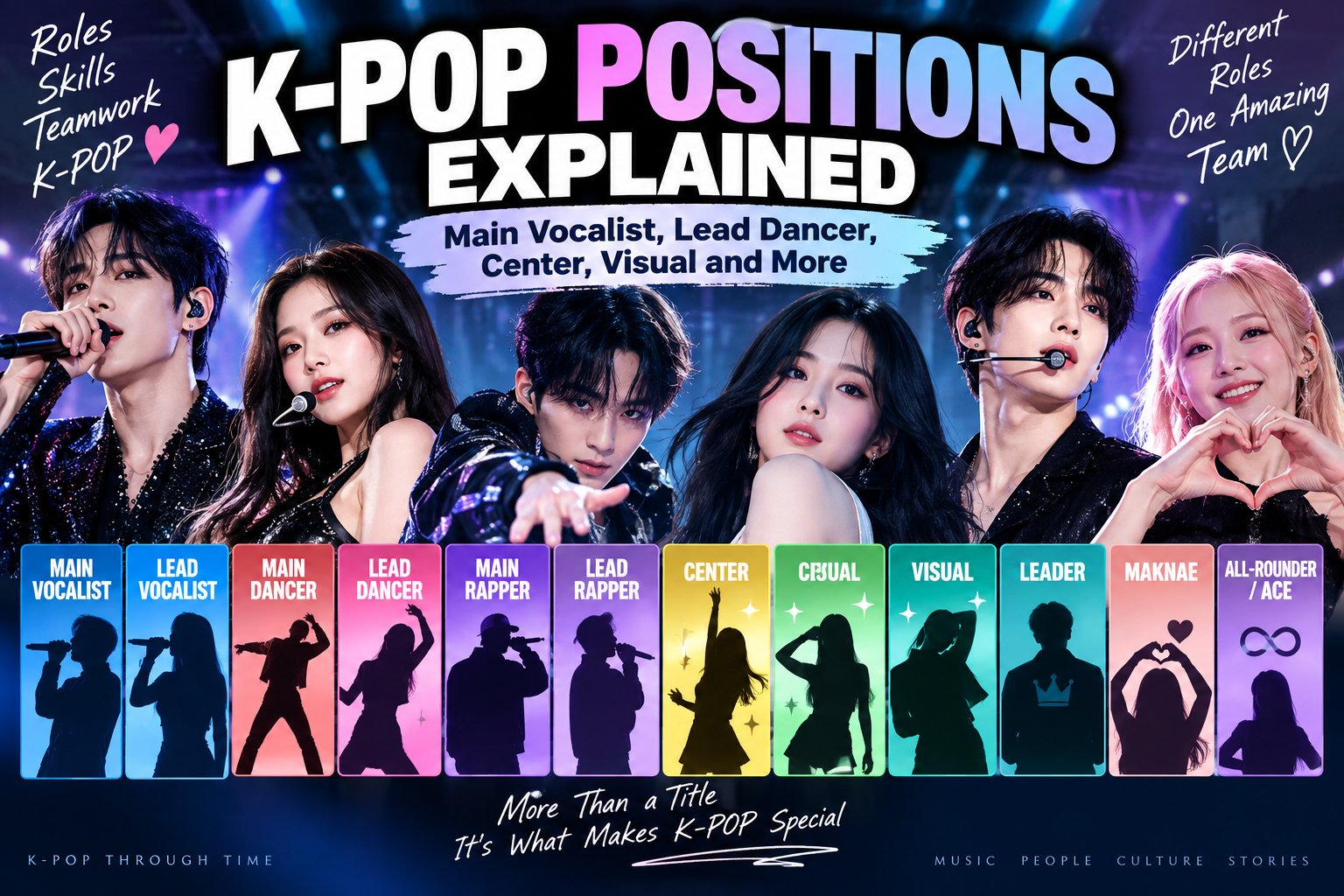
  • K-Pop Positions Explained: Main Vocalist, Lead Dancer, Center, Visual and More

    K-Pop Positions Explained: Main Vocalist, Lead Dancer, Center, Visual and More

    K-Pop Positions Explained: Why Do Idols Have Different Roles?

    If you are new to K-pop, group profiles can sometimes feel like they come with their own vocabulary.

    You may see one member described as the main vocalist, another as the lead dancer, and someone else as the visual or center.

    Then there are terms such as leader, rapper, maknae, all-rounder, and ace.

    What do all these K-pop positions actually mean?

    K-pop positions are labels used to describe the different strengths and responsibilities members may have within a group. Some positions focus on singing, dancing, or rapping, while others describe leadership, age, image, or prominence during performances.

    However, there is one important thing new fans should understand:

    K-pop positions are not always rigid rules.

    A member can have several positions, roles can overlap, and some newer groups use fewer fixed position labels than earlier generations.

    Here is a beginner-friendly guide to the most common K-pop positions and how they work.

    Quick Guide to the Most Common K-Pop Positions

    Here is the simple version:

    Main Vocalist — usually one of the strongest singers in the group
    Lead Vocalist — an important vocalist who supports the main vocal line
    Main Dancer — usually one of the strongest technical dancers
    Lead Dancer — a strong dancer who often receives prominent choreography
    Main Rapper — usually handles major or technically demanding rap sections
    Lead Rapper — supports the main rapper and performs important rap parts
    Leader — helps represent and coordinate the group
    Center — frequently becomes the visual focal point of performances
    Visual — a member highlighted strongly for the group’s visual image
    Maknae — the youngest member
    All-Rounder / Ace — commonly used for idols considered strong in several areas

    Now let’s look at each position more carefully.

    1. Main Vocalist

    The main vocalist is generally one of the group’s strongest singers.

    Main vocalists are often trusted with technically demanding sections of songs.

    These may include:

    • High notes
    • Vocal climaxes
    • Ad-libs
    • Difficult melodic passages
    • Important live singing moments

    Being the main vocalist does not necessarily mean singing the greatest number of seconds in every song.

    Line distribution can change depending on the song, concept, vocal range, and producer’s decisions.

    Instead, the position usually indicates that the member plays an especially important role in the group’s vocal performance.

    Main Vocalist vs Lead Vocalist

    This is one of the most confusing parts of K-pop terminology for English-speaking fans.

    In everyday English, the word lead can sound like the highest position.

    In traditional K-pop terminology, however, main vocalist usually refers to the primary vocal specialist, while a lead vocalist is another strong singer who handles significant vocal sections.

    The difference should not be interpreted as a simple ranking of who is “better.”

    Both can be essential to a group’s sound.

    2. Lead Vocalist

    A lead vocalist is an important member of the vocal line who supports the group’s overall melody.

    Lead vocalists may sing:

    • Verses
    • Pre-choruses
    • Choruses
    • Harmonies
    • Bridges
    • Other prominent melodic sections

    Some groups have multiple lead vocalists.

    And in modern K-pop, the distinction between main and lead vocalist can sometimes become less obvious because different members may receive major singing moments depending on the song.

    3. Main Dancer

    The main dancer is usually one of the group’s strongest dance performers.

    Main dancers often receive prominent moments during choreography-heavy sections.

    They may be featured during:

    • Dance breaks
    • Difficult choreography
    • Performance introductions
    • Solo dance moments
    • Special stages

    A main dancer may also help create the overall performance identity of a group.

    However, being the main dancer does not mean the member must always stand in the center.

    That brings us to another commonly misunderstood position.

    4. Lead Dancer

    The lead dancer is another highly capable dancer who supports the group’s performance line.

    Lead dancers may frequently appear near the front during choreography and receive important performance moments.

    The distinction between main dancer and lead dancer can vary considerably between groups.

    Some groups use both titles clearly.

    Others simply have a dance line without emphasizing a strict hierarchy.

    5. Main Rapper

    The main rapper usually handles some of the group’s most prominent or technically demanding rap sections.

    Depending on the group and artist, the role can involve:

    • Flow
    • Rhythm
    • Delivery
    • Diction
    • Stage presence
    • Lyric writing
    • Rap composition

    Not every K-pop rapper writes every rap they perform, so being a rapper and being a songwriter are not automatically the same thing.

    Some idol rappers, however, become deeply involved in writing and producing their own music.

    6. Lead Rapper

    The lead rapper supports the group’s rap line and often handles significant rap sections.

    As with vocal and dance positions, the distinction between main and lead rapper depends on the group.

    A member can also hold several positions at once.

    For example, an idol might simultaneously be a rapper, dancer, and leader.

    This overlap is extremely common in K-pop.

    7. Leader

    The leader has a different type of responsibility.

    Rather than describing a specific performance skill, the position usually relates to communication and group coordination.

    A leader may:

    • Represent the group in interviews
    • Speak during important public moments
    • Help communicate between members
    • Support teamwork
    • Help maintain group morale
    • Take responsibility during schedules

    The leader is sometimes the oldest member, but the oldest member does not automatically become the leader.

    Leadership may instead depend on personality, experience, communication ability, or the company’s decision.

    8. Visual

    The visual is one of the K-pop terms that often surprises new international fans.

    Traditionally, the visual is a member highlighted for fitting the group’s image and prevailing beauty ideals.

    Visual members may receive particular attention in:

    • Promotional photographs
    • Advertisements
    • Fashion content
    • Close-up shots
    • Brand activities

    However, the visual position should not be interpreted as meaning that other members are not attractive.

    It is primarily a role associated with the way an entertainment company presents and markets the group.

    And importantly:

    Visual and center do not mean exactly the same thing.

    9. Center

    The center is the member who becomes a focal point during important moments of a performance or promotion.

    You may notice the center standing prominently during:

    • Chorus choreography
    • Opening formations
    • Group photographs
    • Ending poses
    • Signature dance moments

    Some groups have a recognizable fixed center.

    Others rotate the center depending on the song, choreography, or concept.

    The center may also be the visual, but this is not required.

    Center vs Visual: What Is the Difference?

    The easiest way to remember it is:

    Visual = image-related role

    Center = performance or formation focal point

    One member can hold both positions, but they describe different functions.

    10. Maknae

    Maknae (막내) is a Korean word meaning the youngest person in a group.

    It is not actually a K-pop-specific word.

    Koreans use the term in many social situations to describe the youngest member of a family, workplace, team, or other group.

    In K-pop, the maknae is simply the youngest member.

    Being the maknae does not describe talent or ability.

    A maknae can simultaneously be:

    • Main vocalist
    • Main dancer
    • Rapper
    • Center
    • Visual

    or hold several other roles.

    The special attention given to the youngest member also reflects the importance of age relationships in Korean social culture.

    11. All-Rounder

    Fans frequently use the term all-rounder for an idol who is considered strong across several performance areas.

    An all-rounder may be skilled at combinations of:

    • Singing
    • Dancing
    • Rapping
    • Performing
    • Songwriting
    • Producing

    Unlike positions such as leader or main vocalist, “all-rounder” is not necessarily an official company-assigned position.

    It is often a description used by fans and media.

    12. What Does “Ace” Mean in K-Pop?

    Another term you may hear is ace.

    Fans often describe an idol as an ace when they believe that member performs at a particularly high level across multiple skills.

    The words ace and all-rounder are sometimes used interchangeably, although fans may debate the exact distinction.

    Because these labels are often informal, there is no universal official definition.

    Main vs Lead vs Sub: The Easy Way to Understand It

    For beginners, this is probably the most useful distinction to learn.

    Traditionally:

    Main — primary specialist in a particular area

    Lead — strong supporting specialist with important responsibilities

    Sub — contributes in that area without being the primary specialist

    For example:

    Main Vocalist → Lead Vocalist → Sub Vocalist

    or

    Main Rapper → Lead Rapper → Sub Rapper

    But these labels should not be treated like permanent rankings.

    K-pop performances are collaborative, and individual roles can change depending on the song.

    Can One K-Pop Idol Have Multiple Positions?

    Absolutely.

    In fact, this is normal.

    One member could simultaneously be:

    Leader + Main Rapper + Dancer

    while another could be:

    Main Vocalist + Center

    and another:

    Lead Dancer + Vocalist + Maknae

    Positions describe different aspects of what a member contributes.

    They are not mutually exclusive job titles.

    Who Decides K-Pop Positions?

    Traditionally, entertainment companies have played a major role in assigning positions when groups are formed.

    Decisions can reflect factors such as:

    • Vocal ability
    • Dance ability
    • Rap ability
    • Stage presence
    • Image
    • Personality
    • Age
    • Leadership qualities
    • The overall concept of the group

    But fans should be careful when reading online profiles.

    Not every position listed on fan websites is necessarily an officially announced company position.

    Different websites may even list different positions for the same idol.

    Are K-Pop Positions Still Important in 2026?

    Yes—but the system is becoming more flexible.

    Traditional K-pop groups often had clearly defined positions such as main vocalist, lead vocalist, main dancer, and lead rapper.

    Some newer groups, however, emphasize versatility rather than strict titles.

    A member may sing more in one comeback, receive a major dance moment in another, and become the center for a particular concept.

    This reflects a broader shift toward idols being presented as multi-skilled performers.

    For new fans, this means positions are best understood as a guide to a member’s strengths and responsibilities, not an unchangeable ranking system.

    Why Do K-Pop Groups Use Positions?

    Positions historically helped organize groups containing members with different specialties.

    A song and performance require many different strengths:

    Strong vocals.

    Rap delivery.

    Dance technique.

    Stage presence.

    Leadership.

    Visual storytelling.

    Public communication.

    Instead of expecting every member to perform every role in exactly the same way, positions helped groups emphasize each person’s strengths.

    This specialization became one of the recognizable features of the idol system.

    Why Fans Debate K-Pop Positions

    Positions can also create intense discussions among fans.

    Fans may disagree about:

    • Who deserves more lines
    • Who should receive a dance break
    • Who should stand in the center
    • Whether someone should be called a main or lead vocalist
    • Whether official positions still reflect a member’s current abilities

    These debates happen partly because idols continue improving after debut.

    Someone who began as a supporting vocalist may become a much stronger singer several years later.

    That is another reason not to treat debut-era positions as permanent judgments of talent.

    K-Pop Positions vs Line Distribution

    A common misunderstanding is assuming a position automatically determines how many lines someone receives.

    It does not.

    Line distribution can depend on:

    • The song
    • Vocal range
    • Concept
    • Producer
    • Arrangement
    • Performance requirements

    A main vocalist may receive fewer lines in one song while another member receives more because their voice fits that particular track.

    The same principle applies to center time and dance highlights.

    Frequently Asked Questions About K-Pop Positions

    What is the highest vocal position in K-pop?

    Traditionally, the main vocalist is considered the group’s primary vocal specialist.

    However, this should not be treated as a permanent ranking of every singer’s ability.

    Is main vocalist higher than lead vocalist?

    In traditional K-pop terminology, “main” usually indicates the primary specialist, while “lead” indicates another important member of that performance line.

    Is the visual always the center?

    No.

    The visual and center are different roles, although the same member can hold both.

    Is the leader always the oldest member?

    No.

    Some leaders are the oldest, while others are selected because of leadership ability, experience, or group dynamics.

    What does maknae mean?

    Maknae is the Korean word for the youngest member of a group.

    Can a K-pop group have more than one main vocalist?

    Yes.

    Some groups have multiple members identified as main vocalists or several members who share major vocal responsibilities.

    Do all K-pop groups have official positions?

    No.

    Some groups use clearly defined positions, while others use broader or more flexible roles.

    This has become increasingly noticeable among newer generations of K-pop groups.

    The Easiest Way to Remember K-Pop Positions

    If all these terms still feel confusing, remember them in four groups.

    Music

    Main Vocalist
    Lead Vocalist
    Main Rapper
    Lead Rapper

    Performance

    Main Dancer
    Lead Dancer
    Center

    Group Identity

    Leader
    Visual

    Age and Versatility

    Maknae
    All-Rounder
    Ace

    Once you understand these categories, K-pop profiles become much easier to read.

    Final Thoughts

    K-pop positions help explain how different members contribute to a group.

    The main vocalist may anchor difficult singing moments.

    The main dancer may shine during choreography.

    The rapper adds another musical texture.

    The leader helps guide the team.

    The center draws attention during key performance moments.

    The visual contributes to the group’s public image.

    And the maknae is simply the youngest member.

    But modern K-pop is increasingly flexible.

    Members grow, skills develop, concepts change, and positions sometimes become less important over time.

    So rather than viewing K-pop positions as a strict ranking, think of them as a useful map.

    They help new fans understand a group—but they never tell the whole story of what an idol can do.


  • What Does “Visual” Mean in K-Pop? The K-Pop Visual Position Explained

    What Does “Visual” Mean in K-Pop? The K-Pop Visual Position Explained

    What Does “Visual” Mean in K-Pop?

    If you are new to K-pop, the word “visual” can be confusing.

    In K-pop, a “visual” is a member traditionally recognized for representing the group’s image and appearance.

    In everyday English, visual usually refers to something related to appearance or sight.

    Entertainment companies may select a visual based on how well a member fits the group’s concept, public image, or beauty trends.

    But the visual position is more complicated than simply calling someone “the most attractive member.”

    What Does a K-Pop Visual Do?

    Unlike a main vocalist, rapper, or dancer, the visual does not describe a specific musical or performance skill.

    Instead, the role is traditionally connected to the group’s public image.

    A visual may receive prominent placement in promotional photographs, advertisements, interviews, music videos, or other media appearances.

    Because K-pop combines music, fashion, choreography, photography, and visual storytelling, appearance has historically played an important role in how idol groups are presented.

    However, every group uses the visual position differently.

    Is the Visual the Most Beautiful Member?

    This is one of the most common misunderstandings about the position.

    Calling someone the visual does not objectively mean that person is the “most beautiful” member.

    Beauty is subjective, and fans naturally have different preferences.

    The visual position traditionally reflects decisions made within the entertainment industry about which member best represents a particular image or concept.

    Beauty standards also change over time and differ between cultures.

    Therefore, the visual position should be understood as part of K-pop’s traditional group structure rather than as a universal ranking of appearance.

    Visual vs. Center

    The visual and the center are often confused because both can receive significant attention.

    However, they are different roles.

    The center is generally associated with prominent positioning during performances, choreography, photographs, or promotional activities.

    The visual is traditionally associated more closely with the group’s image and appearance.

    One idol can hold both positions, but this is not always the case.

    A group may have one member recognized as the visual and another who frequently performs in the center.

    Visual vs. Face of the Group

    Another expression fans sometimes use is “face of the group.”

    This is not necessarily the same as the visual.

    The face of the group generally refers to a member who is especially recognizable to the general public or frequently represents the group in media and promotional activities.

    That person might become widely known through television programs, acting, advertisements, fashion, viral performances, or individual popularity.

    The visual may also become the face of the group, but the roles can belong to different members.

    Visual vs. Leader

    The visual position is also very different from the leader position.

    A leader usually has responsibilities related to communication, teamwork, representation, and supporting the members.

    The visual position is traditionally related to image and presentation.

    These examples demonstrate an important point about K-pop positions: different titles describe different kinds of contributions.

    No single position determines who is the most important member.

    Why Did the Visual Position Become Important?

    K-pop developed as a highly visual entertainment industry.

    Idols do not only release songs. They also appear in music videos, album photography, advertisements, television programs, concerts, fashion events, and social media content.

    Entertainment companies therefore pay close attention to styling, concepts, makeup, hairstyles, clothing, photography, and overall visual identity.

    Within this system, the visual position became one way of identifying a member who could strongly represent the group’s image.

    K-Pop Visuals and Beauty Standards

    Discussions about K-pop visuals often lead to conversations about Korean beauty standards.

    Certain features or styles may become popular within the entertainment industry at particular times.

    However, these standards are not permanent.

    Fashion, makeup, hairstyles, concepts, and public preferences continuously change.

    International audiences have also expanded the range of opinions surrounding K-pop beauty.

    As K-pop became global, fans from different cultures brought different ideas about attractiveness and style.

    This makes the concept of a “perfect visual” increasingly difficult to define.

    Does Every K-Pop Group Have an Official Visual?

    No.

    Some groups officially introduce one or more members as visuals, while others do not use the position at all.

    This has become especially noticeable in newer generations of K-pop.

    Some entertainment companies prefer to avoid strict labels and instead emphasize that every member contributes to the group’s visual identity.

    Just as some modern groups no longer use fixed positions such as main vocalist, main rapper, or main dancer, the visual position can also be flexible or unofficial.

    Can a Group Have More Than One Visual?

    Yes.

    Some K-pop groups have more than one member recognized as a visual.

    This may be especially common in larger groups where members represent different styles or concepts.

    Fans may also informally describe several members as part of a group’s “visual line.”

    However, fan-created descriptions are not always the same as official positions announced by an entertainment company.

    It is useful to distinguish between official group roles and terms commonly used by fans.

    What Is a “Visual Line” in K-Pop?

    The phrase “visual line” is often used by fans to describe several members who are particularly associated with the group’s appearance.

    It may include officially designated visuals, but it can also include members whom fans consider especially striking or well suited to the group’s image.

    Unlike some formal positions, “visual line” is often an informal fan expression.

    Its meaning can therefore vary depending on the fandom.

    Does Being the Visual Affect Popularity?

    It can, but there is no guarantee.

    A visual may receive attention because of photographs, music videos, advertisements, or public appearances.

    This visibility can help attract new fans.

    However, popularity in K-pop depends on many factors.

    Personality, vocals, dancing, rap, songwriting, stage presence, fashion, acting, variety skills, social media, and individual activities can all influence how popular a member becomes.

    A member who is not the official visual may eventually become one of the group’s most recognized stars.

    The Visual Position in Modern K-Pop

    The traditional K-pop position system is becoming increasingly flexible.

    In the past, groups were often introduced with clearly defined roles: leader, main vocalist, main rapper, main dancer, center, visual, and other positions.

    Today, some groups prefer fewer official labels.

    Members may change roles depending on the song or concept, and entertainment companies may emphasize each member’s individual strengths rather than assigning permanent titles.

    This change reflects the broader evolution of K-pop toward more versatile performers.

    Visual Identity Is Bigger Than One Member

    Although a group may have an official visual, the visual identity of a K-pop group is created by much more than one person’s appearance.

    Concept designers, stylists, makeup artists, photographers, choreographers, music video directors, graphic designers, and the idols themselves all contribute.

    Album artwork, stage costumes, hairstyles, lighting, choreography, and music videos work together to create a recognizable identity.

    In this sense, the “visual” side of K-pop is a collaborative form of storytelling.

    Understanding the K-Pop Visual Position

    The visual is a traditional K-pop position associated with representing a group’s image and appearance.

    But it should not be interpreted as an objective judgment about who is the most attractive member.

    The visual is also different from the center, leader, main dancer, or face of the group, even though one person may sometimes hold several of these roles.

    As K-pop continues to evolve, strict positions are becoming less important for some groups.

    Understanding the visual position therefore gives new fans not only a better understanding of K-pop terminology, but also a glimpse into how the industry’s approach to image, performance, and group identity has changed over time.

  • What Does “Center” Mean in K-Pop? The K-Pop Center Position Explained

    What Does “Center” Mean in K-Pop? The K-Pop Center Position Explained

    What Does “Center” Mean in K-Pop?

    If you are new to K-pop, you may hear fans describe a member as the center of a group.

    The center is generally the member who is placed in a prominent position during important parts of performances, photos, music videos, or promotional activities.

    The role is closely connected to visibility and stage presence, but it does not necessarily mean that the center is the leader, main dancer, main vocalist, or most popular member.

    Understanding the center position can help new fans understand how K-pop groups organize both their performances and visual presentation.

    What Does a K-Pop Center Do?

    The center often appears in visually important positions during a performance.

    In group choreography, this member may stand in the middle during key moments such as the chorus, opening, ending, or signature dance move.

    Because the center naturally attracts attention, strong stage presence can be especially important.

    Facial expressions, confidence, movement, and the ability to communicate a song’s concept can all contribute to an effective center performance.

    However, K-pop choreography constantly changes formations. The official center does not remain in the middle throughout an entire song.

    Center vs. Main Dancer

    The center and main dancer are not the same position.

    A main dancer is generally recognized for strong dance technique and may perform difficult choreography or important dance breaks.

    The center, meanwhile, is usually associated with prominent positioning and the ability to attract attention during important moments.

    Sometimes the same idol can be both the center and main dancer, but this is not required.

    A member can be an excellent center because of stage presence and charisma even if another member is considered the group’s strongest technical dancer.

    Center vs. Leader

    The center is also different from the leader.

    A K-pop leader often helps represent the group, communicate with members, and provide stability within the team.

    The center’s role is more closely related to performance and presentation.

    One member can hold both roles, but many groups have different members serving as leader and center.

    This shows why K-pop positions should be understood separately rather than treated as a simple ranking system.

    Center vs. Visual

    Another common source of confusion is the difference between the center and the visual.

    Traditionally, the visual is a member recognized for fitting the beauty standards or image that an entertainment company wants to represent.

    The center is primarily about prominent placement and audience attention.

    Sometimes the visual also becomes the center because strong visual appeal can work well in promotional images and performances.

    But the two positions are not automatically the same.

    Is the Center Always in the Middle?

    No.

    Despite the name, a K-pop center does not stand in the middle for every second of a performance.

    Modern K-pop choreography relies heavily on changing formations.

    Members move forward and backward, switch positions, form lines, circles, or smaller units, and take turns occupying the center.

    These changes allow choreographers to highlight different members depending on who is singing, rapping, or performing a particular movement.

    The center may simply receive more strategically important center moments.

    What Makes a Good K-Pop Center?

    Dance ability can help, but being a successful center involves more than choreography.

    Stage presence is extremely important.

    A strong center may naturally draw the viewer’s attention through facial expressions, confidence, energy, movement, or charisma.

    The ability to communicate the concept of a song is also valuable.

    A bright pop song may require playful expressions, while a darker concept may require intensity or dramatic performance.

    Versatility can therefore make an idol especially effective in the center position.

    How Is the Center Chosen?

    There is no universal rule.

    Entertainment companies may consider several factors when selecting a center, including stage presence, performance skills, concept compatibility, popularity, visual impact, and the overall balance of the group.

    In some groups, one member is clearly identified as the official center.

    In others, the role is more flexible.

    Different members may take center positions depending on the song, concept, or promotional activity.

    Does Every K-Pop Group Have an Official Center?

    No.

    Some groups have an officially recognized center, while others do not use the title.

    Even without an official center, choreography still requires members to occupy central positions at different moments.

    As K-pop has evolved, many groups have moved away from rigid position labels.

    Instead, roles can change depending on the music and concept.

    This is similar to the way some newer groups no longer strictly identify members as main vocalist, lead rapper, or main dancer.

    Why Is Center Position Important in K-Pop?

    K-pop is both musical and visual.

    Fans experience songs through music videos, live stages, dance practices, concerts, photographs, short-form videos, and television performances.

    Because of this, visual composition matters.

    The person positioned in the center can influence where viewers naturally focus their attention.

    A memorable center moment can become closely associated with a song, choreography, or era.

    This makes the center position an important part of K-pop’s performance language.

    Center Time and Line Distribution Are Different

    Another important distinction is between center time and line distribution.

    Line distribution refers to how singing or rap parts are divided among members.

    Center time refers to how much time a member occupies a prominent central position during choreography or visual presentation.

    A member can have relatively few vocal lines but still receive memorable center moments.

    Likewise, a main vocalist may sing many important parts without spending the most time in the center.

    The two concepts should therefore not be confused.

    Is the Center the Most Popular Member?

    Not necessarily.

    Being the center can increase visibility, which may help a member attract attention from new audiences.

    However, popularity depends on many factors, including personality, music, variety appearances, fashion, acting, social media presence, individual activities, and fan preferences.

    Another member may become more popular even if they are not the official center.

    Popularity can also change significantly over the course of a group’s career.

    The Center Position in Modern K-Pop

    K-pop positions have become increasingly flexible.

    Many modern groups emphasize teamwork and versatility rather than assigning every member a fixed role.

    Choreography may rotate center positions frequently, allowing different members to become the focus during different sections.

    This approach can give each performer opportunities to stand out.

    As a result, the idea of one permanent center is less important in some groups than it was in more traditional idol systems.

    Understanding the K-Pop Center Position

    The center is one of the most interesting positions in K-pop because it connects choreography, stage presence, visual presentation, and group identity.

    A center is not simply the member who stands in the middle.

    The role involves drawing attention at key moments and helping communicate the concept and energy of a performance.

    At the same time, the center works as part of a larger team.

    Main vocalists, rappers, dancers, leaders, and other members all contribute different strengths.

    Understanding the center position makes it easier for new fans to see how carefully K-pop performances are organized—and why every position can contribute something different to the final stage.