
Tag: K-Pop Title Track

  • What Is a Title Track in K-Pop? How It Differs From B-Sides and Pre-Releases

    What Is a Title Track in K-Pop? How It Differs From B-Sides and Pre-Releases

    Introduction

    If you are new to K-pop, the phrase “title track” can be confusing.

    In many English-speaking music markets, a title track traditionally means a song that has the same name as the album. In K-pop, however, the term is often used differently. A title track is usually the main song chosen to represent and promote an album, single album, EP, or mini album—even when the song and album have completely different names.

    The title track is typically the song that receives the biggest promotional push. It may get the main music video, choreography, music-show performances, dance challenges, interviews, and other promotional content during a comeback.

    But that raises several questions. How is a title track different from a B-side? Is a pre-release song also a title track? And why do some K-pop albums have two title tracks?

    Understanding these terms makes it much easier to follow K-pop releases and comeback promotions. It also reveals something important about how the K-pop industry has developed: an album is not promoted only as a collection of songs, but often as a complete era built around music, performance, visuals, and storytelling.

    What Does “Title Track” Mean in K-Pop?

    In K-pop, a title track is generally the main song selected to represent a new release and receive the most promotion.

    It does not have to share the same name as the album.

    For example, a K-pop mini album may contain five or six songs, but one song is usually chosen as the central promotional track. That song may receive an official music video, choreography, music-show stages, performance videos, dance challenges, and extensive promotion on social media.

    This is why international K-pop fans often use “title track” almost interchangeably with “main promotional song.”

    Title Track Does Not Mean the Song Has the Same Name as the Album

    This is one of the biggest differences between the way the term is commonly understood in K-pop and its traditional English-language meaning.

    Outside K-pop, “title track” often refers specifically to a song whose title matches the album title.

    In K-pop fandom and promotional language, however, the album and its main song can have completely different names.

    What matters is the song’s role in the promotional cycle, not whether its name matches the album.

    That distinction is especially useful for new international fans because K-pop releases are often organized around clearly defined promotional eras. The title track usually becomes the musical centerpiece of that era.

    Title Track vs B-Side: What Is the Difference?

    The simplest difference is promotion.

    A title track is usually the main song selected to represent the release, while B-sides are the other songs included on the album or mini album.

    That does not mean B-sides are less important musically. In fact, some B-sides become fan favorites, go viral on social media, receive performance videos, or even become more popular with listeners than the title track.

    The difference is mainly about how the songs are positioned when the release begins.

    A title track typically receives:

    • The main music video
    • Major music-show performances
    • Choreography and performance content
    • More promotional appearances
    • A larger role in defining the comeback’s concept and visual identity

    B-sides may receive some of these things too, especially when a song becomes popular or the company decides to promote more than one track. But they usually begin as supporting tracks rather than the main promotional focus.

    Can a B-Side Become More Popular Than the Title Track?

    Yes.

    K-pop history includes many cases in which a B-side attracted significant attention after an album was released. Streaming platforms, short-form video, dance challenges, concert performances, and fan recommendations have made it much easier for songs that were not originally the main promotional track to reach large audiences.

    This is one reason the distinction between a title track and a B-side is about promotional status, not necessarily song quality or eventual popularity.

    A B-side can become a major hit while still technically being a B-side on the original release.

    Pre-Release vs Title Track: Are They the Same?

    Not necessarily.

    A pre-release is a song released before the main album or mini album arrives. Its purpose may be to build anticipation, introduce a new concept, or give fans an early taste of the upcoming release.

    The title track, by contrast, is usually the main promotional song associated with the full release.

    Sometimes a pre-release receives its own music video and extensive promotion, making it feel almost as important as the later title track. In other cases, it serves mainly as an introduction to the comeback.

    This means a song’s release timing and promotional role are two different things:

    • Pre-release: describes when the song is released relative to the album.
    • Title track: describes the song’s main promotional role.
    • B-side: generally describes an album track that is not designated as the main title track.

    These categories can occasionally overlap depending on how an entertainment company structures a release campaign.

    Why Do K-Pop Artists Release Songs Before the Title Track?

    Pre-releases have become an important part of modern K-pop promotion.

    Instead of concentrating all attention on one release date, companies can begin the comeback cycle earlier. A pre-release can generate streaming activity, social-media discussion, choreography clips, and international attention before the complete album arrives.

    For fans, this can make a comeback feel like a longer sequence of events rather than a single release day.

    It also shows how K-pop promotion has evolved. As streaming and global social platforms became increasingly important, release campaigns gained more flexibility. An artist can now introduce one song first, build anticipation, and then reveal the main title track as another major moment in the same era.

    Can a K-Pop Album Have Two Title Tracks?

    Yes. A K-pop release can have more than one title track.

    When two songs are officially presented as the main promotional tracks, fans may refer to them as double title tracks or dual title tracks.

    Instead of choosing only one song to represent the release, an artist or company may give two songs major promotional attention. Both can receive music videos, performances, choreography, or other prominent content.

    There are several reasons for using two title tracks.

    The songs may show different sides of an artist, target different musical audiences, or help demonstrate the range of an album. One track might emphasize powerful performance while another highlights vocals or a different concept.

    This also explains why simply looking for “the song with the album’s name” does not reliably identify a K-pop title track. The designation depends much more on how the release is officially structured and promoted.

    Why Is the Title Track So Important in K-Pop?

    The title track often does more than promote an album.

    It can define an entire comeback era.

    K-pop combines music with choreography, fashion, visual concepts, music videos, performances, and storytelling. Because the title track usually receives the greatest promotional attention, it often becomes the song that audiences associate most strongly with that particular era.

    For casual listeners, it may be their first introduction to the album—or even to the artist.

    For existing fans, the title track can become the center of weeks of teasers, performances, fan discussions, dance challenges, and other comeback activities.

    That is why choosing a title track can be an important strategic decision. It is not necessarily a declaration that the song is objectively the “best” track on the album. Instead, it is the song—or sometimes songs—chosen to lead the release publicly.

    How the Role of the K-Pop Title Track Has Changed Over Time

    The basic idea of promoting one main song is not new. Korean pop artists have long used a lead song to represent an album and perform on television music programs.

    What has changed is the scale of promotion surrounding that song.

    In earlier generations of K-pop, television performances, physical albums, radio, and domestic media played a particularly important role in introducing a new release. The main promoted song naturally became the track most familiar to the general public.

    As K-pop expanded internationally, the promotional environment changed.

    YouTube made music videos available instantly to global audiences. Streaming services allowed international fans to explore entire albums. Later, platforms built around short-form video helped choreography, memorable hooks, and even B-sides spread independently of traditional promotions.

    Today, a title track can sit at the center of a much larger campaign involving:

    • Concept photos and trailers
    • Music-video teasers
    • Performance and dance-practice videos
    • Music-show stages
    • Short-form dance challenges
    • Fan events and livestreams
    • Global interviews and promotional appearances

    At the same time, B-sides and pre-release songs now have more opportunities to gain attention of their own.

    This has made modern K-pop album promotion more complex than a simple “main song versus everything else” structure. The title track remains important, but fans can discover and popularize songs across the entire album.

    Title Track, Lead Single, and Promotional Single

    International fans may also encounter the terms lead single and promotional single.

    They can describe similar ideas, but they come from somewhat different music-industry terminology and should not always be treated as exact synonyms.

    In K-pop discussions, “title track” remains a very common way to identify the main song being promoted with a release. English-language media may instead describe the same song as a lead single, particularly when writing for audiences outside K-pop fandom.

    The safest way to understand a specific release is to look at how the artist, label, and official promotional materials describe the songs.

    How to Identify the Title Track on a K-Pop Album

    If you are new to K-pop, there are several easy clues that can help you identify the title track.

    Look for the song that receives the main music video, appears most prominently in comeback promotions, and is performed repeatedly on music shows. Official album announcements, track lists, and promotional schedules may also identify the title track directly.

    However, remember that not every release follows exactly the same formula. Some albums have two title tracks, while others use pre-release singles or promote selected B-sides alongside the main song.

    When in doubt, official information from the artist or label is the most reliable guide.

    Frequently Asked Questions

    Is a K-Pop Title Track Always the Best Song on the Album?

    No. Calling a song the title track describes its promotional role, not its quality.

    Fans may prefer a B-side, and sometimes a non-title track becomes especially popular after release.

    Does a Title Track Have to Have the Same Name as the Album?

    No. In K-pop, the main promotional song and the album can have completely different names.

    This is one of the main reasons the term can initially confuse international fans.

    Is Every K-Pop Single a Title Track?

    Not necessarily.

    The terminology depends on how a particular release is structured and officially promoted. A standalone single may function as the main promoted song, while albums and mini albums can contain a title track alongside multiple B-sides.

    Can There Be More Than One Title Track?

    Yes. Some K-pop releases officially promote two or more songs as title tracks.

    These may be described by fans as double or dual title tracks.

    Is a Pre-Release Song a B-Side?

    Not automatically.

    “Pre-release” describes when a song becomes available, while “B-side” and “title track” describe its position or promotional role within a release. Because these terms describe different aspects of a song, the categories do not always fit into a simple either-or system.

    Final Thoughts

    In K-pop, a title track is generally the main song chosen to lead the promotion of a new release. It does not need to share the album’s name, and it is not automatically considered better than the other songs.

    B-sides are the other tracks on the release, while pre-release songs arrive before the main album or mini album and may have their own promotional campaigns. Some releases even use multiple title tracks.

    Understanding these differences makes K-pop comeback schedules, track lists, music-show performances, and fan discussions much easier to follow.

    More importantly, the changing role of the title track tells part of the larger story of K-pop itself. What was once centered heavily on a main song promoted through domestic media has developed into a global release cycle in which title tracks, B-sides, pre-releases, music videos, performances, and social platforms can all shape how an era is experienced.
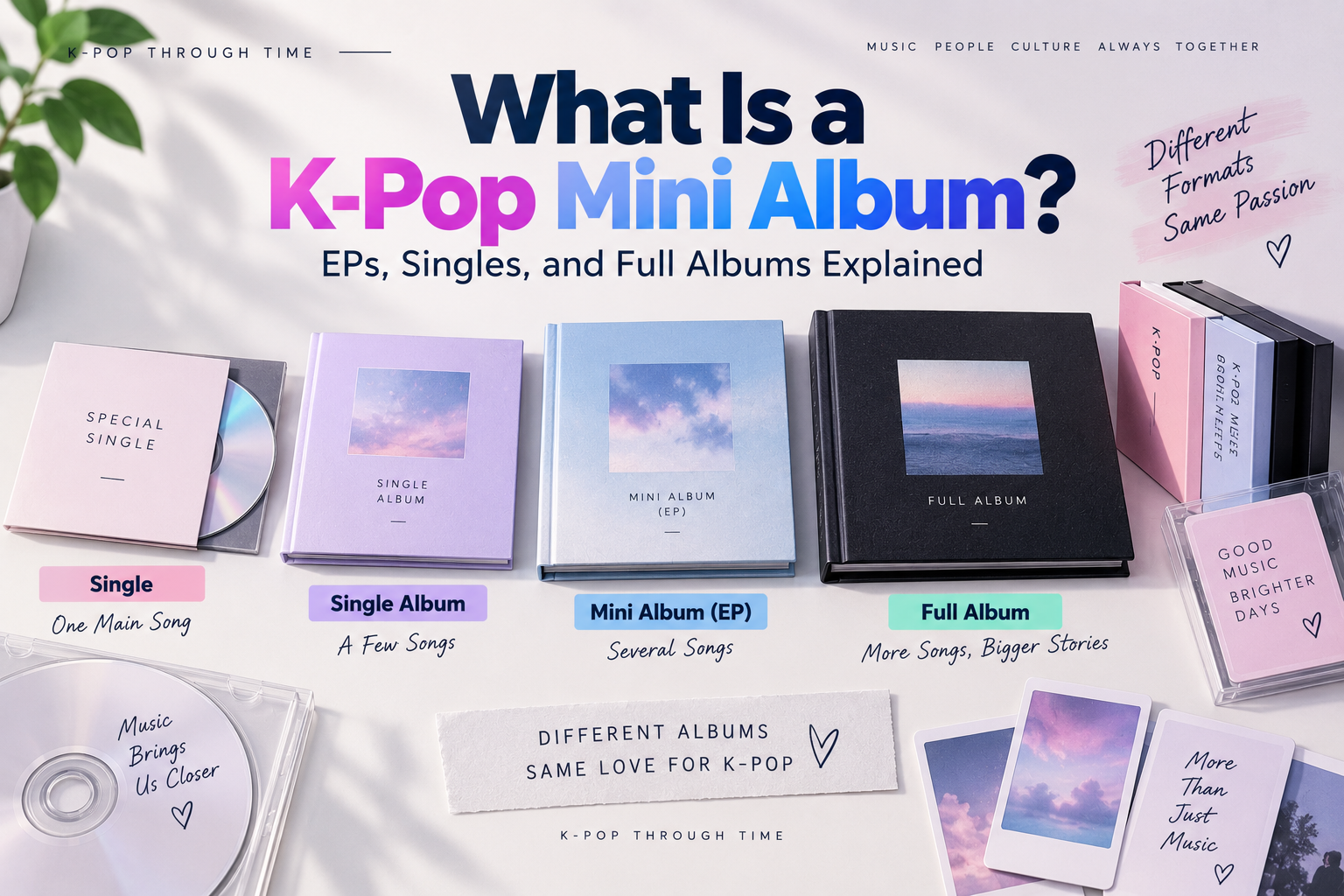

  • What Is a K-Pop Mini Album? EPs, Singles, and Full Albums Explained

    What Is a K-Pop Mini Album? EPs, Singles, and Full Albums Explained

    If you are new to K-pop, album terminology can quickly become confusing.

    A group announces a single album. A few months later, they release a mini album. Then fans celebrate the arrival of a full album.

    So what is the difference?

    Although these terms may sound complicated at first, they mainly describe different types and sizes of music releases. Understanding them makes it much easier to follow K-pop comebacks, track lists, and album announcements.

    What Is a K-Pop Mini Album?

    A mini album is one of the most common release formats in K-pop.

    It usually contains several songs but is shorter than a full-length studio album. Internationally, a similar format is often called an EP, which stands for “extended play.”

    A mini album gives artists enough space to present several songs and explore a concept without producing a full-length album.

    For many K-pop groups, mini albums are an important part of their regular comeback schedule.

    Is a Mini Album the Same as an EP?

    In many situations, yes.

    The terms mini album and EP are often used to describe similar releases.

    However, terminology can vary depending on the artist, entertainment company, music platform, or market. A release described as a mini album in Korean promotional materials may appear as an EP on an international streaming service.

    Rather than focusing only on the label, it is often more useful to look at the number of tracks and how the release is being promoted.

    What Is a K-Pop Single?

    A single usually focuses on one main song.

    It may be released digitally without a large physical album package, although promotional strategies differ between artists.

    Singles can be used to introduce new music between larger album releases, test a new musical direction, celebrate a special occasion, or begin a new promotional period.

    Some singles also become major hits even though they are not part of a full album at the time of release.

    What Is a Single Album?

    Here is where K-pop terminology becomes especially interesting.

    A single album is not necessarily just one song.

    In K-pop, a single album often contains a small number of tracks—perhaps a main song plus one or two additional tracks.

    It may also be released physically with packaging similar to larger K-pop albums.

    That means fans might receive a photobook, photocards, posters, or other collectible items even though the musical release itself contains only a few songs.

    What Is a Full Album?

    A full album, sometimes called a studio album or full-length album, generally contains more songs than a mini album.

    Because it offers more tracks, a full album gives artists greater space to explore different musical styles and themes.

    For fans, a full album can be particularly exciting because it provides more new music to discover beyond the main promotional song.

    However, full albums often require more time and resources to produce, which is one reason mini albums are so common in K-pop.

    Why Are Mini Albums So Common in K-Pop?

    K-pop operates around highly organized promotional cycles.

    A comeback can involve concept photos, teasers, music videos, choreography, music-show performances, interviews, fan events, and other content.

    Releasing mini albums allows artists to introduce new music regularly while still creating a complete concept around each release.

    Instead of waiting several years between full albums, an artist may return more frequently with mini albums or singles.

    This helps keep fans engaged while allowing each comeback to have its own identity.

    What Is Usually Inside a Mini Album?

    A mini album often contains a title track and several additional songs.

    The title track usually receives the main promotional attention, including a music video and music-show performances.

    The remaining tracks are commonly described by fans as B-sides.

    These B-sides can explore different musical styles and sometimes become fan favorites even without receiving the same level of promotion as the title track.

    What Is a Repackaged Album?

    Another term K-pop fans often encounter is the repackaged album.

    A repackage typically takes an existing album and releases an expanded or revised version with additional material.

    This may include new songs and a new main promotional track.

    Rather than being an entirely unrelated project, a repackage often extends the era of the original album and gives fans additional music and promotions.

    What Is a Pre-Release Single?

    Sometimes an artist releases a song before the main album arrives.

    This is known as a pre-release single.

    The purpose is often to build anticipation for the upcoming album and introduce listeners to its musical direction.

    A pre-release single may receive its own music video and significant promotion, but it does not always become the album’s primary title track.

    When the complete album arrives, another song may take center stage.

    Physical Albums Are a Big Part of K-Pop

    One thing that makes K-pop albums distinctive is the importance of physical packaging.

    A physical K-pop album can be more than a CD.

    Depending on the release, it may include photobooks, photocards, posters, stickers, lyric books, postcards, or other collectible items.

    Albums may also be sold in several versions with different photos or design concepts.

    For many fans, buying an album is therefore both a way to listen to music and a way to collect something connected to the artist and the comeback era.

    Why Are There Multiple Versions of the Same Album?

    It is common for a K-pop album to be released in several versions.

    The songs may be identical, but the packaging, concept photos, covers, or included collectibles can differ.

    This allows one album to present several visual interpretations of the same musical era.

    Collectors may choose their favorite version, while some fans purchase multiple versions to collect different designs or inclusions.

    Do More Songs Mean a More Important Release?

    Not necessarily.

    A full album contains more music, but that does not automatically make it more successful or culturally important than a mini album or single.

    A single song can become one of an artist’s biggest hits.

    Likewise, a mini album can define an important era in a group’s career.

    In K-pop, the impact of a release depends on many factors, including the music, concept, performances, timing, promotion, and audience response.

    Mini Album vs. Full Album: The Simple Difference

    The easiest way to understand the distinction is this:

    A single or single album is generally the smallest release.

    A mini album or EP contains several songs but is shorter than a typical full album.

    A full album generally contains a larger collection of songs and represents a more extensive musical project.

    The exact number of tracks can vary, so these categories should be understood as general industry terms rather than strict mathematical rules.

    Why Understanding Album Types Helps K-Pop Fans

    Once you understand these terms, K-pop announcements become much easier to follow.

    When an entertainment company announces a mini album, you know to expect several new songs.

    When fans talk about a full album, you know they are anticipating a larger collection of music.

    And when you see the words “single album,” you will know that it may contain more than just one track.

    These small pieces of vocabulary make a surprisingly big difference when exploring K-pop.

    Final Thoughts

    K-pop releases come in many forms, from singles and single albums to mini albums, EPs, full albums, and repackaged albums.

    Among them, the mini album has become especially familiar because it fits naturally into K-pop’s comeback-driven promotional system.

    But no matter how many tracks a release contains, each format can introduce a new sound, concept, performance, and chapter in an artist’s career.

    Understanding the different album types allows you to look beyond the terminology and enjoy what matters most—the music and the story surrounding each new release.


  • What Is a K-Pop Title Track? Why It Matters More Than Other Songs

    What Is a K-Pop Title Track? Why It Matters More Than Other Songs

    When a K-pop group releases a new album, fans often talk about the “title track.”

    If you are new to K-pop, this term can be confusing. Does it simply mean a song with the same name as the album? Is it always the first song on the track list?

    Not necessarily.

    In K-pop, a title track usually means the main song chosen to represent and promote an album or release. It is often the song that receives the most attention from the company, the artists, the media, and fans.

    Understanding the title track is important because it sits at the center of many K-pop comebacks.

    What Is a Title Track in K-Pop?

    A K-pop album may contain several songs, but usually one song is selected as the primary promotional track.

    That song is commonly called the title track.

    The title track typically receives an official music video and becomes the song performed most frequently during music-show promotions.

    It is often the first song that casual listeners hear from a new album.

    Because of this, the title track plays an important role in creating the public image of a comeback.

    Does the Title Track Have the Same Name as the Album?

    Not always.

    This is one reason the term can confuse international listeners.

    In some music markets, a “title track” often refers to a song that shares the same title as an album. In K-pop usage, however, the term commonly refers to the main promoted song, regardless of whether its name matches the album.

    The album and its title track can therefore have completely different names.

    How Is a Title Track Chosen?

    Choosing a title track can be an important decision.

    Entertainment companies and artists may consider many factors, including the song’s concept, choreography potential, memorable hooks, performance impact, and how well it represents the album.

    The selected song needs to attract attention while also introducing listeners to the artist’s latest musical direction.

    Sometimes several songs may be considered before the final title track is chosen.

    The Title Track Defines the Comeback

    In many cases, the title track becomes closely associated with the entire comeback.

    Its sound, choreography, fashion, music video, and stage performances help establish the identity of that promotional era.

    A powerful title track might introduce a darker concept, while another could present a bright summer image or a more experimental sound.

    For this reason, fans often remember different periods of an artist’s career through their title tracks.

    Title Tracks and Music Videos

    One of the biggest differences between a title track and many other album songs is the music video.

    Title tracks usually receive the main official music video connected to the comeback.

    K-pop music videos can involve elaborate sets, fashion, choreography, visual effects, and storytelling. As a result, the video becomes an important part of how the title track is experienced.

    For international fans especially, a music video may be their first introduction to a new K-pop release.

    Title Tracks and Choreography

    Performance is another major reason title tracks matter.

    Many K-pop title tracks are designed with stage performances in mind. Choreography can become almost as recognizable as the song itself.

    A memorable dance move may spread through short-form videos, dance challenges, fan covers, and social media.

    This means a successful title track is often more than an audio recording. It can become a complete visual and performance experience.

    Title Tracks on Music Shows

    During a comeback promotion period, idols frequently perform their title track on Korean music shows.

    The same song may appear across several programs with different outfits, stage designs, camera work, and performance details.

    Fans follow these stages closely and may support the song as it competes for music-show wins.

    This promotional exposure helps make the title track the most visible song from the album.

    What About B-Sides?

    Songs on an album that are not the primary title track are often called B-sides in K-pop fan discussions.

    But being a B-side does not mean that a song is less valuable or lower in quality.

    In fact, some B-sides become extremely popular among fans and may even gain wider attention through performances, social media, or word of mouth.

    The main difference is usually which song receives the primary promotional focus.

    Can an Album Have More Than One Title Track?

    Yes.

    Some K-pop releases use double title tracks or promote more than one song as a major track.

    This allows artists to show different musical styles or concepts within the same release.

    One song might emphasize performance and choreography, while another highlights vocals or a different emotional atmosphere.

    Promotional strategies vary between artists and entertainment companies, so there is no single rule that applies to every K-pop release.

    Title Track vs. Pre-Release Single

    Another term fans often encounter is pre-release single.

    A pre-release song is released before the main album arrives. It can build anticipation and introduce part of the album’s musical direction.

    However, the pre-release single is not necessarily the main title track.

    When the full album is released, another song may become the primary track for promotions.

    This strategy gives fans more music before the official comeback and can extend the promotional period.

    Why Do Fans Care So Much About the Title Track?

    The title track often becomes the song most closely associated with an artist’s new era.

    It may receive the largest promotional campaign, the most prominent performances, and the greatest public exposure.

    For fans, the title track also provides the first major clue about how an artist has changed since the previous comeback.

    Has the sound changed?

    Is the concept different?

    Has the choreography evolved?

    What kind of image is the artist presenting this time?

    A single title track can answer many of these questions.

    Can a B-Side Become More Popular Than the Title Track?

    Absolutely.

    Sometimes listeners discover a B-side that becomes a fan favorite or attracts unexpected attention.

    Social media can also give album tracks a second life. A dance clip, performance video, or viral moment can introduce a B-side to audiences who may never have listened to the full album.

    This shows that being selected as the title track provides promotional advantages, but it does not guarantee that it will ultimately become everyone’s favorite song.

    Final Thoughts

    The K-pop title track is more than simply the first song on an album or a song that shares the album’s name.

    It is usually the main promotional song chosen to represent a release.

    Through music videos, choreography, music-show performances, and other promotional activities, the title track often becomes the centerpiece of a K-pop comeback.

    At the same time, the growing popularity of B-sides reminds us that every album can contain songs worth discovering beyond its main single.

    Understanding the difference between title tracks, B-sides, and pre-release singles makes it much easier to follow K-pop releases—and to understand why fans get so excited whenever a new track list appears.


  • What Is a B-Side in K-Pop? Why Some of the Best Songs Are Not Title Tracks

    What Is a B-Side in K-Pop? Why Some of the Best Songs Are Not Title Tracks

    If you are new to K-pop, you may often hear fans say things like:

    “This B-side should have been the title track.”

    Or:

    “Their B-sides are even better than their singles.”

    But what exactly is a B-side in K-pop?

    In modern K-pop, a B-side generally refers to a song on an album or mini album that is not the main title track promoted as the release’s primary song.

    B-sides may receive less promotion, but that does not mean they are less important.

    In fact, some of the most loved songs in K-pop are B-sides.

    They can reveal different musical styles, highlight individual members, experiment with unusual sounds, and show sides of an artist that may not appear in the main title track.

    Here is a beginner-friendly guide to what B-sides mean in K-pop and why fans care about them so much.

    What Does B-Side Mean in K-Pop?

    Traditionally, the term B-side came from physical records.

    A single could have a main song on the A-side and another song on the B-side.

    The music industry has changed dramatically since then, but the expression survived.

    In modern K-pop fandom, B-side is commonly used for album tracks that are not the main title track.

    For example, a K-pop mini album might contain six songs.

    One song may be chosen as the title track and receive the main music video, choreography, music-show performances, interviews, and promotional campaign.

    The other tracks are commonly described by fans as B-sides.

    B-Side vs. Title Track: What Is the Difference?

    The easiest way to understand the difference is through promotion.

    A title track is normally the main song representing a K-pop release.

    It is usually supported by major promotional activities such as a music video, choreography, teaser campaign, music-show stages, and media appearances.

    A B-side belongs to the same album or mini album but is not the primary promotional song.

    However, the distinction is not always completely simple.

    Some B-sides also receive choreography videos, special performances, lyric videos, or even additional music videos.

    This means a song can receive substantial attention while still not being the release’s main title track.

    Why Do K-Pop Albums Have B-Sides?

    An album needs to do more than produce one hit song.

    B-sides give artists and producers room to explore.

    A title track often has to make an immediate impression. It may need a memorable hook, strong visual concept, choreography, and enough impact to represent an entire comeback.

    B-sides can operate differently.

    They may be quieter, stranger, more emotional, more experimental, or more focused on vocals.

    This allows an album to show more of an artist’s musical identity.

    Why Do Fans Love K-Pop B-Sides?

    For many fans, discovering B-sides is the moment when they move beyond casually knowing a group and begin exploring its music more deeply.

    Someone may first discover a K-pop artist through a popular title track.

    Then they listen to the full album.

    Suddenly, they find a song that was never the main single but becomes their favorite.

    This is why fans frequently recommend B-sides to new listeners.

    B-sides can feel like hidden discoveries inside an artist’s discography.

    Are B-Sides Lower-Quality Songs?

    No.

    Calling a song a B-side does not mean it is lower quality.

    The label mainly describes its role within a release and its promotional status.

    Entertainment companies choose title tracks for many reasons.

    A song may be selected because it suits choreography, communicates the album’s concept clearly, has strong commercial potential, or works well for television performances.

    Another song might be excellent but less suitable for the main promotional campaign.

    That song can still become a fan favorite.

    Why Are R&B Songs Often K-Pop B-Sides?

    R&B is particularly common among K-pop B-sides.

    Many R&B-influenced songs focus on atmosphere, vocal harmonies, groove, and subtle production rather than an explosive chorus.

    That can make them ideal album tracks.

    A group may promote a powerful dance song as its title track while placing smoother R&B songs elsewhere on the album.

    For listeners who enjoy vocal-focused or atmospheric music, exploring B-sides can therefore reveal an entirely different side of a K-pop group.

    Famous K-Pop B-Sides Fans Often Recommend

    Different generations of K-pop have produced many B-sides that became highly popular among fans.

    Some gained attention through concerts.

    Others became popular through dance performances, social media, fan recommendations, or word of mouth.

    Examples frequently discussed by listeners include songs such as Red Velvet’s “Kingdom Come,” BTS’s “House of Cards,” aespa’s “Lucid Dream,” and LE SSERAFIM’s “Impurities.”

    These tracks demonstrate an important point:

    A song does not have to be the main title track to become memorable.

    In some cases, a B-side develops a reputation almost as strong as the promoted single.

    Can a B-Side Have a Music Video?

    Yes.

    This is one of the reasons the terminology can confuse beginners.

    A B-side may receive a music video even though it is not the main title track.

    Entertainment companies sometimes create additional videos to promote an album, showcase a fan-favorite track, or provide more content during a comeback.

    Some B-sides may also receive performance videos or special clips.

    Therefore:

    Music video does not automatically mean title track.

    The song’s role in the release and promotional strategy matters.

    Can a B-Side Be Performed on Music Shows?

    Yes.

    K-pop artists sometimes perform more than one song during their comeback promotions.

    A group might perform the title track and an additional B-side during its first week of music-show appearances.

    This gives audiences a better sense of the album and may help another song attract attention.

    However, the title track normally remains the central song of the promotional campaign.

    Can a B-Side Become More Popular Than the Title Track?

    Absolutely.

    Sometimes listeners connect more strongly with a B-side than with the official title track.

    A song can gain popularity through fan recommendations, short-form videos, live performances, concerts, dance challenges, or streaming.

    When this happens, fans may jokingly say:

    “This should have been the title track.”

    That does not necessarily mean the company made the wrong decision.

    It simply shows that audiences can respond to music in unexpected ways.

    What Is a Promoted B-Side?

    Fans sometimes use the expression promoted B-side for an album track that receives more attention than a typical B-side.

    For example, the song might receive choreography, music-show performances, a special video, or additional promotional content.

    It still may not be the primary title track, but the company gives it a larger role in the comeback.

    This reflects how flexible modern K-pop promotion has become.

    What Is a Pre-Release Song?

    A pre-release song is different from a B-side.

    A pre-release is released before the main album or primary promotional release as part of the buildup to a comeback.

    It may receive its own music video and extensive promotion.

    After the full album arrives, that song may appear on the album, but its promotional role is different from a typical B-side.

    For beginners, it helps to remember:

    Pre-release = released before the main album as part of the promotional campaign

    Title track = primary song representing the main release

    B-side = another album track that is not the primary title track

    What Is a Double Title Track?

    Sometimes a K-pop release may promote two songs as major title tracks.

    This is often described as having double title tracks.

    In that situation, it would be misleading to call one of those two songs a normal B-side simply because it appears alongside another promoted track.

    K-pop release strategies vary between artists and companies, so context is important.

    B-Sides and K-Pop Comebacks

    B-sides are closely connected with the K-pop comeback system.

    When an artist makes a comeback, fans do not only wait for the main music video.

    They often listen to the entire album immediately.

    Fans discuss which B-side is their favorite, which song deserves a performance, and which track might become popular later.

    This makes album listening an important part of K-pop fan culture.

    A comeback is therefore not always about a single song.

    For dedicated fans, it can be about discovering an entire collection of new music.

    Why B-Sides Matter for Understanding a K-Pop Artist

    If you only listen to title tracks, you may understand only part of an artist’s musical identity.

    Title tracks often need to be visually striking and immediately recognizable.

    B-sides have more freedom.

    They can emphasize vocals.

    They can explore R&B, hip-hop, rock, electronic music, ballads, or experimental production.

    They can include unit songs or solo performances.

    They can also explore themes that do not fit the main concept of the album.

    For this reason, B-sides often provide a deeper picture of what an artist can do musically.

    How to Discover Good K-Pop B-Sides

    The easiest method is simple:

    Listen to the entire album.

    If you discover a title track you enjoy, open the full mini album or studio album instead of moving immediately to another artist.

    You can also explore fan recommendations, concert setlists, performance videos, and playlists.

    Another useful approach is to follow a particular musical style.

    If you enjoy R&B, for example, you may find that many of your favorite K-pop R&B songs are B-sides.

    If you prefer rock or hip-hop, the same principle applies.

    B-Sides Can Become Fan Favorites Over Time

    Title tracks often receive the most attention when an album is first released.

    But B-sides can have longer, less predictable lives.

    A song may suddenly gain attention months or even years later.

    A concert performance can introduce it to new listeners.

    A viral clip can revive interest.

    Or fans may continue recommending it until it becomes one of the artist’s best-known album tracks.

    This is one reason exploring older K-pop albums can be rewarding.

    There may be excellent songs that never received major promotion when they were first released.

    Why B-Sides Are Important to K-Pop’s Musical Diversity

    K-pop is known for mixing genres.

    But much of that diversity becomes especially visible when listeners go beyond title tracks.

    An artist known for powerful electronic singles may have soft R&B B-sides.

    A group known for bright pop may have darker experimental album tracks.

    A performance-focused group may have vocal-heavy ballads.

    B-sides give artists room to expand beyond the musical identity that casual listeners associate with them.

    That makes them an important part of understanding K-pop as a broader musical culture.

    Final Thoughts

    In modern K-pop, a B-side generally means a song included on an album or mini album that is not the primary title track.

    But being a B-side does not make a song unimportant.

    Some B-sides become fan favorites, receive special performances, gain music videos, go viral, or eventually become some of the most remembered songs in an artist’s discography.

    Title tracks may introduce you to a K-pop group.

    B-sides often help you understand that group.

    So the next time you discover a K-pop title track you love, do not stop after one song.

    Open the album.

    The song you end up loving most may be waiting just a few tracks away.