
Tag: K-pop Producer

  • G-DRAGON: How the BIGBANG Leader Became a K-Pop Icon

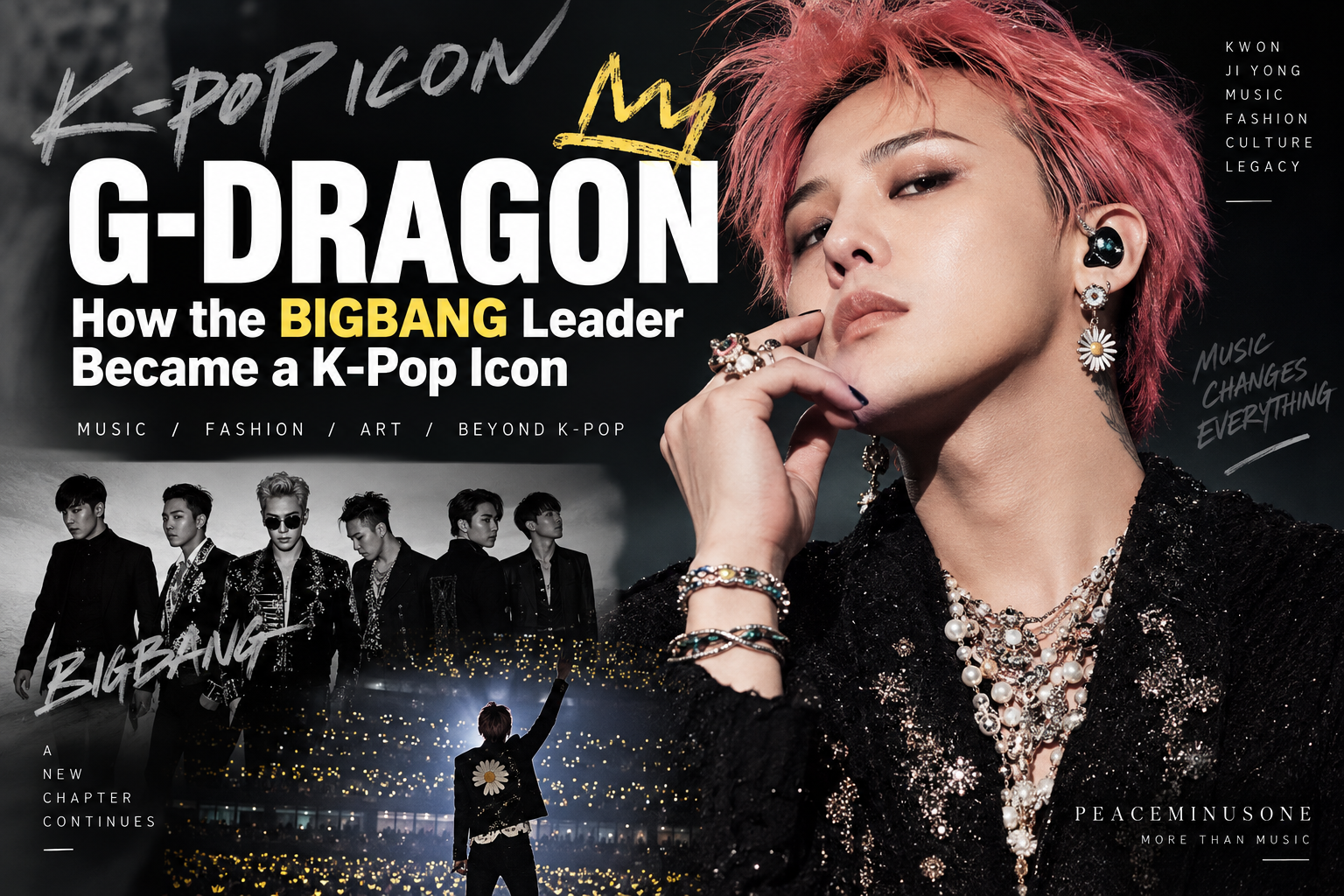
    G-DRAGON: How the BIGBANG Leader Became a K-Pop Icon

    G-DRAGON: How the BIGBANG Leader Became a K-Pop Icon

    Few artists have influenced the identity of modern K-pop as deeply as G-DRAGON.

    As the leader of BIGBANG, he helped shape one of the most influential groups of K-pop’s second generation. But his impact went far beyond performing on stage. As a songwriter, producer, rapper, solo artist, and fashion figure, G-DRAGON helped redefine what a K-pop idol could become.

    His career reflects an important transformation in Korean pop music: the rise of idols who were not simply performers, but also creative artists with distinctive musical identities.

    This is the story of how Kwon Ji-yong became G-DRAGON — and how he became one of the defining icons of K-pop.

    Before BIGBANG: Kwon Ji-yong’s Early Years

    G-DRAGON was born Kwon Ji-yong on August 18, 1988, in Seoul, South Korea.

    His connection with entertainment began at a remarkably young age. Long before becoming the leader of BIGBANG, he was already gaining experience in Korea’s entertainment industry.

    As a young trainee, he developed a strong interest in hip-hop and eventually joined YG Entertainment, where he spent years preparing for his future career.

    Those long years of training were important. G-DRAGON was not only learning how to perform. He was also developing his own ideas about music, rap, songwriting, and style.

    That creative foundation would later become one of the defining characteristics of his career.

    2006: BIGBANG Debuts

    In 2006, G-DRAGON debuted as the leader of BIGBANG under YG Entertainment.

    BIGBANG emerged during what is now commonly called the second generation of K-pop.

    At the time, the Korean idol industry was already growing rapidly, but BIGBANG developed an identity that felt different from many conventional idol groups.

    The members had distinctive personalities and musical styles, while G-DRAGON became increasingly involved in the creative direction of the group’s music.

    That involvement would become crucial to BIGBANG’s success.

    “Lies” and the Rise of BIGBANG

    A major turning point came in 2007 with the release of “Lies.”

    The song became a major hit in South Korea and helped establish BIGBANG as one of the leading groups of their generation.

    G-DRAGON’s involvement in songwriting became an important part of the group’s public identity.

    Songs such as “Lies,” “Last Farewell,” and later “Haru Haru” helped demonstrate that an idol group could build a recognizable musical identity while having members actively participate in the creative process.

    BIGBANG was becoming more than a successful idol group.

    The group was helping change expectations about what K-pop idols could do.

    G-DRAGON and the Rise of the “Artist Idol”

    One of G-DRAGON’s most important contributions to K-pop was his role in popularizing the image of the self-producing idol.

    K-pop had always involved professional producers, composers, choreographers, and creative teams. But G-DRAGON became highly visible as an idol who participated directly in songwriting and music production.

    This helped strengthen the idea that idols could also be recognized as artists and creators.

    Later generations of K-pop would increasingly emphasize songwriting, producing, and creative participation as important parts of an idol’s identity.

    G-DRAGON became one of the most prominent early examples of that evolution.

    2009: G-DRAGON Goes Solo

    In 2009, G-DRAGON released his first solo studio album, Heartbreaker.

    The album marked an important moment in his career because it allowed him to establish an identity outside BIGBANG.

    The title track “Heartbreaker” became one of his signature songs, while the album demonstrated his ability to command attention as an individual artist.

    His solo career was not simply an extension of BIGBANG.

    It became a space where he could experiment more freely with music, visuals, fashion, and performance.

    That combination would become central to the G-DRAGON brand.

    BIGBANG Becomes a Major Force in Asian K-Pop

    During the late 2000s and early 2010s, BIGBANG expanded far beyond the Korean market.

    The group built a major following across Asia and became one of the most recognizable names of second-generation K-pop.

    Songs including “Fantastic Baby,” “Blue,” “Bad Boy,” and “Bang Bang Bang” helped define different stages of BIGBANG’s career.

    Their music combined hip-hop, electronic music, pop, R&B, and other influences while maintaining a recognizable BIGBANG identity.

    G-DRAGON remained at the center of much of that creative evolution.

    2012: “Crayon” and a More Experimental G-DRAGON

    G-DRAGON continued expanding his solo identity with the 2012 EP One of a Kind.

    Tracks such as “One of a Kind” and “Crayon” showcased his willingness to experiment with sound, visual concepts, and performance.

    Rather than presenting a carefully standardized idol image, G-DRAGON often embraced unpredictability.

    His music videos could be colorful, strange, extravagant, or deliberately provocative.

    His clothing could move between streetwear, luxury fashion, and unexpected combinations.

    That unpredictability became part of his appeal.

    2013: Coup d’Etat and Global Attention

    In 2013, G-DRAGON released his second solo studio album, Coup d’Etat.

    The project further expanded his international profile and demonstrated the growing connections between K-pop and the global music industry.

    The album explored hip-hop, electronic music, pop, and experimental sounds while presenting G-DRAGON as an artist increasingly comfortable moving between different musical worlds.

    By this stage, his influence was no longer limited to BIGBANG fans.

    He had become one of the most recognizable individual figures associated with K-pop.

    G-DRAGON as a Fashion Icon

    Music is only one part of G-DRAGON’s cultural influence.

    Fashion became another major part of his identity.

    Over the years, he became known for experimenting with hairstyles, streetwear, luxury clothing, accessories, and gender-fluid approaches to styling.

    His appearances at international fashion events helped strengthen the relationship between K-pop stars and the global luxury industry.

    Long before luxury-brand partnerships became common across K-pop, G-DRAGON was already demonstrating how an idol could become an influential figure in international fashion culture.

    His influence helped make fashion an increasingly important part of the global K-pop image.

    PEACEMINUSONE and Creative Independence

    G-DRAGON also expanded his creative identity through PEACEMINUSONE, a fashion and lifestyle label associated with his artistic world.

    The project demonstrated how a K-pop artist could build a creative brand extending beyond albums and concerts.

    Music, fashion, art, design, and celebrity culture increasingly overlapped.

    For G-DRAGON, these areas were not completely separate.

    Together, they formed a larger creative identity.

    2017: Kwon Ji Yong

    In 2017, G-DRAGON released the self-titled EP Kwon Ji Yong.

    The title itself was significant.

    Rather than focusing only on the stage name G-DRAGON, the project drew attention to the person behind the celebrity identity.

    Songs including “Untitled, 2014” revealed a more vulnerable and emotional side of the artist.

    The project explored themes of fame, identity, loneliness, and the complicated relationship between Kwon Ji-yong the person and G-DRAGON the public figure.

    It represented a more introspective stage of his career.

    Military Service and a Long Musical Hiatus

    G-DRAGON began his mandatory military service in 2018 and was discharged in 2019.

    Following his return, fans waited for a major solo musical comeback.

    Years passed without a new full solo album, but his cultural visibility remained strong.

    Fashion appearances, collaborations, and public events continued to generate significant attention.

    The long absence also demonstrated something unusual about his position in K-pop.

    Even without frequent new releases, G-DRAGON remained culturally relevant.

    A New Chapter Beyond YG Entertainment

    After many years associated with YG Entertainment, G-DRAGON entered a new stage of his career.

    In late 2023, he signed with Galaxy Corporation for his solo activities, marking a significant transition after his long relationship with YG.

    For an artist whose career had been closely connected with one company for decades, the change represented a major turning point.

    It also created expectations for the next phase of his music.

    2024: “POWER” Marks His Return

    In October 2024, G-DRAGON released “POWER,” marking his long-awaited return with new solo music.

    The comeback attracted major attention because it arrived after years without a solo release.

    For longtime fans, it represented the return of one of K-pop’s most influential artists.

    For newer K-pop audiences, it offered an opportunity to encounter an artist whose influence could already be seen across later generations.

    2025: Übermensch and a New Era

    In February 2025, G-DRAGON released his third studio album, Übermensch.

    The album represented another major chapter in his solo career and arrived more than a decade after Coup d’Etat.

    Its release showed that G-DRAGON was not simply returning to recreate his earlier career.

    Instead, he was attempting to define what his music and identity could mean in a very different K-pop era.

    The industry around him had changed dramatically.

    K-pop had become a truly global business, streaming had transformed music consumption, and younger generations of idols were reaching audiences around the world.

    Yet G-DRAGON remained part of the conversation.

    Why G-DRAGON Matters in K-Pop History

    G-DRAGON’s importance cannot be measured only by album sales, chart positions, or awards.

    His larger influence can be seen in the changing image of the K-pop idol.

    He helped demonstrate that an idol could participate in songwriting and production, develop a distinctive artistic identity, influence fashion, create a personal brand, and maintain an individual career alongside group activities.

    Many of these qualities are now common ambitions for modern K-pop artists.

    During G-DRAGON’s rise, however, they helped challenge older expectations about what an idol could be.

    From BIGBANG Leader to K-Pop Icon

    G-DRAGON’s career has moved through several identities.

    He has been a trainee, BIGBANG’s leader, songwriter, producer, rapper, solo artist, fashion figure, and creative entrepreneur.

    But perhaps his greatest legacy is the way he expanded the possibilities of K-pop stardom.

    He showed that an idol could become more than the face of a carefully designed concept.

    An idol could help create the music, shape the image, influence culture, and build an artistic identity capable of lasting across generations.

    That is why the story of G-DRAGON is not only the story of one successful K-pop star.

    It is also an important chapter in the history of how K-pop itself evolved.


  • SUGA of BTS: From Underground Rapper to Agust D and Global Producer

    SUGA of BTS: From Underground Rapper to Agust D and Global Producer

    When people first discovered SUGA as a member of BTS, they saw a rapper with a calm presence, sharp delivery, and an unmistakable seriousness about music.

    But SUGA’s story began long before BTS became a global phenomenon.

    Behind the stage name SUGA is Min Yoongi, a musician who started writing songs and making beats as a teenager. Over time, he would become not only a BTS rapper but also a songwriter, producer, solo artist, and the creator of another musical identity: Agust D.

    His journey from the underground music scene in Daegu to international arenas reveals something important about the evolution of K-pop itself.

    This is the story of how Min Yoongi became SUGA, how SUGA became Agust D, and how all three identities came together to create one of the most distinctive artists of his generation.

    Before BTS: Min Yoongi and His Early Love of Music

    Min Yoongi was born on March 9, 1993, in Daegu, South Korea.

    His interest in music developed early. As a teenager, he became fascinated with hip-hop, songwriting, and music production.

    Rather than approaching music only as a performer, Yoongi was interested in what happened behind the song: how beats were constructed, how lyrics worked, and how a track could be shaped from beginning to end.

    He began making music and became involved in Daegu’s underground hip-hop scene before joining Big Hit Entertainment.

    This background would later become an important part of his identity.

    While many people would eventually know him primarily as a member of BTS, Yoongi had already begun thinking like a songwriter and producer before the group debuted.

    2013: Debuting as SUGA of BTS

    BTS debuted on June 13, 2013, with seven members: RM, Jin, SUGA, j-hope, Jimin, V, and Jung Kook.

    SUGA became part of the group’s rap line alongside RM and j-hope.

    In BTS’s early music, hip-hop played a major role. Songs addressed school pressure, social expectations, ambition, frustration, and the experiences of young people trying to find their place in society.

    SUGA’s rap style fit naturally into this world.

    His delivery could be controlled and understated, but it could also become fast, aggressive, and emotionally intense.

    More importantly, he was involved in songwriting and production.

    As BTS gradually moved beyond its early hip-hop sound and explored pop, R&B, EDM, rock, and other genres, SUGA continued developing behind the scenes as well as onstage.

    That combination—rapper and producer—would become central to his career.

    More Than an Idol Rapper

    The term “idol rapper” has sometimes been used to distinguish rappers in K-pop groups from artists who emerged from independent or underground hip-hop scenes.

    SUGA complicated that distinction.

    He was unquestionably a K-pop idol, performing choreography and participating in the highly organized world of BTS.

    But he was also deeply involved in writing and producing music.

    For Yoongi, these roles did not have to contradict each other.

    As BTS grew, his work demonstrated that an idol could participate seriously in the creative process while still operating within the structure of a K-pop group.

    His ambitions also extended beyond performing BTS songs.

    Eventually, he needed another space for music that was more personal, raw, and uncompromising.

    That space became Agust D.

    2016: The Birth of Agust D

    In 2016, SUGA introduced the world to his solo alter ego through the mixtape Agust D.

    The name itself reflected his origins. “Agust D” rearranged elements associated with “SUGA” and his hometown of Daegu.

    But Agust D was more than another stage name.

    It gave Yoongi a different artistic language.

    As Agust D, he could explore subjects with a level of intensity and directness that felt different from his work within BTS.

    The mixtape addressed ambition, anger, success, fear, and deeply personal struggles.

    The sound was often harder and more confrontational.

    For listeners who knew only the quieter, reserved SUGA seen in some BTS content, Agust D revealed another side of the same person.

    It also established an important idea that would continue throughout his career:

    SUGA and Agust D were different artistic identities, but both belonged to Min Yoongi.

    Producer Min Yoongi

    While his identity as Agust D was developing, SUGA was also expanding his reputation as a producer.

    His work was not limited to BTS.

    Over the years, he collaborated with and produced music for other artists, demonstrating that his creative identity could exist beyond his own group.

    One particularly notable project was his collaboration with Korean singer IU on “eight” in 2020, on which SUGA participated as a producer and featured artist.

    He also worked with artists from different musical backgrounds, gradually building a career that connected K-pop, Korean hip-hop, and international pop.

    These collaborations helped reinforce something fans had understood for years:

    SUGA was not simply someone who performed music.

    He wanted to make it.

    2020: D-2 and the Impact of “Daechwita”

    Four years after Agust D, Yoongi returned with his second mixtape, D-2, in 2020.

    Its title track, “Daechwita,” became one of the defining works of his solo career.

    The song was especially striking because it brought together seemingly different musical worlds.

    “Daechwita” drew inspiration from traditional Korean military music while placing those sounds inside a modern hip-hop track.

    The music video pushed the contrast even further, using imagery inspired by historical Korea alongside the rebellious persona of Agust D.

    For international audiences, the result was memorable even without detailed knowledge of Korean history.

    Traditional instruments, royal imagery, contemporary rap, and cinematic storytelling existed in the same space.

    This was more than visual spectacle.

    It demonstrated how modern K-pop and hip-hop could use Korean cultural elements without simply reproducing the past.

    Old and new could collide—and create something entirely different.

    For a genre increasingly consumed by audiences around the world, “Daechwita” was also a reminder that global music did not have to erase local identity.

    SUGA, Agust D, and Two Different Ways of Speaking

    By this stage, the difference between SUGA and Agust D had become increasingly interesting.

    SUGA existed within BTS—a group built on collaboration among seven members.

    Agust D offered greater freedom to explore Yoongi’s individual experiences.

    But the two identities were never completely separate.

    Themes of ambition, fear, success, self-doubt, and personal growth appeared across his work.

    What changed was the perspective and intensity.

    Over time, the relationship between these identities became less about choosing one over the other and more about understanding that they were different expressions of the same artist.

    That evolution would become especially clear with his first official solo album.

    2023: D-DAY Completes the Agust D Trilogy

    In April 2023, SUGA released D-DAY under the name Agust D.

    The album completed a trilogy that had begun with Agust D in 2016 and continued with D-2 in 2020.

    By now, the young musician who once expressed fierce ambition and frustration had experienced extraordinary global success.

    BTS had become one of the biggest music acts in the world.

    That success created a fascinating challenge for Agust D.

    What does an artist write about after achieving dreams that once seemed almost impossible?

    D-DAY explored freedom, memory, identity, anger, and the process of moving forward.

    Rather than simply celebrating success, the album reflected on what success had cost and what it meant to let go of old emotions.

    The trilogy therefore documented more than musical development.

    It documented time.

    Listeners could hear the changing perspective of Min Yoongi across seven years of his life.

    The D-DAY Tour: Standing Alone on the Stage

    Another major step came with the SUGA | Agust D D-DAY Tour in 2023.

    For years, SUGA had performed in front of enormous audiences as one of seven BTS members.

    A solo tour created a completely different challenge.

    Now the responsibility for carrying the performance rested primarily on him.

    The concerts brought together different periods of his career, connecting BTS member SUGA with solo artist Agust D.

    Songs that had originally existed on mixtapes could now be performed before large international audiences.

    The tour demonstrated just how much his solo identity had grown.

    Agust D was no longer simply a side project released between BTS albums.

    It had become an artistic world capable of supporting a major live show of its own.

    Military Service and a Pause in the Story

    In September 2023, SUGA began fulfilling his mandatory military service obligation through alternative service as a social service worker.

    His enlistment came during a period when the BTS members were beginning their individual military service commitments.

    For SUGA, it created a temporary pause after an unusually intense period of solo activity.

    By then, however, the Agust D trilogy had been completed.

    The tour had taken his solo music around the world.

    The chapter had reached a natural stopping point.

    When his service concluded in June 2025, another transition became possible—not simply a return to the past, but the beginning of whatever would come next.

    Why SUGA’s Journey Matters in K-Pop History

    SUGA’s career tells a larger story about the changing boundaries of K-pop.

    He began as a young producer and underground rapper in Daegu.

    He became a member of BTS.

    He developed into a songwriter and producer whose work reached far beyond his own performances.

    Then, through Agust D, he built a parallel solo identity capable of expressing ideas that required a different musical space.

    Those identities eventually converged.

    The distinction between “idol,” “rapper,” “producer,” and “solo artist” became increasingly difficult to maintain.

    And perhaps that is exactly the point.

    K-pop artists do not have to fit permanently into the roles assigned to them at debut.

    They can change.

    They can produce.

    They can write.

    They can collaborate.

    They can create new identities and later redefine them.

    From Min Yoongi to SUGA to Agust D

    There is a remarkable distance between the teenager making music in Daegu and the artist who eventually performed an international solo tour.

    Yet the connection between them is music.

    Before the global awards, stadium concerts, record-breaking albums, and enormous BTS fandom, Min Yoongi wanted to write and produce songs.

    That part never disappeared.

    SUGA gave him a place inside BTS.

    Agust D gave him another language for telling his own story.

    Production allowed him to shape music beyond his own voice.

    And over time, those different roles became parts of one increasingly complete artist.

    The story of SUGA is therefore not simply the story of a BTS member who became successful on his own.

    It is the story of a musician who kept expanding what his role could mean.

    From Min Yoongi to SUGA to Agust D, the names changed—but the determination to make music remained at the center of everything.