Tag: K-pop Photocards

  • K-Pop Album Versions Explained in 2026: Photobook vs Digipack vs Platform Albums, Photocards and Hidden Costs

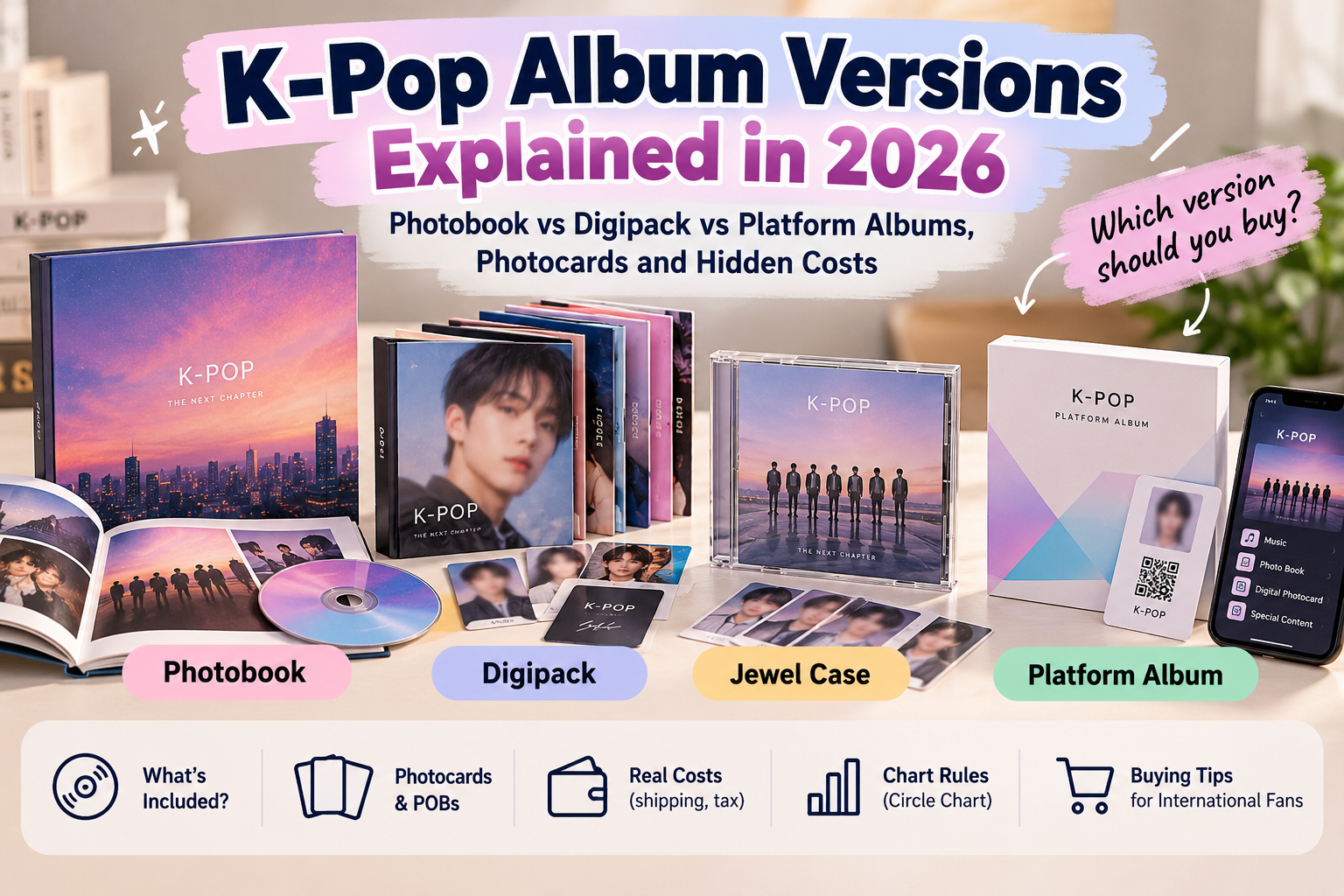
    K-Pop Album Versions Explained in 2026: Photobook vs Digipack vs Platform Albums, Photocards and Hidden Costs

    Buying a K-pop album should be exciting. But for international fans, choosing the wrong version can mean paying for a CD you cannot play, missing the photocard you wanted, or discovering that international shipping costs almost as much as the album.

    A single comeback may offer photobook editions, member-specific digipacks, jewel cases, QR-based platform albums and retailer-exclusive pre-order benefits.

    They are not necessarily different musical releases. Often, they are different ways of packaging and collecting the same music.

    The best K-pop album version depends on what you actually want: a CD, a photobook, a specific member, collectible photocards, or an affordable way to support your favorite artist.

    This 2026 guide explains how to choose without overspending.

    Quick Answer: Which K-Pop Album Version Should You Buy?

    Your main priorityStart withCheck before buying
    Large concept photos and a physical CDPhotobook versionPage count, dimensions and CD inclusion
    Your favorite member’s coverMember digipackWhether member selection is guaranteed
    A compact, conventional CDJewel caseIncluded photos and photocards
    App-based music and portable collectiblesPlatform or QR albumApp compatibility, redemption and CD absence
    A retailer-exclusive photocardEligible POB editionBenefit eligibility, deadline and stock
    Lowest total international costCompare all formatsShipping, tax and checkout fees

    These are starting points, not universal rules. Album specifications vary by artist and release.

    1. Photobook Albums: Best for Fans Who Want the Full Visual Concept

    The photobook edition is often the most visually substantial format.

    Depending on the release, it may include:

    • A printed photobook
    • A physical CD
    • One or more random photocards
    • Posters, stickers, postcards or lyric materials
    • Version-specific concept photography

    A photobook album can be particularly satisfying if you enjoy displaying albums or revisiting the photography long after the comeback.

    However, larger packaging can increase shipping costs, particularly when buying several albums internationally.

    Best for: Fans who value printed photography, physical music ownership and display-worthy packaging.

    Watch out for: Paying more for size and weight when you primarily want a single photocard.

    2. Digipack Albums: Smaller Packaging, Often With Member Covers

    A digipack generally uses compact cardboard packaging rather than a large album box.

    Many K-pop releases offer member-specific covers, although the exact design depends on the artist.

    A digipack may contain a CD, a smaller booklet and photocards. It does not automatically guarantee a photocard matching the member on the cover.

    For example, official AHOF digipack specifications for RUN TO YOU list member and group versions, a CD, a 16-page photobook and randomly included photocards.

    This illustrates an important distinction: choosing a member cover is not necessarily the same as choosing a member photocard.

    Best for: Fans who want a compact physical CD or a particular member’s cover.

    Watch out for: Listings marked random version, even when the product photographs show every member.

    3. Jewel Case Albums: A Conventional CD in Compact Packaging

    Jewel case versions generally resemble traditional CD releases.

    They are useful for fans who want a physical disc without the size of a full photobook package.

    Some releases add booklets, photocards or alternative covers, but inclusions differ.

    A jewel case may be less expensive to ship because it is compact, although shipping prices depend on the retailer and destination.

    Best for: Fans who primarily want a physical CD and prefer smaller packaging.

    Watch out for: Assuming the jewel case includes the same printed photographs as the larger edition.

    4. Platform Albums: What Are QR, Weverse, Nemo and POCA Versions?

    Platform albums are one of the most confusing categories for first-time buyers.

    Instead of relying on a conventional CD, these editions may use a QR code, NFC technology or another physical access item to connect to music and digital content through an app.

    Weverse Albums, for example, describes a system that lets users register albums through QR codes and access music, digital photobooks and digital photocards.

    Other platforms may work differently.

    Before buying, check:

    1. Is there a physical CD?
    2. Which app is required?
    3. Does the app work in your country?
    4. How is the album registered?
    5. Can the access item be reused after registration?
    6. What happens if you change phones?
    7. Can you listen offline after completing the required setup?

    Best for: Fans who prefer compact collectibles and are comfortable accessing music through an app.

    Watch out for: Assuming a QR-based album can be played in a CD player or that all platforms have identical access rules.

    Do Platform Albums Count Toward K-Pop Album Charts?

    Some do, but not every QR-based product should automatically be treated as chart-eligible.

    Circle Chart officially recognizes approved platform album formats under defined requirements, including distribution, release status and access conditions.

    Its album chart methodology is based on distribution volume adjusted for returns, rather than simply counting every purchase made by a fan.

    If chart contribution matters to you, verify the exact album and seller’s stated chart eligibility.

    Do not assume that buying a digital code, a platform album and a conventional CD will always have identical reporting arrangements.

    5. Random Photocards: What Does “Random 1 of 8” Actually Mean?

    Suppose an album lists:

    Photocard: Random 1 out of 8.

    That means the album contains one card selected from eight possible designs. It does not mean you receive all eight cards.

    Buying two albums also does not guarantee two different cards.

    You may receive duplicates.

    A member-specific album cover does not necessarily guarantee a matching member photocard unless the product specifications explicitly say so.

    A Better Photocard Buying Strategy

    If you only want one particular card, compare the total cost of buying random albums with the cost of obtaining that card separately from a reputable seller or through a trusted trade.

    For example, if an album has eight equally likely card designs and includes one card, the probability of obtaining one specific card from a single album would be 12.5%.

    With three independent purchases under those assumptions, the probability of receiving that card at least once is approximately 33%.

    Actual distributions and packaging practices can differ, so this is an illustration rather than a guarantee.

    The key lesson: Buying more random albums can become expensive without guaranteeing your desired photocard.

    6. What Is a POB? Pre-Order Benefits vs Album Inclusions

    POB means pre-order benefit.

    A POB is an additional item offered under particular promotional conditions, often by a specific retailer or for a particular purchase period.

    It may be a photocard, postcard or another collectible.

    But a POB is not necessarily included in every copy of the album.

    Consider three separate items:

    ItemWhat it meansMain risk
    Standard album photocardIncluded according to the album specificationsUsually random
    Retailer POBExtra benefit for qualifying purchasesDeadline, stock or seller restrictions
    Lucky draw benefitPromotional collectible offered under event rulesEligibility and selection conditions

    A product listing that says POB included should identify the actual promotion or provide enough detail for you to verify it.

    Before paying, check whether the benefit is guaranteed, random, limited to a certain quantity or available only while supplies last.

    For collectors, the retailer and promotion can matter as much as the album version.

    7. The Hidden Cost of Buying K-Pop Albums Internationally

    A lower album price does not necessarily mean a cheaper purchase.

    International buyers should compare the final delivered cost, not just the price displayed on the product page.

    Here is a hypothetical example. These are illustrative figures, not current retailer quotes.

    Cost componentPhotobook albumCompact album
    Album price$22$15
    International shipping$19$13
    Estimated tax or handling$5$4
    Total delivered cost$46$32

    The compact version saves $14 in this example, even though the album itself costs only $7 less.

    Your actual total depends on shipping weight, destination, carrier, taxes and seller policies.

    Three Costly Mistakes to Avoid

    Mistake 1: Buying multiple albums without comparing combined shipping.

    Some sellers calculate shipping by package weight, while others use different rules. Combining items may save money, but it is not guaranteed.

    Mistake 2: Paying extra for a POB you do not particularly want.

    A promotional photocard can be valuable to collectors, but that does not mean it offers value to every buyer.

    Mistake 3: Ordering a random version when you want a specific member.

    Check whether the retailer allows version selection before paying.

    8. Do All Album Versions Have the Same Songs?

    Often, different packaging versions of one release share the same tracklist.

    However, that should not be assumed for every special edition, repackage, regional release or platform product.

    Always compare the official tracklist and edition details.

    If you are trying to understand the distinction between a single, mini album and full album, see our guide:

    What Is a K-Pop Mini Album? EPs, Singles, and Full Albums Explained

    The album format describes how the music is packaged or accessed; the release type describes the musical project itself.

    9. Which K-Pop Album Should You Buy? Four Realistic Scenarios

    Scenario A: You Are Buying Your First K-Pop Album

    Choose a photobook version if the printed photographs and physical CD are important to you.

    If your budget is limited, compare the total delivered cost with a compact edition.

    Do not buy every version simply because they are displayed together.

    Scenario B: You Only Collect One Member

    Start by looking for an officially selectable member version.

    Then check whether the cover, booklet and photocard are member-specific or random.

    If the photocard is your real priority, buying random albums may not be the most economical option.

    Scenario C: You Want to Support a Comeback

    Check whether the seller identifies the purchase as eligible for the relevant album charts.

    Circle Chart and Hanteo are not interchangeable systems, and their reporting methods should not be assumed to be identical.

    Buy from a seller whose eligibility claims are clear and verifiable.

    You can also read our related explanation:

    Inside the K-Pop Comeback: Why Every New Release Becomes a Major Event

    Scenario D: You Live Outside South Korea

    Compare the final checkout price for at least two album formats.

    Include international shipping, import charges where applicable, currency conversion and any additional fees.

    A compact album may be the better value, but the cheapest choice depends on your destination and what you want to collect.

    10. Seven Things to Check Before You Order

    Use this checklist before completing your purchase:

    • The exact album version is identified.
    • The listing confirms whether a physical CD is included.
    • Member selection or random allocation is clearly stated.
    • Standard inclusions are distinguished from POBs.
    • The platform and app requirements are clear, if applicable.
    • Chart eligibility is verified if it matters to you.
    • The final delivered cost fits your budget.

    Taking a few minutes to verify these details can prevent expensive disappointment.

    Frequently Asked Questions

    Is a digipack a real K-pop album?

    Yes. A digipack is a legitimate physical packaging format when released as an official album edition. Its contents vary by release.

    Does a platform album include a CD?

    Many platform albums use QR, NFC or similar access systems instead of a conventional CD. Check the exact product specifications.

    Does buying a member version guarantee that member’s photocard?

    Not necessarily. The cover and photocard allocation may follow different rules.

    Are pre-order benefits included in every album?

    No. POB eligibility depends on the promotion, retailer, purchase timing and stock conditions.

    Are platform albums counted on Circle Chart?

    Approved platform album formats can qualify under Circle Chart’s official criteria. Eligibility should be verified for the specific release and format.

    Should I buy every version to support my favorite group?

    You do not need to purchase every version to enjoy or support an artist. Choose according to your budget and what you actually value.

    Final Verdict: Buy for Your Purpose, Not the Number of Versions

    There is no single best K-pop album format.

    A photobook edition may offer the most satisfying physical collection. A digipack may be ideal for a member-focused fan. A jewel case can provide a compact CD, while a platform album may appeal to someone who prefers app-based access.

    The smartest purchase is the one that matches your priorities without unnecessary spending.

    Before ordering, verify the version, inclusions, benefits, chart claims and total delivery cost.

    One carefully chosen album can be more satisfying than several versions bought without knowing what is inside.


    Sources and Further Reading

  • How Much Does It Cost to Be a K-Pop Fan in 2026? Albums, Concerts, Merch, Fan Clubs and More

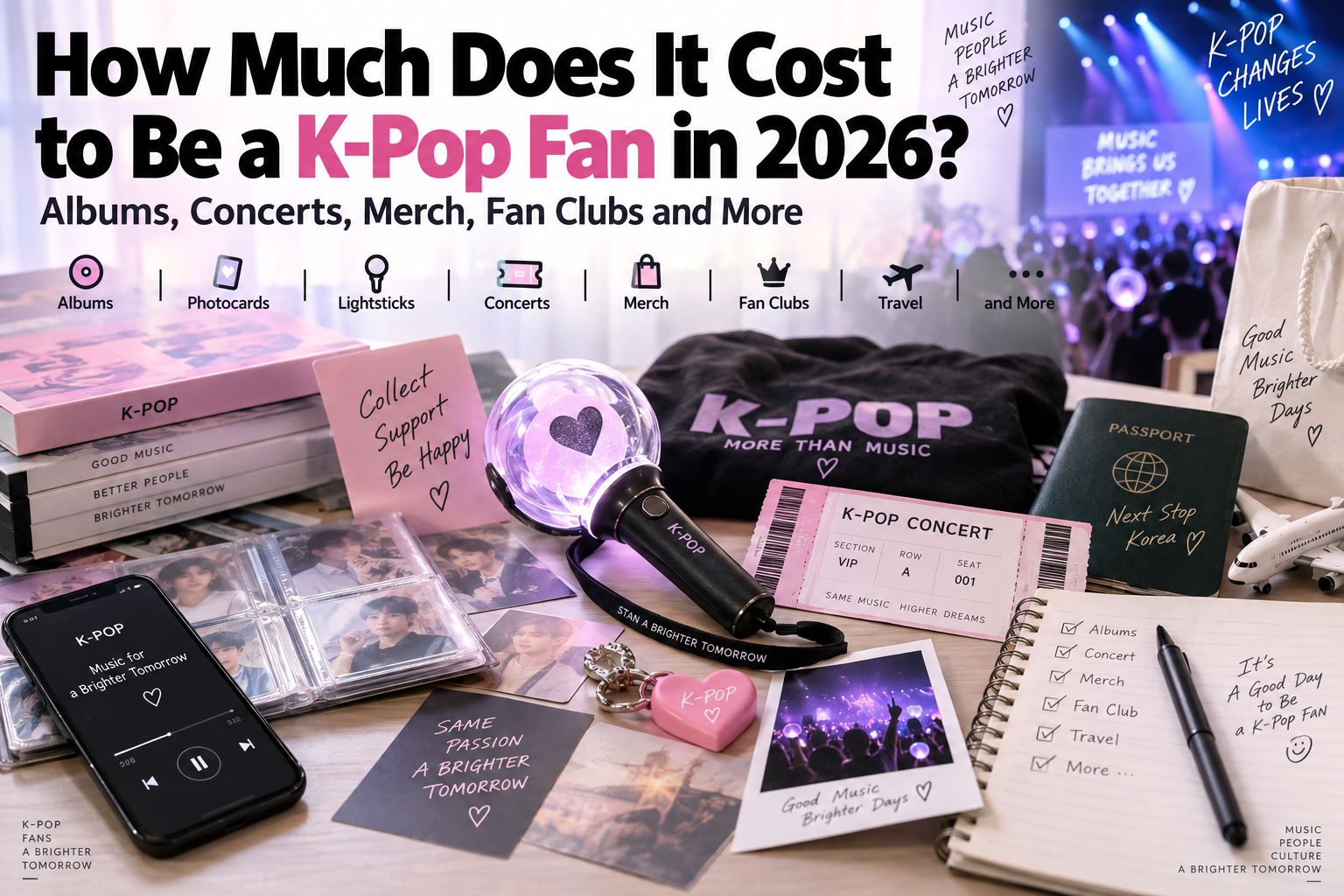
    How Much Does It Cost to Be a K-Pop Fan in 2026? Albums, Concerts, Merch, Fan Clubs and More

    How Much Does It Cost to Be a K-Pop Fan in 2026?

    Being a K-pop fan can be completely free.

    You can watch music videos, listen to songs, follow your favorite artists on social media, and enjoy performances without buying anything.

    But once albums, photocards, lightsticks, concerts, fan memberships, merchandise, and even trips to Korea enter the picture, K-pop can become an expensive hobby surprisingly quickly.

    So, how much does it actually cost to be a K-pop fan in 2026?

    There is no single answer.

    A casual fan may spend almost nothing, while a dedicated collector or international concert traveler can spend hundreds—or even thousands—of dollars a year.

    This guide breaks down the major expenses so new fans can understand where the money goes and decide what is actually worth buying.

    Quick Answer: How Much Does a K-Pop Fan Spend?

    Your annual K-pop budget could look something like this:

    Casual fan: $0–$100+ per year
    Regular fan: $100–$500+ per year
    Active collector or concert fan: $500–$1,500+ per year
    Dedicated international fan: $1,500–$5,000+ per year

    These are not official industry averages.

    They are practical examples showing how dramatically spending can vary depending on albums, concerts, collecting, travel, and the number of groups you follow.

    And there is no amount of money you need to spend to be considered a “real fan.”

    Let’s look at where those costs come from.

    1. K-Pop Albums

    Albums are often the first physical products new K-pop fans buy.

    Unlike a basic CD, a physical K-pop album frequently comes as a collectible package containing items such as:

    • Photobook
    • CD
    • Photocard
    • Poster
    • Stickers
    • Postcards
    • Lyrics book
    • Other limited inclusions

    This makes the album both a music product and a collectible.

    But there is another factor that can increase spending significantly:

    multiple versions.

    One comeback may have several album versions with different concepts, covers, photocards, or bonus items.

    A fan who wants only one copy may spend relatively little.

    A collector who wants every version can spend several times more.

    The Hidden Cost: Shipping

    International fans also need to consider shipping.

    An album that appears affordable at first can become considerably more expensive after:

    • International shipping
    • Local delivery charges
    • Import taxes
    • Customs duties

    This is why fans sometimes use group orders or local K-pop retailers rather than ordering individual albums directly from Korea.

    2. Photocards

    For many fans, photocards start as a fun bonus inside an album.

    Then collecting begins.

    Photocards usually feature individual members and are randomly included in albums.

    That randomness creates a collecting challenge.

    If you want a particular member, you might:

    • Buy another album
    • Trade with another fan
    • Purchase the photocard separately
    • Join a group order

    Some common photocards can be inexpensive.

    Rare, limited, event-exclusive, or highly demanded photocards can cost much more on resale markets.

    This means photocard collecting can become one of the least predictable K-pop expenses.

    Why Do Fans Buy Multiple Albums?

    Photocards are one reason.

    But fans may also buy multiple copies because of:

    • Different album versions
    • Pre-order benefits
    • Store-exclusive photocards
    • Fan-sign entry opportunities
    • Collecting goals
    • Supporting chart performance

    This is why album spending can vary enormously between two fans of the same group.

    3. Official Lightsticks

    The K-pop lightstick is much more than a glowing concert accessory.

    For many fandoms, it is a symbol of membership and identity.

    Official lightsticks often feature a design associated specifically with an artist or fandom.

    At concerts, modern lightsticks may also synchronize with the venue’s lighting system to create coordinated colors and effects throughout the audience.

    For a fan attending several concerts by the same artist, buying an official lightstick may feel worthwhile.

    For someone who mainly streams music at home, it may be unnecessary.

    And because each group generally has its own official design, fans who follow several groups can quickly accumulate multiple lightsticks.

    4. Concert Tickets

    Concerts can become one of the largest expenses in K-pop fandom.

    Ticket prices depend heavily on:

    • Artist
    • Country
    • Venue
    • Seat location
    • Tour
    • VIP package
    • Additional benefits

    Standard seats may already represent a significant purchase.

    Premium packages can cost considerably more.

    VIP benefits may include things such as:

    • Soundcheck access
    • Early entry
    • Premium seating
    • Exclusive merchandise
    • Special check-in benefits

    The exact package varies by tour.

    But the ticket itself is often only the beginning.

    5. The Real Cost of Attending a K-Pop Concert

    Suppose the concert is in another city.

    Now you may need:

    Concert ticket

    • transportation
    • hotel
    • food
    • lightstick
    • concert merchandise

    For international concerts, airfare may become the biggest expense of all.

    A fan could therefore spend much more on the trip than on the actual concert ticket.

    This is an important distinction when calculating a realistic fandom budget.

    Don’t ask only:

    “How much is the ticket?”

    Ask:

    “How much will the entire concert experience cost?”

    6. K-Pop Merchandise

    K-pop merchandise has expanded far beyond albums.

    Official products can include:

    • T-shirts
    • Hoodies
    • Hats
    • Bags
    • Keychains
    • Dolls
    • Character merchandise
    • Photocard holders
    • Posters
    • Photobooks
    • Season’s Greetings
    • Tour merchandise
    • Anniversary merchandise
    • Collaboration products

    One item may not seem expensive.

    The difficulty is frequency.

    There can be new merchandise for tours, birthdays, anniversaries, pop-up stores, fan meetings, album releases, and collaborations.

    Following several groups multiplies those opportunities.

    7. Fan Club and Membership Costs

    Many artists operate official fan memberships through dedicated platforms.

    Membership can offer benefits such as:

    • Presale opportunities
    • Membership-only content
    • Exclusive merchandise
    • Fan-club events
    • Special digital content
    • Member-specific purchasing opportunities

    For fans who want concert presale access, membership may be particularly attractive.

    However, membership does not necessarily guarantee that you will successfully purchase a concert ticket.

    Demand for popular artists can still be extremely high.

    Before paying, read the current membership terms and benefits carefully.

    8. Fan-Sign Events

    Fan-sign events are one of the most distinctive parts of K-pop fan culture.

    Fans may have an opportunity to briefly interact with idols through an in-person or video-call event.

    But participation can become expensive.

    For some album-based events, purchasing an eligible album provides an entry into a drawing.

    That creates an incentive for some fans to purchase multiple albums to increase the number of entries.

    However:

    Buying more albums does not guarantee winning unless the event explicitly uses a different selection system.

    This can make fan-sign spending particularly risky for fans on a limited budget.

    Set a spending limit before entering rather than chasing a result after repeated purchases.

    9. Paid Digital Content and Subscriptions

    Physical products are not the only expenses.

    Depending on the artist and platform, fans may encounter paid:

    • Membership content
    • Livestreams
    • Concert streams
    • Messaging services
    • Exclusive videos
    • Digital fan communities
    • Subscription services

    Each individual subscription may seem small.

    But multiple recurring subscriptions can quietly become a meaningful yearly expense.

    A useful habit is to review recurring fan subscriptions every few months.

    Ask yourself:

    Am I actually using this enough to keep paying for it?

    10. Music Streaming

    K-pop itself does not require a special music subscription.

    Fans commonly listen through mainstream streaming services.

    If you already subscribe to a music service for everyday listening, following K-pop may not add any extra expense.

    But some dedicated fans may use more than one platform or purchase digital music separately.

    Again, this is optional.

    Enjoying an artist does not require participating in every form of chart support.

    11. Traveling to Korea as a K-Pop Fan

    This is where fandom spending can enter an entirely different category.

    Some international fans eventually plan a trip to South Korea connected partly or heavily to their interest in K-pop.

    Potential expenses include:

    • Flights
    • Hotels
    • Transportation
    • Concert tickets
    • Pop-up stores
    • Cafes
    • Merchandise
    • Entertainment-company destinations
    • Exhibitions
    • Fan events

    A trip to Korea can therefore cost far more than a year of casual album collecting.

    But for some fans, it becomes a combined music, culture, food, and travel experience rather than simply a fandom purchase.

    12. Pop-Up Stores and Limited Merchandise

    K-pop pop-up stores are another increasingly visible part of fan spending.

    They may appear around:

    • Comebacks
    • Concert tours
    • Anniversaries
    • Character collaborations
    • Brand partnerships

    Limited availability creates urgency.

    Fans know that a product may disappear when the event ends.

    That can encourage impulse purchases.

    A simple rule can help:

    Decide your maximum budget before entering the store.

    Otherwise, small purchases can add up quickly.

    13. The Cost of Following Multiple Groups

    Following one artist and following ten artists are financially very different hobbies.

    Suppose several favorite groups release:

    • Two albums each year
    • New merchandise
    • Fan memberships
    • Concert tours

    Your potential spending opportunities multiply rapidly.

    This is why many experienced fans eventually prioritize.

    They may have:

    One group they actively collect

    while casually following many others.

    You do not need to purchase merchandise from every artist you enjoy.

    A Sample K-Pop Budget

    Consider a hypothetical regular fan.

    During one year, they might buy:

    4 albums × $30 = $120

    1 lightstick = $60

    1 concert ticket = $180

    Concert merchandise = $100

    Fan membership = $30

    Other merchandise = $150

    That totals approximately:

    $640 per year

    Now add transportation and a hotel for the concert and the total could easily rise further.

    On the other hand, another fan might spend only $50 all year.

    Both are equally capable of enjoying K-pop.

    Budget Example 1: The Casual Fan

    A casual fan might:

    • Stream music
    • Watch YouTube content
    • Follow artists on social media
    • Buy one favorite album

    Possible yearly spending:

    $0–$100+

    This is one of the easiest ways to enjoy K-pop without financial pressure.

    Budget Example 2: The Regular Fan

    A regular fan might buy:

    • Several albums
    • One lightstick
    • Some merchandise
    • One membership
    • One concert ticket

    Possible yearly spending:

    $100–$500+

    Concert travel can push the total higher.

    Budget Example 3: The Collector

    Collectors may spend significantly more because they purchase:

    • Multiple album versions
    • Photocards
    • Limited merchandise
    • Pre-order benefits
    • Season’s Greetings
    • Tour merchandise

    Possible yearly spending can easily reach:

    $500–$1,500+

    For serious collectors, it can go considerably beyond that.

    Budget Example 4: The International Concert Fan

    Now imagine traveling internationally to see an artist.

    Expenses could include:

    • Airfare
    • Hotel
    • Concert ticket
    • Local transportation
    • Food
    • Merchandise
    • Lightstick

    A single trip could potentially cost:

    $1,000–$3,000+

    depending heavily on the destination, flight distance, accommodation, and ticket type.

    That is why international concert travel should be treated as a travel budget, not merely a fandom purchase.

    What K-Pop Purchases Are Actually Worth It?

    There is no universal answer.

    Value depends on how you personally enjoy fandom.

    If you love physical collecting, albums may be worth it.

    If live performance is your favorite part of K-pop, saving for concerts may make more sense.

    If you enjoy community access, membership may be valuable.

    If you mostly enjoy music, you may need almost none of these things.

    The important question is not:

    “What do other fans buy?”

    It is:

    “What improves my own experience enough to justify the cost?”

    How to Enjoy K-Pop Without Overspending

    K-pop marketing can create a strong sense of urgency.

    Limited editions, random photocards, pre-order benefits, concert presales, and temporary pop-up stores can make fans feel they need to buy immediately.

    A few simple rules can help.

    Set a Monthly Fandom Budget

    Choose an amount you can comfortably spend after essential expenses and savings.

    Once the budget is used, wait until the next month.

    Don’t Collect Everything

    You can choose:

    • One member
    • One album version
    • One group
    • Only favorite releases

    A smaller collection can still be meaningful.

    Separate Concert Savings

    If concerts matter most to you, create a separate concert budget.

    Saving $30 or $50 each month can be more useful than spending the same money on merchandise you do not really want.

    Compare the Final Price

    Always check:

    Product + shipping + tax + customs

    before ordering internationally.

    Be Careful With Resale Prices

    Limited photocards and merchandise can become expensive on resale markets.

    Scarcity does not automatically mean something is worth the asking price.

    Why K-Pop Is So Effective at Turning Fans Into Customers

    K-pop combines several business models in one ecosystem.

    An artist is not selling only recorded music.

    Fans may encounter:

    Music → albums → collectibles → membership → concerts → merchandise → digital content → brand collaborations

    Each part reinforces the others.

    A comeback can generate album sales.

    The album creates collectible photocards.

    The new era produces merchandise.

    The music leads to a tour.

    The tour creates ticket and merchandise sales.

    The fandom relationship supports memberships and other products.

    This helps explain why the modern K-pop business extends far beyond streaming revenue.

    Where Does All That Fan Spending Go?

    Not every dollar spent by a fan goes directly to an idol.

    Revenue may be distributed among many parties depending on the product and contract.

    These can include:

    • Entertainment companies
    • Artists
    • Songwriters
    • Producers
    • Distributors
    • Concert promoters
    • Venues
    • Merchandise manufacturers
    • Retailers
    • Ticketing companies
    • Digital platforms

    The exact distribution differs enormously depending on contracts and products.

    This is one reason K-pop entertainment companies have developed multiple revenue streams rather than relying only on music sales.

    Albums vs Concerts vs Merch: Which Matters Most?

    There is no universal answer because revenue structures differ by company and artist.

    Albums can generate large sales volumes.

    Concerts can produce significant ticket and venue-related revenue.

    Merchandise can expand the commercial value of tours and fandoms.

    Memberships and digital platforms can create ongoing relationships with fans between major releases.

    The important business lesson is that K-pop monetization is diversified.

    A successful artist can generate revenue across several interconnected categories.

    The K-Pop Fandom Economy

    This larger ecosystem is sometimes described as part of the fandom economy.

    Fans do more than consume music.

    They may:

    • Collect
    • Travel
    • Attend events
    • Buy fashion
    • Join memberships
    • Visit pop-up stores
    • Purchase branded products
    • Participate in fan communities

    This creates economic activity far beyond the original song.

    It also helps explain why global K-pop growth has attracted attention not only from music companies but also from tourism, fashion, beauty, technology, retail, and entertainment businesses.

    Frequently Asked Questions

    Is K-pop an expensive hobby?

    It can be, but it does not have to be.

    You can enjoy K-pop almost entirely for free or spend thousands of dollars on collecting and travel.

    Do I need to buy albums to be a real K-pop fan?

    No.

    There is no required purchase that makes someone a legitimate fan.

    Why do K-pop fans buy multiple copies of the same album?

    Reasons can include multiple versions, photocards, pre-order benefits, fan-sign entries, collecting, and chart support.

    Are K-pop concerts expensive?

    They can be.

    The total cost depends on ticket type, artist, venue, location, transportation, accommodation, and merchandise.

    Do I need an official lightstick for a concert?

    Not necessarily.

    Rules vary by event, but owning a lightstick is not a universal requirement for enjoying a concert.

    Is K-pop fan membership worth paying for?

    It depends on the benefits you use.

    Fans interested in presales, exclusive content, or official membership benefits may find it valuable, while casual fans may not need it.

    How much should I spend on K-pop each month?

    There is no ideal amount.

    Your K-pop budget should come from discretionary money after essential expenses and financial priorities are covered.

    Final Thoughts

    So, how much does it cost to be a K-pop fan in 2026?

    The answer can range from almost nothing to several thousand dollars a year.

    That huge range is part of what makes K-pop fandom unusual.

    You can participate casually through music and videos, or dive deeply into albums, photocards, concerts, merchandise, memberships, and travel.

    The key is remembering that fandom is supposed to add enjoyment to your life—not financial pressure.

    Buy what genuinely matters to you.

    Skip what does not.

    And if you are curious about why entertainment companies offer so many different products in the first place, the answer lies in the fascinating business model behind the global K-pop industry.


  • What Is a K-Pop Fan Sign? How Fans Meet Their Favorite Idols

    What Is a K-Pop Fan Sign? How Fans Meet Their Favorite Idols

    For many K-pop fans, seeing their favorite artist at a concert is already an unforgettable experience.

    But imagine sitting directly across from your favorite idol, speaking with them for a short time, and receiving a signed album.

    That is the basic idea behind a K-pop fan sign.

    Fan signs have become an important part of K-pop fan culture. They give selected fans an opportunity to interact with artists more personally than they normally could at a concert or large public event.

    But how do fan signs actually work? How are fans selected? And what is the difference between an in-person fan sign and a video call event?

    Let’s take a closer look.

    What Is a K-Pop Fan Sign?

    A fan sign, sometimes called a fansign or fan signing event, is an organized event where selected fans can meet K-pop artists and receive autographs.

    At a traditional in-person fan sign, members of a group usually sit at a table while fans meet them one by one.

    Each interaction is relatively short, but fans may have a brief conversation with each member while their album is being signed.

    For many fans, the appeal is simple: it provides a rare opportunity for direct interaction with an artist they normally see only through screens or performances.

    How Do Fans Get Into a Fan Sign?

    Fan signs usually have limited capacity, so not everyone who wants to attend can participate.

    One common method involves purchasing eligible albums during a specific entry period.

    Fans submit their information according to the event rules, and winners are selected from eligible entries.

    The exact system varies depending on the organizer, retailer, artist, and event.

    Because of this, fans should always read the official rules carefully rather than assuming every fan sign works the same way.

    Why Do Fans Buy Multiple Albums?

    You may have seen photographs of fans purchasing many copies of the same K-pop album.

    Fan sign entry systems are one reason this can happen.

    For some events, purchasing more eligible albums can provide additional entries into the selection process.

    As a result, highly dedicated fans may purchase multiple copies when trying to increase their chances of being selected.

    However, buying many albums does not necessarily guarantee a win.

    The rules and selection process can differ between events.

    What Happens at an In-Person Fan Sign?

    At an in-person fan sign, winners arrive at a designated venue and follow the organizer’s instructions.

    Fans typically bring or receive an album that will be signed.

    When their turn comes, they move along the table and interact briefly with the members.

    A fan might tell an idol which song they love, congratulate them on a comeback, or share a short supportive message.

    Because time is limited, many fans think carefully about what they want to say before the event.

    Why Are Fan Signs Different From Concerts?

    Concerts are designed around performance.

    Thousands of fans may watch the same artist at once.

    Fan signs are much smaller and focus on brief individual interactions.

    At a concert, the artist performs for the audience.

    At a fan sign, the experience is centered more on conversation, autographs, and direct communication.

    Both can be meaningful fan experiences, but they serve very different purposes.

    What Is a Video Call Fan Sign?

    K-pop fan signs are no longer limited to physical venues.

    A video call fan sign allows selected fans to speak with idols through a video call.

    These events became especially visible as the K-pop industry expanded its methods of connecting with international audiences.

    For overseas fans, video call events can remove the need to travel to Korea just to participate in a short fan interaction.

    The call is usually limited to a specific amount of time, and organizers provide detailed instructions about the platform and procedure.

    How Long Does a Fan Sign Interaction Last?

    There is no universal time limit.

    The length of an interaction depends on the event format and organizer.

    In-person events may give fans a brief opportunity with each member, while video call events often operate under carefully controlled time limits.

    Because the interaction can feel very short, experienced participants often prepare a few simple things they want to say.

    Trying to fit too much into the conversation can make the experience more stressful than enjoyable.

    What Do Fans Talk About?

    Fan sign conversations can cover many light and respectful topics.

    Fans may talk about a favorite song, performance, album, hairstyle, memorable stage, or encouraging message.

    Some prepare a question they have always wanted to ask.

    Others simply want to say thank you.

    The best conversations usually respect the artist’s boundaries and the event’s rules.

    A fan sign is a chance to create a positive interaction—not an opportunity to demand private information or make an artist uncomfortable.

    What Are Post-it Questions?

    At some fan signs, fans have traditionally used small notes or prepared questions as part of the interaction.

    Depending on event rules, a fan might ask an artist to choose between options or answer a simple question.

    However, organizers may restrict what can be written or asked.

    Rules can change between events, so fans should check the specific guidelines before preparing anything.

    Can International Fans Attend Fan Signs?

    Yes, depending on the event.

    International K-pop fans may participate in some in-person fan signs if they meet the entry requirements and can attend the venue.

    Video call events have also made direct fan interactions more accessible across borders.

    However, purchasing procedures, identification requirements, language barriers, shipping costs, and time zones can make participation more complicated for overseas fans.

    Carefully checking the official event information is essential.

    Do You Need to Speak Korean?

    Not necessarily.

    Some international fans prepare a few Korean sentences, while others communicate in English or another language depending on the artist.

    Language ability varies among idols, and the interaction time is limited.

    Simple communication is often more practical than preparing a long speech.

    Fans sometimes write down key phrases beforehand so they do not forget them when they become nervous.

    Fan Signs and Album Promotions

    Fan signs are closely connected to K-pop comeback promotions.

    After a new album is released, artists may participate in several fan sign events organized with retailers or other partners.

    This creates another way for artists to meet fans while promoting the new release.

    It also connects physical album culture with direct fan participation.

    For this reason, fan signs often appear during the same period as music shows, interviews, performances, and other comeback activities.

    Fan Signs and Photocard Culture

    Fan sign events can also intersect with K-pop collecting culture.

    Depending on the event or retailer, album purchases may come with special photocards or other benefits.

    Collectors may refer to some event-specific or retailer-specific cards when discussing their collections.

    This means fan sign promotions can become interesting even to fans who are not primarily trying to win a conversation with an idol.

    Some may simply be interested in the exclusive collectibles connected to the event.

    Why Are Fan Signs So Important to Fans?

    K-pop is built partly around a strong sense of connection between artists and fandoms.

    Music videos and performances allow fans to watch artists.

    Social media allows fans to follow them.

    Concerts allow fans to experience performances together.

    Fan signs add another dimension: brief personal interaction.

    For a fan who has followed an artist for years, even a short conversation can become a lasting memory.

    The Emotional Side of Fan Signs

    Fans sometimes prepare for fan signs for days.

    They may decide what to wear, practice what to say, prepare questions, and worry about becoming nervous.

    Then the actual interaction may last only a short time.

    But the length of the conversation does not necessarily determine its emotional significance.

    A simple smile, encouraging response, or memorable exchange can become something a fan remembers long after the event ends.

    Are Fan Signs Necessary to Be a “Real Fan”?

    Absolutely not.

    Attending fan signs can require money, time, travel, and sometimes luck.

    Many fans will never attend one.

    That does not make their connection to the music any less meaningful.

    Some fans collect albums. Some attend concerts. Some watch performances online. Others simply listen to the songs they love.

    There is no single correct way to enjoy K-pop.

    A Healthy Approach to Fan Sign Culture

    Fan signs can be exciting, but it is important to keep spending and expectations in perspective.

    Buying large numbers of albums in pursuit of an event entry can become expensive.

    Fans should decide what fits comfortably within their own budget rather than feeling pressure to compete with other fans.

    It is also important to remember that idols are people with personal boundaries.

    Respectful interactions help make fan signs positive experiences for both artists and fans.

    Final Thoughts

    A K-pop fan sign is a special event that allows selected fans to interact directly with their favorite artists, usually while receiving signed albums.

    Traditional fan signs offer face-to-face meetings, while video call fan signs make similar experiences possible across greater distances.

    The events also connect several parts of K-pop culture—albums, comebacks, fandoms, collecting, and artist-fan communication.

    For those lucky enough to participate, the most memorable part may not be the autograph itself.

    It may simply be those few moments when the person they have watched on countless stages is suddenly sitting across from them, listening and responding.

    That brief connection is what makes the K-pop fan sign such a distinctive part of fandom culture.


  • What Is a K-Pop Album Unboxing? Why Fans Love the Surprise

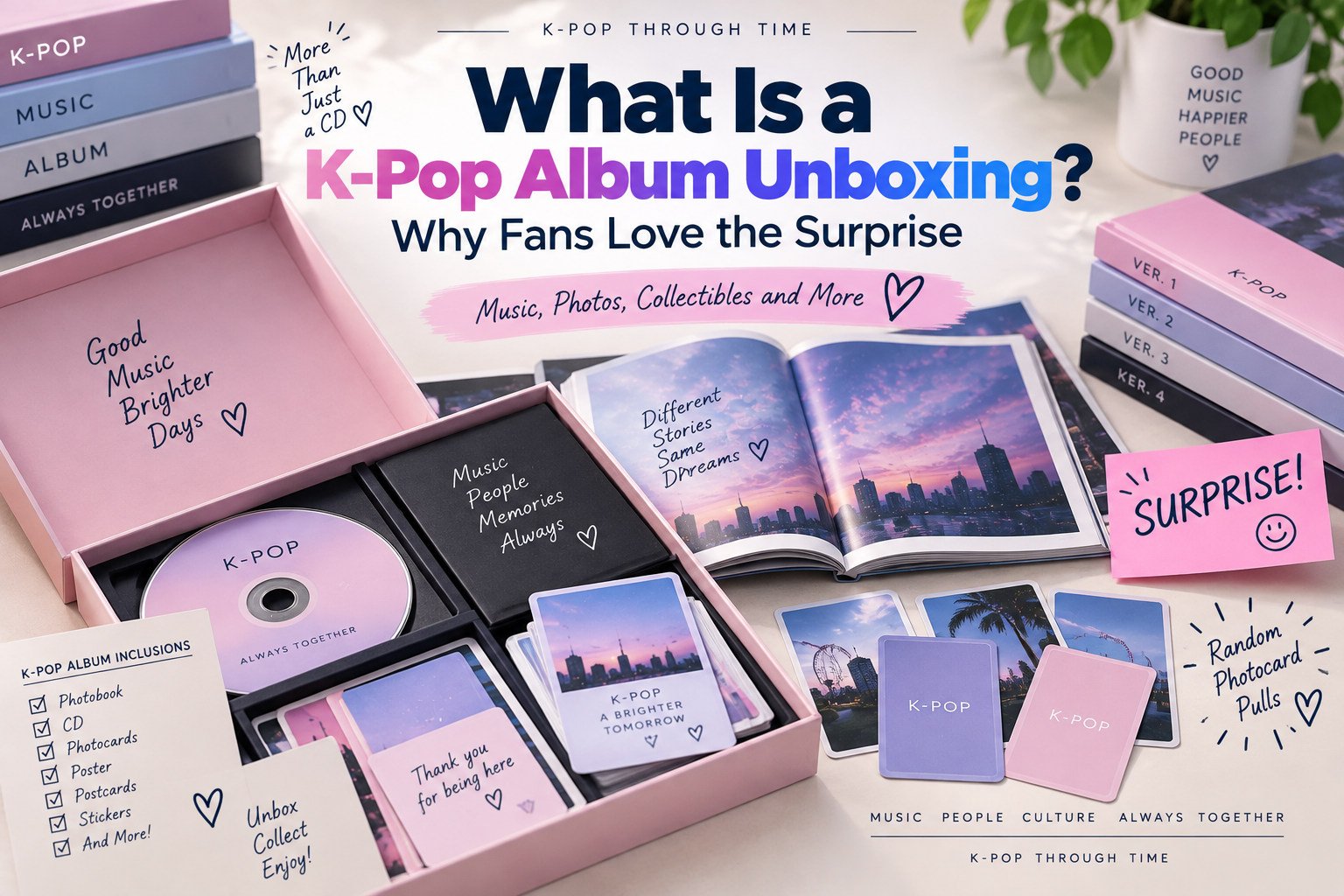
    What Is a K-Pop Album Unboxing? Why Fans Love the Surprise

    If you have ever searched for a K-pop album online, you may have come across videos with titles such as “K-pop album unboxing,” “photocard pulls,” or “album haul.”

    At first, it may seem unusual.

    Why would thousands—or even millions—of people want to watch someone open an album?

    The answer lies in the unique way K-pop physical albums are designed.

    A K-pop album is often more than a CD. It can contain photobooks, photocards, posters, stickers, postcards, and other surprises. Because some of these items are random, opening an album can become an experience of its own.

    That is where K-pop album unboxing comes in.

    What Is a K-Pop Album Unboxing?

    A K-pop album unboxing is exactly what it sounds like: someone opens a newly purchased album and shows what is inside.

    But unlike opening a simple CD case, a K-pop unboxing can involve many different items.

    The person may show the album cover, packaging, photobook, CD, lyric booklet, photocards, posters, stickers, and other inclusions.

    They may also compare different versions of the same album.

    For viewers, an unboxing video provides a detailed look at the physical album before they decide whether to purchase it themselves.

    Why Are K-Pop Albums So Good for Unboxing?

    Physical K-pop albums are often designed as collectible packages.

    The music is obviously important, but considerable attention can also be given to the album’s visual concept and packaging.

    A release may include:

    • A photobook
    • Photocards
    • A CD
    • A lyric booklet
    • Posters or folded posters
    • Postcards
    • Stickers
    • Special cards or other collectibles

    The exact contents vary from album to album.

    This means opening a new K-pop album can feel more like opening a carefully designed package than simply removing a disc from a case.

    The Excitement of Random Photocard Pulls

    One of the most anticipated moments in many unboxing videos is the photocard reveal.

    Albums often contain randomly selected photocards featuring different members.

    The buyer usually does not know which member they will receive until the album is opened.

    Fans commonly call this a photocard pull.

    If someone unexpectedly receives a card of their favorite member—their bias—the reaction can be especially exciting.

    This element of chance gives each unboxing a small moment of suspense.

    What Does “Inclusions” Mean?

    In K-pop collecting, you may hear fans use the word “inclusions.”

    This generally refers to the extra physical items included with an album.

    Photocards are one type of inclusion, but the term can also cover postcards, posters, stickers, bookmarks, mini posters, photo strips, and other items.

    Different albums offer different combinations of inclusions.

    For collectors, these extras are an important part of the physical album experience.

    Why Does One Album Have Several Versions?

    Many K-pop albums are released in multiple versions.

    The music may be the same, but each version can feature different cover designs, photobooks, concept photos, packaging, or collectible items.

    For example, one version might use a bright concept while another presents a darker visual style.

    This gives fans the option to choose the design they prefer.

    Collectors may also purchase more than one version when they want to own the different concepts.

    What Is an Album Haul?

    An album haul is slightly different from a single album unboxing.

    Instead of opening just one album, a fan may show several albums purchased at the same time.

    An album haul might include multiple versions of one release, albums from several artists, or a collection of purchases accumulated over time.

    These videos can give viewers a broader look at K-pop album packaging and collecting culture.

    Why Do Fans Watch Unboxing Videos Before Buying?

    Unboxing videos can be practical.

    Online store photographs do not always show every detail of an album.

    By watching an unboxing, a fan can see the actual size of the album, the photobook design, the packaging, and the included items.

    This can help someone decide which version they prefer before spending money.

    For international fans who may need to pay additional shipping costs, seeing the album clearly before purchasing can be particularly useful.

    Unboxing as Part of Fan Culture

    Unboxing videos are not only product demonstrations.

    They can also feel like shared fan experiences.

    Viewers may recognize the excitement of seeing new concept photos, discovering random photocards, or comparing favorite album versions.

    Comments often become places where fans discuss their own pulls, favorite designs, or collecting experiences.

    In this way, a simple unboxing video can become part of a larger conversation within K-pop fandom.

    The Role of Album Design

    K-pop album design often reflects the concept of a particular comeback.

    Colors, typography, photographs, symbols, and packaging may all connect to the music or visual identity of that era.

    Opening the album can therefore reveal another layer of the comeback concept.

    A photobook might contain images that were not used in the main promotional photos.

    The packaging itself may also include creative details that fans only discover after opening it.

    This is another reason unboxing videos can be interesting even to people who do not collect albums themselves.

    What Are Pre-Order Benefits?

    Fans watching album unboxings may also hear the term pre-order benefit, often shortened to POB.

    A pre-order benefit is an extra item offered when an album is ordered during a specific pre-release period, often through a particular retailer.

    These benefits can include exclusive photocards or other collectibles.

    Because different retailers may offer different benefits, two fans purchasing the same album from different stores might receive different extras.

    These items are separate from the standard contents of the album and can become part of photocard collecting culture.

    Do You Need to Buy Every Version?

    No.

    Multiple versions and random collectibles can make K-pop albums exciting, but fans do not need to purchase everything.

    Some people buy only one version of an album.

    Others choose their favorite cover or concept.

    Some fans collect every version, while others do not buy physical albums at all.

    There is no requirement to spend money to prove that you are a fan.

    The collecting side of K-pop should remain something people participate in because they enjoy it.

    Are Unboxing Videos Only for Collectors?

    Not at all.

    Some viewers watch because they are considering purchasing an album.

    Others simply want to see the concept photos or packaging.

    International fans may watch albums that are difficult to obtain where they live.

    And some people simply enjoy the surprise of seeing which photocards appear.

    You can enjoy an album unboxing without ever becoming a collector yourself.

    Album Unboxing and the Digital Music Era

    Streaming has made music instantly accessible around the world.

    Yet physical K-pop albums continue to attract attention partly because they offer something digital music cannot provide: a tangible experience.

    Fans can hold the photobook, display the album, organize photocards, and keep physical memories connected to a particular musical era.

    Unboxing highlights this difference.

    The music may be available instantly online, but the physical album offers another way to experience the release.

    Why the Surprise Matters

    The word “surprise” is important when understanding K-pop album unboxing culture.

    You may know which album you purchased, but you may not know exactly which random items are inside.

    Which photocard will you pull?

    Which member will appear?

    What will the photobook look like in person?

    These small unknowns make opening the package more interactive.

    For many fans, that anticipation is part of the enjoyment.

    Final Thoughts

    A K-pop album unboxing is much more than watching someone remove plastic packaging.

    It provides a close look at the visual and collectible side of K-pop albums—from photobooks and album designs to photocards, inclusions, and multiple versions.

    Random photocard pulls add an element of surprise, while detailed unboxing videos can help fans decide which albums or versions they want to purchase.

    They also reveal something important about modern K-pop culture.

    Even in an age dominated by streaming, physical albums can still create excitement because they combine music, design, collecting, and surprise in one package.

    And sometimes, the most memorable moment comes right at the end—when a fan turns over that final photocard and discovers exactly who they pulled.


  • What Is a K-Pop Photocard? Why Fans Love Collecting Them

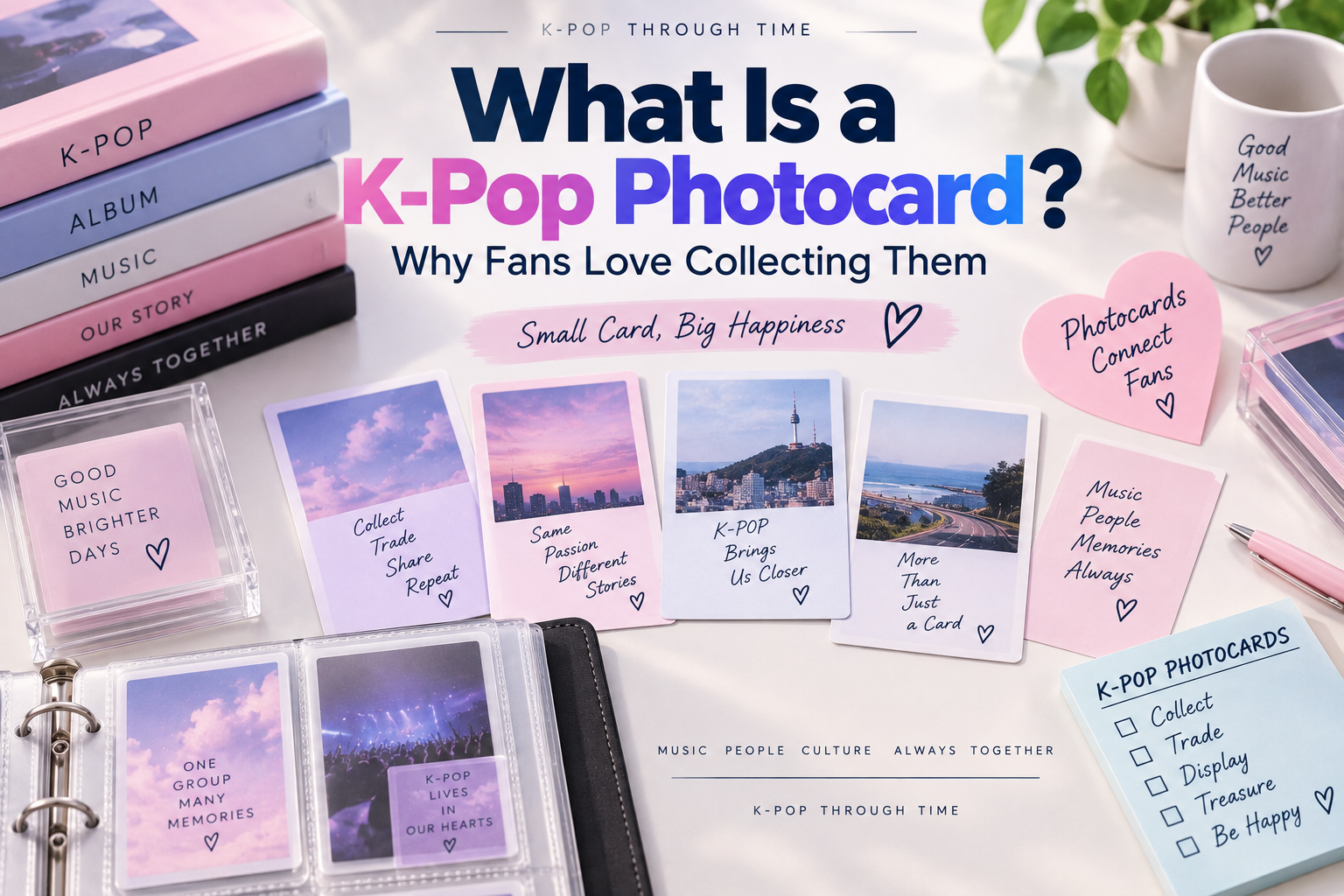
    What Is a K-Pop Photocard? Why Fans Love Collecting Them

    If you have ever watched a K-pop album unboxing video, you may have noticed one small item that creates a surprisingly big reaction.

    A fan opens an album, turns through the photobook, and suddenly becomes excited about a small card featuring one of the members.

    That card is called a photocard.

    Photocards have become one of the most recognizable parts of K-pop album culture. They may be small, but for many fans they are much more than simple photographs.

    So what exactly is a K-pop photocard, and why do fans enjoy collecting them so much?

    What Is a K-Pop Photocard?

    A K-pop photocard is a small collectible card featuring a photo of an idol or, sometimes, several members of a group.

    Photocards are commonly included inside physical K-pop albums, although they can also appear in merchandise, fan events, special releases, and promotional products.

    They are usually designed to fit easily into card sleeves, binders, or small holders.

    What makes them especially exciting is that fans often do not know which member’s card they will receive until they open the album.

    Why Are Photocards Random?

    Many K-pop albums include photocards randomly.

    Imagine a group with several members. An album might have different photocards for each member, but a buyer receives only one or a few of them.

    That means opening the album becomes a small surprise.

    Fans may hope to receive a card featuring their favorite member, often called their bias.

    If they receive another member instead, they may keep the card, collect the entire group, or trade it with another fan.

    This random system has helped create a large collecting and trading culture around photocards.

    What Does “Pull” Mean?

    K-pop fans often use the word “pull” when talking about photocards.

    If someone says, “I pulled my bias,” it means they opened an album and randomly received a photocard of their favorite member.

    Fans often film album unboxings because the moment of discovering which photocard they pulled can be part of the fun.

    For collectors, opening an album can therefore feel different from simply buying a CD.

    There is an element of surprise involved.

    Why Do Fans Collect Photocards?

    There is no single reason.

    Some fans collect photocards because they enjoy having small physical memories connected to their favorite artists.

    Others enjoy completing sets.

    A collector might try to collect every member from a particular album era, every version of one member’s photocards, or cards from several different albums.

    For some people, organizing the collection itself becomes an enjoyable hobby.

    Photocards can be placed in binders, displayed in holders, or carefully stored in protective sleeves.

    What Is a Bias Photocard?

    A bias photocard simply refers to a photocard featuring a fan’s favorite member.

    Many collectors focus primarily on one member rather than trying to collect every member of a group.

    This can make collecting more manageable, especially for groups with many members or albums with numerous photocard versions.

    Other fans prefer to collect the entire group.

    There is no single correct way to build a photocard collection.

    Why Are Some Photocards Hard to Find?

    Not all photocards are equally easy to obtain.

    Some may come from older albums that are no longer widely available.

    Others may have been distributed only through specific stores, events, concerts, fan meetings, or limited promotions.

    A card can also become highly sought after because fans particularly like the photo, styling, pose, or era.

    Availability and collector demand can therefore make certain cards much harder to find than ordinary album photocards.

    What Are POB Photocards?

    Another term collectors may encounter is POB, which usually means pre-order benefit.

    Some stores or retailers offer exclusive photocards to fans who pre-order an album through them.

    Different stores may offer different card designs.

    As a result, a single album era can produce many photocards beyond those included inside the standard album itself.

    For new collectors, this can initially feel overwhelming.

    The important thing to remember is that collecting everything is not necessary. Fans can choose what they personally enjoy.

    What Is Photocard Trading?

    Because album photocards are often random, fans frequently trade cards with one another.

    For example, one fan may receive Member A but want Member B. Another fan may have Member B and be looking for Member A.

    They can agree to exchange the cards.

    Photocard trading takes place through fan communities, social media, local meetups, and other collector networks.

    This trading culture has become an important social part of the hobby.

    What Is Photocard Selling?

    Fans also buy and sell individual photocards.

    This allows collectors to search for a specific card without repeatedly buying albums and hoping to receive it randomly.

    Prices can vary greatly depending on availability, demand, condition, and the type of card.

    However, popularity does not automatically mean that a card has a fixed value. Collector markets can change, and prices can differ between sellers and communities.

    For beginners, it is wise to compare carefully before purchasing expensive cards.

    How Do Fans Protect Their Photocards?

    Collectors often use protective sleeves to help prevent scratches, fingerprints, and other damage.

    Cards may then be stored in binder pages or protective holders.

    Some fans also display photocards in decorative holders attached to bags or placed on desks.

    Because collectors may care about the condition of a card, careful storage becomes part of the hobby.

    Photocards and K-Pop Album Culture

    Photocards are closely connected to the physical album experience in K-pop.

    A physical album may include a photobook, CD, lyric booklet, stickers, posters, postcards, and photocards.

    Different versions of the same album may also contain different photos and collectible items.

    This turns the physical album into something more than a container for music.

    For many fans, it becomes a collectible object representing a particular comeback or period in an artist’s career.

    Why Do Albums Have So Many Photocards?

    Over time, photocard systems have become increasingly varied.

    An album may contain several possible cards for each member, while additional versions may be offered through retailers or special events.

    This gives collectors more items to discover and trade.

    At the same time, it means that completing every possible set can become difficult and expensive.

    Fans do not need to collect every card to participate in K-pop fandom. Many people simply keep the photocards they naturally receive from albums.

    Are Photocards Official Merchandise?

    Many photocards are official items produced or authorized as part of albums, merchandise, events, or promotions.

    However, fans may also encounter unofficial photocards created by other fans or sellers.

    These are sometimes called fan-made cards.

    Fan-made cards can be enjoyable collectibles, but they should not be confused with official album or event photocards when buying, selling, or trading.

    Knowing the source of a card is especially important when money is involved.

    Why Are Photocards So Popular?

    Part of their appeal comes from the combination of music, collecting, surprise, and personal connection.

    They are small enough to store easily but varied enough to create an entire collecting hobby.

    They also give fans a physical reminder of an album era, concert, event, or favorite member.

    And because cards can be traded, collecting can help fans interact with other people who share the same interests.

    In this sense, photocards are not simply pictures. They have become part of the social culture surrounding K-pop fandom.

    Do You Need Photocards to Be a K-Pop Fan?

    Absolutely not.

    Some fans love collecting albums and photocards. Others listen only through streaming services.

    Some attend concerts, while others enjoy music videos, performances, or online content.

    There is no requirement to buy merchandise in order to be a genuine fan.

    Photocard collecting is simply one of many ways people choose to enjoy K-pop.

    Final Thoughts

    A K-pop photocard may look like a simple picture card, but it represents a fascinating part of modern K-pop culture.

    Random album pulls create excitement. Trading creates interaction between fans. Collecting allows people to preserve memories of favorite members, albums, and comeback eras.

    From ordinary album cards to pre-order benefits and limited promotional releases, photocards have developed into a collecting culture of their own.

    But the most important thing is not how many cards someone owns.

    For fans who enjoy the hobby, the value often comes from the memories, excitement, and personal meaning attached to each card.

    And sometimes, opening an album and unexpectedly pulling your bias is simply part of the fun.