
If you are new to K-pop, album terminology can quickly become confusing.
A group announces a single album. A few months later, they release a mini album. Then fans celebrate the arrival of a full album.
So what is the difference?
Although these terms may sound complicated at first, they mainly describe different types and sizes of music releases. Understanding them makes it much easier to follow K-pop comebacks, track lists, and album announcements.
What Is a K-Pop Mini Album?
A mini album is one of the most common release formats in K-pop.
It usually contains several songs but is shorter than a full-length studio album. Internationally, a similar format is often called an EP, which stands for “extended play.”
A mini album gives artists enough space to present several songs and explore a concept without producing a full-length album.
For many K-pop groups, mini albums are an important part of their regular comeback schedule.
Is a Mini Album the Same as an EP?
In many situations, yes.
The terms mini album and EP are often used to describe similar releases.
However, terminology can vary depending on the artist, entertainment company, music platform, or market. A release described as a mini album in Korean promotional materials may appear as an EP on an international streaming service.
Rather than focusing only on the label, it is often more useful to look at the number of tracks and how the release is being promoted.
What Is a K-Pop Single?
A single usually focuses on one main song.
It may be released digitally without a large physical album package, although promotional strategies differ between artists.
Singles can be used to introduce new music between larger album releases, test a new musical direction, celebrate a special occasion, or begin a new promotional period.
Some singles also become major hits even though they are not part of a full album at the time of release.
What Is a Single Album?
Here is where K-pop terminology becomes especially interesting.
A single album is not necessarily just one song.
In K-pop, a single album often contains a small number of tracks—perhaps a main song plus one or two additional tracks.
It may also be released physically with packaging similar to larger K-pop albums.
That means fans might receive a photobook, photocards, posters, or other collectible items even though the musical release itself contains only a few songs.
What Is a Full Album?
A full album, sometimes called a studio album or full-length album, generally contains more songs than a mini album.
Because it offers more tracks, a full album gives artists greater space to explore different musical styles and themes.
For fans, a full album can be particularly exciting because it provides more new music to discover beyond the main promotional song.
However, full albums often require more time and resources to produce, which is one reason mini albums are so common in K-pop.
Why Are Mini Albums So Common in K-Pop?
K-pop operates around highly organized promotional cycles.
A comeback can involve concept photos, teasers, music videos, choreography, music-show performances, interviews, fan events, and other content.
Releasing mini albums allows artists to introduce new music regularly while still creating a complete concept around each release.
Instead of waiting several years between full albums, an artist may return more frequently with mini albums or singles.
This helps keep fans engaged while allowing each comeback to have its own identity.
What Is Usually Inside a Mini Album?
A mini album often contains a title track and several additional songs.
The title track usually receives the main promotional attention, including a music video and music-show performances.
The remaining tracks are commonly described by fans as B-sides.
These B-sides can explore different musical styles and sometimes become fan favorites even without receiving the same level of promotion as the title track.
What Is a Repackaged Album?
Another term K-pop fans often encounter is the repackaged album.
A repackage typically takes an existing album and releases an expanded or revised version with additional material.
This may include new songs and a new main promotional track.
Rather than being an entirely unrelated project, a repackage often extends the era of the original album and gives fans additional music and promotions.
What Is a Pre-Release Single?
Sometimes an artist releases a song before the main album arrives.
This is known as a pre-release single.
The purpose is often to build anticipation for the upcoming album and introduce listeners to its musical direction.
A pre-release single may receive its own music video and significant promotion, but it does not always become the album’s primary title track.
When the complete album arrives, another song may take center stage.
Physical Albums Are a Big Part of K-Pop
One thing that makes K-pop albums distinctive is the importance of physical packaging.
A physical K-pop album can be more than a CD.
Depending on the release, it may include photobooks, photocards, posters, stickers, lyric books, postcards, or other collectible items.
Albums may also be sold in several versions with different photos or design concepts.
For many fans, buying an album is therefore both a way to listen to music and a way to collect something connected to the artist and the comeback era.
Why Are There Multiple Versions of the Same Album?
It is common for a K-pop album to be released in several versions.
The songs may be identical, but the packaging, concept photos, covers, or included collectibles can differ.
This allows one album to present several visual interpretations of the same musical era.
Collectors may choose their favorite version, while some fans purchase multiple versions to collect different designs or inclusions.
Do More Songs Mean a More Important Release?
Not necessarily.
A full album contains more music, but that does not automatically make it more successful or culturally important than a mini album or single.
A single song can become one of an artist’s biggest hits.
Likewise, a mini album can define an important era in a group’s career.
In K-pop, the impact of a release depends on many factors, including the music, concept, performances, timing, promotion, and audience response.
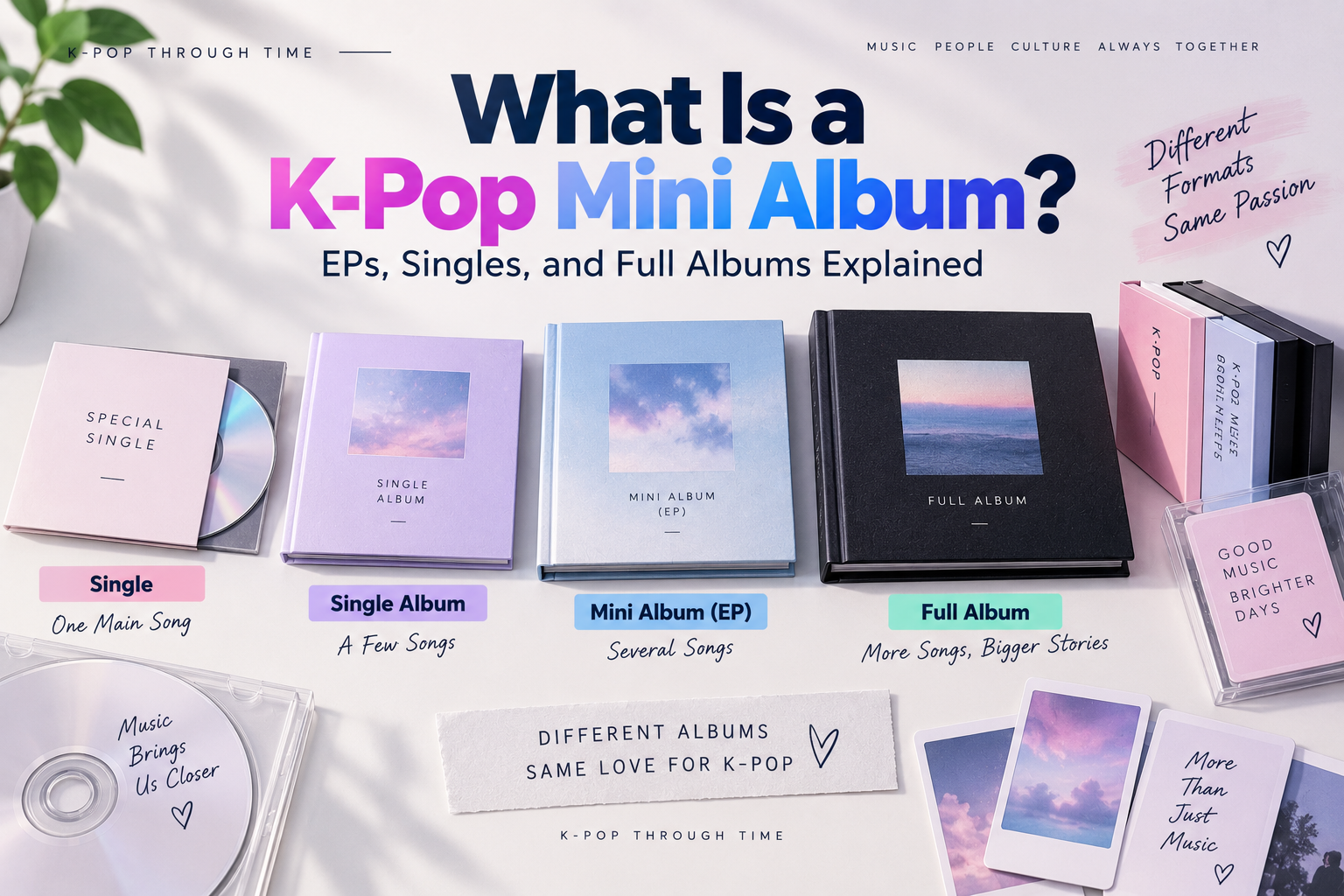
Mini Album vs. Full Album: The Simple Difference
The easiest way to understand the distinction is this:
A single or single album is generally the smallest release.
A mini album or EP contains several songs but is shorter than a typical full album.
A full album generally contains a larger collection of songs and represents a more extensive musical project.
The exact number of tracks can vary, so these categories should be understood as general industry terms rather than strict mathematical rules.
Why Understanding Album Types Helps K-Pop Fans
Once you understand these terms, K-pop announcements become much easier to follow.
When an entertainment company announces a mini album, you know to expect several new songs.
When fans talk about a full album, you know they are anticipating a larger collection of music.
And when you see the words “single album,” you will know that it may contain more than just one track.
These small pieces of vocabulary make a surprisingly big difference when exploring K-pop.
Final Thoughts
K-pop releases come in many forms, from singles and single albums to mini albums, EPs, full albums, and repackaged albums.
Among them, the mini album has become especially familiar because it fits naturally into K-pop’s comeback-driven promotional system.
But no matter how many tracks a release contains, each format can introduce a new sound, concept, performance, and chapter in an artist’s career.
Understanding the different album types allows you to look beyond the terminology and enjoy what matters most—the music and the story surrounding each new release.