
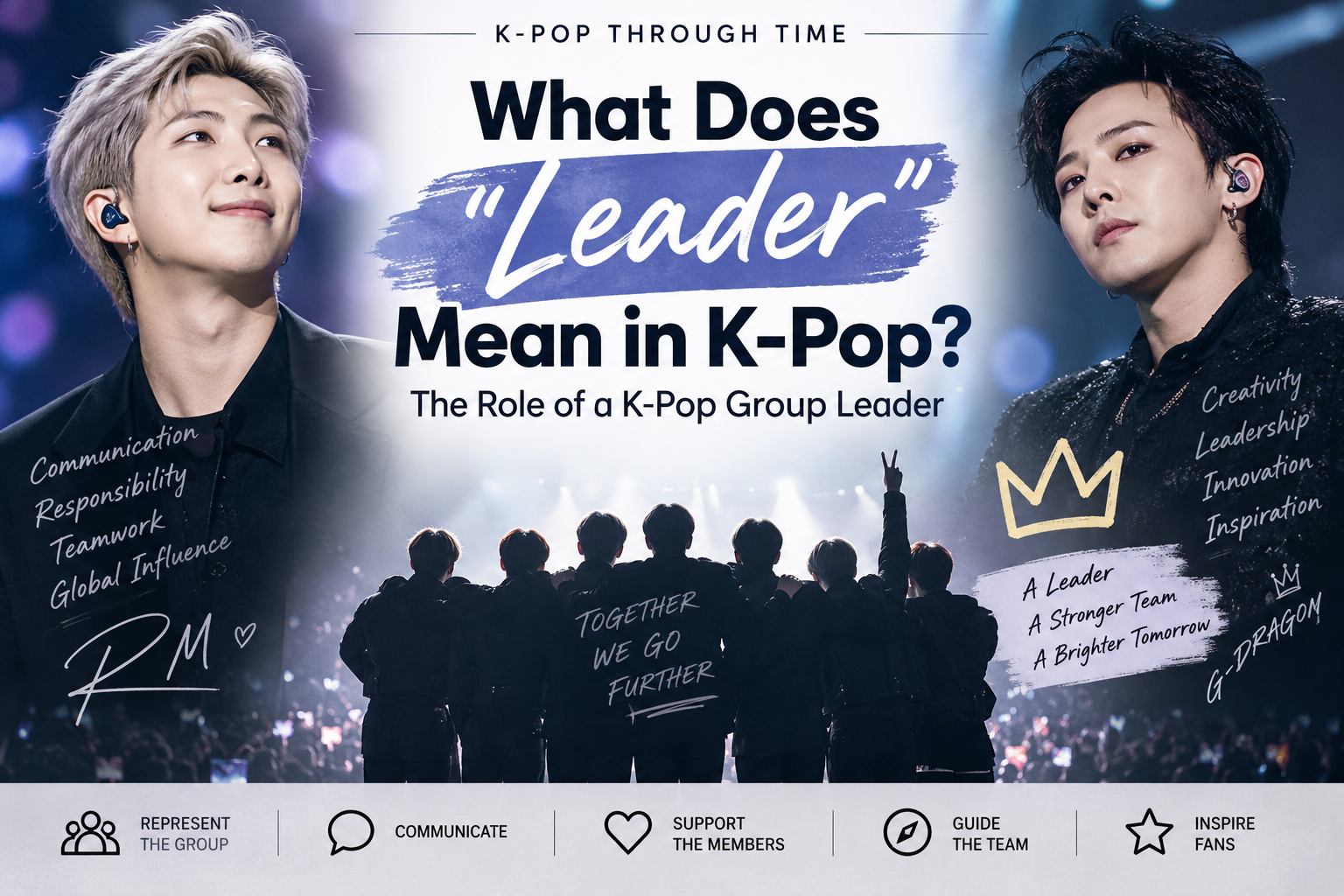
What Is a Leader in K-Pop?
In K-pop, a leader is a member who often represents the group and helps keep the members connected as a team. The leader is not necessarily the oldest member, the main vocalist, or the most popular member. Instead, the role is usually given to someone who can communicate well, take responsibility, and support the other members.
Unlike positions such as main vocalist, rapper, or dancer, the leader’s job is not mainly about performing. Much of the role happens behind the scenes.
What Does a K-Pop Leader Do?
A K-pop leader may have several responsibilities. Leaders often speak on behalf of the group during interviews, award ceremonies, and public appearances. They may also help communicate between the members and their entertainment company.
Inside the group, the leader can become an important source of emotional support. K-pop idols often spend years training, recording, rehearsing, traveling, and performing together. When disagreements or stressful situations arise, the leader may help the members communicate and work through problems.
However, every group is different. Some leaders have very visible roles, while others lead more quietly.
How Is a K-Pop Leader Chosen?
There is no single rule for choosing a K-pop leader.
In some groups, the oldest member becomes the leader. In others, entertainment companies choose a member based on personality, communication skills, training experience, or the ability to take responsibility.
This is why the leader and the oldest member are not always the same person.
The leadership style can also change depending on the group. Some leaders are serious and organized, while others lead through encouragement, humor, or strong relationships with their members.
RM: Leadership Through Communication
RM of BTS is one of the best-known examples of a K-pop group leader. As the leader of BTS, he has frequently represented the group in international interviews and major public appearances.
His English skills have also helped BTS communicate with international audiences, but his role goes beyond language. RM has often been associated with thoughtful communication and the ability to express the group’s ideas and experiences.
His leadership illustrates how a K-pop leader can become an important bridge between the individual members, the group, and the public.
G-DRAGON and Leadership in BIGBANG
G-DRAGON is another influential example of leadership in K-pop. As the leader of BIGBANG, he became closely associated not only with the group’s public identity but also with its musical direction.
His songwriting, production, performance style, and fashion helped shape BIGBANG’s distinctive image.
This shows another form of K-pop leadership: a leader can influence a group not only through communication but also through creative direction.
Is the Leader Always the Most Powerful Member?
Not necessarily.
Calling someone the leader does not mean that person controls every decision. K-pop groups operate within entertainment companies, and major decisions involving albums, schedules, promotions, and business strategy usually involve managers, producers, executives, and other professionals.
Within the group itself, members may also share responsibilities.
A good leader therefore does not simply give orders. Leadership often involves listening, communicating, representing the team, and helping different personalities work together.
Do All K-Pop Groups Have Leaders?
No. Although many K-pop groups officially designate a leader, some groups do not have one.
In groups without an official leader, responsibilities may be shared among several members. One member might speak frequently during interviews, while another helps organize the members or provides emotional support.
This demonstrates that leadership can exist even without an official title.
Why Is the Leader Important in K-Pop?
K-pop groups work in unusually demanding environments. Members may live together, practice for long hours, travel internationally, appear on television, interact with fans, and perform under intense public attention.
Because of this, teamwork is extremely important.
A strong leader can help create stability within the group while also giving the public a recognizable representative. At the same time, successful K-pop groups usually depend on cooperation among all their members rather than on one person alone.
The Meaning of Leadership in K-Pop
The word “leader” in K-pop describes much more than the person who stands at the front of a group.
A leader can be a spokesperson, mediator, supporter, organizer, and sometimes a creative influence. Different idols approach the role differently, which is why leadership has become an interesting part of K-pop culture.
From RM’s communication-focused leadership in BTS to G-DRAGON’s creative influence in BIGBANG, K-pop shows that there is no single way to lead a successful group.
Understanding the leader position also helps new fans understand how K-pop groups work behind the performances they see on stage.