
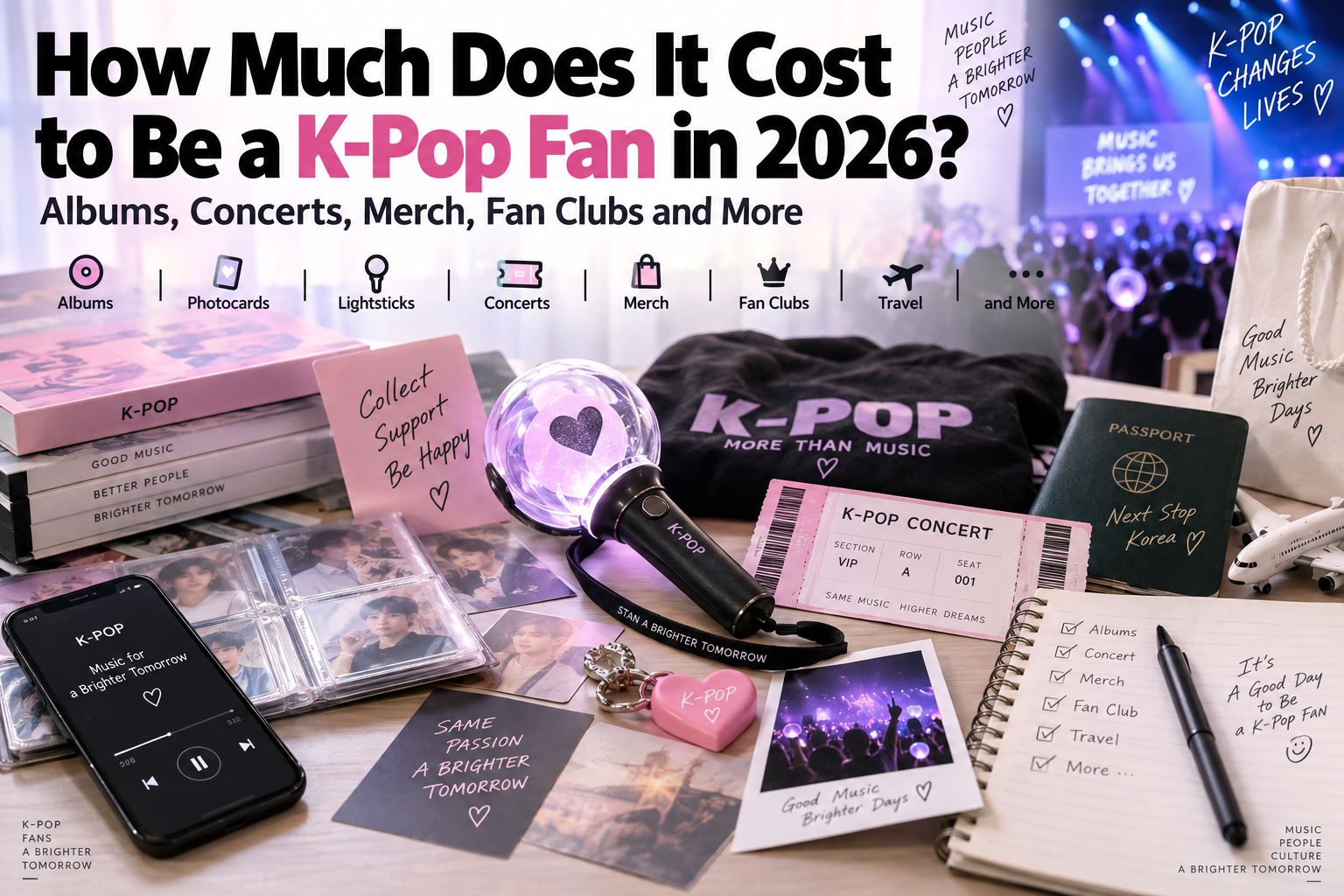
How Much Does It Cost to Be a K-Pop Fan in 2026?
Being a K-pop fan can be completely free.
You can watch music videos, listen to songs, follow your favorite artists on social media, and enjoy performances without buying anything.
But once albums, photocards, lightsticks, concerts, fan memberships, merchandise, and even trips to Korea enter the picture, K-pop can become an expensive hobby surprisingly quickly.
So, how much does it actually cost to be a K-pop fan in 2026?
There is no single answer.
A casual fan may spend almost nothing, while a dedicated collector or international concert traveler can spend hundreds—or even thousands—of dollars a year.
This guide breaks down the major expenses so new fans can understand where the money goes and decide what is actually worth buying.
Quick Answer: How Much Does a K-Pop Fan Spend?
Your annual K-pop budget could look something like this:
Casual fan: $0–$100+ per year
Regular fan: $100–$500+ per year
Active collector or concert fan: $500–$1,500+ per year
Dedicated international fan: $1,500–$5,000+ per year
These are not official industry averages.
They are practical examples showing how dramatically spending can vary depending on albums, concerts, collecting, travel, and the number of groups you follow.
And there is no amount of money you need to spend to be considered a “real fan.”
Let’s look at where those costs come from.
1. K-Pop Albums
Albums are often the first physical products new K-pop fans buy.
Unlike a basic CD, a physical K-pop album frequently comes as a collectible package containing items such as:
- Photobook
- CD
- Photocard
- Poster
- Stickers
- Postcards
- Lyrics book
- Other limited inclusions
This makes the album both a music product and a collectible.
But there is another factor that can increase spending significantly:
multiple versions.
One comeback may have several album versions with different concepts, covers, photocards, or bonus items.
A fan who wants only one copy may spend relatively little.
A collector who wants every version can spend several times more.
The Hidden Cost: Shipping
International fans also need to consider shipping.
An album that appears affordable at first can become considerably more expensive after:
- International shipping
- Local delivery charges
- Import taxes
- Customs duties
This is why fans sometimes use group orders or local K-pop retailers rather than ordering individual albums directly from Korea.
2. Photocards
For many fans, photocards start as a fun bonus inside an album.
Then collecting begins.
Photocards usually feature individual members and are randomly included in albums.
That randomness creates a collecting challenge.
If you want a particular member, you might:
- Buy another album
- Trade with another fan
- Purchase the photocard separately
- Join a group order
Some common photocards can be inexpensive.
Rare, limited, event-exclusive, or highly demanded photocards can cost much more on resale markets.
This means photocard collecting can become one of the least predictable K-pop expenses.
Why Do Fans Buy Multiple Albums?
Photocards are one reason.
But fans may also buy multiple copies because of:
- Different album versions
- Pre-order benefits
- Store-exclusive photocards
- Fan-sign entry opportunities
- Collecting goals
- Supporting chart performance
This is why album spending can vary enormously between two fans of the same group.
3. Official Lightsticks
The K-pop lightstick is much more than a glowing concert accessory.
For many fandoms, it is a symbol of membership and identity.
Official lightsticks often feature a design associated specifically with an artist or fandom.
At concerts, modern lightsticks may also synchronize with the venue’s lighting system to create coordinated colors and effects throughout the audience.
For a fan attending several concerts by the same artist, buying an official lightstick may feel worthwhile.
For someone who mainly streams music at home, it may be unnecessary.
And because each group generally has its own official design, fans who follow several groups can quickly accumulate multiple lightsticks.
4. Concert Tickets
Concerts can become one of the largest expenses in K-pop fandom.
Ticket prices depend heavily on:
- Artist
- Country
- Venue
- Seat location
- Tour
- VIP package
- Additional benefits
Standard seats may already represent a significant purchase.
Premium packages can cost considerably more.
VIP benefits may include things such as:
- Soundcheck access
- Early entry
- Premium seating
- Exclusive merchandise
- Special check-in benefits
The exact package varies by tour.
But the ticket itself is often only the beginning.
5. The Real Cost of Attending a K-Pop Concert
Suppose the concert is in another city.
Now you may need:
Concert ticket
- transportation
- hotel
- food
- lightstick
- concert merchandise
For international concerts, airfare may become the biggest expense of all.
A fan could therefore spend much more on the trip than on the actual concert ticket.
This is an important distinction when calculating a realistic fandom budget.
Don’t ask only:
“How much is the ticket?”
Ask:
“How much will the entire concert experience cost?”
6. K-Pop Merchandise
K-pop merchandise has expanded far beyond albums.
Official products can include:
- T-shirts
- Hoodies
- Hats
- Bags
- Keychains
- Dolls
- Character merchandise
- Photocard holders
- Posters
- Photobooks
- Season’s Greetings
- Tour merchandise
- Anniversary merchandise
- Collaboration products
One item may not seem expensive.
The difficulty is frequency.
There can be new merchandise for tours, birthdays, anniversaries, pop-up stores, fan meetings, album releases, and collaborations.
Following several groups multiplies those opportunities.
7. Fan Club and Membership Costs
Many artists operate official fan memberships through dedicated platforms.
Membership can offer benefits such as:
- Presale opportunities
- Membership-only content
- Exclusive merchandise
- Fan-club events
- Special digital content
- Member-specific purchasing opportunities
For fans who want concert presale access, membership may be particularly attractive.
However, membership does not necessarily guarantee that you will successfully purchase a concert ticket.
Demand for popular artists can still be extremely high.
Before paying, read the current membership terms and benefits carefully.
8. Fan-Sign Events
Fan-sign events are one of the most distinctive parts of K-pop fan culture.
Fans may have an opportunity to briefly interact with idols through an in-person or video-call event.
But participation can become expensive.
For some album-based events, purchasing an eligible album provides an entry into a drawing.
That creates an incentive for some fans to purchase multiple albums to increase the number of entries.
However:
Buying more albums does not guarantee winning unless the event explicitly uses a different selection system.
This can make fan-sign spending particularly risky for fans on a limited budget.
Set a spending limit before entering rather than chasing a result after repeated purchases.
9. Paid Digital Content and Subscriptions
Physical products are not the only expenses.
Depending on the artist and platform, fans may encounter paid:
- Membership content
- Livestreams
- Concert streams
- Messaging services
- Exclusive videos
- Digital fan communities
- Subscription services
Each individual subscription may seem small.
But multiple recurring subscriptions can quietly become a meaningful yearly expense.
A useful habit is to review recurring fan subscriptions every few months.
Ask yourself:
Am I actually using this enough to keep paying for it?
10. Music Streaming
K-pop itself does not require a special music subscription.
Fans commonly listen through mainstream streaming services.
If you already subscribe to a music service for everyday listening, following K-pop may not add any extra expense.
But some dedicated fans may use more than one platform or purchase digital music separately.
Again, this is optional.
Enjoying an artist does not require participating in every form of chart support.
11. Traveling to Korea as a K-Pop Fan
This is where fandom spending can enter an entirely different category.
Some international fans eventually plan a trip to South Korea connected partly or heavily to their interest in K-pop.
Potential expenses include:
- Flights
- Hotels
- Transportation
- Concert tickets
- Pop-up stores
- Cafes
- Merchandise
- Entertainment-company destinations
- Exhibitions
- Fan events
A trip to Korea can therefore cost far more than a year of casual album collecting.
But for some fans, it becomes a combined music, culture, food, and travel experience rather than simply a fandom purchase.
12. Pop-Up Stores and Limited Merchandise
K-pop pop-up stores are another increasingly visible part of fan spending.
They may appear around:
- Comebacks
- Concert tours
- Anniversaries
- Character collaborations
- Brand partnerships
Limited availability creates urgency.
Fans know that a product may disappear when the event ends.
That can encourage impulse purchases.
A simple rule can help:
Decide your maximum budget before entering the store.
Otherwise, small purchases can add up quickly.
13. The Cost of Following Multiple Groups
Following one artist and following ten artists are financially very different hobbies.
Suppose several favorite groups release:
- Two albums each year
- New merchandise
- Fan memberships
- Concert tours
Your potential spending opportunities multiply rapidly.
This is why many experienced fans eventually prioritize.
They may have:
One group they actively collect
while casually following many others.
You do not need to purchase merchandise from every artist you enjoy.
A Sample K-Pop Budget
Consider a hypothetical regular fan.
During one year, they might buy:
4 albums × $30 = $120
1 lightstick = $60
1 concert ticket = $180
Concert merchandise = $100
Fan membership = $30
Other merchandise = $150
That totals approximately:
$640 per year
Now add transportation and a hotel for the concert and the total could easily rise further.
On the other hand, another fan might spend only $50 all year.
Both are equally capable of enjoying K-pop.
Budget Example 1: The Casual Fan
A casual fan might:
- Stream music
- Watch YouTube content
- Follow artists on social media
- Buy one favorite album
Possible yearly spending:
$0–$100+
This is one of the easiest ways to enjoy K-pop without financial pressure.
Budget Example 2: The Regular Fan
A regular fan might buy:
- Several albums
- One lightstick
- Some merchandise
- One membership
- One concert ticket
Possible yearly spending:
$100–$500+
Concert travel can push the total higher.
Budget Example 3: The Collector
Collectors may spend significantly more because they purchase:
- Multiple album versions
- Photocards
- Limited merchandise
- Pre-order benefits
- Season’s Greetings
- Tour merchandise
Possible yearly spending can easily reach:
$500–$1,500+
For serious collectors, it can go considerably beyond that.
Budget Example 4: The International Concert Fan
Now imagine traveling internationally to see an artist.
Expenses could include:
- Airfare
- Hotel
- Concert ticket
- Local transportation
- Food
- Merchandise
- Lightstick
A single trip could potentially cost:
$1,000–$3,000+
depending heavily on the destination, flight distance, accommodation, and ticket type.
That is why international concert travel should be treated as a travel budget, not merely a fandom purchase.
What K-Pop Purchases Are Actually Worth It?
There is no universal answer.
Value depends on how you personally enjoy fandom.
If you love physical collecting, albums may be worth it.
If live performance is your favorite part of K-pop, saving for concerts may make more sense.
If you enjoy community access, membership may be valuable.
If you mostly enjoy music, you may need almost none of these things.
The important question is not:
“What do other fans buy?”
It is:
“What improves my own experience enough to justify the cost?”
How to Enjoy K-Pop Without Overspending
K-pop marketing can create a strong sense of urgency.
Limited editions, random photocards, pre-order benefits, concert presales, and temporary pop-up stores can make fans feel they need to buy immediately.
A few simple rules can help.
Set a Monthly Fandom Budget
Choose an amount you can comfortably spend after essential expenses and savings.
Once the budget is used, wait until the next month.
Don’t Collect Everything
You can choose:
- One member
- One album version
- One group
- Only favorite releases
A smaller collection can still be meaningful.
Separate Concert Savings
If concerts matter most to you, create a separate concert budget.
Saving $30 or $50 each month can be more useful than spending the same money on merchandise you do not really want.
Compare the Final Price
Always check:
Product + shipping + tax + customs
before ordering internationally.
Be Careful With Resale Prices
Limited photocards and merchandise can become expensive on resale markets.
Scarcity does not automatically mean something is worth the asking price.
Why K-Pop Is So Effective at Turning Fans Into Customers
K-pop combines several business models in one ecosystem.
An artist is not selling only recorded music.
Fans may encounter:
Music → albums → collectibles → membership → concerts → merchandise → digital content → brand collaborations
Each part reinforces the others.
A comeback can generate album sales.
The album creates collectible photocards.
The new era produces merchandise.
The music leads to a tour.
The tour creates ticket and merchandise sales.
The fandom relationship supports memberships and other products.
This helps explain why the modern K-pop business extends far beyond streaming revenue.
Where Does All That Fan Spending Go?
Not every dollar spent by a fan goes directly to an idol.
Revenue may be distributed among many parties depending on the product and contract.
These can include:
- Entertainment companies
- Artists
- Songwriters
- Producers
- Distributors
- Concert promoters
- Venues
- Merchandise manufacturers
- Retailers
- Ticketing companies
- Digital platforms
The exact distribution differs enormously depending on contracts and products.
This is one reason K-pop entertainment companies have developed multiple revenue streams rather than relying only on music sales.
Albums vs Concerts vs Merch: Which Matters Most?
There is no universal answer because revenue structures differ by company and artist.
Albums can generate large sales volumes.
Concerts can produce significant ticket and venue-related revenue.
Merchandise can expand the commercial value of tours and fandoms.
Memberships and digital platforms can create ongoing relationships with fans between major releases.
The important business lesson is that K-pop monetization is diversified.
A successful artist can generate revenue across several interconnected categories.
The K-Pop Fandom Economy
This larger ecosystem is sometimes described as part of the fandom economy.
Fans do more than consume music.
They may:
- Collect
- Travel
- Attend events
- Buy fashion
- Join memberships
- Visit pop-up stores
- Purchase branded products
- Participate in fan communities
This creates economic activity far beyond the original song.
It also helps explain why global K-pop growth has attracted attention not only from music companies but also from tourism, fashion, beauty, technology, retail, and entertainment businesses.
Frequently Asked Questions
Is K-pop an expensive hobby?
It can be, but it does not have to be.
You can enjoy K-pop almost entirely for free or spend thousands of dollars on collecting and travel.
Do I need to buy albums to be a real K-pop fan?
No.
There is no required purchase that makes someone a legitimate fan.
Why do K-pop fans buy multiple copies of the same album?
Reasons can include multiple versions, photocards, pre-order benefits, fan-sign entries, collecting, and chart support.
Are K-pop concerts expensive?
They can be.
The total cost depends on ticket type, artist, venue, location, transportation, accommodation, and merchandise.
Do I need an official lightstick for a concert?
Not necessarily.
Rules vary by event, but owning a lightstick is not a universal requirement for enjoying a concert.
Is K-pop fan membership worth paying for?
It depends on the benefits you use.
Fans interested in presales, exclusive content, or official membership benefits may find it valuable, while casual fans may not need it.
How much should I spend on K-pop each month?
There is no ideal amount.
Your K-pop budget should come from discretionary money after essential expenses and financial priorities are covered.
Final Thoughts
So, how much does it cost to be a K-pop fan in 2026?
The answer can range from almost nothing to several thousand dollars a year.
That huge range is part of what makes K-pop fandom unusual.
You can participate casually through music and videos, or dive deeply into albums, photocards, concerts, merchandise, memberships, and travel.
The key is remembering that fandom is supposed to add enjoyment to your life—not financial pressure.
Buy what genuinely matters to you.
Skip what does not.
And if you are curious about why entertainment companies offer so many different products in the first place, the answer lies in the fascinating business model behind the global K-pop industry.