K-Pop Fandom Is More Than an Audience
Every music industry has fans.
But K-pop developed something more organized, visible, and participatory than a conventional audience.
Fans do not simply listen to songs or attend concerts. They create communities, translate content, organize projects, collect albums, learn fan chants, vote in competitions, share performances, promote artists, and connect with other fans across national borders.
In some cases, they also organize charitable campaigns or social projects in an artist’s name.
This makes K-pop fandom an important part of the industry’s history.
The global rise of K-pop cannot be explained only through entertainment companies and artists.
It also requires understanding the people on the other side of the stage.
The fans helped build the network through which K-pop traveled.
Before Social Media: The Rise of Organized Fan Clubs
Modern K-pop fandom did not begin with Twitter, TikTok, or YouTube.
Its foundations were established much earlier.
As South Korea’s idol industry expanded during the first generation of K-pop in the 1990s, large organized fan communities formed around popular groups.
Groups such as H.O.T. and Sechs Kies attracted passionate supporters who developed strong collective identities.
Fans gathered at performances.
They joined organized communities.
They used colors and symbols to identify themselves.
They learned coordinated ways to support their favorite artists.
The important development was not simply that many people liked the same group.
They began to think of themselves as members of a fandom.
The Official Fan Club Created a Shared Identity
Entertainment companies recognized the power of these communities and increasingly formalized relationships through official fan clubs.
An official fandom could have a name, membership structure, color, symbols, and specific ways of supporting the artist.
This transformed fandom into something resembling a cultural identity.
A fan could say not only:
“I like this group.”
They could say:
“I belong to this fandom.”
That difference matters.
Personal preference became collective membership.
Once fans saw themselves as part of a community, they could organize activities that an isolated listener could never accomplish alone.
Fandom Names Became Cultural Symbols
One of K-pop’s most recognizable traditions is the official fandom name.
Over time, names such as Cassiopeia, S♡NE, ELF, VIP, SHINee World, ARMY, BLINK, CARAT, STAY, and many others became meaningful identities within K-pop culture.
To outsiders, these may appear to be branding devices.
To fans, they can represent years of memories, friendships, concerts, releases, and shared experiences.
A fandom name also gives artists a convenient way to address their supporters as a community.
Instead of speaking to an undefined mass of consumers, an artist can speak to a named group with its own history.
This strengthens one of K-pop’s most powerful characteristics:
the feeling of an ongoing relationship between artist and audience.
Fandom Colors Made the Audience Visible
Before sophisticated official light sticks became widespread, colors played an important role in identifying fandoms.
Fans could use balloons, clothing, banners, or other objects associated with particular colors.
At large music events, sections of an audience could become visually identifiable through those colors.
This turned fandom into something that could literally be seen.
The audience was no longer simply a dark crowd facing the stage.
It became part of the spectacle.
A large area filled with one fandom’s color could demonstrate the size and organization of that community.
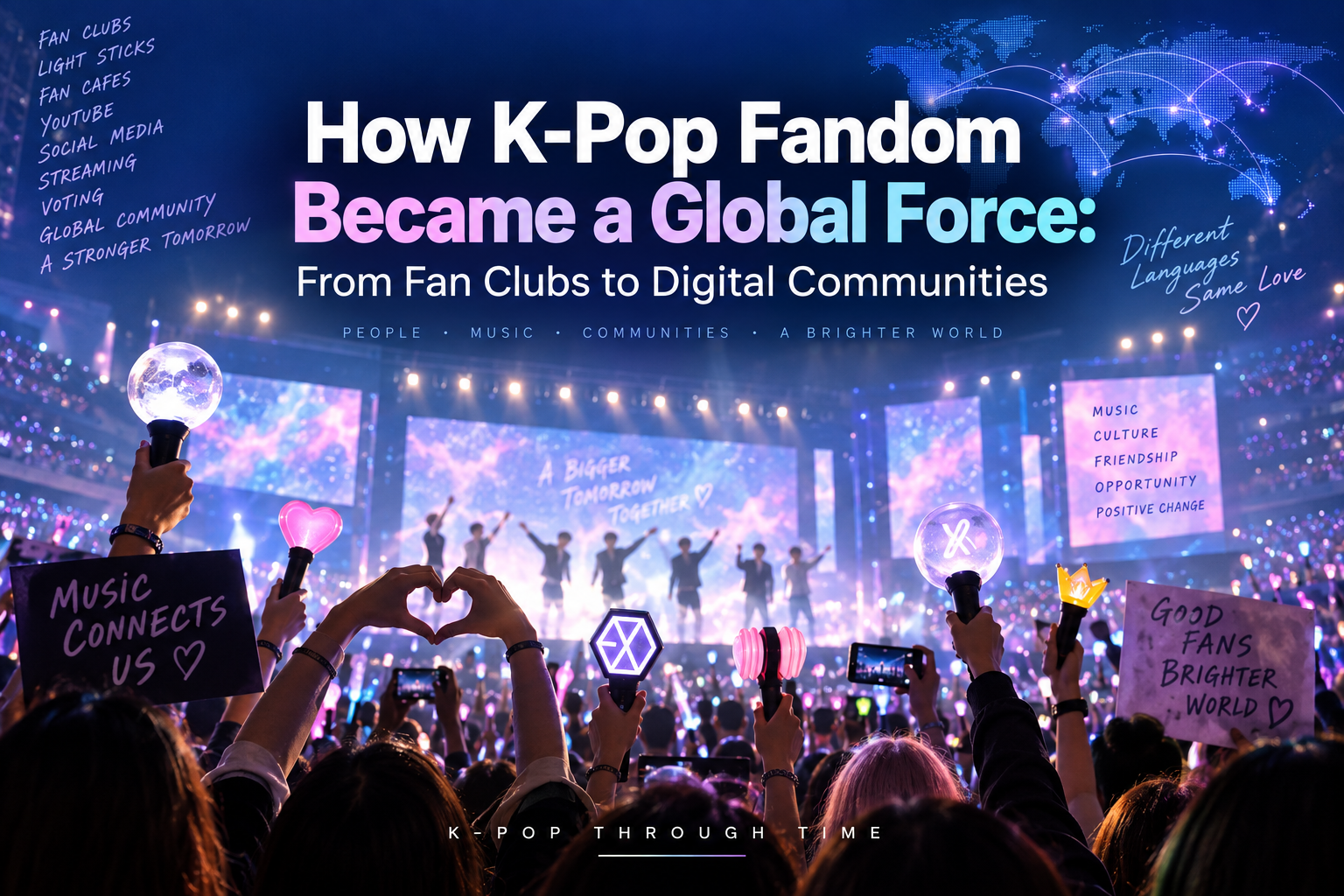
The idea eventually evolved into one of the most visually distinctive features of modern K-pop concerts.
From Balloons to Light Sticks
Official light sticks transformed fandom symbolism.
Modern K-pop light sticks can be elaborate objects designed specifically for individual artists.
Their shapes, colors, logos, and names can become instantly recognizable.
But their importance goes beyond merchandise.
At concerts, thousands of light sticks can create coordinated patterns across an arena or stadium.
Technology may allow them to synchronize with songs and stage production.
The audience becomes part of the show’s visual design.
This is a powerful reversal of the traditional relationship between performer and spectator.
Fans are watching the concert.
But they are also helping create what the concert looks like.
Fan Chants Turned Listening Into Participation
Another distinctive feature of K-pop concert and music-show culture is the fan chant.
Fans may learn specific words, member names, or responses to perform at particular moments in a song.
The effect can be striking.
The artist performs one part.
The audience answers with another.
A song that originally existed as a recording becomes a coordinated exchange between stage and crowd.
Fan chants demonstrate why K-pop fandom is best understood as participatory culture.
The ideal fan experience is often not simply:
Watch.
It is:
Learn. Respond. Participate. Belong.
The Fan Cafe Era
Before today’s global social-media platforms became dominant, online fan cafes played an important role in Korean fandom culture.
These communities provided spaces where fans could share information, discuss artists, organize activities, and sometimes receive official updates.
They helped move fandom beyond physical concerts and television broadcasts.
A fan did not need to be standing outside a broadcasting station to participate in the community.
They could connect online.
This was an important step toward the digital fandom that would later become essential to K-pop’s international expansion.
But early online communities still had limitations.
Language was one of the biggest.
For international fans, finding information about Korean artists could be difficult.
And that problem produced one of the most important unofficial roles in global K-pop fandom:
the fan translator.
Fan Translators Became Bridges Between Korea and the World
Imagine discovering a Korean group before international subtitles became common.
You enjoy the music.
You want to understand an interview.
You want to know what the members said during a livestream or television appearance.
But you do not speak Korean.
For many international fans, other fans solved the problem.
People translated interviews, television clips, social-media posts, lyrics, and news.
They created subtitles.
They explained cultural references.
They summarized information.
They shared translations through forums, blogs, video platforms, and social networks.
These activities were often unpaid.
Yet their cultural impact was enormous.
Fan translators helped reduce one of the biggest barriers between Korean artists and international audiences.
Translation Was a Form of Distribution
Traditional entertainment distribution focuses on moving products.
Fan translation moved meaning.
A music video could travel internationally on its own.
But personality-driven content was harder to export without language support.
Translation allowed overseas fans to understand jokes, conversations, interviews, and emotional moments.
That deeper understanding could strengthen attachment to individual members and groups.
In this sense, fan translators became part of K-pop’s unofficial international infrastructure.
Entertainment companies eventually expanded professional subtitling and multilingual communication, but fandom had already demonstrated the demand.
Fans did not wait for every barrier to be removed.
They began removing barriers themselves.
YouTube Changed Everything
The rise of YouTube dramatically accelerated this process.
K-pop performances no longer depended entirely on television broadcasts reaching foreign markets.
Music videos could be uploaded once and watched around the world.
Dance practices could attract enormous audiences.
Fans could discover older performances years after they originally aired.
Reaction videos, dance covers, lyric explanations, compilations, and fan-created content generated additional paths into K-pop.
This gave fandom a new function.
Fans were no longer only consuming official media.
They were producing an enormous secondary layer of media around it.
Every fan-made video had the potential to introduce another person to the artist.
The Recommendation Chain
K-pop often spreads through a simple but powerful process.
One person discovers a song.
They send it to a friend.
The friend watches another video.
An algorithm recommends a dance practice.
They search for member profiles.
They watch interviews.
They encounter fan translations.
They learn the fandom name.
Eventually, they may purchase an album or concert ticket.
This process rarely follows a company’s official marketing plan exactly.
It is distributed across fans, platforms, algorithms, and communities.
That is why K-pop’s global expansion cannot be understood only as traditional cultural export.
It also functioned as networked cultural transmission.
Millions of small acts of sharing collectively produced enormous visibility.
Social Media Removed Geographic Distance
As social platforms became central to everyday communication, the relationship between K-pop artists and international fans changed again.
A fan living thousands of kilometers from Seoul could receive an artist’s update almost immediately.
They could respond.
They could share it.
They could discuss it with fans in several countries at once.
Geographic distance still mattered for concerts and physical events.
But it mattered much less for everyday fandom.
An international fan could participate in comeback excitement at the same time as a Korean fan.
The K-pop audience was becoming synchronized across time zones.
And once those globally connected fans learned how to coordinate their activity, fandom would gain a new kind of power:
the ability to influence visibility, charts, voting, and commercial outcomes together.
Streaming Turned Fandom Into Coordinated Action
As streaming platforms became central to the music industry, K-pop fandom developed new ways of participating in an artist’s success.
Listening was no longer always treated as an entirely private activity.
Fans could organize around release dates, encourage others to discover new songs, share playlists, explain how particular platforms worked, and celebrate milestones together.
This reflected a broader transformation in fandom.
Supporting an artist increasingly meant understanding the digital systems through which music became visible.
Charts, recommendations, playlists, video views, and social-media trends became part of everyday fan conversation.
For some fans, the comeback experience now included not only enjoying the music but helping it reach a wider audience.
Streaming Guides and the Culture of Organization
Large fandoms often became highly organized during major releases.
Fan communities created guides explaining where music could be heard or purchased. Accounts specialized in chart information. Others translated schedules, organized reminders, or collected information about promotional activities.
This organization could be remarkably sophisticated.
A fandom spread across dozens of countries might coordinate without having a conventional headquarters.
Instead, networks of volunteer accounts and communities distributed information.
This is one of the defining features of digital K-pop fandom:
Organization can emerge without centralized control.
Entertainment companies may provide the official content, but fans frequently build their own systems around it.
When Support Becomes Pressure
However, organized support can have a difficult side.
When streaming goals or sales targets become highly visible, some fans may feel that enjoying the music is no longer enough.
They may feel pressure to stream repeatedly, purchase multiple albums, vote continuously, or prove that they are sufficiently dedicated.
This can turn fandom from a source of enjoyment into an obligation.
There is an important difference between:
“I want to support this artist.”
and
“I must do this or I am a bad fan.”
Healthy fandom should leave room for different levels of participation.
A person does not need to spend large amounts of money or devote every free hour to prove that music matters to them.
Voting Became Another Arena of Competition
Music programs, award ceremonies, online polls, and other competitions gave fans another way to influence visible outcomes.
Voting could become highly organized.
Fans shared instructions.
They created multiple-language guides.
They reminded one another about deadlines.
International fans who could not attend Korean music broadcasts could still feel that they were participating in the competition surrounding a comeback.
This strengthened global engagement.
But it also intensified rivalry between fandoms.
When rankings become symbolic measures of an artist’s importance, disagreement can quickly become emotional.
The competitive structure of K-pop can therefore unite people inside a fandom while creating conflict between fandoms.
Charts Became Part of Fan Vocabulary
As K-pop expanded globally, fans became increasingly familiar with music charts in different countries.
Chart performance could symbolize international recognition.
Fans discussed album rankings, digital performance, streaming numbers, sales figures, and other measurements.
This created a highly data-aware fan culture.
But numbers require context.
Different charts measure different things.
Rules can change.
Markets vary in size.
Physical sales and streaming represent different forms of consumption.
A high ranking on one chart does not automatically mean the same thing as a high ranking on another.
The danger appears when numbers stop being tools for understanding success and become the only definition of success.
Music has cultural value that cannot always be reduced to a ranking.
Social Media Created Global Fan Headquarters
Platforms such as X, Instagram, TikTok, YouTube, and other online communities allowed fandoms to operate continuously across borders.
There was no single closing time.
When fans in Seoul went to sleep, fans in Europe or the Americas could continue discussions.
Information moved across time zones.
Translations appeared.
Performance clips circulated.
Memes spread.
Voting reminders continued.
The global fandom effectively became a twenty-four-hour network.
This was something earlier generations of fan clubs could not easily achieve.
Physical distance no longer prevented coordinated participation.
Fan Accounts Became Specialized Media Channels
As fandoms grew, some fan accounts developed specialized roles.
One account might focus on translations.
Another might track schedules.
Another might explain charts.
Another might archive photographs or performances.
Some focused on fashion, choreography, lyrics, music production, or individual members.
These accounts could attract large audiences of their own.
In effect, fandom created an unofficial media ecosystem surrounding the official entertainment industry.
This ecosystem could be extraordinarily useful.
It helped fans navigate enormous amounts of content.
But it also created a new challenge:
Who verifies the information?
The Problem of Rumors and Misinformation
Speed is one of social media’s greatest strengths and greatest weaknesses.
A translation can reach thousands of people within minutes.
So can an incorrect translation.
A rumor can travel globally before reliable information appears.
An edited video clip can remove important context.
A mistranslated sentence can create unnecessary controversy.
Fan communities therefore carry responsibilities as well as power.
The larger an account becomes, the more influence it may have over how other fans understand events.
Responsible fandom requires distinguishing confirmed information from speculation.
It also requires recognizing that being first is not always more important than being accurate.
Parasocial Relationships Became More Intense
K-pop has always encouraged emotional connection between idols and fans.
Digital media made that connection feel more immediate.
Fans can watch livestreams from artists.
They can receive frequent updates.
They can see behind-the-scenes content.
Some platforms allow forms of paid or membership-based communication that can feel highly personal.
This can create genuine comfort and enjoyment.
An artist’s music or messages may help someone through a difficult period.
A fandom can provide friendships and a sense of belonging.
But the relationship remains structurally unequal.
A fan may know hundreds of details about an idol.
The idol usually does not know the individual fan personally.
This is known as a parasocial relationship—a one-sided sense of familiarity with a public figure.
Parasocial relationships are not automatically unhealthy.
The problem begins when emotional closeness is mistaken for personal ownership.
Fans Do Not Own Idols
One of the most difficult tensions in idol culture appears when some fans believe that financial or emotional support gives them authority over an artist’s private life.
Dating can become controversial.
Personal decisions may be intensely criticized.
Some individuals may attempt to discover private schedules, travel information, addresses, or other personal details.
This crosses a fundamental boundary.
Supporting an artist does not create ownership of that person.
Buying albums does not purchase control over an idol’s relationships.
Following someone online does not create a right to their private life.
A sustainable fan culture must recognize that idols are public performers with private human lives.
Sasaeng Behavior Shows the Extreme
K-pop discussions often use the term sasaeng to describe obsessive behavior that seriously violates an artist’s privacy or safety.
Such behavior can include stalking or intrusive attempts to access private information and spaces.
It should not be confused with ordinary enthusiastic fandom.
Most fans do not behave this way.
In fact, fan communities often criticize invasive behavior themselves.
The distinction is important because intense enthusiasm and harmful intrusion are not the same thing.
A person can be deeply devoted to an artist while still respecting boundaries.
Respect is not the opposite of fandom.
It is one of the conditions for healthy fandom.
Fan Wars and the Cost of Competition
Competition between fandoms has existed since early idol culture.
Digital platforms amplified it.
Disagreements over charts, awards, popularity, records, or perceived disrespect can escalate rapidly.
Anonymous or semi-anonymous accounts can make aggressive behavior easier.
Sometimes the original artists have little or nothing to do with the conflict.
This reveals another paradox.
Fandom can create friendship across countries and cultures.
The same group identity can also produce tribal behavior.
When supporting one artist becomes inseparable from attacking another, fandom loses much of what makes music valuable in the first place.
K-Pop Fandom Can Also Mobilize for Good
The organizational abilities developed by K-pop fandom are not used only for charts or voting.
Fan communities have also organized charitable donations, fundraising campaigns, environmental projects, disaster support, and other forms of social action.
Some projects are organized in connection with birthdays or anniversaries.
Others respond to particular causes or emergencies.
The important point is not that every fandom participates in the same activities.
It is that the infrastructure created for entertainment can also be redirected toward other goals.
Fans already know how to communicate quickly.
They know how to coordinate internationally.
They know how to collect small contributions from large numbers of people.
Those same skills can support social initiatives.
Fandom Creates Friendships Across Borders
One of the least measurable but most important effects of K-pop fandom is social connection.
People who might never otherwise meet can become friends because they follow the same artist.
They may live in different countries.
They may speak different first languages.
They may come from different generations or cultural backgrounds.
Music gives them an initial reason to communicate.
Over time, the relationship can become larger than the artist who introduced them.
This is one reason fandom cannot be understood purely as consumer behavior.
People purchase products, but they also create relationships.
The economic value of fandom is significant.
Its social value can be just as meaningful.
From Community to Economic Power
As fandom became larger, more organized, and more international, entertainment companies could no longer treat fans simply as the final consumers of finished music.
Fans had become active participants in the entire K-pop ecosystem.
They influenced album demand.
They filled concert venues.
They purchased merchandise.
They supported fan platforms.
They amplified promotional content.
They helped new listeners discover artists.
They created cultural communities that could persist between releases.
In other words, fandom became both a cultural network and an economic force.
And that raises an important question:
When millions of highly organized fans can influence visibility, sales, and global conversation, how much power do fans actually have—and where are the limits of that power?
How Much Power Do K-Pop Fans Really Have?
Modern K-pop fandom can be remarkably powerful.
Fans can help songs gain visibility, fill arenas, create demand for albums and merchandise, translate content, organize international communities, and attract attention from media and brands.
But fan power has limits.
Fans can amplify an artist.
They cannot completely control the music industry.
They cannot guarantee that a song will become a lasting hit.
They cannot determine every company decision.
And they do not own the artists they support.
Understanding this balance is important because K-pop works through an unusual relationship between three major forces:
artists, entertainment companies, and fandoms.
Each depends on the others, but none has complete control.
Fans Can Influence Companies
Organized fandoms can make their opinions difficult for entertainment companies to ignore.
Fans may object to poor promotion, demand better treatment, criticize scheduling decisions, or raise concerns about an artist’s health and safety.
They may organize statements, petitions, boycotts, or other collective actions.
Because fandom contributes directly to album sales, concerts, merchandise, platforms, and online visibility, companies have economic reasons to pay attention.
This does not mean every fan demand is reasonable or that companies should automatically follow every online campaign.
But the relationship is no longer entirely one-directional.
Companies communicate with fans.
Fans respond.
And sometimes that response affects business decisions.
The Consumer Became a Participant
Traditional entertainment businesses often followed a relatively simple model:
A company created a product.
The audience purchased it.
K-pop complicated that relationship.
Fans help circulate promotional material.
They create translations.
They organize streaming and voting information.
They produce fan art, edits, dance covers, reaction videos, memes, and educational content.
They create communities that keep artists culturally visible between releases.
The consumer therefore becomes a participant in the distribution and interpretation of the product.
This is one reason K-pop could expand globally so efficiently.
Entertainment companies did not have to build every international connection themselves.
Fans helped build many of them.
But Fan Labor Raises Difficult Questions
The phrase fan labor is sometimes used to describe unpaid activities through which fans create value around entertainment.
This does not mean every fan project should be understood as exploitation.
Many fans translate, edit, organize, or create content because they genuinely enjoy doing it.
The activity itself may provide friendship, creativity, status within the community, or personal satisfaction.
But the economic relationship is worth examining.
When unpaid fan activity increases an artist’s visibility, it can also increase the commercial value of the company behind that artist.
The boundary between participation and labor can therefore become complicated.
K-pop provides a particularly clear example of how modern digital entertainment can turn audience enthusiasm into productive activity.
Fandom Is Not One Unified Mind
Large fandoms are often discussed as though they were single individuals.
“ARMY thinks this.”
“BLINK wants that.”
“Fans are angry.”
But a fandom may contain millions of people with different ages, nationalities, values, personalities, and opinions.
No single social-media account speaks for everyone.
A trending hashtag does not necessarily represent the entire community.
The loudest voices are not always the majority.
Recognizing this diversity helps prevent one of the most common mistakes in discussions of K-pop:
treating the behavior of a small number of people as evidence about every fan of an artist.
Different Countries Create Different Fan Cultures
As K-pop expanded internationally, fandom practices were adapted to local environments.
Fans in South Korea may have different opportunities for music-show attendance or domestic events.
Japanese fandom operates within a distinctive music market and concert culture.
Fans in North America, Europe, Southeast Asia, Latin America, the Middle East, and other regions encounter K-pop through different languages, platforms, media environments, and economic conditions.
This means there is no single global K-pop fan experience.
The culture travels, but it also changes as people participate in it.
That process is one reason K-pop has become genuinely global rather than simply internationally distributed.
Fans Became Cultural Interpreters
International fandom does more than translate Korean words.
Fans often explain Korean cultural references, honorifics, television formats, food, school culture, holidays, military service, and other aspects of Korean society to one another.
This can create curiosity about South Korea beyond music.
Some fans begin studying Korean.
Others become interested in Korean dramas, food, fashion, beauty, history, or travel.
K-pop can therefore operate as an entry point into a much larger cultural landscape.
However, fan explanations are not always accurate.
Korean society is complex, and entertainment content cannot represent an entire country.
Responsible cultural exchange requires curiosity without assuming that fandom expertise automatically equals expertise about Korea.
K-Pop Fandom and the Korean Wave
This broader cultural curiosity connects fandom to the Korean Wave, or Hallyu.
K-pop is only one part of Hallyu, alongside television, film, food, beauty, fashion, gaming, and other cultural industries.
But fandom can create pathways between these areas.
A person may discover Korea through an idol group and later watch a Korean film.
Another may begin with a drama and later explore K-pop.
Another may visit South Korea after years of engagement with Korean culture.
The economic impact can therefore extend beyond entertainment companies.
K-pop fandom can influence tourism, consumer products, language learning, and perceptions of South Korea itself.
This gives fandom significance beyond the music industry.
The Global Concert as a Meeting Place
Perhaps nowhere is global fandom more visible than at an international K-pop concert.
Online communities suddenly become physical.
People who have communicated through screens meet in person.
Fans trade photocards.
They distribute banners.
They wear clothing associated with the artist.
They carry light sticks.
They learn fan chants.
For several hours, strangers behave like members of the same community.
The concert is therefore more than a performance.
It is a temporary physical home for a fandom that normally exists across countries and digital platforms.
This helps explain why concerts can have such powerful emotional value.
They transform an online identity into a shared real-world experience.
Why Fandom Is So Valuable to the K-Pop Business
In the previous chapter, we examined how K-pop entertainment companies make money.
Fandom is the thread connecting many of those revenue sources.
A dedicated fan may stream music.
Purchase albums.
Attend concerts.
Buy merchandise.
Join memberships.
Use fan platforms.
Follow brand collaborations.
Consume additional content.
But the most valuable characteristic of fandom may be continuity.
A hit song can disappear from public attention quickly.
A strong fandom can remain for years.
It can support an artist through changing musical trends, individual projects, military-service periods, hiatuses, contract changes, and later stages of a career.
For entertainment companies, that long-term relationship can be more valuable than temporary viral attention.
Why Trust Matters
Because fandom has economic value, trust becomes essential.
Fans need to believe that the company respects the artist.
They need to believe official products provide reasonable value.
They need confidence that communication is authentic enough to sustain the relationship.
Repeated disappointment can damage that trust.
Artists also need trust.
They need fans who respect boundaries and understand that performers have private lives.
The strongest fandom relationship is therefore not one of unlimited access.
It is one of mutual respect at an appropriate distance.
Can K-Pop Fandom Become More Sustainable?
The future of fandom will also involve environmental and economic questions.
Multiple album versions, international shipping, collectible merchandise, concert travel, and frequent product releases all have environmental costs.
At the same time, fandom participation can become financially demanding.
Future fan culture may increasingly ask whether support can be meaningful without requiring constant consumption.
Digital collectibles, more sustainable packaging, responsible merchandise production, and new forms of participation may become more important.
The question is not whether fans should stop supporting artists.
It is whether the industry can create ways of supporting them that remain enjoyable and sustainable over the long term.
The Next Generation of Fandom
Technology will continue changing the relationship between artists and audiences.
Artificial intelligence, real-time translation, virtual spaces, immersive concerts, new community platforms, and other technologies could reduce geographic and language barriers even further.
A fan may eventually experience a concert or fan event in ways that are difficult to imagine today.
But technological change will not remove the basic human reason fandom exists.
People want to connect.
They want to share excitement.
They want to belong to communities.
They want music to mean something beyond the moment it plays through a speaker.
The platforms will change.
That emotional need probably will not.
From Fan Clubs to a Global Network
The history of K-pop fandom reflects the history of K-pop itself.
Early idol fan clubs established strong collective identities.
Fandom colors made communities visible.
Fan chants turned audiences into participants.
Online fan cafes created new spaces for organization.
Fan translators helped international audiences cross language barriers.
YouTube made performances globally accessible.
Social media connected fandoms across time zones.
Streaming and voting created new forms of coordinated participation.
Dedicated platforms brought fandom and commerce closer together.
What began as organized support around Korean idol groups evolved into a worldwide digital network.
Fans Did Not Simply Watch K-Pop Go Global
This is the central point.
K-pop was not created by fans alone.
Artists, producers, songwriters, choreographers, entertainment companies, media organizations, technology platforms, and many others all contributed to its expansion.
But fans were not passive passengers on that journey.
They translated.
They recommended.
They organized.
They purchased.
They traveled.
They created communities.
They introduced K-pop to friends who had never heard Korean pop music before.
Millions of individual actions accumulated into global cultural momentum.
Fans did not simply watch K-pop go global.
They helped carry it there.
What Comes Next?
We have now followed K-pop from its historical development through four generations, into the trainee system, the entertainment business, and the global power of fandom.
The next question takes us to another defining feature of the industry:
Why does K-pop look so different from much of global pop music?
The answer lies in the extraordinary importance of choreography, music videos, fashion, concepts, stage design, and visual storytelling.
In the next chapter of K-Pop Through Time, we will explore how K-pop became a visual culture—and why performance and image became almost as important as the music itself.