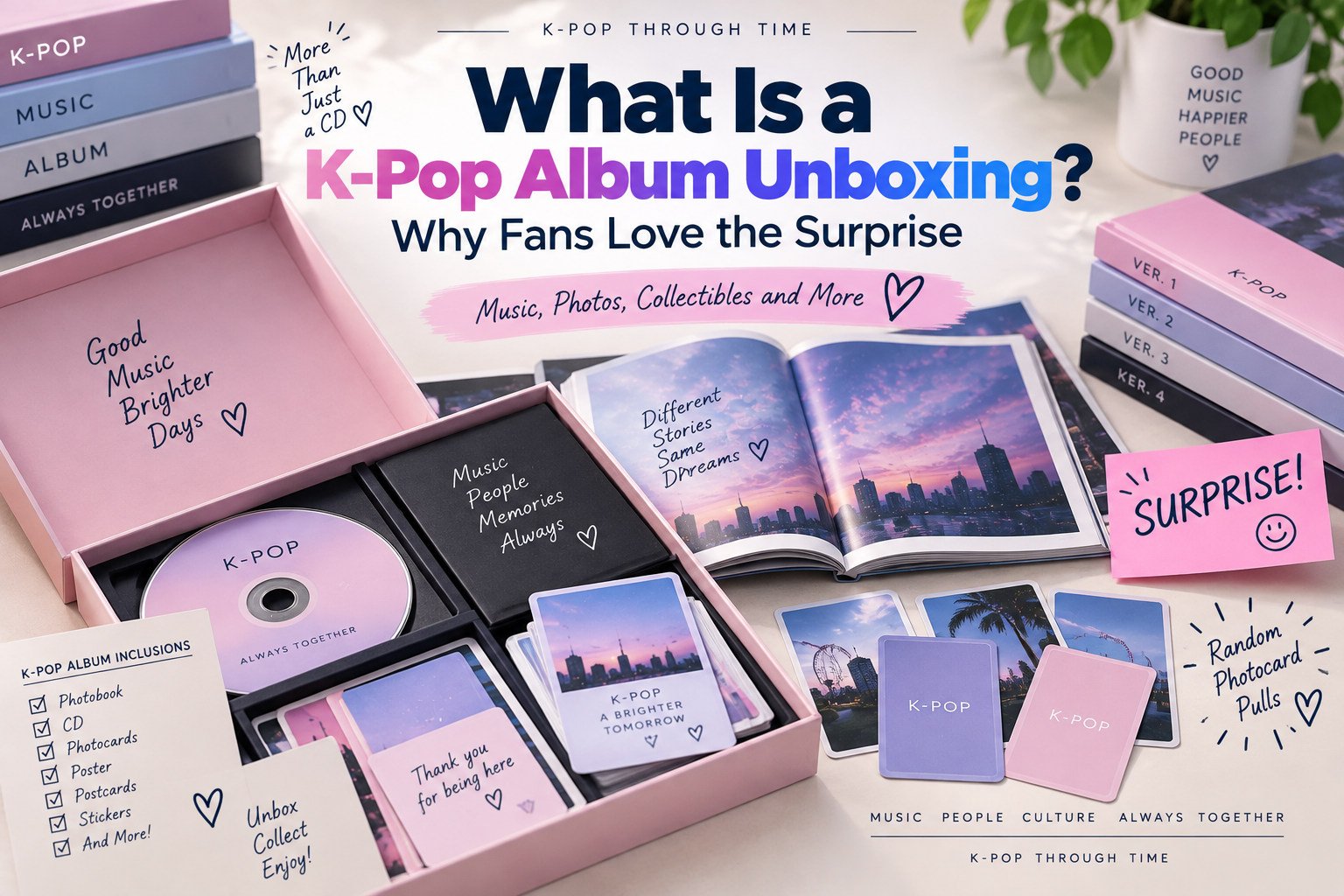
Buying a K-pop album should be exciting. But for international fans, choosing the wrong version can mean paying for a CD you cannot play, missing the photocard you wanted, or discovering that international shipping costs almost as much as the album.
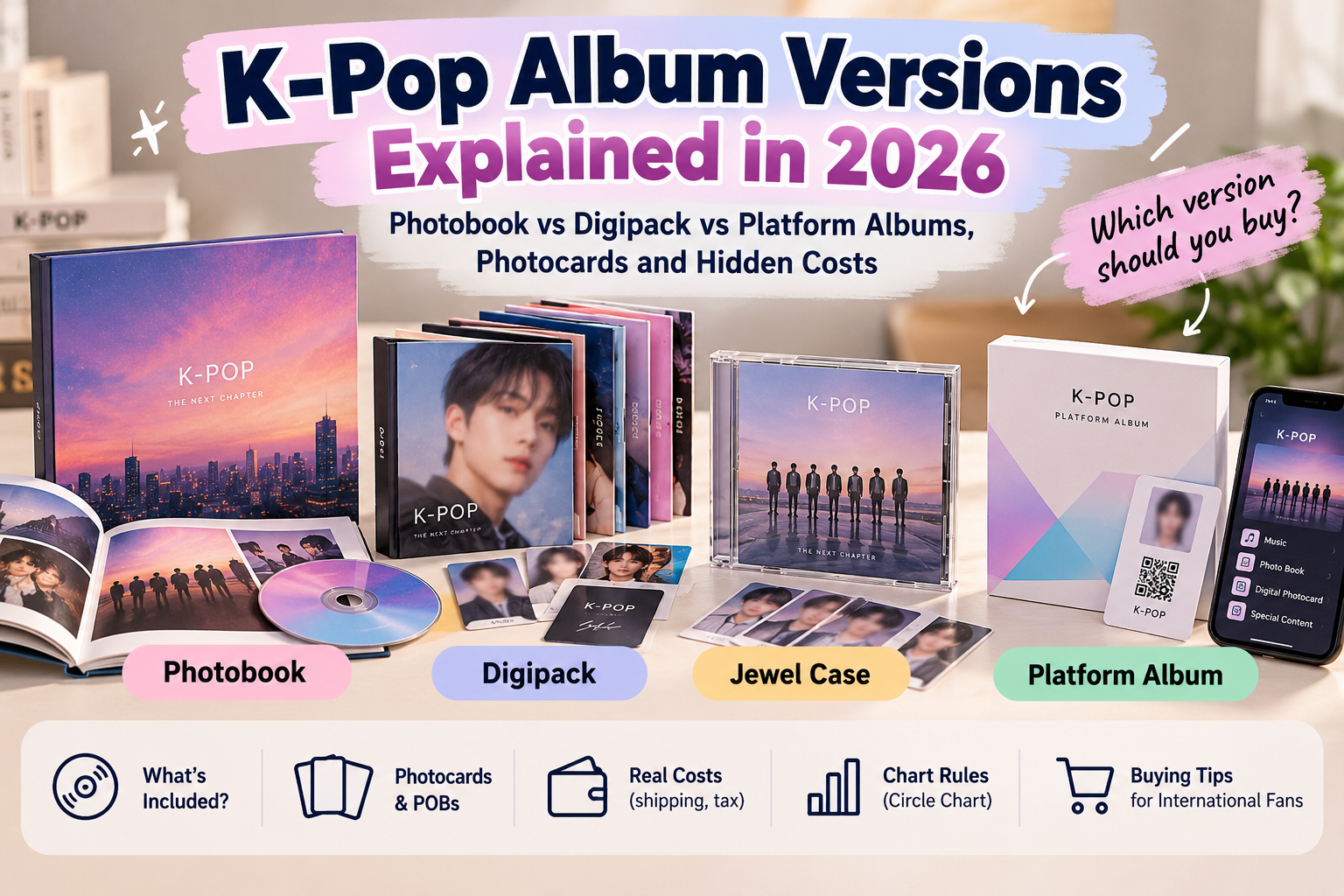
A single comeback may offer photobook editions, member-specific digipacks, jewel cases, QR-based platform albums and retailer-exclusive pre-order benefits.
They are not necessarily different musical releases. Often, they are different ways of packaging and collecting the same music.
The best K-pop album version depends on what you actually want: a CD, a photobook, a specific member, collectible photocards, or an affordable way to support your favorite artist.
This 2026 guide explains how to choose without overspending.
Quick Answer: Which K-Pop Album Version Should You Buy?
| Your main priority | Start with | Check before buying |
|---|---|---|
| Large concept photos and a physical CD | Photobook version | Page count, dimensions and CD inclusion |
| Your favorite member’s cover | Member digipack | Whether member selection is guaranteed |
| A compact, conventional CD | Jewel case | Included photos and photocards |
| App-based music and portable collectibles | Platform or QR album | App compatibility, redemption and CD absence |
| A retailer-exclusive photocard | Eligible POB edition | Benefit eligibility, deadline and stock |
| Lowest total international cost | Compare all formats | Shipping, tax and checkout fees |
These are starting points, not universal rules. Album specifications vary by artist and release.
1. Photobook Albums: Best for Fans Who Want the Full Visual Concept
The photobook edition is often the most visually substantial format.
Depending on the release, it may include:
- A printed photobook
- A physical CD
- One or more random photocards
- Posters, stickers, postcards or lyric materials
- Version-specific concept photography
A photobook album can be particularly satisfying if you enjoy displaying albums or revisiting the photography long after the comeback.
However, larger packaging can increase shipping costs, particularly when buying several albums internationally.
Best for: Fans who value printed photography, physical music ownership and display-worthy packaging.
Watch out for: Paying more for size and weight when you primarily want a single photocard.
2. Digipack Albums: Smaller Packaging, Often With Member Covers
A digipack generally uses compact cardboard packaging rather than a large album box.
Many K-pop releases offer member-specific covers, although the exact design depends on the artist.
A digipack may contain a CD, a smaller booklet and photocards. It does not automatically guarantee a photocard matching the member on the cover.
For example, official AHOF digipack specifications for RUN TO YOU list member and group versions, a CD, a 16-page photobook and randomly included photocards.
This illustrates an important distinction: choosing a member cover is not necessarily the same as choosing a member photocard.
Best for: Fans who want a compact physical CD or a particular member’s cover.
Watch out for: Listings marked random version, even when the product photographs show every member.
3. Jewel Case Albums: A Conventional CD in Compact Packaging
Jewel case versions generally resemble traditional CD releases.
They are useful for fans who want a physical disc without the size of a full photobook package.
Some releases add booklets, photocards or alternative covers, but inclusions differ.
A jewel case may be less expensive to ship because it is compact, although shipping prices depend on the retailer and destination.
Best for: Fans who primarily want a physical CD and prefer smaller packaging.
Watch out for: Assuming the jewel case includes the same printed photographs as the larger edition.
4. Platform Albums: What Are QR, Weverse, Nemo and POCA Versions?
Platform albums are one of the most confusing categories for first-time buyers.
Instead of relying on a conventional CD, these editions may use a QR code, NFC technology or another physical access item to connect to music and digital content through an app.
Weverse Albums, for example, describes a system that lets users register albums through QR codes and access music, digital photobooks and digital photocards.
Other platforms may work differently.
Before buying, check:
- Is there a physical CD?
- Which app is required?
- Does the app work in your country?
- How is the album registered?
- Can the access item be reused after registration?
- What happens if you change phones?
- Can you listen offline after completing the required setup?
Best for: Fans who prefer compact collectibles and are comfortable accessing music through an app.
Watch out for: Assuming a QR-based album can be played in a CD player or that all platforms have identical access rules.
Do Platform Albums Count Toward K-Pop Album Charts?
Some do, but not every QR-based product should automatically be treated as chart-eligible.
Circle Chart officially recognizes approved platform album formats under defined requirements, including distribution, release status and access conditions.
Its album chart methodology is based on distribution volume adjusted for returns, rather than simply counting every purchase made by a fan.
If chart contribution matters to you, verify the exact album and seller’s stated chart eligibility.
Do not assume that buying a digital code, a platform album and a conventional CD will always have identical reporting arrangements.
5. Random Photocards: What Does “Random 1 of 8” Actually Mean?
Suppose an album lists:
Photocard: Random 1 out of 8.
That means the album contains one card selected from eight possible designs. It does not mean you receive all eight cards.
Buying two albums also does not guarantee two different cards.
You may receive duplicates.
A member-specific album cover does not necessarily guarantee a matching member photocard unless the product specifications explicitly say so.
A Better Photocard Buying Strategy
If you only want one particular card, compare the total cost of buying random albums with the cost of obtaining that card separately from a reputable seller or through a trusted trade.
For example, if an album has eight equally likely card designs and includes one card, the probability of obtaining one specific card from a single album would be 12.5%.
With three independent purchases under those assumptions, the probability of receiving that card at least once is approximately 33%.
Actual distributions and packaging practices can differ, so this is an illustration rather than a guarantee.
The key lesson: Buying more random albums can become expensive without guaranteeing your desired photocard.
6. What Is a POB? Pre-Order Benefits vs Album Inclusions
POB means pre-order benefit.
A POB is an additional item offered under particular promotional conditions, often by a specific retailer or for a particular purchase period.
It may be a photocard, postcard or another collectible.
But a POB is not necessarily included in every copy of the album.
Consider three separate items:
| Item | What it means | Main risk |
|---|---|---|
| Standard album photocard | Included according to the album specifications | Usually random |
| Retailer POB | Extra benefit for qualifying purchases | Deadline, stock or seller restrictions |
| Lucky draw benefit | Promotional collectible offered under event rules | Eligibility and selection conditions |
A product listing that says POB included should identify the actual promotion or provide enough detail for you to verify it.
Before paying, check whether the benefit is guaranteed, random, limited to a certain quantity or available only while supplies last.
For collectors, the retailer and promotion can matter as much as the album version.
7. The Hidden Cost of Buying K-Pop Albums Internationally
A lower album price does not necessarily mean a cheaper purchase.
International buyers should compare the final delivered cost, not just the price displayed on the product page.
Here is a hypothetical example. These are illustrative figures, not current retailer quotes.
| Cost component | Photobook album | Compact album |
|---|---|---|
| Album price | $22 | $15 |
| International shipping | $19 | $13 |
| Estimated tax or handling | $5 | $4 |
| Total delivered cost | $46 | $32 |
The compact version saves $14 in this example, even though the album itself costs only $7 less.
Your actual total depends on shipping weight, destination, carrier, taxes and seller policies.
Three Costly Mistakes to Avoid
Mistake 1: Buying multiple albums without comparing combined shipping.
Some sellers calculate shipping by package weight, while others use different rules. Combining items may save money, but it is not guaranteed.
Mistake 2: Paying extra for a POB you do not particularly want.
A promotional photocard can be valuable to collectors, but that does not mean it offers value to every buyer.
Mistake 3: Ordering a random version when you want a specific member.
Check whether the retailer allows version selection before paying.
8. Do All Album Versions Have the Same Songs?
Often, different packaging versions of one release share the same tracklist.
However, that should not be assumed for every special edition, repackage, regional release or platform product.
Always compare the official tracklist and edition details.
If you are trying to understand the distinction between a single, mini album and full album, see our guide:
What Is a K-Pop Mini Album? EPs, Singles, and Full Albums Explained
The album format describes how the music is packaged or accessed; the release type describes the musical project itself.
9. Which K-Pop Album Should You Buy? Four Realistic Scenarios
Scenario A: You Are Buying Your First K-Pop Album
Choose a photobook version if the printed photographs and physical CD are important to you.
If your budget is limited, compare the total delivered cost with a compact edition.
Do not buy every version simply because they are displayed together.
Scenario B: You Only Collect One Member
Start by looking for an officially selectable member version.
Then check whether the cover, booklet and photocard are member-specific or random.
If the photocard is your real priority, buying random albums may not be the most economical option.
Scenario C: You Want to Support a Comeback
Check whether the seller identifies the purchase as eligible for the relevant album charts.
Circle Chart and Hanteo are not interchangeable systems, and their reporting methods should not be assumed to be identical.
Buy from a seller whose eligibility claims are clear and verifiable.
You can also read our related explanation:
Inside the K-Pop Comeback: Why Every New Release Becomes a Major Event
Scenario D: You Live Outside South Korea
Compare the final checkout price for at least two album formats.
Include international shipping, import charges where applicable, currency conversion and any additional fees.
A compact album may be the better value, but the cheapest choice depends on your destination and what you want to collect.
10. Seven Things to Check Before You Order
Use this checklist before completing your purchase:
- The exact album version is identified.
- The listing confirms whether a physical CD is included.
- Member selection or random allocation is clearly stated.
- Standard inclusions are distinguished from POBs.
- The platform and app requirements are clear, if applicable.
- Chart eligibility is verified if it matters to you.
- The final delivered cost fits your budget.
Taking a few minutes to verify these details can prevent expensive disappointment.
Frequently Asked Questions
Is a digipack a real K-pop album?
Yes. A digipack is a legitimate physical packaging format when released as an official album edition. Its contents vary by release.
Does a platform album include a CD?
Many platform albums use QR, NFC or similar access systems instead of a conventional CD. Check the exact product specifications.
Does buying a member version guarantee that member’s photocard?
Not necessarily. The cover and photocard allocation may follow different rules.
Are pre-order benefits included in every album?
No. POB eligibility depends on the promotion, retailer, purchase timing and stock conditions.
Are platform albums counted on Circle Chart?
Approved platform album formats can qualify under Circle Chart’s official criteria. Eligibility should be verified for the specific release and format.
Should I buy every version to support my favorite group?
You do not need to purchase every version to enjoy or support an artist. Choose according to your budget and what you actually value.
Final Verdict: Buy for Your Purpose, Not the Number of Versions
There is no single best K-pop album format.
A photobook edition may offer the most satisfying physical collection. A digipack may be ideal for a member-focused fan. A jewel case can provide a compact CD, while a platform album may appeal to someone who prefers app-based access.
The smartest purchase is the one that matches your priorities without unnecessary spending.
Before ordering, verify the version, inclusions, benefits, chart claims and total delivery cost.
One carefully chosen album can be more satisfying than several versions bought without knowing what is inside.
Sources and Further Reading
- Circle Chart — Official FAQ — platform album eligibility and requirements
- Circle Chart — Album Chart — chart methodology
- Weverse Albums — Official Product Overview — QR-based music and digital content
- Weverse Shop — AHOF RUN TO YOU Digipack Specifications — official example of member versions and random inclusions