Tag: j-hope

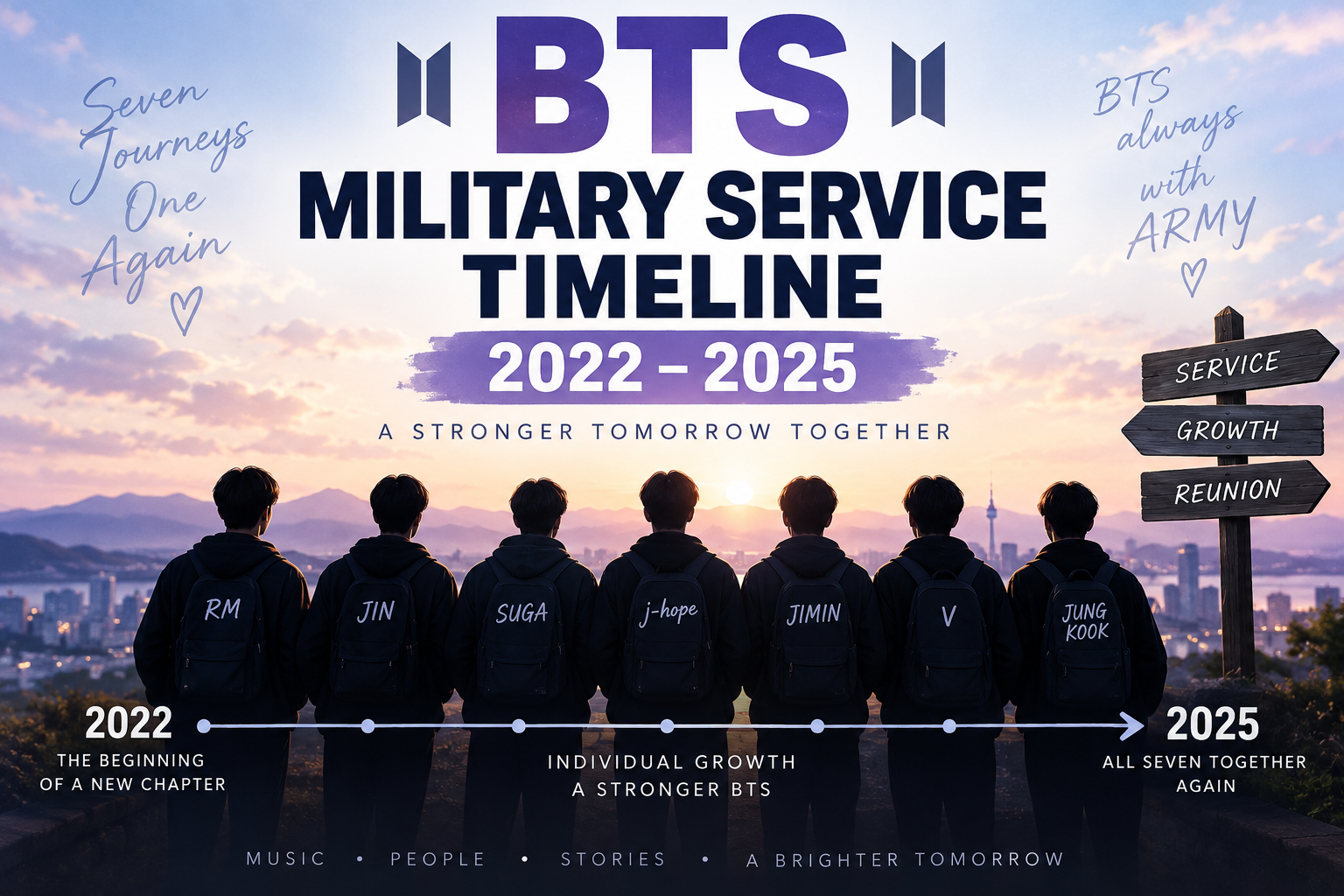
  • BTS Military Service Dates: All 7 Members (2022–2025)

    BTS Military Service Dates: All 7 Members (2022–2025)

    All seven BTS members have now completed their military service. Jin enlisted first on December 13, 2022, and SUGA became the final member to complete his service on June 21, 2025.

    Between 2022 and 2025, all seven BTS members — RM, Jin, SUGA, j-hope, Jimin, V, and Jung Kook — completed their mandatory service obligations in South Korea. For ARMY around the world, this period became an important part of the BTS story, filled with solo projects, temporary goodbyes, and long-awaited returns.

    In this guide, we’ll follow the BTS military service timeline from the group’s early years through 2026, including when each member enlisted, when they completed their service, and what happened as BTS entered a new chapter together.

    Whether you are a longtime ARMY or a new fan discovering BTS, this timeline will help you understand one of the most significant periods in the group’s history.

    Why BTS Had to Complete Military Service

    In South Korea, most able-bodied men are required to complete mandatory military service. For years, BTS’s global success led to widespread discussion about how the country’s military service rules would apply to the group.

    In 2020, South Korea revised its laws to allow certain pop culture artists who had received government recognition to postpone enlistment until age 30. This allowed eligible BTS members to delay their service, but it did not provide a full exemption.

    The next major turning point came in October 2022, when BIGHIT MUSIC announced that the BTS members would move forward with plans to fulfill their military service obligations. Jin, the group’s oldest member, became the first to enlist in December 2022.

    His enlistment marked the beginning of a new era in BTS history — one in which the seven members would temporarily focus on military service and individual activities before eventually returning as a complete group.

    BTS Military Service Timeline: All Seven Members

    MemberEnlistedCompletedService Type
    JinDec 13, 2022Jun 12, 2024Active duty
    j-hopeApr 18, 2023Oct 17, 2024Active duty
    SUGASep 22, 2023Jun 21, 2025Social service
    RMDec 11, 2023Jun 10, 2025Active duty
    VDec 11, 2023Jun 10, 2025Active duty
    JiminDec 12, 2023Jun 11, 2025Active duty
    Jung KookDec 12, 2023Jun 11, 2025Active duty

    BTS completed its military service chapter step by step, beginning with Jin in December 2022 and ending when SUGA completed his alternative service in June 2025.

    Jin
    Jin became the first BTS member to enlist, entering military service on December 13, 2022. He served as an active-duty soldier and was discharged on June 12, 2024. His return was especially meaningful for ARMY because he became the first member to complete his service.

    j-hope
    j-hope enlisted on April 18, 2023. After serving as an active-duty soldier and working as an assistant instructor, he was discharged on October 17, 2024.

    SUGA
    SUGA began his service obligation on September 22, 2023. Due to circumstances related to a previous shoulder injury, he fulfilled his duty as a social service worker rather than an active-duty soldier. He completed his service on June 21, 2025.

    RM and V
    RM and V enlisted on December 11, 2023. Both completed their military service and were discharged on June 10, 2025.

    Jimin and Jung Kook
    Jimin and Jung Kook enlisted together on December 12, 2023. They were discharged on June 11, 2025, leaving SUGA as the final BTS member still completing his service obligation.

    By June 21, 2025, all seven BTS members had officially completed their military service obligations, closing a major chapter in the group’s history.

    What Happened to BTS During the Military Service Period?

    BTS did not simply disappear while the members completed their military service. Instead, this period became one of the most important eras for their individual careers.

    Before and during their enlistments, the members released solo albums, singles, documentaries, and other projects that allowed each artist to show a different musical identity.

    Jin released solo music surrounding his military-service period, while j-hope continued expanding his solo career through music and special projects. RM explored a more experimental side of his artistry, and SUGA developed his Agust D catalog further through his solo album and tour.

    Jimin, V, and Jung Kook also achieved major international success with their individual releases. Their solo projects introduced different sides of BTS to listeners who may not previously have followed the group closely.

    This strategy helped BTS remain visible globally even while group activities were limited. Instead of becoming an empty period in BTS history, the military-service era became a bridge between the group’s first decade and the next stage of their career.

    BTS Reunites: A New Chapter After Military Service

    June 2025 became a historic month for BTS and ARMY. With RM, V, Jimin, Jung Kook, and finally SUGA completing their service obligations, all seven members were once again free to pursue group activities.

    The end of military service did not simply represent a return to the past. BTS entered a different stage of its career: all seven members had experienced years of solo work, personal growth, and time away from full-group promotions.

    That made the next chapter especially significant. Fans around the world began looking toward new group music, performances, and opportunities to see RM, Jin, SUGA, j-hope, Jimin, V, and Jung Kook together again.

    For new fans, the military-service timeline is therefore more than a collection of enlistment and discharge dates. It marks the transition between two major eras of BTS — the extraordinary rise of the group before enlistment and the beginning of their post-military era.

    Frequently Asked Questions About BTS Military Service

    When did BTS begin military service?
    Jin became the first BTS member to enlist when he entered military service on December 13, 2022.

    Who was the first BTS member to finish military service?
    Jin was the first member to complete his service, returning on June 12, 2024.

    Who was the last BTS member to complete military service?
    SUGA was the final member to complete his service obligation, finishing his alternative service on June 21, 2025.

    Did all seven BTS members serve at the same time?
    No. Their service periods overlapped, but the members enlisted on different dates between December 2022 and December 2023.

    When did all BTS members finish military service?
    All seven members had completed their respective service obligations by June 21, 2025.

    Is BTS together again after military service?
    With all seven members having completed their service obligations, BTS entered its post-military chapter with the members able to resume full-group activities.

    Final Thoughts

    BTS’s military service period was a unique chapter in the group’s remarkable journey. From Jin’s enlistment in December 2022 to SUGA’s completion of alternative service in June 2025, ARMY waited as each of the seven members fulfilled his obligation and returned.

    At the same time, the members continued building their individual musical identities, helping BTS remain a major presence in global music even without regular full-group promotions.

    Now, the military-service chapter is complete. For BTS and millions of fans around the world, the focus has shifted from waiting for seven individual returns to discovering what RM, Jin, SUGA, j-hope, Jimin, V, and Jung Kook will create together in the next era of BTS history.

  • BTS Members Through Time: How Seven Artists Became Global K-Pop Icons

    BTS Members Through Time: How Seven Artists Became Global K-Pop Icons

    Seven Members, One Extraordinary Story

    Few groups have changed the global perception of K-pop as dramatically as BTS.

    But the story of BTS is not simply the story of one successful group.

    It is also the story of seven very different artists who grew together while developing individual voices, talents, and creative identities.

    RM, Jin, SUGA, j-hope, Jimin, V, and Jung Kook entered BTS with different backgrounds and strengths.

    Some were deeply connected to hip-hop.

    Some came from dance.

    Some developed primarily as vocalists.

    Others became producers, songwriters, performers, and eventually solo artists with musical worlds of their own.

    Those differences did not weaken BTS.

    They became one of the group’s greatest strengths.

    To understand BTS through time, it is worth looking at the seven individual journeys that came together to create one of the most influential acts in modern K-pop.

    Before BTS Became a Global Name

    BTS debuted on June 13, 2013, under Big Hit Entertainment.

    The group’s early identity was strongly influenced by hip-hop, and its music frequently addressed subjects connected to youth, school, social expectations, dreams, and pressure.

    Their early years looked very different from the enormous stadium tours and international success that would later define them.

    BTS had to build its audience gradually.

    Albums and eras such as 2 COOL 4 SKOOL, O!RUL8,2?, Skool Luv Affair, and Dark & Wild established the group’s early identity.

    Then The Most Beautiful Moment in Life series marked an important transition.

    The group’s storytelling became broader and more emotionally complex, focusing on youth, uncertainty, friendship, pain, and the difficult transition toward adulthood.

    Wings expanded that artistic ambition further.

    Then came Love Yourself, Map of the Soul, BE, and major global singles such as “Dynamite,” “Butter,” and “Permission to Dance.”

    The scale changed dramatically.

    But throughout that transformation, the foundation remained the same: seven members with different strengths learning how to work as one group.

    RM: The Leader, Rapper, and Thinker

    RM‘s journey is closely connected to the intellectual and lyrical identity of BTS.

    Before becoming an idol, he developed his skills within Korea’s underground hip-hop scene.

    That background gave him a strong foundation in rap and lyric writing before BTS officially debuted.

    As the group’s leader, RM eventually took on responsibilities that extended far beyond performing.

    He frequently represented BTS in interviews and international settings while also contributing to the group’s songwriting and creative direction.

    His role became especially visible as BTS expanded internationally.

    But RM’s artistic story also developed beyond the group.

    His solo work allowed him to explore identity, art, uncertainty, adulthood, and the tension between public success and private reflection.

    Projects such as mono., Indigo, and Right Place, Wrong Person revealed an artist increasingly interested in creating music without being restricted by a single genre or image.

    RM’s importance to BTS cannot be explained only by the word “leader.”

    He helped create an intellectual and lyrical foundation that became central to the group’s identity.

    Jin: From Unexpected Trainee to Distinctive Vocalist

    Jin‘s path into BTS was very different from RM’s.

    He did not enter the company with an established underground music career.

    Instead, his development happened largely within the idol training system.

    Over time, Jin grew into a vocalist whose emotional delivery became an important part of BTS’s music.

    Songs such as “Awake,” “Epiphany,” and “Moon” demonstrated how his individual vocal identity developed within the group.

    His public personality also became an important part of BTS’s chemistry.

    Humor, confidence, and the famous “Worldwide Handsome” persona gave audiences one image of Jin, while his solo songs often revealed something more reflective and vulnerable.

    That contrast became part of his appeal.

    His later solo work further demonstrated that the artist behind the humor had a musical identity worth exploring on its own.

    Jin’s journey shows that an artist does not need to begin with every skill fully developed.

    Sometimes the most important story is the growth itself.

    SUGA: Rapper, Producer, and Agust D

    SUGA entered BTS with a strong connection to hip-hop and music production.

    Before becoming a K-pop idol, he had already been developing as a rapper and producer.

    Within BTS, his sharp rap style and production knowledge became important parts of the group’s musical foundation.

    But SUGA also needed another creative identity.

    That identity became Agust D.

    Through the Agust D mixtape, D-2, and later D-DAY, he explored subjects and emotions with a directness that could feel different from BTS’s group releases.

    The Agust D identity allowed him to examine ambition, anger, success, fear, memory, and personal struggle.

    At the same time, SUGA developed a reputation as a producer and collaborator whose musical work extended beyond BTS.

    His career illustrates one of the most interesting aspects of the group: individual members could build creative identities that were distinct from BTS without rejecting the group that made those journeys possible.

    j-hope: From Street Dancer to Complete Performer

    Before j-hope became a rapper and songwriter in BTS, dance was at the center of his life.

    His roots in street dance gave him a strong performance foundation before he entered Big Hit Entertainment.

    Within BTS, j-hope became essential to the group’s choreography and stage energy.

    But reducing him to “the dancer” would miss much of his development.

    Over time, he grew as a rapper, songwriter, and solo artist.

    Hope World introduced a colorful and energetic musical identity.

    Later, Jack In The Box revealed a darker and more experimental side.

    Then HOPE ON THE STREET brought his musical career back into direct conversation with the dance culture that had shaped him from the beginning.

    His solo performances and touring further demonstrated how completely his identity had expanded.

    j-hope’s journey is a reminder that an artist’s original strength can become a foundation rather than a limitation.

    Dance opened the door.

    But his career grew far beyond it.

    Jimin: Turning Movement into Emotion

    Jimin brought another dance tradition into BTS.

    Before becoming an idol, he studied contemporary dance.

    That background helped create a performance style characterized by control, fluidity, expression, and emotional storytelling.

    Within BTS, Jimin gradually developed not only as a dancer but also as a vocalist with a highly recognizable tone.

    Songs such as “Lie” and “Serendipity” became important demonstrations of his individual identity.

    They combined voice, movement, and atmosphere in ways that felt distinctly his own.

    His solo career expanded that identity.

    FACE presented a more personal and emotionally conflicted side of Jimin.

    “Like Crazy” became one of the defining songs of that era.

    Then MUSE moved toward different themes and a broader pop direction, with “Who” becoming another major moment in his solo development.

    Jimin’s story demonstrates how dance can become more than choreography.

    In his performances, movement often functions as another form of emotional language.

    V: A Voice and Artistic World of His Own

    V entered BTS with one of the group’s most immediately distinctive vocal characteristics: a deep, warm tone that contrasted with many conventional K-pop vocal styles.

    As BTS’s music developed, songs such as “Stigma” and “Singularity” gave him opportunities to explore that voice more fully.

    But V’s artistic interests were never limited to singing.

    Acting, photography, fashion, visual art, cinema, jazz, R&B, and soul all became part of the creative world associated with him.

    His appearance in the Korean drama Hwarang demonstrated his interest in acting.

    Meanwhile, songs such as “Scenery,” “Winter Bear,” and “Snow Flower” offered early glimpses of his individual musical preferences.

    Those ideas became much clearer with Layover.

    Rather than trying to reproduce BTS’s large-scale pop sound, V built a quieter and more atmospheric solo identity.

    Later releases such as “FRI(END)S” and “Winter Ahead” continued expanding that world.

    V’s career demonstrates the value of individuality inside a group.

    His strength comes partly from the fact that his artistic instincts do not always follow the most obvious path.

    Jung Kook: From Teenage Maknae to Global Pop Star

    Jung Kook entered BTS at an exceptionally young age.

    As the group’s youngest member, he grew up publicly while BTS itself was growing.

    His versatility eventually led to the nickname “Golden Maknae.”

    He developed as a vocalist, dancer, and performer capable of adapting to many different musical styles.

    Songs such as “Begin” and “Euphoria” helped reveal his individual development within BTS.

    “Still With You” and “My You” showed a more intimate musical side.

    Then his solo career entered a completely different scale.

    “Seven” introduced Jung Kook as a major global pop soloist.

    “3D” expanded that direction.

    His first solo album, GOLDEN, brought those ideas together in a project designed around contemporary international pop.

    “Standing Next to You” particularly highlighted the combination of vocals and dance that had taken years to develop.

    Jung Kook’s story may be the clearest example of what it means to grow up inside BTS.

    Audiences first met him as a teenager.

    They eventually watched him become an artist capable of standing alone on the global pop stage.

    Seven Different Paths

    Looking at the members individually reveals something important about BTS.

    They were never seven interchangeable performers.

    RM brought leadership, rap, lyricism, and intellectual curiosity.

    Jin developed a distinctive vocal identity and emotional style.

    SUGA brought production, hip-hop, and the uncompromising voice of Agust D.

    j-hope connected dance, rap, performance, and experimentation.

    Jimin transformed contemporary dance and expressive vocals into a recognizable artistic language.

    V brought a deep vocal tone and a strong interest in visual and atmospheric artistry.

    Jung Kook developed into a versatile singer and performer with broad global pop appeal.

    Each member filled a different space.

    The group worked because those differences could coexist.

    The Power of the Rap Line

    One useful way to understand BTS is through its different internal musical strengths.

    RM, SUGA, and j-hope formed the group’s rap line.

    Yet even within that smaller unit, their styles were very different.

    RM’s rap often emphasized language, reflection, and conceptual ideas.

    SUGA could be sharper, more confrontational, and closely connected to production.

    j-hope brought rhythmic energy, performance instincts, and a distinctive sense of movement.

    Together, the three helped preserve BTS’s connection to hip-hop even as the group’s music expanded into many other genres.

    Their differences gave BTS’s rap sections unusual variety.

    The Vocal Line

    Jin, Jimin, V, and Jung Kook formed the vocal line, but they too had very different strengths.

    Jin developed an emotional and increasingly confident vocal style.

    Jimin’s higher, expressive tone became closely connected to his performance identity.

    V’s deep register gave the group warmth and contrast.

    Jung Kook’s adaptable pop voice helped connect many different parts of BTS’s sound.

    Rather than trying to make the four vocalists sound identical, BTS benefited from their contrasts.

    Different songs could emphasize different combinations.

    That flexibility became increasingly important as the group’s music moved across hip-hop, pop, R&B, EDM, ballads, and other styles.

    Why the Solo Eras Matter

    The members’ solo careers should not be understood as separate from the history of BTS.

    They are part of that history.

    After years of working within a seven-member structure, solo projects gave each artist more space to answer a fundamental question:

    What kind of music do I want to make when the entire project can revolve around my own voice?

    The answers were remarkably different.

    RM moved toward artistic experimentation and introspection.

    Jin explored his own vocal and emotional world.

    SUGA expanded the intense creative identity of Agust D.

    j-hope moved between colorful energy, darker experimentation, and dance culture.

    Jimin focused on emotion, performance, and personal transformation.

    V built an atmospheric musical world shaped by his own tastes.

    Jung Kook embraced global contemporary pop.

    The diversity of these projects reveals how much individuality had always existed inside BTS.

    From Seven Solo Stories Back to BTS

    There is an interesting paradox at the center of BTS’s solo era.

    The more clearly the members reveal their individual identities, the easier it becomes to understand the group itself.

    Listeners can hear what RM contributes.

    They can recognize SUGA’s musical instincts.

    They can understand why j-hope’s performance energy matters.

    They can hear the differences among Jin, Jimin, V, and Jung Kook as vocalists.

    Solo work makes those distinctions clearer.

    And those distinctions explain why the combination of seven members became so powerful.

    BTS was never successful because seven people became the same.

    It succeeded because seven different people learned how to build something together.

    How BTS Helped Change Global K-Pop

    BTS did not create international interest in Korean pop music by itself.

    K-pop had already traveled beyond South Korea through earlier generations of artists.

    But BTS became one of the most important forces in expanding that reach to an unprecedented scale.

    The group’s rise demonstrated that Korean artists could build enormous international audiences without abandoning their Korean identity.

    It also showed the power of direct communication between artists and global fan communities.

    Social media, online video, behind-the-scenes content, live broadcasts, music, storytelling, and constant interaction helped create a relationship between BTS and ARMY that crossed national borders.

    The result influenced how the global music industry understood K-pop.

    BTS was no longer simply successful “for a Korean group.”

    It was competing within global popular music itself.

    BTS and the Meaning of Growth

    One of the strongest themes running through BTS’s history is growth.

    Their early music frequently dealt with the frustrations of youth.

    Later albums explored uncertainty, temptation, identity, self-love, fear, adulthood, and change.

    At the same time, the members themselves were living through those transitions.

    They were growing older.

    Their music was changing.

    Their audience was expanding.

    Their responsibilities were increasing.

    And eventually, each member needed space to explore what being an individual artist meant.

    This is why looking at BTS “through time” is particularly revealing.

    The group cannot be understood through one song, one album, or one era.

    Its identity has always been changing.

    Essential BTS Songs Through Time

    For listeners beginning the BTS story, several songs help reveal major stages in the group’s development.

    “No More Dream” captures the rebellious energy of their debut.

    “I NEED U” represents a major emotional and musical turning point.

    “Blood Sweat & Tears” demonstrates the ambition of the Wings era.

    “Spring Day” reveals the group’s ability to combine emotion and accessibility.

    “DNA” marks an important stage in BTS’s international expansion.

    “Fake Love” represents the darker side of the Love Yourself story.

    “Boy With Luv” shows a brighter global pop direction.

    “Black Swan” explores the relationship between artists and their art.

    “Dynamite” became a major global pop breakthrough.

    “Butter” continued that international momentum.

    And “Yet To Come” offered a reflective look at the group’s history while pointing toward the future.

    Together, these songs provide only part of the story.

    The seven individual member journeys reveal the rest.

    BTS Members Through Time

    The story begins with seven young people entering an uncertain music industry.

    RM became the leader.

    Jin found his voice.

    SUGA turned experience into music.

    j-hope transformed movement into performance.

    Jimin combined dance and emotion.

    V built an artistic world around his distinctive voice.

    Jung Kook grew from the youngest member into a global pop performer.

    Then each began exploring what existed beyond the boundaries of the group.

    But the seven stories never truly became separate.

    They remained connected by more than a decade of shared music, performances, challenges, achievements, and growth.

    Final Thoughts

    BTS became a global phenomenon, but global success alone does not explain why the group matters.

    The deeper story is about seven individuals whose differences became the foundation of a shared identity.

    RM, Jin, SUGA, j-hope, Jimin, V, and Jung Kook did not follow identical paths into BTS.

    They did not develop identical artistic styles.

    And their solo careers have not moved in identical directions.

    That is precisely what makes the story compelling.

    Seven artists grew together.

    Then they began showing the world more clearly who they were individually.

    Those solo journeys did not erase BTS.

    They revealed the ingredients that had always existed inside it.

    To understand BTS through time is therefore to understand both stories at once:

    the story of one extraordinary group and the stories of seven artists who made it possible.

    And as their individual and collective journeys continue, the history of BTS remains unfinished.


  • j-hope of BTS: From Street Dancer to Global K-Pop Star

    j-hope of BTS: From Street Dancer to Global K-Pop Star

    Known for his explosive energy, precise dancing, rhythmic rap style, and bright personality, j-hope has played an important role in shaping BTS’s performance identity. But his story goes far beyond being a member of one of the world’s biggest music groups.

    Before BTS, he was a young dancer from Gwangju. Over time, he transformed that passion for movement into a musical language of his own.

    From Hope World and Jack In The Box to HOPE ON THE STREET VOL.1, his first solo world tour, and a new series of solo singles, j-hope’s career shows how a dancer can evolve into a complete global artist.

    From Gwangju to the Dance Floor

    j-hope was born Jung Hoseok on February 18, 1994, in Gwangju, South Korea.

    Long before becoming a K-pop star, dance was at the center of his life.

    His background in street dance gave him something that would later become essential to his artistic identity: an instinctive understanding of rhythm.

    For j-hope, music and movement have never been completely separate.

    Dance became one of the foundations through which he learned to understand beats, performance, and eventually music itself.

    That background would become especially important when he joined the group that would later become BTS.

    Becoming j-hope

    When Jung Hoseok became a trainee at Big Hit Entertainment, he entered a new world.

    He was already experienced as a dancer, but becoming an idol required much more. He needed to develop as a rapper, performer, recording artist, and member of a team.

    The stage name j-hope eventually became closely associated with the optimistic energy he brought to BTS.

    But the name also became more complex as his career developed.

    Behind the bright image was an artist interested in ambition, uncertainty, pressure, identity, and the question of what “hope” actually means.

    Those ideas would become increasingly visible in his solo music.

    Debuting with BTS

    BTS debuted on June 13, 2013.

    In the group’s early years, j-hope became especially recognizable for his dancing and stage presence.

    His dance experience helped strengthen BTS’s performance style at a time when powerful choreography was an important part of the group’s identity.

    But he was never simply “the dancer.”

    As part of BTS’s rap line, j-hope developed a distinctive rhythmic approach that contrasted with RM and SUGA while complementing them.

    His delivery could be energetic, playful, melodic, aggressive, or emotionally expressive depending on the song.

    That flexibility became one of his strengths.

    The Performer Behind BTS

    BTS became known worldwide not only for its music but also for highly coordinated live performances.

    j-hope’s role in that development was significant.

    His understanding of movement allowed him to communicate musical details physically. Small changes in rhythm, expression, or energy could alter the feeling of an entire performance.

    This is one reason his dancing often feels closely connected to the music rather than simply placed on top of it.

    His identity as a performer grew from the combination of three elements:

    dance, rhythm, and stage communication.

    Those same elements later became central to his solo career.

    Hope World: Discovering His Own Musical Color

    In March 2018, j-hope released his first solo mixtape, Hope World.

    The project gave listeners a much clearer view of his individual musical personality.

    Songs such as “Daydream” presented an artist who could combine bright production and playful energy with more personal thoughts about dreams, pressure, and identity.

    The title Hope World was appropriate.

    It felt like an invitation into j-hope’s musical imagination.

    The project was colorful and energetic, but it also showed that the optimistic image associated with j-hope could contain more complicated emotions.

    It established an important foundation for everything that followed.

    BIGHIT MUSIC’s official discography continues to list Hope World as the starting point of his major solo discography.

    Chicken Noodle Soup and His Dance Roots

    In 2019, j-hope released “Chicken Noodle Soup” featuring Becky G.

    The song had special meaning because of its connection to his early dance years.

    Rather than separating his past as a dancer from his identity as a global K-pop artist, j-hope brought those worlds together.

    The collaboration also demonstrated his ability to work across languages and musical cultures.

    The track combined Korean, English, and Spanish elements while placing dance at the center of the project.

    For j-hope, dance was no longer simply part of his biography.

    It had become part of his global artistic identity.

    Jack In The Box: Stepping Outside the Image

    A major turning point arrived in July 2022 with Jack In The Box.

    If Hope World introduced the colorful side of j-hope’s musical personality, Jack In The Box revealed something darker and more experimental.

    BIGHIT MUSIC describes the album as a project expressing his desire to break the mold and grow further as an artist. Its ten tracks include the central songs “MORE” and “Arson.”

    The album explored ambition, uncertainty, passion, artistic hunger, and the consequences of success.

    This was important for his development.

    j-hope was showing that he did not want to remain inside one fixed image—even an image as positive as “hope.”

    He wanted room to change.

    MORE and Arson

    The contrast between “MORE” and “Arson” helps explain Jack In The Box.

    “MORE” expresses hunger.

    It reflects the desire to create, perform, learn, and continue moving forward.

    “Arson,” meanwhile, examines what happens when ambition becomes a fire that is difficult to control.

    Together, the songs reveal a more complicated version of j-hope.

    The bright performer had not disappeared.

    Instead, audiences were seeing more of the artist behind that image.

    Lollapalooza and a New Level of Solo Performance

    The Jack In The Box era also gave j-hope an opportunity to prove himself on a major stage as a solo performer.

    His 2022 appearance at Lollapalooza in Chicago became one of the defining moments of his early solo career.

    Performing without the other BTS members meant carrying the entire stage himself.

    It required a different kind of confidence.

    For an artist whose career had been built partly around teamwork, this represented an important transition.

    j-hope was demonstrating that his performance identity could exist both inside BTS and independently.

    “on the street” with J. Cole

    In March 2023, j-hope released “on the street” with J. Cole.

    The collaboration was meaningful because J. Cole had long been an important musical influence for him.

    The song also returned symbolically to the “street”—the place where j-hope’s journey as a dancer began.

    The official BIGHIT MUSIC discography lists the collaboration as an important part of his solo catalog between Jack In The Box and HOPE ON THE STREET VOL.1.

    The title therefore carries more than one meaning.

    The street represents dance, beginnings, artistic growth, and the path he continues to follow.

    HOPE ON THE STREET: Returning to the Beginning

    In 2024, j-hope brought dance back to the center of his story with HOPE ON THE STREET.

    The project included a documentary series exploring his dance journey and the six-track special album HOPE ON THE STREET VOL.1, released on March 29, 2024.

    This project is particularly important when looking at j-hope “through time.”

    Many artists move away from their beginnings as they become more successful.

    j-hope did something different.

    He returned to them.

    Dance was not treated as an old chapter that had already ended. It remained part of the artist he had become.

    HOPE ON THE STREET VOL.1

    The album connected j-hope’s past and present through collaborations and different musical styles.

    Rather than presenting dance only visually, the project explored the relationship between movement and sound.

    It demonstrated a central idea in j-hope’s career:

    He learned music through movement, and movement continues to influence the way he creates music.

    This helps explain why rhythm is so central to his work.

    A New Solo Chapter in 2025

    After completing his military service, j-hope entered another major period of solo activity.

    In 2025, he released a series of singles that expanded his musical range.

    “Sweet Dreams (feat. Miguel)” arrived first, followed by “MONA LISA” and “Killin’ It Girl (feat. GloRilla).”

    BIGHIT MUSIC described “Killin’ It Girl,” released on June 13, as the finale of the solo single project that had begun with the two March releases.

    These releases showed a smoother and increasingly confident side of j-hope’s solo identity.

    Instead of repeating the sound of Hope World or Jack In The Box, he continued experimenting with different styles.

    Sweet Dreams, MONA LISA and Killin’ It Girl

    The three singles also demonstrate how broad j-hope’s musical identity has become.

    “Sweet Dreams (feat. Miguel)” presented a softer side of his music.

    “MONA LISA” continued the 2025 solo project with a different mood and performance style.

    Then “Killin’ It Girl (feat. GloRilla)” brought the project to its conclusion with a hip-hop track built around a minimalist arrangement and j-hope’s rhythmic delivery.

    A solo version of “Killin’ It Girl” was released at the same time, placing even greater focus on his own voice and performance.

    Together, the songs showed an artist who was no longer trying to prove that he could work alone.

    He already had.

    The question had become what direction he wanted to explore next.

    HOPE ON THE STAGE

    Another major milestone came with HOPE ON THE STAGE, j-hope’s first solo tour.

    The tour began in Seoul on February 28, 2025, before traveling through North America and cities across Asia. The official tour schedule included stops in Brooklyn, Chicago, Mexico City, San Antonio, Oakland, Los Angeles, Manila, Saitama, Singapore, Jakarta, Bangkok, Macau, Taipei, and Osaka.

    For j-hope, the tour brought different eras of his career together.

    Songs from Hope World, Jack In The Box, HOPE ON THE STREET VOL.1, his newer singles, and music connected to BTS could exist within one performance story.

    It was an opportunity to see how much his solo stage identity had developed.

    Why Dance Still Matters

    To understand j-hope, it is impossible to separate the musician from the dancer.

    Dance shaped his sense of timing before he became known as a rapper.

    It influenced the way he performs.

    It influenced the way he hears rhythm.

    And it continues to shape the visual language of his solo work.

    This makes j-hope unusual even within K-pop, where strong dancing is common.

    For him, dance is not simply one skill among many.

    It is part of the foundation of his musicianship.

    j-hope’s Role in BTS

    j-hope’s solo success does not erase his importance within BTS.

    Instead, his individual career helps explain what he contributes to the group.

    He brings a dancer’s understanding of rhythm, a rapper’s sense of timing, a songwriter’s perspective, and a performer’s awareness of the stage.

    BTS works because its members have different strengths and personalities.

    j-hope’s energy and performance instincts are an important part of that balance.

    His solo career makes those qualities easier to see.

    From Team Member to Independent Artist

    One of the most interesting aspects of the BTS members’ solo careers is that each artist has been able to reveal something that may not always be obvious within a seven-member group.

    For j-hope, solo work revealed artistic ambition beneath his bright public image.

    Hope World showed his color.

    Jack In The Box challenged that color.

    HOPE ON THE STREET returned to his foundation.

    His 2025 singles and solo tour then demonstrated what happens when all of those experiences meet on the same stage.

    Why j-hope Matters in Modern K-Pop

    j-hope’s career represents several important changes in modern K-pop.

    He demonstrates that an idol can develop a serious individual artistic identity without rejecting the group that made him famous.

    He shows that dance can be part of musical authorship rather than simply choreography.

    And his collaborations illustrate how K-pop artists increasingly move between Korean and international music scenes without treating those worlds as completely separate.

    His story is therefore not only about BTS.

    It is also part of the broader story of how K-pop artists have expanded what a global Korean solo career can look like.

    Essential j-hope Songs for New Listeners

    For readers discovering j-hope for the first time, these songs provide a useful introduction to different sides of his career:

    “Daydream” – the colorful world of his early solo identity.

    “Chicken Noodle Soup” – his connection to street dance and global collaboration.

    “MORE” – artistic hunger and experimentation.

    “Arson” – a darker examination of ambition.

    “on the street” – a return to his roots and a meaningful collaboration with J. Cole.

    “NEURON” – the connection between dance, memory, and musical growth.

    “Sweet Dreams” – a smoother side of his later solo work.

    “MONA LISA” – another step in his evolving 2025 sound.

    “Killin’ It Girl” – a confident hip-hop-driven conclusion to his 2025 solo single project.

    j-hope Through Time

    Looking at j-hope’s career through time reveals a clear pattern.

    He does not simply abandon one version of himself and replace it with another.

    Instead, he keeps adding layers.

    The street dancer remains inside the BTS performer.

    The BTS performer remains inside the solo artist.

    The optimism of Hope World exists alongside the darker questions of Jack In The Box.

    And the artist performing on a global solo tour still returns to dance—the place where his journey began.

    Final Thoughts

    j-hope’s story is ultimately a story about movement.

    He moved from the dance studios of Gwangju to the K-pop trainee system.

    He moved from trainee to BTS member, from dancer to rapper and songwriter, and from global group member to established solo performer.

    But movement for j-hope is more than career progression.

    It is his artistic language.

    Dance taught him rhythm. BTS taught him the power of teamwork and global performance. Solo music gave him space to explore ambition, uncertainty, creativity, and identity.

    From Hope World to Jack In The Box, from HOPE ON THE STREET to HOPE ON THE STAGE, the names may change, but the underlying journey remains connected.

    For j-hope, the road forward has always begun with movement.

    And that may be the clearest way to understand his place in K-pop history.