
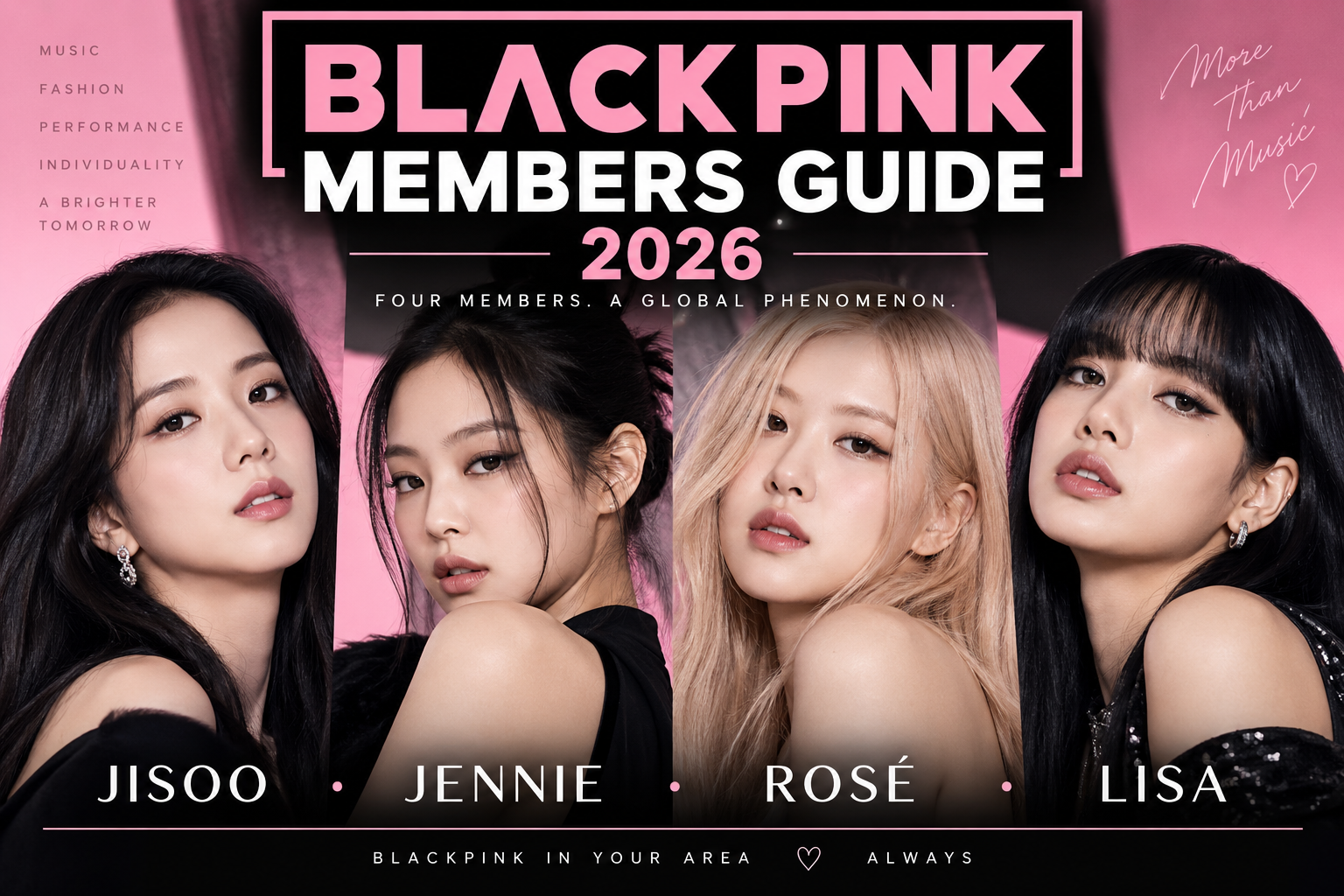
Tag: BLACKPINK Members

  • BLACKPINK Members Guide 2026: Names, Ages, Roles, Solo Careers, and Everything New BLINKs Should Know

    BLACKPINK Members Guide 2026: Names, Ages, Roles, Solo Careers, and Everything New BLINKs Should Know

    Introduction

    BLACKPINK is one of the most influential K-pop groups in the world. Since their debut in 2016, JISOO, JENNIE, ROSÉ, and LISA have grown from YG Entertainment rookies into global stars with successful careers in music, fashion, acting, and entertainment.

    What makes BLACKPINK especially interesting in 2026 is that each member has developed a distinct solo identity while remaining connected to the group. Their individual careers have introduced them to new audiences around the world, while BLACKPINK continues to hold an important place in global K-pop culture.

    In this guide, we’ll introduce all four BLACKPINK members, including their names, ages, roles, nationalities, solo careers, and key facts that new BLINKs should know.

    Whether you have followed BLACKPINK for years or have just discovered their music, this guide is a simple starting point for getting to know JISOO, JENNIE, ROSÉ, and LISA.

    BLACKPINK at a Glance

    BLACKPINK is a four-member South Korean girl group formed by YG Entertainment. The group officially debuted on August 8, 2016, with the single album Square One, featuring “Whistle” and “Boombayah.”

    The four members are JISOO, JENNIE, ROSÉ, and LISA. Unlike many K-pop groups, BLACKPINK does not have an officially designated leader, and each member brings a different combination of vocals, rap, dance, performance, and personality to the group.

    The members also have diverse international backgrounds. JISOO and JENNIE were born in South Korea, ROSÉ was born in New Zealand and raised in Australia, while LISA was born and raised in Thailand.

    Over the years, BLACKPINK expanded far beyond the traditional K-pop market, building a worldwide fanbase known as BLINK and establishing major individual careers alongside their group activities.

    JISOO: Vocalist, Actress, and Solo Artist

    Full name: Kim Jisoo
    Born: January 3, 1995
    Nationality: South Korean

    JISOO is the oldest member of BLACKPINK and is known for her distinctive vocal tone, elegant stage presence, and acting career. She trained under YG Entertainment before debuting with BLACKPINK in 2016.

    Alongside her group activities, JISOO expanded into acting and solo music. She made her solo debut in 2023 with the single album ME, led by the track “FLOWER,” which became one of her signature songs.

    Her career later entered a new phase when she established BLISSOO for her individual activities. She has continued developing both her music and acting careers while remaining a member of BLACKPINK.

    For new BLINKs, JISOO represents an important part of BLACKPINK’s identity: a performer whose career connects K-pop, acting, fashion, and entertainment.

    JENNIE: Rapper, Vocalist, and Global Solo Star

    Full name: Kim Jennie
    Born: January 16, 1996
    Nationality: South Korean

    JENNIE is one of BLACKPINK’s most recognizable members, known for combining rap, vocals, fashion, and a powerful stage presence. Before debuting with BLACKPINK, she spent several years training under YG Entertainment and also lived and studied in New Zealand.

    In 2018, JENNIE became the first BLACKPINK member to officially debut as a solo artist with “SOLO.” The song established her individual identity outside the group and became a major milestone in BLACKPINK’s solo history.

    Her independent career later expanded through ODDATELIER (OA), the company she founded for her individual activities. She has continued developing her own musical direction while participating in BLACKPINK’s group activities.

    JENNIE’s influence also extends well beyond music. Her work in fashion, entertainment, and global brand partnerships has helped make her one of the most internationally visible figures associated with modern K-pop.

    ROSÉ: Vocalist, Songwriter, and International Solo Artist

    Full name: Roseanne Park (Park Chaeyoung)
    Born: February 11, 1997
    Nationality: New Zealand–born Korean artist, raised in Australia

    ROSÉ is widely recognized for her distinctive singing voice and emotional performance style. Born in New Zealand and raised in Australia, she moved to South Korea after successfully auditioning for YG Entertainment in 2012.

    She made her solo debut in 2021 with the single album R, featuring “On the Ground” and “Gone.” Her solo career later entered a major new phase as she pursued individual activities outside YG Entertainment while continuing her BLACKPINK group activities with the company.

    ROSÉ reached an even broader global audience with “APT.,” her collaboration with Bruno Mars. The song became a major international hit and introduced her solo music to listeners far beyond the traditional K-pop audience.

    Her career demonstrates how a BLACKPINK member can maintain a strong connection to the group while developing a distinctive musical identity as an international solo artist.

    LISA: Rapper, Dancer, and Global Solo Performer

    Full name: Lalisa Manobal
    Born: March 27, 1997
    Nationality: Thai

    LISA is BLACKPINK’s Thai member and is especially known for her dance skills, rap performances, and charismatic stage presence. Born and raised in Thailand, she successfully auditioned for YG Entertainment and moved to South Korea to train before BLACKPINK’s debut.

    She launched her solo career in 2021 with the single album LALISA, featuring “LALISA” and “MONEY.” The latter became a major international success and helped expand her audience beyond K-pop.

    LISA later established LLOUD to manage her individual activities and continued expanding into international music, fashion, and entertainment. Her solo career has increasingly positioned her as a global performer with an identity distinct from, but still connected to, BLACKPINK.

    As the only Thai member of BLACKPINK, LISA has also played an important role in the group’s international appeal, particularly across Southeast Asia and the wider global K-pop audience.

    BLACKPINK Members: Ages, Nationalities, and Roles

    BLACKPINK’s four members bring different backgrounds and strengths to the group.

    JISOO — Born January 3, 1995. South Korean. Known primarily for vocals, acting, and her distinctive visual and performance style.

    JENNIE — Born January 16, 1996. South Korean. Known for both rap and vocals, as well as her strong presence in fashion and solo music.

    ROSÉ — Born February 11, 1997. Born in New Zealand and raised in Australia. Known especially for her distinctive vocals, guitar skills, songwriting, and solo music.

    LISA — Born March 27, 1997. Thai. Known especially for dance and rap, as well as her international solo career.

    One detail that often surprises new fans is that BLACKPINK does not have an official leader. Rather than organizing the group around a designated leader, the four members contribute different strengths to BLACKPINK’s identity.

    Frequently Asked Questions About BLACKPINK Members

    Who are the four members of BLACKPINK?
    BLACKPINK consists of JISOO, JENNIE, ROSÉ, and LISA.

    Who is the oldest BLACKPINK member?
    JISOO is the oldest member. She was born on January 3, 1995.

    Who is the youngest BLACKPINK member?
    LISA is the youngest member. She was born on March 27, 1997.

    Does BLACKPINK have a leader?
    No. BLACKPINK does not have an officially designated group leader.

    Which BLACKPINK member is from Thailand?
    LISA was born and raised in Thailand before moving to South Korea to train under YG Entertainment.

    Which BLACKPINK member grew up in Australia?
    ROSÉ was born in New Zealand and raised in Australia before moving to South Korea.

    Do the BLACKPINK members have solo careers?
    Yes. All four members have developed individual careers alongside BLACKPINK, including solo music as well as activities in fashion, acting, and entertainment.

    Final Thoughts

    BLACKPINK’s story is built around four artists with very different backgrounds and individual strengths. JISOO, JENNIE, ROSÉ, and LISA have each developed successful careers beyond the group while remaining central to BLACKPINK’s identity.

    For new BLINKs, learning about each member is one of the best ways to understand why BLACKPINK has become such an influential name in global pop culture. From music and performance to fashion and acting, each member has created a distinctive path of her own.

    As BLACKPINK continues its journey, the combination of four individual careers and their work together as a group remains one of the most fascinating parts of the BLACKPINK story.

  • BLACKPINK: How Four Artists Became Global K-Pop Icons

    BLACKPINK: How Four Artists Became Global K-Pop Icons

    From Seoul to the Global Stage

    BLACKPINK is one of the most recognizable names in modern K-pop. Made up of Jisoo, Jennie, Rosé, and Lisa, the group has grown from a highly anticipated YG Entertainment debut into a global music phenomenon.

    Their story is not simply about hit songs or record-breaking performances. It is also the story of four artists with different backgrounds, personalities, and talents who came together to create a distinctive identity.

    From music and fashion to international tours and solo careers, BLACKPINK has played an important role in expanding the global reach of K-pop.

    How Did BLACKPINK Begin?

    BLACKPINK debuted under YG Entertainment on August 8, 2016.

    Their debut single album, Square One, introduced the songs “Boombayah” and “Whistle.” From the beginning, the group attracted attention for its combination of powerful performances, confident visual style, memorable choreography, and distinctive musical sound.

    The group name BLACKPINK reflects a contrast between two ideas. “Pink” can represent beauty and femininity, while “black” adds strength and confidence. That contrast became an important part of the group’s image.

    Rather than presenting all four members in exactly the same way, BLACKPINK allowed each member to develop a recognizable individual identity.

    Who Are the Four Members of BLACKPINK?

    BLACKPINK consists of four members: Jisoo, Jennie, Rosé, and Lisa.

    Jisoo became known for her distinctive voice, calm presence, visual identity, and later her work as both a solo singer and actress.

    Jennie emerged as a versatile performer who could move between rap and vocals. Her confident stage presence also helped establish her as an influential figure in music and fashion.

    Rosé became especially recognizable for her unique vocal tone and strong connection to music. Born in New Zealand and raised in Australia, she brought an international background to the group.

    Lisa, who was born in Thailand, became widely recognized for her dancing, rap performances, and charismatic stage presence.

    Their differences became one of BLACKPINK’s greatest strengths.

    Why Did BLACKPINK Become So Popular?

    There is no single reason for BLACKPINK’s global success.

    Their music combined elements of K-pop, hip-hop, EDM, and pop with highly polished visual concepts. Songs such as “DDU-DU DDU-DU,” “Kill This Love,” “How You Like That,” and “Pink Venom” helped establish a sound and image that could reach listeners far beyond South Korea.

    Their music videos also played an important role. Bold sets, fashion, choreography, and memorable visual moments made BLACKPINK particularly suited to the global era of YouTube and social media.

    But the four members themselves were equally important.

    Fans were not only following BLACKPINK as a group. They were also developing connections with Jisoo, Jennie, Rosé, and Lisa as individual artists.

    How Did BLACKPINK Help K-Pop Become More Global?

    BLACKPINK arrived at an important moment in the international expansion of K-pop.

    As global audiences became increasingly familiar with Korean music, BLACKPINK helped introduce another powerful image of what a K-pop group could look and sound like.

    Their international collaborations with artists including Dua Lipa, Lady Gaga, Selena Gomez, and Cardi B connected them with audiences who might not previously have followed K-pop.

    Major international performances also expanded their visibility.

    In 2019, BLACKPINK became the first K-pop girl group to perform at Coachella. Their return to the festival as headliners in 2023 demonstrated how dramatically their international position had grown.

    BLACKPINK was no longer simply a Korean group attracting international attention. They had become part of the global pop music landscape.

    BLACKPINK and the Power of Fashion

    BLACKPINK’s influence extends beyond music.

    Each member developed relationships with major global fashion and luxury brands, helping strengthen the connection between K-pop, fashion, beauty, and celebrity culture.

    Their appearances at fashion shows and international campaigns introduced the members to audiences who may not have first encountered them through music.

    This helped demonstrate something important about modern K-pop: an artist’s influence can extend across multiple cultural industries.

    BLACKPINK became not only musicians but also global cultural figures.

    From Group Members to Solo Artists

    Another important chapter in BLACKPINK’s story has been the development of the members’ individual careers.

    Jennie was the first member to make an official solo debut with “SOLO” in 2018.

    Rosé followed with her single album R in 2021, while Lisa released Lalisa later that year. Jisoo made her solo debut with ME in 2023.

    Over time, all four members continued expanding their individual careers in music, acting, fashion, and entertainment.

    Their solo activities reveal something interesting about BLACKPINK’s structure: the members can maintain strong individual identities while still remaining connected to the group that introduced them to a global audience.

    Are BLACKPINK Still Together?

    As the members developed increasingly independent careers, fans naturally began asking what the future would mean for BLACKPINK.

    The group’s career demonstrates that the relationship between group activities and solo careers in K-pop is evolving.

    A successful idol group no longer has to define every part of an artist’s career. Members can build individual musical identities, acting careers, businesses, or fashion partnerships while still sharing an important history and identity as a group.

    For BLACKPINK, this balance between individual growth and group identity has become part of the next chapter of their story.

    What Makes BLACKPINK Different?

    BLACKPINK’s impact comes from more than statistics.

    Jisoo, Jennie, Rosé, and Lisa each bring a different personality, artistic style, and cultural background to the group. Together, those differences created a group that could appeal to audiences across countries and cultures.

    Their rise also represents a larger change in K-pop.

    K-pop artists are no longer limited to being successful within the Korean entertainment industry. They can become global musicians, fashion figures, actors, entrepreneurs, and cultural ambassadors.

    BLACKPINK helped make that possibility more visible.

    Four Artists, One Global Story

    BLACKPINK began with four young artists pursuing their careers within the demanding K-pop training system.

    Years later, Jisoo, Jennie, Rosé, and Lisa have become internationally recognized artists with individual careers of their own.

    Yet the story of BLACKPINK remains the story that connects them.

    Their journey shows how K-pop changed from a primarily regional music industry into a global cultural force—and how four very different artists became some of the most recognizable faces of that transformation.

    As each member continues to build her own path, BLACKPINK’s place in K-pop history continues to evolve.

  • JENNIE of BLACKPINK: From K-Pop Star to Global Solo Icon

    JENNIE of BLACKPINK: From K-Pop Star to Global Solo Icon

    When BLACKPINK debuted in 2016, JENNIE quickly became one of the group’s most recognizable members. Her confident performances, distinctive rap style, vocals, and fashion presence helped create an image that seemed perfectly suited to the new global era of K-pop.

    But JENNIE’s story did not stop with BLACKPINK.

    Over the years, she became the first member of the group to launch a major solo career, expanded her influence into global fashion, established her own company, and began building a musical identity increasingly separate from the group that introduced her to the world.

    Her journey reflects a larger change in K-pop.

    An idol could now be a member of a globally successful group while simultaneously developing an independent career, personal brand, and creative identity.

    This is the story of how Jennie Kim became JENNIE of BLACKPINK—and how she grew from a K-pop star into a global solo artist.

    Before BLACKPINK: Jennie Kim’s Early Years

    Jennie Kim was born on January 16, 1996, in South Korea.

    Part of her childhood was spent in New Zealand, where she studied before eventually returning to Korea.

    That international experience would later seem particularly relevant as BLACKPINK developed into a group with an enormous audience outside South Korea.

    After returning to Korea, Jennie joined YG Entertainment as a trainee in 2010.

    The road to debut was long.

    K-pop trainees can spend years developing vocals, dance, stage presence, language skills, and other aspects of performance without any guarantee that they will eventually debut.

    Jennie trained for approximately six years.

    During that period, she began appearing in projects connected to established YG artists, giving audiences early glimpses of a performer who had not yet officially debuted.

    Then, in 2016, everything changed.

    2016: JENNIE Debuts with BLACKPINK

    BLACKPINK debuted in August 2016 with four members: Jisoo, Jennie, Rosé, and Lisa.

    Their debut releases immediately attracted attention, and the group quickly established an identity built around strong visual concepts, memorable hooks, hip-hop influences, and powerful performances.

    Jennie occupied an interesting position within the group.

    She could rap, sing, and move between different roles depending on the song.

    Her stage image combined confidence and elegance, qualities that would later become closely associated with her individual brand.

    BLACKPINK’s rise also came at an important moment in K-pop history.

    By the mid-to-late 2010s, social media and streaming platforms were making it increasingly possible for Korean artists to reach international audiences without relying entirely on traditional Western media.

    BLACKPINK became one of the groups that demonstrated just how large that audience could become.

    And Jennie would soon become the first member to test what that global attention might mean for a solo career.

    2018: “SOLO” Changes the Story

    In November 2018, Jennie released her debut solo single, “SOLO.”

    The title was simple, but historically it represented an important moment in BLACKPINK’s story.

    Jennie became the first BLACKPINK member to make an official solo debut.

    “SOLO” allowed her to present herself outside the four-member structure of the group.

    The song combined pop and hip-hop elements while emphasizing independence and self-confidence—qualities already associated with Jennie’s public image.

    Its success demonstrated something important.

    Fans were not interested only in BLACKPINK as a collective.

    Individual members could also command enormous audiences under their own names.

    That model would later become increasingly important as other BLACKPINK members developed their own solo projects.

    For Jennie, however, “SOLO” was only the beginning.

    The Rise of a Global Fashion Icon

    Music was only one part of Jennie’s expanding influence.

    As BLACKPINK became increasingly visible internationally, Jennie also emerged as a major figure in global fashion.

    Her relationship with luxury fashion—particularly Chanel—helped make her a familiar presence at international fashion events.

    Fans sometimes referred to her as “Human Chanel,” reflecting how closely her public image became associated with the brand.

    But the significance went beyond a celebrity wearing luxury clothes.

    K-pop idols were becoming increasingly important to the global fashion industry.

    Major fashion houses recognized that Korean artists could attract enormous digital attention, influence consumer trends, and connect brands with younger international audiences.

    Jennie became one of the clearest examples of this transformation.

    The boundaries between K-pop, fashion, advertising, and global celebrity culture were becoming increasingly difficult to separate.

    JENNIE and the Expansion of BLACKPINK

    During the late 2010s and early 2020s, BLACKPINK continued expanding internationally.

    The group performed at major festivals, collaborated with internationally recognized artists, toured around the world, and became one of the most visible K-pop acts of their generation.

    Jennie’s individual fame grew alongside the group.

    This created an interesting balance.

    She was still JENNIE of BLACKPINK, but “Jennie” was also becoming a globally recognizable identity in its own right.

    Her fashion appearances, solo music, magazine covers, performances, and collaborations meant that audiences could encounter her in many different contexts.

    This was becoming a new model for K-pop stardom.

    An artist did not necessarily have to choose between being a group member and an individual celebrity.

    Both identities could grow simultaneously.

    Beyond Music: Entering a New Entertainment World

    Jennie’s activities eventually expanded beyond music and fashion.

    In 2023, she appeared in the HBO series The Idol, credited under the name Jennie Ruby Jane.

    The role introduced her to another area of the international entertainment industry.

    The series itself generated considerable debate and mixed reactions, but Jennie’s participation remained significant in terms of career expansion.

    A member of one of Korea’s biggest girl groups was now appearing in an American television production alongside international performers.

    It illustrated how much the boundaries surrounding K-pop artists had changed.

    The global idol was no longer confined to Korean music programs, concerts, or variety shows.

    K-pop stars were increasingly moving across industries and countries.

    2023: ODD ATELIER and a Major Turning Point

    One of the most important developments in Jennie’s career came in late 2023 when she announced the establishment of her own company, ODD ATELIER, also known as OA.

    The decision represented a major shift.

    Rather than relying entirely on the management structure that had shaped her career since her trainee years, Jennie now had a company dedicated to her individual activities.

    At the same time, BLACKPINK remained together for group activities.

    This arrangement reflected a broader evolution in the K-pop industry.

    Artists who had spent years building their careers within major entertainment companies were increasingly exploring ways to gain greater control over their individual work.

    For Jennie, ODD ATELIER created the foundation for the next stage of her solo career.

    She was no longer simply waiting for opportunities to be created around her.

    She was building the structure through which those opportunities could develop.

    “Mantra”: JENNIE Begins Again

    In October 2024, Jennie released “Mantra.”

    The song marked an important new beginning for her solo music.

    Six years had passed since “SOLO.”

    During that time, Jennie had changed dramatically as an artist and public figure.

    BLACKPINK had become a global powerhouse. Her fashion influence had expanded. She had entered acting and established her own company.

    “Mantra” therefore arrived in a completely different context from her first solo single.

    This was no longer simply the first solo experiment of a BLACKPINK member.

    It was music from an artist intentionally building the next phase of her career.

    The confident energy associated with Jennie remained, but the scale of her individual ambitions had become much larger.

    2025: Ruby and JENNIE’s Solo Identity

    In March 2025, Jennie released her first full-length solo studio album, Ruby.

    The album represented one of the clearest statements of independence in her career.

    A single can introduce an artist.

    A full album must build a larger musical world.

    With Ruby, Jennie had the opportunity to show different aspects of her voice and musical personality across a complete project rather than through one isolated song.

    The project also featured collaborations with internationally known artists, reflecting the increasingly global environment in which her solo career existed.

    By this point, the phrase “JENNIE of BLACKPINK” remained important—but it no longer told the whole story.

    She was developing a discography, creative structure, and audience around JENNIE as an individual artist.

    Group Member and Solo Artist at the Same Time

    Jennie’s career raises an important question about modern K-pop:

    What happens when the individual identity of an idol becomes almost as powerful as the group identity?

    In earlier eras of K-pop, leaving or stepping outside an agency structure could sometimes create uncertainty about a group’s future.

    BLACKPINK’s situation demonstrated another possibility.

    Members could pursue individual careers through different management arrangements while still maintaining a group identity.

    For Jennie, this means that BLACKPINK and her solo career do not necessarily have to compete with each other.

    One represents the history she built with Jisoo, Rosé, and Lisa.

    The other gives her room to discover what she wants to create under her own name.

    The two stories can exist together.

    Why JENNIE’s Journey Matters in K-Pop History

    Jennie’s career reflects several major changes in the K-pop industry.

    She represents the generation that benefited from K-pop’s enormous international expansion while also helping accelerate it.

    She demonstrated the commercial potential of individual BLACKPINK members through “SOLO.”

    Her fashion career showed how K-pop idols could become major players in the global luxury industry.

    Her establishment of ODD ATELIER reflected the growing desire of established artists to exercise greater control over individual careers.

    And Ruby demonstrated how a performer known primarily through a group could gradually build a larger musical identity of her own.

    None of these developments happened in isolation.

    They are part of a broader transformation in what it means to be a K-pop idol.

    Today, the most successful artists can move between music, fashion, business, acting, global collaborations, and personal creative projects.

    Jennie is one of the artists helping define that model.

    From K-Pop Star to Global Solo Icon

    When Jennie debuted with BLACKPINK in 2016, few people could have known exactly how far her career would expand.

    She began as one of four members of a new YG girl group.

    Then came global success with BLACKPINK.

    “SOLO” introduced Jennie as an individual performer.

    Fashion transformed her into an international style figure.

    ODD ATELIER gave her greater control over her personal career.

    “Mantra” opened another musical chapter.

    And Ruby established the foundation of a much larger solo discography.

    Yet this story is not about Jennie leaving BLACKPINK behind.

    It is about expansion.

    BLACKPINK gave Jennie a global stage.

    Over time, she began building another stage of her own.

    And that evolution may ultimately be one of the most important stories of her career.

    From BLACKPINK member to solo artist, fashion icon, and independent creative force, JENNIE’s journey shows how dramatically the possibilities of K-pop stardom have changed.